
Bot followers are not just a vanity-metric problem anymore. In 2026, they create operational damage. They make your engagement rate look weak, they poison creator vetting, they distort campaign reporting, and they can quietly push your account out of recommendation systems that now care much more about authentic interaction than raw audience size. That shift is visible in the official language. Instagram still tells users not to artificially collect likes, followers, or shares. TikTok explicitly bans fake engagement services and says it may remove fake followers or likes, restrict accounts, or ban them outright. X says “free followers” apps can compromise accounts, force spammy actions, and get you suspended. And in the US, the FTC’s fake-reviews rule now covers fake indicators of social media influence such as followers or views generated by bots or hijacked accounts when they are used commercially to misrepresent influence.[1][5][8][9]
That is why the old “who cares, it is just social proof” argument does not survive contact with real platform behavior anymore. Recommendation engines are harder on manipulative behavior. Brand teams are more likely to screen creators with audience-quality tools before signing deals. Platforms are also spending more on anti-scam and anti-impersonation enforcement. Meta said in March 2026 that it removed over 10.9 مليون حسابات على فيسبوك وإنستغرام مرتبطة بمراكز الاحتيال الإجرامية في عام 2025، وأفادت بشكل منفصل أنها أزالت أكثر من 20 مليون حساب ينتحل شخصية منشئي محتوى كبار في عام 2025 بينما تشدد توزيع المحتوى الأصلي على فيسبوك.[20][21]
إذا كانت مشكلتك الفورية لا تزال تتعلق بباعة المتابعين على فيسبوك أو صفحات الإعجاب التلقائي، استخدم تفصيل المتابعين الخاص بنا على فيسبوك بعد ذلك. هذه المقالة تخدم وظيفة مختلفة. إنها النسخة متعددة المنصات للمسوقين، والمبدعين، والوكالات، والمشغلين الذين يتعاملون مع إنستغرام، وتيك توك، وX، حيث تتصادم تضخيم الجمهور المزيف الآن مع تجارة المبدعين، وأنظمة التوصيات، وعمليات التدقيق.
لقد قمت بالتحقق من صفحات السياسات الرسمية، وصفحات تسعير الأدوات العامة، وصفحة تسعير MessengerBot الحالية على 12 أبريل 2026. تحقق واقعي مفيد قبل أن ندخل في التكتيكات: تقرير HypeAuditor حول حالة التسويق عبر المؤثرين لعام 2025 يقول إن تقريره حلل 76 مليون إنستغرام حساب و 104 million TikTok accounts, and it still puts Instagram above 2.11 billion monthly active users and TikTok above 1.6 billion. In other words, the platforms are too large, too commercial, and too saturated with money to treat fake followers like a harmless edge case.[11]
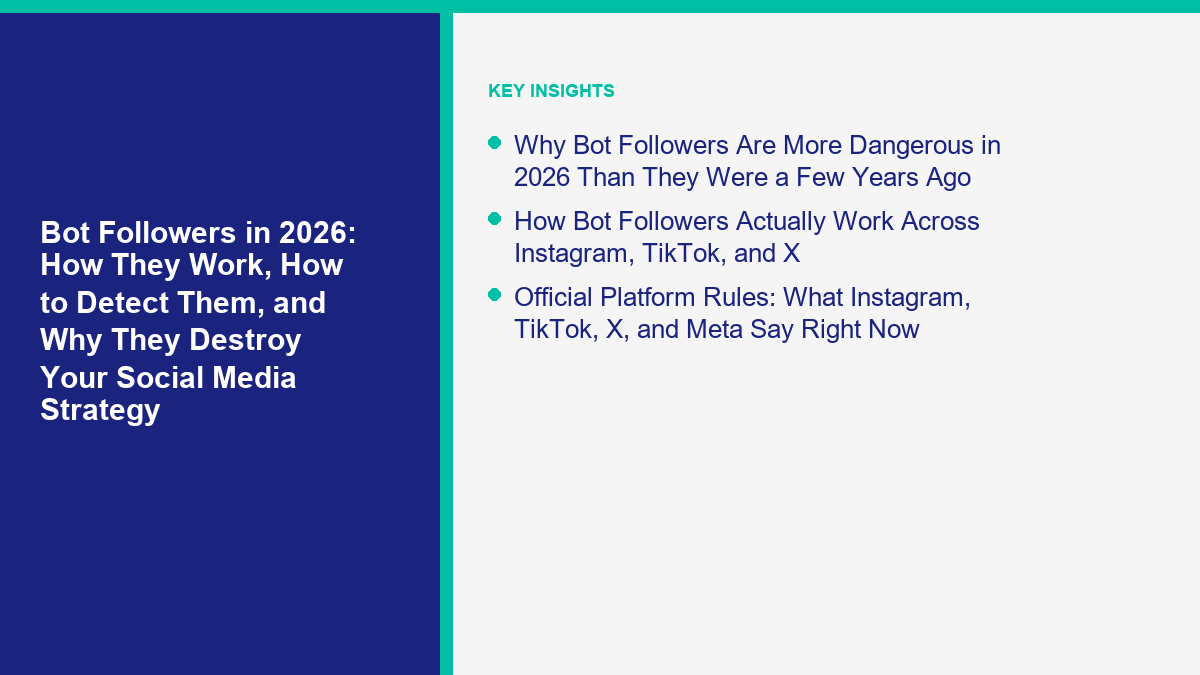
Why Bot Followers Are More Dangerous in 2026 Than They Were a Few Years Ago
The basic mechanics of fake followers have not changed much. What changed is the environment around them. Social teams now use creator analytics before partnership approvals. Platforms are leaning harder on recommendation eligibility and authenticity signals. Regulators are also clearer about what counts as deceptive social proof in a commercial setting. That means the same fake audience package that once looked like a cheap shortcut now creates more downstream friction.
The first reason is distribution. Recommendation systems care less about the absolute follower count and more about whether new content gets believable interaction from the audience it already has. If a creator with 80,000 followers repeatedly posts content that gets weak watch time, thin comment quality, and almost no secondary actions, the follower count stops helping and starts asking questions. Instagram’s recommendation guidance says public accounts can lose recommendation eligibility if their content or profile goes against recommendation rules, and Instagram’s public recommendations guidance also says it tries not to recommend accounts that repeatedly engage in misleading practices to build followings, such as purchasing likes.[3][4]
The second reason is economics. Bot followers do not usually fail because the number never moves. They fail because the number moves without creating anything else: no real reach, no qualified clicks, no repeat viewers, no messages, no sales, no audience memory. The account looks larger, but the operating system under it gets weaker. That hurts twice. First, your content looks underperforming to real humans. Second, your own reporting gets harder to trust because the denominator is fake.
The third reason is risk concentration. In 2026, a follower problem is rarely just a follower problem. The same sellers that offer fake followers often sit adjacent to fake views, fake reviews, spammy DM tools, hijacked accounts, and extension-based automation. That is one reason the FTC’s rule matters so much. Its guidance makes clear that “fake indicators of social media influence” can include followers generated by bots, accounts not associated with a real individual, accounts created with someone’s personal information without consent, or hijacked accounts. That is not harmless growth hacking. That is a fraud definition.[9][10]
| What you buy | What it looks like on day one | What it usually looks like two weeks later | Why it hurts strategy |
|---|---|---|---|
| Cheap follower package | Fast spike in follower count | Flat comments, weak reach, suspicious ratios | Turns your profile into a credibility problem |
| Exchange-network followers | Real-looking but low-intent accounts | Poor retention and weak repeat engagement | Pollutes your audience with people who never cared |
| Automation-based follower growth | Short-term velocity | Feature restrictions, checkpoints, or cleanup losses | Adds account-security risk to audience-quality risk |
| Fake engagement layered on fake followers | Temporarily smoother ratios | Pattern breaks show up in view depth and comments | Makes audits easier to fail, not harder |
If you came here specifically looking for bot followers instagram checks, this is the key mindset change: stop asking whether the count can be inflated and start asking whether the account still behaves like a real audience system after the spike. That is the only question that matters once a platform begins making recommendation and monetization decisions from authenticity signals instead of vanity numbers.
How Bot Followers Actually Work Across Instagram, TikTok, and X
Most people imagine one giant bot farm with endless fake profiles. The 2026 reality is messier. Follower inflation usually comes from a mix of inventory sources, not one clean pool. Some sellers use mass-created low-quality accounts. Some blend in dormant or recycled accounts. Some rely on hacked or hijacked profiles. Some use exchange systems with real people doing low-value actions for credits. Some now pad the mix with AI-generated personas that look more convincing on the surface, especially on X where the authenticity policy now explicitly calls out fake personas that use stock, stolen, or AI-generated profile photos and misleading bios.[7][10]
The Cheapest Layer Is Still Inventory, Not Influence
Cheap follower sellers do not sell trust. They sell inventory. That inventory can be bots, ghost accounts, compromised accounts, or people who only followed because they were rewarded somewhere else. This matters because none of those sources create the thing social teams actually need, which is future attention. You are not buying tomorrow’s audience. You are buying today’s screenshot.
Instagram makes that distinction clearer than most platforms. Its Help Center says that if likes, follows, or comments came from accounts generating inauthentic activity, Instagram may remove that activity. That means the number you bought is not even stable as a number, let alone useful as an audience asset.[2]
Exchange Networks Create the Most Common “Looks Real, Performs Fake” Pattern
A lot of suspicious audiences are not obviously robotic. They are exchange-driven. The account names look human enough. The profile pictures are not all empty. Some of them may even be real people. But they followed for credits, reciprocity, or some small off-platform incentive, not because they expect future value from the account. That is why this audience type can fool lazy audits but still crush performance over time.
You see it in the ratios. Likes may look less absurd than with obvious bots, but video depth, saves, profile taps, replies, and click-through behavior stay weak. Comment quality also feels generic. The audience can inflate surface metrics while starving the deeper ones.
Automation Adds a Second Risk Layer: Security and Enforcement
Once a seller relies on browser automation, extension verification, session tokens, or scripted interactions, you are no longer only talking about fake followers. You are talking about account operations. X’s own warning about “free followers” apps is unusually blunt here. It says those apps can compromise the account, post spammy URLs, aggressively follow other accounts, add fake or compromised followers, force extra app authentication, and push the account into enough blocks that it becomes suspended.[8]
TikTok is just as clear from the policy side. Its current guidelines say it does not allow services that artificially boost engagement or trick the recommendation system. The updated integrity rules also say deceptive account behavior can lead to bans, bans on additional accounts, or restrictions that limit the ability to post, appear in top search results, or appear in the For You feed.[5][6]
Bot Followers Are Usually Bundled With Fake Signals You Did Not Order
This is the part too many brands miss. A follower seller may deliver more than followers. To make the spike look believable, they sometimes attach weak likes, shallow comments, short-lived views, or even weird referral traffic. That creates a false sense of validation in week one and a strange analytics mess in week two. If you only watch the follower line, you miss the damage showing up everywhere else.
That is also why cleanup takes longer than most buyers expect. You are not undoing one number. You are undoing a contaminated audience mix and re-teaching the profile to speak to actual people again.
Official Platform Rules: What Instagram, TikTok, X, and Meta Say Right Now
You do not need rumor threads to understand the risk line anymore. The main platforms spell out the integrity issue clearly enough that this should be a policy question before it becomes a growth question. The wording differs, but the pattern is the same: fake follower acquisition is treated as spam, manipulation, deception, or recommendation abuse.
| المنصة | Current policy signal | What can happen | النقاط العملية |
|---|---|---|---|
| إنستغرام | Community Guidelines prohibit artificially collecting likes, followers, or shares | Activity removal, recommendation loss, deleted content, account restrictions, or disabled accounts | Fake audience can cost reach even if the account survives |
| TikTok | Guidelines prohibit fake engagement, manipulation, bulk automation, and buying or selling followers | Removal of fake followers or likes, FYF ineligibility, restrictions, account bans, and bans on linked accounts | TikTok treats follower inflation as a recommendation-system problem |
| X | Authenticity rules prohibit inauthentic accounts, unauthorized automation, and fake personas | Suspension, blocks, spam behavior, compromised account risk, and enforcement for misleading identities | Cheap “free followers” apps are explicitly flagged as risky by the platform |
| Meta/Facebook | Recommendation guidance says entities that repeatedly use misleading practices to build followings may not be widely recommended | Lower recommendation eligibility, Page limits, disabled Like button, feature limits, or unpublished Pages | Even if you care about Instagram more than Facebook, Meta’s cross-app integrity posture matters |
Instagram is still the cleanest place to start because the language is direct. The Community Guidelines tell users not to artificially collect likes, followers, or shares. Instagram’s recommendations guidance also says accounts that repeatedly engage in misleading practices to build followings, such as purchasing likes, may not be recommended. And if you see a sudden dip in follower count after using third-party growth services, Instagram’s help pages say that may be because some of those follows came from accounts generating inauthentic activity and were removed.[1][4][2]
TikTok is more explicit about recommendation-system abuse. Its integrity rules say authentic engagement informs recommendations, and it does not allow the trade or marketing of services that artificially increase engagement or deceive TikTok’s recommendation system. The current guidelines also say TikTok may ban the account, ban additional or new accounts, or restrict the account from posting, ranking in search, or reaching the For You feed when deceptive account behavior is found.[5]
X is the platform where marketers sometimes get sloppy because the follower economy there has been noisy for years. That is a mistake. X’s April 2025 authenticity policy says accounts must be genuine and transparent as to source, identity, and popularity. It specifically calls out fake personas and unauthorized automation. Its help page on free followers apps goes further and says those apps can cause compromised accounts, forced spam behavior, fake or compromised followers, and suspension. That is not ambiguous.[7][8]
There is also a commercial-risk layer above platform policy now. The FTC’s final rule says fake indicators of social media influence, including followers or views generated by a bot or hijacked account, can trigger enforcement when sold or bought to misrepresent influence for a commercial purpose. If you run brand deals, pitch sponsorships, report campaign reach, or represent your social footprint in a sales process, that matters.[9][10]
The Metrics That Expose Fake Followers Faster Than the Follower Count
Bad audits obsess over the visible number. Good audits look for contradictions. Fake followers are easiest to spot when one metric says “large account” and three others say “nobody is home.” That contradiction shows up across formats, not just in likes.
Follower-to-View and Follower-to-Reach Mismatch
The most common red flag is not low likes. It is a deep mismatch between audience size and actual content consumption. A creator can have 100,000 followers and still get a weak post now and then. That is normal. What is not normal is a pattern where the account repeatedly produces tiny view depth relative to its follower base while claiming the audience is highly active.
On Instagram, that usually shows up in Reels views, saves, shares, and Story replies. On TikTok, it shows up in watch depth, shares, and the quality of comment threads. On X, it shows up in the gap between follower count and any believable level of replies, reposts, bookmarks, or discussion gravity.
Comment Quality That Looks Generated, Generic, or Geographically Wrong
Low comment count alone does not prove fake followers. Low-quality comments across multiple posts are more useful. Watch for comments that look copied, context-free, or linguistically disconnected from the content and audience. If a local dentist in Chicago suddenly gets a run of vague praise from profiles with no local logic, that matters. If a B2B SaaS account attracts comments that look like lifestyle engagement filler, that matters too.
HypeAuditor’s reporting language is useful here because it treats audience quality, comment authenticity, and engagement authenticity as separate signals rather than one big blended vanity score. That is the correct way to think about the problem. Fake followers rarely fail only one test.[14]
Growth Curves That Spike Without a Content or PR Reason
A growth spike is not suspicious by itself. A growth spike with no corresponding reason usually is. The clean questions are simple:
- Did the account have a viral post, media mention, collaboration, giveaway, or campaign that explains the jump?
- Did views, mentions, profile visits, or search demand move with the follower count?
- Did the growth sustain into later content, or did the account immediately go back to baseline behavior?
If the answers are no, no, and no, you are probably looking at purchased or manipulated growth. This is one reason Social Blade remains useful even though it is not a dedicated fraud-detection platform. It is cheap, easy, and good at making suspicious follower curves visible over time.[16]
Audience Geography and Identity Signals That Do Not Match the Account
An audience mismatch is often more revealing than engagement rate. If an account is supposed to serve US real-estate buyers, but its visible follower quality and interaction hints suggest unrelated regions and no real buyer behavior, you do not need a giant machine-learning model to know something is off.
Instagram gives you one of the simplest manual checks for this through About this account. Meta says that screen can show date joined, former username count, and in some cases the country where the account is based. That is useful for suspicious followers, suspicious sellers, and suspicious creator accounts because it helps you see whether the identity trail even makes sense.[12]
Conversion Gaps That Keep Getting Explained Away
The final giveaway is commercial. If a creator has a huge stated audience and still cannot drive believable clicks, replies, leads, or sales over time, do not keep inventing narrative excuses for them. Either the audience is weak, the content fit is poor, or the audience was inflated. None of those are acceptable if you are paying for influence.
This is exactly why follower count is now a weak buying metric. HypeAuditor’s 2025 platform report still shows that nano-influencers dominate on Instagram and TikTok and often deliver the strongest engagement rates relative to size. Bigger is not safer. Better matched is safer.[11]
A 30-Minute Bot Followers Detection Workflow You Can Run Today
The cleanest bot followers detection process is not complicated. It just needs to be disciplined. Here is the workflow I use when I need a fast audit on a creator account, brand profile, or suspicious competitor profile.
Start With the Last 15 to 20 Posts, Not the Profile Header
Ignore the top-line follower number for the first five minutes. Open the recent content and look for pattern consistency instead:
- Check the spread. Are views and interactions clustered in a believable range, or do they jump randomly with no explanation?
- Check the comments. Do they reference the actual content, or do they read like filler?
- Check the ratio shifts by format. Reels, TikToks, and short posts should not all fail in exactly the same lifeless way if the audience is real.
- Check the dates. Was there a recent spike followed by an immediate return to weak engagement?
This first pass catches more fake-following problems than most tool dashboards because the human eye is good at spotting repeated weirdness quickly.
Compare Growth to a Real Trigger
Now ask whether the growth curve has a visible reason. A creator collaboration, product launch, media hit, or viral clip can justify a spike. If there is no visible reason, you need to treat the spike as suspect until proven otherwise. Tools like Social Blade help here because the time-series view is fast, but you can also do it manually by reviewing post history and public mentions.[16]
Run One Manual Identity Check
On Instagram, use About this account to inspect join date, former username count, and account location when available. This is especially good at catching profiles that were renamed, repurposed, or made to look more established than they are. It is also a useful way to sanity-check sellers, affiliates, and “growth experts” who promise a lot but have a thin identity trail themselves.[12]
Check Whether the Audience Behaves Like Buyers or Just Bystanders
This is where most brand teams get lazy. They stop once they decide the account is “probably real enough.” That is not the right threshold. You need to know whether the audience behaves like people who would actually click, reply, or buy.
Practical checks:
- Do comment threads lead to real discussion?
- Do stories, CTAs, or link pushes produce visible response behavior?
- Do followers show signs of category fit, not just existence?
- Does the audience quality line up with the offer being sold?
If the creator wants sponsorship money but cannot create visible buying intent, the follower base may be real, fake, or just badly matched. In all three cases, the buying decision should get stricter.
Use a Tool Only After the Manual Pass
Tooling works best when you already know what question you are asking. If you start with a tool, you can get hypnotized by a nice-looking score. If you start with the content and behavior, the tool becomes a way to verify or challenge your first read.
That is also the right moment to move from surface checking into process. If you are building a serious inbound system around real comments, DMs, and lead capture instead of fake audience inflation, تصفح دوراتنا التدريبية before you scale. The operational problem after a clean audience spike is usually response speed, not reach.
The 30-Minute Checklist
- Minutes 1 to 5: scan the last 15 to 20 posts for ratio consistency and comment quality.
- Minutes 6 to 10: inspect growth spikes and ask whether a visible event explains them.
- Minutes 11 to 15: run the Instagram About this account check or equivalent identity check.
- Minutes 16 to 20: audit CTA behavior, reply quality, and audience fit.
- Minutes 21 to 30: verify the manual read with one or two paid or free analytics tools.
That process is fast enough for agencies, brand teams, and creators doing self-audits. It is also much more reliable than any single “fake followers percentage” widget used in isolation.
Bot Followers Detection Tools Compared: What You Get for Free and Paid
No tool solves this by itself. The good tools do one of four jobs: they score audience quality, expose suspicious growth curves, map the audience around an account, or help you compare creators at scale. The most useful stack is usually one scoring tool, one trend tool, and one audience-research tool.
| أداة | Current public price | أفضل لـ | What it gives you | القيود الرئيسية |
|---|---|---|---|---|
| HypeAuditor | Free checker available; basic plan starts at $299/month billed annually | Audience-quality scoring and fraud screening | Audience Quality Score, comment authenticity, suspicious growth, engagement authenticity | Cost rises fast once you need more team usage |
| Modash | $299/month monthly or $199/month billed yearly for Essentials | Brand and agency creator vetting at scale | 350M+ creator database across Instagram, TikTok, and YouTube, plus profile analysis and tracking | Not positioned as a cheap one-off audit tool |
| Social Blade | Bronze $4.50/month, Silver $12.50/month, Gold $50/month | Fast anomaly checks and historical trend review | Follower and content trend visibility at very low cost | No deep audience-authenticity scoring |
| SparkToro | Free tier, Personal $50/month, Business $150/month, Agency $300/month | Audience research and overlap validation | Social accounts, websites, search behavior, and audience-source patterns | It validates fit better than it detects bots directly |
HypeAuditor is still one of the strongest dedicated fraud-analysis options in this category because its product language is built around authenticity checks. Its public reporting pages say the fraud model uses more than 53 patterns to detect low-quality followers and combines audience credibility, engagement authenticity, and growth signals into audience quality scoring. For teams screening creators before money changes hands, that is useful.[13][14]
Modash is better when you need operating scale more than a one-off fraud number. Its public pricing says Essentials is $299 monthly أو $199 per month billed yearly, and it gives access to 350M+ creators across Instagram, TikTok, and YouTube. That makes it more suitable for active brand or agency programs where creator discovery and ongoing vetting matter together.[15]
Social Blade remains useful because it is cheap and honest about what it is. It will not tell you who is fake with a clean lab-style verdict, but it will help you spot the kind of historical movement that fake follower injections often leave behind. For many small teams, that is still worth the low monthly cost.[16]
SparkToro deserves a place in the stack because fake-audience problems are often audience-fit problems in disguise. Its free tier gives five reports per month, Personal starts at $50/شهر, وبيزنس عند $150/month. I would not use it as a fake-follower detector. I would use it to answer the harder question: does this account’s visible audience ecosystem actually resemble the market it claims to reach?[17]
The practical buying rule is simple. If you audit creators constantly, pay for a serious analytics tool. If you only need quick suspicion checks, start with Social Blade plus a free HypeAuditor pass. If the real problem is that your own brand account has decent reach but no workflow for converting real comments and DMs into leads, that is not a detection-tool purchase at all. It is an operations purchase, which is why it helps to عرض تسعير MessengerBot only after you decide the audience you are working with is real.
What Bot Followers Do to Reach, Brand Deals, and Customer Trust
Fake followers do not stay hidden in analytics. They leak into business decisions. A brand overpays for a creator because the top-line audience looks strong. A creator wonders why “big enough” posts still do not travel. A founder keeps doubling down on the wrong platform because the account looks healthier than it is. The damage is strategic because the team begins making planning choices from poisoned input.
The first leak is content planning. If the account believes it has 50,000 engaged followers, it will interpret mediocre post performance differently than if it knows 20% or 30% of the audience is dead weight. That leads to wrong creative conclusions. The team blames the hook, the topic, or the editor when the deeper problem is audience quality.
The second leak is sales. Buyers, sponsors, and clients increasingly run audits. If the account looks inflated, every number after that gets discounted. The sponsor offers less, asks for more proof, or walks away. The creator then tries to compensate with more vanity inflation, which makes the cycle worse.
The third leak is reputation. Humans are much better at smelling fake popularity than a lot of operators admit. A profile with huge follower count and dead comment sections feels off immediately. Even people who cannot name the analytics problem still read it as low trust.
That matters even more for agencies and consultants. If your service includes helping clients grow channels or qualify creators, a fake-audience miss damages your credibility fast. If you already build client automation stacks around real inbound traffic, there is a straightforward business upside too: once your cleanup and conversion system is working, you can انضم إلى برنامج الشركاء الخاص بنا and turn those implementations into a cleaner recurring referral stream than any fake-growth service could ever offer.
How to Clean Up an Account After Buying Fake Followers
The cleanup playbook is less glamorous than the buying pitch, but it works. The goal is not to “look normal” tomorrow. The goal is to remove the risky inputs, secure the account, and rebuild enough real audience behavior that the platform sees the profile as worth distributing again.
Stop Feeding the Source First
This sounds obvious, but a lot of teams sabotage cleanup by continuing small purchases “just to stabilize the number.” That keeps the contamination alive. Stop the seller, stop the exchange, stop the automation, and stop any vendor who cannot clearly explain how followers are acquired.
Reset Security Before You Chase Engagement
If you used a service that touched the account, do a security pass immediately. X explicitly warns that free-follower apps can compromise accounts and force additional app authentication. Facebook’s own help pages also warn against apps or websites that offer free likes and followers and say shared login details can put the account and friend network at risk. Do the boring work first: password change, two-factor review, app audit, admin audit, extension audit.[8][18]
Let the Number Shrink if It Needs to Shrink
Most operators hate this step because it feels like losing status. Ignore that instinct. A smaller real audience is better than a larger fake one. Instagram already removes inauthentic activity when it finds it. Fighting to keep the dead weight is the wrong battle.[2]
Rebuild Around Repeatable Audience Actions
Your first 30 days after cleanup should focus on signals that fake followers do not create well:
- Replies that reference the actual content
- Saves and shares on useful posts
- DM replies from real people
- Click-through behavior from high-intent posts
- Comments that turn into conversations instead of filler
That is the part where most accounts realize the real issue was never “not enough followers.” It was “no reliable system for capturing and handling real interest.”
Authentic Growth Alternatives That Survive 2026 Recommendation Systems
If fake followers are the shortcut, the replacement is not “be patient and hope.” The replacement is a system that creates real audience memory and handles the attention properly once it shows up. The good news is that platforms are increasingly aligned on what they reward: original content, authentic interaction, and useful follow-up.
Meta’s March 2026 update on original creators is one of the clearest signals here. It says views and time spent watching original Reels on Facebook approximately doubled in the second half of 2025 compared with the same period in 2024, while Meta also reduced the reach of unoriginal content and removed more than 20 million impersonation accounts targeting large creators. That is a platform telling you what kind of inventory it wants more of: original, real, attributable content.[21]
Original Short-Form Content Still Beats Synthetic Audience Inflation
This is still the cleanest trade in social media. A strong short-form content sprint may be slower than buying followers, but it creates compounding assets: audience memory, repeat viewers, saved content, replies, and data you can actually use. Fake followers create none of those things.
Warm Distribution Beats Cold Audience Rental
Email lists, customer lists, owned communities, website traffic, loyal cross-platform followers, and partner collaborations are still far more durable than bought audience inventory. Warm traffic behaves better because it arrives with context. It knows who you are and why it should care.
Comment-to-DM and DM-to-Site Flows Beat Empty Reach
This is where real growth gets practical. When a person comments on a post, replies to a Story, or taps a link from a Reel, you need a path that turns that moment into a real conversation while the intent is fresh. That is a much higher-value system than buying followers and then wondering why nothing compounds.
MessengerBot is useful in that exact layer because it solves the response-speed problem after you earn real attention. The public pricing page still lists أدوات الدردشة, دردشة الموقع, روبوت الدردشة على إنستغرام, and Instagram comment-reply tooling, with Premium at $19.99/30 يومًا, وبرو عند $49.99/30 يومًا, and Agency at $299.99/30 يومًا as checked on April 12, 2026.[19]
That matters because the cleaner alternative to fake followers is not just “post better.” It is “post better, then catch the real replies before they go cold.” If your team outgrows a starter setup because you need more pages, sites, or operational headroom, Upgrade to MessengerBot Pro after you have evidence that the audience is real and the workflow is paying off.
Build Real Audience Signals, Then Automate the Follow-Up
The useful pattern in 2026 is not bigger fake numbers. It is stronger original content, cleaner creator vetting, faster response to real comments and DMs, and better handoff into site chat or lead capture. Start with تصفح دوراتنا التدريبية if you need the operational blueprint, then عرض تسعير MessengerBot when you are ready to turn real engagement into a system instead of renting fake social proof.
الأسئلة الشائعة
ما هم المتابعون الآليّون بلغة بسيطة؟
المتابعون الآليون هم متابعون لا يمثلون اهتمامًا حقيقيًا وطوعيًا من الجمهور. يمكن أن يأتوا من الروبوتات، أو الشخصيات المزيفة، أو الحسابات المخترقة، أو الحسابات ذات الجودة المنخفضة المعاد تدويرها، أو أنظمة التبادل حيث يتابع الناس فقط لأنهم حصلوا على مكافأة. المشكلة الرئيسية ليست فقط أنهم مزيفون. بل إنهم يسيئون تمثيل التأثير ونادرًا ما ينتجون وصولًا حقيقيًا، أو ردودًا، أو نقرات، أو مبيعات.
هل يمكن لإنستغرام إزالة المتابعين المزيفين أو الروبوتات من حساب؟
Yes. Instagram’s Help Center says that if your likes, follows, or comments came from accounts generating inauthentic activity, some of that activity may be removed. That is why purchased follower spikes often shrink later and why fake-growth services cannot honestly promise a stable long-term audience.
ما هي أسرع طريقة لاكتشاف المتابعين المزيفين على تيك توك أو إكس؟
أسرع طريقة موثوقة هي الفحص الهجين: مراجعة آخر 15 إلى 20 منشورًا للعمق الضعيف في المشاهدة والتعليقات العامة، فحص أي ارتفاع مفاجئ في عدد المتابعين بحثًا عن سبب حقيقي، ثم التحقق من النمط باستخدام أداة الاتجاه أو جودة الجمهور. على تيك توك، راقب سلوكًا ضعيفًا على نمط "من أجلك" بالنسبة لحجم المتابعين. على إكس، راقب الأعداد الكبيرة من المتابعين المقترنة بعدم وجود ردود أو إعادة نشر موثوقة تقريبًا.
هل المتابعون المزيفون غير قانونيين أم أنهم فقط ضد قواعد المنصة؟
They are clearly against platform rules on the major networks discussed here. In commercial contexts, they can also create regulatory risk. The FTC’s fake-reviews rule now covers fake indicators of social media influence, such as followers or views generated by bots or hijacked accounts, when they are sold or bought to misrepresent influence for a commercial purpose.
هل يجب أن أزيل المتابعين المشبوهين أم أكتفي بالتوقف عن شرائهم؟
ابدأ بإيقاف المصدر وتأمين الحساب. ثم دع الجمهور المزيف يتلاشى بدلاً من دعمه. جمهور حقيقي أصغر هو أكثر صحة من جمهور مزيف أكبر. الخطوة الحقيقية للتعافي هي إعادة البناء حول المحتوى الأصلي، والردود الحقيقية، ومسارات التحويل التي تحول التفاعل الفعلي إلى رسائل أو عملاء محتملين أو زبائن.
Sources and Pricing Pages Used for This Guide
All policy and pricing references below were checked on April 12, 2026. When a source refers to a rule or update that began earlier, the original effective date is noted on the source page.
- إرشادات مجتمع إنستغرام
- Changes to your likes, follows or comments on Instagram
- Recommendation eligibility on Instagram
- Recommendations on Instagram
- TikTok Community Guidelines: Integrity and Authenticity
- TikTok Community Guidelines: Enforcement
- X Help: Authenticity policy
- X Help: The risks of “free followers” apps
- FTC final rule on fake reviews, testimonials, and fake social indicators
- FTC FAQ on fake indicators of social media influence
- HypeAuditor State of Influencer Marketing 2025
- What is “About this account” on Instagram
- HypeAuditor pricing overview
- HypeAuditor reports and fraud detection overview
- Modash pricing
- SparkToro pricing
- Facebook Help: Do not use apps or websites that offer free Facebook likes and followers
- عرض تسعير MessengerBot
- Meta anti-scam update, March 2026
- Meta update on original creators and impersonation enforcement

 العربية
  English
  Tagalog
  简体中文
简体中文  हिन्दी
  Português do Brasil
  Español de México
  Français
  বাংলা
বাংলা  香港中文
香港中文  繁體中文
繁體中文  Nederlands
  Deutsch
  Bahasa Indonesia
  日本語
日本語  한국어
한국어  Polski
  Русский
  Español
  Tiếng Việt