
A ManyChat bot can help a team acknowledge inquiries, ask useful qualifying questions, and route conversations without making every customer wait for a manual first reply. The buying decision still depends on the plan shown in your account, the channels you need, the number of people who actively engage, and the human work required after automation reaches its limit.
This guide focuses on the business questions that matter now: what a ManyChat bot does well, where its limits appear, how the July 2026 pricing model works, and how to measure cost per qualified conversation without promising a result. If you need a quick reset on Facebook messaging before you automate it, start with this komplette Messenger-App-Handbuch.
How a ManyChat Bot Helps Teams Reply and Qualify Leads
“Navigieren” bei ManyChat bedeutete früher, zwischen Free und Pro zu wählen, eine Seite zu verbinden und ein paar einfache Flows zu erstellen. Im Jahr 2026 bedeutet es etwas Größeres: herauszufinden, welches Preismodell für Ihr Konto gilt, zu entscheiden, ob Messenger weiterhin Ihr Hauptkanal ist, zu verstehen, wie die Messaging-Fenster von Meta die Nachverfolgung beeinflussen, und sicherzustellen, dass Ihre Automatisierungen echte Geschäftsergebnisse liefern, anstatt nur beeindruckend aussehende Diagramme.
Der letzte Punkt ist wichtiger als die Benutzeroberfläche. ManyChat ist immer noch ausgereift, aber ein ausgereifter Builder kann teure Fehler verbergen. Der größte Fehler besteht darin, jede Antwort, jeden Kommentar-Trigger und jede Broadcast-Nachricht wie kostenlose Interaktionen zu behandeln. Das neuere Preismodell von ManyChat basiert auf aktiven Kontakten und nicht nur auf Ihrer gesamten Zielgruppengröße. Einfach ausgedrückt, sind die Personen, die tatsächlich mit Ihren Automatisierungen während des Abrechnungsmonats interagieren, das, was den Zähler antreibt. Wenn Sie zu viele Automatisierungen mit geringem Wert auslösen, kann die Plattform erfolgreich erscheinen, während sie stillschweigend Ihre Rechnung weniger freundlich macht.
Es gibt auch einen Kategoriefehler, der die Leute verwirrt. ManyChat funktioniert mit Geschäftsnachrichtenkanälen wie Facebook Messenger, Instagram, WhatsApp, Telegram, TikTok, SMS und E-Mail, je nach Plan. Es ist kein Auto-Reply-Hack für persönliche Profile und es ist kein Weg, um die Meta-Richtlinien zu umgehen. Die eigenen Hilfedokumente von ManyChat aus dem Jahr 2026 sind klar, dass der Facebook-Support für Unternehmensseiten und nicht für persönliche Profile oder Gruppen gedacht ist. Das klingt grundlegend, ist aber immer noch einer der ersten Gründe, warum Setups scheitern.
The second thing “navigating” means now is dealing with two pricing realities at once. ManyChat’s public pricing page still shows the older Free, Pro, and Elite framing for some visitors. Its March 2026 plan docs describe a newer structure for accounts created on or after March 2, 2026: Free, Essential, Pro, Business, and Advanced. If you see people online arguing about what ManyChat costs, they are often not confused. They are seeing different official ManyChat surfaces.
The practical mindset is straightforward. Do not ask whether ManyChat is good in the abstract. Ask whether it fits your actual channel mix, your actual lead volume, and your tolerance for contact-based billing. That is the real job here. If most of your revenue comes from Instagram comments turning into DMs, ManyChat still makes a strong case. If your business is mostly a Facebook Page inbox plus repetitive questions, the answer can change fast.
Where ManyChat Automations Fit Best
When people search for manychat bots, they usually mean the whole family of automations built inside ManyChat: Messenger reply flows, Instagram comment-to-DM sequences, story reply triggers, WhatsApp follow-up, lead magnets, booking flows, post-purchase updates, and inbox routing for a human team. The product is broader than it was a few years ago, and that changes both the upside and the complexity.
Where manychat bots still earn their keep
ManyChat ist immer noch am stärksten, wenn Ihr Publikum bereits mit Ihnen in sozialen Apps interagiert. Ein Creator kann es nutzen, um Kommentare in Opt-Ins umzuwandeln. Eine Klinik kann DMs in Terminanfragen umwandeln. Ein E-Commerce-Shop kann Versandfragen beantworten, Rabattlogik senden und komplizierte Fälle an einen Menschen weiterleiten. Ein lokales Dienstleistungsunternehmen kann einen Bot verwenden, um Menschen in Preis-, Buchungs- und Unterstützungswege zu sortieren, ohne dass das Personal den ganzen Tag dieselbe Eingangsfrage beantworten muss.
Der Grund, warum ManyChat-Bots in diesen Fällen funktionieren, liegt nicht darin, dass sie magisch intelligent sind. Es liegt daran, dass sie Reibung reduzieren. Sie antworten sofort, sie leiten den Benutzer zu einem klaren nächsten Schritt und sie erfassen genau genug Daten, um die nächste Nachverfolgung intelligenter zu machen. Deshalb schlägt ein einfaches Button-Menü oft ein “vollständig konversationelles” Setup, das clever klingt, aber den Kunden im Unklaren lässt, was er als Nächstes eingeben soll.
ManyChat bleibt auch nützlich, weil es mehrere wertvolle Trigger gut behandelt. Kommentar-Trigger sind immer noch eines der besten sozialen Lead-Tools, wenn sie sorgfältig eingesetzt werden. Story-Antworten funktionieren gut für Creator und Coaches. DM-Keyword-Flows sind immer noch gut für FAQs, Preise, Verfügbarkeit und Lead-Erfassung. Sobald Sie diese mit Tags, benutzerdefinierten Feldern, Google Sheets-Synchronisierung und einer einfachen menschlichen Übergabe kombinieren, beginnt die Plattform, echte Arbeit zu leisten, anstatt wie ein Demospielzeug zu agieren.
Wo ManyChat-Bots anfangen, zu belasten
The weak side shows up when the business problem is not really social automation. If you need a website-first support stack, full ticketing, email-heavy customer service, or a deeper CRM-driven routing system, ManyChat can start feeling like the wrong center of gravity. It also gets less appealing when the economics matter more than the interface. A beautiful builder is nice. A bill that rises because the same audience engages every month is less nice.
Manychat bots also fall short when teams expect them to do cold outreach or unlimited post-window promotions. Meta still controls that. As of the current 2026 docs, automated messages on Messenger, Instagram, and WhatsApp are limited by the 24-hour window after user interaction. ManyChat can help you operate inside that box. It does not remove the box.
That is why the best use of ManyChat in 2026 is narrow and intentional. Use it to speed up warm conversations, route people toward a useful next action, and take repetitive load off the team. Do not use it like a spray-and-pray bot cannon. That is how businesses end up disappointed with tools that were actually doing exactly what they were designed to do.
How One Useful ManyChat Bot Should Work
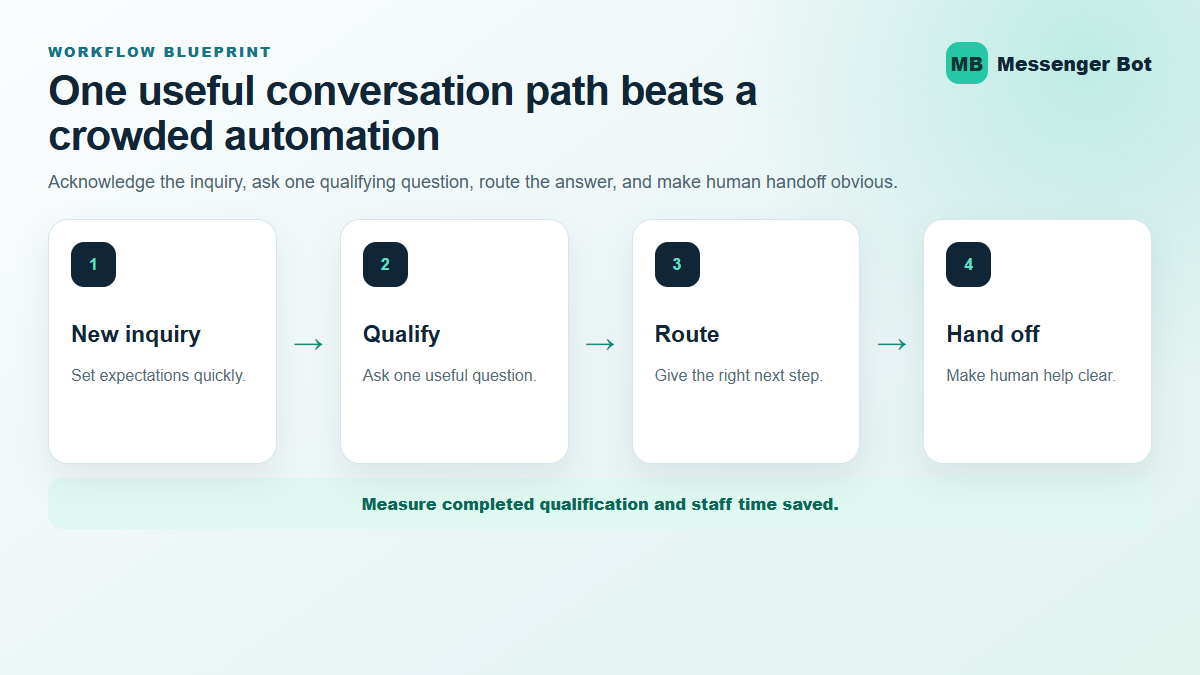
A single manychat bot is easiest to understand when you look at one clean workflow instead of the whole platform. Think of one bot as a guided path with five parts: a trigger, an opening choice, a qualification step, a data capture step, and a handoff or follow-up action. If any one of those parts is muddy, the bot feels broken even when the software is technically working.
The anatomy of one useful manychat bot
Here is a version that works for a lot of small businesses. Someone comments on a post asking for pricing. ManyChat sends a private DM. The DM offers three buttons: pricing, availability, or talk to a person. If the user taps pricing, the bot asks one clarifying question such as service type or location. Then it gives the right answer or collects contact info for a quote. If the user taps talk to a person, the conversation gets tagged and routed for human follow-up.
That sounds simple because it is supposed to be simple. Most bot failures come from doing too much too early. Teams try to build a giant branching monster that answers every edge case on day one. The result is usually worse for the customer and worse for the team. One bot should solve one repeated business problem cleanly. Build another one when the first one is stable and paying for itself.
The simplest useful build is usually not the fanciest build
If measurable follow-up is the goal, the best first ManyChat bot is usually one of these:
- A lead capture bot that turns comments and DMs into qualified leads.
- An appointment bot that answers common questions and books or routes inquiries.
- A support bot that handles top FAQs, order status prompts, and human escalation.
- A sales-assist bot that delivers an offer, a coupon, or a product finder and then hands off.
Notice what is missing from that list: vague “AI engagement.” That phrase sells demos, not outcomes. What pays off is one useful automation attached to one measurable next step. If you can track booked appointments, recovered orders, collected emails, or staff time saved, you can judge the bot honestly. If all you can say is that people clicked around, the profit story is probably weak.
The cleanest mental model is this: a ManyChat bot is not the business. It is a routing and follow-up layer on top of attention you already have. If the attention or offer is weak, the bot will not repair it. If people already send useful inquiries, one well-scoped workflow can be measured against completed qualifications and team time.
ManyChat Bot Pricing and Cost-Per-Conversation Math
ManyChat changed its pricing model on March 2, 2026, and the offer can still differ by account age, region, billing channel, and the plan shown inside a workspace. For an account created under the current web model, the public pricing page checked on July 29, 2026 lists Free at $0, Essential from $14 per month, Pro from $29 per month, Business from $69 per month, and Advanced from $139 per month. Annual billing and regional offers can change the amount, so treat the price displayed inside your own account as the final quote.
The current model uses monthly Active Contacts: people who interact with your connected automation during the billing cycle. The public plan page lists 25 Active Contacts for Free, 250 for Essential, 2,500 for Pro, 7,500 for Business, and 25,000 for Advanced. Additional-contact pricing and channel access vary by plan. Older workspaces can still see the earlier contact-based plan, so do not copy a price from an old tutorial into a budget.
| Plan shown on the current web page | Starting monthly price | Included Active Contacts | Best planning use |
|---|---|---|---|
| Kostenlos | $0 | 25 | Test one small workflow before committing |
| Wesentlich | From $14 | 250 | Qualify a modest flow of inquiries |
| Pro | From $29 | 2,500 | Run several channels or higher-volume workflows |
| Geschäft | From $69 | 7,500 | Coordinate a larger team and conversation load |
| Fortgeschritten | From $139 | 25,000 | Plan enterprise-scale volume and support |
Pricing and limits were checked against ManyChat’s public pricing and help pages on July 29, 2026. Confirm the exact offer in your account before buying.
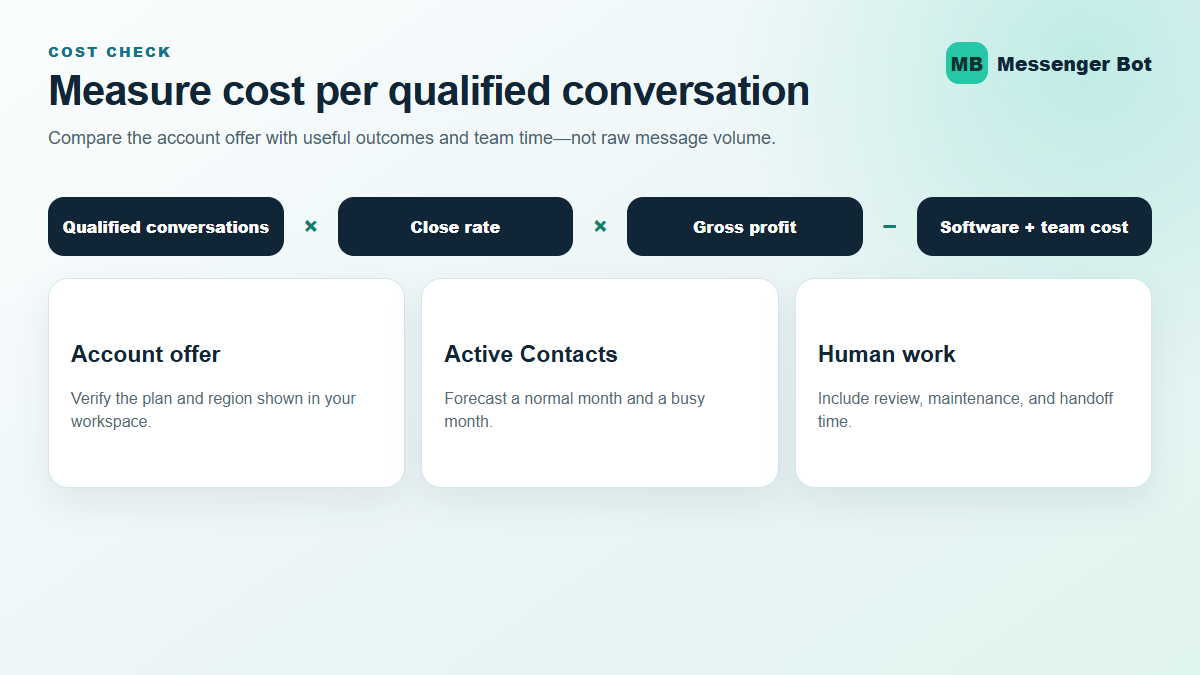
Use a transparent return model instead of a profit promise
A useful evaluation starts with assumptions your team can verify:
Incremental qualified conversations × close rate × gross profit per sale − software and operating cost.
For example, record the number of inquiries that reach a meaningful qualification step, the share that become customers, the gross profit from those customers, and the time your team spends maintaining the workflow. The result is an estimate, not a guarantee. Audience quality, offer strength, consent, response quality, channel rules, and human follow-up all affect the outcome.
How to Set Up a ManyChat Bot Without Wasting Budget
The best ManyChat setups in 2026 still start the boring way: one page, one goal, one trigger, one handoff path. Do not start by importing a giant template library. Start by mapping the one conversation your team repeats most often and build that first. If you want a broader build walkthrough after this article, the Messenger Bot-Tutorial covers the larger automation playbook.
- Connect the right asset first. Use a Facebook business page, not a personal profile, and make sure the person connecting it actually has the right page permissions inside Meta.
- Pick one business outcome. Choose lead capture, bookings, support deflection, order updates, or sales assist. Mixing all five into your first build is how bad bots happen.
- Choose one high-intent trigger. A DM keyword, a comment trigger, a story reply, or a page message is usually enough for version one.
- Build a tight opening menu. Give people three or four choices, not twelve. Pricing, availability, support, and talk to a person is a strong default for many SMBs.
- Capture only the data you need. Name, email, phone, service type, order number, or budget can be enough. Do not turn your bot into a form marathon.
- Apply tags and custom fields early. This is what makes later follow-up useful instead of generic.
- Add a human exit. A “talk to support” or “talk to a person” path prevents the bot from becoming a dead end.
- Test everything on mobile. Click every button, trigger every comment flow, and confirm that the tag, field, and handoff logic actually work from a real account.
A launch checklist that avoids the usual money leaks
- Keep version one to a single revenue or support path.
- Write the opening message like a receptionist, not a sci-fi assistant.
- Use tags that reflect decisions, not vague labels like “engaged.”
- Track where the bot hands off, not just where it starts.
- Disable or redesign any trigger that pulls in low-intent people just to pad numbers.
The setup rule I trust most is simple: if the first flow does not save time or create clear revenue potential within the first month, do not scale the automation tree yet. Fix the flow first. ManyChat is powerful enough to let you build a lot of complexity. That does not mean complexity is helping.
Fix ManyChat Bot Costs, Delivery, and Follow-Up Problems
Most ManyChat problems in 2026 are not dramatic software failures. They are mismatches between what the business expects and what the platform or channel rules actually allow. That is good news because it means most issues are fixable once you know where to look.
| Problem | Why it happens | Fastest fix |
|---|---|---|
| The Facebook page will not connect | The wrong Meta permissions are being used, or the page is not showing up for the connected user | Verify page admin or business access in Meta first, then reconnect from the correct account |
| Comment trigger sends a private reply but the flow dies | The user did not actually interact with the DM, so the broader messaging window never opened | Make the first DM ask for a button click or reply before the bot expects deeper follow-up |
| Automations stop after one day | Messenger, Instagram, and WhatsApp still run under the 24-hour automation window | Restructure the follow-up, use approved message types where appropriate, or move the next step to email or SMS |
| Costs jump faster than expected | Too many people are becoming active contacts through low-value automations | Audit triggers, tighten segmentation, and stop waking up low-intent users just because you can |
| AI replies feel off-brand or too loose | The instructions are vague and the bot is being asked to improvise too much | Restrict AI to narrow FAQ zones and use fixed menus or human handoff for higher-risk replies |
| Leads sit unanswered in the inbox | No routing rules, weak tagging, or too few team seats | Add ownership rules, cleaner labels, and a clear “who replies next” process |
The 24-hour rule is still the biggest misunderstanding
ManyChat’s current 2026 help docs make this easier to explain than older blog posts did. Messenger, Instagram, and WhatsApp still allow automated messages during the first 24 hours after the user’s last interaction. After that, Messenger and Instagram still give you a 7-day manual inbox window, but automations stop. That means your team can keep the conversation going manually for a limited period, but the bot itself cannot keep firing regular automated follow-ups like nothing happened.
There is one useful nuance here. ManyChat now documents Messenger utility message templates for approved non-promotional use cases such as order updates, shipping notices, account notifications, and reminders. That is helpful, but it is not a loophole for marketing blasts. If your message is promotional, treat it like promotional content and do not try to disguise it as a utility update.
The fastest cleanup move is usually simplification
When a ManyChat account feels messy, the safest first move is not to add another feature. It is to remove low-value automations, tighten the opening choices, fix the tags, and shorten the path to a useful answer. Businesses often assume the cure for a disappointing bot is more AI or more branches. Usually the cure is less clutter.
For the wider product and plan picture, review our ManyChat pricing and features guide. If your work is centered on a Facebook Page, the ManyChat for Facebook guide separates supported business messaging from risky assumptions. You can also compare a different inbox approach in ManyChat vs Tidio.
Comparison With Alternatives: What Works Better
ManyChat is good, but it is not the best answer for every job. The better question is what works better for the exact kind of conversations your business has every day.
| Workflow need | ManyChat strength | When to compare another approach |
|---|---|---|
| Instagram and Messenger social qualification | Comment, story, and direct-message entry points with visual flows | Your team mainly handles website support or ticket queues |
| Facebook Page first replies | Structured questions, tags, routing, and human inbox handoff | You need a focused Page workflow with simpler operating boundaries |
| Several messaging channels | One builder can coordinate supported channels under the selected plan | Your operation needs deeper service-desk controls, ownership, or reporting |
| AI-assisted answers | AI features can support reviewed conversation paths | Your team needs BYOK (Bring Your Own Key), source controls, and a stricter review step |
Choose the platform that matches the conversations your team already receives. ManyChat is strongest for social entry points and visual qualification flows. Messenger Bot is designed for businesses that want controlled Facebook and Instagram workflows, clear human review, and BYOK (Bring Your Own Key) options. Website-first support teams may need a different tool class.
Chatfuel sits in an interesting middle zone. Its public 2026 pitch is more AI assistant than classic bot builder, and that will appeal to some teams. It is worth shortlisting if you want broader messaging coverage with a more agent-like feel. But if your team wants very explicit, rule-based social funnels and the friendliest learning curve, ManyChat still feels easier to put to work quickly.
The biggest mistake in this category is comparing business messaging platforms to general AI chat apps. If your real need is simply a smart assistant to brainstorm, write, or answer questions, skip bot builders entirely and go look at consumer AI. If your real need is automating business conversations across channels you already own, then ManyChat and its alternatives make sense. That broader split is laid out in the Vergleich der Chatbot-Plattformen.
Safety, Privacy, and What to Watch Out For
ManyChat itself clears the basic legitimacy test. Its public security page says the company maintains ISO/IEC 27001:2022 certification, SOC 2 Type II compliance, CSA STAR listing, Meta Business Partner status, and GDPR and CCPA alignment. That is a much stronger trust baseline than the random auto-DM tools and browser extensions that still get pitched around social marketing circles.
Safe to use does not mean risk-free to use. Most of the real risk sits in implementation, not branding. A ManyChat account becomes risky when a business collects too much personal data, shares logins casually, lets AI improvise in sensitive conversations, or ignores message-window rules and consent expectations. That is how you get compliance headaches, angry users, and broken trust.
What a safer ManyChat setup looks like
- Ask for only the minimum data needed to complete the next step.
- Do not store passwords, card details, or unnecessary personal data in custom fields.
- Turn on 2FA and stop sharing one master login across the whole team.
- Separate promotional flows from utility and support flows.
- Give people a clear human path when the bot is unsure or the topic is sensitive.
- Document how you handle deletion or access requests for contact data.
ManyChat’s GDPR help materials also make clear that contacts can request their data to be downloaded, changed, or removed. That matters for real operations. If your business cannot explain where customer data lives, who can see it, and how it gets deleted, the problem is no longer just a marketing problem.
The spam risk is usually self-inflicted
ManyChat does not force you to spam. People force spammy strategies onto it. If you use comment triggers responsibly, segment your audience, and message people based on clear recent interaction, the platform can feel fast and useful. If you use every trigger you can find just to keep touching people, the software will expose that bad strategy instead of hiding it.
The clean rule is this: use the bot to make warm conversations easier, not to turn cold or stale conversations into noisy ones. That is the line between automation that helps and automation that degrades the brand.
What Changed in 2026 and What to Expect Next
The biggest practical shift in 2026 is pricing clarity for new accounts and pricing confusion for everyone comparing old and new accounts side by side. ManyChat introduced its new pricing model on March 2, 2026. That brought the Free, Essential, Pro, Business, and Advanced plan structure, active-contact billing, clearer user and inbox-seat limits, and a more explicit multichannel ladder for growing teams.
The second important change is that the 2026 help docs explain messaging windows more clearly than older ManyChat content did. Regular automations still run inside the 24-hour window. Messenger and Instagram then move into a 7-day manual inbox window, while approved message types handle specific post-window cases. That does not make the platform looser. It makes the rules easier to plan around.
The third useful change is the Messenger utility message workflow. ManyChat now documents approved non-promotional Messenger templates for things like shipping updates, reminders, and account notifications. That helps legitimate businesses that need operational follow-up outside the normal automation window without pretending all outbound communication is marketing.
The fourth change is less flashy but still important: ManyChat is now positioning itself much more openly as a broader messaging business platform, not just “the Messenger bot tool.” That means WhatsApp, SMS, email, AI assistance, routing, and team operations matter more in the product story than they used to.
That broader story is why buyers need to think harder now. As of April 12, 2026, the question is not just “Can ManyChat build a bot?” Of course it can. The question is whether you want a broader social-and-messaging stack with active-contact pricing, or whether you want a narrower Messenger-first platform with flatter billing, or a website-first support stack, or a multi-channel operations system. The category split is sharper than it used to be.
What to expect next is fairly predictable. Free tiers will likely stay tighter, not looser. AI-assisted routing and drafting will keep expanding, but human review will still matter for anything sensitive. Cross-channel handoff will matter more than pure Messenger automation. And businesses that do not track real outcomes will keep overpaying for chat tools because they confuse activity with value.
Who Should Use Manychat Bots and Who Should Skip Them in 2026
Manychat bots make sense for businesses that already get regular comments, DMs, and warm social traffic and want to turn that attention into leads, bookings, support resolution, or sales faster. They make especially good sense for creators, local businesses, coaches, ecommerce brands, and small teams that live inside Instagram and Messenger every day and want a polished no-code tool.
You should lean toward ManyChat if these statements sound true:
- Your audience already interacts with you on Messenger or Instagram.
- You want social triggers such as comments, story replies, and DM keywords.
- You care about speed to launch and a clean interface.
- You can measure value through bookings, leads, orders, or staff time saved.
You should probably skip ManyChat, or at least stop treating it like the default, if these sound closer:
- Your real problem is website support, ticketing, or inbox operations, not social DMs.
- You hate engagement-based billing and want flatter public pricing.
- You only want a general AI assistant and do not need business-message automation at all.
- You are searching for a no sign up required chatbot instead of a channel-connected business tool.
That last case matters because people still confuse categories. If you do not need business automation and you just want a useful assistant to ask questions, write, or research, skip this entire tool class and start with these besten kostenlosen KI-Chatbots. A business bot builder is the wrong answer to a consumer AI question.
The better closing test is practical: define one workflow, measure qualified conversations and staff time, and compare the result with the real account cost. Expand only after the first workflow proves useful.
If your business is still mostly Facebook Messenger and you want flatter public pricing for forms, flows, comment automation, and customer follow-up, compare the current options before you rebuild everything. See Our Plans.
Häufig gestellte Fragen
Was sind ManyChat-Bots und wie funktionieren sie im Jahr 2026?
Manychat-Bots sind Automatisierungen, die in ManyChat für Kanäle wie Facebook Messenger, Instagram, WhatsApp, TikTok, Telegram, E-Mail und SMS je nach Plan erstellt werden. In der Praxis funktionieren sie, indem sie Ihre Unternehmensseite oder Ihr Konto verbinden und dann einen Flow auslösen, wenn jemand kommentiert, eine DM sendet, auf eine Story antwortet oder einen anderen unterstützten Einstiegspunkt verwendet. Im Jahr 2026 ist die Plattform multikanaliger als je zuvor, aber die grundlegende Aufgabe bleibt die gleiche: Menschen zur richtigen Antwort zu leiten, nützliche Daten zu erfassen und bei Bedarf an einen Menschen weiterzugeben.
Funktioniert ein ManyChat-Bot im Jahr 2026 noch und ist er sicher zu verwenden?
Yes, a manychat bot still works in 2026, and ManyChat itself has a solid trust baseline with public security and privacy commitments. The bigger safety issue is how you use it. If you run it on a business page, respect Meta’s messaging rules, keep permissions tight, and avoid spammy broadcasts, it is a legitimate business tool. If you use it carelessly, over-collect data, or try to abuse the message windows, the risk comes from the setup, not from the brand name on the login screen.
Wie viel kosten ManyChat-Bots im Jahr 2026?
ManyChat’s public web pricing checked on July 29, 2026 lists Free with 25 Active Contacts, Essential from $14 per month for 250, Pro from $29 for 2,500, Business from $69 for 7,500, and Advanced from $139 for 25,000. The account offer can vary by region, billing choice, and account age, so confirm the final amount inside your workspace.
Können ManyChat-Bots nach dem 24-Stunden-Zeitraum weiterhin Nachrichten senden?
Regular automated messages are still limited by the 24-hour window after the user’s last interaction on Messenger, Instagram, and WhatsApp. In 2026, ManyChat’s docs also describe a 7-day manual inbox window for Messenger and Instagram, which means your team can continue the conversation manually for a limited time after the first 24 hours, but automations stop. For specific non-promotional cases such as order updates or reminders, approved utility or template-based message paths may still work outside the regular window.
Ist der ManyChat-Bot 2026 für kleine Unternehmen lohnenswert?
Es lohnt sich, wenn das Unternehmen bereits einen stetigen Strom von Kommentaren, DMs oder wiederholten Fragen erhält und den Bot auf ein messbares Ergebnis wie Buchungen, Leads, wiederhergestellte Warenkörbe oder Unterstützungseinsparungen ausrichten kann. Es lohnt sich nicht, wenn der Posteingang klein ist, das Angebot nicht konvertiert oder das Team wirklich nach einem allgemeinen KI-Assistenten anstelle einer Messaging-Automatisierungsplattform sucht. Der einfachste Test ist, ob ein sauberer Workflow innerhalb des nächsten Monats Geld sparen oder verdienen könnte.



 Deutsch
  English
  Tagalog
  简体中文
简体中文  العربية
  हिन्दी
  Português do Brasil
  Español de México
  Français
  বাংলা
বাংলা  香港中文
香港中文  繁體中文
繁體中文  Nederlands
  Bahasa Indonesia
  日本語
日本語  한국어
한국어  Polski
  Русский
  Español
  Tiếng Việt