
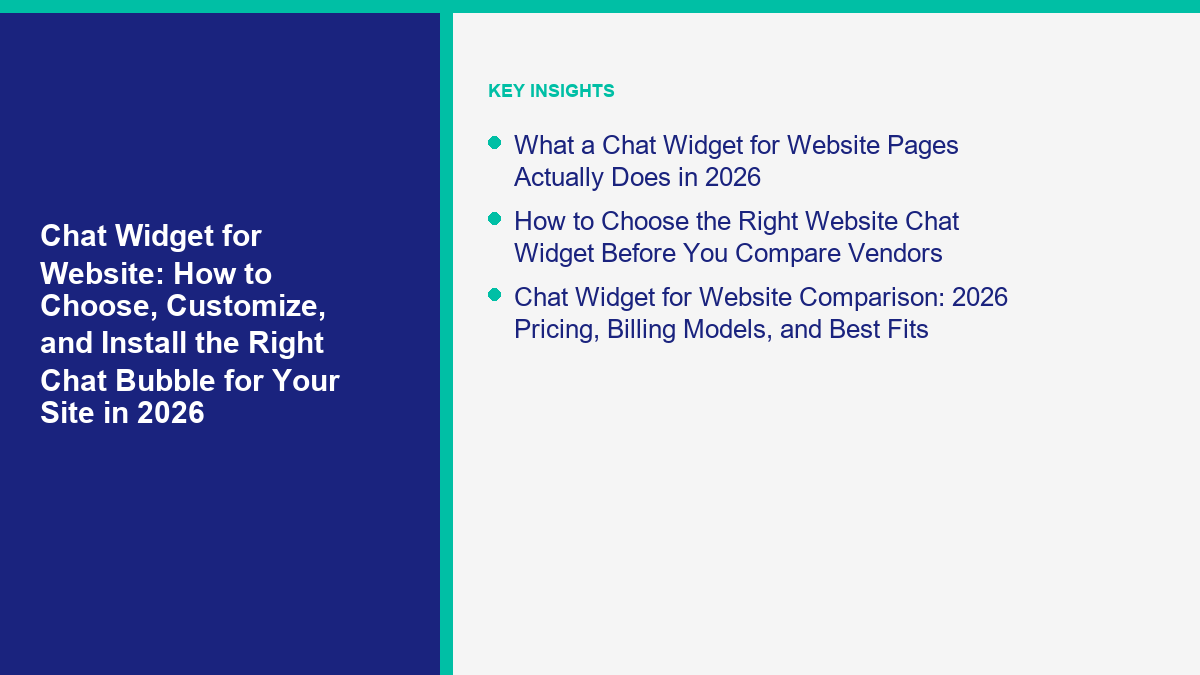
Der einfachste Fehler bei einem Chat-Widget für die Website Projekten besteht darin, die Blase wie ein kosmetisches Add-On zu behandeln. Es ist nicht kosmetisch. Der Launcher, der Willkommens-Text, die ersten Klick-Optionen, die Seitenzielsetzung und das Verhalten auf Mobilgeräten entscheiden darüber, ob das Widget echten Besuchern hilft oder nur in der Ecke sitzt und beschäftigt aussieht.
Dieser Leitfaden konzentriert sich nur auf diese Ebene: das Widget selbst. Nicht der gesamte KI-Stack, nicht die gesamte Automatisierungsarchitektur und nicht eine breite “Was ist ein Chatbot?”-Erklärung. Wenn Sie den umfassenderen Aufbau benötigen, einschließlich Logik zur Lead-Erfassung, Support-Flows und Automatisierungsdesign, lesen Sie unser vollständiges Implementierungsleitfaden für Website-Chatbots nach diesem. Hier ist die Aufgabe enger und praktischer: Wählen Sie das richtige Website-Chat-Widget, platzieren Sie es richtig, passen Sie es an, damit es zur Seite passt, installieren Sie es sauber und vermeiden Sie es, Ihre Hilfsblase in ein Konversionsleck zu verwandeln.
Ich habe die offiziellen öffentlichen Preis- und Dokumentationsquellen überprüft, die in diesem Artikel erwähnt werden. 13. April 2026. Das ist wichtig, weil sich die Preisgestaltungsmodelle der Anbieter schneller ändern, als die meisten Vergleichsbeiträge zugeben. MessengerBot listet weiterhin Premium für $19,99 pro 30 Tage und Pro für 49,99 € pro 30 Tage. Tidio listet Starter für 24,17 € pro Monat, und die Lyro-Hilfedokumente machen weiterhin deutlich, dass das kostenlose KI-Kontingent ein nicht erneuerbares Kontingent von 50 Gesprächen, nicht eine monatliche Rücksetzung ist. Freshchat hat weiterhin eine echte kostenlose Stufe für bis zu 10 Agenten, mit Growth für 19 € pro Agent und Monat, jährlich abgerechnet. Intercom beginnt weiterhin bei $29 pro Sitz und Monat, jährlich abgerechnet und erhebt $0,99 pro Fin-Ergebnis. HubSpot bewirbt derzeit seine Starter Customer Platform zu $15 pro Sitz und Monat für Neukunden, während der Katalogpreis des Service Hub Starter bei $20 pro Sitz und Monat; bleibt; HubSpot hat auch angekündigt, dass Breeze Customer Agent am 14. April 2026 auf, bei $0,50 pro gelöster Konversation. Landbot bietet weiterhin ein kostenloser Sandbox, mit Starter für $45 pro Monat. Botpress positioniert weiterhin sein Pay-as-you-go-Plan bei $0 plus KI-Ausgaben, mit Plus bei $79 plus KI-Ausgaben jährlich abgerechnet.[1][2][3][4][5][6][7][8][9][10]
Die kurze Empfehlung im Voraus ist einfach. Wenn Sie ein System benötigen, das ein Live-Chat-Widget auf Ihrer Website betreiben und das Gespräch mit Facebook Messenger und Instagram verbunden halten kann, ist MessengerBot die sauberste Lösung für die meisten KMUs, Agenturen und Vermarkter. Wenn Ihre Website das Zentrum der Schwerkraft ist und das Widget hauptsächlich ein Support-Desk ist, dann könnten Tidio, Freshchat, HubSpot, Intercom, Landbot oder Botpress je nach dem, wie viel Kontrolle, KI und Abrechnungs-Komplexität Sie tatsächlich wollen, die bessere Wahl sein. Wenn Sie das zuerst gegen Ihre eigenen Grenzen preislich abwägen möchten, MessengerBot-Preise anzeigen.
Was ein Chat-Widget für Webseiten im Jahr 2026 tatsächlich tut
Viele Menschen nutzen immer noch Chat-Widget für die Website, Website-Chatbots, und Live-Chat-Widget als ob sie alle dasselbe bedeuten. Tun sie nicht. Ein Widget ist die sichtbare Schnittstelle: der Launcher, die Blase, das angedockte Panel, der Teaser, das Benachrichtigungsabzeichen, die erste Nachricht und manchmal ein paar schnelle Antworten. Ein Chatbot ist die Logik dahinter. Sie können ein Widget haben, das fast keine Automatisierung hat. Sie können auch einen intelligenten Bot hinter einem schwachen Widget haben und trotzdem schlechte Ergebnisse erzielen.
Diese Unterscheidung ist wichtig, da Käufer oft das falsche Werkzeug für den falschen Job wählen. Wenn Ihr Team nur eine polierte Chat-Blase-Website erfahrung mit grundlegender Weiterleitung, proaktiven Aufforderungen und einem Offline-Erfassungsformular benötigt, brauchen Sie nicht unbedingt einen tiefen KI-Stack. Wenn Ihr Team möchte, dass die Blase Supportfragen aus einer Wissensdatenbank beantwortet, Leads qualifiziert, hochintensive Interessenten weiterleitet und an Agenten über verschiedene Kanäle übergibt, dann ist das Widget nur die Eingangstür zu einem größeren System.
Die Eingangstür verdient immer noch eine eigene Kaufentscheidung. Ein starkes Widget sollte fünf Dinge gut machen, bevor Sie überhaupt an fortgeschrittene Automatisierung denken:
- So aussehen, als gehöre es zur Seite. Die Blase sollte sich nahtlos in das Layout der Seite einfügen und nicht von einer anderen Marke aufgeklebt wirken.
- Erwartungen auf einen Blick setzen. Besucher sollten wissen, ob das Widget für Support, Preisberatung, Buchungen oder allgemeine Fragen gedacht ist.
- Die Absicht der Seite respektieren. Das gleiche Widget sollte sich auf einer Startseite, Preisübersichtsseite, Checkout-Seite und im Hilfezentrum nicht identisch verhalten.
- Auf mobilen Geräten arbeiten, ohne den echten CTA zu verdecken. Ein Widget, das den Warenkorb-Button oder den festen Buchungs-CTA versteckt, ist aktiv schädlich.
- Bieten Sie einen klaren Weg zu einem Menschen oder einem nächsten Schritt. Wenn der Chat die Aufgabe nicht lösen kann, sollte er umleiten, anstatt zu stagnieren.
Dieser letzte Punkt ist der Grund, warum schwache Widgets scheitern. Sie sind für den Beginn eines Chats optimiert, nicht für abgeschlossene Aktionen. Die Demo des Anbieters hebt Animationen, Avatare und flüssige Übergänge hervor. Der tatsächliche Käufer benötigt die Blase, um jemanden zu einem Angebot, einem Kauf, einer Antwort oder einem Gespräch mit der richtigen Person zu bewegen. Wenn das Widget das nicht kann, liegt das Problem oft nicht an der KI. Es ist die Benutzeroberfläche.
Die praktische Erkenntnis ist folgende: Bewerten Sie das Widget zuerst als Konversionsoberfläche und dann als Softwarefunktion. Fragen Sie, ob es einem Besucher hilft, zu verstehen, was als Nächstes zu tun ist. Fragen Sie, ob es im richtigen Kontext erscheint. Fragen Sie, ob es auf mobilen Geräten vertrauenswürdig aussieht. Vergleichen Sie dann die Automatisierungstiefe dahinter.
Wie man das richtige Website-Chat-Widget auswählt, bevor man Anbieter vergleicht
Die meisten Teams wählen ein Website-Chat-Widget rückwärts. Sie öffnen fünf Preisübersichtsseiten, vergleichen Logos, klicken durch einige Demos und entscheiden sich letztendlich basierend auf dem, was auch immer modern aussieht. Das ist nicht genug. Die Kaufentscheidung wird einfacher, wenn Sie das Widget zuerst in eine primäre Aufgabe zwingen.
Es gibt vier gängige Aufgaben, die ein Chat-Widget für die Website gut bewältigt:
| Widget-Aufgabe | Beste Seitentypen | Wie gute Ergebnisse aussehen | Was normalerweise schiefgeht |
|---|---|---|---|
| Live-Verkaufshilfe | Preise, Serviceseiten, Produktseiten | Schnelle Antworten, Angebotsweiterleitung, Lead-Erfassung, Übergabe an den Vertrieb | Nach einer E-Mail-Adresse fragen, bevor man einen Mehrwert bietet |
| Support-Triage | Hilfezentrum, Bestellverfolgung, Konto, Abrechnung | Probleme weiterleiten, FAQ-Antworten, klare menschliche Eskalation | Jeden Benutzer zu offenen Texten ohne Abkürzungen zwingen |
| Lead-Qualifizierung | Landingpages, lokale Dienstseiten, Demoseiten | Strukturierte Details und Timing der nächsten Schritte sammeln | Den Chat in ein langes Formular verwandeln, das als Gespräch getarnt ist |
| Hybrid-Launcher für Vertrieb und Support | Startseite, Preisgestaltung, Hauptnavigationsseiten | Schnelle Menüoptionen, die Besucher sauber weiterleiten | Versuchen, zehn Jobs aus einer vagen Willkommensnachricht zu erledigen |
Sobald Sie den Hauptjob kennen, wird die Liste der Anbieter kleiner. Ein konversionsorientierter Chat-Blase-Website Aufbau benötigt oft starke Formulare, Menüs, Seitenzielgruppen und Integrationen. Ein supportintensives Widget benötigt Ticketing, Posteingangs-Workflows, Routing und die Qualität der KI-Antworten. Ein kanalübergreifendes Widget benötigt Kontinuität mit Messenger und Instagram. Das sind nicht die gleichen Produktprioritäten.
Bevor Sie die Pläne vergleichen, beantworten Sie diese Fragen in einfachem Englisch:
- Wo wird das Widget zuerst erscheinen? Sitewide ist selten der richtige erste Start.
- Was sollte in den ersten 15 Sekunden passieren? Menü, Begrüßung, Freitext oder Formular?
- Ist das Widget hauptsächlich für Leads, Support oder beides?
- Brauchen Sie denselben Assistenten auf der Website, Messenger und Instagram?
- Wird ein menschliches Team tatsächlich Übergaben beantworten? Wenn nicht, sind Ihr Abwesenheitsstatus und das Fallback-Design wichtiger.
- Mit welchem Abrechnungsmodell können Sie leben? Fest monatlich, sitzbasierend, ergebnisbasiert oder nutzungsbasiert?
Diese letzte Frage wird zu oft ignoriert. Einige Tools sind bei geringem Volumen günstig und werden teuer, sobald das Widget anfängt, seine Arbeit zu tun. Andere erscheinen im Voraus teurer, bleiben aber vorhersehbar, weil der Plan fest ist. Wenn Sie eine Agentur oder ein kleines Unternehmen sind, ist Vorhersehbarkeit wichtig. Ein Widget, das mehr Gespräche generiert, sollte nicht automatisch schwer vorhersehbar werden.
Wenn Sie sich noch früh im Prozess befinden, hilft es, eine Regel im Hinterkopf zu behalten: das Widget ist nicht das Produkt, es ist der Einstiegspunkt in die Produkterfahrung. Das bedeutet, dass die beste Lösung normalerweise die Plattform ist, die zu Ihrem Kanal-Mix und Geschäftsmodell passt, nicht die mit der auffälligsten Blasenanimation.
Chat-Widget für Website-Vergleich: Preise 2026, Abrechnungsmodelle und beste Passungen
Sie benötigen keine Liste von dreißig Tools. Sie benötigen eine Shortlist, die widerspiegelt, wie Unternehmen tatsächlich Chat auf der Website einbetten pages today. The platforms below matter because they cover the main buying patterns: website-first support, cross-channel marketing and automation, conversational lead forms, and developer-controlled webchat.
| Plattform | Current public starting point | Free path | Widget strength | Billing watch-out |
|---|---|---|---|---|
| MessengerBot | Premium $19,99 pro 30 Tage | Trial available | Best cross-channel fit for website, Messenger, and Instagram | No permanent free plan listed publicly |
| Tidio | Starter $24,17 pro Monat | Free workspace plus 50 lifetime free Lyro conversations | Strong all-around website live chat and SMB support widget | AI quota is separate and the free Lyro limit does not renew |
| Freshchat | Free for up to 10 agents; Growth $19 per agent per month billed annually | Ja | Good for support-heavy web chat with social channels | Per-agent pricing rises fast as the team grows |
| Intercom | $29 pro Sitz und Monat, jährlich abgerechnet | Nur Testversion | Excellent enterprise-grade support widget and inbox stack | $0.99 per Fin outcome sits on top of seat pricing |
| HubSpot | Starter promo $15 per seat monthly for new customers; Service Hub Starter catalog price $20 per seat | Free tools | Good if every chat should feed CRM context | Promo pricing and regular catalog pricing are not the same thing |
| Landbot | Sandbox free; Starter $45 per month | Ja | Strong conversational-form widget design and guided lead flows | Can get expensive once usage and channels expand |
| Botpress | Pay-as-you-go $0 plus AI spend; Plus $79 plus AI spend billed annually | Ja | Best for teams that want more control over webchat behavior | Low base price, but the team owns more technical complexity |
Here is how I would actually interpret that list, not how a vendor landing page wants you to interpret it.
MessengerBot is the best fit when the widget is part of a broader Meta messaging strategy. The public pricing page still shows 1 chat widget on Premium und 5 chat widgets on Pro, plus website chat, forms, Google Sheets integration, WooCommerce integration, JSON API + Zapier, and Instagram chatbot features. That is unusually practical if your site lead often needs to continue the conversation in Messenger or Instagram later.[1]
Tidio is one of the safer website-first choices for SMBs. The base pricing is understandable, but the AI layer needs careful reading. Tidio’s pricing page lists Starter für 24,17 € pro Monat and says the first 50 Lyro conversations are free for life. Its help article makes the catch explicit: that free quota is non-renewable. Once it is gone, it is gone unless you buy a monthly Lyro package. That makes Tidio good for testing, but not something you should misread as “unlimited free AI chat”.[2][3]
Freshchat is still one of the more attractive support-led entries because the free plan covers website live chat and email for up to 10 agents. That is a real entry point, not a token free badge. The tradeoff is that seat pricing becomes real as the team grows, and the platform makes the most sense when support operations matter at least as much as marketing conversion.[4]
Intercom remains strong and expensive in exactly the way you would expect. It is not overpriced for teams that need what it does. It is overpriced for teams that only need a basic Live-Chat-Widget with a few flows and decent routing. The official pricing page still shows Essential at $29 per seat per month billed annually, and Fin is still $0,99 pro Ergebnis. That is a rational model if support containment is a core KPI. It is a less pleasant model if you just want a helpful bubble on a marketing site.[5]
HubSpot is useful when chat should be a CRM surface first and a widget second. The current public Starter Customer Platform offer shows $15 per seat per month on monthly billing for new customers, marked down from $20. The Service Hub catalog still lists Service Hub Starter at $20 per seat per month. That means your real price depends on whether you are entering through the current starter promo or pricing the service product directly. The same caution applies to HubSpot’s AI billing shift. HubSpot has publicly stated that starting 14. April 2026, Breeze Customer Agent moves from $1.00 per conversation aus um $0,50 pro gelöster Konversation. That is a useful change, but it is still outcome-based billing, not a flat-fee widget model.[6][7][8]
Landbot is best when your widget is really a guided conversion path in chat clothing. The pricing page still shows a kostenloser Sandbox, Starter at $45, und Pro at $110, with web and Messenger coverage. If your goal is a structured lead interview, Landbot can outperform more open-ended chat tools. If you want a simple always-on support bubble, it can feel heavier than necessary.[9]
Botpress is the control option. The public pricing page still shows Pay-as-you-go at $0 plus AI spend, mit Plus bei $79 plus KI-Ausgaben billed annually. That looks very attractive until you remember what it implies: more implementation ownership. Botpress is excellent when you want that control. It is overkill when you mainly need a clean, no-drama Chat-Widget für die Website deployment on a small business site.[10]
If you are comparing only on price, MessengerBot and Freshchat are the easiest places to start. If you are comparing on website-first polish, Tidio deserves a hard look. If you are comparing on deep support infrastructure, Intercom and HubSpot sit higher. If you are comparing on guided conversational forms, Landbot is the specialist. If you are comparing on control, Botpress is the builder’s choice.
Where to Place a Chat Bubble on Your Website So It Gets Used
Placement is one of the most underrated decisions in Chat-Blase-Website work. A lot of guides act like lower right is the whole answer. Lower right is just the default. It is not the strategy.
The better rule is to match widget behavior to page intent. A pricing page should not get the same chat behavior as a blog post. A help center should not use the same opener as a product detail page. The bubble can stay in a consistent place, but the prompt, timing, and first options should change by context.
| Page type | Best widget behavior | Good opening prompt | Common mistake |
|---|---|---|---|
| Startseite | Passive launcher, optional teaser after a few seconds | Need help choosing the right plan? | Full pop-up on load |
| Pricing page | Visible launcher with plan shortcuts | Compare plans or ask about limits | Generic “How can I help?” opener |
| Product page | Context-specific support tied to that product | Ask about stock, delivery, or fit | Using the same generic sales copy sitewide |
| Kasse | Manual launcher or low-key rescue prompt | Need help before you place the order? | Covering payment or coupon fields |
| Hilfezentrum | Issue-routing widget with quick categories | Track order, billing, technical issue, talk to support | Forcing a blank text box first |
Consistency matters too. WCAG 2.2’s Consistent Help criterion says repeated help mechanisms should stay in the same relative place across pages so people can find them more easily. That does not mean every widget needs identical copy on every page. It means visitors should not have to hunt for help every time they move deeper into the site.[18]
The lower-right corner still works for most sites because users already expect help there. But there are three cases where moving or modifying the launcher is smarter:
- Sticky commerce bars are already using that corner. If your mobile cart bar or booking CTA lives there, the widget needs to shrink, shift, or wait.
- You use a bottom navigation pattern on mobile. A fixed bubble can easily overlap core navigation.
- The page has one dominant conversion action. On some landing pages, a subtle inline launcher or delayed teaser performs better than a permanent floating bubble.
The tactical advice is simple. Start with a consistent corner placement. Then test page-specific teaser copy and display rules. Do not move the bubble around randomly from page to page. Do change what the widget says and when it appears based on intent.
How to Customize a Live Chat Widget Without Making It Look Fake
Customization is where a lot of widgets go wrong because teams confuse branding with trust. Brand color matters. The avatar matters. The launcher label matters. But the most important customization choice is still the first thing the widget asks the visitor to do.
Ein guter Live-Chat-Widget in 2026 should feel like part of the site, not like an aggressive sales pop-up wearing your logo. That usually means five customization rules:
- Name the job, not just the channel. “Pricing Help” or “Support” is usually better than just “Chat.”
- Use a welcome message that reflects the page. A pricing page opener should not sound like a help-center opener.
- Start with guided choices if the task is predictable. Buttons reduce hesitation.
- Use the avatar carefully. A role-based assistant often feels more honest than pretending a live person is already there.
- Make the human path visible. If a visitor needs a person, say how that works.
Here is a practical way to think about the launcher copy:
| Customization choice | What usually works | What usually hurts trust |
|---|---|---|
| Launcher label | Pricing Help, Order Help, Sales Chat, Support | Chat, Ask AI, Need help? with no context |
| First message | One clear sentence plus 3 to 5 actions | Long paragraph explaining the bot |
| Schaltflächen | Track order, compare plans, book demo, talk to a person | General inquiry, learn more, other |
| Avatar | Support Assistant, Store Help, MessengerBot Assistant | Fake human portrait implying live presence when it is not live |
| Color | One brand accent with accessible contrast | Neon bubble that competes with the CTA |
The rule I keep coming back to is this: the widget should lower uncertainty, not add personality for its own sake. A lot of teams spend an hour choosing an avatar and ten minutes deciding the first menu. That is backwards. The first menu decides whether users feel momentum or friction.
For most business sites, the highest-performing opener is still menu-first. For example:
Hi, I can help with:
- Pricing and plan questions
- Setup and integrations
- Talk to support
- Talk to a person
That beats an empty “Ask me anything” box more often than people expect. Open text sounds flexible, but it pushes the hardest part of the job onto the visitor. Buttons are not restrictive when they reflect the real reasons people open the widget.
Customization should also include operational settings, not just visuals. Decide:
- whether the widget remembers prior sessions
- whether it opens with sound or badges
- whether it behaves differently during business hours
- whether it shows on blog posts at all
- whether the offline state captures contact details or routes elsewhere
If you want working setup examples after you finish the design decisions, Durchsuchen Sie unsere Tutorials. The important thing at this stage is not the code snippet. It is deciding what the widget should say, who it is for, and what it should help with first.
Mobile Responsiveness and Accessibility Rules That Matter in 2026
Mobile is no longer the “also check on your phone” part of widget design. Statcounter’s public worldwide data shows mobile generated 55.94% of web traffic in March 2026. If your widget feels polished on desktop and clumsy on mobile, then the widget is clumsy for the majority of visitors.[15]
That has design consequences immediately. The launcher has to clear sticky nav, cookie banners, and mobile CTAs. The panel needs enough vertical room to type without swallowing the entire screen. The close button needs to be easy to hit with one thumb. The welcome message cannot be a wall of copy because mobile users will see almost none of the actual options below it.
Accessibility is the second constraint, and it is not optional polish. WebAIM’s 2026 Million report found that 95,9% der Startseiten festgestellte WCAG 2-Fehler aufwiesen. Chat widgets do not get a pass just because they are small. In fact, they often create extra accessibility problems because they are floating, interactive, and persistent.[16]
Three accessibility rules matter especially for chat bubbles:
- Target size. WCAG 2.2’s Target Size guidance says controls should support at least a 24 by 24 CSS pixel target area. Tiny launcher buttons are still common, especially on minimalist sites. They are a bad idea.[17]
- Consistent help location. Repeated help mechanisms should stay in a consistent relative place across pages so users can find them again.[18]
- Input labels and focus behavior. If the widget asks for email, phone, or message details, those inputs still need to be properly labeled and keyboard-usable.
The easiest way to catch mobile and accessibility problems is to test the widget with the keyboard open on an actual phone. Responsive mode helps, but it does not fully simulate thumb reach, browser chrome, or how the launcher behaves when sticky elements are already on screen.
I also recommend testing these failure modes explicitly:
- widget overlaps cookie consent controls
- launcher blocks sticky cart or booking bar
- panel cannot be dismissed easily
- focus gets trapped inside the widget
- text contrast is weaker than the rest of the brand palette
- first buttons are too close together for one-thumb tapping
Most of these are not AI problems. They are interface discipline problems. And because the widget is both persistent and interactive, users notice them faster than almost any other UI defect on the page.
How Much a Website Chat Widget Affects Page Speed and What to Check Before Launch
The honest answer on speed is this: the widget usually is not the single biggest performance problem on a modern website, but it becomes a real problem fast when teams install it carelessly. The common mistakes are boring and avoidable: loading it twice, forcing it sitewide when only a few pages need it, putting heavy scripts in the wrong place, or stacking it on top of several other third-party tools that all want to initialize immediately.
Vendor documentation quietly tells you a lot here. Webflow’s help docs state that while scripts can go in the <head>, putting scripts before the closing </body> Tag typically improves site performance and gives visitors a better experience. Wix says placement depends on the third-party instructions, but it also lets you limit code to all pages or selected pages and choose whether it loads once per visit or on every page. Squarespace makes the same distinction between header and footer injection, with footer code inserted before the closing </body> tag. Botpress is a useful counterexample because its webchat quickstart explicitly tells self-hosted users to add its embed code to the head section. In other words: there is no universal install rule. Follow the vendor’s embed instructions first, then use the most performance-friendly insertion point your site builder supports.[14][12][13][11]
From a practical site-owner perspective, speed impact comes down to five checks:
- Make sure the widget script is installed once. Duplicate tags are more common than people think, especially after theme edits, GTM experiments, and plugin installs.
- Start on high-intent pages instead of sitewide. Pricing, product, service, and help pages deserve the first rollout more than low-intent blog posts do.
- Use the vendor’s recommended location. Some widgets expect the head, others perform better near the end of body.
- Do not auto-open the panel on page load unless the page is already support-oriented. Animation and auto-open can add layout distraction even when they do not hurt core metrics directly.
- Test on a slower mobile connection. Admin desktops hide performance pain.
If you want one fast rule of thumb, use this one: the launcher should be cheap, the panel should wait, and the heavy logic should only wake up when the visitor gives you a reason. That does not mean every vendor works that way automatically. It means your install choices should push in that direction whenever possible.
It is also worth separating perceived speed from raw load time. A widget can be technically acceptable and still feel intrusive because it animates too aggressively, grabs focus, or overlaps primary page actions. That is why performance testing should include visual behavior, not just network timing.
How to Embed Chat on Website Builders and Custom Sites Without Breaking Layout
The actual install step is easier than the planning step, but it is still easy to get wrong if you treat every platform the same. The generic workflow is consistent:
- Create or configure the widget inside your chosen platform.
- Set the first message, launcher style, and page targeting before copying the code.
- Copy the vendor’s embed snippet.
- Install it in the right location for your builder.
- Publish and test in incognito on desktop and mobile.
A typical snippet looks something like this:
<script src="https://widget.example.com/chat.js" defer></script>
<script>
  window.ExampleChat = window.ExampleChat || {};
  window.ExampleChat.load({
    widgetId: "YOUR_WIDGET_ID"
  });
</script>
The important part is where that code goes.
How to install a website chat widget on custom HTML sites
If you control the HTML directly, follow the vendor docs exactly. Botpress, for example, tells self-hosted users to place its Webchat embed code in the head section of the site. Other vendors will prefer the end of body. The wrong move is assuming your last install location is automatically correct for the next tool.[11]
How to add a chat bubble on Wix
Wix’s custom code flow is straightforward. Its help docs say you can place code on all pages or selected pages and choose Head, Body - start, oder Body - end. That makes Wix especially good for testing widget rollout on a smaller set of pages before going sitewide. Wix also lets you choose whether a sitewide snippet loads once per visit or on each page opened, which is worth using thoughtfully for chat installs.[12]
How to install a live chat widget on Squarespace
Squarespace separates header and footer injection cleanly. Its current code injection docs say header code goes into the <head> tag on every page, while footer code is injected before the closing </body> tag. It also supports per-page header injection. That means a site owner can run the widget sitewide, or launch it first on high-intent pages such as pricing, services, or support without forcing it onto every blog post.[13]
How to embed chat on Webflow
Webflow supports page-level custom code and explicitly notes that scripts can go in the head but usually perform better before the closing </body> tag. That makes Webflow a good fit for progressive rollout. Put the widget on a pricing page, compare behavior, then widen the install only if the transcripts and conversion data justify it.[14]
What to do before you publish the widget
Run this short install checklist before calling the job done:
- open the site in incognito and confirm the launcher appears
- open the panel and click every visible quick action
- test on a real phone with the keyboard open
- reload the page and make sure the widget does not duplicate
- check a page where the widget should not appear
- confirm the handoff or lead notification goes to a real inbox
The main installation lesson is simple: embed rules come from the widget vendor first, then the site builder. If those two instructions conflict, read more closely before you publish anything. Most broken widget installs come from assuming the builder’s default slot is always correct.
A Launch Checklist for Testing, Measuring, and Iterating the Widget
A widget that “looks fine in preview” is not the same thing as a widget that works on a live site. The fastest way to tighten a new Website-Chat-Widget is to review it like a conversion path, not a design accessory.
This is the checklist I would use for week one:
- Check the launcher CTR by page. Low CTR on a pricing page usually means the prompt is wrong, not that chat is a bad idea.
- Review start-to-second-turn rate. If visitors open the widget and immediately leave, the first screen is unclear.
- Read the top unanswered questions. Those become your next quick replies or fallback improvements.
- Check mobile completion separately. Desktop hides a lot of widget problems.
- Audit handoff quality. A handoff path that sends empty transcripts to your team is not a real handoff.
- Measure outcome, not conversation volume. Leads, bookings, resolved issues, and qualified chats matter more than opens.
One more rule saves a lot of wasted redesign time: change one thing at a time. If you rewrite the launcher copy, move the bubble, change the welcome message, add new buttons, and swap vendors all in one week, you will learn nothing useful. Start by fixing the first screen. Then fix page targeting. Then improve the handoff path. Most gains come from that sequence, not from platform switching.
If your growth path starts demanding page-specific widgets for sales, support, and campaigns, that is the point where plan limits matter. MessengerBot’s public plans still show 1 widget on Premium und 5 widgets on Pro. When your rollout moves from one generic site widget to multiple intent-specific widgets, that capacity difference becomes meaningful, and that is the moment it makes sense to Upgrade to MessengerBot Pro.[1]
Why MessengerBot Is the Best Fit When Your Widget Also Needs Messenger and Instagram Coverage
MessengerBot is the recommended option in this guide for one specific reason: it matches the way a lot of small businesses and agencies actually use chat in 2026. Their conversations do not stay on the website. A prospect sees a site, opens the widget, asks a question, then continues in Messenger or Instagram later. A support lead starts on the site, then wants follow-up in Meta channels. A promo campaign pulls traffic from social, and the site widget needs to keep the context coherent.
MessengerBot’s pricing page is unusually clear for that use case. Premium still includes 1 chat widget, website chat, web view forms, JSON API + Zapier, Google Sheets integration, WooCommerce integration, and Meta automation features at $19.99 pro 30 Tage. Pro expands the widget count to 5 and adds more operational room at $49.99 pro 30 Tage. That is easier to forecast than seat pricing plus AI outcomes, especially for businesses that care as much about lead flow as support containment.[1]
The practical advantage is not just price. It is workflow shape. MessengerBot is built around menus, forms, automation, comment and message triggers, and channel continuity. That makes it a better fit for businesses that want the Chat-Widget für die Website layer to connect naturally with Facebook Messenger and Instagram, instead of acting like a separate support island.
There is also a planning advantage. Because MessengerBot is not trying to behave like an enterprise help desk suite first, it is easier to think of the widget as part of a conversion system. That usually matches how SMBs operate. They need pricing questions handled, leads captured, common objections answered, and conversations moved to the right channel. They do not need enterprise procurement complexity just to put a smart bubble on a service page.
Start With One Widget Job, Then Scale What Actually Works
Die besten Chat-Widget für die Website rollouts start small. Pick one high-intent page group, one opening message, one set of first-click actions, and one outcome you care about. Launch that. Review transcripts. Fix the obvious friction. Then expand.
If you want the current plan limits and widget capacity before you commit, MessengerBot-Preise anzeigen. If you build widgets and chat funnels for clients, there is a straightforward services angle too: Treten Sie unserem Affiliate-Programm bei.
Häufig gestellte Fragen
Was ist der Unterschied zwischen einem Website-Chat-Widget und einem Chatbot?
A website chat widget is the visible interface on the page: the launcher, bubble, panel, teaser, and first-click experience. A chatbot is the logic behind that interface. You can have a simple widget with almost no automation, or a powerful bot behind a weak widget. The buying mistake is treating them as the same layer.
Wo sollte eine Chat-Blase auf einer Website platziert werden?
Lower right is still the safest default for most sites, but placement should respect page intent and existing fixed UI. If the site already has a sticky mobile CTA, bottom nav, or commerce bar, the widget may need to shrink, move, or delay its appearance. The important rule is consistency plus non-interference.
Verlangsamt ein Live-Chat-Widget eine Website?
It can, especially if it is installed twice, loaded on every page unnecessarily, or placed in the wrong location for that vendor’s script. In practice, the biggest speed wins come from following vendor embed instructions, avoiding duplicate snippets, and starting on high-intent pages instead of forcing the widget sitewide on day one.
Kann ich den Chat nur auf Webseiten und nicht auf der gesamten Seite einbetten?
Yes. Most major builders and chat platforms support page-level targeting or page-level code injection. Wix lets you choose all pages or specific pages, Squarespace supports per-page header injection, and Webflow supports page-specific custom code. That is usually the smarter first rollout.
Welches Chat-Widget ist am besten, wenn ich Website-Chat sowie Facebook Messenger und Instagram benötige?
MessengerBot ist die beste Wahl, wenn diese drei Oberflächen alle wichtig sind und Sie vorhersehbare Pauschalpreise wünschen. Support-Teams, die sich zuerst auf die Website konzentrieren, ziehen möglicherweise Tidio, Freshchat, HubSpot oder Intercom je nach ihrem Workflow vor, aber MessengerBot hat die klarste Ausrichtung für Unternehmen, die das Widget eng mit den Messaging-Kanälen von Meta verknüpfen möchten.
Sources and Pricing References
All pricing, feature, platform, mobile-share, and accessibility references below were checked on April 13, 2026. Where a source describes a scheduled change, the article states the exact effective date.
- MessengerBot-Preise anzeigen
- MessengerBot-Preise anzeigen
- Tidio Lyro AI Agent Limit
- MessengerBot-Preise anzeigen
- Intercom Pricing
- HubSpot Starter Customer Platform
- HubSpot Product and Services Catalog
- HubSpot Outcome-Based Pricing Update
- Landbot Pricing (USD)
- Botpress Pricing
- Botpress Webchat Quickstart
- Wix Custom Code Help
- Squarespace Code Injection Help
- Webflow Custom Code in Head and Body Tags
- Statcounter Desktop vs Mobile Market Share Worldwide
- WebAIM Million 2026 Report
- W3C WCAG 2.2 Target Size Minimum
- W3C WCAG 2.2 Consistent Help



 Deutsch
  English
  Tagalog
  简体中文
简体中文  العربية
  हिन्दी
  Português do Brasil
  Español de México
  Français
  বাংলা
বাংলা  香港中文
香港中文  繁體中文
繁體中文  Nederlands
  Bahasa Indonesia
  日本語
日本語  한국어
한국어  Polski
  Русский
  Español
  Tiếng Việt