
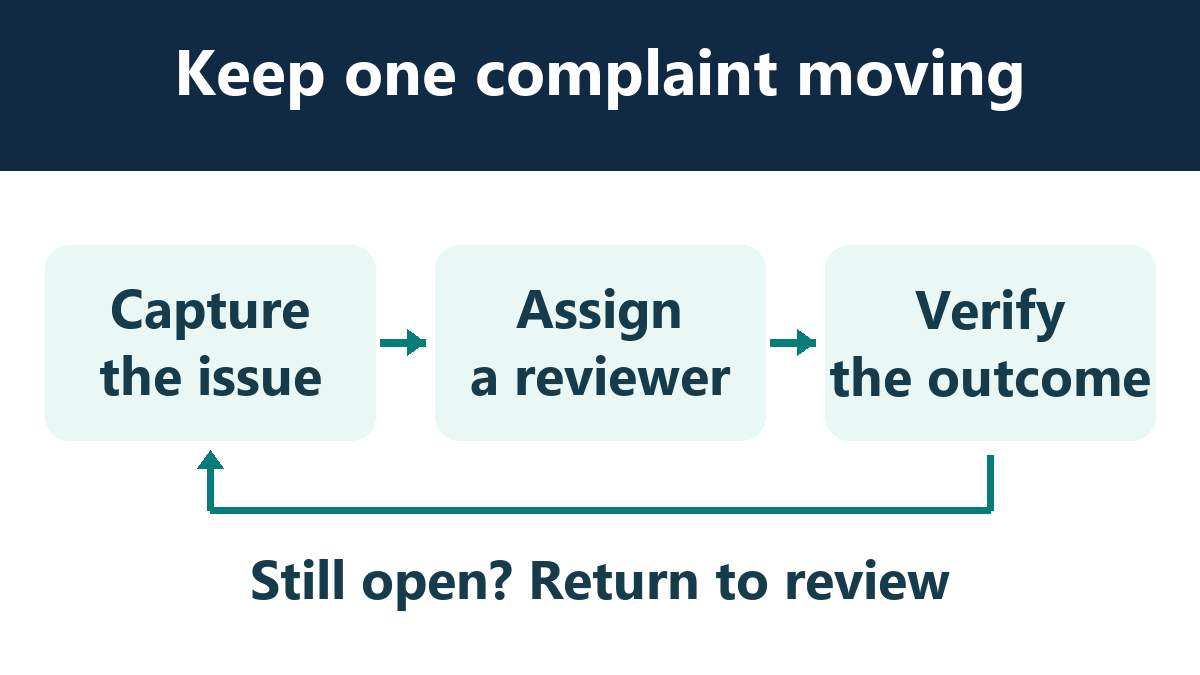
A useful customer complaint handling process gives every case a named owner, a truthful next update and evidence that the agreed action happened. A courteous reply matters, but it cannot tell you whether someone approved the remedy, completed it or checked the outcome with the customer.
This worksheet helps a small-business owner or support lead make those distinctions. Use it with your existing appropriate working system: a restricted case log, a shared service record or another approved tool. The states, examples and checkpoints below are an original operating proposal, not a certified standard, legal timetable or promise about software features.
Give each complaint one owner and one next update
Start with a simple question: who must make sure this particular case moves forward? That person need not perform every task or approve every exception. They must know who is deciding, what remains unverified and when the customer will hear from the business again. A handoff changes the working owner only when the receiving person accepts it.
Use separate states rather than one ambiguous “resolved” checkbox:
- Received: the complaint reached the team and has a record.
- Acknowledged: the customer was told what the team understands and what happens next.
- Assigned: a named person accepted responsibility for the next step.
- Decision approved: someone with the right authority approved a specific action.
- Remedy confirmed: the team checked evidence that the approved action happened.
- Customer outcome: the customer confirmed the result, disputed it or has not confirmed it.
- Reopened: new information or an incomplete remedy requires another working step.
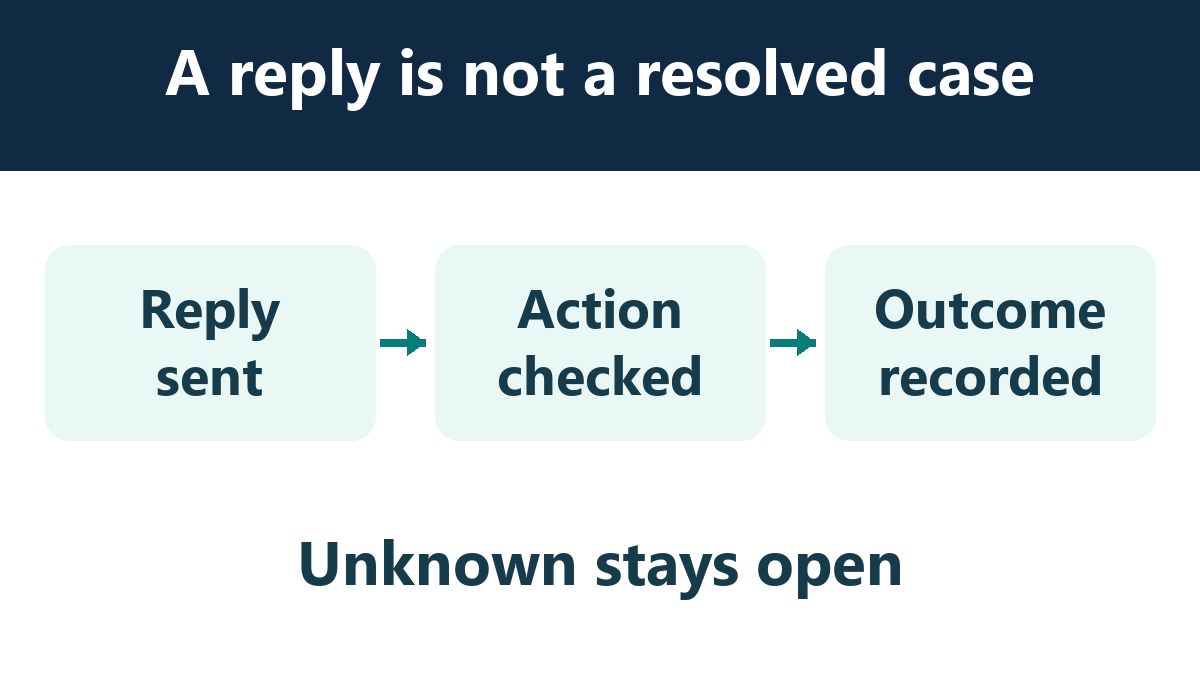
Keep these fields separate when stages overlap. A customer can receive an acknowledgment while the decision is pending. A remedy can be completed without a confirmed customer outcome. Record that uncertainty rather than allowing a neat status label to hide it.
Keep the wider relationship separate from the case decision. The customer retention plan starts with existing-customer context and unresolved service issues; it is not evidence that this complaint is closed or that another offer will fix it.
ISO’s public description of ISO 10002:2018 covers internal product and service complaint handling for organizations of different sizes and notes small-business guidance. Its scope excludes external dispute resolution and employment disputes. That is useful context; this worksheet does not reproduce the paid standard or establish conformity with it.
Keep only information needed to understand and act on the complaint. Put sensitive supporting material in the business’s appropriate restricted system, not in a widely copied handoff note. The working summary should help the next person act without redistributing unnecessary customer details.
Copy a minimum complaint case log
A case log should answer the next reviewer’s questions without becoming a transcript archive. Copy the fields below, then replace each prompt with facts for one complaint. “Unknown” is a useful entry when it comes with a question, an owner and a planned check.
| Field | What to record |
|---|---|
| Received and channel | When the complaint arrived, the timezone and the customer’s appropriate reply channel. |
| Issue summary | One neutral sentence describing the disputed experience, without assigning blame. |
| Requested next step | What the customer is asking the business to consider; do not imply approval. |
| Facts and questions | Verified observations, their evidence and the specific points still unknown. |
| Owner and backup | The reviewer who accepted the case and who covers their absence. |
| Authority boundary | What the reviewer can explain or approve, and who decides exceptions. |
| Next update | A specific date, time and timezone, plus what the update should contain. |
| Decision and remedy | The approved action separately from evidence that it was completed. |
| Customer outcome | Confirmed satisfactory, disputed or unconfirmed; record the basis. |
| Related or reopened case | A connection to earlier work, the new information and the next assigned step. |
Avoid replacing evidence with an impression. “The appointment was missed” may be the customer’s report; “the calendar shows a booking” is a separate observation. Neither proves whether the business and customer had the same location, time or confirmation. Label the sources and write the remaining question.
Also distinguish a proposed action from a commitment. “Ask the supervisor to consider a replacement” is not “a replacement is approved.” Add the approver and decision before the owner communicates a definite remedy. This makes a missing decision visible instead of leaving the customer to discover it later.
Set an escalation matrix before promising a remedy
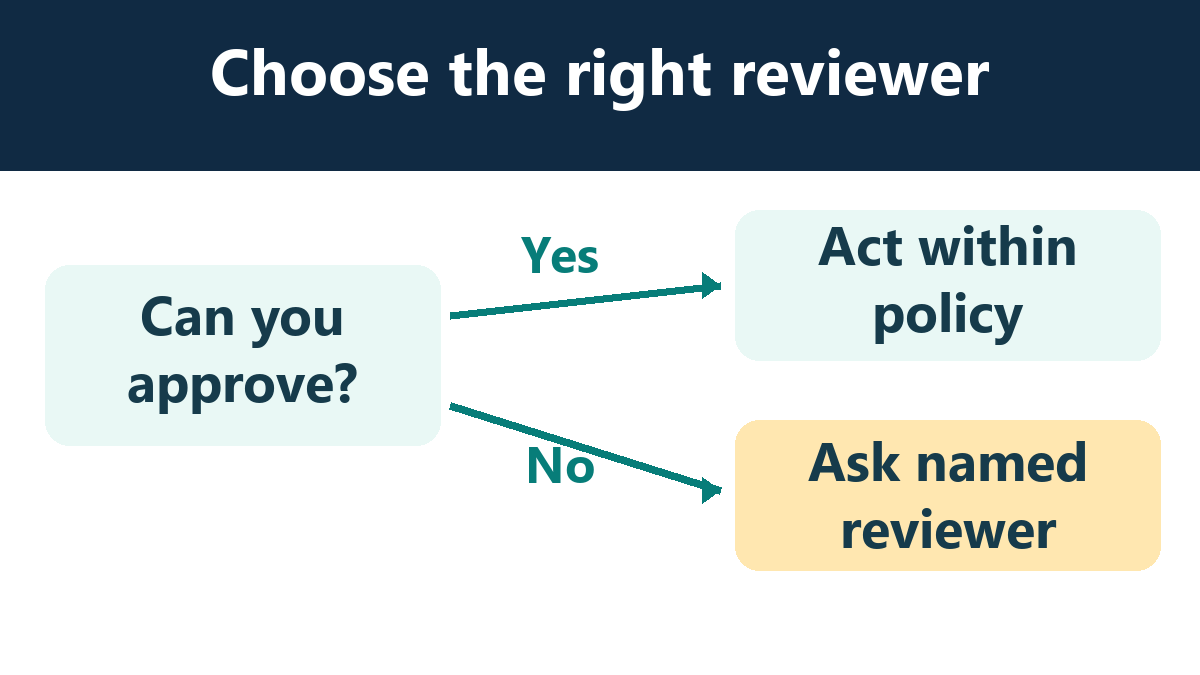
The matrix answers two questions: who can decide, and what must the owner do while waiting? Build it around your actual policies and staff authority, not a chatbot’s confidence or the customer’s tone.
| Review level | Permitted working step | Boundary and next step |
|---|---|---|
| Frontline owner | Clarify the issue, check ordinary records and explain an applicable approved policy. | Do not invent an exception or promise an action outside assigned authority. |
| Supervisor | Review a disputed interpretation or an exception within their actual authority. | Record the decision and conditions; assign any separate completion task. |
| Authorized specialist | Review account access, security, privacy, legal or safety concerns through the appropriate process. | Limit unnecessary sharing and avoid unsupported technical or legal conclusions. |
Price disputes, refunds and billing adjustments need the person authorized for that decision. A complaint involving suspected account compromise belongs with the appropriate security or account reviewer. The case owner can coordinate the next update without making those decisions themselves.
The U.S. Chamber of Commerce’s business guidance recommends documenting the process and timelines, deciding when escalation is needed and making responsibilities clear. Translate that advice into a small matrix your team can actually use, rather than treating an escalation as an unexplained transfer.
Write update commitments in unambiguous terms. In a fictional policy, “by 3 p.m. Pacific time on the next staffed business day” means something different from “within 24 calendar hours.” State the actual date when replying. If a closure day makes the promise unworkable, agree a realistic update instead of quietly resetting the clock.
The next update is not a guaranteed resolution. It can truthfully report that the supervisor is still checking a record, identify what is missing and give the next checkpoint. When that checkpoint is at risk, the owner should revise the expectation before it passes, without pretending the remedy has progressed.
Rehearse three fictional cases
These invented examples demonstrate the worksheet, not actual customer results or software behavior. The evidence checks are deliberately different: a warehouse action, disputed appointment records and a recurring specification problem.
Case 1: A component is missing from an order
Known and unknown: the order record lists a kit containing the component; the customer reports it was absent. A packing checklist is available, but the team has not established what reached the customer. The requested next step is a replacement, not yet approved.
Owner and authority: the service reviewer owns the case. The warehouse lead checks packing evidence; the authorized supervisor decides the proposed replacement. The reviewer cannot treat a warehouse query as approval.
Sample acknowledgment: “You expected the complete kit and have reported a missing component. I am checking the packing record and the replacement request. I will update you tomorrow, Tuesday, by 3 p.m. Pacific time, even if the decision is still pending.”
Action proof: if a replacement is approved, record that decision separately from the dispatch record. Dispatch evidence confirms a warehouse step, not receipt of a complete kit. Check the actual customer outcome through the appropriate agreed channel.
Closure or reopening: if the customer confirms the missing component arrived, record that outcome. If completion cannot be verified, leave it unconfirmed and assign a follow-up check. If the replacement is also incomplete, reopen the linked case with that new fact; do not start an unrelated record that conceals the first attempt.
Case 2: A service appointment is disputed
Known and unknown: a booking exists, the customer says no one attended, and a staff note says the visit could not proceed. The available records do not yet establish whether both parties received the same appointment details. Avoid treating either account as a proven explanation.
Owner and authority: the scheduling reviewer compares confirmation and attendance records. A supervisor decides any exception to the usual appointment policy. The owner asks only for missing details that are necessary, rather than requiring the customer to retell the whole complaint.
Sample acknowledgment: “The appointment records do not yet explain the different accounts. I am checking the confirmation details and visit note. I will update you by 11 a.m. Pacific time on Thursday with the findings or the specific question still open.”
Action proof: a proposed new appointment is not a completed service. Record the authorized decision, any accepted booking and, later, evidence of the service itself. Do not announce that the complaint is resolved because a calendar entry changed.
Closure or reopening: ask whether the agreed action addressed the reported problem. If the customer disputes the result, record the remaining disagreement and authorized reviewer. If a new appointment does not happen, reopen the same history so the next person sees both commitments.
Case 3: A specification mismatch keeps recurring
Known and unknown: the customer reports that a replacement still differs from the agreed specification. The team has the accepted specification and two fulfillment records, but it has not checked which version the fulfillment team used.
Owner and authority: the service owner coordinates a technical or operations reviewer who can compare the actual item or work with the agreed requirement. An authorized manager decides any corrective commitment. Repeating the previous remedy without examining the mismatch is not a verified fix.
Sample acknowledgment: “The replacement has not addressed the difference you reported. We are comparing the accepted specification with the fulfillment instructions before proposing another action. I will update you Friday by 2 p.m. Pacific time, including what we have verified.”
Action proof: record the approved correction, the specification used and the actual check of the corrected result. A changed instruction does not prove the delivered result matches it.
Closure or reopening: retain separate operational and customer checks. If the team cannot inspect the result and the customer has not confirmed it, the outcome remains unknown. Keep an owner and next checkpoint. A later mismatch reopens the linked case and identifies which previous verification was insufficient.
Use a handoff note that prevents restarting the conversation
Handoff quality is visible in what the next reviewer can do without another explanation. Use this compact note in your appropriate existing system:
- Issue and requested next step: the neutral summary and what the customer wants considered.
- Verified / unknown: the evidence already checked and the exact open question.
- Authority / decision: who can decide and what, if anything, is approved.
- Next action / accepted owner: one working step and its receiving person.
- Customer update: the promised time, channel and information to provide.
- Completion check / reopen trigger: what would establish the result and what returns it to review.
Completed fictional example: “Appointment disputed. Customer requests a review before another booking. Booking exists; confirmation details and attendance account are not reconciled. Scheduling supervisor will compare those records; no exception is approved. Supervisor accepted the review. Service owner will update the customer Thursday by 11 a.m. Pacific time through the agreed channel. A corrected booking alone does not establish service completion. A further missed visit returns this case to review.”
BBB’s business guidance on responding to complaints emphasizes professionalism, understanding the facts, explaining the actual policy and following up. A specific handoff preserves those intentions after the first conversation ends.
Respect the customer’s contact choices. Do not promise a call when they asked for written updates, and do not interpret silence as acceptance. If contact stops, record what was attempted through the appropriate channel and distinguish administrative inactivity from a confirmed satisfactory outcome.
Before the original owner steps away, the receiving reviewer should confirm the assignment and identify any missing authority or evidence. If they cannot accept it, the original owner keeps the working responsibility while arranging a suitable reviewer. Two teams may investigate different questions, but the customer should not receive contradictory commitments from two apparent case owners.
For an absence, the backup reads the existing decision and next-update commitment before replying. They should not restart the deadline simply because the case changed hands. If the available evidence cannot support the promised decision, communicate that limit and the revised checkpoint clearly.
Separate response, remedy and closure measures
Use counts that explain the work rather than one oversized “resolution rate.” In a fictional cohort of ten distinct complaints received during one period, eight were acknowledged, six had a confirmed remedy and four had customer-confirmed outcomes by the same reporting cutoff.
| Messen | Numerator / denominator | Ergebnis |
|---|---|---|
| Acknowledged | 8 acknowledged / 10 received complaints | 80% |
| Remedy confirmed | 6 confirmed remedies / the same 10 received complaints | 60% |
| Customer outcome confirmed | 4 confirmed outcomes / the same 10 received complaints | 40% |
Those figures are not interchangeable. They do not establish why customers stayed, whether a remedy was fair or how much revenue the business earned. They identify three different checkpoints in the same received-case cohort.
BBB’s own external complaint process distinguishes “Answered” from “Resolved”; its resolved outcome includes complainant verification. That distinction illustrates why an answer and a confirmed result should not be collapsed into one label. BBB’s process is not a universal deadline or a rule governing this worksheet.
Label the reporting cutoff and allow unfinished cases to remain visible. Cases closed this week can include complaints received earlier; do not divide that closure count by this week’s new complaints and call it the same cohort rate. If the denominator is missing or zero, report “not calculable,” not zero percent. If confirmation is unknown, keep it unknown.
Once individual cases are accurate, review repeated themes separately. The guide to customer feedback analysis tools and techniques addresses that later collection and analysis job. It is not a substitute for assigning authority or verifying the remedy in a particular case.
Test a non-sending rehearsal and improve one verified weak step
Before changing the live process, run one fictional complaint through the log with the people who would handle it. Do not send test messages to customers, submit real refund requests or change account access. The purpose is to expose a missing responsibility or check.
- Have the first reviewer separate the customer’s report from verified facts.
- Ask the intended owner to accept the next working step.
- Check who can approve the proposed action and who covers an absence.
- Read the next-update promise aloud, including date and timezone.
- Describe evidence that would prove completion, not merely approval.
- Test a disputed result and an unconfirmed result without forcing closure.
Choose one demonstrated weakness to correct. If the receiving person never accepted the handoff, repair that step. If staff cannot distinguish dispatch from receipt, change the completion question. Repeat the fictional case after the small correction and check whether the gap remains.
For business teams considering Messenger Bot, use this rehearsal to identify where clearer replies and human handoffs would help. Check Current Pricing when evaluating whether the available plans fit your business. Verify the features available in your account before building a process around them. This worksheet does not claim that complaint records, decisions or corrective actions are created or completed automatically.
Five questions about putting the worksheet to work
What should a customer complaint record include?
Record the issue, requested next step, verified facts, open questions, accepted owner, decision authority and next update. Keep the approved decision separate from evidence that the remedy happened. Record whether the customer confirmed the outcome, disputed it or has not confirmed it, using only the customer details needed for the work.
When should a complaint be escalated?
Escalate when the next decision exceeds the owner’s authority, the evidence remains disputed or an earlier remedy has failed. Account, security, privacy, legal and safety concerns need the appropriate authorized reviewer. Keep a named owner and a truthful customer update while that review is pending.
What is the difference between response time and resolution time?
Response time measures the interval to a defined reply, such as an acknowledgment. Resolution time needs a separately defined endpoint, such as a verified remedy or customer-confirmed outcome. State the endpoint, reporting cutoff and whether the clock uses business or calendar hours; do not treat an update promise as a guaranteed resolution.
When can a complaint be closed?
Use an explicit closure rule that distinguishes the approved action, verified completion and customer outcome. Record what evidence supports each stage. If completion or satisfaction cannot be verified, label that outcome unconfirmed rather than declaring success. An administratively inactive case is not the same as a customer-confirmed resolution.
What if the customer does not respond or the problem returns?
Respect the agreed contact channel and record the appropriate follow-up without treating silence as agreement. Keep the outcome unconfirmed when confirmation is missing. If the problem returns, reopen the linked history, record the new information and assign an accepted owner, decision boundary and next update.

 Deutsch
 English
 Tagalog
 简体中文
 العربية
 हिन्दी
 Português do Brasil
 Español de México
 Français
 বাংলা
 香港中文
 繁體中文
 Nederlands
 Bahasa Indonesia
 日本語
 한국어
 Polski
 Русский
 Español
 Tiếng Việt