

Evidence review date: July 27, 2026. A page that says “free registration” may still lead to an activation charge, a referral-only form, an unclear operator, or withdrawal conditions that appear only after signup. A working form proves that a route responded; it does not prove that the route is official, the service is safe, or a promised payout will arrive. This checklist is designed to help you slow the process down and verify each claim before you share personal information or send money.
The earlier version of this page described several services as active or legitimate and mixed registration guidance with broad earning claims. Those statements were not supported by retained, current evidence. They have been removed. This refresh does not endorse any earning platform, quote expected daily income, or treat a social page, referral link, wallet feature, or successful login as payout proof.
This page has one job: help you evaluate a registration route and its fee terms. For the wider evidence review—including current cautions about route availability, platform identity, and payout claims—read the current Messenger Bot platform safety guide. The two pages serve different purposes: this one is the step-by-step registration checklist; the linked guide is the broader evidence review.
Start with a registration claim, not a registration click
Before opening a signup form, write down the exact claim that brought you there. Was it “free registration,” “no referral required,” “instant withdrawal,” or “official new domain”? A vague claim is hard to test. A written claim can be compared with the page, terms, pricing, and support information you actually find.
Use a simple worksheet with five columns: claim, source, date checked, conflicting evidence, and decision. If a promoter says registration is free but the first-party page lists an account fee, record both statements. Do not average them together or assume one is old. The conflict itself is the result, and it means the route is not ready for payment.
Keep registration evidence separate from earning evidence. A form may let you create an account even when the operator, withdrawal rules, or business model remain unclear. Likewise, a dashboard balance is only an internal number until an independently verifiable withdrawal reaches an account you control and matches the published fee and timing rules.
- Registration evidence shows how an account can be created and which conditions appear before submission.
- Identity evidence connects the domain, company, support channel, and terms to the same operator.
- Fee evidence states the amount, purpose, refund policy, and any later charge in writing.
- Payout evidence documents a completed withdrawal under current rules; it is not supplied by the registration page.
- Wallet evidence explains what the wallet provider can do after funds arrive; it does not prove the platform will send them.
If a claim cannot be assigned to one of these evidence types, it is probably too broad to guide a decision. “Legit,” “trusted,” and “paying” are conclusions, not source documents.
Verify the domain, operator, and route before entering data
Start from a domain you can tie to the operator’s own current materials. Do not rely on a screenshot, shortened link, copied message, or search advertisement by itself. Type the domain carefully, confirm HTTPS, and compare the name shown in the browser with the company name in the terms, privacy notice, support page, and payment instructions.
A domain can load correctly and still be the wrong place to register. Look for identity conflicts such as a .com page calling a different .net address “official,” a support email using an unrelated domain, or pricing pages that point to different signup systems. When first-party routes disagree, stop. The safe next step is written clarification from a support channel that can be independently tied to the operator.
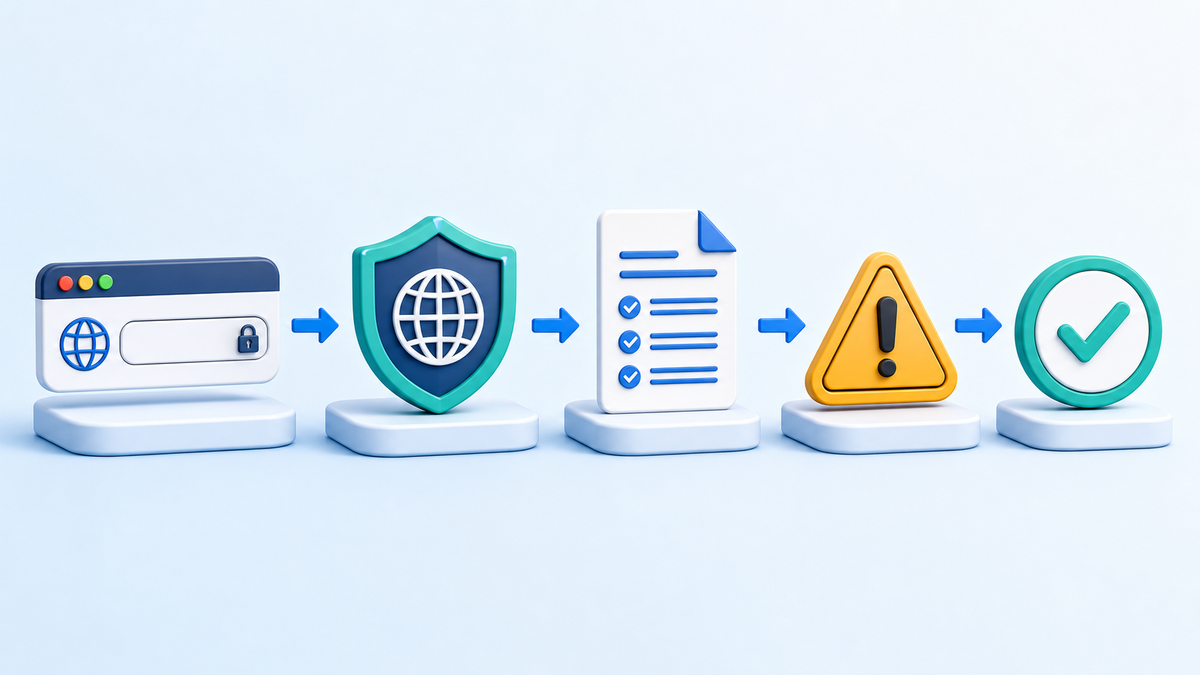
Use this route check before you create an account:
- Confirm the exact domain spelling and the final destination after any redirect.
- Find the operator name in the terms and privacy notice, not only in the logo.
- Compare the login, signup, pricing, help, and withdrawal pages for the same company and domain.
- Check whether the support contact belongs to that domain and whether the response answers the conflict directly.
- Save the page URL and date. Terms can change, so an undated screenshot is weak evidence.
- Leave immediately if the browser reports a certificate warning or the form requests information unrelated to account creation.
Do not “test” an identity conflict by uploading identification or paying a small fee. A small exposure is still an exposure, and it does not resolve who controls the destination.
Read free registration, referral, and activation terms separately
“Free registration” should mean that opening the basic account requires no payment. It does not automatically mean every feature is free, but any required activation, membership, upgrade, or referral payment should be disclosed before personal data is submitted. If the route presents a charge only after the account is created, the original free-registration claim was incomplete.
Referral requirements deserve their own check. A referral-only form proves that access depends on an inviter or code. It does not prove that the inviter is authorized, that the service is safe, or that recruiting others will produce income. Do not buy a code, borrow an identity, or let a promoter create the account for you. You should control the email address, password, recovery method, and device from the first step.
Compare every amount shown on the signup and pricing pages. Record what the fee is called, when it becomes payable, whether it is refundable, what it unlocks, and whether the same terms appear in a durable policy. If one page lists one amount and another page lists a different amount, do not choose the lower figure and continue. Ask the operator to reconcile the discrepancy in writing and identify which document governs the transaction.
| Question | Acceptable evidence | Stop signal |
|---|---|---|
| Is basic registration free? | The signup form and current terms both say no payment is required to open the basic account. | A fee, deposit, paid referral code, or activation payment appears later without prior disclosure. |
| Is a referral required? | The requirement and the inviter’s role are explained in first-party terms. | A promoter sells codes, requests your password, or says the requirement can be bypassed. |
| What does a fee buy? | The purpose, amount, refund rule, and service delivered are consistent across first-party pages. | Signup and pricing pages disagree, or the fee is described as guaranteed earning capital. |
| Can the terms change? | The page has a date, version, and understandable change policy. | Important conditions exist only in a private message or disappearing post. |
A non-refundable fee carries real loss risk even when the website is functioning. If the first-party terms also say earnings are not guaranteed, treat that language literally. Do not reframe it as a promise that most users earn or that payment is only a matter of time.
Separate wallet cash-out rules from platform payout proof
Wallet documentation answers questions about the wallet. It may explain eligibility, transaction limits, fees, QR-code expiry, or where a cash-out is available. It does not establish that a separate earning platform will send funds into the wallet. These are two different transactions controlled by different systems.
For example, the official GCash Help Center page for RCBC Scan to Withdraw, checked July 27, 2026, described eligibility for fully verified accounts, a 100-peso minimum, a 5,000-peso maximum, an 18-peso fee, and a five-minute QR expiry. Those are GCash and RCBC route conditions. They do not verify any earning service, platform balance, or payout promise.
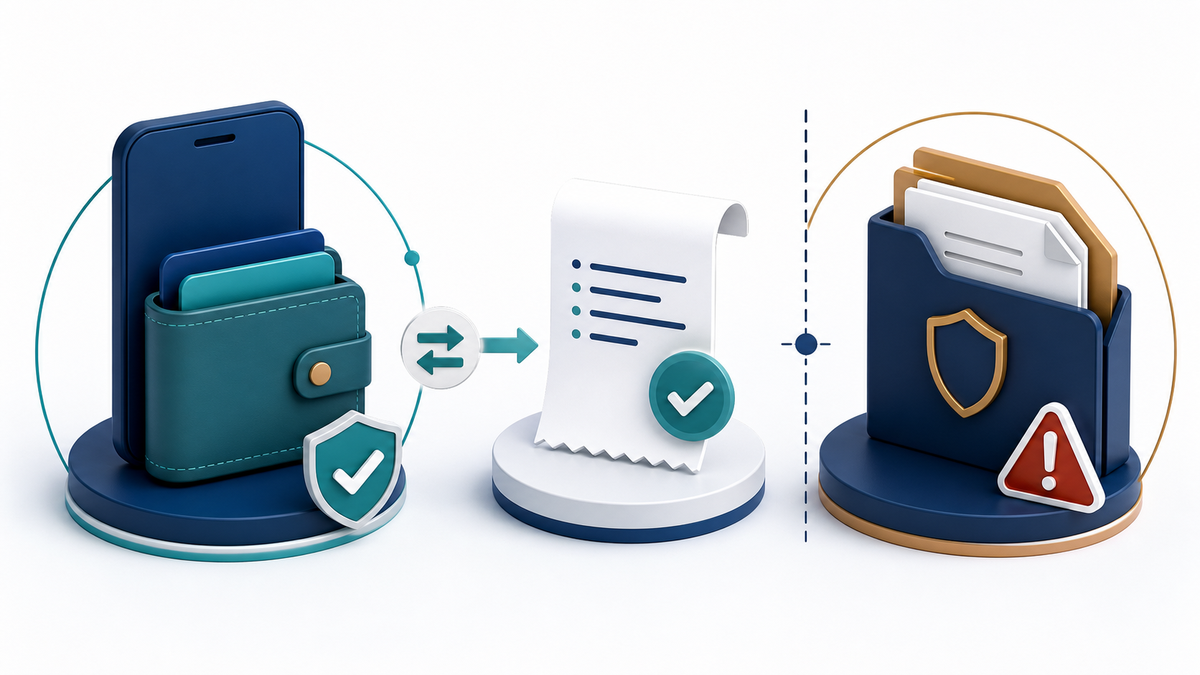
When a platform claims to support a wallet, verify the platform side and the wallet side separately:
- Find the platform’s current written withdrawal rules, minimum, fee, processing time, and account-name requirements.
- Find the wallet provider’s current eligibility, limits, fees, and security guidance.
- Confirm that the destination account belongs to you and that you can access its recovery method.
- If the evidence is otherwise sufficient, test only the smallest permitted withdrawal and save the platform request, transaction reference, wallet receipt, date, and final amount.
- Never send a new “release,” “verification,” or “tax” payment solely because a private message says it will unlock a pending withdrawal.
Even a successful small withdrawal is time-bound evidence of one transaction. It should not be promoted as a lifetime guarantee, a promise of profit, or proof that larger withdrawals will behave the same way.
What the dated route checks show—and do not show
The following observations come from a limited review of public first-party routes on July 27, 2026. They are included to demonstrate how the checklist works. They are not rankings, endorsements, or instructions to register.
| Search name | Dated observation | What remains unresolved | Decision |
|---|---|---|---|
| MathBot | The public signup page described a 140-peso non-refundable fee and said earnings are not guaranteed. The public pricing page listed Starter at 160 pesos and Premium at 360 pesos. | The signup and pricing amounts conflict, and no payout endorsement follows from either page. | Do not pay until the operator reconciles the amount and governing terms in writing. |
| MathBot V2 | The public signup route required a referral link. | A referral gate does not establish operator identity, safety, or payout reliability. | Do not buy or borrow access. Verify the operator and terms before sharing data. |
| ECNL search routes | Standard certificate validation failed for the .com routes. A diagnostic retrieval exposed pages labeled EBooks Digital with metadata pointing to ebooks-digital.com, while the .net routes returned loading/challenge pages. | The certificate, visible brand, metadata domain, and requested ECNL domains did not establish one consistent identity. | Do not register, pay, or upload documents until the operator resolves the domain conflict. |
| Chrome Encoding | A public Facebook presence was reachable. | A social page is not current first-party proof of fees, terms, identity, or payouts. | Treat the page as presence evidence only. |
| KKCB, GoECB, and OLA search names | This limited review did not retain sufficient current first-party evidence to support registration guidance. | Identity, current terms, fees, and payout claims remain unverified here. | No recommendation or registration link is provided. |
The MathBot observations were taken from the first-party signup terms y página de precios. The MathBot V2 observation came from its first-party signup route. The ECNL result came from comparing certificate behavior, returned page identity, metadata, and route behavior rather than treating a response code as proof of identity. Each result is a dated snapshot and should be checked again before any action. For the full row-by-row source review, use the dated MathBot registration-cost comparison.
An unavailable route is not automatic proof of fraud; outages, maintenance, and migrations occur. But an unavailable route cannot support a claim that registration is currently safe or official. The correct label is unresolved, followed by a new check through an independently verified operator channel.
Use a two-pass registration review
A two-pass review reduces the chance that urgency, persuasive copy, or sunk cost will control the decision. Complete the evidence pass first. Only if every material conflict is resolved should you begin the account-security pass.
Pass one: evidence and terms
- Record the exact domain and the source that identified it as official.
- Save the terms, privacy notice, pricing, withdrawal page, and support contact.
- Compare every fee and minimum across those pages.
- Identify whether a referral is optional, required, or paid.
- Look for a clear operator identity and an explanation of how user rewards are funded.
- Search your notes for contradictions. Any unresolved contradiction blocks the second pass.
Pass two: account and data safety
- Use a unique password and enable multi-factor authentication when the service supports it.
- Control the email address, phone number, recovery method, and wallet yourself.
- Provide only data required by a clear written purpose and privacy notice.
- Do not install remote-access software or let a promoter operate your device.
- Do not reuse a wallet PIN, email password, or one-time code on the platform.
- Keep receipts and dated copies of the terms you accepted.
If the service pressures you to finish registration before you can read the terms, the review has already produced a useful answer: stop. A legitimate account process should survive a careful reading.
Recognize claims that the registration page cannot prove
Registration copy often tries to answer questions that only later evidence can resolve. Treat the following phrases as prompts for more documentation, not conclusions:
- “Legit paying app” requires current operator, terms, and transaction evidence. The phrase on a page is not that evidence.
- “Guaranteed earnings” is incompatible with ordinary uncertainty and may conflict with the platform’s own disclaimers.
- “Instant withdrawal” should be compared with written processing times, minimums, fees, holds, and identity checks.
- “Official new link” requires a verifiable connection from the established operator to the new domain.
- “Limited slots” is not a reason to skip identity, fee, and privacy checks.
- “Verified by thousands” needs a disclosed source and method; a testimonial count is not an audit.
Do not rely on a private chat as the only source for a fee, refund rule, or withdrawal condition. Ask for the governing first-party document. If the promoter refuses, changes the subject, or tells you the written terms do not matter, do not proceed.
Protect identity documents and account recovery
Identity verification can be legitimate in financial and regulated services, but the request must be tied to a clear operator, privacy notice, purpose, retention rule, and secure route. Never upload identification merely to investigate whether a site is official. Resolve the operator and domain first.
Be especially careful when a promoter asks for an identification photo through direct messaging, requests a selfie holding credentials without a first-party explanation, or offers to “help” by controlling the account. Those steps can expose both the document and the recovery path. A later password change may not repair an account created with someone else’s email, phone, or device.
Before submitting sensitive information, answer these questions:
- Who is the legal operator receiving the data?
- Why is each item required at this stage?
- Where is the privacy notice, and how long will the data be retained?
- Can you correct or delete the account through an authenticated process?
- Does the upload stay on the verified first-party domain?
- Can support identify the exact policy that governs the request?
If you cannot answer those questions, do not upload the document. Preserve the route and screenshots for reporting, but do not increase the exposure simply to gather more evidence.
Know which Messenger Bot you are evaluating
Search results can combine unrelated products that share similar words. Messenger Bot on this website is business messaging automation software. It helps organizations configure automated conversations; it is not a paid-task, investment, wallet, or guaranteed-income service. A page about a similarly named earning platform should not be treated as a description of this software.
If you are evaluating business automation, use the product documentation and Explora Nuestros Tutoriales. If you need plan information, Verificar Precios Actuales. Product pricing is a charge for software features, not a deposit into an earning program, and no sales or income result is guaranteed.
When you evaluate any search result, match the domain, operator, product purpose, and terms before carrying claims from one service to another. Similar names are not shared ownership.
A reusable decision record
Finish the review with a short decision record. This prevents an unresolved warning from being forgotten after a persuasive follow-up message.
| Field | What to record |
|---|---|
| Route | Exact final domain, signup URL, redirect destination, and date checked. |
| Operator | Legal or trading name shown in terms, privacy notice, and support channel. |
| Accede a | Whether registration is open, referral-gated, fee-gated, or unavailable. |
| Money | Every fee, refund rule, withdrawal minimum, processing time, and conflict. |
| Datos | Information requested, stated purpose, retention terms, and recovery owner. |
| Evidence state | Verified, contradicted, unavailable, or not independently verified. |
| Decision | Proceed to a limited account test, request written clarification, or stop. |
A “stop” decision does not require proving that a service is fraudulent. It means the available evidence is not sufficient for the requested exposure. That is a practical safety standard: the person asking for your money or data carries the burden of resolving material conflicts before you proceed.
Preguntas frecuentes
Does free registration mean there will never be a fee?
No. It should mean that opening the basic account does not require payment, but a service may disclose optional paid features later. Any mandatory activation, referral, deposit, or upgrade charge should be clear before you submit personal data. If a required fee appears only after signup, pause and compare it with the original claim and written terms.
Is a working signup page proof that a platform is legitimate?
No. It proves only that a route responded during the check. Operator identity, domain control, privacy terms, fees, account security, and withdrawal performance need separate evidence.
What should I do when signup and pricing pages show different fees?
Do not pay either amount. Save both pages and ask the operator to reconcile the difference in writing, including which terms govern the transaction and whether the fee is refundable.
Does a GCash cash-out feature prove that an earning platform pays?
No. Official wallet documentation describes what the wallet or partner channel can do after eligible funds are available. It does not prove that a separate platform will initiate a valid payout.
Should I register through an ECNL .com page if it calls a .net page official?
Not while the identity conflict remains unresolved. During the July 27, 2026 check, standard certificate validation failed for the .com routes; a diagnostic retrieval showed a different visible brand and metadata domain; and the .net routes returned loading/challenge pages. Do not bypass a certificate warning, register, pay, or provide documents until an independently verified operator channel resolves the conflict.
Is Messenger Bot on this website an earning platform?
No. Messenger Bot on this website is business messaging automation software. It does not guarantee sales, profits, payouts, or personal income.



 Español de México
  English
  Tagalog
  简体中文
简体中文  العربية
  हिन्दी
  Português do Brasil
  Français
  বাংলা
বাংলা  香港中文
香港中文  繁體中文
繁體中文  Nederlands
  Deutsch
  Bahasa Indonesia
  日本語
日本語  한국어
한국어  Polski
  Русский
  Español
  Tiếng Việt