
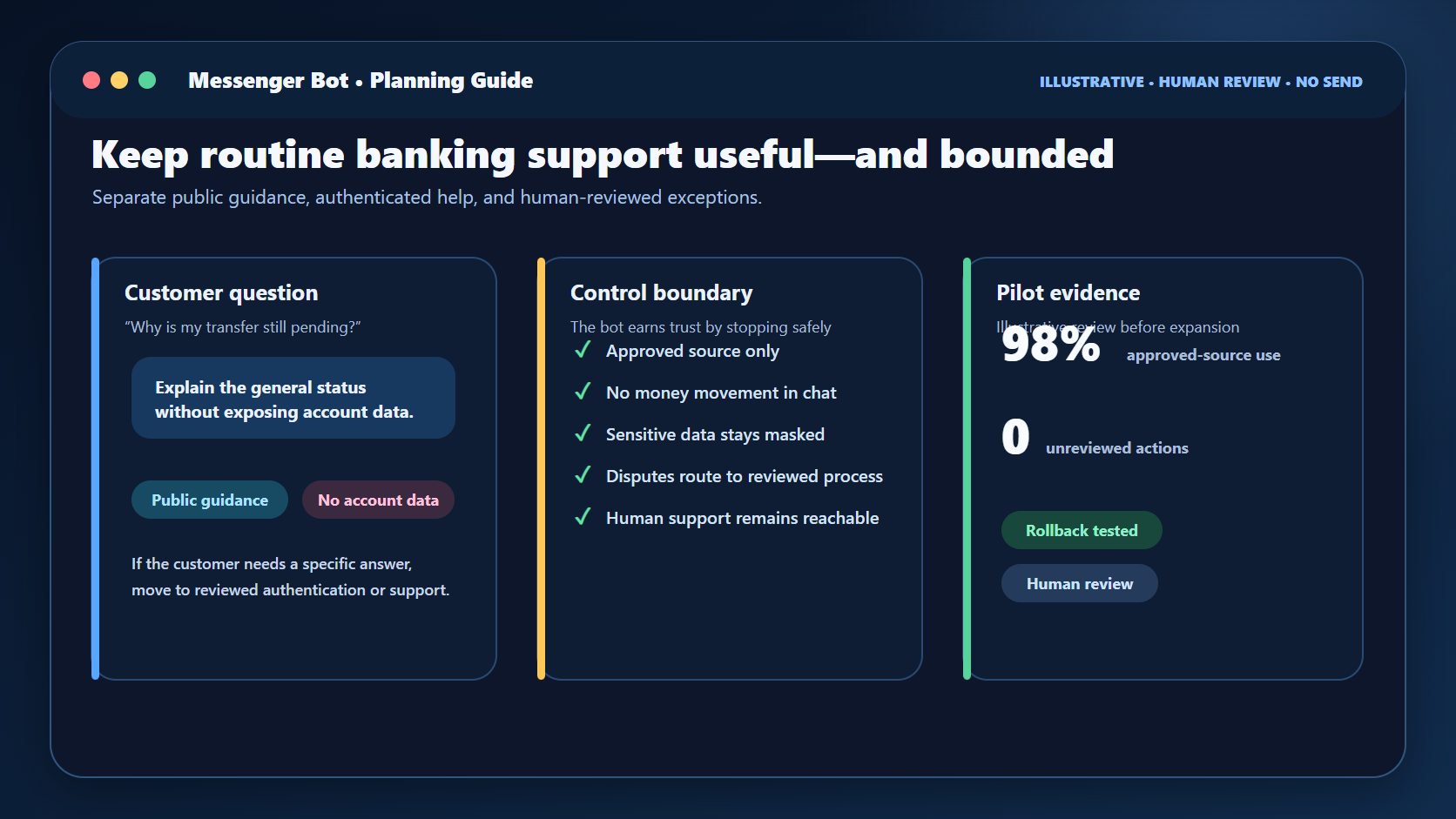
The integration of artificial intelligence into financial services is fundamentally changing how institutions interact with their customers. A well-implemented banking chatbot serves as a powerful tool for handling routine inquiries, streamlining account management, and providing consistent support. However, deploying a chatbot for banks involves unique challenges, particularly regarding security, privacy, and regulatory compliance. This practical planning guide outlines the essential components of a financial chatbot implementation, helping business leaders and product managers navigate the complexities of conversational AI in the banking sector. Note that this article is a planning guide, not legal, compliance, security, or financial advice; institutions should always have qualified legal and compliance teams assess their specific obligations and risk posture.
Whether you are evaluating a new banking chatbot initiative or optimizing an existing deployment, understanding the right use cases and establishing robust risk controls is critical. Financial institutions need to balance the drive for operational efficiency with customer protection and data security. Below, we explore suitable applications for chatbots in banking, detail considerations for security frameworks, and provide a comprehensive pilot checklist for effective deployment.
Suitable Use Cases for a Banking Chatbot
Not every customer interaction is suitable for automation, especially in finance where errors carry significant consequences and complex issues require human nuance. Identifying the right use cases is the first step in deploying a successful banking chatbot. The most effective deployments focus on high-volume, low-complexity inquiries that do not require deep emotional intelligence, complex discretionary judgment, or extensive troubleshooting.
Routine Account Inquiries and Navigation: Chatbots excel at answering straightforward questions such as checking account balances, locating nearby ATMs or branches, and reviewing recent transaction history. By automating these routine tasks, financial institutions can reduce general inquiry volume, allowing human agents to focus on more complex customer needs like loan origination or detailed account reviews. A chatbot can quickly pull this data via secure APIs and present it in a digestible format within the chat window, provided the user is appropriately authenticated.
Basic Transaction Assistance and Alerts: A chatbot for banks can guide users through basic transactions, such as transferring funds between internal accounts or paying standard utility bills. These workflows should be tightly constrained and require clear user confirmation at each step to prevent accidental actions. Furthermore, chatbots are excellent vehicles for proactive alerts, such as notifying a user of a low balance to help them manage their funds or flagging a suspicious transaction for review. However, institutions must carefully assess the risk of allowing bots to initiate complex money movement without sufficient secondary review.
Financial Literacy and Product Discovery: Chatbots can proactively assist customers in discovering relevant financial products, such as savings accounts or credit cards, based on their explicit inquiries. They can also provide basic financial literacy tips, helping users understand general terms. It is crucial, however, that these bots provide general, educational information. Institutions should constrain high-risk advice and have their counsel and compliance teams approve the bot’s scope, as providing personalized financial advice carries regulatory implications.
If you are looking for a reliable platform to build out conversational flows and manage customer interactions at scale, you can See Our Plans to explore solutions designed for professional deployments.
Establishing Secure Authentication Boundaries
Security is a paramount concern when deploying any banking chatbot. Customers should be authenticated through the institution’s reviewed controls before the bot can access or disclose personal financial information. Establishing clear authentication boundaries helps protect both the consumer and the institution from unauthorized access.
Pre-Authentication vs. Post-Authentication Experiences: A banking chatbot should offer distinctly different experiences based on the user’s authentication state. Before logging in (the pre-authentication phase), the bot should generally only answer general FAQs, such as branch hours or generic product features. Once the user logs in via the bank’s secure portal, the chatbot transitions to an authenticated state. The chatbot interface itself should generally avoid collecting primary login credentials like passwords or PINs directly in the chat window, as this can condition users to unsafe behaviors. Instead, rely on established authentication gateways.
Step-Up Authentication Integration: For actions that move money, alter account settings, or view highly sensitive data, the chatbot workflow should integrate with the institution’s existing framework for step-up authentication. Institutions should use their approved methods and risk-based controls—such as utilizing an authenticator app, hardware token, or other verified channels—to confirm the user’s identity. This additional layer of security ensures that critical actions require out-of-band or secondary verification, aligning with the bank’s broader risk policies.
Session Management and Risk-Based Controls: Chatbot sessions dealing with financial data should use controls reviewed for the institution’s risk profile. Those controls can determine when a session times out due to inactivity and how chat history is managed on the user’s device. These policies can reduce unauthorized-access risk if a user leaves a device unlocked, and should align with the bank’s broader digital security guidelines rather than relying on arbitrary, universal time limits.

Privacy and Security Review for Financial Bots
Beyond user authentication mechanisms, the architecture of a banking chatbot should undergo a privacy and security review to support compliance with financial regulations and general data protection standards.
Data Encryption and Technical Safeguards: Communication between the user’s device and the chatbot server should be encrypted in transit using current, robust protocols approved by the institution’s security team. Furthermore, chat logs or user data stored by the system should be encrypted at rest. Security and encryption practices should be evaluated as key risk-review considerations during the design phase to ensure they meet the institution’s specific internal standards and threat models.
Data Minimization and Automated Redaction: A core principle of privacy in conversational AI is data minimization. The chatbot should generally be designed to collect only the information necessary to fulfill the user’s request. Financial institutions should establish clear data retention policies. Crucially, Personally Identifiable Information (PII) and Payment Card Industry (PCI) data should be masked or redacted from logs used for system training, quality assurance, or general analytics, to reduce the risk of accidental exposure.
Vendor Risk Management and Due Diligence: When utilizing a third-party platform to host the chatbot for banks, vendor due diligence is a critical risk-review consideration. Institutions should verify the vendor’s security posture, review their incident response capabilities, and evaluate data privacy controls. Contracts should clearly address data ownership, confidentiality, and restrictions on how the vendor may use the bank’s data for training external AI models. Thorough vendor assessments help institutions understand and mitigate third-party risks effectively.
Integrating Cybersecurity Frameworks: Financial institutions often align their security posture with established, voluntary standards to guide their risk management. For example, the NIST CSF 2.0 provides a voluntary risk-management framework for identifying, protecting, detecting, responding to, and recovering from cybersecurity threats. While frameworks like NIST do not prescribe the exact workflow or implementation details for a banking chatbot, they offer a structured methodology that institutions can use to inform their access controls, API security, and overall threat modeling.
Managing Risk Controls and Compliance
The regulatory landscape for financial services is complex, and institutions need to assess how chatbots interact with applicable rules. According to the Consumer Financial Protection Bureau (CFPB), deficient chatbots can lead to law violations, diminished service, and customer harm. While bots may be suitable for basic inquiries, their effectiveness often wanes with complexity.
Constraining Financial Advice: Chatbots must be carefully programmed to avoid providing unapproved personalized financial advice. Providing factual, standardized information is generally acceptable, but advising a specific customer on complex financial decisions introduces risk. Institutions should recommend constraining high-risk advice entirely and having counsel and compliance teams review and approve the bot’s conversational scope before deployment.
Handling Complaints and Formal Disputes: A key consideration for compliance is how a chatbot handles customer complaints and disputes. As highlighted in CFPB research, dispute recognition is essential, but chatbots may be technically limited in conducting full investigations or resolving complex disputes. When a customer expresses intent to dispute a charge or file a complaint, the bot should recognize this possible dispute intent and route customers into the institution’s reviewed, formal process or transfer them to accessible human support. The bot should not invent process outcomes or promise immediate resolution.
Proactive Intent Routing and Auditing: The ability to recognize varying customer intents is vital for a smooth experience. If a user types ‘I did not make this purchase,’ the system should ideally classify this as a potential fraud claim and route the user to the correct fraud resolution team or specialized workflow. Continuous compliance auditing of the chatbot’s natural language understanding (NLU) logic by internal legal and compliance teams helps ensure the bot responds appropriately as institutional policies evolve. Establishing a model governance process supports ongoing alignment with risk management goals.
Human Handoff in Financial Services
A banking chatbot is an augmentation designed to handle routine tasks, not a total replacement for human customer service. A clear path to a live human agent is essential, as human support must remain reachable when the bot cannot meet a customer’s needs.
Triggers for Human Escalation: The system should offer escalation to a human agent under predefined conditions. These might include situations where the user explicitly asks for a human, when the bot repeatedly fails to understand the intent, or when the user attempts to initiate a complex process—like a multi-tiered dispute or hardship request—that exceeds the bot’s authorized capabilities.
Context Preservation During Handoff: When a transfer occurs, passing the context of the conversation to the human agent can improve the experience. Providing the agent with the chat history and the recognized intent aims to reduce the need for the customer to repeat themselves, addressing a common source of frustration. While instant context delivery and reduced wait times are desired outcomes, institutions should measure these conditionally based on their actual system capabilities and staffing levels, rather than promising specific efficiency.
Managing Expectations and Asynchronous Support: The chatbot UI should communicate the status of the handoff accurately. If an agent is available, the bot can provide an estimated wait time if known. If the request occurs outside of normal business hours and live agents are unavailable, the bot should inform the user that live support is currently offline and offer a concrete next step, such as creating a secure support ticket, scheduling a callback, or providing an emergency hotline number for urgent issues like lost cards.
Operational and Implementation Frameworks
To successfully deploy a banking chatbot, cross-functional teams must adhere to strict operational guidelines. The following structured materials provide a foundational methodology for safe implementation, ongoing management, and continuous improvement.
Use-Case Scope Card
A clearly defined scope card establishes the operational boundaries of the chatbot. This document dictates what the bot is allowed to do and what triggers an immediate escalation. This helps manage risk and sets clear expectations for performance.
- Allowed Customer Questions: The bot is authorized to answer general FAQs, provide branch locations and hours, and assist with routing numbers. For authenticated users, it may provide balance inquiries and standard transaction history.
- Allowed Data: The system may process non-personally identifiable information for general inquiries. For authenticated sessions, it may process masked user data strictly as required to fulfill the approved request.
- Prohibited Actions: The bot must not execute money movement without secondary verification, must not process password resets directly in chat, must not update primary contact information without step-up authentication, and must never provide personalized financial advice.
- Escalation Triggers: Immediate handoff is triggered by explicit human requests, potential fraud or dispute keywords, hardship inquiries, or repeated fallback responses due to low confidence.
- Owner: Digital Product Owner or designated conversational AI lead.
- Review Date: Evaluated on a quarterly basis to align with evolving regulatory and business requirements.
- Rollback Condition: Unapproved external claims, potential data leakage, or an unresolved loop rate exceeding predefined institutional risk thresholds.
Pre-Pilot Evidence Pack
Before any conversational AI enters a live environment, a pre-pilot evidence pack ensures all necessary testing and approvals are completed. This documentation serves as a record of diligence.
- Fixture Test Cases: A comprehensive suite of pre-approved user utterances mapped to expected intents, covering both happy paths and edge cases, to validate the natural language understanding model.
- Approved Source Material: The bot’s responses must be generated strictly from approved knowledge base articles, public website FAQs, and curated internal documents.
- Scope Version: Initial deployments should begin with a narrowly defined scope (e.g., version 1.0 focusing on read-only inquiries).
- Reviewer Signoff: Formal, documented approval from Information Security, Legal, Compliance, and Product Management teams prior to launch.
- Safe Fallback Copy: Standardized, compliant language for unrecognized intents, such as offering to connect the user with a specialist without making absolute promises.
- Channel/Account Binding: Clear definition of where the bot operates, such as restricting authenticated features exclusively to the secure portal or mobile application.
- Disable Steps: A documented kill-switch procedure via the administrative dashboard to immediately suspend bot operations if necessary.
Deterministic Pilot Test Matrix
A deterministic matrix outlines how the chatbot should respond to specific scenarios, prioritizing safety and appropriate routing over claiming specific legal outcomes. Expected dispositions are measures of system behavior, not legally binding results.
- Happy Path: A user asks for branch hours; the expected disposition is the bot providing accurate hours based on the requested location using approved source material.
- Ambiguous Request: A user states a broad need like “help with account”; the expected disposition is the bot offering a disambiguation menu with options like balance, transactions, or routing to a human.
- Stale Information: If the bot accesses a knowledge base article past its review date, the expected disposition is to withhold the stale data and provide the safe fallback copy.
- Low Confidence: When natural language understanding confidence falls below the designated threshold, the expected disposition is an immediate transition to the safe fallback copy.
- Requested Human: A user types “agent”; the expected disposition is routing to an available support person and attempting to pass the conversation context to them.
- Dispute/Fraud Language: A user mentions a “stolen card”; the expected disposition is immediate routing to the specialized fraud team without attempting to resolve the issue in the automated chat.
- Account Access: An unauthenticated user asks for a balance; the expected disposition is a prompt to log in securely before proceeding.
- Privacy Request: A user asks to delete their data; the expected disposition is routing the user to the institution’s formal privacy compliance form or team.
- Outage Fallback: In the event of a backend API failure, the expected disposition is a graceful explanation of the system issue and the provision of an alternative contact method.
Practical Measurement Table
Tracking the right metrics is vital for understanding bot performance and identifying areas for improvement. These metrics should be treated as practical measures of the system’s operational health, not as promised outcomes.
- Answer Accuracy Review: The percentage of bot responses that correctly match the approved source material during a sampled review.
- Handoff Completion: The percentage of initiated transfers that successfully connect the user to a live agent.
- Unresolved Loops: The percentage of sessions where the bot repeats the same prompt or fails to progress the conversation.
- Stale-Source Incidents: The frequency with which the system attempts to use expired or unreviewed knowledge base content.
- Unsafe-Action Blocks: The number of times the step-up authentication process correctly prevents an unverified action from proceeding.
- Staff Review Time: The average time required for the quality assurance team to evaluate a standard sample of chat transcripts.
- Comentarios de Clientes: Qualitative and quantitative scores gathered from post-chat surveys to assess user sentiment.
Failure-Response and Rollback Runbook
Institutions must be prepared for unexpected system behavior. A rollback runbook provides clear instructions for mitigating risks during an active incident.
- Pause: Execute the immediate suspension of automated traffic, routing all incoming chats directly to live agents or offline ticketing forms.
- Preserve Safe Evidence: Lock and export all relevant chat logs, system state data, and error reports for thorough root-cause analysis by the engineering and security teams.
- Route Open Conversations: Gracefully notify users currently engaged with the bot about the pause and provide clear, alternative channels for immediate support.
- Restore the Last Approved Scope/Content: Revert the natural language understanding model, knowledge base, or conversational flows to the previously stable and approved version.
- Retest Fixtures: Run the complete regression suite of fixture test cases to confirm the system behaves as expected before considering reactivation.
- Re-Enable Only After Review: Obtain formal signoff from Incident Response, Information Security, and Product teams before resuming any automated traffic.
Governance Cadence and Role Map
Effective chatbot management requires a dedicated, cross-functional team with clear responsibilities. Institutions should adapt these roles to fit their own organizational structure and resources.
- Product Owner: Defines the strategic roadmap, prioritizes use cases, monitors key performance indicators, and serves as the primary decision-maker for the chatbot’s direction.
- Operaciones: Manages day-to-day bot performance, oversees support handoffs, updates the knowledge base, and identifies opportunities to make conversation flows clearer.
- Soporte: Consists of the live agents who receive escalated chats, manage complex customer needs, and provide critical frontline feedback on bot performance and gaps.
- Seguridad: Conducts ongoing threat modeling, reviews encryption protocols, and manages access controls to protect both the institution and the consumer.
- Privacidad: Ensures adherence to data minimization principles, verifies PII masking procedures, and monitors compliance with data retention policies.
- Compliance/Legal: Reviews and approves the bot’s conversational scope, assesses required disclosures, and monitors alignment with evolving financial regulations.
- Engineering: Manages system integrations, tunes the natural language understanding models, ensures system uptime, and executes technical rollbacks when necessary.
Measuring Success and Pilot Implementation Checklist

Deploying a banking chatbot is often approached as a phased process, starting with a pilot program before scaling to broader use cases. Measuring relevant metrics and maintaining tight controls during the pilot helps determine readiness for expansion.
Key Performance Indicators (KPIs) for Banking Bots: Focus on metrics that indicate resolution and user satisfaction. Track the completion rate for specific bot flows, the escalation rate to human agents (and the reasons for escalation), and drop-off points within conversations. Additionally, collect qualitative feedback through post-chat surveys to gauge customer sentiment regarding the automated experience.
Pilot Implementation Checklist:
- Define a narrow, well-understood scope for the pilot phase (e.g., answering general FAQs and providing branch locations).
- Conduct a documented security and privacy review with internal InfoSec, Legal, and Compliance teams to assess risk.
- Implement and test authentication boundaries for any flows that access personalized data.
- Establish a human handoff protocol, aiming to pass relevant conversational context to the agent dashboard where feasible.
- Configure the bot’s NLU model to recognize potential complaint or dispute intents and route them to appropriate human channels or formal workflows.
- Ensure the bot contains visible disclosures that it is an automated assistant and does not provide personalized financial advice.
- Train human agents on how to receive and handle escalated chats based on the specific capabilities of the new system.
By taking a structured, risk-aware approach, financial institutions can explore the benefits of conversational AI for routine inquiries while maintaining focus on the security and support requirements of the banking sector.
Preguntas frecuentes
What are the safest and most effective use cases for a banking chatbot?
The safest use cases involve high-volume, low-risk inquiries such as answering general FAQs, providing branch locations, explaining generic product features, or guiding users through simple tasks like checking an account balance or reviewing recent transactions when properly authenticated.
How do chatbots authenticate users securely?
Secure banking chatbots generally do not collect primary credentials in the chat interface. Instead, they often require users to log in through the institution’s secure, existing portal. Once authenticated, the bot can be granted access to appropriate account data. High-risk actions typically involve institution-approved step-up authentication methods.
Can a banking chatbot independently help with a disputed transaction?
While a chatbot can guide a user to the correct secure form or explain the general dispute process, it generally cannot handle the complex investigation of a dispute itself. Chatbots should be programmed to recognize possible dispute intents and route customers into the institution’s reviewed process or accessible human support.
What happens if a banking chatbot gives incorrect information to a customer?
Incorrect information provided by a bot can lead to customer harm and regulatory scrutiny. Institutions should establish a formal model governance and review process, constrain high-risk advice, and ensure appropriate fallback mechanisms to human agents are available.
Why is human handoff important for financial chatbots?
Human handoff is important because chatbots may be technically limited in investigating and resolving complex or highly nuanced situations. As the CFPB notes, human support must remain reachable when the bot cannot meet the user’s needs.



 Español de México
  English
  Tagalog
  简体中文
简体中文  العربية
  हिन्दी
  Português do Brasil
  Français
  বাংলা
বাংলা  香港中文
香港中文  繁體中文
繁體中文  Nederlands
  Deutsch
  Bahasa Indonesia
  日本語
日本語  한국어
한국어  Polski
  Русский
  Español
  Tiếng Việt