
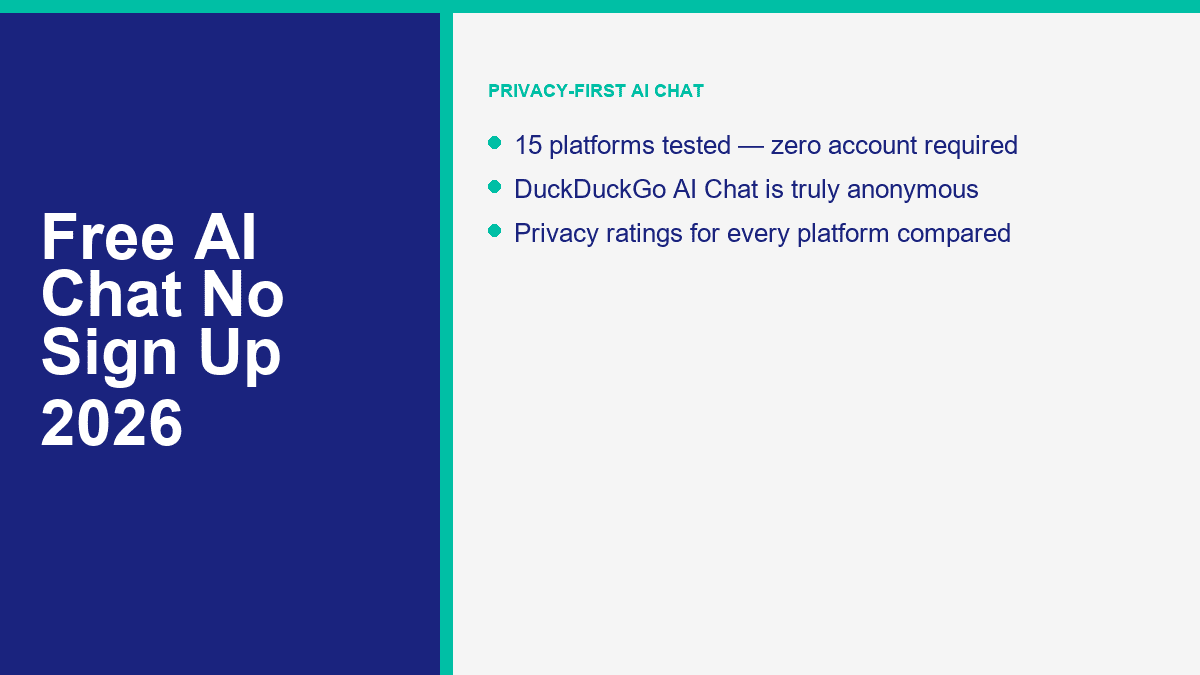
La mayoría de las listas de “chat AI gratuito sin registro” todavía actúan como si esto fuera un simple filtro de sí o no. No lo es. En abril de 2026, algunas herramientas te permiten comenzar a chatear sin ninguna cuenta, algunas permiten una sesión de invitado pero te empujan silenciosamente hacia el inicio de sesión en el momento en que deseas historial o cargas, y algunas marcas todavía se posicionan para esta palabra clave a pesar de que el flujo web actual ahora te pide iniciar sesión antes de que ocurra algo útil.
Revisé páginas de productos públicos, lenguaje de privacidad y flujos de acceso de invitados en vivo el 9 de abril de 2026. Eso importa porque esta categoría cambia rápidamente. Una guía de hace seis meses puede decirte fácilmente que una herramienta es “sin registro” cuando la página actual dice lo contrario. Si deseas la pregunta más amplia de con cuáles AIs puedes hablar gratis, esa publicación complementaria cubre el panorama más amplio de planes gratuitos. Este artículo se mantiene más estrecho: qué herramientas puedes usar realmente ahora mismo sin crear una cuenta, y dónde comienzan las barreras suaves.
Una cosa más antes de la lista. Los resultados de búsqueda para este tema están llenos de sitios de chat de personajes como Wsup, Perchance y PolyBuzz. Algunos de ellos son realmente útiles si tu objetivo es el juego de roles o la conversación casual. Pero si necesitas ayuda con la investigación, respuestas rápidas y fácticas, asistencia para escribir o un filtro realista para uso empresarial, no son suficientes por sí solos. Por eso esta comparación favorece primero los casos de uso prácticos y segundo el entretenimiento. Si quieres la versión centrada en el precio de este tema, consulta nuestra comparación completa gratuita de chatbots de IA.
Lo que realmente significa Sin Registro para el Chat de IA en 2026
La frase suena limpia. La realidad es desordenada. Hay tres ofertas diferentes ocultas bajo el mismo término de búsqueda, y si no las separas, terminas pensando que una herramienta es más privada o más generosa de lo que realmente es.
Acceso verdaderamente anónimo significa que puedes abrir la herramienta, aceptar los términos y comenzar a chatear sin dar un correo electrónico, número de teléfono o inicio de sesión social. Duck.ai, Brave Leo, Venice, Andi, SlagBot, Wsup.ai y Perchance encajan mejor en esta categoría. Eso no los hace automáticamente privados, pero elimina una capa obvia de identidad.
Acceso de invitado con límites significa que el producto funciona sin una cuenta para una primera sesión, pero las comodidades básicas permanecen bloqueadas. ChatGPT, Microsoft Copilot, Perplexity, HuggingChat, DeepAI y Phind caen aquí. Puedes usarlos sin iniciar sesión, pero el historial, las cargas, los límites más altos o una personalización más fuerte suelen aparecer en el momento en que inicias sesión.
Soft-wall access means the brand still shows up in “no sign up” conversations, but the current workflow does not really honor that promise anymore. As of April 9, 2026, You.com and Poe both fall into that category for most users. They still matter because readers will see them in search results, but I would not call them true no-sign-up winners today.
The bigger trap is privacy theater. A site can be account-free and still log your IP address, collect telemetry, use prompts for training, or monetize your activity through advertising. “No sign up” only tells you how the front door works. It does not tell you what happens after your prompt leaves the browser.
Before you paste anything important into an anonymous AI chat, run this quick safety check:
- Ask a throwaway question first. Use a harmless test prompt and see whether the site immediately builds chat history or asks you to save a profile.
- Look for the privacy and terms links before the second prompt. If the policy is hard to find, that is already useful information.
- Check whether training is opt-out, opt-in, or not mentioned. If it is not mentioned clearly, assume your prompt is not private.
- Notice what login unlocks. If the page says sign in for memory, uploads, or sync, guest mode is probably a short-term session rather than a real workspace.
- Never paste customer data or legal or financial details into a consumer guest tool. Anonymous chat is for convenience, not compliance.
15 Free AI Chat Platforms You Can Use Without Creating an Account
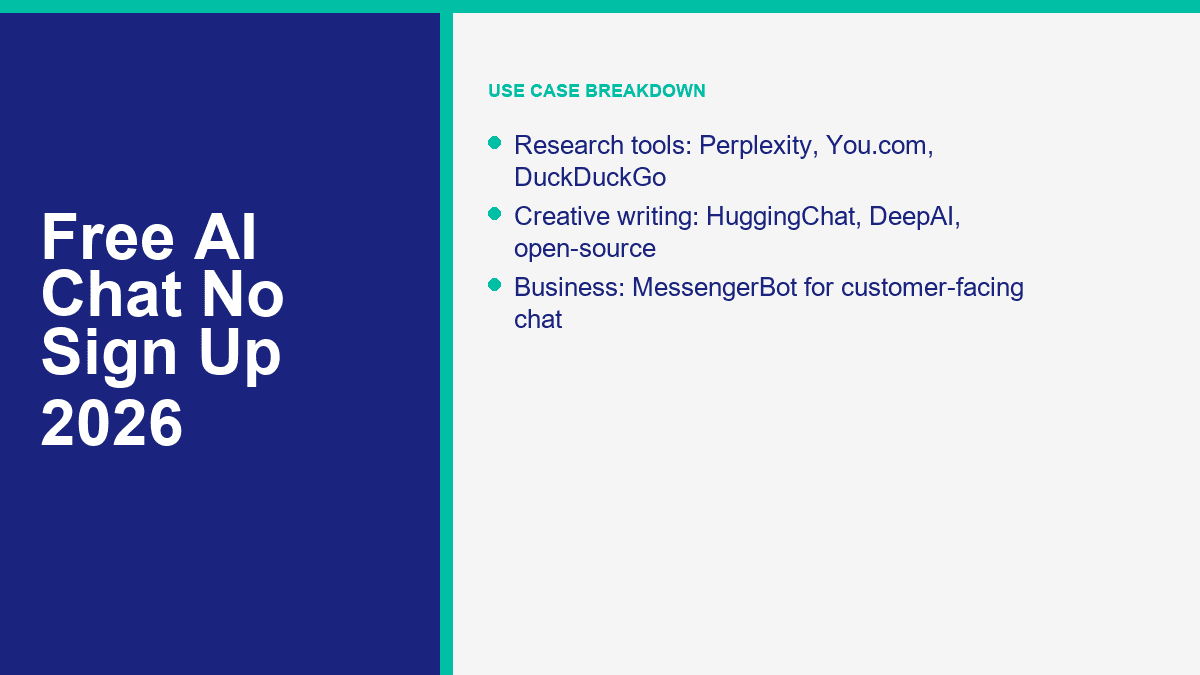
The table below mixes true anonymous tools, useful guest modes, and a small number of soft-wall names that people still expect to see for this query. Privacy Rating is a practical score based on public privacy claims, data-retention clarity, and how much identity the tool demands up front. It is not a legal certification.
| Plataforma | Sign Up Required? | Límite de Mensajes | Mejor Para | Privacy Rating |
|---|---|---|---|---|
| Duck.ai | No | Daily limits apply, but DuckDuckGo does not publish one simple universal cap | Anonymous research, quick answers, multi-model chat | 5/5 |
| ChatGPT | No for basic guest chat | Guest chat works, but history, uploads, and broader tools need login | General writing, brainstorming, everyday questions | 3/5 |
| Microsoft Copilot | No | Guest chat works; sign-in unlocks file uploads, more voice, and memory | Web-grounded answers and general productivity | 3/5 |
| Perplexity | No, but limited | Guest use works; account adds saved history and a better long-session experience | Cited research and quick fact-checking | 3/5 |
| Brave Leo | No separate account | Free inside the Brave Browser; paid tiers raise limits | Private browsing-side AI help | 5/5 |
| HuggingChat | No | Availability varies by model, load, and Hugging Face infrastructure | Open-source model testing and creative experiments | 3/5 |
| Venecia | No | Free starter usage; Pro is for heavier volume | Private-feeling chat and uncensored model access | 4/5 |
| Andi | No | Limits are not clearly published | Search-style answers without a cluttered results page | 4/5 |
| SlagBot | No | 5 chats per day on the free tier | Privacy-first everyday prompts | 4/5 |
| DeepAI | No, but login nudges show up fast | Free basic use with aggressive Pro upsells and fewer polished controls | Simple writing help and quick one-off prompts | 2/5 |
| Phind | No, but guest access is inconsistent | Free questions, though uptime and guest flow feel less stable than before | Coding and technical Q&A | 2/5 |
| Perchance AI Chat | No | No hard cap is prominently published | Story ideas, roleplay, and casual creative writing | 3/5 |
| Wsup.ai | No | Limits are not very transparent | Character chat and free casual conversation | 2/5 |
| You.com | Yes in practice | The current web workflow asks you to log in before real use | Legacy AI-search brand with business and API focus | 2/5 |
| Poe | Yes now | After login, free usage runs on points | Sampling many models in one interface | 2/5 |
If you only want the short version, start with Duck.ai for the cleanest anonymous experience, Perplexity for citation-heavy answers, Copilot for fast general use, ChatGPT for all-purpose drafting, and Brave Leo if privacy matters enough that installing a browser is acceptable.
HuggingChat, Andi, SlagBot, y Venecia are the most interesting second-tier options because each solves a different problem. HuggingChat is the open-source playground. Andi makes search feel lighter and less spammy. SlagBot is small, but refreshingly direct about free limits. Venice leans hard into private, uncensored positioning and will appeal to users who hate over-sanitized assistants.
DeepAI, Perchance, y Wsup.ai are useful if your expectations stay realistic. DeepAI is fine for quick prompts, but it is not my favorite place for anything sensitive or important. Perchance is better than it looks for creative use, especially if you want freeform story help. Wsup.ai is clearly built for character-chat entertainment more than grounded productivity.
The two names I would not oversell for this specific query are You.com y Poe. They still belong in the conversation because readers will keep seeing them in search results and older roundups, but as of April 9, 2026 neither feels like a clean no-sign-up recommendation. If the page tells you to log in before the real conversation starts, the no-sign-up promise is already broken.
Which No-Sign-Up AI Tools Are Actually Worth Your Time for Research and Quick Answers
If your goal is not roleplay but actual answers you can use, three names matter most: Duck.ai, Perplexity, and Copilot. I am including You.com here too because readers still search for it, but it belongs in the “know the caveat first” bucket.
Duck.ai Is the Best True Anonymous Pick for Fast Research
Duck.ai is the cleanest answer to the query in this article title. You open the page, accept the terms, and chat. DuckDuckGo says chats are anonymized, not used to train models, and routed so your full IP address is not handed to the model providers. That is a materially stronger privacy posture than most consumer AI tools. It also gives you access to multiple model families instead of locking you into one brand.
The trade-off is that Duck.ai still has usage limits, and DuckDuckGo does not market it as a limitless power-user workspace. You also will not get the same persistent memory and heavy file workflow you would expect from a logged-in premium tool. For fast research, low-friction Q&A, and privacy-conscious everyday use, that is an acceptable trade.
Perplexity Is Better Than Duck.ai When Citations Matter More Than Anonymity
Perplexity remains one of the strongest research assistants on the consumer web because it shows its work. If you are comparing products, checking a claim, or scanning a fast-moving topic, built-in citations save time. Guest mode is enough for occasional use, but not as private as Duck.ai and not as friction-free over a longer stretch. Once you want history, stable workflows, or a heavier research habit, the product nudges you toward an account.
That is why I rate Perplexity as a top no-sign-up research option, but not the top anonymous one. It is excellent for answer quality and verification. It is only average on privacy.
Copilot Deserves More Credit Than It Usually Gets in This Search
Microsoft Copilot is easy to overlook because people think of it as a Microsoft add-on rather than a serious guest AI chat. That undersells it. Signed out, you can still use guest chat immediately. Signed in, you get saved conversations, file uploads, more voice flexibility, and memory. For a user who wants quick answers in a familiar interface, it is one of the most practical account-free starting points.
The privacy catch is straightforward: Microsoft is a large ecosystem company, not a privacy-minimal operator. If you just want convenience, that is fine. If you want the strongest anonymous posture, Duck.ai and Brave Leo are better fits.
You.com Still Has Brand Recognition, but the No-Sign-Up Case Is Weak Now
You.com used to be easier to recommend in this exact category. Today, the consumer experience is much less convincing. The current web flow can still show AI-answer styling, but the live page also tells users to log in before real use. That makes it hard to rank as a genuine no-sign-up tool in 2026.
I still mention it because the name has momentum and readers ask about it. Just do not confuse search visibility with current usability. If you need a live no-sign-up research tool, use Duck.ai, Perplexity, Copilot, or even Andi before you rely on You.com.
The Best Guest AI Chat Tools for Creative Writing and Brainstorming
Creative work is where account-free AI can still be fun without becoming frustrating. The factual bar is lower, model personality matters more, and you usually do not need persistent memory across weeks of work.
HuggingChat Is the Best Open-Source Playground
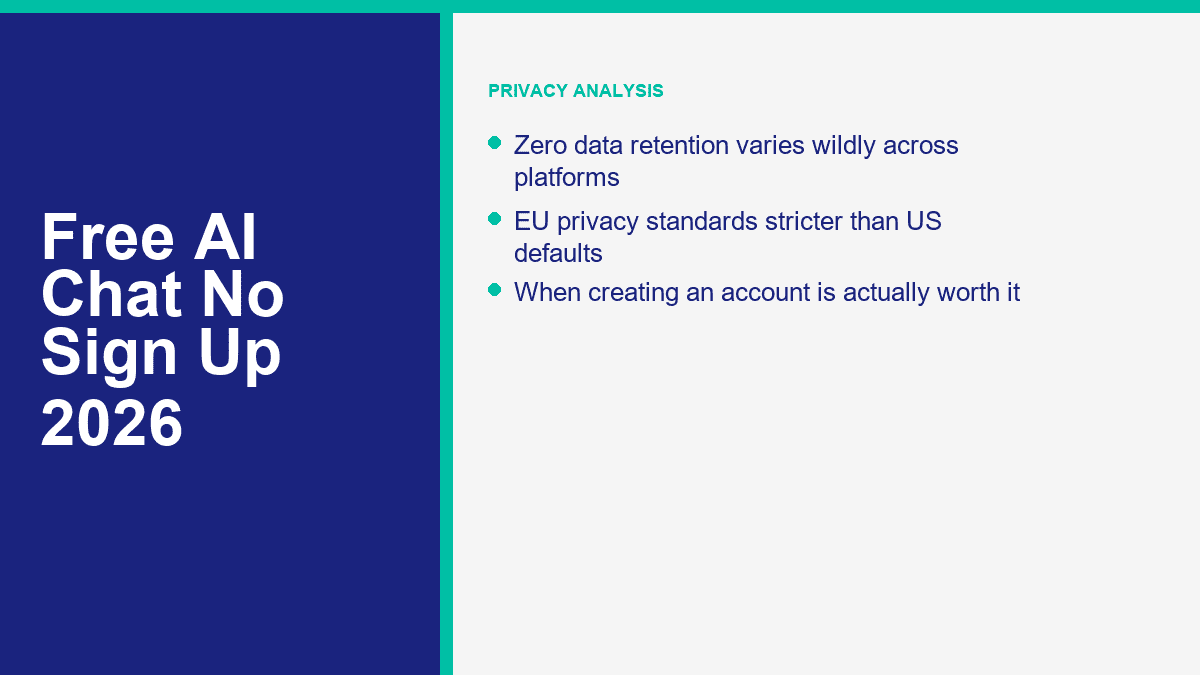
HuggingChat is the strongest creative pick if you want variety instead of one corporate assistant voice. You can jump across open-source models, test different personalities, and use it as a rough ideation lab. It is not as polished as the biggest commercial assistants, but that is part of the appeal. When you are outlining, rewriting, experimenting with tone, or comparing how different models handle the same prompt, HuggingChat feels more like a workshop than a product funnel.
The downside is consistency. Availability can shift with model load, and the whole experience is better for exploration than for mission-critical work. That is still a fair trade if your goal is brainstorming, not guaranteed throughput.
DeepAI Still Works for Throwaway Drafting, but Privacy Is the Catch
DeepAI stays popular because it is easy to open and start using. For a quick draft, a social caption, a blog outline, or a short idea dump, it works. The interface also surfaces multiple creative modes fast. The problem is that the privacy policy is much more aggressive than people assume from the no-sign-up positioning. DeepAI openly says it collects user content, uses information for advertising and analytics, and can use information to train models.
That does not make it unusable. It makes it a tool for low-stakes prompts. Use it for ideas, not for anything confidential.
Perchance and Wsup.ai Are Good If You Want Freeform Character or Story Play
Perchance is the better of the two if you want weird, flexible, free creative energy. Its privacy notes are surprisingly specific: the AI text plugin says it does not store your data on the server, but the site also warns that each generator should be treated like a random page on the internet. That is a smart warning, and you should take it seriously.
Wsup.ai is simpler. If your goal is instant character chat with no account, it delivers that more directly than many competitors. It is entertainment-first, not research-first. That means it belongs in a no-sign-up roundup, but not near the top if you want grounded help for work.
If you want more general free options rather than strictly no-sign-up ones, nuestra comparación completa gratuita de chatbots de IA goes wider on daily drivers, free tiers, and which plans stay useful after the first week.
Where No-Sign-Up AI Falls Short for Business and Customer Service
This is the section most roundup posts skip. Consumer guest chat and business chat automation are not the same product category.
A no-sign-up AI chat tab is good for drafting replies, summarizing a complaint, or brainstorming FAQ language. It is not a customer-service system. It does not know your refund policy, it does not route messages, it does not qualify leads, it does not keep reliable conversation history for your team, and it definitely should not be the place where you paste customer records.
That is where MessengerBot is different. For the end user, there is no separate MessengerBot login flow at all. Your customer simply opens Facebook Messenger and messages your Page the same way they already would. The business owner sets up the automation layer behind the scenes. That distinction matters because it removes friction for customers while still giving the business a real automation stack instead of a one-off consumer AI tab.
Free guest tools are enough for business only when the job is tiny:
- Drafting FAQ answers before you publish them
- Testing wording for a welcome message or quick reply
- Summarizing a support issue for a human agent
- Brainstorming lead-qualification questions
They stop being enough when you need production behavior:
- Persistent conversation flows
- Lead capture and routing
- Broadcasts, sequences, and tags
- Human handoff rules
- Reporting and team visibility
- Customer messaging on a channel people already use
If that is your use case, the smart move is not to keep hunting for a slightly less limited guest chatbot. It is to compare a real Messenger automation product. You can Ver precios de MessengerBot when you are ready to see where the business-grade features start.
The Privacy Trade-Off Behind Anonymous AI Chat
The best no-sign-up AI tool is not always the smartest model. Often it is the one with the clearest privacy architecture.
Duck.ai y Brave Leo are the strongest mainstream examples right now. DuckDuckGo says chats are anonymized, not used to train the models, and proxied so providers do not receive your raw IP address. Brave says Leo conversation history is stored locally on your device, not on Brave’s servers, and that no account is required. Those are concrete claims, not vague “we value privacy” copy.
Venecia y SlagBot are interesting privacy-first challengers. Venice markets itself around private, uncensored AI and no account required. SlagBot is more modest, but refreshingly specific about free limits and “no stored history” positioning. I still rate both slightly below Duck.ai and Brave Leo because smaller vendors have less long-term trust built into the market, but they are clearly aiming in the right direction.
The middle tier is where most people will land without thinking about it. ChatGPT guest, Copilot guest, Perplexity, HuggingChat, y Perchance are usable, but you should not mistake them for disposable anonymous chat spaces. They are more private than old-school ad-tech sites in some ways, but they are not all making the same no-training or no-retention promises. In this tier, the right habit is simple: keep your prompts boring.
The weakest privacy category is also the one where people get overconfident. DeepAI is the clearest example. Its current privacy policy says it collects prompts and other content, uses information for analytics and advertising, and may use information to train models. Phind says signed-out users may have inputs logged and used for training, even if they are not tied to an identified account. You.com collects telemetry and says outright not to enter sensitive personal information into prompts. Poe is now firmly account-centered, which makes the privacy conversation much less anonymous from the start.
EU versus US privacy rules matter, but not in the simplistic way people assume. A platform that serves UK or EU users may still process data on US infrastructure. A US company can still build a stronger privacy architecture than a site that waves around “GDPR” language but keeps vague retention practices. The useful question is not “Which country is the company in?” The useful questions are:
- Do they require identity up front?
- Do they say whether prompts train models?
- Do they say how long data is retained?
- Do they minimize what third-party providers can see?
- Do they make deletion or opt-out controls easy to find?
If you want the most private and anonymous practical picks from this whole list, choose Duck.ai first, Brave Leo second, and Venice or SlagBot after that. If privacy is a hard requirement rather than a preference, skip DeepAI, skip guest coding tools that train on logged-out inputs, and skip anything with vague or hard-to-find policy language.
When Creating an Account Is the Smarter Move
No-sign-up AI is great for quick answers. It is bad as a permanent workflow. The moment you care about conversation history, context carryover, file uploads, consistent limits, or saved preferences, the reason to stay anonymous starts shrinking.
Create an account when you want one of these:
- Conversations that continue across sessions
- Higher message limits or better models
- File uploads, voice, memory, or custom bots
- Shared work across a team
- Business automation instead of one-off prompts
That does not mean every upgrade is worth paying for. It means no-sign-up access is usually a testing layer, not a full workflow. For casual consumer use, that is fine. For business use, it is a ceiling. If your next step is customer support automation, follow-up flows, Page inbox management, or lead capture on Messenger, the relevant upgrade path is not another anonymous toy chatbot. It is a platform built for operations. That is where Características de MessengerBot Pro become more relevant than yet another guest chat tab.
When the Goal Is Customer Conversations, Not Just AI Chat
Testing anonymous AI tools is useful. Running customer messaging through a real channel is a different job. If you are moving from casual AI prompts to Facebook Messenger automation, compare Características de MessengerBot Pro y Ver precios de MessengerBot before you waste time trying to stretch guest chat tools into a support stack they were never designed to be.
Preguntas Frecuentes
¿Hay un chat de IA completamente gratuito sin necesidad de registrarse?
Yes, but with limits. Duck.ai, Andi, Brave Leo, Perchance, Wsup.ai, and SlagBot all let you start without creating an account. The catch is that “completely free” usually still means daily caps, weaker persistence, or fewer advanced tools than a logged-in plan.
¿Cuál chat de IA es el más privado y anónimo?
Duck.ai es la opción más fuerte en el mercado actual para un uso anónimo práctico porque DuckDuckGo dice que los chats están anonimizados, no se utilizan para entrenamiento y se enrutan para que los proveedores no reciban tu dirección IP en bruto. Brave Leo también es fuerte si estás dispuesto a usar el navegador Brave. Venice y SlagBot son alternativas prometedoras centradas en la privacidad, pero están menos establecidas.
¿Puedo usar el chat de IA sin dar mi dirección de correo electrónico?
Yes. Several tools still allow that, including Duck.ai, Brave Leo, HuggingChat, DeepAI, Andi, Perchance, Wsup.ai, and SlagBot. ChatGPT and Copilot also offer meaningful guest access. On the other hand, You.com and Poe now push users into sign-in flows much faster than older no-sign-up guides suggest.
¿Son seguros de usar los chatbots de IA sin registro?
They are safe for low-stakes prompts if you use common sense. They are not automatically safe for confidential work. A tool can be account-free and still log prompts, keep telemetry, or use your data for training or advertising. Treat guest AI chat as public-enough for brainstorming unless the vendor makes unusually strong privacy promises.
¿Cuáles son los límites del chat de IA gratuito sin una cuenta?
Los límites habituales son sin historial, menor uso diario, modelos más débiles, menos cargas, menos integraciones y sin memoria persistente. Por eso, la IA sin registro es mejor para respuestas rápidas y primeras pruebas, no para un flujo de trabajo a largo plazo o automatización orientada al cliente.



 Español
  English
  Tagalog
  简体中文
简体中文  العربية
  हिन्दी
  Português do Brasil
  Español de México
  Français
  বাংলা
বাংলা  香港中文
香港中文  繁體中文
繁體中文  Nederlands
  Deutsch
  Bahasa Indonesia
  日本語
日本語  한국어
한국어  Polski
  Русский
  Tiếng Việt