
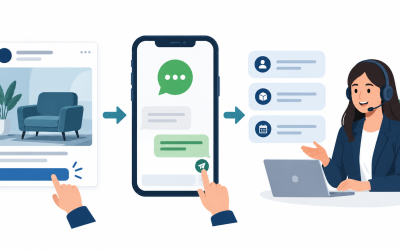
Choosing between whatsapp business vs messenger sounds like a simple Meta channel decision. In practice, it is a choice between two different business models. WhatsApp Business is stronger when you need phone-number identity, transactional follow-up, and international support. Facebook Messenger is stronger when conversations start from a Facebook Page, an Instagram or Facebook ad, or a community that already lives inside Meta’s social graph.
That is why the older “they are basically the same” advice breaks down so fast in 2026. WhatsApp Business app is still a free and useful starting point, but serious automation lives on the WhatsApp Business Platform, where template rules and per-message pricing matter. Messenger can still be free to use at the platform level through a Page and Meta Business Suite, but it depends more on ad entry points, active conversation windows, and how well your team handles inbound leads once they arrive.
Research note: pricing, policy, and reach figures in this guide were checked on 12 de abril de 2026 en contra Meta’s official WhatsApp pricing calculator, current Meta business and help pages, Centro de Investigación Pew, y Ofcom. Si estás comparando la pila de software alrededor del canal y no solo el canal en sí, mantén esto comparación completa de chatbots abierto también.
Una realidad más antes de entrar en las características. No hay una versión seria de “no se requiere registro” de ninguno de los canales para uso empresarial. Messenger es gratuito para comenzar si ya tienes una Página de Facebook. La aplicación WhatsApp Business es gratuita para descargar. Pero los verdaderos buzones de equipo, enrutamiento de IA, automatización de API y campañas salientes en cualquiera de los lados aún requieren configuración, aprobación y, por lo general, software de terceros o trabajo de desarrollador.
Cómo hacer la elección correcta de Meta Messaging en 2026
La forma más fácil de decidir es dejar de pensar en nombres de marcas y comenzar a pensar en los orígenes de la conversación.
Si el primer mensaje generalmente comienza porque alguien hizo clic en un anuncio de Facebook o Instagram, tocó un botón de Página, respondió a una publicación o ya sigue tu marca en Facebook, Messenger suele ser el primer canal correcto. Si el primer mensaje generalmente comienza porque alguien guardó tu número, quiere actualizaciones de pedidos, espera recordatorios o ya se siente cómodo haciendo negocios a través de chat basado en número de teléfono, WhatsApp Business suele ser el mejor primer canal.
La messenger vs whatsapp business debate also gets distorted by sticker price. Messenger looks cheaper because Meta does not charge a direct per-message platform fee for normal Messenger conversations. WhatsApp looks more expensive because its Platform pricing is explicit. But that does not automatically make Messenger the better deal. A low-fee channel that cannot handle your outbound reminder flow or your international support queue can still cost more in missed conversions and staff time.
- Pick WhatsApp first if reminders, order updates, appointment flows, or international customer service are core to revenue.
- Pick Messenger first if Facebook and Instagram still generate most of your inbound demand.
- Pick WhatsApp first if your market is U.K.-heavy and customers already treat WhatsApp like default business chat.
- Pick Messenger first if you need a free shared inbox before you are ready to pay for a BSP or shared WhatsApp workspace.
- Pick WhatsApp first if you need approved outbound templates and auditable notification workflows.
- Pick Messenger first if the main job is lead capture, qualification, and handoff from Meta ads.
That is the frame for the rest of this guide. We are not trying to crown one universal winner. We are matching the channel to the business motion and forcing a clear winner once the use case is specific enough.
What WhatsApp Business Actually Gives You in 2026: App, Platform, and Templates
Most businesses still say “WhatsApp Business” when they really mean three different things.
- Aplicación WhatsApp Business: the free app for a small business that wants a branded inbox, greeting messages, away messages, labels, quick replies, and a product catalog.
- WhatsApp Business Platform: the API-based layer for webhooks, chatbot flows, shared team inboxes, CRM sync, analytics, and approved outbound messaging.
- Third-party software on top of the Platform: the chatbot or shared-inbox vendor you use to avoid building everything yourself.
The free app is still good. For a solo operator, it is one of the best free starting points in business messaging. You can get a verified business profile, set working hours, add saved replies, build a simple catalog, and handle light chat volume without paying a software bill. That is enough for a salon, clinic, tradesperson, boutique, or local ecommerce store that is still under manual-inbox scale.
The moment you need multiple agents, AI triage, CRM-connected handoff, or outbound notifications outside an active support chat, you are no longer choosing just the app. You are choosing the WhatsApp Business Platform. That is where the approvals start to matter: business verification, display name approval, number connection, template submission, webhooks, and policy compliance.
The free app is a lightweight inbox; the Platform is where serious automation starts
That distinction matters because it changes both cost and expectations. A lot of businesses ask whether WhatsApp is “free” when what they really want is API-scale automation. The honest answer is simple. The app is free. The Platform is not. And there is no credible path to a production-grade WhatsApp automation stack without setup, sign-up, and policy work.
Meta’s current pricing model is now based on per delivered message, not the old conversation-fee logic that still shows up in stale blog posts. The message categories are marketing, utility, authentication, and service. Meta’s official pricing page also makes three rules very clear:
- Service messages are free. When a user messages your business, you get a 24-hour customer service window and service replies in that window are not charged.
- Utility templates sent in response to users are free. That is a big deal for transactional support and follow-up.
- Messages in the 72-hour free entry point window are free. If a user enters from a supported click-to-WhatsApp ad or a Facebook Page CTA button, all of your messages are free for 72 hours.
That 72-hour rule is one of the biggest practical advantages WhatsApp has in 2026. It rewards you for getting the user into chat first, then continuing the conversation well. If you run high-intent lead gen, it changes campaign math immediately.
Template messages are the power tool and the policy bottleneck
WhatsApp Business is better than Messenger when you need outbound messaging that is structured, approved, and predictable. Appointment reminders, delivery notifications, account verification, payment nudges, and booking confirmations all fit naturally into WhatsApp’s template system.
It is also the platform’s main bottleneck. If your team does not understand template categories, a “simple” automation project can stall on review or get billed in ways the business did not model. Marketing templates are for promos and re-engagement. Utility templates are for non-promotional status updates triggered by the user’s action. Authentication is for one-time passcodes and verification. Service is the free-form reply layer inside the service window.
There is one U.S.-specific catch that changes the recommendation for a lot of North American businesses. Updated provider documentation from Manychat, reflecting Meta policy as of February 17, 2026, says the temporary pause on marketing templates to U.S. phone numbers is still in effect and still has no public end date. In plain English, U.S. businesses can still use utility templates, authentication templates, click-to-WhatsApp ads, and the support window, but they should not build a U.S. growth plan around WhatsApp marketing blasts right now.
That does not kill WhatsApp in the U.S. It just changes what it is best at. In the U.S., WhatsApp is stronger for support, reminders, updates, and service-heavy flows than for promotional broadcast-style growth. In the U.K. and many international markets, it can comfortably do both.
How Facebook Messenger Works for Business in 2026: Inbox, Bots, and Ads
Messenger for business is simpler to start and messier to scale if you do not build process around it. The starting point is a Facebook Page plus the Inbox in Meta Business Suite. That gives you a real business workspace for Messenger conversations with assignments, notes, labels, filters, instant replies, away messages, and cross-channel visibility when Instagram and WhatsApp are linked.
For a lot of small businesses, that alone is enough. Messenger does not force you into a per-message billing model, and you can let multiple people handle conversations with Page or task access. If your business already lives on Facebook, this is the lowest-friction route to a usable shared inbox.
Meta Business Suite is still the free shared inbox most SMBs overlook
The strongest argument for Messenger in 2026 is not that it has better bot logic than WhatsApp. It is that Messenger can be operationally useful on day one with almost no channel fee. A small team can open Meta Business Suite, connect the Page, set instant replies, add a couple of labels, and start handling real demand from desktop and mobile.
That is why Messenger keeps winning with local services, ecommerce brands, gyms, agencies, coaches, and home-service businesses that already get Facebook leads. They do not need a telecom-style messaging stack. They need a fast inbox, human handoff, and simple qualification logic that catches people when they tap “Send Message.”
Messenger’s weak side shows up when the business needs structured outbound follow-up. There is still a standard 24-hour messaging logic around active conversations, and outside that window your options narrow into approved or paid paths instead of the broad template system that WhatsApp offers. So Messenger can be excellent for warm conversations and weaker for formal notification workflows.
Messenger bots are still best when the chat starts from Facebook itself
Messenger automation works best when it helps you capture or qualify demand that Meta already generated. Think ad response handling, lead routing, FAQs, coupon flows, product recommendations, booking prompts, and human handoff after someone clicks from a Page or ad. This is where Messenger bots still make practical sense.
Messenger is also tightly connected to Meta’s ad stack. Meta’s current business materials still position ads that click to Messenger as a purchase-driving format, and that matters because it shortens the path between ad intent and conversation. If your business already buys Facebook or Instagram traffic, Messenger inherits that intent with less friction than asking a user to switch channels.
That is the core reason Messenger remains so competitive. It is not that consumers love Messenger more than every other app. It is that Messenger sits directly inside the social surfaces where businesses are already spending money to create demand.
So if your question is “whatsapp or messenger for business” and you run Meta ads every week, Messenger deserves extra weight. It is native to your acquisition flow in a way WhatsApp often is not.
WhatsApp Business vs Messenger: The Side-by-Side Feature Table
| Decision factor | WhatsApp Business | Messenger para Empresas | Ganador |
|---|---|---|---|
| Cheapest native team starting point | Free app for small teams, but serious shared inbox usually means Platform plus software | Meta Business Suite inbox has no direct platform fee and supports multiple Page users | Messenger |
| Best solo-operator starting point | Free app with catalog, labels, quick replies, greeting and away messages | Works, but Pages and Business Suite are heavier than a single business number | WhatsApp Business |
| Best free multi-agent start | Possible only in a limited app workflow | Assignments, notes, labels, and cross-channel inbox support out of the box | Messenger |
| Best direct reach in the U.K. | Ofcom says WhatsApp reached 90% of U.K. online adults in May 2025 | Messenger app or messenger.com reached 58% of U.K. online adults | WhatsApp Business |
| Best practical acquisition surface in the U.S. | Pew says 32% of U.S. adults use WhatsApp | Pew says 71% of U.S. adults use Facebook, which makes Messenger a stronger Meta-native entry point | Messenger |
| Best international support channel | Phone-number-based identity and broader global user habit | Works well in Facebook-heavy markets but is less universal globally | WhatsApp Business |
| Best channel for order updates and reminders | Template system is built for utility and authentication workflows | Can handle live support, but structured outbound is less natural | WhatsApp Business |
| Direct channel fee model | Per-message pricing on the Platform | No direct Meta per-message fee for standard Messenger conversations | Messenger |
| Best structured outbound outside a live chat | Approved templates by category with auditable rules | More restrictive outside the active conversation window | WhatsApp Business |
| Best ad-driven lead capture from Meta properties | Strong with click-to-WhatsApp for high intent | Stronger when your campaigns already live in Facebook and Instagram ad flows | Messenger |
| Best free post-ad follow-up window | 72-hour free entry point window after click-to-WhatsApp or Page CTA | No comparable fee concept because Messenger is not metered per message | WhatsApp Business |
| Best phone-number-based customer identity | Native strength | Secondary to the social account and Page relationship | WhatsApp Business |
| Best Page and community integration | Can connect to Facebook assets, but it is not the core experience | Native to Pages, social posts, comments, and Meta’s lead ecosystem | Messenger |
| Best compliance-friendly service automation | Better for approvals, categories, and transactional clarity | Better for live conversations than for regulated notification logic | WhatsApp Business |
| Best product-catalog feel inside the channel | Catalog is a natural part of the business app experience | Can sell through chat, but catalog is not the core channel feature | WhatsApp Business |
| Best no-code lead funnel behavior | Works well, but usually needs a Platform vendor | Excellent for social lead capture, qualification, and handoff | Messenger |
| Best long-term support stack with CRM handoff | Better once you commit to the Platform and shared inbox tooling | Good for small to mid-sized teams, but less ideal for template-heavy service ops | WhatsApp Business |
| Best “launch it this week” channel if you already run Facebook ads | Good, but requires more channel transition | Users stay inside the Meta environment they already came from | Messenger |
| Best market for promotional growth in 2026 | Strong in the U.K. and many global markets; weaker for U.S. marketing templates right now | Strong for social and ad-led promotions tied to Meta properties | Messenger in the U.S., WhatsApp in the U.K. |
| Best overall for international service-led commerce | Better fit | Secondary fit | WhatsApp Business |
Where Each Channel Wins on Reach in the US and UK
If your business sells in the U.K., WhatsApp has the cleaner reach argument. Ofcom’s 2025 Online Nation reporting says WhatsApp reached 90% of U.K. online adults in May 2025, while Facebook Messenger app or messenger.com reached 58%. That is not a tiny edge. It is the difference between being on the default messaging rail and being on a meaningful but clearly smaller one.
That same Ofcom release adds useful nuance. The combination of Facebook and Messenger reaches an even larger share of adults, but the app-specific behavioral habit still favors WhatsApp. For a business owner, that means this: if you want the one messaging channel U.K. customers are most likely to already use daily, start with WhatsApp first unless your lead generation is overwhelmingly Facebook-driven.
The U.S. picture is different. Pew’s November 20, 2025 social media report says 71% of U.S. adults use Facebook, while 32% use WhatsApp. That does no prove Messenger itself is the favorite personal messenger in the United States. What it does prove is that Facebook remains a much bigger business entry surface than WhatsApp for the average U.S. SMB.
That is why Messenger often wins in the U.S. without being the most culturally loved messaging app. It piggybacks on Page traffic, Marketplace-style inquiries, local community visibility, and click-to-message ads. WhatsApp can still be a strong U.S. channel, especially for multicultural markets, international buyers, travel, healthcare coordination, or service businesses that already collect mobile numbers. But it is less likely to be the default first touch for a generic U.S. local business.
So the reach answer is blunt:
- U.K.: WhatsApp Business wins unless your whole funnel depends on Facebook or Instagram ad clicks.
- U.S.: Messenger wins for Meta-native lead generation; WhatsApp wins only when your business is already phone-number-first.
Which Platform Delivers Better Automation and AI Workflows
Neither channel gives you a magical AI advantage by itself. The model, the vendor, the data quality, and the handoff design matter more than the green icon versus the blue icon. But the channel still changes what kind of automation is realistic.
WhatsApp Business Platform is better when the AI layer needs structure. Support triage, appointment rescheduling, delivery updates, verification codes, post-purchase care, and multilingual service all fit naturally because the channel is built around known identity, template rules, and clear escalation. If your main goal is bots de servicio al cliente con IA, WhatsApp usually gives you the cleaner operating environment.
Messenger is better when the AI layer needs to qualify intent at the top of the funnel. A Messenger bot can welcome a lead from an ad, ask two questions, route by intent, collect a phone number or email, and hand off to a human fast. It is especially good when the message is part of the acquisition flow rather than part of service operations after the sale.
WhatsApp wins for service automation; Messenger wins for social lead automation
That is the cleanest AI answer in 2026.
- Choose WhatsApp if the AI job is to reduce support load, manage reminders, answer repetitive service questions, and keep a human fallback path intact.
- Choose Messenger if the AI job is to capture leads from ads, qualify them, route them, and get a salesperson into the conversation quickly.
What both channels still punish is overbuilding. A weak bot on either platform feels like a dead end. The best deployments keep the first interaction narrow, collect only the data they truly need, and expose a human handoff before frustration spikes. If the channel question has turned into a software shortlist question, our mejor chatbot para pequeñas empresas guide is the faster next step.
What the Pricing Math Looks Like Now: WhatsApp Rates vs Messenger’s Free Model
This is where the gap between the two channels becomes impossible to ignore.
Messenger’s model is operationally simple: Meta does not charge a direct per-message platform fee for standard Messenger conversations through a Facebook Page. Your costs come from ad spend, staff time, and any third-party software you add for bots, routing, or analytics.
WhatsApp’s model is explicit: the app is free, but the Platform charges per delivered template message by category and destination market. Service messages are free, utility templates in response to users are free, and click-to-WhatsApp or Page CTA entry can open a 72-hour free window. Outside those cases, you pay by message.
| Cost item | WhatsApp Business | Messenger para Empresas | What it means |
|---|---|---|---|
| Native entry cost | WhatsApp Business app: $0 | Facebook Page plus Meta Business Suite inbox: $0 | Both are free to start, but they do not scale the same way |
| Direct channel fee | Platform bills per delivered template message | No direct Meta per-message fee for standard conversations | Messenger is cheaper at the channel layer |
| North America utility list rate | $0.0034 per delivered message | $0 | WhatsApp is very cheap for utility in North America, but it is still metered |
| North America authentication list rate | $0.0034 per delivered message | $0 | Great for OTP and verification flows on WhatsApp |
| North America marketing list rate | $0.025 per delivered message | No fixed Meta message fee; paid growth depends on ads | U.S. businesses should treat WhatsApp marketing carefully because marketing templates to U.S. numbers remain paused |
| U.K. utility list rate | $0.022 per delivered message | $0 | U.K. WhatsApp service automation is powerful, but materially pricier than North America |
| U.K. authentication list rate | $0.022 per delivered message | $0 | Still competitive if the flow replaces SMS or manual staff work |
| U.K. marketing list rate | $0.0529 per delivered message | No fixed Meta message fee; paid growth depends on ads | Promotional WhatsApp in the U.K. needs strong conversion economics |
| Service-window replies | $0 service messages; utility templates in response to users are also free | $0 | Both are strong for live support, but WhatsApp adds clearer template logic |
| Volume discounts | Utility and authentication pricing falls with higher volume tiers | Not relevant at the Meta message-fee layer | High-volume WhatsApp senders can cut unit costs over time |
| Ads that start the chat | Auction-priced ad spend, plus any later paid templates outside free windows | Auction-priced ad spend | Ad spend is variable on both sides |
| Software layer on top | Usually needed for serious multi-agent automation | Optional early, often needed later | Always separate channel cost from software cost |
The official Meta rate calculator also shows why older generic advice is dangerous. As of April 12, 2026, North America utility and authentication list rates are $0.0034, with volume tiers falling to $0.0026. In the U.K., utility and authentication list rates are $0.022, with higher tiers dropping to $0.0165. That is a real gap, and it changes whether you can justify using WhatsApp for high-frequency reminders or status updates in each market.
Put another way, 10,000 U.K. utility templates at list rate are roughly $220 in channel cost before your software fee. The same 10,000 North America utility templates are roughly $34. U.K. promotional WhatsApp gets expensive faster: 10,000 U.K. marketing messages at list rate are about $529.
Messenger still wins the raw “direct fee” comparison because the channel itself is not metered that way. But that is not a full buying decision. If the business needs structured outbound utility messaging and Messenger cannot do the same job cleanly, zero channel fee is not the same as lower total cost. If you are budgeting the software layer on top of either channel, this guía de precios del chatbot will keep the SaaS side honest.
When Ad Spend Starts the Conversation: Click-to-WhatsApp vs Click-to-Messenger
Both channels become more valuable when ads are involved, but they shine in different parts of the funnel.
Click-to-WhatsApp is stronger for high-intent buyers who want to talk now and keep the thread alive later. It is especially good for quote requests, appointment booking, support-heavy retail, travel, healthcare coordination, and service businesses where the customer expects a more personal, phone-number-based relationship. The 72-hour free entry point window is not just a pricing perk. It gives your bot and your agents room to answer, qualify, and follow up without immediate channel cost pressure.
Click-to-Messenger is stronger for social lead capture. The user stays inside the Facebook or Instagram environment they already came from. For many SMB campaigns, that lowers friction enough to matter. Meta is also still actively pushing purchase optimization for ads that click to Messenger, which is another signal that Messenger remains strategically important for ad-led sales flows.
The practical winner depends on what happens after the click.
- If the post-click job is qualification and fast human handoff, Messenger wins.
- If the post-click job is support, scheduling, updates, and continued service follow-up, WhatsApp wins.
That is why businesses that rely heavily on Meta ads often end up using both. Messenger catches top-of-funnel social intent. WhatsApp handles later-stage service or retention. But if you only want one first channel, choose the one that best matches the post-click job, not just the ad creative.
Which Channel Handles Teams, Handoffs, and Shared Ownership Better
This is the section most comparison posts underplay, even though it determines whether the channel stays usable after the first month.
Messenger is better for teams that need a free native shared inbox. Meta Business Suite already supports notes, assignments, labels, and multiple people handling Page conversations. If you have a two-person to eight-person team and most chats come from Meta properties, Messenger is the easier operational fit.
WhatsApp is better once the team needs a serious support workflow built around one phone-number identity. The free app can work for a tiny team, but serious multi-agent support usually means a WhatsApp Business Platform vendor or a custom integration. That adds cost and setup, but it also gives you stronger routing, better CRM sync, cleaner handoff rules, and a more durable support architecture.
So the honest team answer is this:
- For the first free shared inbox, Messenger wins.
- For scaled support operations after you commit budget, WhatsApp often wins.
If you are a U.S. or U.K. small business and you are not ready for a BSP-style WhatsApp stack yet, starting with Messenger and then layering structured automation later is often the smarter move. If the business already knows it needs reminders, notifications, and service workflows more than ad-response handling, start on WhatsApp and budget for the Platform early.
The Best Channel for Each Business Type and Market
Here is the blunt verdict section most guides avoid.
| Business scenario | Ganador | ¿Por qué? |
|---|---|---|
| U.K. local service business | WhatsApp Business | Higher user habit in-market, stronger reminder flow, better phone-number trust |
| U.S. local service business using Facebook lead ads | Messenger | Better first-touch fit with Page and ad traffic, zero direct channel fee |
| Clinic, salon, or home service with appointments and reminders | WhatsApp Business | Template-driven utility messaging is exactly what the channel is built for |
| Brand whose sales team lives in Meta ads and DMs | Messenger | Lower-friction lead capture and faster social handoff |
| International ecommerce support team | WhatsApp Business | Stronger cross-border customer habit and better structured service workflows |
| Small team that needs a free shared inbox today | Messenger | Meta Business Suite gives you a usable starting point without API cost |
| Business that needs outbound promos in the U.K. | WhatsApp Business | Promotional messaging is possible, though you must respect the price and ROI math |
| Business that needs outbound promos to U.S. numbers | Messenger | WhatsApp U.S. marketing templates remain paused, so Messenger is the safer path |
| Support-heavy SaaS or service brand with AI triage goals | WhatsApp Business | Better structure for support automation, reminders, and verified outbound flows |
| Creator, coach, or local business getting demand from Facebook and Instagram | Messenger | Closer to the social graph where interest begins |
If you want the shortest possible recommendation, here it is:
- For the U.K., start with WhatsApp first.
- For the U.S., start with Messenger first if your leads come from Facebook or Instagram.
- For reminders, order updates, and service operations, choose WhatsApp.
- For ad-driven lead capture and free shared inbox use, choose Messenger.
- If you only have budget to do one channel well, choose the channel that already creates the first message.
That last point matters most. Businesses lose more money from running the wrong channel half-well than from committing to one channel and running it properly. WhatsApp Business is not automatically better because it is newer-feeling or more global. Messenger is not automatically better because it looks free. The winner is the one that fits how your customers actually start and continue conversations.
If You End Up Choosing a Messenger-First Stack
If your audit lands on Messenger first, compare the software layer separately from the channel layer. Start with the mejor chatbot para pequeñas empresas guide, and if you want a Messenger-focused option without custom building the whole stack, you can Ver precios de MessengerBot.
Preguntas Frecuentes
¿Cuál es mejor, WhatsApp Business o Messenger en 2026?
Para la mayoría de las empresas del Reino Unido, WhatsApp Business es el mejor primer canal porque el alcance y el hábito del cliente son más fuertes allí. Para la mayoría de las empresas de EE. UU. que dependen de las Páginas de Facebook o anuncios de Meta, Messenger es el mejor primer canal porque es más barato comenzar y está más cerca de donde comienza la demanda. Para recordatorios y automatización de soporte, WhatsApp gana. Para la captura de leads sociales, Messenger gana.
¿Cuánto cuesta WhatsApp Business en comparación con Messenger?
WhatsApp Business app is free, but the WhatsApp Business Platform charges per delivered template message. As of April 12, 2026, Meta’s rate calculator showed North America utility and authentication at $0.0034 list rate, North America marketing at $0.025, U.K. utility and authentication at $0.022, U.K. marketing at $0.0529, and service messages at $0. Messenger has no direct Meta per-message platform fee for standard business conversations, so costs usually come from ads and third-party software instead.
¿Qué plataforma tiene mejores características de IA en 2026?
La plataforma de WhatsApp Business es mejor para el soporte estructurado de IA, recordatorios, triaje de servicios y flujos de trabajo salientes verificados. Messenger es mejor para la captura de leads asistida por IA, enrutamiento de preguntas frecuentes y calificación dentro de los flujos de tráfico de Facebook e Instagram. Así que la mejor plataforma de IA depende de si tu trabajo de IA es soporte o adquisición. Para soporte, WhatsApp está adelante. Para adquisición, Messenger está adelante.
¿Puedo cambiar fácilmente entre las dos plataformas?
Puedes ejecutar ambos, pero no puedes tratarlos como una migración de un clic. La lógica de automatización, las reglas de aprobación, las plantillas y la identidad del cliente son diferentes. Lo que es fácil es agregar el segundo canal una vez que el primero esté funcionando. Lo que no es fácil es suponer que un flujo de bot de Messenger se puede copiar directamente en WhatsApp o viceversa sin rediseñarlo para la política y el comportamiento del usuario.
¿Cuál es mejor para las pequeñas empresas?
Para las pequeñas empresas de EE. UU. que ya están obteniendo clientes potenciales de Facebook, Messenger suele ser el mejor primer paso porque la bandeja de entrada compartida es gratuita y el camino del anuncio al chat es corto. Para las pequeñas empresas del Reino Unido o negocios de servicios que necesitan recordatorios y actualizaciones de pedidos, WhatsApp Business suele ser mejor porque el hábito del cliente y los flujos de servicio basados en plantillas son más fuertes. Las pequeñas empresas deben elegir el primer canal en función de dónde ya se muestra la demanda real entrante.
 Español
  English
  Tagalog
  简体中文
简体中文  العربية
  हिन्दी
  Português do Brasil
  Español de México
  Français
  বাংলা
বাংলা  香港中文
香港中文  繁體中文
繁體中文  Nederlands
  Deutsch
  Bahasa Indonesia
  日本語
日本語  한국어
한국어  Polski
  Русский
  Tiếng Việt