
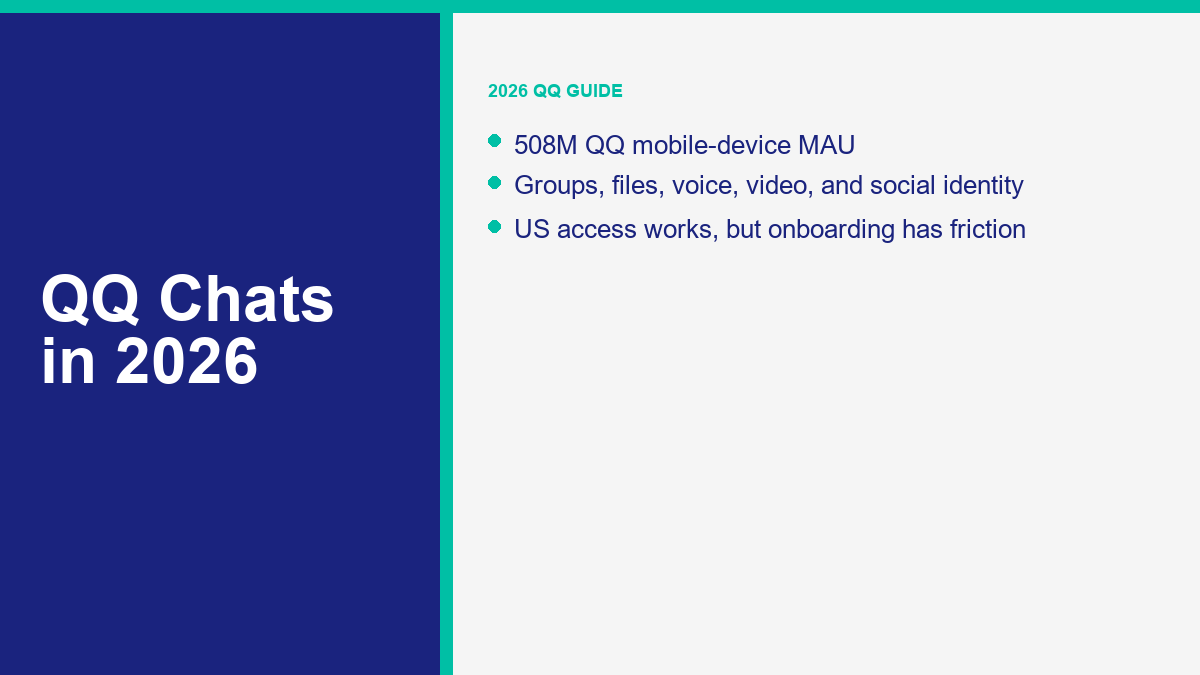
QQ chats are still a real part of China’s internet in 2026, but the English web often describes them badly. QQ is not a dead relic, and it is not the default international messenger either. It is a China-first messaging and social platform that still has giant scale, strong desktop habits, and a feature mix built for people who do more than trade short texts. Tencent reported 508 million mobile-device monthly active accounts for QQ as of December 31, 2025, in its 2025 annual report. In the same period, China reached 1.125 billion internet users, according to CNNIC data published by Xinhua on February 5, 2026. Put those numbers together and the simple answer is this: QQ chats still matter because hundreds of millions of people still use QQ on phones.
The bigger question is what QQ chats are good for now. In 2026, QQ works best when you need large China-based groups, active hobby or gaming communities, quick file handoffs between phone and computer, voice or video chat, and a social layer around the messages themselves. Tencent’s current iOS listing in the US App Store shows exactly where the product is heading: group-chat AI summaries, 10GB flash file transfer, cross-app sharing, voice-message transcription, and a steady flow of group-management tools. That is not the roadmap of a dying messenger. It is the roadmap of a product trying to stay central to day-to-day conversation, media sharing, and community management.
QQ also confuses a lot of US readers because it is doing several jobs at once. It is a messenger. It is a social network. It is a file-transfer tool. It has payments, subscriptions, themed profiles, gaming tie-ins, and public-facing community behavior that feels closer to a social platform than to a stripped-down private messenger. That is why people search for qq chats, QQ मैसेंजर, is QQ safe, y can I use QQ in the USA at the same time. They are not asking one question. They are trying to figure out what category QQ actually belongs to.
If what you really need is structured customer messaging, lead capture, or automated replies on Meta channels, do not force a consumer chat app to do a bot platform’s job. मेसेंजरबॉट मूल्य निर्धारण देखें first. QQ is powerful, but it is built for people and communities, not for running a clean customer-support workflow.
Why QQ Chats Still Matter in 2026
I reviewed Tencent’s March 18, 2026 annual report, Tencent’s 3Q25 service-offerings sheet, the US App Store listing, the US App Store review feed, the US Google Play listing, and current CNNIC coverage again on June 6, 2026. The clean takeaway looks like this:
- QQ is still huge. Tencent’s year-end 2025 operating metrics put QQ at 508 million mobile-device MAU, which is lower than a year earlier but still massive.
- QQ chats are strongest when the thread is not just text. File movement, large groups, voice, video, gaming communities, and social identity still matter inside QQ.
- QQ is broader than messaging. Tencent defines QQ smart-device activity around messaging, Qzone, and Tencent Channels behavior, which tells you the product is part messenger and part social ecosystem.
- US access is possible but not frictionless. As of June 6, 2026, QQ is still available in the US App Store and US Google Play, but current store reviews still report phone-number, region, and QR-verification friction.
- QQ is mainstream, not privacy-maximal. The current App Store privacy disclosure says data linked to identity may include phone number, precise location, user ID, device ID, and payment info.
- QQ chats are worth learning only if the people you need are already there. If your contacts, groups, classes, or gaming circles live on QQ, it is useful. If they do not, QQ becomes harder to justify.
What People Actually Use QQ Chats For in 2026
A lot of English-language posts still answer this badly by repeating the same old line: text, voice, video, done. That leaves out the reason QQ survives. People do not stay inside a platform for more than two decades because it can send a message bubble. They stay because the platform solves a cluster of daily communication jobs at the same time.
On QQ, the message thread is only the center of gravity. Around it you get groups, calls, file transfer, social discovery, profile expression, payments, entertainment, and community management. That mix is exactly why qq chats still feel more alive in some Chinese internet circles than outsiders expect.
Big Group Chats That Need Actual Management
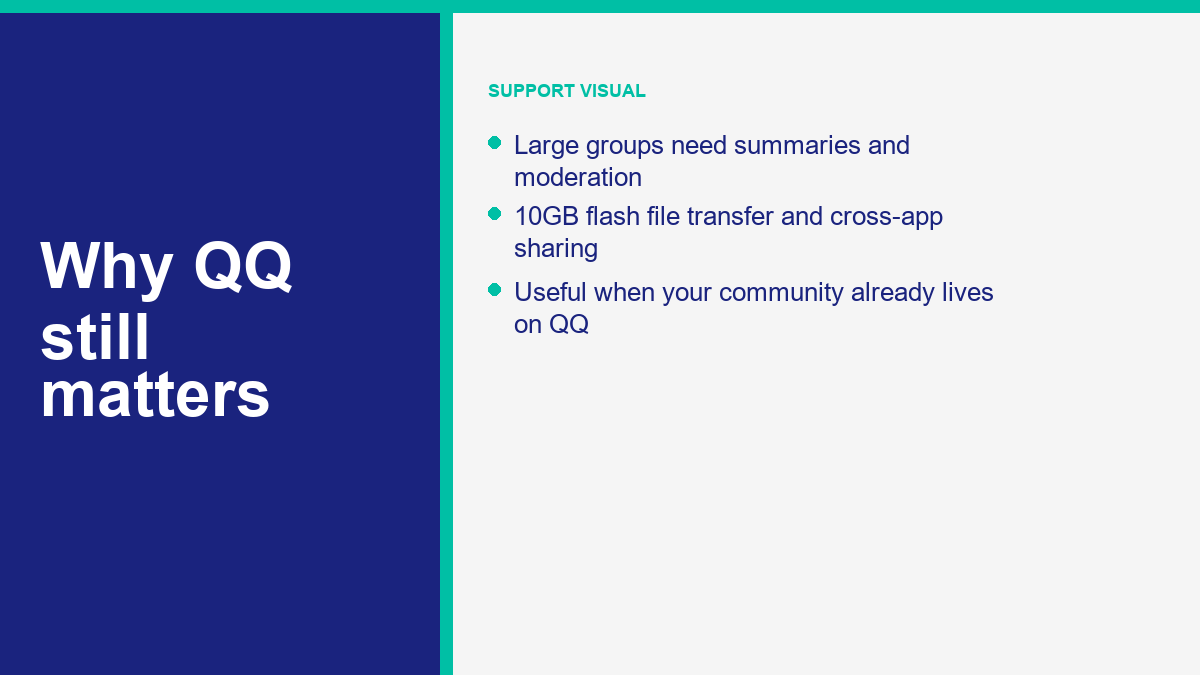
QQ has long been comfortable with larger, noisier, more community-style conversation than many Western messaging apps. Tencent’s 2025 and early 2026 App Store update notes show where the product team is still investing: group-chat AI summaries for unread messages, timed muting for group administration, and group relay exports that can be pushed into a table. Those are not gimmicks. They solve a real problem inside active group chats where dozens or hundreds of people post before you wake up.
That matters for classes, study groups, gaming clans, fandom communities, local interest groups, and event coordination. If you have ever returned to 300 unread messages and wished the app would tell you the five decisions that actually mattered, you can see why QQ’s group-summary feature is not just a flashy AI checkbox. It makes high-volume QQ chats less punishing to re-enter.
Fast File Transfer Between Phone and Computer
The current US App Store listing still highlights one of QQ’s oldest practical strengths: multi-terminal file transfer between mobile phones and computers. Recent version notes go further and mention QQ flash transfer के लिए 10GB files with cross-app sharing support. That is a real differentiator because many chat apps are fine until you try to move a large file, a design asset, a recorded lecture, a mod package, or a batch of photos between devices without bouncing through three other tools.
This is one reason QQ chats keep surviving on desktops and laptops. WeChat is stronger as an everyday identity and payment layer inside China, but QQ still feels more comfortable when the conversation is attached to heavier desktop behavior. Students sending documents, gamers sharing files, club admins exporting lists, and friends trading media from phone to PC are all working in a lane that QQ still handles well.
Voice, Video, and Always-On Community Threads
QQ’s current store description still leads with the basics that matter most in real use: one-to-one and group messaging, voice calls, video chat, and large-group communication. That sounds ordinary until you remember how many people use chat apps as persistent community spaces rather than as private direct-message boxes. QQ chats are sticky because the same account can handle a quick voice call with family, a late-night group thread with classmates, and a file exchange with a collaborator without forcing you into separate products.
The current iOS release notes also mention voice-message improvements, transcription, and translation-related capabilities through Tencent’s official AI assistant features. That means QQ is not just trying to move text faster. It is trying to reduce friction when people communicate through mixed media, long voice notes, and high-volume group discussion.
Social Identity Around the Chat Thread
This is the part many non-Chinese readers miss. QQ chats are not just sterile message logs. They sit inside a more expressive social system. The US App Store page still advertises themes, profile decoration, game center integration, bubbles, pendants, and social updates. Tencent’s own investor materials define QQ activity broadly enough to include actions in Qzone और Tencent Channels, not just sending a direct message. That tells you the platform still treats chat as one layer of a bigger digital identity.
If you grew up with WhatsApp, Signal, or iMessage, that can feel cluttered. If you grew up with community-first Chinese internet products, it feels normal. QQ chats live inside a louder interface because QQ is trying to be a place, not just a pipe.
QQ vs WeChat and Global Messaging Apps: Where QQ Wins and Where It Does Not
The easiest way to understand QQ is to stop asking whether it beats every other messenger overall. It does not. Ask instead which job you are hiring it for. Tencent’s latest annual report reported 1.418 billion combined MAU for Weixin and WeChat की विस्तृत विश्लेषण करेंगे 508 million mobile-device MAU for QQ at year-end 2025. That alone tells you WeChat is the more universal daily utility inside China. But QQ still wins in a few lanes that matter.
| प्लेटफार्म | सर्वश्रेष्ठ फिट | Where it beats QQ | Where QQ still wins |
|---|---|---|---|
| China-based group chats, student and hobby communities, cross-device file transfer, expressive social identity | Not applicable | Large groups, PC habits, heavier file sharing, community-style chats | |
| वीचैट | Daily life in China, payments, official accounts, mini programs, business and personal identity in one app | Smoother mainstream utility inside China and broader real-world integration | QQ often feels better for larger interest groups, desktop-heavy use, and less formal social spaces |
| WhatsApp or Signal | International contacts, easier onboarding, cleaner interfaces, privacy-first use in Signal’s case | Better English-first experience and stronger comfort for non-China users | QQ wins when your actual community already lives inside QQ groups and files move constantly between devices |
| MessengerBot | Automated customer chats, lead capture, persistent menus, workflows, and campaign messaging on Meta channels | Business automation, analytics, tags, and repeatable support or marketing flows | QQ is still better for consumer community conversation, personal social presence, and China-specific user groups |
The honest way to read that table is simple. QQ is not the best universal messenger in 2026. It is the best answer when the community, class, fandom, gaming group, or China-based contact network you care about is already anchored there.
Why QQ Still Feels More Useful on Desktop Than Many Mobile-First Messengers
QQ’s roots matter here. Tencent launched QQ in 1999 as an instant-messaging product built around online status, text, voice, and file transfer. That old PC DNA never fully disappeared, even after the smartphone era rewired most messaging habits. You can still feel it in how QQ handles file movement, how many communities expect longer-lived group structures, and how normal it is to treat the app as part messenger and part desktop utility.
That is one reason Western readers sometimes underestimate QQ chats. If you evaluate QQ only as a phone messenger, it can look busy, dated, or overstuffed. If you evaluate it as a communication layer that still expects real work to happen across phones and computers, some of its design choices make more sense. The file-transfer emphasis, group structure, and admin features stop looking random once you picture student clubs, gaming groups, creators, and office-adjacent communities moving between devices all day.
QQ also keeps adding features that make more sense on that kind of workflow. Recent updates mention document handling, exportable group relay tables, AI-powered summaries, and better voice-message transcription. Those are not strictly social-gossip features. They are utility features for people who treat the app as a serious communication hub.
That does not mean QQ is a great business collaboration suite. It is not. It means the platform still serves a type of hybrid behavior that many US apps split across separate tools: chat in one place, file sharing in another, community updates in a third, and light coordination tasks in a fourth. QQ keeps more of that in one account.
Can You Use QQ in the USA on June 6, 2026?
हाँ, you can use QQ in the USA in the sense that the app is still publicly listed in the US App Store और यह US Google Play Store. The iOS listing shows Tencent Technology (Shenzhen) Company Limited as the developer, lists the app under Social Networking, and says the app supports English and Simplified Chinese. The Google Play listing is also live in the United States and shows 10M+ डाउनलोड के वादों के साथ होते हैं।.
That is the easy part. The harder truth is that availability is not the same thing as frictionless onboarding. The US App Store review feed still includes complaints about phone-number and region friction, and a 2026 Google Play review describes QR verification as a barrier for users who do not already know established QQ users. Those reviews are anecdotal evidence rather than official Tencent policy, but they match years of user complaints that QQ can be regionally awkward if you are outside mainland China.
The App Store data also shows why some non-Chinese users bounce fast. QQ has a 2.7 out of 5 rating from 8.9K ratings in the US App Store. Google Play shows an even rougher 1.7 star rating with 210K reviews on the US listing. Some of that gap comes from language friction, some from account-recovery pain, and some from the simple fact that QQ is optimized first for users inside Tencent’s ecosystem, not for casual Western first-time users.
The practical answer, then, is: yes, you can try QQ from the USA, but you should assume setup friction, language friction, and occasional recovery friction until your own account is working.
How to Improve Your Odds of Getting QQ Working Outside China
- Use the live iOS or Android store listing. Do not side-load random APKs or trust third-party “QQ international” download pages.
- Register with a real mobile number. Avoid disposable or VoIP numbers. They are more likely to trigger failures on almost any region-sensitive platform.
- Expect mixed-language surfaces. The US App Store lists English support, but current reviews still complain that parts of the experience remain Chinese-heavy.
- Keep a backup contact path. If your reason for joining QQ is one important friend, client, or class group, keep email, WeChat, WhatsApp, or another fallback active until QQ is stable.
- Do not preload money or depend on QQ wallet-style features on day one. First confirm you can log in, stay logged in, and recover the account.
- Save device and account details immediately. If account recovery later asks for verification, you will want every detail you can keep.
There is another useful clue on Android. The current US Google Play listing is live, but its public update timestamp still reads December 25, 2020. That does not prove the Android app is abandoned, because app-store metadata can be messy and Tencent clearly continues updating QQ on iOS. It does tell you that the cleanest current public signal for features and active version history is the iPhone listing, not the Play page.
If you only need QQ chats for a narrow reason, such as one China-based class group or a gaming community, the hassle may still be worth it. If you are hoping QQ will become your default all-purpose messenger in the US, you will probably hit enough friction that you go back to something else.
What QQ Messenger Is Really Used For Now
QQ Messenger in 2026 is still used for communication, but stopping there misses the point. The product is better understood as a messaging-centered social platform with multiple revenue layers and utility features wrapped around the chats.
Messaging and Group Coordination
This is still the core. QQ lets people send one-to-one messages, build groups, make voice calls, and jump into video chat. The investor materials and App Store listing both keep those functions front and center. If your contact network is already there, QQ chats feel normal quickly. The reason the network stays sticky is that the platform is still useful for both high-frequency direct contact and noisy group coordination.
Where QQ stands out is that it keeps shipping tools for unread-message overload. Group summaries, timed muting, relay exports, and AI-assisted parsing of long threads all push the app toward high-volume coordination. That is a strong hint about current use: QQ is not just for little private threads. It is also for group communication that would become exhausting without admin tools.
Entertainment, Gaming, and Digital Identity
The current product surface is still entertainment-heavy. Tencent’s App Store listing mentions game center, themes, profile decoration, color ring tones, bubbles, pendants, and other personalization features. Recent version notes mention interactive themes, refreshed QQ Show features, AI-powered playful content, and friend-facing visual interaction. That is a younger, more expressive mix than what many Western messaging apps emphasize.
This matters because people often ask whether QQ is a messenger or social media. The correct answer is that it behaves like both. The chat exists, but so does a performative layer of identity and presence around it. That makes QQ chats feel more like living inside a community platform than opening a pure private-messaging utility.
Payments, Membership, and Premium Perks
Tencent also still monetizes QQ directly. Its 3Q25 service-offerings document lists QQ VIP पर RMB10 to RMB12 per month और SVIP पर RMB20 to RMB25 per month. The US App Store listing shows active in-app purchases in dollars as well. That tells you QQ is not just a free communication layer funded quietly in the background. It remains a product with paid privileges, upgraded social features, and user willingness to spend.
That monetization model shapes the app’s feel. Premium identity perks, social-status features, themed customization, and value-added services are part of the product, not side notes. If you are used to minimalist messengers, QQ can look loud. If you are used to Tencent-style social products, it looks like a platform still designed to keep users inside the ecosystem.
School, Hobby, and Semi-Professional Communities
One reason QQ survives next to WeChat is that not every communication context wants the same tone. WeChat often feels more universal and real-life anchored inside China. QQ often feels more flexible in communities that are younger, more interest-based, more desktop-heavy, or simply more comfortable with persistent groups. That makes QQ chats common in exactly the kind of spaces that reward heavy interaction: clubs, gaming communities, fan groups, project groups, and friend networks with a lot of media exchange.
It is also why QQ still shows up in cross-border use. If a US user has friends in China, belongs to a Chinese gaming guild, studies with Chinese classmates, or follows a China-based niche community, QQ can still be the account they need to keep around. Not because it is globally dominant, but because it is locally sticky.
How Businesses and Creators Should Think About QQ Chats
If you run a business, QQ is usually not the first messaging app you standardize around unless your actual audience is China-based and already active there. That does not make it irrelevant. It just changes the job.
For a business, QQ is strongest as a community and contact channel, not as your central customer-support system. It can be useful if you sell to Chinese students, gaming communities, fandom audiences, or creator circles that already organize inside QQ groups. In that case, QQ chats can work like a live community room, a follow-up lane, or an informal coordination channel.
Where companies get into trouble is when they mistake QQ for a clean CRM or automation platform. It is not built to give you the structured control that a support or marketing stack needs: predictable tagging, repeatable workflows, analytics, handoff logic, or cross-channel campaign management. You can absolutely answer customers there if that is where they show up. You should not pretend that a consumer social messenger is the same thing as a business automation system.
That distinction matters even more if you are a creator or agency. If your audience uses QQ, show up there. If your goal is scalable lead capture, campaign messaging, and repeatable support flows, use QQ for relationship access and something else for operational control.
How to Make QQ Chats Usable Instead of Chaotic
Most bad QQ experiences come from one mistake: people install it, accept the default firehose, and judge the whole platform before setting it up for the one thing they actually need. If your real goal is only a handful of qq chats, treat QQ like a tool, not like a lifestyle feed.
- Pin the few threads that matter. Do this first. If you joined for one class group, two friends, and one project thread, surface those and ignore the noise.
- Mute aggressively. Tencent’s recent updates show that QQ is still investing in group management for a reason. High-volume groups can get unmanageable fast.
- Use desktop when files matter. QQ remains much more comfortable when you are moving documents, media, and larger files across devices.
- Separate your social and practical use. Decide which groups are for real coordination and which are just background community chatter.
- Back up important data before you reinstall anything. Recent App Store reviews describe painful history loss after deleting and reinstalling the app. That is anecdotal, but it is enough reason to be cautious.
- Turn off permissions you do not need. Location, contacts, and media access all deserve a second look before you hand them over by reflex.
- Do not trust unknown files or links just because they arrived inside a familiar group. Treat them the same way you would on Discord, Telegram, or any other large community platform.
- Keep a second channel for critical contacts. If a login or verification issue locks you out, you still need a way to reach the people who matter.
That setup approach changes the experience a lot. Used narrowly, QQ can be efficient. Used like a random all-you-can-click social bundle, it can feel messy within minutes.
What First-Time QQ Users Usually Get Wrong
The first mistake is treating QQ like a cleaner Western messenger and then blaming the app when it behaves like a social platform. QQ is not trying to be minimal. It assumes you may want chat, groups, profiles, entertainment, files, and community updates in one account. If you install it expecting Signal-level simplicity, the interface will feel noisy immediately.
The second mistake is joining too broadly. People accept every friend request, every community invite, every suggested group, and every noisy notification category in the first hour. Then the app becomes unusable by day two. A better approach is to decide your job first. If your job is one project group and two personal contacts, build the account around that job and ignore the rest.
The third mistake is assuming chat history, account recovery, and file storage will behave exactly like the apps you already know. QQ can be very convenient when it is working, but you should not assume every message, login state, or media item will survive device changes without planning. That is why experienced users tend to keep important files outside the chat, leave a fallback contact path open, and treat reinstalling the app as something to prepare for instead of something to do casually.
Is the QQ App Safe Enough for Normal Use?
For ordinary mainstream use, QQ is not a fake app or a fringe product. It is a long-running Tencent platform with hundreds of millions of active users, live US store listings, and current feature development. If your safety question is “is this a scam app pretending to be a messenger,” the answer is no.
The more useful safety question is whether QQ matches your privacy expectations. Here the answer is more complicated. The current US App Store privacy disclosure says data linked to identity may include phone number, precise location, user ID, device ID, and payment info. It also says the app may collect contacts, photos or videos, audio data, search history, usage data, and diagnostics in different contexts. That is not unusual for a feature-heavy social app, but it is a very different profile from a privacy-first messenger pitch.
| Safety question | Practical answer |
|---|---|
| Is QQ a real, active product? | Yes. Tencent’s March 18, 2026 annual report still reports 508 million mobile-device MAU for QQ at year-end 2025. |
| Is QQ privacy-first? | No. Tencent’s reviewed public materials emphasize communication, social features, payments, and entertainment, not a privacy-maximalist encrypted-chat posture. |
| Does QQ collect identity-linked data? | According to the current US App Store privacy disclosure, yes. Phone number, location, identifiers, and payment info may be linked to identity depending on use. |
| Are random group files and links safe? | Not by default. Treat unknown files, QR codes, and links as untrusted even if they arrive in a familiar QQ group. |
| Can account or history problems hurt you? | Yes. User reviews still describe registration failures, account friction, and history-loss pain after reinstalling, so backup and recovery planning matter. |
My practical verdict is straightforward. QQ is safe enough for ordinary social use if you understand what it is. It is not the right tool for highly sensitive legal, political, whistleblower, or security-critical communication. If you want the smallest possible data footprint and the clearest privacy positioning, use a different app for those conversations.
There is one more thing worth saying plainly: the fact that QQ is huge does not automatically make every part of the experience low-risk. Big groups are still big groups. Unknown files are still unknown files. Social engineering still works. If someone drops a link into a busy QQ chat and everyone else reacts first, that does not make the link trustworthy.
That is why I suggest a boring safety routine on QQ: use a unique password, review permissions, keep wallet use minimal unless you truly need it, store important files outside the chat thread, and assume reinstallation or device migration can create headaches unless you prepare first.
If your actual goal is controlled customer communication rather than casual community messaging, read through MessengerBot Pro विशेषताएँ. The difference is not cosmetic. A bot platform is built for workflows, visibility, and repeatable support. QQ is built for people talking to people inside a social platform.
Is QQ Social Media or Just Messaging?
QQ is both. The cleanest proof comes from Tencent’s own materials. The current US App Store listing categorizes QQ under सामाजिक नेटवर्किंग, not just Communication. Tencent’s 3Q25 service-offerings document defines QQ smart-device MAU as users who logged in and either sent a message or conducted an activity in Qzone or Tencent Channels. That definition alone settles the argument. Tencent itself measures QQ as more than a pure chat app.
This hybrid identity explains most of QQ’s strengths and most of its weaknesses. It is stronger than a bare messenger when you want groups, presence, expression, media, profiles, and community behavior all in one place. It is weaker than a bare messenger when you want a clean, simple, low-noise interface that does one thing and gets out of the way.
So when someone asks, “Is QQ a social media platform?” the best answer is yes, but not in the same way as Instagram or TikTok. QQ is a social communication platform. The chat thread is central, yet the social layer around that thread is built deep into how the product works.
Who Should Use QQ Chats in 2026 and Who Should Skip Them
QQ chats are worth your time if:
- the people you actually need to talk to already use QQ every day;
- you belong to Chinese student, gaming, fandom, or hobby communities that organize in QQ groups;
- you move files between phone and computer often enough to care about cross-device convenience;
- you want a China-based messaging option that is not just a WeChat clone in your workflow.
QQ is probably the wrong choice if:
- you want a frictionless US onboarding experience with minimal translation issues;
- you need a privacy-first default messenger for sensitive conversations;
- you only use one-to-one chat and do not care about QQ’s group, social, or desktop strengths;
- you are actually trying to automate customer replies, lead capture, and campaign messaging.
That last point matters because people often confuse “lots of chats” with “good customer communication stack.” Those are different jobs. A consumer social messenger can be where your audience hangs out. It does not automatically become the right system for operating a business.
If Your Real Goal Is Automated Customer Chats, Use the Right Stack
QQ can teach a useful lesson to marketers and small businesses: people respond faster when conversation feels immediate, persistent, and community-driven. But once you need menus, tags, broadcast logic, lead capture, handoff rules, and reporting, consumer chat threads are no longer enough. That is where a dedicated bot platform starts making more sense.
If you need those capabilities on Meta channels, See Our Plans. If you already know you want the advanced workflow layer, analytics, and deeper automation options, Upgrade to Pro. If you teach chat automation, run an agency, or publish software recommendations, Become an Affiliate and turn that traffic into a cleaner revenue stream than ad hoc app advice.
Official Sources Reviewed for This 2026 Update
These are the main references I used for the facts and practical judgments above. I reviewed them again on June 6, 2026.
- Tencent 2025 Annual Report for year-end 2025 QQ MAU and Weixin/WeChat MAU.
- Tencent Service Offerings (3Q25) for QQ MAU definitions and QQ VIP/SVIP pricing ranges.
- QQ US App Store listing for current iOS version history, features, language support, age rating, and privacy disclosures.
- QQ US App Store reviews for current anecdotal evidence on international registration and usability friction.
- QQ US Google Play listing for US availability, support contact, downloads, and public review totals.
- Xinhua summary of the latest CNNIC report for China’s 1.125 billion internet users reached in late 2025.
- Tencent’s 1999 QQ launch article for original product history and long-standing positioning around presence, messaging, voice, and file transfer.
अक्सर पूछे जाने वाले प्रश्नों
Is QQ still popular in China in 2026?
Yes. Tencent reported 508 million mobile-device monthly active accounts for QQ as of December 31, 2025. That is smaller than Weixin and WeChat, but it still makes QQ one of the biggest messaging and social platforms in China.
क्या मैं अमेरिका में QQ का उपयोग कर सकता हूँ?
Yes, as of June 6, 2026 QQ is still listed in the US App Store and US Google Play. The catch is onboarding: current store reviews still report phone-number, region, and QR-verification friction, so availability does not guarantee an easy signup flow.
What are QQ chats mostly used for now?
QQ chats are mostly used for direct messaging, large group conversations, voice and video calls, cross-device file transfer, gaming and hobby communities, and social interaction tied to Qzone and other Tencent features. The app works best when chat is only one part of the job.
Is QQ safe for private conversations?
QQ is safe enough for normal mainstream social use, but it is not the right choice for highly sensitive conversations. Tencent’s current App Store privacy disclosures show that identity-linked data may include phone number, location, identifiers, and payment info, so QQ should not be treated like a privacy-first messenger.
Is QQ social media or just a messenger?
It is both. Tencent and Apple both frame QQ as more than a plain chat app, and Tencent’s own MAU definition for QQ includes activity in Qzone and Tencent Channels as well as messaging behavior.



 हिन्दी
  English
  Tagalog
  简体中文
简体中文  العربية
  Português do Brasil
  Español de México
  Français
  বাংলা
বাংলা  香港中文
香港中文  繁體中文
繁體中文  Nederlands
  Deutsch
  Bahasa Indonesia
  日本語
日本語  한국어
한국어  Polski
  Русский
  Español
  Tiếng Việt