
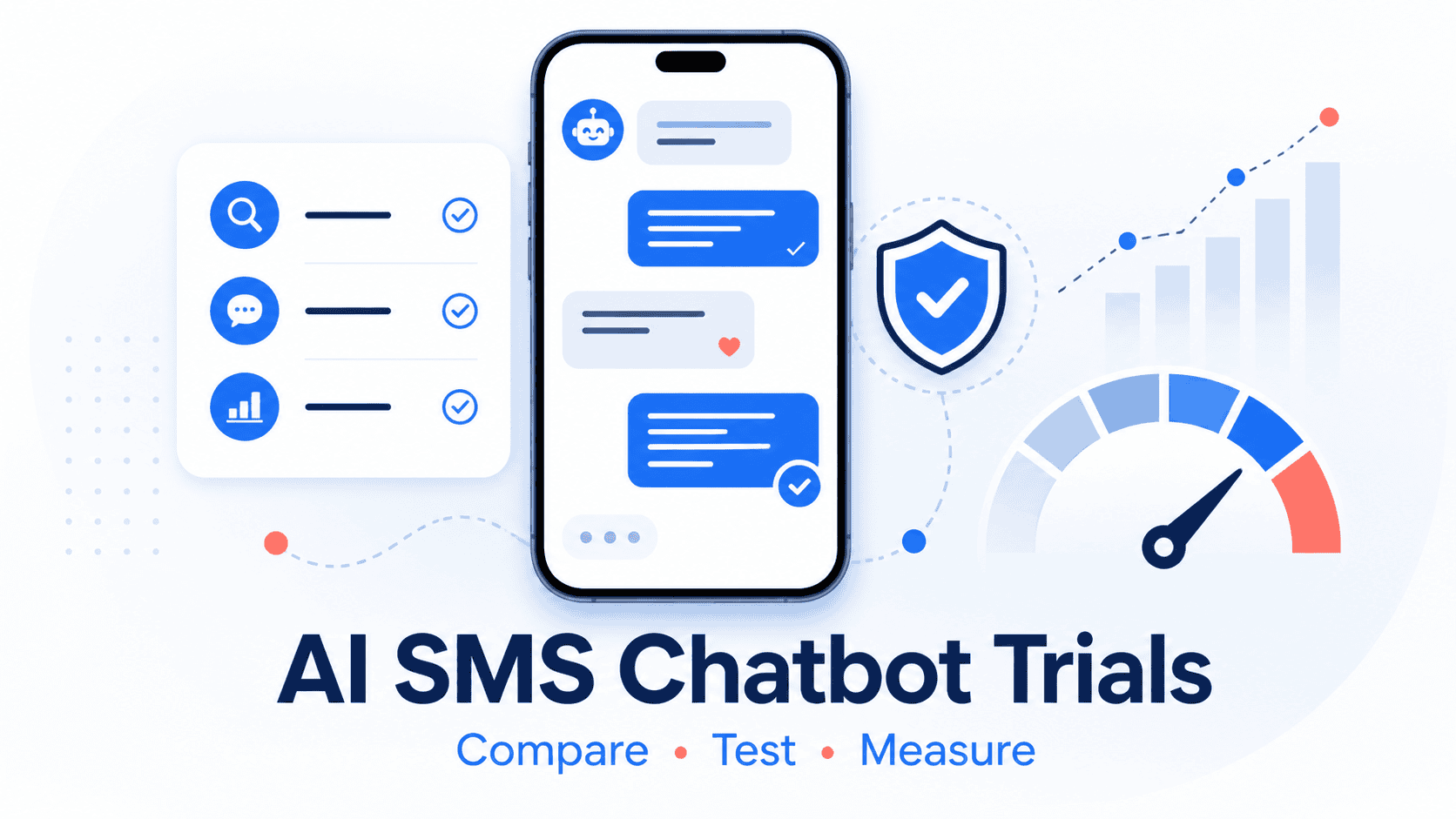
When researching options for an AI SMS chatbot number, finding current and accurate information requires navigating a variety of telecom provider platforms, software trials, and developer environments. This guide evaluates different pathways to establish an SMS testing environment, prototype automated messaging flows, and validate initial chatbot interactions. These are current examples and test paths as of August 28, 2026, not universal endorsements or promises. Readers should re-check the linked official terms before signup, as platform policies, trial allowances, and pricing structures update regularly depending on the specific vendor.
This guide evaluates SMS testing paths separately from Messenger Bot. For the comparison detailed here, Messenger Bot is treated exclusively as a Facebook Messenger channel; the article does not assume SMS capability for the platform. Businesses that are already serving customers in Facebook Messenger can compare that channel’s established features before adding SMS-specific transport, registration, and message-segment considerations to their architecture.
Evaluating an SMS platform is rarely as straightforward as finding a permanent testing environment. Routing messages across global networks creates carrier-level costs, so providers commonly offer bounded test environments instead of indefinite access. A useful evaluation therefore starts with one customer outcome, a limited internal audience, and clear success measures. That structure helps a team learn whether the conversation works before it considers a paid live rollout.
The Intent Split: Categorizing Chatbot Use Cases
Before selecting a messaging platform or creating a trial account, define the exact use case you intend to test. SMS chatbot projects can serve different goals, and each goal needs different controls. A development team may want a bounded environment where it can confirm message formatting, reply handling, and basic application logic before paying for live traffic. For that team, clear setup documentation and repeatable tests matter more than a polished visual interface.
Conversely, other business operators and marketing teams often look for a short-term, no-code software trial that provides a temporary text-enabled number. Their objective is to experience a visual conversation builder, map out dialogue trees using drag-and-drop interfaces, and evaluate the user experience of the contact management dashboard. They need to understand how easily a non-technical staff member can update an autoresponder or adjust a keyword trigger. A third group might seek ways to test complex inbound reply handling from a verified device, evaluating how natural language processing models interpret varying user intents when restricted to text-only input.
Understanding these fundamental differences helps in selecting the appropriate test path. Attempting to force a no-code visual builder into a complex custom integration test, or conversely, expecting a robust visual campaign manager from a bare-bones developer API, often leads to misalignment. Instead of expecting a single universal solution to cater to all testing requirements, matching your project’s specific scope and technical capabilities to the corresponding telecom or software environment ensures that the trial period yields useful, actionable technical and operational insights.

Four-Option Verified Comparison for 2026
To provide a clear perspective on the available testing pathways, this section details four distinct platforms that offer varying types of trials and sandboxes. These are not exhaustive, but they represent common starting points for different types of evaluators.
ट्विलियो
When evaluating developer-focused communication platforms, the Twilio platform represents a widespread testing environment with extensive documentation. According to their official public resources, a Twilio pricing guide states that a free trial is available without a credit card. Within this trial ecosystem, developers can configure webhooks, test API responses, and validate their application’s ability to send and receive structured payloads. Twilio SMS is billed per segment, and carrier fees can apply to messages. Furthermore, moving into production traffic typically requires compliance steps; for example, US A2P 10DLC registration has onboarding fees. This makes the platform a robust space for technical validation, provided the developer understands the eventual production requirements.
Telnyx
Another pathway for technical evaluation is Telnyx, which provides a structured environment for account setup and capability testing. Based on the official Telnyx trial account setup, the platform states that users receive a $5 testing credit, one verified number, and one local number subject to trial conditions. The documented boundaries include outbound messaging to the verified number, a 100-message daily limit, and inbound messaging from the verified number. Those limits let a team measure delivery time and reply reliability within a controlled test.
Sinch
For developers who want to validate message handling before expanding a pilot, Sinch offers another starting path. The official Sinch getting-started documentation states that it provides a free account and a free virtual number for testing. A team can use that bounded setup to check message formatting, response behavior, and activity records before deciding whether a broader pilot is justified.
SimpleTexting
For those preferring a software-as-a-service approach rather than an API-first developer environment, SimpleTexting offers a different trial format focused on usability and campaign management. The official SimpleTexting free tools page states that it provides a 14-day free trial, a text-enabled number, and 50 free messages. This setup is generally utilized by teams needing to evaluate user interface features, contact management layouts, and visual workflow builders before committing to a paid subscription plan or integrating the platform into their broader technology stack.

The Cost Model: Carrier Economics Beyond the Free Trial
Understanding message segments is essential when estimating an SMS chatbot pilot. The current Twilio SMS character-limit documentation explains that a single GSM-7 message supports up to 160 characters, while longer messages use smaller per-segment limits. This means the words a customer sees as one message can be billed or processed as multiple technical segments. Check the exact rules and rate card for the provider and number type in your pilot.
However, the introduction of emojis, specialized punctuation, or specific international characters forces the encoding to shift from GSM-7 to UCS-2. When this shift occurs, the character limit for a single segment immediately drops to 70 characters. Consequently, a conversational AI response that might appear as a brief, single message on a smartphone screen could easily be split into two or three technical segments if it contains an emoji and exceeds 70 characters. Because billing is typically calculated per segment, a lack of attention to character encoding can multiply the anticipated transport costs.
Beyond the basic encoding mechanics, businesses must also consider the cost implications of inbound versus outbound messaging. While some telecom providers charge identical rates for messages sent and received, others maintain distinct pricing tiers depending on the direction of the traffic. Furthermore, the type of phone number selected—such as a toll-free number, a local ten-digit long code, or a dedicated short code—carries its own monthly lease cost and varying per-message fees. A comprehensive cost model must account for the anticipated ratio of inbound user inquiries to outbound automated responses, multiplying these estimates against the specific rate card of the chosen provider to project realistic operational expenses.
Furthermore, standard per-segment rates are often accompanied by additional carrier surcharges. These surcharges are determined by the receiving carrier networks and can fluctuate. When evaluating the financial viability of moving a chatbot from a testing environment into production, teams must calculate the combined cost of the software platform’s usage fees, the per-segment transport rates, and the applicable carrier surcharges. Recognizing these variables early in the design phase allows developers to optimize their chatbot’s prompt instructions, encouraging concise, GSM-7 compliant responses to maintain predictable infrastructure utilization.
Test Design: Structuring Your SMS Chatbot Experiment
Moving from a theoretical concept to a functional prototype requires a structured test design. A successful trial period is rarely achieved by attempting to automate every conceivable customer interaction simultaneously. Instead, teams should define a narrow, highly specific pilot scope. Choosing a single use case—such as answering basic store-hour questions, confirming appointment details, or routing specific inquiries to the correct department—allows for focused development and clearer evaluation metrics. By constraining the initial domain, developers can more effectively train the underlying logic and map out the expected dialogue tree without becoming overwhelmed by edge cases.
Another critical element of test design involves evaluating the system’s ability to maintain state across multiple conversational turns. A basic autoresponder merely reacts to a single keyword, but a sophisticated chatbot must remember context from previous messages to guide a user through a multi-step process, such as collecting a name, date, and location sequentially. The trial period should rigorously test how the application handles interruptions during these multi-step flows. For instance, if a user asks an unrelated question halfway through booking an appointment, the system must either answer and smoothly return to the booking process, or gracefully reset the state, preventing the logic from becoming irrevocably confused.
Mapping the conversational flow should ideally occur before writing code or configuring a visual builder. Documenting the expected progression of a conversation helps identify critical decision points, required data inputs, and appropriate termination conditions. A vital component of this mapping is establishing robust fallback logic. Natural language processing models will inevitably encounter phrases, idioms, or intents they do not recognize. Designing a polite, clear fallback response—such as offering an alternative way to reach a human representative or presenting a numbered list of understood commands—prevents the user experience from degrading into frustrating, repetitive loops.
During the initial trial phase, keep testing on internal devices allowed by the provider’s current terms. Sending test messages only to approved phones controlled by the team prevents errors or unexpected replies from reaching customers. This controlled environment lets the team validate reply handling, conversation state, and intent recognition before it considers any public use.
Creating a Privacy-Safe Pilot
Executing a pilot program responsibly involves stringent attention to data protection and privacy considerations, even when operating within a limited trial environment. Development teams should prioritize data minimization strategies, ensuring that the chatbot logic is tested using mock data rather than real customer records or sensitive personal information. Uploading actual client lists or processing live transactional data through a temporary testing sandbox introduces unnecessary risk and complicates compliance efforts.
Furthermore, it is advisable to establish clear data retention policies even during the testing phase. Developers should ensure that their application logic includes mechanisms for automatically purging test logs and conversational histories after the validation process is complete. By proactively managing the lifecycle of the data generated during the pilot, teams reduce their exposure to unnecessary risk and demonstrate a commitment to privacy principles that will be vital when transitioning the system to handle actual user interactions.
It is essential to review the privacy policies, data retention schedules, and security disclosures of any platform selected for testing. Understanding how the provider handles message logs, user identifiers, and interaction history informs the technical boundaries of the pilot. Rules vary significantly by country, number type, specific use case, and the chosen provider. Therefore, readers must verify the consent, opt-out, registration, privacy, and carrier requirements that apply directly to their unique operational context.
This guide does not give legal advice. The responsibility for ensuring that an automated messaging system adheres to regional regulations, industry standards, and carrier guidelines rests entirely with the business deploying the service. Establishing clear protocols for handling test data and defining the acceptable parameters for pilot interactions builds a foundation for responsible deployment should the project progress beyond the testing phase.
Measurement Worksheet: Evaluating Your Trial
To determine whether a testing phase has been successful, teams need a structured framework for measurement. Establishing predefined metrics prevents subjective evaluations and focuses the review process on technical and operational realities. A primary metric is the intent recognition rate, which measures how accurately the system identifies the core purpose of a user’s text message. High accuracy indicates that the prompt engineering or underlying model is well-aligned with the expected vocabulary, while frequent misinterpretations suggest a need for refinement.
Closely related is the fallback escalation frequency. Tracking how often the chatbot resorts to its default error response provides insight into the boundaries of its conversational capability. If the fallback is triggered excessively, the defined scope may be too broad, or the natural language processing may require additional training examples. Additionally, measuring the completion rate of the main task—such as successfully navigating an appointment confirmation flow from start to finish—offers a concrete indicator of the system’s practical utility.
Measure end-to-end reply time from the moment a test message arrives until the test device receives the response. Slow processing or platform time limits can make replies unreliable even when the conversation logic is correct. Record that timing throughout the trial so the next decision is based on observed customer experience rather than a feature list.
Channel-Fit Decision: Evaluating Facebook Messenger Before SMS
When assessing the feasibility of automated communication, it is strategically valuable to evaluate the constraints of SMS against the capabilities of alternative digital channels. The strict character limits, potential encoding challenges, and per-segment infrastructure dynamics of SMS present specific design hurdles. Businesses already serving customers in Facebook Messenger can compare that channel before adding SMS-specific transport, registration, and message-segment considerations to their operational overhead.
The Facebook Messenger channel has a different interaction model from SMS. A business can evaluate whether the conversation patterns available in its current Messenger setup make the next action clearer for the audience it already serves there. The useful question is not which channel is universally better; it is whether the selected channel matches the customer’s starting point, the information the business needs to collect, and the handoff the team can support.
Evaluating these differences allows teams to determine which channel best aligns with their technical resources and customer communication preferences. If your organization determines that a rich-media, socially integrated approach better suits your automation goals, you can See Our Plans to evaluate how Messenger Bot handles workflows designed specifically for the Facebook Messenger environment. This comparison ensures that the chosen platform aligns with the desired user experience and operational capabilities before committing to a specific architectural path.
Common Failure Modes in SMS Automation
Even with careful planning and rigorous testing, SMS automation projects frequently encounter specific failure modes that teams must anticipate and mitigate. One common technical issue arises from character encoding errors. As previously discussed, inadvertently including characters that trigger UCS-2 encoding can cause unexpected message segmentation. If the application logic is not designed to handle multipart messages gracefully, or if it fails to concatenate them correctly upon receipt, the conversation can become fragmented and confusing for the end user.
Delayed replies are another common test failure. If understanding the inbound text and preparing a useful response takes longer than the platform allows, the customer may receive nothing or experience an awkward pause. Test a short acknowledgment and a clear human-handoff path so the conversation still moves forward when a detailed answer needs more time.
Another frequent pitfall involves inadequate monitoring and alerting systems. If a chatbot encounters a critical error, such as a database connection failure or an API authentication rejection, the system must generate immediate alerts for the development team rather than silently failing or providing unhelpful generic responses to the user. Implementing comprehensive logging for both successful interactions and error states is essential for diagnosing issues rapidly and maintaining the reliability of the automated communication channel as usage scales.
Furthermore, failing to design robust handling for conversational deviations can result in infinite loops or broken user experiences. If an automated system does not understand a user’s input and repeatedly sends the same error message without offering an escalation path, user frustration escalates rapidly. Similarly, processing opt-out strings—such as STOP or UNSUBSCRIBE—must be handled flawlessly. Failure to recognize and respect these commands not only damages customer trust but also violates carrier policies and regulatory standards. Because compliance rules vary by country, number type, and provider, ensuring that the application logic accurately manages these states is a critical component of deployment.
अक्सर पूछे जाने वाले प्रश्नों
Do permanent free numbers exist for business SMS?
In standard telecom environments, carriers charge for infrastructure and message routing, which heavily influences whether providers offer long-term free access. Consequently, permanent free offerings designed specifically for business use are uncommon. Most testing pathways rely on short-term trials, restricted sandboxes, or small initial credit allocations intended to facilitate technical validation rather than sustained production traffic.
What distinguishes a developer sandbox from a software trial?
A developer test environment may restrict messaging to verified internal numbers or other documented boundaries, allowing engineers to evaluate reply logic and message formatting within a controlled scope. A software trial may grant temporary access to a platform’s interface and a limited message allowance. The exact capabilities differ, so confirm the current official terms before choosing a test path.
Can anyone text a trial number?
This capability depends on the platform’s current trial policy. Some test environments restrict messaging to numbers that have been verified in the account. Do not assume that a trial number is ready for public use; confirm the documented inbound and outbound boundaries before sharing it.
Does Messenger Bot integrate with SMS?
For the purposes of this specific comparison and guide, Messenger Bot is treated exclusively as a Facebook Messenger channel. The platform does not assume SMS capability. Businesses are encouraged to evaluate the Facebook Messenger channel’s features separately before considering the addition of SMS-specific transport and infrastructure.
How are opt-outs handled in these environments?
Technical handling of opt-out commands (like STOP) varies significantly by provider and the level of the integration. Readers must proactively verify the consent and opt-out requirements that apply to their specific use case, ensuring their application logic or the chosen platform accurately respects user preferences and halts communication when requested.
Is business registration required for texting?
Regulatory frameworks and carrier policies governing business messaging vary by country, number type, specific use case, and the telecom provider facilitating the service. Readers should thoroughly verify the registration requirements, identity vetting processes, and campaign approvals necessary for their specific region and operational context.
Can the software handle high volume?
Throughput limits and processing capabilities vary widely depending on the chosen platform, the specific type of number provisioned (e.g., short code versus long code), and the account’s registration status. Transitioning from a low-volume trial to high-volume production typically requires architectural adjustments and formal carrier approvals to increase message limits.



 हिन्दी
  English
  Tagalog
  简体中文
简体中文  العربية
  Português do Brasil
  Español de México
  Français
  বাংলা
বাংলা  香港中文
香港中文  繁體中文
繁體中文  Nederlands
  Deutsch
  Bahasa Indonesia
  日本語
日本語  한국어
한국어  Polski
  Русский
  Español
  Tiếng Việt