
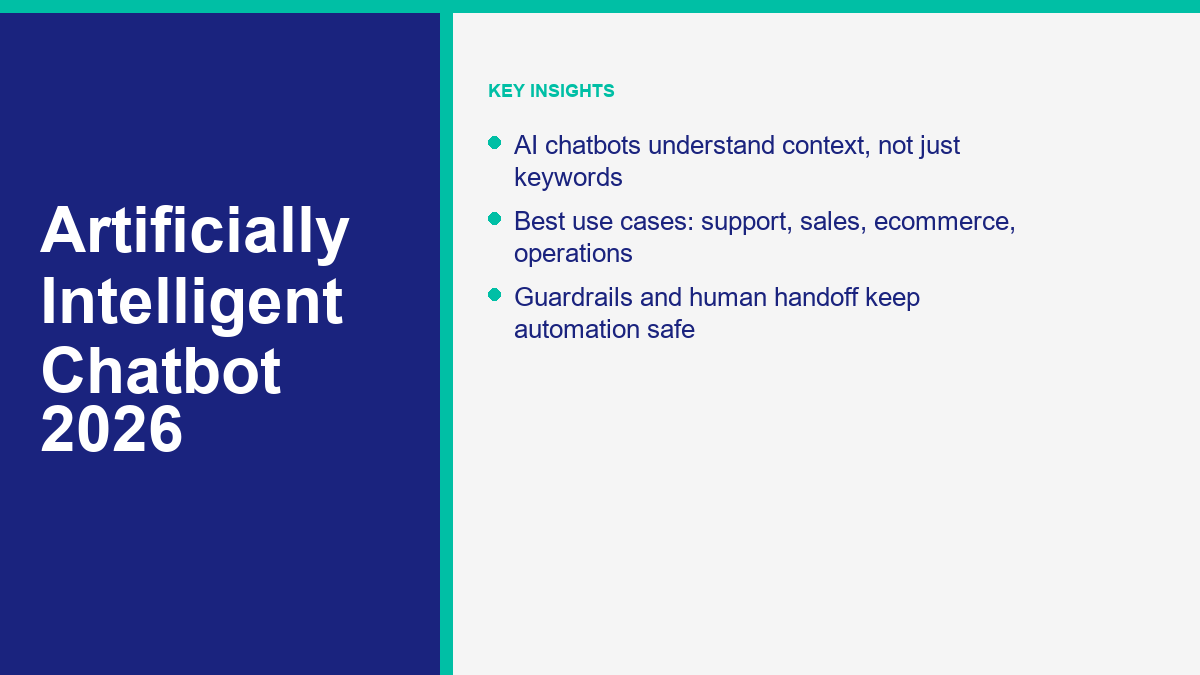
The term “chatbot” used to bring to mind a frustrating series of buttons that led to a dead end. You would click “Support,” then “Shipping,” only to be told to wait for a human. In 2026, the artificially intelligent chatbot has finally buried that experience. We are no longer dealing with rigid decision trees; we are interacting with dynamic systems that understand nuance, context, and even the unstated intent behind a user’s question. This shift represents the most significant change in customer communication since the invention of the telephone. It is the transition from “command-based” software to “conversational” software.
For business owners and marketing teams, this evolution is more than just a technological upgrade. It is a fundamental change in how we scale conversations. An artificially intelligent chatbot allows a small team to provide enterprise-level support and a large enterprise to provide a personalized, “mom-and-pop” feel to millions of customers simultaneously. If you have been wondering how these tools actually function or which examples apply to your specific niche, you are in the right place. We are moving away from “automated replies” and toward “digital teammates” that can reason, solve problems, and build trust.
By 2026, the distinction between a “bot” and an “assistant” has blurred. The modern AI chatbot is proactive. It does not just wait for a question; it uses behavior, history, and real-time context to guide the next useful action. For small stores, agencies, service businesses, and larger support teams, the practical advantage is the same: more conversations can be answered without making every customer wait for a person.
Defining the Artificially Intelligent Chatbot
An artificially intelligent chatbot is a software application designed to simulate human conversation through text or voice interactions by utilizing Large Language Models (LLMs), Natural Language Processing (NLP), and machine learning. Unlike the “dumb” bots of the past, these systems do not rely on a pre-written script. Instead, they “understand” the language being used and generate responses based on the data they have been trained on or the specific knowledge base they have been given. They are linguistic engines that can translate, summarize, and synthesize information in real-time. They don’t just “match” keywords; they “process” meaning.
In 2026, the definition has expanded significantly. It is not just about a chat window on a website. These bots are now agents: autonomous or semi-autonomous assistants that can perform tasks, update databases, and handle complex workflows. They recognize that a customer asking “Where is my stuff?” is actually looking for a shipping update, even if the word “shipping” never appears in the prompt. This ability to parse intent is what separates artificial intelligence from simple automation. Intelligent chatbots can now reason through multi-step problems, such as “Cancel my last order, refund the shipping cost, and send a follow-up offer to my email.”
Intelligent chatbots can also be multimodal when the platform supports it. They may interpret an uploaded image, read a document, or use a product manual to explain a fix. They can also keep context across channels when the business has connected the right data. A user might begin on Facebook Messenger and finish through a website chat without restarting the entire conversation. That continuity is what makes the experience feel intelligent rather than mechanical.
Furthermore, the “intelligence” in these bots comes from their ability to handle ambiguity. If a customer provides a vague request like “I need something for my dad’s birthday,” a rule-based bot would fail or provide a generic “No results found” message. An AI chatbot, however, will ask clarifying questions: “What are his hobbies? What is your budget? Does he prefer physical gifts or experiences?” By narrowing down the options through natural dialogue, the bot provides a helpful, human-like service that drives actual value. It transforms the shopping experience from a lonely search bar into a guided consultation.
AI Chatbot vs. Rule-Based Chatbot: The Great Divide
Understanding the difference between a rule-based system and an artificially intelligent chatbot is critical for choosing the right tool for your business. Rule-based chatbots follow a “if-this-then-that” logic. They are essentially interactive flowcharts. If the user clicks Button A, the bot shows Message B. If the user types a word the bot doesn’t recognize, it breaks. It’s like a vending machine: you press a button, and you get a specific result. While they are reliable for simple tasks, they are incredibly fragile when faced with the unpredictability of human speech. If a user makes a typo or uses a synonym the developer didn’t anticipate, the rule-based bot hits a wall.
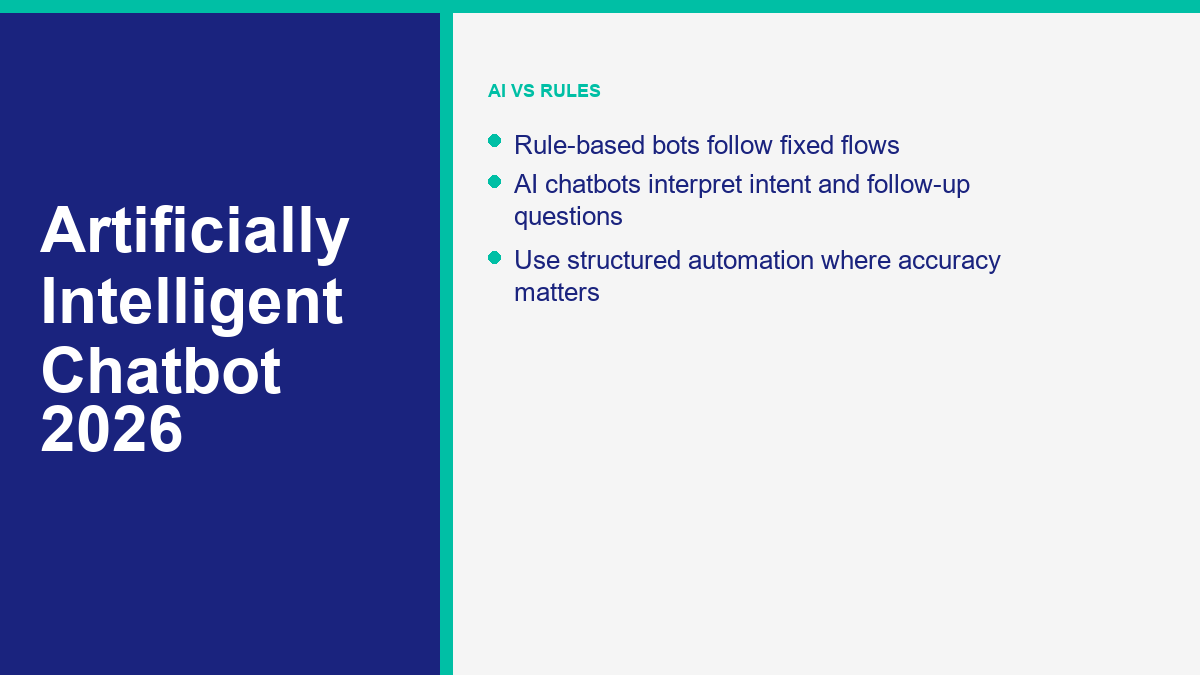
An artificial intelligence chatbot, by contrast, operates more like a well-trained employee. It has access to a library of information and the linguistic skills to explain that information in various ways. It can handle spelling errors, slang, and follow-up questions that don’t fit into a neat category. While rule-based bots are still useful for very simple, high-volume tasks like checking a bank balance via a keypad, they cannot handle the messy reality of human communication. In 2026, a rule-based bot often feels like a barrier to support, whereas an AI bot feels like the support itself. The modern consumer has lost patience with “Press 1 for Sales,” and they expect the same level of understanding from a chat window.
To see how they stack up in the 2026 market, look at the detailed comparison below:
| विशेषता | Rule-Based Chatbot | Artificially Intelligent Chatbot |
|---|---|---|
| Core Logic | Pre-defined decision trees (If/Then) | Large Language Models & NLP |
| समझना | Keyword matching only | Semantic intent and context |
| उपयोगकर्ता इनपुट | Buttons or specific phrases | Free-form natural language |
| सीखना | Static; requires manual updates | Dynamic; improves with feedback/data |
| जटिलता | Low; handles simple FAQ | High; handles complex reasoning |
| Flexibility | None; breaks on unexpected input | High; adapts to user phrasing |
| Multilingual | Requires manual translation for each flow | Native real-time translation capabilities |
| उपयोगकर्ता अनुभव | Functional but often frustrating | Conversational and helpful |
| Cost to Scale | High (More flows = more complexity) | Low (One model handles everything) |
While the intelligent chatbot is clearly more capable, it is often helpful to compare it to the smartest and most advanced chatbots to see where the cutting edge currently lies. For most businesses, the goal is to find the “sweet spot” where the bot is smart enough to be helpful but controlled enough to be safe and on-brand. You don’t always need the most advanced model in the world; you need the model that best understands your specific business data. A bot that knows your return policy perfectly is more valuable than a bot that can write poetry but forgets your shipping rates.
Real-World AI Chatbot Examples Across Industries
To understand the utility of these bots, look at the friction points they remove. Every industry has repetitive questions, handoff delays, and missed follow-up opportunities. A useful AI chatbot does not need to solve every business problem. It needs to solve a narrow set of common problems accurately, quickly, and in a way the customer can trust.
ग्राहक सेवा और समर्थन
In the support world, the primary use case is “deflection.” This does not mean ignoring the customer; it means solving their problem so they do not sit in a queue for a human agent. Modern bots can access real-time APIs to check order statuses, process returns, or troubleshoot technical issues. A customer might say, “My internet is slow,” and the bot can run a diagnostic, identify a likely signal issue, and suggest a fix without forcing the user through a long support script. This first-line support automation allows human agents to focus on the complex, emotionally charged cases that require empathy. The best support bots do not just solve the problem; they also follow up when the workflow calls for it.
बिक्री और लीड जनरेशन
Sales bots are moving away from annoying pop-ups and toward “concierge” selling. Instead of asking “Can I help you?” an AI chatbot on a real estate site might ask, “Are you looking for a home with a home office or a large backyard?” As the user responds, the bot qualifies the lead. It identifies their budget, timeline, and preferences, then automatically books a tour in the agent’s calendar. It turns a passive visitor into a scheduled appointment in under two minutes. By the time the human agent sees the lead, they already have a full profile of what the customer wants, allowing for a much more effective sales call. This reduces the “lead response time” to zero, which is the single most important metric in digital sales.
E-commerce and Retail
The “personal shopper” bot is the gold standard here. Imagine a customer on a clothing site saying, “I need something for a wedding in Italy this July.” The bot knows the weather in Italy in July, understands the “wedding guest” aesthetic, and searches the inventory for breathable fabrics and appropriate styles. It then suggests three outfits, including accessories, and offers a discount code for the bundle. This is proactive selling that feels like a service. It mimics the experience of walking into a high-end boutique where the staff knows exactly what to pull from the back room. In 2026, these bots can even use AR (Augmented Reality) to show the customer how the outfit would look on their specific body type.
Internal Operations and HR
Large companies are using intelligent chatbots to help their own employees. An HR bot can answer questions like “How many days of PTO do I have left?” or “What is our policy on remote work from Canada?” It can also help with onboarding, walking a new hire through their paperwork and software setup. This frees up HR managers to handle sensitive interpersonal issues rather than repetitive data entry. In 2026, “Employee Experience” (EX) is just as important as Customer Experience (CX), and AI chatbots are at the center of that strategy. An internal bot can also serve as a “Knowledge Management” tool, allowing engineers to ask, “How did we solve the server lag issue back in 2024?” and get an instant summary of the relevant Slack threads and Jira tickets.
How Modern AI Chatbots Actually Work Under the Hood
If you want to build or buy an artificially intelligent chatbot, you need to understand the mechanics. It isn’t magic; it is a pipeline of data and logic. The process usually follows a specific sequence from the moment a user types a message to the moment the bot responds. Understanding this pipeline helps you identify where errors might be occurring and how to optimize for better results. The “black box” of AI is actually a series of manageable engineering steps.
Intent Detection and NLP
First, the system uses Natural Language Processing to break down the user’s sentence. It looks for “entities” (nouns like “iPhone” or “New York”) and “intents” (verbs or goals like “buy” or “return”). In 2026, intent detection is incredibly sophisticated. The bot can detect sarcasm, frustration, or urgency, and adjust its tone accordingly. This is the stage where the bot decides what the user actually wants. If the NLP layer fails, everything that follows will be incorrect. Advanced bots now use “multi-intent” detection, allowing them to handle sentences like, “I want to return my boots and buy a gift card, but I also need to update my address.”
Retrieval-Augmented Generation (RAG)
One of the biggest breakthroughs for business AI is RAG. Instead of the bot relying solely on its “general knowledge” (which can lead to hallucinations or making things up), it is connected to a specific “Knowledge Base.” This could be your website, your PDF manuals, or your Google Drive. When a question is asked, the bot searches your specific data, finds the relevant facts, and then uses its language skills to summarize that information for the user. This ensures the answer is both conversational and accurate. It’s like giving an open-book test to a very smart student. RAG allows businesses to update their bot’s “brain” instantly just by editing a document.
Vector Databases and Semantic Search
To make RAG work, your data is often converted into “vectors”—numerical representations of meaning. When a user asks a question, the bot doesn’t just look for matching words; it looks for matching *meanings* in the vector database. This is why an AI chatbot can find the answer to “How do I fix a leaky tap?” even if the manual uses the phrase “Remedying faucet moisture leakage.” The semantic connection is what makes the bot feel truly intelligent. Vector databases allow the bot to understand relationships between concepts, not just strings of characters.
Guardrails and Safety Layers
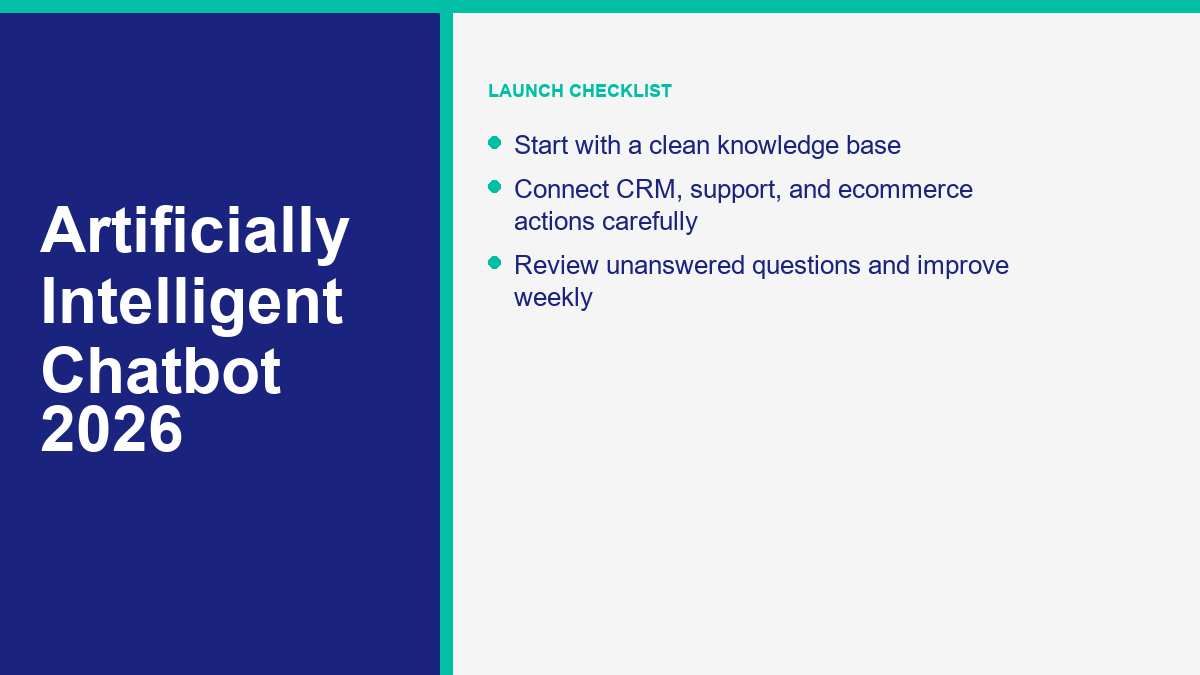
You cannot simply turn an LLM loose on your customers. There must be a “middle layer” of safety. These guardrails prevent the bot from discussing competitors, using inappropriate language, or giving legal/medical advice if it isn’t qualified to do so. In 2026, these guardrails are often secondary AI models that “watch” the primary model to ensure compliance with brand guidelines. They act as a digital editor, catching mistakes before the customer ever sees them. These layers also handle “PII Scrubbing,” ensuring that sensitive customer data like credit card numbers or social security numbers are never stored in the bot’s logs.
The Human-in-the-Loop Handoff
The most important part of an intelligent chatbot’s workflow is knowing when to quit. If the bot detects that a customer is becoming angry or if the question is too complex for its current knowledge base, it should trigger a “handoff.” It notifies a human agent, provides a summary of the chat so far, and allows the human to take over seamlessly. This hybrid approach is how modern businesses maintain high satisfaction scores. The bot handles the speed, and the human handles the heart. In 2026, the handoff is so smooth that the customer often doesn’t even realize they have switched from a bot to a human—they just feel like they are getting excellent service.
Strategic Business Benefits of Deploying AI Chatbots
Why should you invest in an artificial intelligence chatbot? It isn’t just about being “high-tech.” It is about the bottom line. The ROI of these systems usually comes from three main areas: cost reduction, revenue growth, and data collection. In 2026, however, there are also “softer” benefits like improved brand perception and employee satisfaction. Let’s look at the numbers and the strategy behind them.
Cost control is the most obvious benefit. A bot can handle many concurrent conversations while human agents focus on work that requires judgment, empathy, or account-specific authority. The goal is not to replace the support team entirely. The goal is to keep routine questions from consuming the whole day. If the bot answers shipping questions, policy questions, appointment requests, and basic troubleshooting, the human team gets more time for the cases that actually need a human.
Revenue growth happens when questions stop blocking purchases. Many visitors leave because they cannot find the right product, do not understand delivery terms, or need one last reassurance before buying. An AI chatbot can answer those questions immediately and guide the visitor to the next sensible action. Bots can also suggest complementary products consistently, as long as the recommendations are grounded in real catalog data and do not feel pushy.
The third benefit is the “hidden” goldmine: data. Every interaction with a chatbot is a piece of market research. You can see exactly what your customers are confused about, what products they are looking for that you don’t have, and what their most common pain points are. This data can inform your product development, your ad copy, and your overall business strategy. In a world where data is everything, the chatbot is your most efficient researcher, providing qualitative insights at a quantitative scale. You can literally ask your bot, “What were the top three complaints from customers in the UK last week?” and get an instant report.
Employee retention is an often-overlooked benefit. Customer support is a high-stress job with high turnover. Much of that stress comes from answering the same five questions 100 times a day. By automating the mundane, you allow your employees to do more interesting, rewarding work. This reduces burnout, lowers hiring costs, and creates a more motivated workforce that can provide better service when a human is actually needed. When your team sees the AI as a tool that helps them rather than a threat that replaces them, your entire organizational culture improves.
Managing Realistic Limits and Security Guardrails
Despite the incredible progress made by 2026, an artificially intelligent chatbot is not a silver bullet. There are real risks and limitations that every business owner must manage. Hallucinations, data privacy, and model bias are all challenges that require active management and a “security-first” mindset. You cannot afford to be complacent when your brand’s reputation is on the line.
Hallucinations occur when a bot confidently states something that is factually incorrect. This usually happens when the bot is asked a question that isn’t in its training data or its connected knowledge base. To mitigate this, you must strictly limit the bot’s sources of information and use “grounding” techniques. If the bot doesn’t find the answer in your provided documentation, it should be trained to say “I don’t know” and offer a human handoff. Accuracy is the foundation of trust. In 2026, we also use “Verify” layers where a second AI checks the first AI’s output against the source documentation before it’s sent to the user.
Security and privacy are even more critical. If your bot is handling customer data, it must be compliant with regulations like GDPR or CCPA. You need to ensure that the data being fed into the bot isn’t being used to train the public models of companies like OpenAI or Google unless you have explicitly opted into that. Private, hosted instances of these models are the standard for enterprise security in 2026. You must also be wary of “prompt injection” attacks, where malicious users try to trick the bot into revealing sensitive information or bypassing its safety protocols. Regular security audits of your bot’s logic are a necessity, not an option.
Model bias is another significant concern. AI models are trained on internet data, which often contains human biases regarding race, gender, and culture. As a business owner, you are responsible for ensuring your bot treats all customers fairly. This requires “red-teaming”—intentionally trying to get the bot to show bias so you can implement corrections. A biased bot isn’t just a social problem; it’s a massive PR risk. You should also ensure your bot is accessible to users with disabilities, providing text-to-speech and speech-to-text options where appropriate.
Finally, there is the social aspect. Customers appreciate efficiency, but they also want to know they are talking to a bot. Pretending an AI is a human is a recipe for disaster; once the customer realizes the deception, trust is broken. Transparency—stating “I am the MessengerBot Assistant”—is the best policy. It sets expectations correctly and makes the customer more forgiving of minor mistakes. Authenticity is the currency of 2026. If the bot says, “I’m an AI, but I can help you with X, Y, and Z,” the customer understands the boundaries and appreciates the honesty.
How to Choose the Right AI Chatbot Platform for Your Stack
The market is flooded with options, ranging from simple plugins to massive enterprise frameworks. To choose the right one, you need to evaluate your technical capabilities and your specific goals. Are you looking for a “no-code” solution that you can set up in an afternoon, or do you need a custom-coded engine that integrates with your proprietary CRM? The “best” platform is the one that integrates most seamlessly with the tools you already use. Don’t buy a Ferrari if you only need to drive to the grocery store, but don’t buy a tricycle if you need to haul freight.
Most business owners should look for platforms that offer “omnichannel” support. This means the bot can live on your website, but also on Instagram, WhatsApp, and Facebook Messenger. You want a single “brain” that controls all these channels so your messaging is consistent everywhere. If you change a price in your knowledge base, that change should reflect across every chat interface instantly. Consistency is the key to building a professional brand image. A bot that says one thing on Facebook and another on your website will quickly confuse and frustrate your customers.
Check the detailed comparison table below to understand the different tiers of the 2026 market:
| Platform Tier | सर्वश्रेष्ठ के लिए | Key Advantages | Typical Integration | Budget Profile |
|---|---|---|---|---|
| SaaS Plugins | Solopreneurs & Small Blogs | Lowest cost, instant setup | WordPress, Shopify | Lowest budget; usually subscription-based |
| संवादात्मक एआई प्लेटफार्म | SMBs & Marketing Agencies | RAG support, Omnichannel, No-code builders | Klaviyo, Salesforce, Zapier | Mid-market budget; usually based on features and usage |
| Enterprise Frameworks | Fortune 500 & Tech Companies | Full model control, On-premise hosting | Proprietary internal APIs | High budget; usually custom or enterprise contract |
| Niche-Specific Bots | Real Estate, Legal, Medical | Industry-specific logic and compliance | Industry CRMs (e.g., Clio, Zillow) | Varies by industry |
For the vast majority of businesses, the middle tier—Conversational AI Platforms—provides the best value. These platforms allow you to connect your own data and build complex workflows without needing a PhD in machine learning. They provide the “Lego blocks” of AI, letting you assemble a powerful assistant that is tailored to your brand. They also tend to have the best balance of “ease of use” and “powerful features.” Look for a platform that offers a free trial or a demo so you can test their RAG performance with your own documents before committing.
When evaluating a platform, pay close attention to its context window, which controls how much of a conversation the bot can remember, and its latency, which controls how fast it responds. You want a bot that responds quickly enough to keep the conversation moving. Also check the handoff capability. Does the platform integrate with your existing helpdesk software like Zendesk, Gorgias, or Intercom? If not, you may create a siloed support experience that becomes difficult to manage.
Your First AI Chatbot: A Practical Implementation Checklist
Ready to get started? Do not just turn on a bot and hope for the best. Implementation is a process, not a single event. A poorly implemented bot can do more damage to your reputation than having no bot at all. The strongest launches come from clear scope, clean data, careful testing, and a human handoff that works when the bot reaches its limit.
Prepare the Knowledge Base and Strategy
First, identify your “Top 50” questions. Look at your support tickets, your social media comments, and your “Contact Us” emails. What are the things people ask most often? Your bot should be an absolute expert on these before it handles anything else. Next, clean your knowledge base. If your bot is reading your website, make sure that content is accurate. An AI bot is only as smart as the data you give it. If your FAQ page still lists 2024 prices, your 2026 bot will give the wrong information. This is often called “Data Hygiene,” and it is the single most important predictor of bot success.
Define Personality and Tone
Define the tone of voice. Should your bot be formal and professional, or cheeky and fun? Write a “Persona Guide” for your bot. If your brand is a luxury watch company, the bot should be polite and sophisticated. If you sell skateboards, it should be energetic and informal. Consistency in voice is what makes a bot feel like part of the brand rather than a separate piece of software. You should also decide if your bot has a name and a visual avatar. This “anthropomorphism” can make customers feel more comfortable, but it must be handled carefully to avoid the “uncanny valley.”
Connect Integrations and Handoff Logic
Set up the handoff protocols. Decide exactly when a human needs to step in. This should be based on “sentiment analysis” (if the customer is angry) or “complexity analysis” (if the bot has tried and failed to answer the same question twice). Make sure the transition is smooth. The human agent should receive a summary of the chat so the customer doesn’t have to repeat themselves. Nothing kills a customer’s mood faster than having to explain their problem for a second time. You should also integrate the bot with your CRM so it can say, “Hello Sarah, I see your order #1234 is currently in transit.”
Test Before the Full Launch
Beta test with real users. Before you put the bot on your homepage, send a private link to a few trusted customers or team members. Ask them to try to break it. Their phrasing and edge-case questions will reveal gaps in your bot’s logic that a clean internal test will miss. Once you launch, do not walk away. Monitor the unanswered-questions log closely and refine the bot’s training before sending it to your full audience.
Maintain and Improve the Bot Over Time
Review and iterate. A chatbot is a living system. Spend an hour every week reviewing the chats where the bot struggled. Use those insights to update your knowledge base or adjust your prompt engineering. As your business grows, your bot should grow with it, taking on more complex tasks like booking appointments or processing payments directly in the chat window. AI is not a “set it and forget it” solution; it is a “learn and improve” solution. The most successful bots are the ones that get slightly smarter every single day.
If you need help with the technical side of things, you can हमारे ट्यूटोरियल ब्राउज़ करें for deep dives into specific integrations and advanced features. We cover everything from API connections to advanced persona design, providing step-by-step guides for every stage of the journey.
Driving Results with MessengerBot.app
MessengerBot.app is built for businesses that want practical automation without turning every workflow into a custom engineering project. The platform helps you create structured flows, connect customer actions, and use automation where it actually supports conversion. The point is not to make a bot that talks endlessly. The point is to make a bot that answers, routes, qualifies, and follows up.
Our focus is on “Actionable AI.” We don’t want your bot to just talk; we want it to work. That means booking appointments, selling products, and qualifying leads. By combining the power of the latest LLMs with our intuitive workflow builder, you can have a sophisticated agent running in a fraction of the time it would take to build one from scratch. Our integrations with tools like Shopify and Klaviyo mean your bot can act on the data you already have, providing a truly personalized experience that feels like magic to the customer.
One of the unique features of our platform is the “Visual Flow Builder.” You can see the logic of your bot in a graphical interface, making it easy to spot where a customer might get stuck. This combined with our powerful AI “brain” gives you the best of both worlds: the reliability of structured logic and the flexibility of artificial intelligence. You can build complex, multi-step agents that handle everything from customer support to complex sales funnels with ease.
If you are ready to see the difference a truly intelligent assistant can make for your business, you can explore the MessengerBot Pro विशेषताएँ to see our advanced automation capabilities. When you are ready to scale, you can मेसेंजरबॉट मूल्य निर्धारण देखें and find a plan that fits your current volume. We offer flexible tiers that grow as your business grows, ensuring you always have the power you need without paying for more than you use.
The future of business communication is conversational, but the winning teams will be the ones that use automation carefully. An artificially intelligent chatbot should make the customer feel answered, not trapped. It should shorten the path from question to action, then move aside when a person is the better answer.
अक्सर पूछे जाने वाले प्रश्नों
What makes a chatbot “artificially intelligent”?
An AI chatbot uses machine learning and natural language processing to understand the meaning behind words, rather than just matching keywords. It can handle context, follow-up questions, and varied phrasing, making the conversation feel more natural and productive. Unlike older bots, it can reason through a problem and provide a synthesis of information rather than just a canned response. It learns from its interactions and becomes more effective over time.
How much does it cost to build an AI chatbot in 2026?
Costs vary based on the channel, traffic volume, AI features, integrations, and support requirements. A simple website chatbot may be handled with a standard SaaS subscription, while a custom enterprise assistant with private hosting and complex integrations requires a larger budget. For most small and mid-sized businesses, the best starting point is a platform that balances no-code setup, knowledge-base support, and clear upgrade paths.
Can an AI chatbot replace my entire support team?
No, and it should not. A bot can handle routine inquiries like shipping status, basic FAQs, appointment routing, and simple troubleshooting, but you still need humans for complex problems, high-stakes decisions, negotiations, and situations requiring empathy. The best strategy is a hybrid model where the AI handles repeatable work and humans step in for the moments that need judgment.
Is it hard to train a chatbot on my own business data?
In 2026, the process is very streamlined. Most professional platforms use “Retrieval-Augmented Generation” (RAG). You simply “point” the bot at your website URL or upload your internal documents (PDFs, Docs, etc.). The AI then “reads,” indexes, and understands that information automatically. You don’t need to write any code or hire a developer to train the bot on your specific facts. You can update your bot’s knowledge in seconds just by changing a text file.
Do customers actually like talking to AI chatbots?
Customers usually accept AI chatbots when the bot is fast, accurate, transparent, and easy to escape. Satisfaction drops when the bot invents answers, loops the same response, or hides the path to a human. The safest approach is to identify the bot clearly, answer routine questions well, and provide a visible handoff whenever the conversation becomes sensitive or complex.
 हिन्दी
  English
  Tagalog
  简体中文
简体中文  العربية
  Português do Brasil
  Español de México
  Français
  বাংলা
বাংলা  香港中文
香港中文  繁體中文
繁體中文  Nederlands
  Deutsch
  Bahasa Indonesia
  日本語
日本語  한국어
한국어  Polski
  Русский
  Español
  Tiếng Việt