
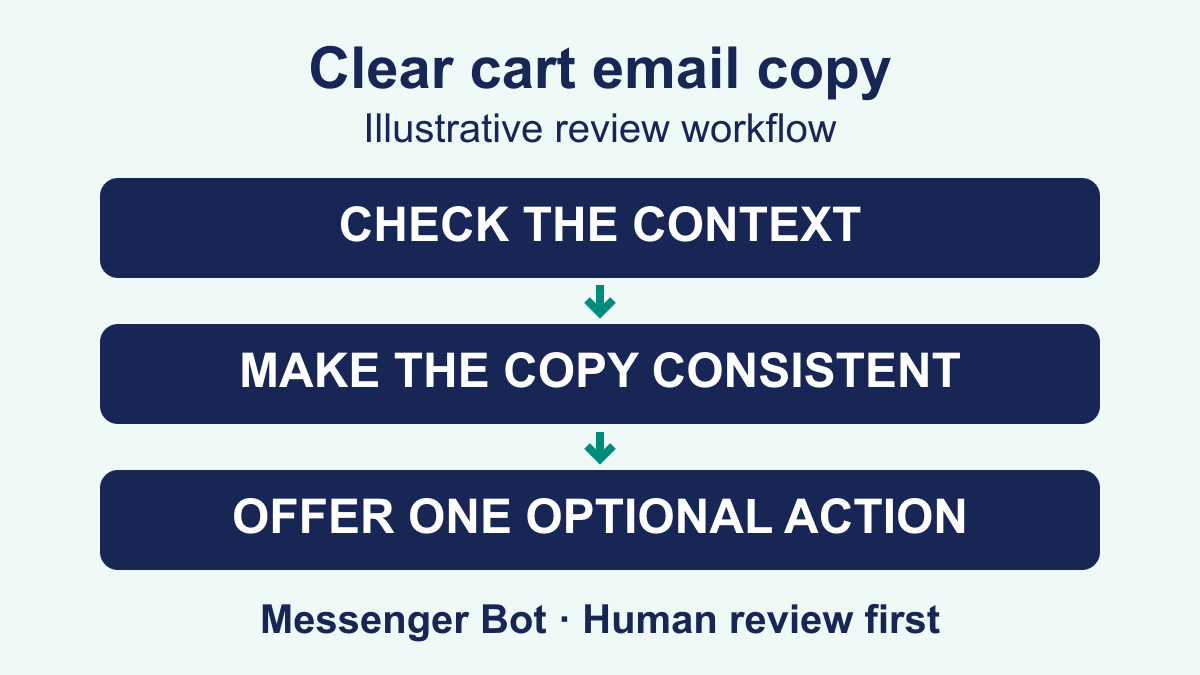
A useful cart email helps someone make a decision without pretending that a purchase, discount or reservation already exists. Start with the checked customer context, a recognizable store name and one optional next step. Keep the subject, preview and body consistent, and review the destination before considering any real contact.
This practical guide is for small online-store teams reviewing their own copy. The examples are hypothetical writing patterns, not messages sent to customers or evidence of recovered sales. They use inert placeholders rather than real customer details or working checkout links. Platform settings, recipient eligibility and the sending decision need separate review by the responsible business team.
Source check: October 13, 2026. Shopify-specific facts below come from its current official help documentation. The copy patterns, worksheets and checks are suggested editorial methods, not native Messenger Bot features, legal advice or a universal recovery schedule.
Make the Email Helpful Before Making It Persuasive
Choose the customer question before choosing the headline. Someone may want to continue a checkout, compare an item, understand delivery information or simply leave without buying. A helpful message offers a relevant option; it does not decide what that person should do. Avoid treating silence as a request for more contact or making the customer explain why they stopped.
Cart interest and an incomplete checkout are different signals. Shopify documents abandoned-checkout automation for shoppers who started checkout without completing it, with defined eligible sales channels. Its default recipient group is subscribed to email marketing. That documentation does not turn every anonymous cart visit into an identifiable, eligible recipient. Check the actual record and current preferences before writing as if the customer left a particular item behind.
Separate copy decisions from tool selection. If you are comparing store conversation tools, the Shopify chatbot and checkout context addresses that broader question. Verify any platform feature against its current documentation. A copy review does not install an app, connect customer records or establish that a store can perform a particular action.
Write a one-line purpose for the example: “Offer an optional route to review the checked checkout.” Then list what the team genuinely knows. If the item, recipient or checkout status is uncertain, do not fill the gap with persuasive wording. Hold the customer-specific example for review. You can improve a generic pattern without attaching it to a real person or sending it.
Before adding a sales claim, ask what useful decision the sentence supports. “Your items are waiting” can imply a reservation. “Complete your order” can imply that an order already exists. A more careful phrase is conditional: “If you would like to continue, use your checked checkout link.” The accurate wording depends on the verified state, not on which phrase sounds more urgent.
Give the Subject, Preview and Body Different Jobs
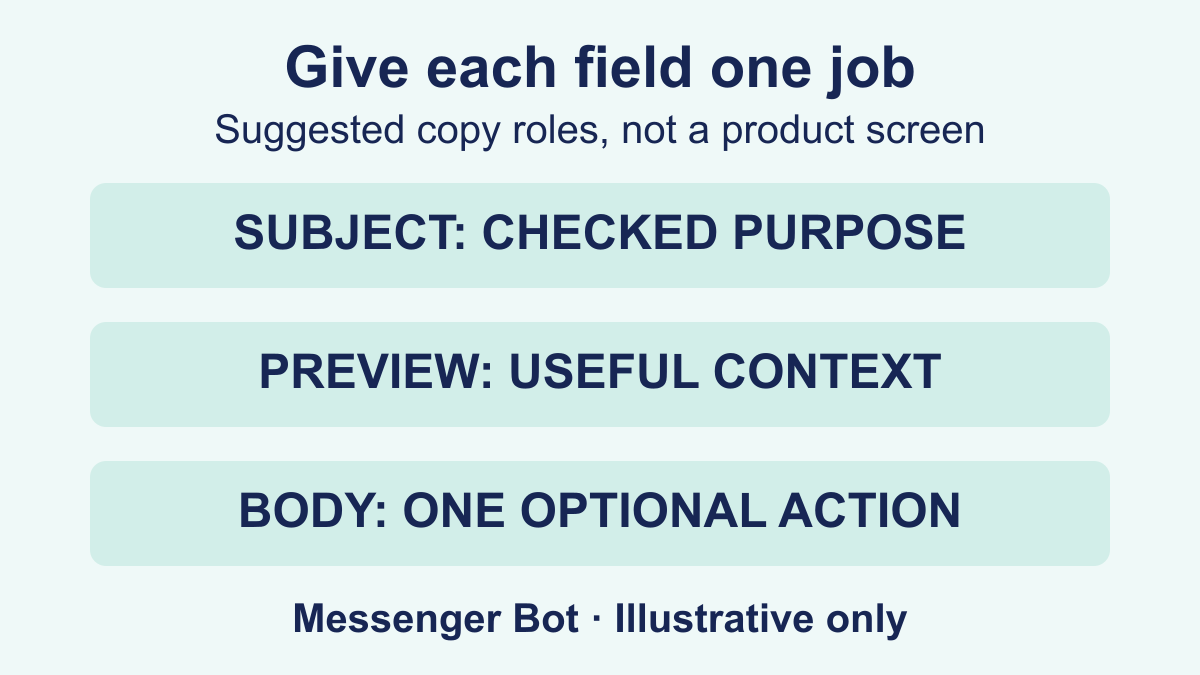
The subject should identify the checked purpose. The preview can add context that the subject does not contain. The body explains the optional next step and any genuine help route. Repeating the same sentence across all three fields wastes the opportunity to make the message clearer. Do not use the preview to introduce an offer or deadline missing from the body.
Shopify’s documented editor separates subject, preview text and message content. Other platforms may use different fields or display rules. Review the combination where your team actually works rather than assuming that a sample represents every email application. The following table is a hypothetical writing worksheet, not a product screen or a claim about how a particular inbox renders text.
| Copy field | Useful job | Hypothetical pattern | Review question |
|---|---|---|---|
| विषय | Identify the checked purpose | A question about [Item name]? | Is the item accurate, and does this avoid implying that help was requested? |
| पूर्वावलोकन | Add optional context | Review the details when it suits you. | Does this add information rather than repeat the subject? |
| शरीर | Explain one relevant option | If you would like to continue, use [checked checkout link]. | Is the destination private, correctly matched and still appropriate? |
Use the actual store identity consistently. A customer should not have to guess who is contacting them. Do not make the subject look like an order confirmation, account warning or personal reply when it is a promotional invitation. If the body has no genuine deadline, leave countdown language out of the subject and preview too.
Read all three fields as one short conversation. Does the preview change the meaning of the subject? Does the action label promise something that the destination does not provide? Does a truncated subject still leave the purpose understandable? These are review questions, not a guarantee that any particular wording improves sales or reaches an inbox.
Use Three Clearly Hypothetical Copy Patterns
Adapt a pattern only after checking that its context is true. The placeholders below are not working links, real product information or customer identities. They are meant for a non-sending review document. An example that looks polished is still unsuitable if the business cannot verify the underlying record or honor the help it offers.
Offer an Optional Way to Continue
Hypothetical subject: Continue when it suits you
Hypothetical preview: Review your checked checkout details before deciding.
Hypothetical body: Hello from [Store name]. If you would like to continue the checkout you started, use [checked checkout link] to review the details. Please check the items and current terms before deciding. If you have already completed your purchase or no longer want to continue, you do not need to buy anything from this invitation.
This pattern needs a verified incomplete checkout and a correctly matched destination. Do not use it for an anonymous visitor, an already completed purchase or an uncertain record. It deliberately makes no stock, discount, shipping or delivery promise. If the message needs one of those facts, add it only after its exact terms are checked.
Make Room for a Genuine Product Question
Hypothetical subject: A question about [Item name]?
Hypothetical preview: Check the current product details before continuing.
Hypothetical body: Hello from [Store name]. If you are still considering [Item name], [checked product-information route] can help you review its current details. You can decide whether it fits your needs before returning to checkout. This is an optional invitation, not an order confirmation or a reservation.
Here the proposed action is reviewing information, not purchasing. Check that the route answers a real question and that its descriptions are current. Avoid adding invented suitability, compatibility or performance claims just to make the example more specific. If the product question needs specialist advice, the copy should not pretend to supply it.
Offer Help Only When Someone Can Provide It
Hypothetical subject: Need help reviewing your checkout?
Hypothetical preview: Use our checked help route if you have a question.
Hypothetical body: Hello from [Store name]. If you have a question before continuing, use [staffed help route]. Our team can review your question through that route. You can also choose not to continue. Please do not share payment details in a message.
Use this pattern only if the help route is actually staffed and its stated availability is accurate. Do not promise an immediate reply, say that a person has been alerted or claim that a request was saved without evidence of that action. For planning staff coverage, keep measuring response time separate from a promise about how quickly every customer will receive help.
Check Every Claim, Offer and Link Before Use
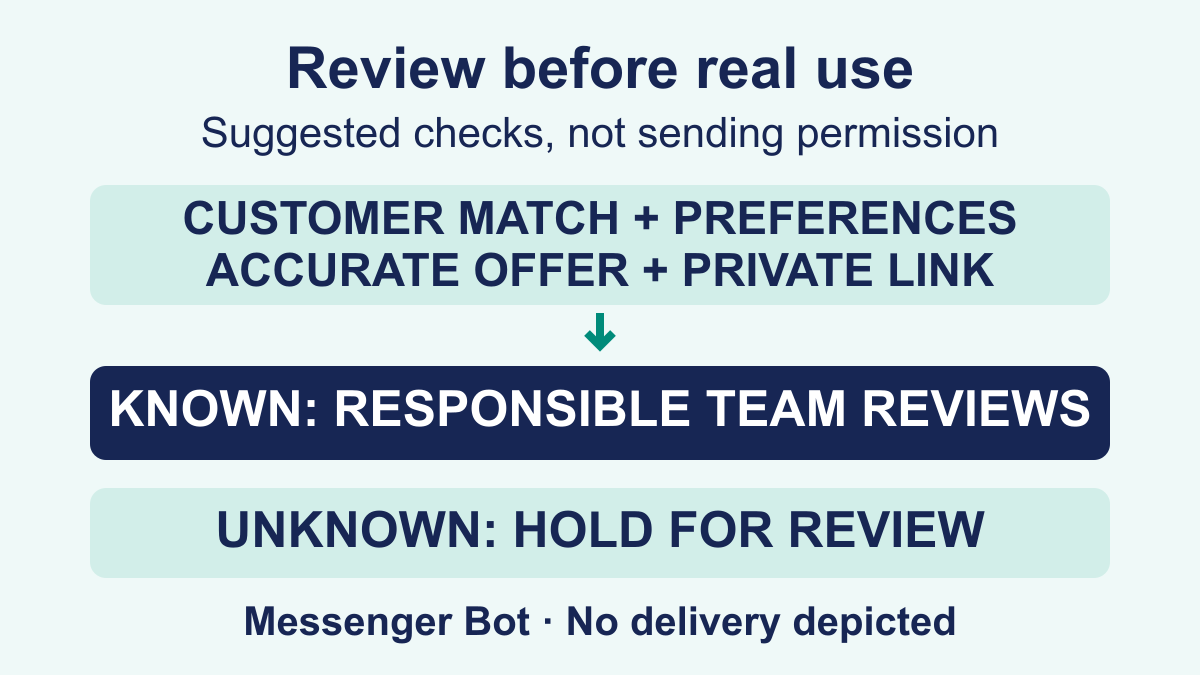
Review the message against current facts, not against an old campaign template. Start with the original customer match and checkout state. Then check whether any item or offer mentioned is accurate. A previously valid promotion may have different terms now. A template that says “free delivery” or “your discount” needs a real, approved basis for that exact recipient and purchase.
Do not invent held stock, a countdown, a last opportunity or a special price. If a genuine offer exists, the subject, preview, body and destination should describe the same terms. If the team cannot confirm those terms, remove the claim from the example or keep it on hold. Better wording cannot repair an unverified offer.
Shopify warns that a checkout link can let its opener continue that checkout. Keep working customer-specific links out of public examples, screenshots and shared copy documents. Review a placeholder such as [checked checkout link] instead. The final real destination needs its own correct-recipient check; replacing a placeholder is not an administrative detail to assume away.
The review record can contain safe checks without containing private checkout data. For example, note that the customer match was verified by the responsible reviewer, that the current destination was checked and that the example contains no real token. Keep the underlying customer record in its authorized system. A public writing exercise does not need an order number, email address or payment information.
Use a clear stop decision for missing facts. Unknown recipient matching, permission, item status or destination validity means that customer-specific use is not ready. Do not interpret “no error appeared” as proof of eligibility. Resolve the missing check through the responsible team or remove the unsupported statement; do not send a test to a real customer to see what happens.
Make the Message Understandable Without Decorative Images
The message should make sense when someone reads only the text. Put the purpose and optional action in words rather than relying on a large product image or a graphic button. If an image clarifies the item, give it a meaningful description. Do not use a decorative image to carry the only explanation of an offer, deadline or help route.
Review the reading order of the actual example. A person should encounter the store identity and relevant context before the action. Labels such as “Review checkout details” describe a destination more usefully than a vague action label. Choose wording that matches what the checked destination actually does, without promising that a purchase will be completed by opening it.
Try a narrow display and a text-only reading of the copy as recommended checks. Look for wrapped item names, missing context, clipped labels or meaning that depends on a visual. Do not turn a successful local review into a claim about delivery, all email applications or every accessibility need. Record the scope you actually checked.
A plain-text alternative can be reviewed as copy even when the team has not verified a platform export feature. Keep the same purpose, offer qualifications and optional next step. Do not add a working customer-specific link to a publicly shared version just because the image has been removed. Privacy and correct-recipient matching apply to both formats.
Coordinate Email With Other Contacts Without Doubling Up
Review recent activity before considering another contact. A completed order, a customer reply, a preference change or an already planned conversation may change what is appropriate. Do not count an email, chat and text about the same checkout as three separate opportunities. Choose a responsible person who can see the relevant context without spreading customer details across copy documents.
There is no universal number of reminders or best waiting interval in this writing method. Platform documentation describes settings, not a schedule that every store should adopt. The responsible team needs to consider actual preferences, checked eligibility, the customer’s question and its applicable rules. This article does not enable a workflow or authorize an email, text or Messenger reply.
Keep prospect-stage conversations distinct too. The guide to follow-up for interested prospects concerns matching useful information to a stated need. A prospect’s interest is not proof of an incomplete checkout, and an incomplete checkout is not permission to start every other follow-up process.
Give the team a stop rule that is visible before use. If another person is already handling the question, resolve ownership first. If the customer chose different updates, respect that choice through the established process. If the record is unclear, pause the customer-specific example. Do not use a lack of reply to infer that the customer is careless, uninterested or ready for pressure.
Measure Observed Outcomes Without Claiming Causation
Name the population before presenting a result. An eligible reviewed checkout group is not the same as all carts, all visitors or all customers. Choose a reporting period and explain whether the unit is a customer or a checkout occurrence. Deduplicate according to that choice, and keep exclusions and unresolved records visible beside the result.
Record attempts, known deliveries, unique replies, verified unique clicks and separately observed completed orders as different measures. An attempted contact is not proof of delivery. A reply is not a sale. Opening a message is not proof that the person understood the offer or wanted another reminder. Do not rename an available count to make a missing measurement appear complete.
For a clearly hypothetical example, suppose a reviewed group contains 50 eligible checkout occurrences, 40 known deliveries and 8 verified unique clicks. A click rate using the known-delivery denominator is 8 divided by 40, or 20%. Using all 50 eligible occurrences gives 16%, a different named measure. Neither percentage is an industry benchmark, a real store result or proof of recovered revenue.
If delivery is unknown, do not call an attempt-based percentage a delivery-based click rate. A zero denominator is not calculable, rather than an impressive 0% or 100%. Missing checkout-to-order matching means the purchase outcome is unknown. A customer may also purchase through a different route, so a later order alone does not settle attribution.
Shopify documents that a checkout can be labeled recovered after an order is completed following email, including completion without clicking that email. Keep that platform label separate from a causal claim. The current official checkout-email documentation provides the platform-specific context; it is not evidence of Messenger Bot delivery or a universal recovery result.
When comparing periods, preserve the definition and inspect product, eligibility, channel and seasonal differences. A smaller eligible group or a change in product mix can move a percentage without a better message. Treat those as things to investigate, not automatic explanations. Report the observed counts and remaining gaps before deciding that a wording change caused an improvement.
Use a Non-Sending Final Review Checklist
Finish with one reviewed example, not an activated campaign. The responsible team should be able to explain the message’s purpose, every claim and the basis for any customer-specific use. A writing review can be useful even when sending remains on hold. Keep an unresolved item open instead of converting a completed checklist into authority to contact someone.
- Verify context and eligibility. Check the actual incomplete state, original customer match, current preferences and the platform rules that apply. Do not infer permission from the existence of a stored address.
- Read the three fields together. The subject identifies the purpose, the preview adds useful context and the body explains one optional next step. Remove any contradictory order, reservation or urgency language.
- Check each offer and destination. Use only accurate approved terms. Keep real customer-specific links private and correctly matched. Leave examples as inert placeholders.
- Review usability and genuine help. Check meaningful labels, reading order and a narrow display. Offer a help route only when its availability has been verified.
- Prevent duplicate contact and misleading reporting. Review recent activity and human ownership. Define attempts, deliveries, clicks and outcomes separately; keep unknown measures unknown.
For businesses reviewing how to handle customer conversations, Explore business conversation examples और Check Current Pricing to evaluate whether Messenger Bot fits the broader need. Confirm the exact capabilities required for your workflow before choosing a tool. These examples do not promise native checkout-email automation, customer delivery or increased revenue.
अक्सर पूछे जाने वाले प्रश्नों
What is the difference between an abandoned cart and an abandoned checkout?
Cart interest does not necessarily mean checkout was started or that an eligible recipient can be identified. Check the actual platform record before writing about an incomplete checkout. Shopify’s documented checkout-email automation concerns shoppers who started checkout without completing it; that platform-specific definition does not authorize contacting every cart visitor.
What should a cart abandonment email subject line say?
State the accurate checked purpose with a recognizable business identity and optional next step. Let the preview add useful context rather than repeat the subject. Do not imply an order confirmation, reserved stock, a discount or a deadline unless that exact statement is verified. The body and destination must support the same meaning.
Should every shopper receive a cart email?
No universal eligibility rule is established by these examples. The responsible business team must check the platform’s current settings, actual recipient matching, permissions and preferences before real use. An anonymous visit, stored address or old purchase does not by itself resolve those checks. Keep uncertain customer-specific use on hold.
Is it safe to share a customer’s checkout link in an example or report?
Keep working customer-specific checkout links out of public examples, screenshots and shared copy reports. Use an inert placeholder instead. The real destination needs a separate correct-recipient check in the authorized system. A link that lets someone continue a checkout should not be treated as ordinary public product information.
Does a recovered checkout prove the email caused the purchase?
No. A later purchase or platform recovery label is an observation, not causal proof. Keep eligible records, attempts, known deliveries, verified clicks and completed orders distinct, with compatible periods and denominators. If the attribution or order match is unavailable, report it as unknown rather than crediting the email with a sale.

 हिन्दी
  English
  Tagalog
  简体中文
简体中文  العربية
  Português do Brasil
  Español de México
  Français
  বাংলা
বাংলা  香港中文
香港中文  繁體中文
繁體中文  Nederlands
  Deutsch
  Bahasa Indonesia
  日本語
日本語  한국어
한국어  Polski
  Русский
  Español
  Tiếng Việt