
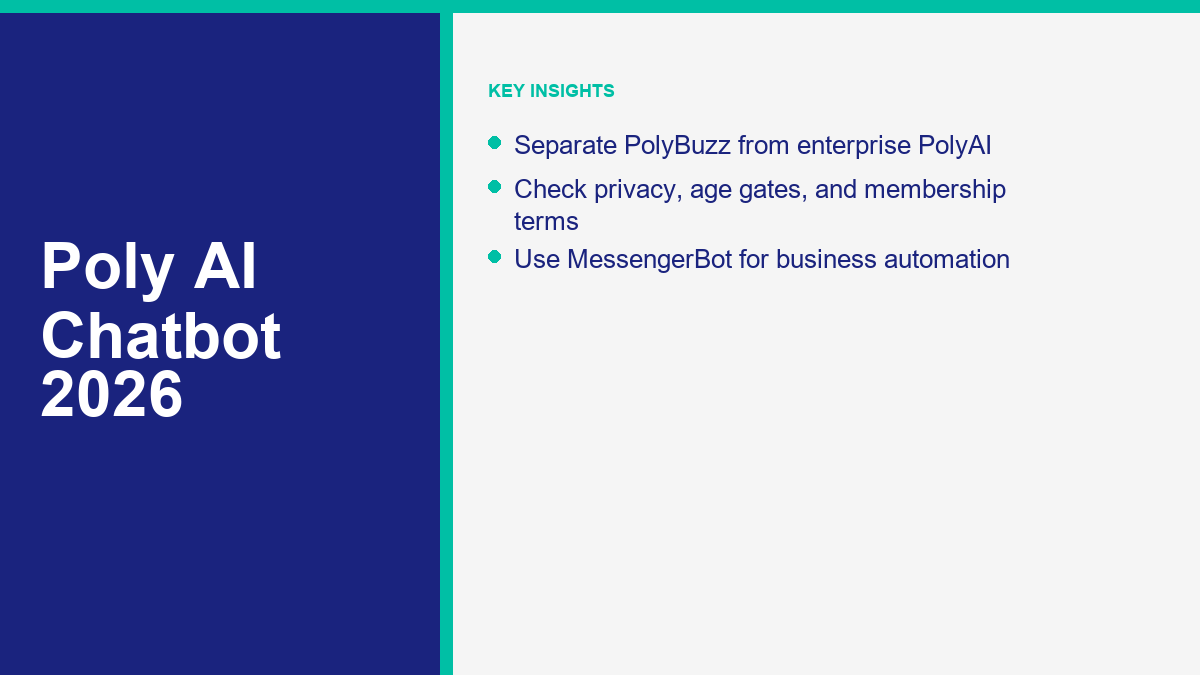
검색 결과 poly ai chatbot are confusing because the phrase can point to two different intents. Some searchers mean PolyAI, the enterprise voice AI company. Others mean PolyBuzz, a consumer AI character chat app that appears in app-store and web results for similar searches. Those are not interchangeable tools. One is built for customer service automation, and the other is built for entertainment-style character conversations.
That identity split matters for safety, privacy, pricing, and practical use. A character-chat app may be fine for casual experimentation, but it is not a customer support system. An enterprise voice AI vendor may be relevant to large contact centers, but it is not the fastest route for a small business trying to automate Facebook or Instagram conversations.
If you are here because you want to build an automated messenger bot for your business, neither version of “Poly” is likely the cleanest starting point. If that is your goal, 메신저봇 가격 보기 to see what a customer-facing messaging platform is designed to handle. This guide explains the difference, the practical safety concerns, and the better alternatives for business automation.
Poly AI vs. PolyBuzz: The Essential Identity Split
Before you look at features, you have to know which “Poly” you are actually looking for. They serve entirely different worlds.
- PolyAI (poly.ai): An enterprise voice AI company focused on customer service conversations, call handling, and contact-center automation.
- PolyBuzz AI (polybuzz.ai): A consumer AI character chat experience where users can chat with or create fictional characters, subject to the platform’s current rules and availability.
The confusion persists because search engines, social videos, app listings, and third-party explainers often use similar naming. If your goal is casual character chat, you are probably looking for PolyBuzz. If your goal is enterprise voice automation, you are looking for PolyAI. If your goal is marketing, lead capture, and support automation in messaging channels, you should compare dedicated chatbot platforms instead.
Poly AI Review: The Enterprise Voice Giant
PolyAI, the enterprise company, is positioned around voice AI agents for customer service. The business case is different from a public chatbot app. Companies evaluate this type of tool when they have high call volume, repeatable service requests, and a need to automate parts of a contact-center workflow while still keeping controls around escalation and compliance.
Key Features of Poly AI Enterprise
- Voice-first automation: The product lane is centered on spoken customer conversations rather than casual mobile chat.
- Contact-center use cases: Typical workflows include account questions, appointment changes, order status, routing, and escalation to a human team.
- Business guardrails: Enterprise deployments usually need clear intents, approved answers, analytics, and escalation rules.
- Implementation work: This type of tool normally requires sales, setup, integration, testing, and ongoing optimization rather than instant self-serve use.
For most individual users and small digital marketers, PolyAI is not the practical first move. It solves a contact-center problem. A local service business, ecommerce brand, creator, or agency often needs structured messaging flows, lead capture, broadcasts, and support routing instead. In that case, 우리의 튜토리얼을 확인하세요 to see how messaging automation works in a smaller business context.
PolyBuzz AI Review: The Character Roleplay App
PolyBuzz is a different category. It is closer to an AI character chatbot than an enterprise support system. Users open it to chat with fictional personas, create characters, test prompts, or explore entertainment-style AI conversations. That can be useful for understanding how people interact with conversational AI, but it should not be confused with production-ready business automation.
Key Features of PolyBuzz in 2026
- Character conversations: Users can browse and chat with fictional AI characters where available.
- Character creation: Many character-chat platforms let users create personas by defining traits, background, and conversation style.
- Media features: Some app experiences may include generated images, avatars, or voice-style features depending on the current product version.
- Casual access: The consumer app lane is built for quick use, entertainment, and experimentation rather than formal customer operations.
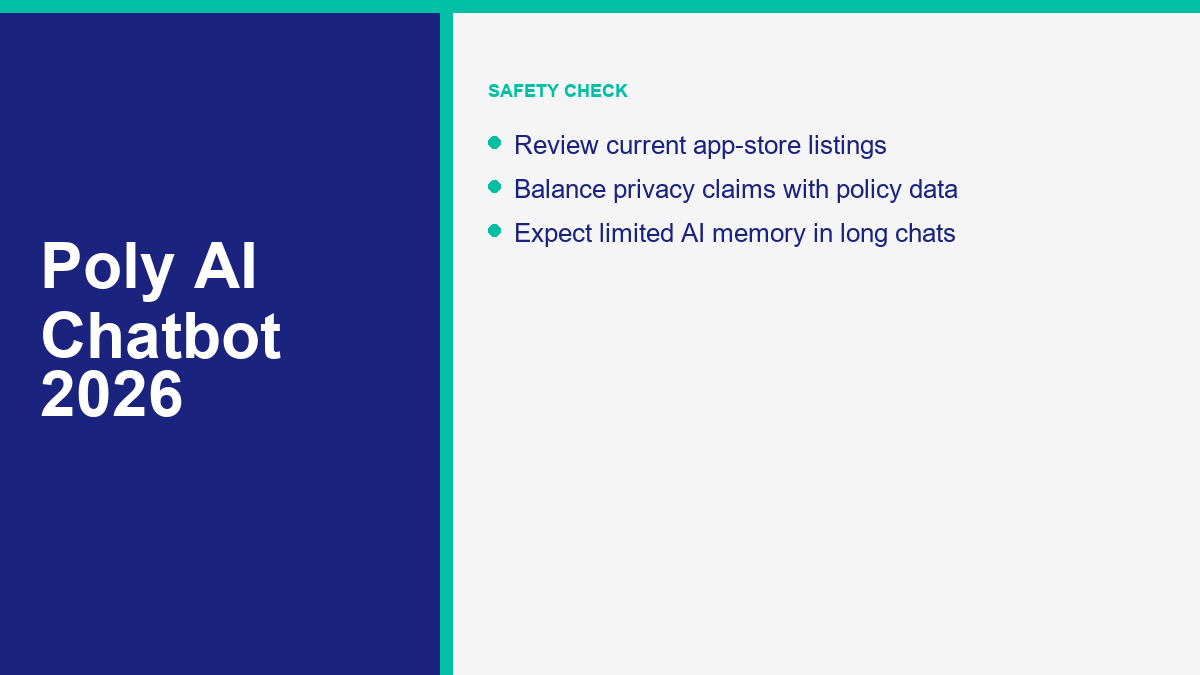
Do not assume every feature is available to every user. App features, pricing, account requirements, content controls, and region availability can change. Before sharing personal information or relying on the app for any serious use, check the current app listing, privacy policy, account settings, and content rules.
Poly AI vs. PolyBuzz: 2026 Comparison Table
| 기능 | Poly AI (Enterprise) | PolyBuzz AI (Consumer) |
|---|---|---|
| Primary Audience | Contact centers and larger service teams | Individual users exploring character chat |
| 비용 | Custom business pricing | Check the current app listing or website |
| 인터페이스 | Voice / Telephone | Text / Mobile App / Web |
| Safety Filters | Strict Business Guardrails | Consumer content rules and account controls |
| Primary Use Case | Automating customer service calls | Entertainment and character conversations |
| Account Type | Corporate Contract | Standard Email/Social Login |
Safety and Privacy: Is Poly AI/PolyBuzz Safe?
Safety means different things depending on which platform you are using. If you are evaluating PolyAI for a business environment, the right questions are about security review, data retention, escalation, logging, integrations, and contract terms. Those details should be validated directly with the vendor during procurement.
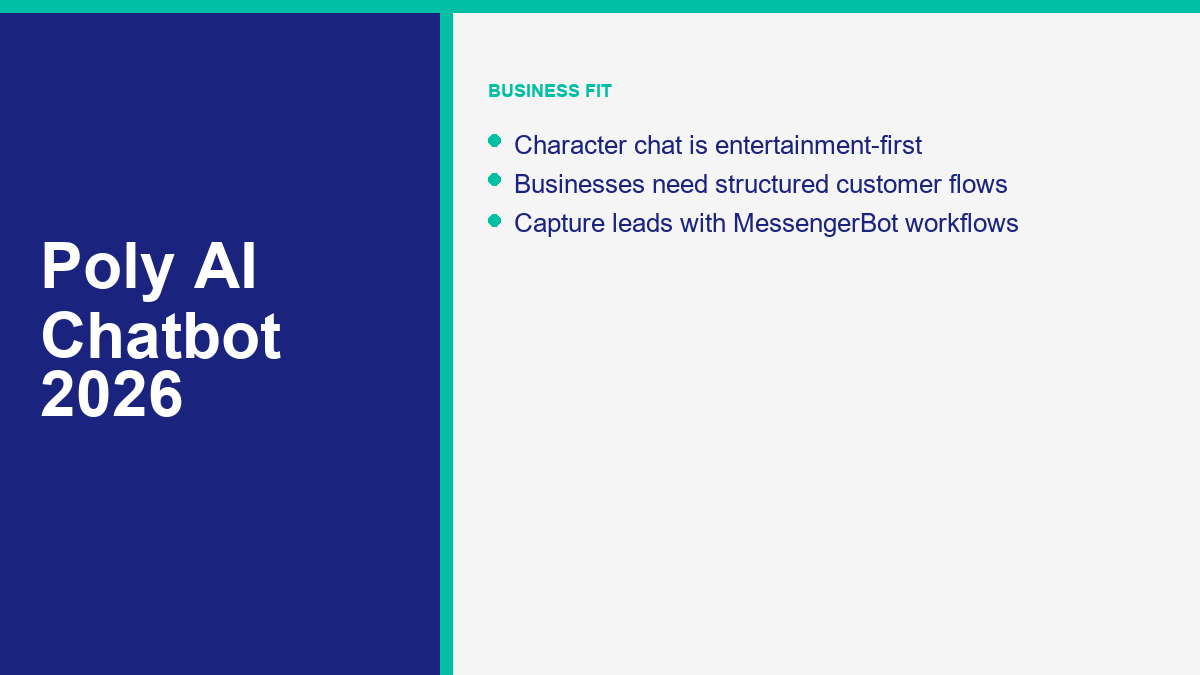
If you are using PolyBuzz as a consumer app, the practical safety questions are different. You are dealing with a character-chat product, not a controlled support platform. Review the app’s current content rules, privacy policy, account controls, and age guidance before use.
- Age and supervision: Character-chat apps may expose users to user-generated personas and conversation styles. Parents and guardians should review age guidance and controls before allowing younger users to participate.
- Data caution: Do not share passwords, financial information, private business data, or sensitive personal details with a consumer AI chat app.
- Account settings: Check whether chats, personalization, history, notifications, and public character settings can be controlled from the account menu.
- Business unsuitability: A consumer character app is not designed for service-level agreements, lead routing, customer records, or brand-safe support scripts.
The practical rule is simple: treat PolyBuzz as a casual AI chat product, not as a secure workspace or business helpdesk. For customer-facing work, use a platform designed for permissions, analytics, consistent responses, and human handoff.
How to Evaluate a Poly AI Chatbot Result Before You Click
Because the search result is mixed, the safest workflow is to identify the category before you evaluate features. Do not start with the product name alone. Start with the problem you are trying to solve. If you need a phone agent for a contact center, you are in the enterprise voice AI lane. If you want to chat with fictional characters, you are in the consumer character-chat lane. If you need a lead capture bot for a Facebook page, neither one is the exact match.
Look at the domain first. A result on poly.ai points to the enterprise company. A result on polybuzz.ai or an app-store listing for PolyBuzz points to the consumer character-chat app. A result on a third-party blog, subreddit, video, or scraped app directory may be stale, promotional, or using the old naming convention. That does not make it useless, but it should not be the source you trust for privacy, pricing, feature availability, or age guidance.
Next, check the stated use case. Enterprise voice AI pages usually talk about contact centers, customer service, dialog agents, call containment, analytics, integrations, and implementation. Character-chat pages usually talk about characters, personas, chat histories, creative scenarios, mobile access, and entertainment. The words around the product tell you more than the shared “Poly” name.
Finally, ask whether the tool gives you operational controls. A business chatbot needs clear admin access, editable scripts, analytics, opt-in handling, support routing, lead capture, and the ability to stop automation when a human should take over. A consumer chat app may have a polished conversation interface, but that does not mean it can safely represent a brand, collect leads, or answer customer questions consistently.
Decision Checklist: Character Chat, Voice AI, or Messenger Automation?
Use this checklist before choosing a tool. It keeps the evaluation practical and prevents a common mistake: choosing the chatbot with the most interesting conversation style instead of the chatbot that solves the business problem.
| 필요 | Best-Fit Tool Type | Reason |
|---|---|---|
| Talk with fictional characters for entertainment | Consumer character-chat app | The goal is open-ended conversation, not structured customer workflow. |
| Automate inbound phone conversations at scale | Enterprise voice AI platform | The workflow needs speech handling, contact-center integration, and vendor-led implementation. |
| Capture leads from Facebook or Instagram | Messenger automation platform | The workflow needs opt-ins, buttons, forms, tagging, and follow-up sequences. |
| Answer repeat support questions in chat | Business chatbot platform | The workflow needs approved answers, escalation, analytics, and reliable handoff. |
| Brainstorm content or write drafts | General AI assistant | The workflow is internal productivity, not public customer automation. |
If your answer falls into the Messenger automation or business chatbot rows, prioritize workflow controls over novelty. A good business bot should feel clear, fast, and predictable. It should not surprise customers with off-topic answers, hide important calls to action, or continue a conversation after the customer has shown purchase intent. The best automation is often less theatrical than a character chatbot because the goal is completion, not endless engagement.
What a Business Should Require From Any Chatbot Alternative
When comparing PolyBuzz, PolyAI, MessengerBot, or any other chatbot option, build the evaluation around requirements that survive product hype. Start with the channel. If your customers already message you on Facebook, Instagram, or your website, a web-only character-chat app is not enough. You need automation where customers already ask questions.
Second, define the handoff rule. Every useful business bot needs a stopping point. The bot should know when to route a refund request, urgent issue, complex quote, complaint, or account-specific problem to a human. Without a handoff rule, even a fluent AI assistant can create support risk because it keeps generating instead of escalating.
Third, make analytics non-negotiable. You should be able to see which flows convert, which questions repeat, where users drop off, and which automations need revision. Entertainment chat does not need that level of measurement. Business automation does, because the bot is tied to revenue, service quality, and customer trust.
Fourth, check ownership of the customer relationship. A business chatbot should help you collect permitted contact information, segment users, and follow up under platform rules. If the conversation lives entirely inside a third-party entertainment app, you do not own the channel, the opt-in, or the customer journey.
Sample Workflows That Show the Difference
The easiest way to understand the difference is to compare real workflows. A character-chat workflow starts with the user’s curiosity. The user chooses a fictional persona, opens a conversation, and keeps chatting for as long as the interaction is interesting. The app does not need to qualify a lead, verify business hours, route a sales inquiry, or record the outcome in a CRM. Success is measured by engagement.
A business Messenger workflow starts with a concrete customer need. A visitor clicks a Facebook ad, sends a message, asks a question about pricing, or requests help after a purchase. The bot should greet the user, identify the intent, provide approved information, capture the right detail, and move the user to the next step. If the person is a buyer, that next step might be a product recommendation or appointment. If the person needs support, it might be a ticket, help article, or human handoff.
A voice AI workflow is different again. A caller may need to reschedule an appointment, check an account, confirm an order, or speak to the right department. That environment requires speech recognition, interruption handling, identity checks where appropriate, and tight integration with back-office systems. The setup effort is higher because the risk is higher. A phone call feels more direct than a chat widget, and a wrong answer can frustrate the customer quickly.
For a small business, the practical question is not “Which AI sounds the most human?” The better question is “Which tool can complete the task safely with the least friction?” A flashy character conversation may feel impressive in a demo, but it does not automatically create a useful sales funnel. A controlled Messenger sequence may look simpler, but it can produce better business results because it asks the right questions in the right order.
That is why MessengerBot’s lane is different from PolyBuzz and different from enterprise voice AI. It is built around repeatable customer journeys: welcome flows, keyword triggers, lead capture, broadcasts, segmentation, and support routing. Those pieces are less dramatic than open-ended AI chat, but they are the pieces that actually help a business respond faster and follow up more consistently.
For marketers, that distinction is especially important. Social traffic is impatient. A user who clicks from a post or ad may only give the business a few seconds to respond. The bot should make the path obvious: answer the common question, collect the needed detail, offer the right link, and keep the follow-up compliant with the platform. Character chat is built for exploration. Marketing chat is built for momentum. That is the difference between an interesting AI demo and an automation asset that can be measured, improved, and trusted by a team. It also keeps reporting cleaner because each conversation has a purpose, an outcome, and a clear next action.
The Best Alternatives to Poly AI and PolyBuzz in 2026
If you checked out Poly and realized it wasn’t exactly what you needed, the right alternative depends on why you were looking in the first place.
Better Alternatives for Character Chat
- Character.AI: A widely known AI character chat platform with a broad character catalog and consumer safety controls.
- 레플리카: A consumer companion-style chatbot focused on longer-term personal interactions rather than business workflows.
- General AI assistants: ChatGPT, Claude, Gemini, and similar assistants may be better when the goal is brainstorming, writing help, research support, or structured productivity.
Better Alternatives for Business Automation (The Poly AI Lane)
- MessengerBot.app: If you need to automate Facebook, Instagram, or website chat for leads and support. It is built for conversion and structured workflows, not just open-ended conversation. Review MessengerBot Pro 기능 for advanced automation options.
- ManyChat: A solid choice for basic marketing automation, though it often requires more manual “flow” building than modern AI-first platforms.
- 인터콤: Excellent for high-end website support, but can get very expensive very quickly as your user count grows.
Why Your Business Doesn’t Need a “Poly” Bot
A lot of business owners see the attention around “Poly AI” or character AI and wonder whether they should build customer service on top of those models. That is usually the wrong comparison. Entertainment bots, productivity assistants, contact-center voice agents, and Messenger automation solve different jobs.
An entertainment bot is designed for open-ended conversation. A business bot is designed to answer, qualify, route, convert, or escalate. It needs approved scripts, reliable buttons, CRM or email capture, analytics, permissions, and a clear path to a human when automation should stop.
For a broader vendor comparison, see the ultimate guide to AI chatbot companies and the best chatbot platforms. The important point is that business automation should be narrow, measurable, and brand-safe. A good customer bot does not need to imitate a fictional character; it needs to move the user to the right next step.
자주 묻는 질문
Is Poly AI the same as PolyBuzz?
No. The search results can look similar, but PolyAI is an enterprise voice AI company, while PolyBuzz is a consumer AI character chat app. Check the domain, app listing, and product description before assuming which one a result refers to.
Is PolyBuzz safe for business use?
PolyBuzz is better understood as a consumer character-chat product, not a business automation platform. For business use, choose software with approved flows, permissions, analytics, lead capture, support routing, and human handoff.
How much does Poly AI (enterprise) cost?
PolyAI is a B2B enterprise service, so pricing should be confirmed directly with the vendor. Do not rely on old forum posts, third-party estimates, or app-store style assumptions for enterprise voice AI pricing.
Is my data private on PolyBuzz?
Review the current PolyBuzz privacy policy and account settings before sharing information. As a practical rule, do not share passwords, financial details, private business data, or sensitive personal information with consumer AI chat apps.
What is the best alternative to PolyBuzz for business automation?
For business automation, use a chatbot platform built for customer journeys, not entertainment chat. MessengerBot is a better fit when you need Facebook, Instagram, website chat, lead capture, and support workflows.
 한국어
한국어  English
  Tagalog
  简体中文
简体中文  العربية
  हिन्दी
  Português do Brasil
  Español de México
  Français
  বাংলা
বাংলা  香港中文
香港中文  繁體中文
繁體中文  Nederlands
  Deutsch
  Bahasa Indonesia
  日本語
日本語  Polski
  Русский
  Español
  Tiếng Việt