DuckDuckGo AI Chat in 2026: Hoe Het Werkt, Welke Modellen Het Gebruikt, en Waarom Privacy-First AI Chat Belangrijk Is
DuckDuckGo AI Chat is een van de interessantste AI-producten in 2026 om een eenvoudige reden: het lost een probleem op dat de meeste AI-apps nog steeds als secundair beschouwen. Privacy is hier niet begraven in een instellingenmenu. Het is de pitch. Als je een snelle manier wilt om met meerdere moderne AI-modellen te praten zonder een ander permanent account aan te maken, een ander geheugensysteem te voeden of casual je identiteit aan elke prompt te koppelen, is Duck.ai het serieus bekijken waard.
Als je nog steeds op zoek bent naar duck duck go ai chat, duckduckgo ai chat, of zelfs duckduckgo chatbot, het product waar je naar op zoek bent is nu Duck.ai. Ik heb de huidige help-pagina's van DuckDuckGo, abonnementsdocumenten, App Store-vermelding en vergelijkingsbronnen op 12 april 2026, en heb vervolgens de huidige documentatie van OpenAI en Microsoft gecontroleerd, zodat deze review het daadwerkelijke product van 2026 weerspiegelt in plaats van de versie van 2024 die veel samenvattingen nog steeds beschrijven.
De korte versie is dit: Duck.ai is niet de meest functie-rijke assistent, en het is niet de sterkste werkruimte voor bestanden, diepgaand onderzoek of team samenwerking. Het is een van de schoonste privacy-eerste AI chatervaringen op de markt. Als je echte doel klantgerichte automatisering op Facebook Messenger, Instagram of je website is in plaats van privé persoonlijke chat, is dat een totaal andere klus, en je zult meer praktische waarde halen uit Bekijk Onze Tutorials.
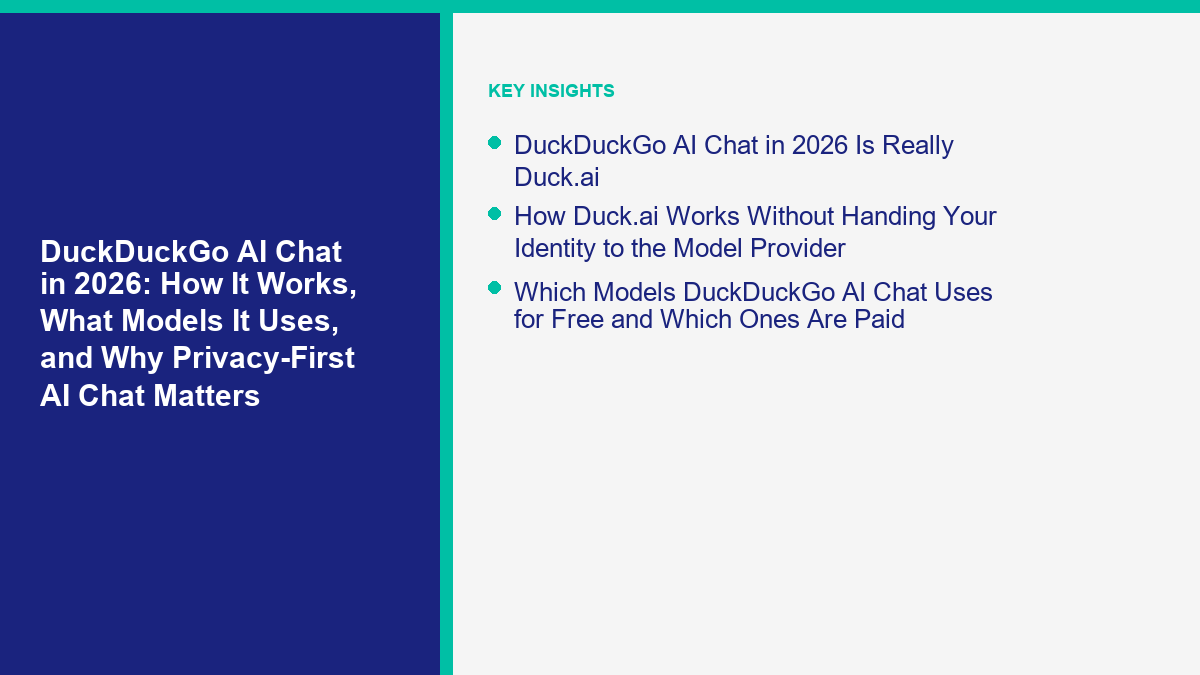
DuckDuckGo AI Chat in 2026 Is Echt Duck.ai
Een van de eerste dingen die mensen in de war brengen is naamgeving. Zoekers typen nog steeds duckduckgo ai chat, maar de huidige productpagina's en helpdocumenten van DuckDuckGo positioneren de ervaring onder de Duck.ai naam. Het huidige hulpoverzicht zegt dat Duck.ai je in staat stelt om privégesprekken te voeren met derde partij AI chatmodellen die geanonimiseerd zijn door DuckDuckGo, en de documentatie van de AI-functies van het bedrijf zegt dat zowel Duck.ai als Search Assist optionele AI-functies zijn in plaats van onvermijdelijke onderdelen van de zoekmachine.
Dat optionele deel is belangrijker dan het klinkt. DuckDuckGo is een van de weinige grote consumenten internetproducten die hardop zegt dat niet iedereen AI de hele tijd ingeschakeld wil hebben. De huidige hulppagina's leggen uit dat je Duck.ai kunt verbergen in zoekresultaten, AI-functies kunt uitschakelen via instellingen, en zelfs gebruiken noai.duckduckgo.com als je een DuckDuckGo zoekervaring wilt met AI-functies uitgeschakeld en AI-gegenereerde afbeeldingen zoveel mogelijk gefilterd.
Het is ook echt een geen account vereist product voor basisgebruik. De AI-aanpak pagina van DuckDuckGo zegt dat zowel Duck.ai als Search Assist gratis te gebruiken zijn, geanonimiseerd, en beschikbaar zonder dat een account vereist is. Dat alleen al maakt het product anders dan ChatGPT en Microsoft Copilot, die beide veel meer leunen op accountgebaseerde geschiedenis, geheugen, personalisatie en opgeslagen context. Duck.ai heeft nog steeds een betaalde abonnementslaag, maar de basis gratis ervaring begint niet met een aanmeldmuur.
Er is één klein nuancepunt dat het waard is om te weten. De documentatie voor beginners van DuckDuckGo zegt dat je geen persoonlijke informatie hoeft te delen om je te abonneren, en je hoeft geen account aan te maken om je te abonneren. Maar als je een betaald abonnement op extra apparaten wilt activeren, kan DuckDuckGo om een e-mailadres vragen alleen voor die extra-apparaat authenticatiestroom. Dat is nog steeds een veel lichter identiteitsmodel dan het gebruikelijke consument AI-patroon.
Hoe Duck.ai Werkt Zonder Je Identiteit Aan De Modelprovider Te Geven
Dit is het onderdeel dat Duck.ai meer maakt dan alleen maar een andere wrapper site.
De privacydocumentatie van DuckDuckGo zegt dat Duck.ai persoonlijke metadata verwijdert voordat prompts naar modelproviders worden verzonden. In praktische termen zegt het bedrijf dat je IP-adres en andere persoonlijke metadata worden verwijderd voordat de prompt de providers zoals OpenAI, Anthropic en Together.ai bereikt. De prompt verschijnt voor de modelprovider als afkomstig van DuckDuckGo in plaats van van jou als individuele gebruiker. DuckDuckGo zegt ook dat het overeenkomsten heeft met modelproviders die beperken hoe de anonieme chatgegevens kunnen worden gebruikt en die vereisen dat ze worden verwijderd wanneer ze niet langer nodig zijn om antwoorden te geven, maximaal binnen 30 dagen, met beperkte veiligheids- en juridische uitzonderingen.
Dat is een sterkere standaardhouding dan het standaard consumenten-AI-model. De huidige helpdocumentatie van OpenAI zegt dat individuele ChatGPT-gesprekken kunnen worden gebruikt om modellen te verbeteren, tenzij je je afmeldt, en dat je Data Controls of Temporary Chat moet gebruiken als je dat niet wilt. De privacy-FAQ van Microsoft voor consumenten Copilot zegt dat gesprekken standaard worden opgeslagen en kunnen worden gebruikt voor de doeleinden die in de Microsoft Privacyverklaring zijn beschreven, waaronder probleemoplossing, monitoring, analyse, verbetering en het bieden van de service.
Duck.ai documenteert ook precies wat het deelt met modelproviders. De huidige help-pagina zegt dat DuckDuckGo de datum van vandaag, je tijdzone en een voorkeurs eenheidssysteem op basis van de wereldwijde regio deelt. Het zegt dat het privé een schatting van de regio maakt met een GEO::IP-lookup zonder je werkelijke IP of precieze locatie op te slaan. Als je expliciet de optionele Gebruik Approximate Location instelling inschakelt, kan Duck.ai ook een schatting van de locatie op stadsniveau delen, zodat antwoorden relevanter voor de lokale context kunnen zijn. De instelling is standaard uit.
Dat betekent dat het privacyverhaal echt is, maar het is geen magie. Je promptinhoud gaat nog steeds naar een AI-modelprovider zodat het model kan antwoorden. DuckDuckGo vermindert de identiteitstracering rond de prompt. Het verandert een internet-AI-service niet in een offline lokaal model op je laptop. Dat onderscheid is belangrijk als je met juridische materialen, medische gegevens, broncode, inloggegevens of iets anders omgaat dat nooit een gecontroleerde omgeving mag verlaten.
Welke modellen DuckDuckGo AI Chat gratis gebruikt en welke betaald zijn
Toegang tot modellen is waar de 2026-versie van Duck.ai veel beter is dan zijn oudere reputatie.
De nieuwere Duck.ai-overzichtspagina van DuckDuckGo, die slechts enkele dagen voor deze beoordeling is gecrawld, vermeldt een breder gratis aanbod dan sommige oudere help-pagina's nog tonen. Volgens dat nieuwere overzicht omvat de huidige gratis modelmix Claude 4.5 Haiku, Llama 4 Scout, Mistral Small 3 24B, GPT-4o mini, GPT-5 mini, en gpt-oss-120b. De oudere model-specifieke helppagina toont nog steeds een kortere lijst gericht op Claude 4.5 Haiku, Llama 4 Scout, Mistral Small 3 24B, en GPT-4o mini. Die mismatch suggereert sterk dat DuckDuckGo helpdocumenten op verschillende tijdstippen bijwerkt, dus het nieuwere overzicht is de betere weergave van wat gratis gebruikers op dit moment kunnen toegang hebben.
Betaalde abonnees krijgen de interessantere sprong. De huidige abonnementshelp-pagina's van DuckDuckGo zeggen Plus abonnees krijgen GPT-4o, GPT-5.2, Claude Sonnet 4.5, en Llama 4 Maverick. Pro abonnees krijgen alles in Plus, plus Claude Opus 4.6, hogere redeneercapaciteit dan Plus, en 2x hogere gebruikslimieten dan Plus. Je kunt ook je standaardmodel wijzigen vanuit de linker zijbalk, wat Duck.ai flexibeler maakt dan de meeste privacy-gemarkeerde tools die je aan één huismodel binden.
Die toegang tot meerdere modellen is een van de meest onderschatte sterke punten van Duck.ai. Als je om privacy geeft maar toch modelgedrag wilt vergelijken, laat Duck.ai je dat doen zonder aparte abonnementen bij elke grote AI-leverancier te hoeven onderhouden. In 2026 is dat geen triviale gemakken. GPT-stijl modellen, Claude-stijl modellen, open-gewicht modellen en kleinere snelle modellen hebben nog steeds merkbaar verschillende persoonlijkheden. Het vermogen om tussen hen te wisselen in één interface is echt nuttig.
Duck.ai niveau
Huidige modeltoegang gecontroleerd op 12 april 2026
Waar het goed voor is
Hoofdruil
Gratis
Claude 4.5 Haiku, Llama 4 Scout, Mistral Small 3 24B, GPT-4o mini, GPT-5 mini, gpt-oss-120b
Snelle Q&A, samenvatten van geplakte tekst, verschillende modelstijlen uitproberen zonder je aan te melden
Dagelijkse gebruikslimieten en lagere plafonds voor de sterkste redeneermodellen
Plus
Alles in Free plus GPT-4o, GPT-5.2, Claude Sonnet 4.5, en Llama 4 Maverick
Zwaarder schrijven, coderen, redeneren en vergelijking van modellen naast elkaar
Nog steeds geen volledige productiviteitswerkruimte met rijke documenttools
Pro
Alles in Plus plus Claude Opus 4.6, hogere redeneringsinspanning en 2x hogere gebruikslimieten dan Plus
Mensen die de sterkste Duck.ai-opstelling willen zonder verschillende aparte AI-abonnementen te kopen
Waarde hangt af van of je genoeg om privacy en modelvariëteit geeft om de sprong te rechtvaardigen
Wie zou Duck.ai in 2026 moeten gebruiken en wie zou het moeten overslaan
Gebruik Duck.ai als je een AI-assistent wilt die in de goede zin wegwerpbaar aanvoelt. Open het, vraag iets, vergelijk modellen, wis het, ga verder. Dat is vooral aantrekkelijk als je moe bent van elke AI-app die probeert je permanente geheugensysteem te worden.
Use Duck.ai if privacy is not a slogan for you. If you routinely hesitate before pasting something into ChatGPT because you do not want it tied to your account history, Duck.ai solves a real psychological and operational problem. The fact that it is no-account by default matters. The fact that it strips metadata matters. The fact that it does not train on chats matters.
Use Duck.ai if you like model comparison. Free users already get a surprisingly useful set of models, and paid users get a genuinely strong mix. If you like seeing how the same prompt behaves across Claude-style, GPT-style, and open-weight options, Duck.ai is cleaner than maintaining several separate apps.
Skip Duck.ai if your workflow is built around files. The no-PDF, no-spreadsheet limitation is not a side note. It is a category limit.
Skip Duck.ai if you want the deepest research workflow. Copilot and ChatGPT both do more around web-grounding, rich output, and document-centric work. Duck.ai is good at chat. It is not trying to become your entire research operating system.
Skip Duck.ai if you need a customer-facing chatbot platform. This is the biggest misconception I see around private AI chat tools. A good personal AI assistant is not the same thing as a deployable customer messaging stack. If your next move is building live business conversations across Messenger, Instagram, and website chat, compare actual channel platforms rather than trying to stretch a consumer AI app into that role. The clean place to start is Bekijk de prijzen van MessengerBot.
Where MessengerBot Fits If You Need AI in Customer Conversations
Duck.ai is built for private personal AI chat. MessengerBot is built for customer conversations across channels. Those are related ideas, but they are not the same product category.
If you are testing prompts privately, comparing models, or summarizing things for yourself, Duck.ai makes sense. If you need to automate replies on Facebook Messenger, Instagram, or your website, you need channel logic, flow design, routing, subscriber management, human handoff, broadcasting, and operational controls. That is where dedicated chatbot platforms win.
The reason this matters is simple. A private assistant can get away with ambiguity. A customer-facing bot cannot. It needs deterministic flow steps for pricing questions, lead capture, appointment routing, order status, FAQ handoff, and escalation. If the project in your head is already moving from “Which AI chat app should I use?” to “How do I automate real conversations customers are having with my business?”, that is the point where a private chat tool stops being enough.
That is also where plan depth matters. If your team needs the heavier workflow side of multi-channel automation, this is the point to Upgrade to MessengerBot Pro rather than piling more expectations onto a consumer AI chat interface that was never designed to run your inboxes.
If You Recommend Chatbot Tools to Clients, Readers, or Other Businesses
There is a practical business angle here too. A lot of agencies, consultants, creators, and tutorial publishers now spend half their time explaining the difference between private AI assistants and deployable chat automation tools. If that is already part of your work, you do not need to leave the monetization side as an afterthought. You can Sluit je aan bij ons affiliate programma and turn those recommendations into something measurable instead of letting them disappear into free advice.
Official Sources Checked for This Review on April 12, 2026
Ja. Duck.ai is gratis te gebruiken, er is geen account nodig voor basis toegang, en DuckDuckGo zegt dat zowel Duck.ai als Search Assist gratis optionele AI-functies zijn. De gratis versie heeft dagelijkse gebruikslimieten, terwijl betalende abonnees hogere limieten en betere modeltoegang krijgen.
Welke modellen gebruikt DuckDuckGo AI Chat momenteel?
DuckDuckGo’s current Duck.ai overview lists Claude 4.5 Haiku, Llama 4 Scout, Mistral Small 3 24B, GPT-4o mini, GPT-5 mini, and gpt-oss-120b for free users. Paid Plus subscribers get GPT-4o, GPT-5.2, Claude Sonnet 4.5, and Llama 4 Maverick, while Pro adds Claude Opus 4.6 plus higher reasoning effort and higher limits.
Slaat Duck.ai jouw chats op of traint het AI-modellen op basis daarvan?
DuckDuckGo says Duck.ai does not record or store your chats on its side and does not use them to train AI models. Chat history is local on your device by default, with optional end-to-end encrypted Sync & Backup if you want it. That is a much stronger default privacy posture than most consumer AI chat apps.
Is DuckDuckGo AI Chat beter dan ChatGPT voor privacy?
For default consumer privacy, yes. Duck.ai’s main advantage is that it anonymizes prompts, strips personal metadata before sending prompts to providers, does not use chats for model training, and does not require an account for basic use. ChatGPT gives you more workspace features, but OpenAI says consumer chats may be used to improve models unless you opt out or use Temporary Chat.
Kan Duck.ai ChatGPT of Microsoft Copilot volledig vervangen?
It can for light personal chat, brainstorming, model comparison, and privacy-sensitive everyday questions. It usually cannot if your workflow depends on PDFs, spreadsheets, deep file analysis, broader research tooling, or a richer productivity workspace. Duck.ai is best treated as a privacy-first assistant, not as the universal answer to every AI task.
The practical takeaway is simple. Free Duck.ai is not just a teaser anymore. It is a real product for light daily use. Paid Duck.ai becomes more compelling if you specifically want privacy plus access to stronger frontier models, not if you want the most powerful productivity suite overall.
What DuckDuckGo Subscription Costs in 2026 and Why the Pricing Page Looks Slightly Confusing
Pricing is where a lot of old reviews are already stale.
DuckDuckGo’s current How much does DuckDuckGo cost? help page still summarizes the paid subscription as $9.99 per month or $99.99 per year. That is accurate for the lower paid tier, but it is no longer the whole story. The current U.S. Apple App Store listing for DuckDuckGo shows in-app purchases for DuckDuckGo (Plus, Monthly) at $9.99, DuckDuckGo (Plus, Yearly) at $99.99, DuckDuckGo (Pro, Monthly) at $19.99, en DuckDuckGo (Pro, Yearly) at $199.99.
So if you see an article saying DuckDuckGo has a single paid plan at $9.99, that article is behind the 2026 product split. The company’s newer subscription help pages clearly describe Plus en Pro as two separate plans, even though some older help material still collapses pricing into one generic subscription summary. That is the kind of product transition that creates a lot of bad AI comparison content, because writers quote one page and miss the rest of the documentation.
There is also a bundle logic to keep in mind. You are not paying only for AI chat. DuckDuckGo describes the subscription as a four-in-one service that includes a VPN, advanced AI models in Duck.ai, personal information removal, and identity theft restoration. That makes the price easier to justify for people who already want a privacy bundle. It makes the price harder to justify if all you want is the single best AI chat tool and you do not care about the VPN or privacy services at all.
Availability is limited by region as well. DuckDuckGo’s current subscription help pages say the subscription is available in the United States, United Kingdom, European Union, and Canada, with local pricing for supported non-U.S. markets. Advanced Duck.ai models can be accessed from any browser, but the VPN and some other subscription features are managed through the DuckDuckGo browser.
For value, here is the honest read. At $9.99 per month, Plus is one of the more interesting AI-adjacent deals if you already want a privacy bundle. At $19.99 per month, Pro starts competing more directly with single-vendor AI subscriptions, so the privacy angle needs to matter to you for it to feel like a win.
DuckDuckGo AI Chat Privacy Claims That Actually Matter
Privacy marketing is usually vague. Duck.ai’s useful part is that the company makes several concrete claims you can evaluate.
First, DuckDuckGo says your chats are not recorded or stored by Duck.ai itself. The main privacy page says Duck.ai does not record or store chats, and that conversations are not used to train chat models by DuckDuckGo or the underlying providers. That is the core promise most people care about.
Second, DuckDuckGo separates prompt content from identifying metadata. The company says personal metadata such as IP address is removed before the prompt goes to the model provider. In other words, the provider may see the content of the prompt, but not the normal consumer-service identity trail attached to it.
Third, Duck.ai makes chat history local by default. DuckDuckGo’s recent chats documentation says chat history is stored locally on your device by default. That is a much better default than building the whole product around cloud-stored, account-tied conversation history.
Fourth, Sync & Backup is optional and end-to-end encrypted. If you want cloud-style continuity, DuckDuckGo says you can enable Sync & Backup to store up to 1,000 conversations on a secure DuckDuckGo server with end-to-end encryption, where decryption keys remain only on your devices. That is a cleaner privacy design than simply pushing everything into plain account history by default.
Fifth, voice chat has its own explicit privacy explanation. DuckDuckGo says voice chat is private, anonymized, not used to train AI models, and that audio is not stored by DuckDuckGo or OpenAI after the session ends. It also explains the real caveat most companies would rather bury: your voice is inherently biometric data, even if the service is designed not to identify you from it.
Those are meaningful claims. They do not make Duck.ai invincible or appropriate for every sensitive use case, but they put it in a different category from assistants that default to cloud history, personalized memory, and model-improvement training unless you go turn that behavior off.
Where the Privacy Story Has Real Limits
This is the part most soft-focus reviews skip. Duck.ai is private by consumer AI standards. That does not mean you should treat it like an air-gapped secure environment.
If you type confidential information into Duck.ai, the model provider still receives the prompt content so it can generate a response. DuckDuckGo says the provider does not get personally identifiable information tied to you, but the prompt itself is still prompt content. If your risk model says a document must never leave your device or organization boundary, Duck.ai does not solve that problem.
DuckDuckGo is also clear that it does not filter or modify the responses received from the model. That matters. Privacy-first does not mean source-grounded, citation-checked, or less hallucination-prone. Duck.ai’s model providers still have their own moderation policies, but DuckDuckGo says it does not rewrite or sanitize the raw model responses itself.
Feature depth is another limit. Duck.ai’s current file upload help page says it supports image uploads only on some models and does not support non-image files such as PDFs or spreadsheets. If your daily AI workflow revolves around dropping in docs, tables, slide decks, and files for analysis, Duck.ai is simply not in the same class as ChatGPT or Copilot for that kind of work.
There is one more practical limit: usage caps. Duck.ai is free, but the company says there is a daily usage limit and does not publish a neat universal message number because different models cost different amounts per prompt. That is sensible engineering, but it also means heavy users will hit the ceiling faster than they expect if they treat free Duck.ai like an unlimited premium assistant.
Recent Chats, Sync, and Data Retention Are Better Than Most People Realize
One of the easiest ways to understand Duck.ai is to stop thinking of it as a permanent cloud notebook and start thinking of it as a privacy-first chat tool with optional persistence.
DuckDuckGo’s current recent chats page says your Duck.ai chat history is private and cannot be accessed by DuckDuckGo or model providers. By default, chat history is stored locally on your device so you can refer back to it later. You can disable chat history entirely in settings if you want a cleaner footprint. You can also delete individual chats, clear them with the Fire Button, or wipe them by clearing browser data.
There are some useful operational details tucked into that help page. You can pin up to five chats to the top of the list, and those pinned chats will not be deleted by the Fire Button inside Duck.ai. Retention also depends partly on your browser or app. DuckDuckGo specifically notes that Safari and the DuckDuckGo browser on Mac and iOS may automatically delete local chat history if you go more than seven days without visiting Duck.ai. That is a meaningful behavior difference from browser to browser, and it is exactly the kind of thing power users should know before relying on local history.
If you want cross-device continuity, Sync & Backup is available as a free optional feature. DuckDuckGo says it stores up to 1,000 conversations privately on a secure server with end-to-end encryption, while the decryption keys stay on your devices. That means DuckDuckGo says it still cannot read your chats even when you choose backup and sync.
This is probably the most underappreciated design choice in the whole product. Duck.ai is not forcing you into a false choice between zero history and fully exposed cloud history. It gives you local storage first, encrypted backup if you want it, and explicit controls around deletion. That is a much more adult privacy model than the usual consumer AI trade where convenience always wins by default.
How to Set Up DuckDuckGo AI Chat for a Private Daily Workflow
If you want to test Duck.ai properly, do not just ask it one gimmick question and move on. Use a short setup flow that shows whether the product fits your real work.
Open Duck.ai directly and test the free tier first. Since no account is required for basic use, start without signing into anything. That shows you the actual low-friction value of the product.
Run the same prompt across at least three different models. Try a summarization prompt, a planning prompt, and a technical reasoning prompt. Claude-style models often feel different from GPT-style models, and smaller open models often behave differently again.
Check the settings before you build a habit around the tool. Confirm whether chat history is on, whether Sync & Backup is on, and whether approximate location is enabled. Decide deliberately instead of accepting defaults without looking.
Use sensitive prompts carefully even though the product is privacy-first. Anonymized does not mean local. Keep secrets, private keys, unreleased contracts, and anything legally sensitive out of the prompt box unless you have cleared that workflow properly.
Test feature boundaries early. Try image generation, try voice if you care about it, and verify whether you need PDF or spreadsheet support. Many people figure out too late that Duck.ai is deliberately lighter than a full AI workspace.
Decide whether you actually need paid Duck.ai or just like the idea of it. If the free models already handle your daily prompts, paying may not change much. If you keep wishing you had stronger reasoning models and higher limits, that is the moment to consider Plus or Pro.
My own practical advice is to treat Duck.ai like a private first-pass assistant. It is great for early drafting, quick explanation, model comparison, prompt testing, and low-friction thinking. It is less compelling as your only serious research environment or document-analysis workspace. If you use it with that expectation, it makes a lot more sense.
Voice Chat, Image Generation, and the Feature Gaps You Will Notice Fast
Duck.ai has gone beyond plain text chat, but it still keeps a lighter feature footprint than the biggest consumer AI apps.
Aan voice, DuckDuckGo’s help page says voice chat is private, anonymized, and not used for model training. It also says the audio is not stored by DuckDuckGo or OpenAI after the chat ends. The technical flow matters here: DuckDuckGo says voice chat connects you to an OpenAI model through an encrypted relay connection that DuckDuckGo cannot decrypt, while OpenAI handles the live listening, transcription, and generated spoken response. The same page notes that voice chat is available in the DuckDuckGo browser and in most third-party browsers, with Firefox support still listed as coming soon.
Aan images, DuckDuckGo’s help docs say you can create AI-generated images by choosing New Image inside Duck.ai and prompting from there. Follow-up edits are supported through more prompts. As with text and voice, there is a daily limit, and paid subscribers get higher usage limits than free users.
Aan uploads, the product is more constrained. DuckDuckGo’s file upload documentation says Duck.ai currently supports image uploads with some models, but does not support non-image file types like PDFs or spreadsheets. That is a big dividing line. ChatGPT and Copilot are both pushing much harder into file-based workflows. Duck.ai is still primarily a privacy-first chat layer, not a document-heavy workbench.
That does not make Duck.ai weak. It just makes it specialized. If you want quick AI conversation, model choice, and strong privacy defaults, the current feature set is enough. If you want one tool that can be your researcher, spreadsheet explainer, PDF analyst, slide helper, and cross-app work assistant, Duck.ai is not trying to win that category.
DuckDuckGo AI Chat vs ChatGPT: Privacy Wins, Workspace Features Lose
Comparing Duck.ai with ChatGPT only by answer quality is lazy. The real difference is product philosophy.
ChatGPT in 2026 is the fuller workspace. OpenAI’s current pricing page says the gratis tier includes limited access to its flagship GPT-5, web search, file uploads, voice, image tools, custom GPT use, and projects. Plus is $20 per month, en Pro is $200 per month. That is a much wider product surface than Duck.ai. If you live inside files, voice, advanced tools, projects, tasks, custom GPTs, or agent-like workflows, ChatGPT is the more capable environment.
But ChatGPT’s privacy defaults are weaker. OpenAI’s current help center says individual ChatGPT conversations may be used to train models unless you opt out. It also says Temporary Chat is required if you want a blank-slate conversation that does not appear in history, use memory, or contribute to model improvement. In other words, privacy is available, but it is not the default operating posture in the same way Duck.ai makes it the default.
That makes the choice pretty clear by use case.
Duck.ai is better if: you want no-account access, stronger anonymity, less persistent identity around prompts, and an easy way to compare models privately.
ChatGPT is better if: you want a richer productivity workspace with documents, projects, tasks, deeper tool integration, and a more mature ecosystem of power-user features.
There is also a pricing story hiding here. For a pure AI subscription, ChatGPT Plus at $20 per month is still easier to justify if you want the most flexible single-vendor assistant. Duck.ai Pro at $19.99 per month gets interesting if you care about privacy and multi-model access, but it is really strongest when you value the whole DuckDuckGo subscription bundle rather than AI alone.
I would put it this way. ChatGPT feels like the better digital office. Duck.ai feels like the better private scratchpad. If you try to make one do the other’s job, the comparison gets unfair quickly.
DuckDuckGo AI Chat vs Bing and Microsoft Copilot: Better Anonymity, Weaker Web Superpowers
If you still think in terms of “Bing AI,” the important naming update is old but still worth stating clearly. Microsoft said on December 1, 2023 dat Microsoft Copilot was formerly Bing Chat en Bing Chat Enterprise. In 2026, that old Bing AI idea mostly lives on through the broader Copilot product family and through Bing features like Copilot Search.
Microsoft Copilot is stronger than Duck.ai in a few obvious areas. Microsoft’s current consumer Copilot features page highlights Copilot Voice, beeldgeneratie, Deep Research, file uploads, app connectors, and context-rich visual answers. Microsoft’s current Microsoft 365 pricing page also says paid consumer subscriptions such as Microsoft 365 Personal at $99.99 per year, Family at $129.99 per year, en Premium at $199.99 per year come with higher Copilot usage than free access.
For search-heavy work, Copilot also has a structural advantage. Microsoft explicitly positions Copilot Search as an experience that goes beyond a traditional list of links with contextual answers, summaries, and deeper exploration. If your day is full of web-grounded lookups, product comparisons, shopping research, or broad information gathering, Copilot is trying harder than Duck.ai to be a search-powered assistant rather than a privacy wrapper around several models.
But the privacy posture is looser. Microsoft’s privacy FAQ for consumer Copilot says conversations are saved by default, and that Microsoft uses them for the limited purposes described in the Microsoft Privacy Statement to provide the service, troubleshoot, diagnose bugs, monitor, analyze, and improve performance. That is a very different promise from Duck.ai’s “we do not record or store your chats and do not use them to train models” position.
So the right comparison is not which brand sounds smarter. It is which tradeoff you actually want. Copilot gives you stronger web-facing features, richer answer cards, more visible research tooling, and better file support. Duck.ai gives you a much cleaner anonymity model and a lower-friction path to multi-model private chat.
Kenmerk
Duck.ai
ChatGPT
Microsoft Copilot
Basic free access
Yes, with no account required for basic use
Yes, but the product strongly pushes account-based history and features
Yes, free access exists, though the broader experience leans heavily on Microsoft account identity
Default privacy posture
No chat recording or storage by Duck.ai, no model training on chats, anonymized relay
Consumer chats may be used to train models unless you opt out or use Temporary Chat
Consumer conversations are saved by default and used per Microsoft’s privacy statement for service operation and improvement
Model choice
Strong multi-model choice in one interface
Mostly one-vendor ecosystem, though with multiple OpenAI model options by plan
Less about explicit model shopping, more about Microsoft’s unified assistant experience
Files
Images only on supported models; no PDFs or spreadsheets
Strong file upload and analysis support
File uploads supported, especially strong inside Microsoft workflows
Voice and images
Yes, with daily limits and privacy-focused handling
Yes, with broader tool depth on paid plans
Yes, with strong voice and image creation emphasis
Paid entry point
Plus $9.99/mo, Pro $19.99/mo in current U.S. App Store listing
Plus $20/maand
Free plus higher-usage access through current Microsoft 365 consumer plans
Beste pasvorm
Privacy-first personal AI chat
All-purpose AI workspace
Web-grounded and Microsoft-connected assistant work
The Mobile Inbound Gap: Why Form Friction Slows Down Sales Follow-Up On a phone, a person who taps an ad may need to move between apps, a browser, and form fields before reaching a business. A messaging destination can remove some of those steps, but it also changes...
A roofing marketing plan should do more than generate impressions or form fills. It should help the right property owners find your company, understand what you do, and reach a person who can decide whether the project fits your services and schedule. For a small...
Connecting conversational intelligence to WhatsApp allows growing businesses to qualify prospective buyers, answer urgent support questions around the clock, and reduce front-desk bottlenecks without losing personal touch. Conversational AI Meets WhatsApp Messaging...
We gebruiken cookies om ervoor te zorgen dat we je de beste ervaring op onze website bieden. Als je deze site blijft gebruiken, gaan we ervan uit dat je tevreden bent.




 Nederlands
  English
  Tagalog
  简体中文
简体中文  العربية
  हिन्दी
  Português do Brasil
  Español de México
  Français
  বাংলা
বাংলা  香港中文
香港中文  繁體中文
繁體中文  Deutsch
  Bahasa Indonesia
  日本語
日本語  한국어
한국어  Polski
  Русский
  Español
  Tiếng Việt