
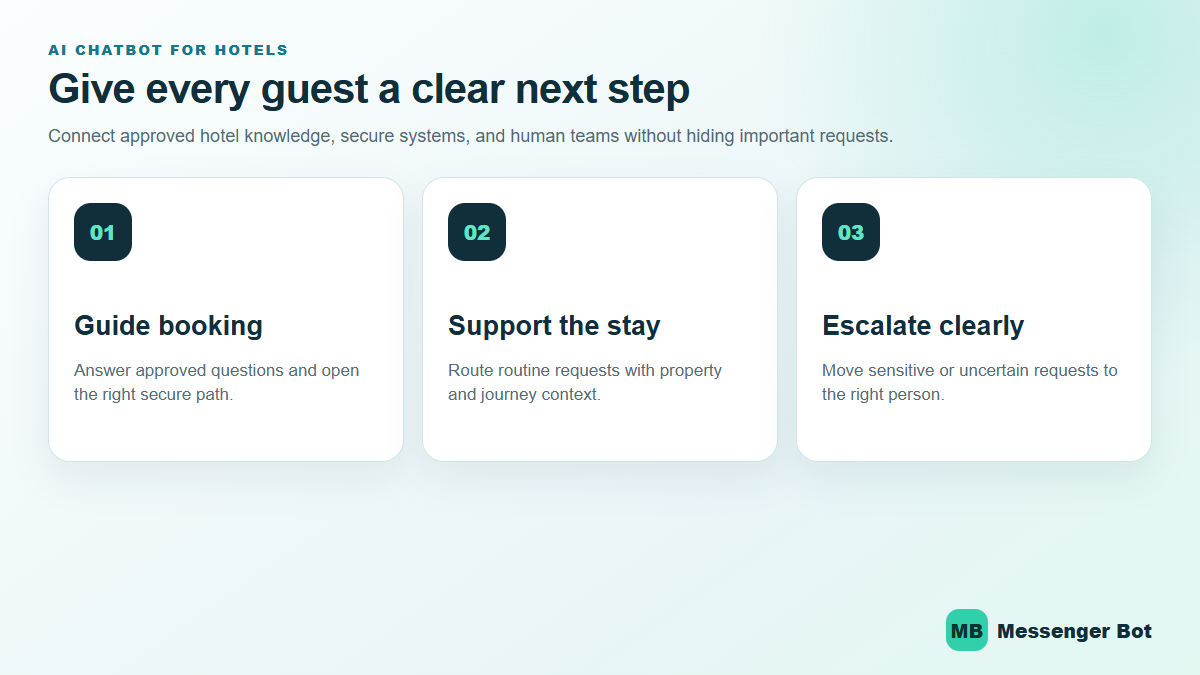
An AI chatbot for hotels should make it easier for a traveler to get a useful answer, choose the right next step, and reach a person when the request needs judgment. For the hotel, the same workflow should reduce repetitive questions without hiding urgent, sensitive, or high-value conversations from the team.
This 2026 guide helps hotel owners and guest-experience teams choose that workflow. It compares hospitality-focused platforms by channel coverage, booking and property-system connections, human handoff, knowledge controls, and reporting. It also shows where a broader conversation platform such as Messenger Bot can help with social inquiries and lead qualification without pretending to replace a hotel property-management system.
What an AI Chatbot for Hotels Should Accomplish
A hotel chatbot is a conversation layer between a traveler and the hotel team. It may answer approved questions, guide a booking inquiry, collect request details, send a guest to a secure booking path, or route a conversation to staff. The strongest use cases are narrow enough to test and valuable enough to maintain.
Before comparing vendors, write down the outcome your property needs. A small independent hotel may want faster answers to pre-arrival questions from Facebook and Instagram. A resort may need multilingual web conversations, booking-engine connections, and in-stay request routing. A multi-property group may care most about central governance, property-level knowledge, analytics, and integrations with its property-management system.
If you need the broader definition, benefits, and hospitality use cases, read our separate guide to how hotel chatbots work. This page owns the selection and implementation decision. Our hotel chatbot examples guide remains focused on example conversations and guest journeys.
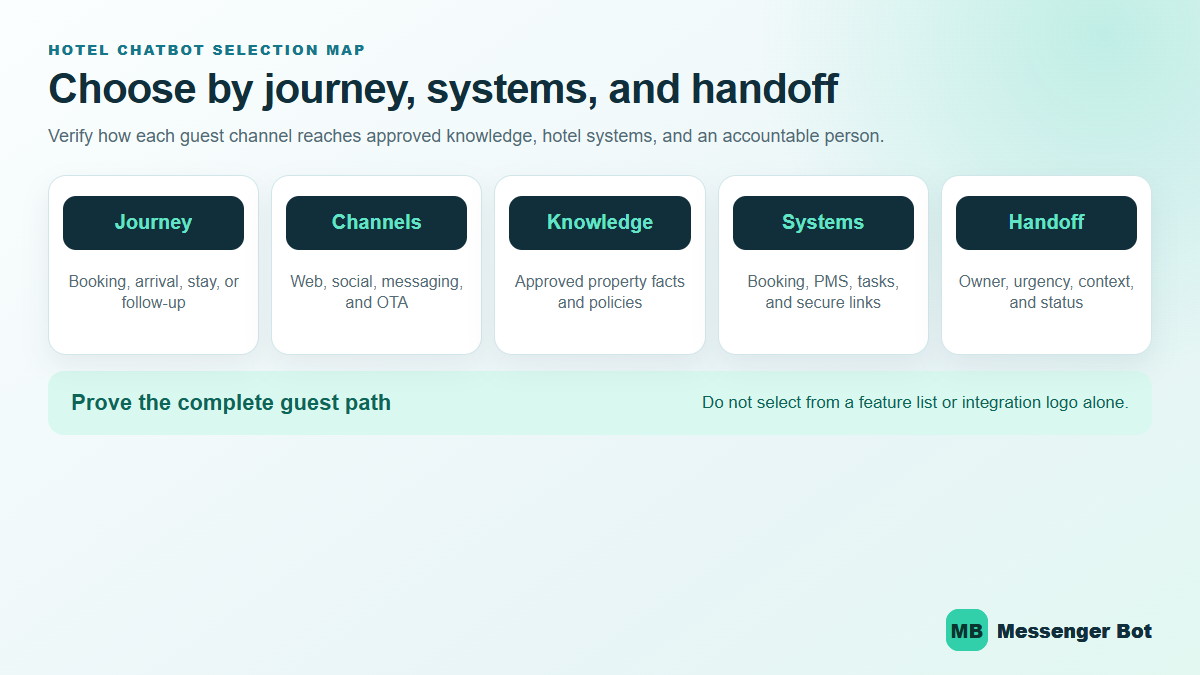
Map the Guest Journey Before You Compare Features
A useful hotel chatbot should behave differently before booking, before arrival, during the stay, and after checkout. Mixing every stage into one unreviewed bot creates confusing answers and unclear ownership.
Pre-booking conversations
Travelers commonly ask about room types, accessibility, parking, pet rules, breakfast, location, cancellation terms, and availability. The chatbot can answer stable property questions and guide the guest to an approved booking path. It should not invent availability, rates, package inclusions, or cancellation terms. If those details come from a booking engine or central reservation system, verify the integration and its failure behavior.
Pre-arrival planning
After a reservation, guests may need check-in information, transportation details, special-request guidance, restaurant hours, or instructions for contacting the property. Decide which answers are public and which require verified reservation context. Do not ask travelers to share payment details or sensitive identity information in an ordinary social conversation.
In-stay requests
Extra towels, maintenance issues, housekeeping needs, dining questions, and late-checkout requests can become structured tasks. The important question is not whether the chatbot can collect the words. It is whether the request reaches an accountable team, receives a status, and escalates when it is urgent or unresolved.
Post-stay follow-up
A post-stay workflow can point guests to a reviewed feedback channel, help them recover a receipt through a secure process, or route a service-recovery concern to a person. Avoid automatically sending a cheerful marketing reply when the message signals safety, privacy, payment, or serious service concerns.
Compare Current Hotel Chatbot Platforms by Operating Fit
The table below is a selection guide, not a universal ranking. Each capability is based on the vendor’s current official materials. Product availability, integrations, plans, languages, and implementation requirements can change, so confirm the exact offer for your property before purchasing.
| Plataforma | Clear operating fit | Current documented strengths | Critical question to verify |
|---|---|---|---|
| HiJiffy | Hospitality-focused omnichannel guest communication | Website, social, messaging, and OTA conversations; booking guidance; human handoff; hospitality integrations | Which exact channels and hotel systems are supported for your property? |
| Asksuite | Reservation inquiries and centralized hotel communications | AI reservation assistance, lead qualification, quote workflows, multiple channels, and booking-engine connections | How are live rates, availability, and booking terms sourced and logged? |
| Canary Technologies | Guest messaging across the stay | Automated answers, staff handoff, service tickets, translations, and guest-messaging workflows | How does the platform identify the guest and protect reservation context? |
| Bot de mensagens | Business messaging, social inquiry capture, qualification, and controlled follow-up | Conversation workflows, clearer reply paths, lead qualification, and human-review boundaries | Which hotel-system actions remain outside the workflow and require a specialist integration? |
HiJiffy Focuses on Hospitality Guest Communications
HiJiffy’s official hotel chatbot overview describes a hospitality-focused assistant spanning hotel websites, social channels, messaging apps, and online travel agencies. It also documents booking guidance, frequently asked questions, quote flows, human handoff, and a centralized console.
That makes HiJiffy relevant when a property wants one hospitality-specific communication layer across several guest channels. The selection work is still property-specific. Confirm the exact booking engine, property-management system, channels, languages, escalation workflow, and data region supported by the proposed configuration.
Best fit to investigate
Consider this category when channel consolidation and hospitality integrations are central to the project. Ask the vendor to demonstrate one real journey using your property data: a traveler asks a policy question, checks a date, follows the booking path, changes topic, and requests a person. The demo should show what the staff sees, not only what the guest sees.
Asksuite Centers the Reservation Conversation
Asksuite positions its product as an AI reservation assistant and omnichannel communication platform for hotels. Its official materials describe handling multiple questions, qualifying leads, providing quotes through connected booking workflows, and centralizing conversations from channels such as the website, WhatsApp, and Instagram.
This is a strong fit to evaluate when direct-booking conversations and reservation-team efficiency are the primary outcomes. A hotel should still verify where each rate and availability answer comes from, what happens when a connected system is unavailable, how a quote is labeled, and when the conversation moves to an agent.
Best fit to investigate
Use a test set with difficult reservation questions: multiple rooms, children, accessible rooms, packages, date changes, group inquiries, and policies that vary by rate. Require the assistant to abstain or hand off when it cannot confirm the correct rule. A conversion-focused flow must not trade accuracy for speed.
Canary Technologies Connects Messaging With Hotel Operations
Canary’s official guest messaging documentation describes communication across the guest journey, a unified inbox, automated and AI-assisted replies, and property-management-system integration. Its AI Guest Messaging page also documents human handoffs, service-ticket creation, a hotel knowledge base, translations, and personalized suggestions.
This category is relevant when the main problem is not only pre-sale chat but the volume and routing of in-stay communication. During evaluation, follow a request all the way to the responsible team. Confirm how duplicate requests are handled, how staff updates the status, what the guest receives, and what happens if the integration or message channel is unavailable.
Best fit to investigate
Use a bounded pilot with routine requests and high-risk exceptions. Routine requests can test routing and response time. Exceptions should include a lockout, safety concern, payment dispute, accessibility need, privacy request, and urgent maintenance issue. Every sensitive path should reach a trained person without an invented resolution.
Verify Property-System Integration Instead of Trusting a Logo
An integration logo does not prove that the workflow supports the exact actions your hotel needs. A connector may provide read-only reservation context, limited property data, or a narrow set of events. Ask for the specific objects, fields, actions, environments, and failure modes included in your setup.
Oracle’s current Hospitality Integration Platform documentation shows why this matters: hotel integrations can span property systems, guest messages, reservations, payments, housekeeping status, and other operational areas. Access and capabilities are controlled at a much more detailed level than a single “PMS integration” label suggests.
For each connected system, document:
- Whether the chatbot reads data, writes data, or only opens a secure link.
- Which property, brand, and environment the connection uses.
- Which guest fields are available and why they are necessary.
- How credentials, partner access, and permissions are reviewed.
- What the guest sees when the connection is delayed or unavailable.
- Which action requires staff confirmation before it changes a reservation or guest record.
Oracle’s guidance for managing partner connections specifically tells administrators to review the modules, functional areas, and sensitive-data access requested by a partner. Apply that same least-access mindset to every chatbot integration, regardless of the underlying hotel system.
Keep Human Handoff Visible and Testable
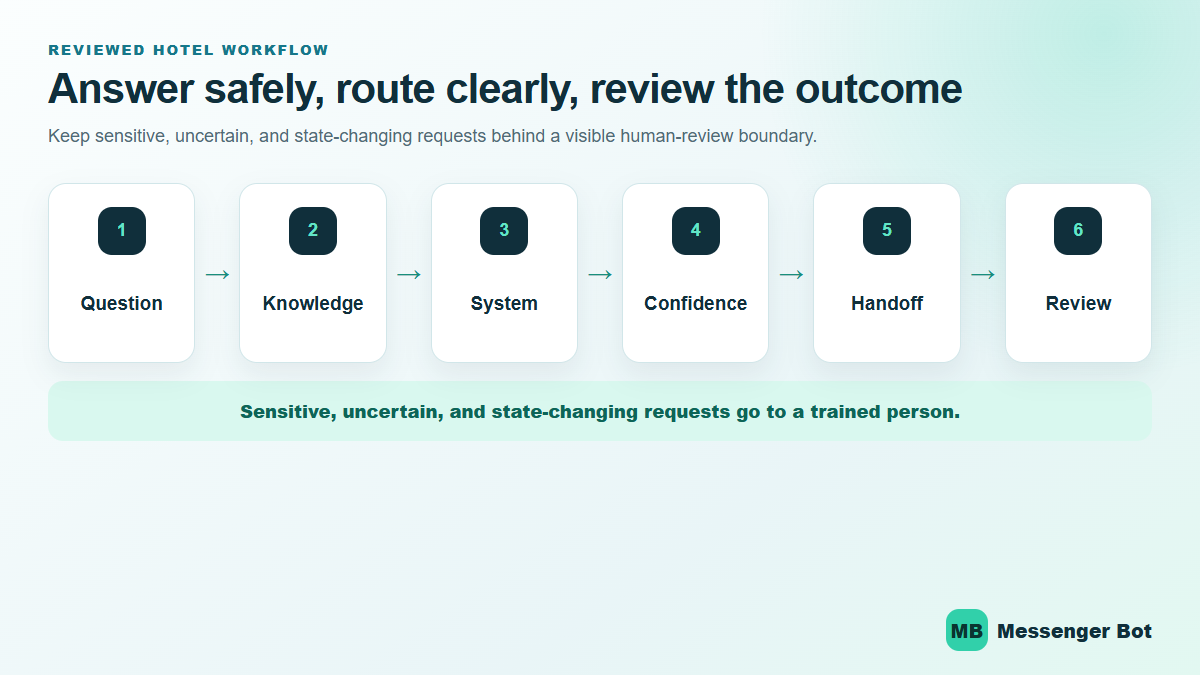
Human handoff is not a fallback label buried in a feature list. It is a customer experience that needs an owner, hours, routing rules, priority levels, and a response expectation. A guest should know when the conversation has moved to a person and whether the team needs more information.
Build escalation rules before launch. Account access, payment, refunds, reservation disputes, safety, medical needs, security, privacy, accessibility, legal concerns, and any request to change a guest record should have a clear human-review path. The chatbot can collect a safe summary, but it should not make an irreversible decision.
Nossa AI chatbot versus human agent framework provides a broader decision model. For a hotel pilot, turn that model into a test sheet with approved answers, required escalations, and prohibited actions.
Build a Hotel Knowledge Base That Staff Can Govern
A hotel chatbot is only as reliable as the material it is allowed to use. Separate global brand information from property-specific information. Then assign an owner and review date to each policy, amenity, schedule, transportation detail, accessibility statement, and booking instruction.
Do not bury seasonal details inside long, unstructured documents. Use clear entries with the property, effective date, source, approved wording, and escalation rule. When a restaurant closes for renovation or a shuttle schedule changes, the team should be able to find every affected answer.
Use one answer source for each material fact
Rates, availability, cancellation rules, and reservation status should come from the appropriate current system or approved booking path. Static knowledge is suitable for stable details such as the property’s address or a consistently available amenity. If two sources conflict, fail closed and route the question instead of choosing the more convenient answer.
Review generated language before guests see it
AI can make approved information sound natural, but the result still needs boundaries. Test names, numbers, dates, prices, durations, accessibility details, and policy language. Reject answers that add facts not found in the approved source. Keep a record of the source and workflow version tested.
Choose Metrics That Reveal Guest and Staff Outcomes
A high automation count can hide bad service. Track whether guests reached a useful next step and whether staff received the right conversations with enough context. A practical scorecard can include:
- Questions answered from approved knowledge without correction.
- Conversations handed to the correct team.
- Unanswered or low-confidence topics that need new content.
- Booking-path starts and completed bookings measured in the booking system.
- Requests reopened because the first route did not resolve the need.
- Sensitive requests correctly escalated without exposing extra information.
- Staff time spent correcting answers or repairing failed integrations.
Compare outcomes by property, journey stage, channel, language, and topic. Avoid using an average that hides one property or guest group with a poor experience. Review the underlying conversations through approved access, then update the knowledge or routing rule.
Run a Bounded Pilot Before a Full Hotel Rollout
- Select one property and one journey. Start with a clear pre-booking or pre-arrival use case rather than every guest interaction.
- Approve the knowledge. Remove stale details, identify system-owned facts, and assign owners and review dates.
- Connect the minimum access. Use a test environment where available and grant only the modules and data required for the pilot.
- Create an escalation matrix. Define routine, low-confidence, sensitive, urgent, and state-changing paths.
- Test real variations. Include typos, multiple questions, different languages, changed dates, conflicting details, and unavailable integrations.
- Train the staff path. Confirm alerts, ownership, context, status updates, and what the guest sees during handoff.
- Review evidence before expansion. Fix knowledge, routing, permissions, and measurement gaps before adding another property or journey.
Pricing should be evaluated against the complete operating cost, not only a monthly platform fee. Include implementation, integrations, knowledge maintenance, staff training, support, message-channel charges, and the cost of correcting failures. Our separate chatbot pricing guide explains the broader cost categories to compare.
Where Messenger Bot Fits for Hotels
Messenger Bot can help a hotel turn social and business-message inquiries into clearer reply paths, basic qualification, and controlled follow-up. A property can guide a traveler toward the correct booking page, collect the topic and preferred dates for staff review, answer approved general questions, and make human help visible.
The business outcome is faster, more consistent handling of common inquiries—not automatic control of a reservation system. If the hotel needs live inventory, reservation changes, check-in, payment, room access, or in-stay task management, verify a specialist integration and keep state-changing actions behind the appropriate security and staff controls.
Turn hotel inquiries into a clearer next step
See how Messenger Bot can help your team qualify common business-message inquiries, guide travelers to the right information, and keep human follow-up visible.
AI Chatbot for Hotels Selection Checklist
- Which guest journey and business outcome does the first release own?
- Which channels are included, and who owns each handoff?
- Which facts come from approved knowledge versus a connected hotel system?
- What exact read and write permissions does each integration receive?
- How are availability, rates, policies, and reservation details kept current?
- Which requests always require a person?
- What happens when confidence is low or a system is unavailable?
- How are guest data, retention, access, exports, and deletion handled?
- Which metrics prove a useful guest outcome instead of activity alone?
- Who reviews the knowledge, integrations, and escalation rules after launch?
Frequently Asked Questions About AI Chatbots for Hotels
What is the best AI chatbot for hotels?
The best fit depends on the guest journey, channels, property systems, human handoff, languages, governance, and reporting your hotel needs. Hospitality-focused platforms may offer deeper booking or guest-messaging integrations, while Messenger Bot can fit social inquiry capture and controlled follow-up. Verify the exact configuration with a pilot.
Can a hotel chatbot make or change a reservation?
Only when an approved integration supports the exact action and the hotel has validated identity, permissions, data handling, failure behavior, and confirmation. A safer initial workflow often guides the guest to a secure booking path or hands the request to staff.
Can an AI hotel chatbot replace the front desk?
No. It can handle approved routine questions and organize requests, but people remain essential for judgment, empathy, safety, service recovery, exceptions, and state-changing decisions. The workflow should make escalation easy and visible.
How should hotels protect guest information in chatbot conversations?
Collect only what the use case requires, keep sensitive actions in secure systems, restrict integration access, define retention and deletion rules, review vendor data practices, and train staff not to request payment or identity details through ordinary social messages.
How long does a hotel chatbot pilot take?
The responsible timeline depends on scope, knowledge readiness, integrations, security review, staff training, and acceptance testing. Start with one property and one journey, then expand only after the evidence shows accurate answers, correct handoffs, and reliable system behavior.

 Português do Brasil
  English
  Tagalog
  简体中文
简体中文  العربية
  हिन्दी
  Español de México
  Français
  বাংলা
বাংলা  香港中文
香港中文  繁體中文
繁體中文  Nederlands
  Deutsch
  Bahasa Indonesia
  日本語
日本語  한국어
한국어  Polski
  Русский
  Español
  Tiếng Việt