
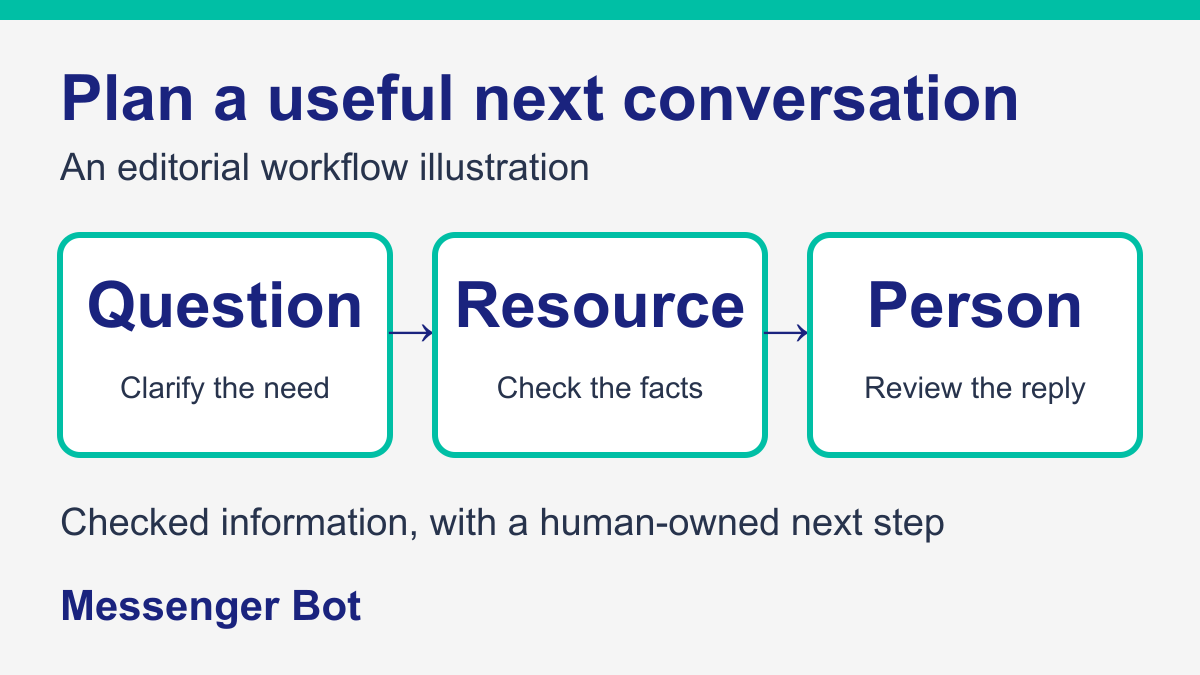
A prospect asks a useful question, then needs time to decide. Your next message should help with that decision, not restart the sales pitch. Lead nurturing gives a small-business team a practical way to connect the person’s stated need with checked information and a clear, human-owned next step. Start with one genuine inquiry, one unanswered question and one resource worth sharing.
The plan below is a suggested working method for business owners and marketers, not a tested performance benchmark or a promise that software will run it automatically. The conversation examples use placeholders, and the measurement example is hypothetical. Reviewed October 12, 2026: keep the process separate from claims about integrations, delivery, predictions or guaranteed sales.
Start With the Prospect’s Unanswered Question
Lead nurturing develops a relationship by supplying relevant information as someone considers a decision. That broad definition is supported by this official training reference. Here, the practical focus is narrower: people who have already made a genuine inquiry but have not agreed to a purchase or another confirmed step.
Keep three jobs separate. Lead generation helps attract or capture a new inquiry. Scoring helps a team review fit and priorities. Nurturing helps answer the questions that remain after an inquiry. A customer who has already bought something and is considering returning belongs to a different retention conversation. Mixing all four jobs into one message makes its purpose harder to understand.
If your first-contact process is unclear, begin with capturing and qualifying new inquiries. Treat that as related-stage reading, not evidence that a particular growth multiplier will apply. Once a person has actually asked for information, you can decide what would make the next conversation useful.
Write the question in plain language: “What is included?”, “Does this work for my situation?” or “What would I need to prepare?” Preserve its meaning rather than translating it into a purchase prediction. A request for a comparison is not agreement to buy. A question about availability is not a confirmed appointment.
Do not start by collecting a longer profile. A small amount of relevant context may be enough: what the person wants to understand, the contact route they have chosen and whether they asked for another reply. Leave unrelated personal information out. If the context is missing, clarify it rather than guessing from a page visit or a previous contact.
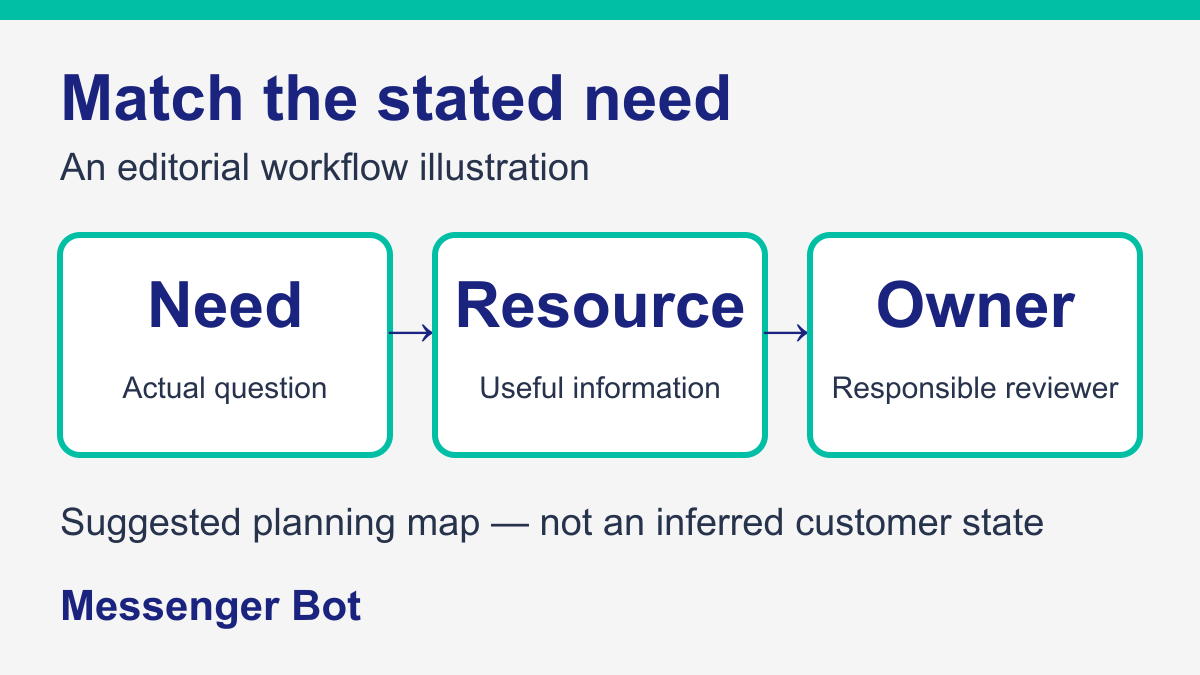
A useful planning note can contain the stated question, a suitable checked resource, a person responsible for reviewing the response and the customer’s next choice. Keep this note in the working system your team actually uses. This recommendation does not imply that any particular chatbot saves that information or alerts staff automatically.
Match the Follow-Up Resource to the Decision Stage
Choose information because it answers a question, not because it is the next item in a preset sequence. The stages in this table are illustrative planning categories. They are not a required funnel, a scoring algorithm or a claim about a prospect’s hidden intentions. Let the person’s request determine which row is useful.
| Current need | Useful resource | Review before sharing |
|---|---|---|
| Understanding the service | A plain explanation of what is included and excluded | Check scope and name the person who answers exceptions |
| Comparing suitable options | A comparison using the criteria the prospect asked about | Check every material difference and avoid unsupported winner claims |
| Preparing for a possible next step | A preparation checklist or explanation of what happens next | Confirm requirements and keep the next step optional |
| Changing timing or preference | A clear way to pause, choose another contact route or ask a person | Respect the stated choice instead of treating it as an objection to overcome |
For a service inquiry, useful information might explain what a quotation needs and what cannot be determined without review. For a software inquiry, it might distinguish an advertised feature from an account-specific requirement. Do not supply invented prices, availability or implementation details merely to make the response feel complete.
A comparison should use consistent criteria. If one option includes a service that another does not, say what is being compared rather than declaring one universally better. Where a difference is unknown, mark it as unknown in your working comparison and ask the responsible person. An unchecked blank should not quietly become “not available.”
Give each resource an owner. That person checks its facts and handles questions outside its scope. They do not need to rewrite it for every inquiry, but they should know when its information changed and when it must not be used. Separate a reusable explanation from a customer-specific answer that needs individual attention.
Close the resource with a choice the reader can understand. They might ask a further question, request a conversation or say that they do not need more information. A large collection of links is not automatically more helpful. Offer the smallest useful next step, with another route available if the resource does not answer their question.
Prepare Follow-Up Examples That a Person Can Review
Write examples to make the intended conversation clearer, not to imply that a message was sent or a customer responded. The following exchanges are hypothetical templates. Replace bracketed information only with facts your team has checked, and do not insert a real customer’s identity into a public example.
Clarify the Initial Inquiry Without Repeating the Pitch
Prospect: “I am comparing [service options] and want to understand what is included.” Suggested response: “The overview explains [checked scope]. Is your main question about what is included, or what you would need to prepare?” This asks one useful question rather than demanding budget, address and a purchase timetable together.
The person reviewing the response should check the linked overview and any exclusions. If the business cannot answer the question without more context, explain what is needed and why. Do not pretend that the first exchange has qualified the prospect or that a staff member has accepted the inquiry.
Share Information the Prospect Actually Requested
Prospect: “Please send the preparation checklist.” Suggested response: “Here is the checklist for [checked next-step purpose]. The section on [relevant requirement] may answer your question. Would you like to ask anything about it, or leave it there for now?” The question keeps further contact optional.
Check the actual destination before using the example. It should lead to the promised resource, not a generic homepage or an unexpected signup request. If an offer has changed, do not send a remembered version. A relevant resource can still be wrong when its price, scope or availability is out of date.
Respect a Request to Pause or Change Contact
Prospect: “I am not deciding yet and do not want more follow-up.” Suggested response: “Understood. We will respect that preference. If you want information later, you can use [actual contact route].” Use this wording only when the team has a working way to honor the preference; do not claim a setting was changed without confirmation.
Review the examples as a sequence. A helpful first reply does not justify an unrelated promotion later. Each message needs its own clear purpose and appropriate basis for contact. If the business is considering an automated workflow, verify its real behavior and applicable channel rules separately rather than assuming the template makes it available or appropriate.
Choose Between Continuing, Pausing and Human Handoff
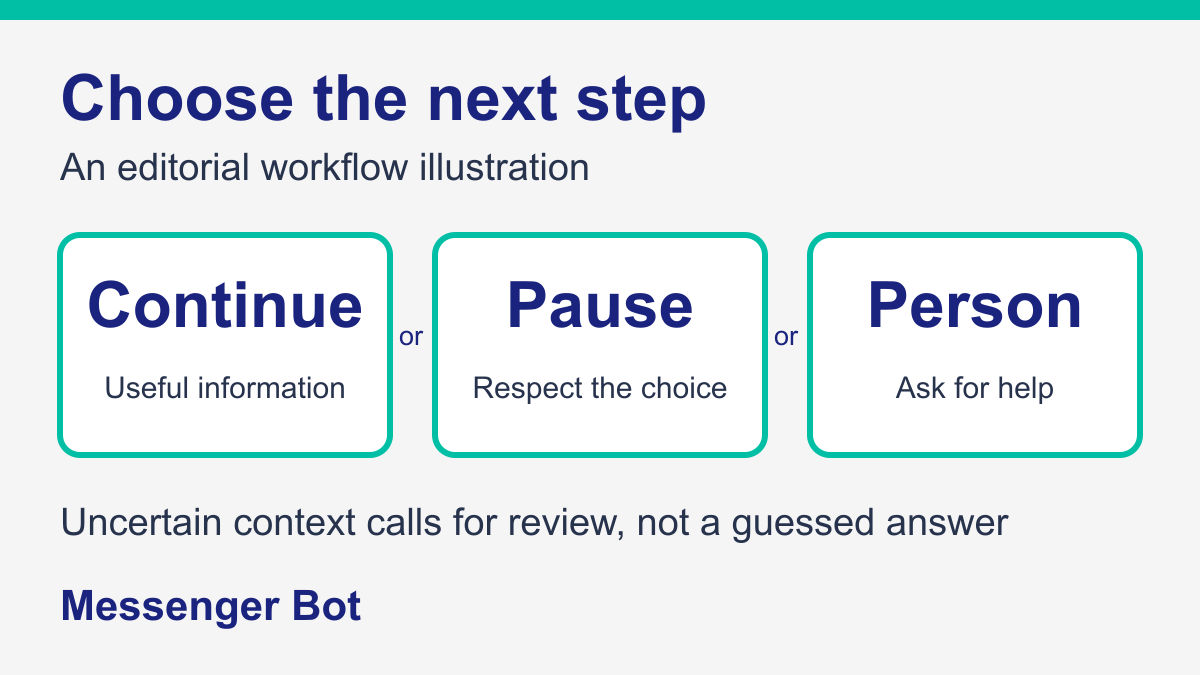
Before another contact, ask what the person requested and what remains unanswered. Silence alone does not prove interest, consent or readiness to buy. There is no universal follow-up interval in this guide. Timing should reflect the actual request, preferences, business context and current rules for the contact route being used.
Continue when the next response supplies relevant, checked information that the person is expecting. Keep its purpose narrow. If they asked about preparation, answer that question instead of introducing an unrelated offer. If there is no useful new information or clear basis for another contact, pause rather than filling the gap with a reminder.
Move to a human-owned conversation when facts need judgment, the person asks for someone, the response is ambiguous or a complaint needs attention. Pricing exceptions, account access and commitments deserve particular care. A draft can explain who should review the issue, but it must not claim that an unseen person has received or acted on it.
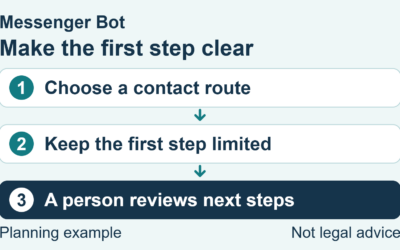
Define what the handoff means in the process you actually have. It might be an assigned task, a conversation passed to an available colleague or a request for the customer to choose a contact option. Verify that route before promising it. “A person can help with this” is not the same as “Someone is reviewing your case now.”
For teams considering reviewing fit and intent, keep scoring separate from the person’s preferences. A high-priority inquiry does not erase a request to stop. A low score does not make a courteous answer less important. The review method should help staff choose a suitable next action, not manufacture certainty about buying intent.
Write exception rules before the team needs them. Include an unavailable resource, an unclear request, a preference change, conflicting information and a request for a person. Define a respectful response and who resolves each case. These are proposed operating rules, not proof that Messenger Bot or another product currently implements them.
Keep the Follow-Up Resource Library Accurate
A reusable library should make checked information easier to find. Start with the questions people actually ask, then assign a suitable resource and a reviewer to each one. This can be a small worksheet; you do not need a complicated system before you know what information is useful.
For each resource, record its purpose, current destination, last review date and responsible person. Add a brief limitation: what does this document not answer? A preparation checklist might not settle availability or price. A feature overview might not confirm that a particular account has access. Clear boundaries help the team avoid turning a general explanation into a specific promise.
Keep a record of the approved version your team is using. When information changes, update the resource and check places where the old wording might still appear, including saved replies and illustrations. Do not assume that changing one document updates every message automatically. Confirm the behavior of the actual tools involved.
Separate public information from private context. A general checklist can be shared as a resource; an individual quotation, account detail or customer-specific link needs appropriate handling. Public templates should use inert placeholders rather than working private links. Check that examples do not accidentally disclose a person’s question or other identifying information.
Plan for unavailable information. If a destination breaks or a fact cannot be confirmed, give a suitable alternative or a human contact route instead of reconstructing the answer from memory. The goal is a reliable next conversation, not the appearance of a complete automated response. Removing an inaccurate resource can be more useful than adding another unchecked one.
Measure Useful Progress Without Calling Replies Sales
Choose an observation period and define the group before calculating results. A practical starting group is the genuine inquiries that meet your stated contact criteria during that period. Record exclusions consistently and deduplicate people or inquiries according to a declared rule. Changing that rule between comparisons can change the result without any improvement in the process.
Keep attempted contacts, known deliveries, unique replies and agreed next-step requests separate. An attempt is not proof of delivery. A reply may ask a question or request no further contact; it is not necessarily a positive buying signal. A request for an appointment is different from staff confirmation, and both are different from a completed purchase.
Hypothetical arithmetic example: a team reviews 20 eligible inquiries, records 12 contact attempts, can confirm delivery for 10 and receives three unique replies among those 10. Its reply rate for confirmed deliveries is 3 divided by 10, or 30%. That is not a 30% sales conversion rate. The two attempts with unknown delivery must stay unknown rather than being counted as successful deliveries.
Suppose one of those replies asks for a conversation and another asks to stop. Record both accurately, but do not treat them as the same kind of progress. If the team later observes a sale, report it separately with the matching and attribution limits. A purchase after contact does not by itself prove that the contact caused the purchase.
Use a named denominator whenever you publish a rate. “Replies per confirmed delivery” and “requests per eligible inquiry” answer different questions. If the denominator is zero, the rate cannot be calculated. If the denominator is unavailable, report it as unknown rather than substituting attempts or page views. A tidy percentage is less useful than an honest gap.
Keep speed separate too. The guide to measuring response time addresses a different operational question. An immediate acknowledgment does not prove that a person answered the prospect’s concern. Compare similar inquiry types and periods, and note changes in demand, staffing, contact route or resource quality before attributing a difference to the nurturing plan.
Review a small set of actual questions alongside the counts. Are people asking the same thing after receiving the resource? Does the proposed next step make sense to them? Use appropriately handled internal examples for that review, not public customer transcripts. Improve the information or process when the evidence shows a specific problem; do not turn a small sample into a universal benchmark.
Rehearse One Conversation Before Expanding the Plan
Use invented information and a non-sending rehearsal to check the plan. Choose one ordinary inquiry and one exception, then ask someone who did not write the response to review both. The aim is to find unclear instructions or unsupported promises before they reach a customer, not to demonstrate a workflow by contacting real people.
- Check the context. Does the proposed reply answer the stated question, use only necessary information and respect the declared preference?
- Check the facts. Are scope, destinations and material statements current, with a responsible reviewer for anything uncertain?
- Check the choice. Can the person understand how to ask another question, pause or reach an actual human contact route?
- Check the reading experience. Is the message understandable on a phone, with descriptive links and a useful text alternative when an image adds meaning?
- Check the evidence. Can the team distinguish an attempt, known delivery, reply, request, confirmation and outcome without inventing missing states?
Try the unavailable-resource and preference-change cases as well. If an answer relies on guessing, stop that path and define a review step. A draft that passes a writing check has not proved an integration, a scheduling action or customer delivery. Verify those capabilities separately if they are part of your intended setup.
For Messenger Bot, begin with the business result you want: clearer answers, more useful qualification and a controlled next conversation. Explore business conversation examples, затем Проверьте текущие цены to assess the current offer against your requirements. Confirm the particular account features and workflow you need rather than assuming a follow-up plan establishes their availability.
Часто задаваемые вопросы
What does lead nurturing mean?
Lead nurturing means developing a relationship by providing relevant information as someone considers a decision. In this guide, the focus is a genuine prospect who has asked a question but has not agreed to a purchase. A useful response answers that question and offers a clear choice rather than treating every inquiry as immediate buying intent.
How is lead nurturing different from lead generation and lead scoring?
Lead generation attracts or captures an inquiry. Lead scoring helps a team review fit and priorities. Lead nurturing supplies useful information for questions that remain after an inquiry. Keep their purposes separate: a score does not grant permission for contact, and an inquiry does not prove that a prospect is ready to buy.
What information should I send a prospect who is not ready to buy?
Start with the person’s stated question. A checked explanation, comparison or preparation checklist may help, provided it matches their situation. Give the resource a responsible reviewer and a clear next choice. Do not add unverified prices, availability, offers or product capabilities simply to make the response longer.
How often should I follow up with a lead?
There is no universal interval in this plan. Consider the person’s actual request, preferences, context and current rules for the contact route. Continue only when there is an appropriate basis and useful information to provide. Silence is not proof of consent or buying readiness; pause or involve a person when the next action is uncertain.
How do I measure whether a lead nurturing plan is useful?
Define the inquiry group, observation period and deduplication rule. Keep attempts, known deliveries, unique replies, next-step requests, staff confirmations and outcomes separate. Name each rate’s denominator, leave missing information unknown and do not calculate a rate with a zero denominator. Replies or purchases after contact do not alone prove causal revenue improvement.

 Русский
  English
  Tagalog
  简体中文
简体中文  العربية
  हिन्दी
  Português do Brasil
  Español de México
  Français
  বাংলা
বাংলা  香港中文
香港中文  繁體中文
繁體中文  Nederlands
  Deutsch
  Bahasa Indonesia
  日本語
日本語  한국어
한국어  Polski
  Español
  Tiếng Việt