
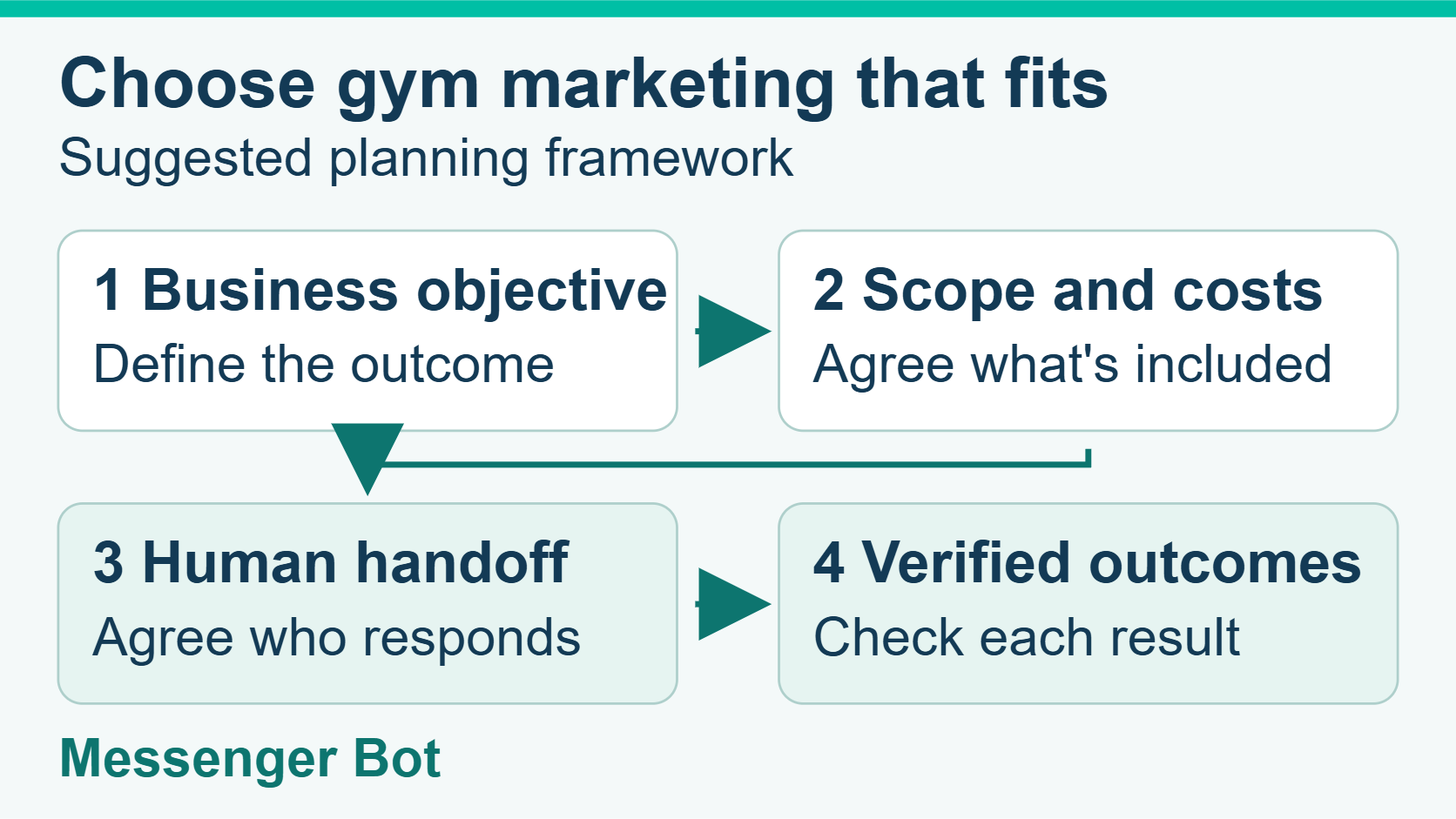
A gym marketing agency should give you a clear answer to three questions: what work will it do, what will that work cost, and how will you judge the result? Before choosing outside help, compare those answers with the inquiries your team can realistically handle. A campaign that attracts interest still needs a useful next step for the person considering your gym.
This is a selection checklist for owners of gyms, fitness studios and personal training businesses. Use it to compare a proposed scope, separate advertising spend from service fees, and agree how inquiries will reach the right person. It is not a ranked agency list or a promise of more memberships. Start with your business goal, then ask each candidate to explain the work behind its proposal.
Decide What Marketing Help Should Achieve
Choose the outcome you want to understand before choosing a package. Local awareness, inquiries, conversations about a relevant class, requests to visit and new memberships are different outcomes. An agency may help with several stages, but a report about reach cannot answer whether anyone attended a visit. Write down which stage matters now and which later stages your own team will confirm.
Плагин SBA marketing and sales guidance recommends defining your target audience, goals, actions and budget in a marketing plan, then comparing marketing costs with results. Apply that planning approach to the service you are considering; it does not supply a gym-specific budget or a promised conversion rate.
Put the business question in plain language
A useful objective might be to understand whether an introductory-class campaign brings inquiries from people interested in that particular class. That is an example of a planning question, not a forecast. Specify the class, the service area, the next action and the period you will review. Check the class information and available capacity before anyone promotes it.
Distinguish a requested visit from a confirmed visit. A person who asks about a time has not necessarily accepted an appointment, and a confirmed appointment is not proof of attendance or membership. Decide who records each change. If your team cannot verify a stage, label it unknown rather than presenting an earlier action as a completed sale.
- Audience: who is the proposed campaign meant to help, and what are they asking about?
- Offer: which reviewed class or service information will the campaign use?
- Capacity: who can answer, and what availability can staff confirm?
- Next action: should the person ask a question, request a visit or speak with a team member?
- Review period: when will you compare the same stages and costs?
- Current unknowns: which costs, customer actions or outcomes can you not establish yet?
Check the existing inquiry path before increasing promotion. If people already wait for an answer, include a realistic handoff plan in the discussion. Begin by reviewing inquiry response times, without assuming a particular response target will produce a particular membership result. The practical question is whether someone knows which inquiries need attention and who will respond.
Compare the Actual Work, Not the Sales Pitch
Ask for deliverables, responsibilities and exclusions rather than a collection of broad service names. “Content” could mean writing, photography, editing, publishing or reviewing material your staff supplies. “Lead generation” might mean attracting inquiries without answering them. Those are reasonable differences between proposals, but they need to be visible before you compare their prices.
Use the table below as a discussion worksheet. These are suggested questions, not services every agency must provide. Keep the columns readable on a small screen by scrolling the table when needed.
| Work area | Ask the agency | Agree with your team |
|---|---|---|
| Local visibility | Which business information and pages will you review or change? | Who checks location, hours and service details before approval? |
| Реклама | Which campaigns, creative work and reporting are included? | Who approves the offer, budget and account access? |
| Контент | What will you produce, and what must we supply? | Who approves descriptions, images and permission to use them? |
| Целевые страницы | Which page changes and inquiry routes are included? | Who confirms that the information and next action are accurate? |
| Inquiry handling | Does the scope stop at attracting interest, or include reviewed response work? | Who answers questions and confirms visits? |
| Отчетность | Which costs and actions will you show for each review period? | Who verifies attendance and memberships outside the campaign report? |
For each work area, ask what “finished” means. A proposed landing page needs approved wording and a working next step; a piece of creative work needs a decision about who can use it. Agree the review process and record what is outside the quoted scope. These are practical purchasing questions, not a claim that every contract must contain identical terms.
Separate the agency’s work from the front desk’s responsibilities and the customer’s choices. An agency cannot decide that a visit occurred merely because someone requested one. Your team should know which information it must review and which conversations it must handle. The prospective member should have a clear way to ask a question without being told that an unconfirmed visit is booked.
Ask the candidate to explain one proposed activity from start to finish. What does it need from you, who reviews it, what happens when a person responds, and where does the result appear? A clear example of the planned process is more useful than a claim that everything is included. Do not treat a sales demonstration as proof of how your own accounts will work.

Understand Costs and Keep Useful Account Access
Request a cost breakdown that separates advertising spend, agency fees, creative production and optional tools. Ask which items recur, which depend on additional work and who approves changes. This guide does not provide typical agency prices: a useful comparison needs the actual scope and costs quoted to your business, not an unsupported industry average.
For Google advertising, Google’s advertiser guidance on third parties provides questions about costs, reporting and account responsibility. It also explains that buying ads does not improve organic search rankings. Treat promises of guaranteed ad positions with caution. These points concern Google’s advertising context; they are not universal legal rules for every marketing contract.
Google’s third-party transparency requirements distinguish Google advertising costs from service fees and address access to cost and performance information. Ask the candidate how it will meet the requirements that apply to its work. Do not assume that a general monthly summary proves that every relevant reporting obligation is satisfied.
Agree access without sharing unnecessary secrets
Ask who controls the business’s advertising accounts, pages, domain and reporting access, and how responsibilities will be handed over if the arrangement ends. Discuss appropriate permissions through the relevant account tools rather than putting passwords or payment details in a customer conversation. Account ownership and the level of access needed for a specific task are separate questions.
Ask how you will receive work already paid for, approved creative files and an explanation of remaining account responsibilities. Clarify what is included before signing; seek qualified advice when a contractual issue needs it. A friendly working relationship is useful, but it does not replace a shared understanding of the scope, costs and handover.
When a proposal includes a new tool, ask why it is necessary, what it costs and what your staff will need to do. Do not buy a tool merely to make a report look more detailed. An understandable record that your team can maintain is preferable to a promised measurement process that nobody has verified.
Ask for Evidence You Can Compare Fairly
Ask what a case study actually measured before comparing it with your gym. The relevant details include the period, the business context, the promoted service, the advertising spend and the action counted. A large inquiry number is not a membership number. A reported increase also needs a clear comparison period and an explanation of what changed.
You can ask a candidate to explain its measurement approach without requesting another business’s private customer records. A redacted example or a description of the calculation can support that discussion. Keep the distinction clear: an illustration explains a method; it is not a result achieved for your business or evidence that you will repeat someone else’s outcome.
Find the denominator behind a percentage
When a proposal mentions a conversion rate, ask what was counted in the numerator and denominator. Was the rate based on advertising clicks, eligible inquiries, confirmed visits or attendees? Were repeated inquiries handled consistently? Without those definitions, two reports that use the same label may be describing different stages.
Ask which results were observed directly and which were attributed by a reporting method. An agency may have evidence of a campaign interaction while your staff records a membership later. Those records are not automatically connected. If the connection has not been established, keep the membership outcome separate rather than assigning it to a campaign by assumption.
| Evidence item | Question to resolve |
|---|---|
| Period and context | Which dates, business setting and promoted service does the example cover? |
| Reported action | Was this a click, inquiry, request, attendance or verified membership? |
| Denominator | Which group was counted, and how were repeats handled? |
| Spend and fees | Which advertising costs and service fees are included? |
| Exclusions | Which records or actions were left out? |
| Attribution limits | Which connections are established, and which remain unknown? |
Bring the discussion back to your own objective. If you need clearer inquiry handling, ask how the proposed work addresses that stage. If you need to compare campaign costs, ask to see the cost definitions. Do not turn an impressive but unrelated example into a guarantee about your class schedule, market or membership sales.

Connect Campaigns to a Human-Reviewed Inquiry Path
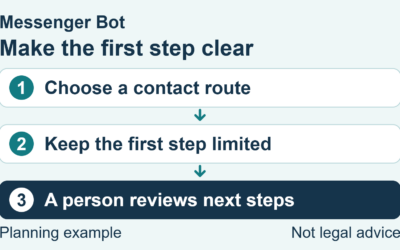
Before launching a campaign, agree what the first conversation should help the person do. A suggested greeting can welcome the inquiry, ask which class the person wants to discuss and offer one optional contact route. These are suggested conversation choices, not claims about a particular platform’s features. Keep the information accurate and make the next step understandable.
Prepare a small set of reviewed answers about the promoted service: location, what the advertised offer includes and how to request further information. Let staff confirm service details and current availability. Health-related suitability questions should go to a qualified professional. Do not improvise medical advice or collect health information simply to make an inquiry form more detailed.
Make the wording match what actually happens. Say that someone can request a visit when confirmation still depends on staff. Do not say a request has been saved, a team member notified or a place reserved unless that action has been verified. A person should not have to discover later that a message presented as a confirmation was only an expression of interest.
Keep the handoff practical
Agree who checks new inquiries, how the person can reach the team and what happens outside the times staff can respond. Use an honest response expectation rather than promising immediate help that the team cannot provide. If a question concerns payment, account access or sensitive health information, direct it to the appropriate person through a suitable channel.
For wider conversation planning, see planning business conversations. Keep any tool choice separate from the agency decision. A software demonstration does not establish that your gym’s accounts, offers, booking process or reporting are connected and ready to use.
Review a sample inquiry with both the agency and the person who will answer it. Check the wording, the destination and the difference between a request and a confirmation. This is a suggested manual check, not a required technology setup. Resolve unclear responsibilities before directing more people toward that path.
Use a Small Evaluation Worksheet Before Committing
Compare proposals using the same questions, not a score invented to make one agency look best. Mark each answer as confirmed, needs clarification or not supplied. “Confirmed” should mean you have a clear written explanation or appropriate evidence, not that a salesperson sounded confident. Keep a note of what you still need to ask.
| Criterion | Check with each candidate | Record your assessment |
|---|---|---|
| Scope fit | Does the work address your business question? | Confirmed, needs clarification or not supplied |
| Cost transparency | Can you separate spend, fees and additional work? | Note the explanation and any unresolved cost |
| Reporting clarity | Are periods, actions and calculations clear? | Note the definitions and evidence supplied |
| Account access | Are control, permissions and handover explained? | Note the arrangements to clarify |
| Inquiry handoff | Who answers and confirms visits? | Note the agreed responsibilities |
| Exit procedure | What happens to access and paid-for work? | Note the explanation and remaining questions |
Use unresolved questions to shape a follow-up discussion. A missing answer does not automatically prove poor practice, but it is not a sound basis for assuming that the work is included. Ask the agency to explain the gap in plain language. Keep the decision tied to the scope you need rather than a package name or a promised position in search.
If a smaller initial scope would make the work easier to evaluate, discuss one that fits your business. Agree the responsibilities, review period and measures together; there is no universal trial length supplied here. Avoid changing several offers and measurement definitions at once, because that can make the comparison harder to interpret.
Share the final proposal with the people who will approve information, answer inquiries and record outcomes. They need to know what they are being asked to do. Choose outside help only after the proposed work, your team’s responsibilities and the unanswered questions are visible in the same decision.
Review Progress Without Moving the Goalposts
Review the agreed stages over consistent periods. Keep eligible inquiries, answered inquiries, requested visits, staff-confirmed visits, attendance and verified memberships separate. Use the same definitions when comparing periods, and record changes in the offer, available capacity or recording method. A change in the records can look like a change in performance if you overlook it.
For a response measure, compare answered inquiries with eligible inquiries from the same group and period. For a visit measure, compare verified attendance with the defined visit group you chose. Only calculate a ratio when the denominator is known and greater than zero. State the definition beside the number so another person can understand it.
Choose a review method that fits the information you actually hold. Avoid silently treating a blank record as a failed visit or a sale. Mark an unknown outcome as unknown, and decide whether your team can improve the record for future reviews. That gives you a more honest starting point than filling gaps with favorable assumptions.
If inquiries need prioritizing, a practical lead-review framework can help structure the questions you discuss. Interest is not proof of purchase readiness, and a review label is not a promise of membership. Keep sensitive judgments and individual questions with the appropriate person.
Do not call a campaign profitable from an inquiry count alone. Separate recorded advertising spend and service costs from verified sales information, and state what you cannot attribute. Avoid inventing a member lifetime value to fill a reporting gap. Discuss the business decision the available evidence can support, such as clarifying the offer or changing the scope under review.
Keep the customer experience in the review too: can people read the page, understand the offer, ask questions and choose an appropriate next step? Use those checks to improve unclear information without blaming customers or staff. Better records and clearer responsibilities help you judge the work; they do not guarantee growth.
- Readability: check the offer, form labels and contact options on a small screen.
- Keyboard access: check that someone can reach the inquiry controls and leave them without getting stuck.
- Конфиденциальность: ask only for information needed for the next conversation; avoid sensitive details in campaign reports.
- Передача человеку: review unanswered questions and unclear confirmations with the responsible person.
- Adjustment: make the next action clearer and let the person choose a suitable contact option.
Messenger Bot is for businesses managing customer conversations, not an agency directory. Explore business conversation examples to consider the next step your customers need, then Проверьте текущие цены if the product fits your business. Review the requirements for your own accounts and team before choosing a tool alongside your agency.
Часто задаваемые вопросы
What should a gym marketing agency actually do?
It should explain the agreed work, costs, responsibilities and reporting. Ask which activities are included and where its role ends. Keep attracting inquiries separate from answering questions, confirming visits and recording memberships.
How can I compare gym marketing agency fees?
Compare the same scope and separate advertising spend, agency fees, creative production and optional tools. Ask which costs recur and who approves additional work. A price without a clear scope is not a useful like-for-like comparison.
What reporting should I ask an agency to provide?
Ask for the review period, costs, actions counted and calculation methods. Separate clicks, inquiries, requested visits, confirmed visits and verified memberships. Label missing outcomes or unproved campaign attribution as unknown.
Should an agency control all of my marketing accounts?
Ask who controls each business asset, which permissions the work needs and how access and paid-for work will be handed over. Use the relevant account tools for access instead of sharing passwords in customer conversations.
How do I know whether more inquiries are becoming members?
Compare eligible inquiries with verified membership outcomes from a clearly defined group and period. Keep requests, confirmations and attendance separate. If you cannot connect an inquiry to a membership reliably, report the gap rather than assuming a conversion.


 Русский
  English
  Tagalog
  简体中文
简体中文  العربية
  हिन्दी
  Português do Brasil
  Español de México
  Français
  বাংলা
বাংলা  香港中文
香港中文  繁體中文
繁體中文  Nederlands
  Deutsch
  Bahasa Indonesia
  日本語
日本語  한국어
한국어  Polski
  Español
  Tiếng Việt