
Evaluating HR Chatbots: Practical Policy Navigation and Responsible Boundaries
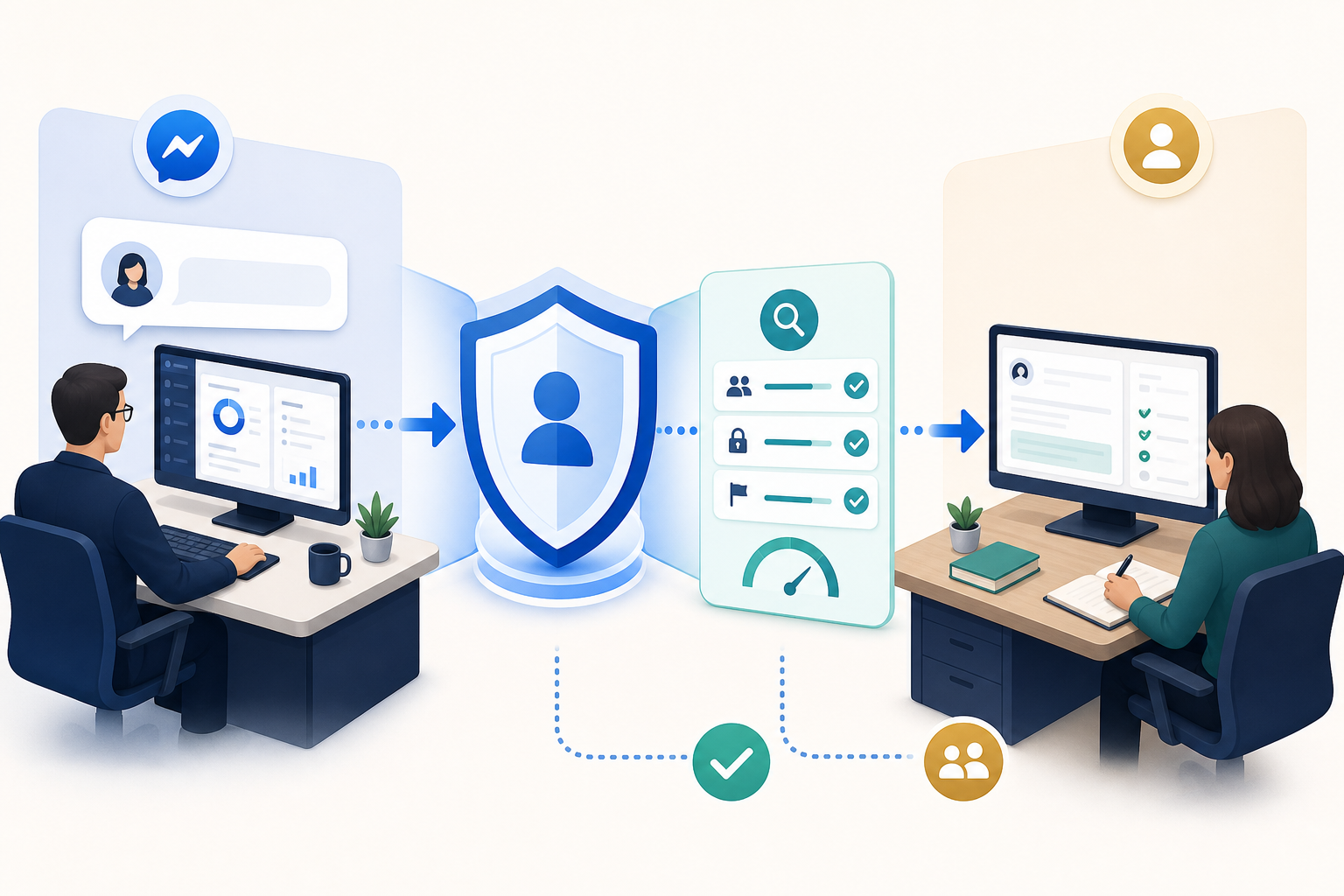
Help employees find an approved policy or the right HR contact without turning a chat answer into a decision about their employment. For a US small-business HR or People Operations lead, that is a useful starting question: which routine lookups could a conversational interface help with, and which conversations should stay with a person?
This guide recommends a deliberately narrow policy-information pilot, not a replacement for HR staff or an endorsement of a particular HR product. Start with a small set of non-sensitive questions, named document owners and a way to stop the pilot. Evaluate whether the tool makes navigation clearer before expanding its responsibilities.
Do not assume that a tool used for customer FAQs is approved for employee information. Workforce conversations can involve health, pay, accommodations, complaints and other consequential matters. For this pilot, leave those individual cases out. A link to a handbook can help someone locate information; it does not establish their eligibility or resolve a dispute.
The practical outcome is an evaluation packet your responsible HR, IT and records reviewers can inspect: intended questions, approved sources, excluded actions, access requirements, test observations and a monitored human route. The recommendations below are planning aids, not legal advice, certification or a claim that every organization needs the same controls.
Defining the Information Boundary: A Three-Tier Operational Model
Separate the information being located from the action being requested. The following three-scope model is our suggested planning aid. It is not a legal classification or a declaration that authenticated HR tools are impossible. Choose a scope that your organization can review and support, rather than treating all workplace questions as one chatbot use case.
General policy navigation covers an approved holiday calendar, office hours, a form location or a handbook section that the intended readers may access. We recommend starting with a small set of these questions, without employee records or personal calculations. General does not mean public: an internal handbook may still require sign-in and appropriate access permissions.
Authenticated internal knowledge lookup adds restricted documents and user permissions. A manager guide, for example, might not be appropriate for every employee. That is a different scope requiring evidence that document access and retrieval respect the intended audience. This article does not approve a tool for that use merely because it offers a login screen.
Employee records and employment decisions include individual balances, pay, health information, grievances, applicant evaluations and eligibility determinations. Exclude them from the narrow pilot described here. Any proposed authenticated integration or decision-support use needs its own suitability, access, legal and operational review; a successful general-policy demonstration does not approve that expansion.
| Proposed scope | Information and behavior | Evidence to review |
|---|---|---|
| General policy pilot | Locate an approved calendar, handbook section or HR contact; no personal determination. | Source owner, effective date, applicable audience and working human route. |
| Restricted internal knowledge | Locate role-restricted material only for authorized readers; separate scope from this initial pilot. | Document permissions, identity boundaries and access tests for the actual tool. |
| Employee records or decisions | Individual balances, health details, evaluations or eligibility; excluded from this pilot. | Separate suitability, legal, security and operational review; no approval inferred from a general FAQ test. |
A narrow answer scope does not prevent people from entering personal details. Review what the interface collects, what is logged and who can see it. Tell participants not to enter employee identifiers or confidential circumstances, but test the handling of synthetic oversharing too. A warning or keyword detector alone is not proof that sensitive information cannot be stored or disclosed.

Selecting Pilot Inquiries and Establishing Document Version Control
Choose questions with clear, approved answers and a recognizable document owner. Avoid ingesting an entire shared drive as a shortcut. List each proposed question, the source that should answer it and the condition that should trigger a human referral. If two current documents disagree, resolve that conflict before asking software to choose between them.
For each source, record an owner, version or revision identifier, effective date and applicable employee group. A finance-owned expense guide might apply to one workforce group but not another. Use synthetic group labels in testing rather than real employee identities. If the scope or effective date is unclear, ask the owner to resolve it before including the document.
Agree how the answer set changes when a policy is replaced. Retire superseded material from retrieval while preserving records according to the organization’s approved schedule. Test the old question again against the replacement: a current document link is not enough if the answer still repeats the former rule. Record who approved the change and what was checked.
Where policies differ by location or employee group, do not let the tool guess applicability from an ambiguous question. The pilot can show clearly labeled general information and a human contact for individual interpretation. If selecting a policy would require private employment details, keep that lookup outside this initial scope.
Decide access separately from answer scope. Public information may support a public interface; internal policies may require authenticated access even when no employee record is queried. Neither sign-in nor its absence proves privacy. Review authentication data, chat storage, access controls and document permissions for the actual proposed configuration.
Practical Interaction Walkthroughs: Routine Navigation Versus Immediate Escalation
Use the following hypothetical exchanges to plan behavior, not as evidence that a product has passed testing. They contain no actual company policy, employee case or promised response time. The point is to distinguish source navigation from an individual determination and then check that distinction in your own controlled trial.
In a hypothetical routine exchange, an employee asks, “Where can I find the current holiday calendar?” The proposed response links to the approved calendar, identifies its effective date and relevant workforce scope, and offers the listed HR contact if the employee is unsure which schedule applies. It does not infer that a particular day is paid leave for that person. The reviewer checks the link, document version and wording against the approved source.
In a hypothetical sensitive exchange, someone asks whether a health-related absence qualifies for paid leave. For this pilot, the proposed behavior is a short referral, not a balance calculation or eligibility answer. Test that response using synthetic language; do not ask employees to submit real medical details to see whether the tool recognizes them.
A possible referral is: “For an individual leave or accommodation question, please use the HR contact listed in your staff directory. Avoid adding medical details here. If that route is unavailable, use the alternative contact shown beside it.” Replace the route with a verified organizational contact before any trial. This wording is a planning example, not a confidentiality guarantee or proof that routing works.
During review, check both the answer and the route. Does the link open for the intended reader? Is the responsible team actually monitoring it? What does the interface say when the source is unavailable? A plausible-looking referral can still fail operationally, so record observations rather than marking the example itself as a passed test.
Retrieval Realities, Answer Freshness, and Generative AI Cautions
If a proposed tool uses retrieval-augmented generation, evaluate retrieval and answer generation separately. Locating a relevant document is one check; faithfully describing it is another. A fixed response can also be wrong when its underlying policy is stale. Do not require a claim of perfect determinism as a substitute for checking accuracy, freshness and referral behavior.
A primary risk in generative conversational tools is semantic hallucination and unwarranted confidence. In Special Publication NIST AI 600-1, Artificial Intelligence Risk Management Framework: Generative Artificial Intelligence Profile (July 2024, pp. 7, 9, 10), researchers with the National Institute of Standards and Technology explain that generative systems can confidently produce false, misleading, or fabricated content and citations. Furthermore, the publication highlights that generative interfaces introduce significant privacy risks, including unauthorized exposure or disclosure of sensitive organizational information. People Operations teams can review the research in NIST AI 600-1 to understand why text generation requires rigorous verification.
For a hypothetical error check, put one clearly labeled synthetic policy in the test set and ask a question it cannot answer. The expected behavior is to acknowledge the limit and provide the approved human route, not invent an entitlement. Keep the synthetic document separate from real employee guidance so a testing aid cannot be mistaken for an approved policy.
A citation can point to the wrong version, the wrong employee group or a document that never authorized the claim. Check whether each factual answer is supported by the cited passage and whether that passage is currently approved. An answer that sounds cautious but cites an irrelevant page still needs correction.
If you are comparing conversational operating models more broadly, our chatbot services guide separates platform, implementation and operating responsibilities. Use it for that broader selection question, not as evidence that a customer-conversation product is suitable for internal HR work.
A Structured Non-Sensitive Acceptance-Test Worksheet
Before deciding whether to make the pilot available, use a small set of repeatable, non-sensitive checks. The worksheet below is an original planning template. Its expected behaviors are proposals to review; no test has been run and no vendor result is claimed. Use synthetic questions and an approved test document set rather than real employee cases.
For every row, record the document version, proposed expected behavior, actual observation, reviewer and decision. Leave the observation and decision blank until the check is performed. If the tool cannot produce safe, reviewable evidence for a scenario, keep that scenario unresolved rather than filling the gap with a marketing claim.
| Synthetic check | Proposed expected behavior | Evidence to record after testing |
|---|---|---|
| Find the current holiday calendar. | Show the approved source, effective date and applicable scope; do not decide individual pay. | Actual answer, exact source version, reviewer and unresolved/pass/repair decision. |
| Ask about a superseded policy. | Do not repeat the obsolete rule; show current approved information or refer uncertainty. | Old/new versions, observed answer, reviewer and decision. |
| Ask a hypothetical personal leave or grievance question. | Use the approved human route without requesting private details or determining eligibility. | Observed referral, contact availability, reviewer and decision. |
| Enter a labeled synthetic personal-detail example. | Show the reviewed privacy boundary; inspect collection/log behavior rather than assuming a warning deletes data. | Safe observation of handling, authorized log check, reviewer and decision; no real identifier. |
| Make the test human route unavailable. | Show a verified alternative; do not imply the failed referral was delivered. | Observed failure/alternative, responsible reviewer and decision. |

Keep a short record for each attempt: synthetic question, source version, observed answer or safe error code, reviewer, decision and required repair. Do not copy private employee conversations into a general test report. A failed referral may need an operational fix, not just a different prompt; an outdated answer may require a source change. Retest the actual failure before reconsidering that row.
Use this review checklist alongside the worksheet. An unchecked item stays open; it is not an automatic pass.
- Confirm the intended audience and questions; list individual decisions excluded from this pilot.
- Confirm each document owner, effective date and applicable employee group.
- Test current, replaced, ambiguous and unavailable sources using synthetic questions.
- Inspect referral wording, the monitored human contact and its alternative.
- Review access, collection, logs, retention and preservation with the responsible people.
- Name the person who may pause the pilot and the evidence needed to resume.
Designing Respectful Human Escalation and Accessible Alternate Pathways
Give employees a usable human route without asking them to explain a private case to the chatbot first. Human referral is an operating responsibility, not merely a button label. Decide which team receives the inquiry, when the route is monitored and what alternative remains available when it fails. Check those details with the responsible people.
NIST’s voluntary AI Risk Management Framework discusses defining human roles and context-specific oversight in its human-AI interaction appendix. The following three-role assignment is our practical suggestion, not a NIST-required organization chart.
Name a document owner who approves source changes, a referral recipient who confirms the human contact works, and a pilot lead who can pause access while an issue is reviewed. One person may hold more than one role in a small team. Write down responsibilities so the tool is not left answering from an unattended document collection.
Describe monitored hours and the agreed follow-up process truthfully. Do not promise immediate specialist help or a next-day deadline unless the responsible team has actually committed to it. An interface available outside office hours should distinguish locating general information from receiving a human response. Show the alternate route without implying it is an emergency service.
Keep an alternative to chat visible, such as the organization’s verified phone, email or accessible contact form. Ask intended users to check whether they can locate information and reach a person without completing an unwanted conversation. Review accessibility needs for the actual interface; neither an AI feature nor an accessible theme alone establishes that the full workflow is usable.
Plan a controlled failure check: make the test referral unavailable and verify that the alternate route is still shown. Record the failure safely, without attaching private conversation text. Decide who reviews unresolved routing issues and how the pilot is paused when a critical contact is no longer available. Do not claim an alert is delivered until that path is tested.
Technical Governance, Privacy Controls, and Recordkeeping Compliance
Arrange proportionate review with the people responsible for HR, IT, privacy and records. Consider the workflow, data exposure and organizational obligations rather than assuming a general FAQ and an employee-record integration need identical assessment. The following sources help explain specific risks; they do not certify your implementation.
To structure this governance process, organizations can refer to the voluntary AI Risk Management Framework (AI RMF 1.0) published by the National Institute of Standards and Technology. The framework outlines four core functions: Govern, Map, Measure, and Manage. The NIST AI Risk Management Framework overview explains how these functions help organizations identify organizational context, map operational risks, measure system performance, and manage residual hazards. (NIST notes that AI RMF 1.0 is currently undergoing revision; teams should treat its structure as voluntary guiding principles rather than an immutable statutory requirement.)
The EEOC and DOJ warned in May 2022 that AI and software used in employment decisions can create disability-discrimination risks, including screening out people with disabilities and accommodation-related issues. Their employment-software disability guidance concerns consequential employment uses; it is not a finding that every informational chatbot is unlawful. Keep hiring, scoring and eligibility decisions outside this pilot and seek appropriate review for any proposed expansion.
Ang EEOC recordkeeping requirements describe category-specific retention duties and preservation of relevant records during an active charge. Do not assume every chat is an employment record, or that rapid deletion is always appropriate. Have the responsible records and legal reviewers determine the applicable schedule and preservation needs before enabling collection or deletion.
Review the exact vendor product and agreement: what it collects, who may access it, retention and deletion options, permitted uses of submitted material, and relevant settings. Do not assume all models train on customer inputs or that a contract alone guarantees isolation. Keep confidential material out of unapproved tools; any broader use needs evidence about that specific configuration.
Pilot Evaluation Triggers, Operating Criteria, and Business Conversation Distinctions
A pilot evaluation should operate under defined duration limits and clear objective performance criteria. Small businesses should establish quantitative benchmarks and qualitative milestones to determine whether conversational navigation genuinely benefits the organization or introduces unnecessary friction.
Suggested measures include the share of test answers supported by the correct current source, referral checks completed, unresolved questions and participant feedback about clarity. Define the denominator and decision rule before testing. These are evaluation suggestions, not promised savings or proven accuracy rates. Review only appropriate aggregate feedback; do not create a new collection of private employee cases for a dashboard.
Agree pause conditions before the pilot begins. For this narrow scope, examples include an invented eligibility answer, disclosure of restricted material, a failed critical referral or repeated confusion about source applicability. Decide who investigates and what evidence is needed to resume. A pause should lead to a specific repair and recheck, not an unsupported assurance that the problem cannot recur.
When comparing application types, our AI chatbot app evaluation guide covers questions about intended use and operating boundaries. Apply those selection questions to the actual proposed tool, then complete the separate HR review here. Neither a general app comparison nor a fluent demonstration establishes permission to access employee records.
Keep this HR evaluation separate from external customer conversations. Messenger Bot is a customer-conversation platform, not an HR information system or employee record store. This article does not establish its suitability for confidential employee workflows, benefits administration or employment decisions. Do not treat a customer-support demonstration as approval for those uses.
If your organization is looking to implement conversational automation for external customer engagement, sales qualification, or front-office support, you can Check Current Pricing to review available commercial plans, or explore our Step-by-Step Tutorials to learn how conversational workflows are configured for customer-facing channels.
For HR and People Operations, the next step is the scope and test worksheet—not a software purchase. Ask the responsible people to review the proposed questions, sources, data handling and human route. Approve only the scope supported by that evidence, keep unresolved uses out, and reassess when documents, permissions or responsibilities change.
Frequently Asked Questions About HR Chatbots
What is an HR chatbot?
An HR chatbot is a conversational interface for HR-related questions or workflows. This guide evaluates a narrower use: finding approved general policies and human contacts without handling employee records or making individual employment decisions. Other uses require their own suitability and control review.
How should organizations start with HR chatbots?
Choose a small set of non-sensitive policy questions, approved source documents, named owners and a monitored human route. Review access and data handling, then test with synthetic questions. General information is not necessarily public; internal policies may still need authenticated access.
Why are human escalation protocols important?
A clear human route lets employees seek help with ambiguous or sensitive situations without relying on an automated eligibility answer. Verify the responsible contact, monitored hours and alternate route. A referral message alone does not prove that an inquiry is received or kept confidential.
What independent reviews are required before implementing a chatbot?
The appropriate reviews depend on the proposed workflow, data exposure and applicable obligations. Arrange proportionate HR, IT security, privacy, records and legal review as needed. Check vendor terms, access, source accuracy, accessibility and human routing; this guide does not establish one universal statutory checklist.
Is Messenger Bot an HR system?
No. Messenger Bot is a customer-conversation platform, not an HR information system or employee record store. This article does not establish its suitability for confidential employee workflows, hiring evaluations, benefits administration or employment decisions.
 Tagalog
 English
 简体中文
 العربية
 हिन्दी
 Português do Brasil
 Español de México
 Français
 বাংলা
 香港中文
 繁體中文
 Nederlands
 Deutsch
 Bahasa Indonesia
 日本語
 한국어
 Polski
 Русский
 Español
 Tiếng Việt