
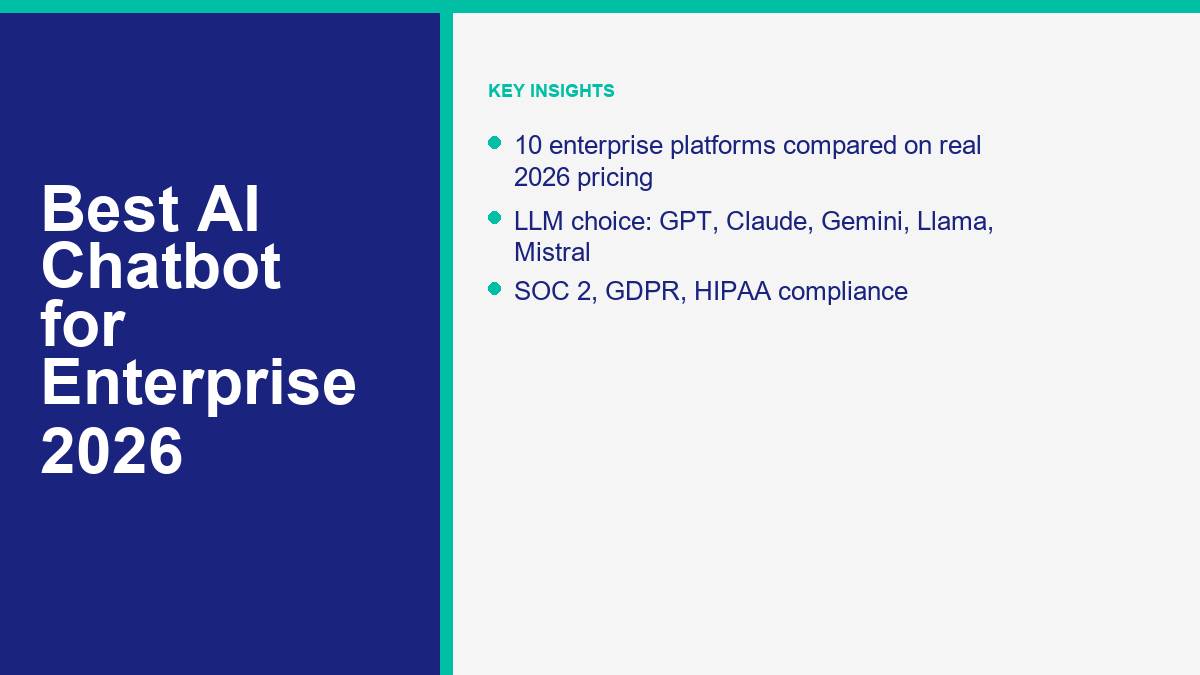
Chọn chatbot AI tốt nhất cho doanh nghiệp năm 2026 không chỉ đơn thuần là tìm kiếm bản demo thông minh nhất. Mà là tìm kiếm sản phẩm mà đội ngũ bảo mật của bạn sẽ phê duyệt, đội ngũ mua sắm của bạn có thể mô hình hóa, đội ngũ vận hành của bạn có thể triển khai, và các đội ngũ tuyến đầu vẫn sẽ tin tưởng sau khi trường hợp xấu đầu tiên xảy ra trong sản xuất.
Tôi đã xem xét các trang giá chính thức, tài liệu sản phẩm, và tài liệu về quyền riêng tư hoặc sự tin cậy cho các nền tảng dưới đây tính đến ngày 11 tháng 4 năm 2026. Ngày tháng đó quan trọng vì giá chatbot doanh nghiệp đang thay đổi nhanh chóng ngay bây giờ. Một số nhà cung cấp tính giá theo ghế, một số theo cuộc trò chuyện, một số theo kết quả AI, một số theo tín dụng, và một số vẫn giấu số thực sau một cuộc gọi bán hàng. Một kiểm tra thực tế nhanh trước khi chúng ta vào xếp hạng: không có chatbot AI doanh nghiệp nào nghiêm túc thực sự không cần đăng ký. Khoảnh khắc SSO, RBAC, nhật ký kiểm toán, giữ dữ liệu, và quyền truy cập quy trình làm việc trở nên quan trọng, danh tính là một phần của sản phẩm.
Nếu bạn muốn bản đồ thị trường rộng hơn trước khi rút gọn danh sách nhà cung cấp, hãy bắt đầu với trụ cột AI hội thoại doanh nghiệp. Bài viết này hẹp hơn và thực tế hơn. Nó được viết cho các người mua doanh nghiệp ở Mỹ và Vương quốc Anh, những người cần so sánh sự phù hợp thực tế của nền tảng, cơ chế giá thực tế, các tùy chọn mô hình, tư thế tuân thủ, độ sâu tích hợp, và tốc độ triển khai.
Ý Nghĩa Thực Sự Của Chatbot AI Doanh Nghiệp Năm 2026 (Không Chỉ Là Giá Cả Cao Hơn)
Sai lầm lớn nhất mà tôi vẫn thấy trong các đánh giá doanh nghiệp là coi chatbot doanh nghiệp như một chatbot SMB với hóa đơn lớn hơn. Điều đó không còn đúng với ý nghĩa của danh mục nữa. Một chatbot thực sự nền tảng chatbot doanh nghiệp vào năm 2026 cần phải làm nhiều hơn là chỉ trả lời các câu hỏi thường gặp. Nó cần xác thực người dùng, thực thi ranh giới vai trò, truy xuất từ kiến thức được quản lý, thực hiện hành động trong các hệ thống kinh doanh, ghi lại những gì đã xảy ra, và thất bại an toàn khi mô hình nên ngừng nói.
Đây là phần mà hầu hết người mua học muộn: mô hình ngôn ngữ hiếm khi là phần khó nhất. Danh tính, ranh giới dữ liệu, quy trình phê duyệt, dọn dẹp kiến thức, và kiểm tra hồi quy là những phần khó khăn. Một bot có thể soạn thảo một câu trả lời đẹp nhưng không thể chứng minh câu trả lời đó đến từ đâu, khi nào nó nên chuyển giao, hoặc hành động hệ thống nào mà nó vừa kích hoạt không phải là sẵn sàng cho doanh nghiệp. Nó chỉ là một bản demo đắt tiền.
Trong thực tế, tôi sử dụng năm bộ lọc để quyết định xem một nền tảng có xứng đáng với nhãn hiệu chatbot ai doanh nghiệp:
- Quản trị: SSO, SAML, SCIM, RBAC, nhật ký kiểm toán, tách biệt môi trường, và kiểm soát quản trị phải có.
- Độ sâu hành động: Chatbot không nên dừng lại ở việc trả lời. Nó nên tạo vé, cập nhật hồ sơ CRM, kiểm tra trạng thái đơn hàng, kích hoạt quy trình làm việc, hoặc phân loại các trường hợp với ngữ cảnh.
- Chiến lược mô hình: Bạn cần biết liệu nền tảng có bị khóa vào một LLM, cho phép bạn mang mô hình của riêng mình, hoặc có thể định tuyến các nhiệm vụ khác nhau đến các mô hình khác nhau.
- Kiểm soát quyền riêng tư: Giữ lại, xóa, cư trú, DPA, BAA, khả năng nhìn thấy của nhà thầu phụ, và hành vi cơ sở quan trọng hơn cả tài liệu bán hàng.
- Operational predictability: Procurement needs a pricing model that can survive a real monthly volume spike without turning into a board-level surprise.
That is why this article stays separate from small-business chatbot roundups. A large enterprise does not buy for the same reason a local clinic, SaaS startup, or ecommerce brand buys. The enterprise buyer is usually solving for one of four problems: support deflection at scale, employee self-service, CRM-guided revenue conversations, or regulated knowledge access with auditability. Those are different jobs, with different risks, and they break in different ways.
It also changes what “best” means. For a large business, the best chatbot might not be the one with the strongest model quality in a vacuum. It might be the one whose integration model is boring enough to survive procurement, legal, identity, and security review without six extra months of friction. Boring is underrated in enterprise software. Boring ships.
| Enterprise requirement | What a serious buyer should expect | What weak platforms usually offer instead |
|---|---|---|
| Identity and access | SAML SSO, SCIM, RBAC, environment controls, audit logs | Email login plus broad admin rights |
| Căn cứ kiến thức | Nguồn có phạm vi, hành vi trích dẫn, kiểm soát độ mới, quy tắc dự phòng | Lấy dữ liệu từ website một lần và hy vọng |
| Hành động của hệ thống | Tạo, cập nhật và định tuyến công việc trong CRM, ITSM, HR và các hệ thống hỗ trợ | Hỗ trợ webhook ẩn sau ngôn ngữ “tích hợp bản địa” |
| Tuân thủ | DPA, danh sách nhà xử lý phụ, kiểm soát lưu giữ, đường dẫn BAA khi có liên quan | Trang doanh nghiệp chung không có chi tiết hợp đồng |
| Giá cả | Toán học minh bạch về số ghế, sử dụng hoặc kết quả mà bạn có thể mô hình hóa | Báo giá tùy chỉnh trước, giải thích sau |
That last row is why this comparison weights pricing transparency so heavily. If a vendor cannot give you enough public detail to sketch a first-pass budget, it should not be your default shortlist. It may still deserve an RFP. It just should not be your starting point.
The 10 Platforms Worth Evaluating for Enterprise in 2026
This ranking is weighted for enterprise buyers who care about public pricing clarity, support or workflow scale, security posture, and deployment realism. I deliberately favored platforms that publish enough detail for finance and procurement to do basic math without booking a demo first. Quote-only players like Ada, Cognigy, Kore.ai, Moveworks, and ServiceNow can absolutely belong in enterprise RFPs, but they do not fit a “real pricing” shortlist nearly as cleanly.
| Xếp hạng | Nền tảng | Public 2026 pricing signal | LLM approach | Phù hợp nhất | Procurement read |
|---|---|---|---|---|---|
| 1 | Zendesk | Suite + Copilot Professional $155/agent/month annually; Enterprise $209/agent/month; Advanced AI agents via sales | Zendesk AI inside the service stack | Support-led enterprises already standardized on Zendesk | Best default shortlist entry if customer service is the core use case |
| 2 | Intercom | Essential $29, Advanced $85, Expert $132 per seat monthly billed annually, plus Fin at $0.99 per outcome | Intercom Fin AI Agent on Intercom or external help desks | Digital-first support teams that want clear outcome pricing | Excellent transparency, but volume can push yearly cost into six figures fast |
| 3 | Salesforce Agentforce | $2 per conversation, $500 per 100k Flex Credits, $5 user license, $125 per-user add-ons, Agentforce 1 from $550/user/month | Agentforce on Salesforce data and workflows | CRM-heavy enterprises where the bot must take action, not just chat | Strongest action layer if your business already lives in Salesforce |
| 4 | Microsoft Copilot Studio | $200 per 25,000 Copilot Credits per month; Microsoft 365 Copilot $30/user/month for internal use | Copilot agents across Microsoft 365, Power Platform, and Azure | Employee self-service and Microsoft-heavy enterprise environments | Procurement-friendly if you already have Microsoft licensing muscle |
| 5 | Google Conversational Agents | Flows $0.007 per request, Playbooks $0.012 per request, voice $0.001 to $0.002 per second | Google Cloud deterministic plus generative agents | Global voice and chat self-service with strong cloud engineering support | Very flexible, but ownership shifts toward cloud and platform teams |
| 6 | Amazon Lex | $0.00075 per text request and $0.004 per speech request | AWS-native bot builder with AWS service integrations | AWS shops that want low raw usage pricing and engineering control | Cheap meter, expensive only when your implementation discipline is weak |
| 7 | Botpress | Plus $79 annually or $89 monthly, Team $445 annually or $495 monthly, Managed $1,245 annually or $1,495 monthly, plus AI spend | Bring-your-own model economics with platform controls | Teams that want builder flexibility and tighter model cost visibility | Strong technical option when help-desk-native suites feel too closed |
| 8 | Freshchat | Growth $19, Pro $49, Enterprise $79 per agent monthly billed annually; Freddy AI first 500 sessions included then $49 per 100 sessions | Freshworks AI inside an omnichannel support stack | Large teams that want serious support operations without Intercom pricing | Best value pick for buyers that want enterprise features without enterprise theater |
| 9 | Tidio | Growth starts at $49.17/month; Plus starts at $749/month; custom above published quotas | Lyro AI Agent with standalone or help-desk-adjacent deployments | Mid-market and enterprise-lite teams that need a fast web support rollout | Good bridge platform, weaker for very deep governance-heavy programs |
| 10 | MessengerBot.app | Premium $19.99 per 30 days, Pro $49.99 per 30 days, Agency $299.99 per 30 days | Channel-first automation with integrations, forms, and visual flows | Enterprises where Facebook Messenger and Instagram are real revenue or support channels | Not a full enterprise help desk, but unusually cost-effective for Meta-first deployments |
Zendesk Is the Best Default Starting Point for Support-Led Enterprises
Zendesk takes the top spot because it is the cleanest enterprise support shortlist entry with transparent base pricing. The current pricing page shows Suite + Copilot Professional at $155 per agent per month billed annually and Enterprise at $209 per agent per month, with Advanced AI agents sold separately through sales (giá của Zendesk). That is not cheap, but it is honest enough to model. Zendesk also benefits from category fit. If your enterprise chatbot is really a customer service automation program, not an internal AI experiment, Zendesk starts from the right system of record.
Intercom Has the Cleanest Outcome Pricing If Digital Support Is Your KPI
Intercom is the easiest platform here to defend in a finance meeting because the math is unusually explicit. The current pricing page shows $29, $85, và $132 per full seat for Essential, Advanced, and Expert when billed annually, plus $0.99 cho kết quả tài chính across plans (giá Intercom). Intercom also states that Fin can run on Zendesk, Salesforce, HubSpot, Freshworks, and other help desks. The catch is obvious: if Fin resolves a lot, the bill grows quickly. That is still a rational trade if resolution quality is strong. It just stops being a bargain the moment volume gets real.
Salesforce Agentforce Belongs on the Shortlist When CRM Actions Matter More Than Chat Alone
Salesforce is not the cheapest option, but it is one of the strongest when the chatbot has to do work inside the CRM, not just answer questions. Agentforce pricing is now public enough to be useful: $2 per conversation, $500 per 100k Flex Credits, một $5 user license for employee access with Flex Credits, $125 per-user add-ons for Sales and Service, and Agentforce 1 editions starting from $550 per user per month (Salesforce Agentforce pricing). If your enterprise already lives in Service Cloud and Sales Cloud, that action depth can outweigh the higher bill.
Microsoft Copilot Studio Wins Internal Rollouts in Microsoft-Heavy Organizations
Copilot Studio is the best fit here for employee self-service, internal assistants, and teams already invested in Microsoft 365, Power Platform, and Azure. Microsoft currently sells Copilot Studio capacity in 25,000-credit packs at $200 per month, and Microsoft 365 Copilot sits at $30 per user per month for internal use cases (Microsoft Copilot Studio pricing). The main planning issue is that credits do not map as neatly to customer conversations as Intercom or Salesforce pricing does. Still, for internal IT, HR, policy search, and workflow automation inside Microsoft estates, it is one of the safest enterprise bets.
Google Conversational Agents Makes the Most Sense for GCP Teams and Voice-Heavy Programs
Google’s current pricing is refreshingly direct: Flows are $0.007 per request, Playbooks are $0.012 per request, and voice pricing runs at $0.001 to $0.002 per second depending on agent type, with extra storage charges after the free index allowance (Google Conversational Agents pricing). If your enterprise has strong GCP skills, multilingual traffic, or serious voice automation plans, Google belongs high on the list. If you want a turnkey support suite with low platform ownership, it probably should not be your first pick.
Amazon Lex Still Offers the Cheapest Raw Usage Meter for AWS-Native Builders
Amazon Lex remains a classic enterprise engineering answer: not the prettiest option, but one of the cheapest raw meters. AWS prices text requests at $0.00075 each and speech requests at $0.004 each (Amazon Lex pricing). That is why Lex stays relevant. At scale, the software meter is rarely the scary part. The scary part is whether your team can own the orchestration, testing, observability, and integrations around it. If the answer is yes, Lex can be extremely cost-effective. If the answer is no, a higher-priced managed platform often ends up cheaper in real life.
Botpress Is the Model-Flexible Builder for Teams That Want More Control
Botpress is worth evaluating when the help-desk-native products feel too closed and the cloud-builder products feel too bare. The pricing page is surprisingly candid: Plus is $79 billed annually hoặc $89 monthly, Team is $445 annually hoặc $495 monthly, Managed is $1,245 annually hoặc $1,495 monthly, and AI spend is passed through at provider cost without markup (giá cả của Botpress). Botpress also exposes role-based access control on Team and higher. That combination makes it a strong option for technically capable enterprise teams that want more say in model economics and orchestration.
Freshchat Delivers the Best Enterprise-Adjacent Value per Dollar
Freshchat earns a spot because a lot of enterprises do not actually need the most famous name in the category. They need omnichannel support, routing, security features, and an AI layer that procurement can forecast. Freshchat Enterprise is $79 per agent per month billed annually, and Freshworks states that the first 500 Freddy AI sessions are included before usage moves to $49 cho mỗi 100 phiên (Freshchat pricing). That does not make it a budget toy. It makes it a rational alternative for larger teams that want enterprise coverage without immediately stepping into Intercom or Zendesk pricing territory.
Tidio Is the Fastest Bridge Between SMB Tools and Enterprise-Lite Governance
Tidio is not a classic large-enterprise platform, but it deserves inclusion because a lot of enterprise divisions, regional business units, and digital teams still buy this way: quick rollout, modest admin overhead, and enough governance to get through review. Tidio’s published pricing currently shows Growth from $49.17 mỗi tháng and Plus from $749 per month, with custom quotas above the published Lyro limits and more than 1,000 monthly AI conversations requiring a custom plan (Giá Tidio). If you need deep ITSM or HR workflow control, look elsewhere. If you need a fast web support deployment that still offers roles, permissions, and sales support, Tidio is a credible bridge product.
MessengerBot.app Fits Enterprises That Actually Care About Meta Channels
MessengerBot is not trying to replace ServiceNow, Zendesk, or Intercom across the whole enterprise. That is exactly why it belongs on this list for a specific buyer. If your enterprise lead capture, post-purchase support, or regional service operation genuinely runs through Facebook Messenger and Instagram, the public pricing is refreshingly clear: Premium is $19.99 mỗi 30 ngày, Pro is $49.99 mỗi 30 ngày, and Agency is $299.99 per 30 days, with the product page listing visual flows, forms, website chat, Google Sheets, JSON API, Zapier, email, SMS, and Instagram features (Xem giá cả của MessengerBot). That does not make it the best enterprise-wide platform. It makes it one of the cheapest serious options for enterprise Meta-channel automation.
LLM Options: Choosing Between GPT, Claude, Gemini, Llama, Mistral at Enterprise Scale
Procurement teams sometimes ask the wrong question here. They ask, “Which LLM is best?” The more useful question is, “Which LLM family is best for this workflow, this risk profile, this data boundary, and this integration stack?” Enterprise chatbot quality is not decided by model prestige alone. It is decided by how the model behaves with your retrieval layer, how well it calls tools, how much control you get over retention and routing, and whether the platform lets you change models without rebuilding the whole system.
If you want the broader consumer-versus-business view of this market, the chatbot platform comparison is the better companion piece. This section stays focused on enterprise deployment logic.
| Model family | Where it usually wins | Where procurement should be cautious | Best enterprise fit |
|---|---|---|---|
| GPT | Tool calling, broad ecosystem support, strong general-purpose reasoning, action-heavy workflows | Need precise retention, grounding, and model-change governance | Support bots and enterprise assistants that must take actions reliably |
| Claude | Long documents, policy-heavy analysis, careful writing, nuanced internal knowledge tasks | Feature availability and retention rules vary by product path | Enterprise policy, knowledge, and document-centric assistants |
| Song Tử | Google Workspace and Vertex AI environments, search and multimodal workflows | Grounding and prompt-logging settings need close review | Google-native enterprises and multilingual cloud-first deployments |
| Llama | Open-weight deployment, private VPC or on-prem use, cost control at scale | You own more of the tuning, evals, and safety stack | Highly regulated or sovereignty-sensitive programs |
| Mistral | Efficient inference, European buyer comfort, open-model flexibility | Enterprise ecosystem depth is still thinner than GPT or Microsoft stacks | Cost-sensitive RAG and private deployment projects |
My practical read is simple. GPT is still the safest default when the chatbot must use tools well, hand off cleanly, and work across a lot of business tasks. Claude remains excellent when the enterprise workload is document-heavy, policy-heavy, or nuance-heavy. Song Tử becomes more attractive when your data, permissions, and workflows already sit inside Google Cloud and Workspace. Llama và Mistral matter most when data control, model portability, or self-hosting matter more than squeezing out the last bit of frontier-model polish.
The procurement question that matters most is not “Can this platform use multiple LLMs?” It is “How hard is it to change models later?” If the answer requires reauthoring flows, retraining prompts, rebuilding tool schemas, and re-approving every compliance control, you do not really have model flexibility. You have slide-deck flexibility.
For large businesses, the strongest setup is often hybrid. Use a higher-performing closed model for externally facing support and action flows where reliability matters most. Use open-weight models for low-risk internal search, private data zones, or regional deployments where sovereignty and cost control dominate. The platform that lets you do that without turning your architecture into spaghetti is usually the better long-term buy.
Enterprise Security and Compliance: SOC 2, GDPR, HIPAA Checklist
Security review is where weak shortlist decisions get exposed. SOC 2 is table stakes. It is not proof that a chatbot is ready for PHI, employee records, or regulated customer data. GDPR is not a badge you inherit by buying an “enterprise plan.” HIPAA is not a marketing bullet. It is a contract, a deployment design, a set of configuration choices, and a lot of operational discipline.
Use this checklist before you let procurement move forward:
- Get the actual security package: SOC 2 report, penetration-testing summary, subprocessor list, and security whitepaper if available.
- Check identity properly: SAML SSO, SCIM, RBAC, session control, and audit trails should be available without awkward workarounds.
- Map data flow: what data goes into prompts, what is stored in transcripts, what is cached, and where each copy lives.
- Confirm retention controls: default retention is not enough. Ask what admins can configure, what APIs support deletion, and what remains in logs.
- Review grounding behavior: web search, external search, and knowledge connectors can change your compliance posture fast.
- Verify DPA and international transfer terms: UK and EU buyers should not skip this just because the workload is “only support chat.”
- For HIPAA, ask about the BAA first: if there is no BAA path, stop pretending the deployment is healthcare-ready.
- Check feature carve-outs: some features are excluded from HIPAA or zero-retention configurations even when the base platform is eligible.
- Demand action controls: if the chatbot can trigger refunds, tickets, approvals, or account changes, you need authorization and rollback rules.
- Require evaluation logs: security is not just data security. It is also answer quality, escalation behavior, and refusal behavior.
Some vendor pages are unusually helpful here. Intercom’s Expert plan explicitly lists SSO & identity management và hỗ trợ HIPAA on the public pricing page (giá Intercom). Tidio’s public security page states that it has completed a SOC 2 examination and describes itself as GDPR and CCPA compliant, but it does không publish a HIPAA claim on that page (Tidio security). That kind of asymmetry is common, and procurement should treat it as signal, not noise.
The HIPAA detail that trips teams up most often is feature scope. Anthropic’s current privacy documentation says some enterprise API customers can get zero data retention on eligible APIs, but it also states that its BAA applies only to HIPAA-eligible services and that the BAA would không apply to web search functionality (Anthropic zero data retention and BAA guidance). That is the kind of detail that belongs in your design review before anyone says the word “launch.”
A simple rule helps here: if the chatbot touches customer identity, health data, financial data, employee data, or regulated case history, buy like an auditor will read the deployment later. Because eventually someone will.
Data Privacy and Zero-Retention Deployment Options in 2026
Zero retention is one of the most abused phrases in enterprise AI. Vendors use it loosely, buyers hear what they want to hear, and then the real deployment still logs prompts in a feature nobody remembered to disable. In 2026, the better way to think about privacy is by deployment pattern, not by marketing slogan.
There are four main privacy patterns on the market right now:
- Standard vendor SaaS: fastest to launch, easiest to operate, but usually includes some level of logging, retention, or feature-specific storage.
- Enterprise SaaS with stronger controls: better admin retention settings, stronger identity, better contracts, but still vendor-managed.
- API-first deployment with modified retention: you use a model through an enterprise API path and layer your own app, retrieval, and guardrails around it.
- Private or self-hosted open-weight deployment: highest control, highest operational burden, strongest fit for residency or sovereignty requirements.
OpenAI’s enterprise privacy page says it does not train models on business data by default, that enterprise customers control retention in products like ChatGPT Enterprise, and that enterprise security includes SAML SSO and SOC 2 controls (OpenAI enterprise privacy). That is useful, but it is not the same thing as saying every workflow is zero retention. For high-sensitivity deployments, you still need to confirm the exact product path, retention setting, and feature scope.
Anthropic is more explicit about zero-retention scope. Its privacy center says zero data retention applies only to eligible Anthropic APIs and Anthropic products using your commercial organization API key, not to every commercial surface by default (Anthropic zero data retention guidance). That is the kind of sentence procurement teams should love, because it is concrete.
Microsoft’s Azure documentation is also direct. Its current Azure Direct Models privacy documentation says prompts, completions, embeddings, and training data are not available to other customers, not available to OpenAI or other model providers, và not used to train generative AI foundation models without your permission. Microsoft also documents an approval path to modify abuse monitoring for managed customers (Azure Direct Models data privacy). For enterprises already inside Azure, that is a strong privacy story.
Google’s Vertex AI documentation gives a more nuanced picture, which I appreciate because it reads like real engineering. Google states that it will not use customer data to train or fine-tune AI or ML models without prior permission, but it also explains where retention still appears by default and what you must change to achieve zero retention. As of the April 8, 2026 update, Google notes that prompt logging for abuse monitoring may apply, that grounding with Google Search stores prompts and outputs for 30 days, and that caching is enabled by default unless you disable it at the project level (Vertex AI zero data retention guidance). That is exactly how enterprise documentation should read: specific, not magical.
As of April 11, 2026, the cleanest zero-retention posture still comes from one of two patterns: an enterprise API path with explicit retention controls and feature restrictions, or a private deployment of open-weight models such as Llama or Mistral in your own cloud or on-prem environment. The tradeoff is operational. Every privacy gain shifts more work onto your platform, MLOps, and application teams. That is fine if the risk warrants it. It is overkill if the chatbot is only answering low-risk public FAQs.
The practical buying rule is this: if your vendor cannot explain retention at the feature level, not just the account-plan level, keep them out of your final round.
Integration Depth: Salesforce, Zendesk, ServiceNow, Workday Real-World Testing
Integration depth is where a lot of enterprise chatbot demos fall apart. On the website, every vendor “integrates” with Salesforce, Zendesk, ServiceNow, and Workday. In production, that can mean anything from full read-write action execution to a one-way webhook and a smile. When I score an nền tảng chatbot doanh nghiệp, I use four integration tests:
- Read: can the bot access the right record or article at runtime?
- Write: can it create or update the right object, case, ticket, or workflow action?
- Respect permissions: does it inherit role boundaries and approval logic?
- Audit: can you prove what it saw, what it changed, and what human approved the action?
| Hệ thống | What strong integration looks like | What weak integration usually means | Platforms that tend to fit best |
|---|---|---|---|
| Salesforce | Read and write to cases, accounts, orders, knowledge, and custom objects with policy-aware actions | Lead capture only, contact sync only, or one-way ticket creation | Salesforce Agentforce first, then Intercom on Salesforce-heavy support stacks |
| Zendesk | Ticket read-write, macro usage, article grounding, escalations, status updates, and agent handoff context | Import articles once and call it a Zendesk integration | Zendesk itself, Intercom Fin on Zendesk, Tidio for lighter article import use cases |
| ServiceNow | Incident, request, HR case, catalog, and workflow execution with entitlements | Notification hooks or basic case creation only | Microsoft and Salesforce ecosystems usually connect cleanest; others often need middleware |
| Workday | Scoped read access plus approved workflow actions for HR, onboarding, or policy use cases | Policy FAQ lookup dressed up as transactional integration | Copilot Studio and custom cloud builders are usually safer than generic chatbot claims |
Salesforce is the easiest to read. If your vendor already sits on Salesforce data and workflow primitives, you can get real business actions. If the platform is external to Salesforce, ask exactly which objects, which actions, which approvals, and which custom-object patterns are supported before you get impressed by the demo.
Zendesk is usually more mature on support depth than buyers expect. Ticketing, help center content, macros, routing, and agent context are all known patterns there. That is one reason Zendesk and Intercom both score well. Intercom even states publicly that Fin can run on Zendesk and Salesforce in addition to Intercom itself (Intercom pricing and integration FAQ).
ServiceNow and Workday are where sloppy vendor language gets expensive. When a chatbot vendor says “native Workday integration,” ask a rude follow-up question: does it only search policies, or can it actually perform a governed action with the right approval and audit chain? If the answer gets fuzzy, assume you are buying custom work.
If your current mandate is narrower than this and mostly about reducing repetitive customer contacts, the chatbot dịch vụ khách hàng AI guide is the more operational companion. Enterprise integration planning is a different layer of work.
Enterprise Deployment Timelines: What 90-Day Rollouts Actually Look Like
Most enterprise vendors will happily imply you can go live in days. Technically, you can. Practically, you usually should not. A 90-day rollout is still the realistic planning frame for a governed enterprise launch unless the project is very narrow, such as a single FAQ bot on one public page with no system actions.
| Window | What should happen | What usually causes delays |
|---|---|---|
| Days 1-15 | Use-case scope, success metrics, security review kickoff, data-flow mapping, vendor selection | Trying to solve five departments at once |
| Days 16-30 | Knowledge cleanup, SSO and access setup, connector design, evaluation set creation | Messy source content and unclear record ownership |
| Days 31-60 | Pilot build, action testing, escalation rules, red-team prompts, legal and privacy signoff | Integration edge cases and missing approval logic |
| Days 61-90 | Controlled production launch, agent training, analytics, tuning, expansion plan | No one owns ongoing evaluation after go-live |
The fastest enterprise rollouts share the same pattern. They start with one measurable use case, one owned knowledge source, one defined escalation rule, and one operations team that actually wants the bot. They do not start with “AI transformation.” That phrase kills more chatbot projects than bad models do.
Here is the rollout sequence I trust most:
- Pick one queue first. Product support, order status, IT help, benefits questions, or appointment routing. Not all of them.
- Build an evaluation set before launch. If you cannot test the bot against real intents, you are not managing risk. You are hoping.
- Add one action path carefully. Ticket creation, order lookup, password reset, or appointment rescheduling. One meaningful action proves value fast.
- Train human handoff behavior early. Bad handoffs create more resentment than bad first answers.
- Review weekly for the first month. Resolution rate, fallback rate, escalation reasons, hallucination cases, and high-risk prompts should all have owners.
For enterprise buyers, a “30-day rollout” should usually be read as a pilot, not a complete production program. Ninety days is a more honest planning frame for a chatbot that touches real systems, real customer records, or regulated content.
Real 2026 Enterprise Pricing Tiers (With Ballpark Dollar Figures)
This is the section most buyers skip too quickly. Public pricing is not the same thing as total cost, but it is still the cleanest starting point. The figures below use live public pricing tính đến ngày 11 tháng 4 năm 2026. Where I model yearly cost, I am only modeling the software meter or seat floor, not implementation, change management, or internal labor. If you want the broader ladder from SMB to enterprise budgets, the phân tích giá chatbot is the next page to read.
| Nền tảng | Published meter | Simple planning math | What that usually means in budget terms |
|---|---|---|---|
| Zendesk | $155 or $209 per agent/month annually | 25 Enterprise seats = $5,225/month | About $62,700/year before Advanced AI agent add-ons and privacy add-ons |
| Intercom | $29, $85, or $132 per seat/month annually plus $0.99 per Fin outcome | 25 Advanced seats = $2,125/month; 10,000 Fin outcomes/month = $9,900/month extra | Base software can look moderate, but real AI-heavy programs can cross $140,000/year quickly |
| Salesforce Agentforce | $2 per conversation or $500 per 100k Flex Credits | 10,000 conversations/month = $20,000/month | About $240,000/year for customer-facing conversation volume before broader Salesforce spend |
| Microsoft Copilot Studio | $200 per 25,000 Copilot Credits/month | 100,000 credits/month = $800/month | About $9,600/year for a modest pilot before Azure services and implementation |
| Google Conversational Agents | $0.007 Flow request, $0.012 Playbook request, $5/GiB over included storage | 100,000 Flow requests/month = $700/month; 100,000 Playbook requests/month = $1,200/month | About $8,400 to $14,400/year before voice, storage overages, and engineering costs |
| Amazon Lex | $0.00075 per text request; $0.004 per speech request | 100,000 text requests/month = $75/month; 100,000 speech requests/month = $400/month | Raw meter is cheap; architecture and ops usually dominate total spend |
| Botpress | Team $445 annually or $495 monthly; Managed $1,245 annually or $1,495 monthly; plus AI spend | Team annual floor = $5,340/year; Managed annual floor = $14,940/year | Reasonable platform cost, but token usage and integration work decide real total |
| Freshchat | $79 per Enterprise agent/month annually; Freddy AI first 500 sessions included then $49 per 100 sessions | 25 Enterprise seats = $1,975/month; extra 1,000 Freddy sessions = $490/month | About $23,700/year base, then roughly $5,880/year per extra 1,000 AI sessions each month |
| Tidio | Plus starts at $749/month; custom quotas above published limits | Plus floor = $749/month | About $8,988/year before higher Lyro quotas and custom enterprise services |
| MessengerBot.app | Premium $199.99/year, Pro $499.99/year, Agency $2,999.99/year | Agency annual floor = $2,999.99/year | Extremely low software cost if your enterprise use case is mostly Meta-channel automation |
Three pricing patterns show up fast in that table. Seat pricing is easiest for finance to forecast but can hide AI add-ons. Outcome pricing is the cleanest value story when the bot really works, but it scales into serious money with success. Raw usage pricing looks cheap until you remember your cloud, engineering, QA, and governance work are part of the actual bill.
The cleanest example of pricing honesty right now is probably Intercom. You can dislike the price, but you can actually do the math. The strongest example of pure meter affordability is still Amazon Lex. The strongest example of platform-to-value ratio for a narrow channel program is MessengerBot on Meta channels. The strongest example of “do not underestimate the bill” is Salesforce if you plan to run large customer-facing conversation volumes.
Total Cost of Ownership: The Hidden Line Items Most Enterprises Miss
Most first-year enterprise chatbot budgets miss the same line items because teams focus too hard on vendor pricing. The vendor line item matters. It is just not the whole number. In a lot of serious deployments, software is only one-third of year-one cost.
| Hidden cost area | What it really covers | Why buyers miss it |
|---|---|---|
| Knowledge cleanup | Rewriting stale help articles, policy pages, SOPs, and FAQ content before grounding | Teams assume the model can fix bad source content by itself |
| Identity and access work | SAML, SCIM, RBAC design, service accounts, and environment segregation | Security review gets treated like paperwork instead of engineering |
| Connector hardening | Field mapping, approvals, error handling, retries, and rollback logic | “Native integration” sounds like zero implementation |
| Evaluation and QA | Prompt tests, regression tests, red-team prompts, multilingual checks, and escalation audits | Teams launch without a repeatable scorecard |
| Human fallback coverage | Agent training, escalation routing, overflow plans, and ownership of bot exceptions | Buyers assume AI will simply remove human work |
| Legal and procurement time | DPA, BAA, security review, vendor assessment, and contract negotiation | Elapsed time never appears in software calculators |
| Observability | Analytics, dashboards, log review, answer quality tracking, and alerting | Teams think the built-in vendor dashboard is enough |
| Địa phương hóa | Translated knowledge, regional policy variants, and multilingual QA | Enterprise programs expand geography faster than content governance |
The hidden cost most enterprises underestimate is still chất lượng nội dung. If your knowledge base is messy, contradictory, or owned by nobody, the chatbot will expose that weakness immediately. The model does not remove the need for operational truth. It amplifies the absence of it.
The second hidden cost is ongoing evaluation. Enterprise chatbots are not static builds anymore. Models change. Knowledge changes. Policies change. Connected systems change. If nobody owns post-launch regression checks, your chatbot drifts from “strong pilot” to “quiet liability” much faster than most teams expect.
That is why I am skeptical when buyers obsess over a $20,000 platform delta and ignore six months of internal labor. For many enterprises, the cheapest-looking license becomes the most expensive deployment because the platform shifts too much work onto engineering, security, or frontline operations.
The Decision Framework: Which AI Chatbot Actually Fits Your Enterprise
If you have read this far, the short answer is probably clear already: there is no single best ai chatbot for enterprise without context. There is a best fit for your environment, your risk profile, and your operating model.
- Choose Zendesk if customer service is the center of gravity and you want the safest default enterprise shortlist entry.
- Choose Intercom if digital support is the KPI and you want the clearest pay-for-value AI pricing on the market.
- Choose Salesforce Agentforce if the chatbot must work directly on CRM data and take meaningful business actions.
- Choose Microsoft Copilot Studio if your first win is employee self-service inside a Microsoft-heavy estate.
- Choose Google Conversational Agents if you have GCP strength, multilingual traffic, or serious voice automation goals.
- Choose Amazon Lex if your AWS team can own the build and you want low raw usage cost.
- Choose Botpress if you need more control over model choice and builder logic than the support suites allow.
- Choose Freshchat if you want strong support coverage at a lower cost than the category leaders.
- Choose Tidio if speed matters more than deep enterprise platform breadth.
- Choose MessengerBot.app if your enterprise use case is really about Facebook Messenger and Instagram operations, not rebuilding your whole service desk.
The hardest discipline in enterprise buying is not choosing the “most powerful” platform. It is refusing to buy more platform than the first rollout needs. If your first production use case is public support deflection on the website, do not buy like you are launching a fully autonomous HR agent across 14 countries. If your first production use case touches employee records, do not buy like you are just adding a fancy FAQ widget.
Where MessengerBot Fits in an Enterprise Stack
If your enterprise is comparing a full service platform, MessengerBot should not be your Zendesk or Intercom replacement. If your enterprise actually has revenue, support, or lead-routing volume inside Facebook Messenger and Instagram, it can be one of the fastest and cheapest ways to automate that channel well. That is a real enterprise use case, especially for retail, franchise, regional service, creator commerce, and campaign-heavy brands. If that is your lane, Xem giá cả của MessengerBot and compare it against the cost of forcing a broader platform to act like a Meta specialist.
Câu hỏi Thường gặp
Chatbot AI nào tốt nhất cho doanh nghiệp vào năm 2026?
Chatbot AI tốt nhất cho doanh nghiệp vào năm 2026 là Zendesk cho các doanh nghiệp dẫn dắt hỗ trợ muốn danh sách ngắn mặc định an toàn nhất, Intercom cho các đội ngũ hỗ trợ kỹ thuật số muốn giá cả kết quả rõ ràng, Salesforce Agentforce cho các chương trình nặng về hành động CRM, và Microsoft Copilot Studio cho các trường hợp sử dụng nội bộ của nhân viên. Không có một người chiến thắng duy nhất cho mọi doanh nghiệp. Lựa chọn đúng phụ thuộc vào việc công việc chính của bạn là hỗ trợ khách hàng, tự phục vụ nhân viên, thực hiện CRM, hay tự động hóa theo kênh cụ thể.
Chi phí cho một chatbot AI doanh nghiệp là bao nhiêu mỗi năm?
Chi phí chatbot AI doanh nghiệp dao động từ dưới $10,000 mỗi năm cho các triển khai kênh hẹp hoặc xây dựng đến hơn $100,000 mỗi năm cho các chương trình hỗ trợ lớn. Các ví dụ công khai vào năm 2026 bao gồm Zendesk Enterprise với khoảng $62,700 mỗi năm cho 25 chỗ ngồi trước khi thêm phụ phí, Intercom Advanced với khoảng $25,500 mỗi năm trước khi có kết quả tài chính, và Salesforce Agentforce với khoảng $240,000 mỗi năm cho 10,000 cuộc hội thoại với khách hàng mỗi tháng. Giấy phép phần mềm chỉ là một phần của tổng chi phí.
LLM nào là tốt nhất cho việc triển khai chatbot doanh nghiệp?
GPT vẫn là lựa chọn mạnh mẽ nhất khi việc gọi công cụ và độ tin cậy của hành động quan trọng, Claude xuất sắc cho công việc nặng tài liệu và chính sách, Gemini mạnh nhất trong các môi trường gốc của Google, và Llama hoặc Mistral trở nên hấp dẫn hơn khi việc kiểm soát dữ liệu, triển khai riêng tư, hoặc hiệu quả chi phí quan trọng hơn sự hoàn thiện. Ở quy mô doanh nghiệp, câu hỏi tốt hơn thường là mô hình gia đình nào phù hợp với quy trình làm việc và nhu cầu tuân thủ của bạn, chứ không phải mô hình nào thắng trong một bài kiểm tra tổng quát.
Mất bao lâu để triển khai một chatbot AI doanh nghiệp?
Một triển khai doanh nghiệp thực tế thường mất từ 60 đến 90 ngày cho một buổi ra mắt sản xuất có quản lý. Các thí điểm hẹp có thể di chuyển nhanh hơn, đặc biệt nếu chúng tránh các hành động hệ thống và dữ liệu được quy định. Những trì hoãn thường đến từ việc dọn dẹp kiến thức, xem xét bảo mật, thiết lập danh tính, phê duyệt quy trình làm việc và kiểm tra, không phải từ việc kéo một widget chatbot lên một trang.
Các chatbot AI doanh nghiệp có tuân thủ HIPAA và GDPR không?
Some do, but only when the deployment path, contract terms, and configuration actually support those requirements. HIPAA needs a valid BAA and feature scoping, while GDPR and UK GDPR require lawful processing, data minimization, retention discipline, and cross-border transfer controls. A chatbot is not compliant just because a vendor says “enterprise.” Procurement and security still need to verify the exact data flow.



 Tiếng Việt
  English
  Tagalog
  简体中文
简体中文  العربية
  हिन्दी
  Português do Brasil
  Español de México
  Français
  বাংলা
বাংলা  香港中文
香港中文  繁體中文
繁體中文  Nederlands
  Deutsch
  Bahasa Indonesia
  日本語
日本語  한국어
한국어  Polski
  Русский
  Español