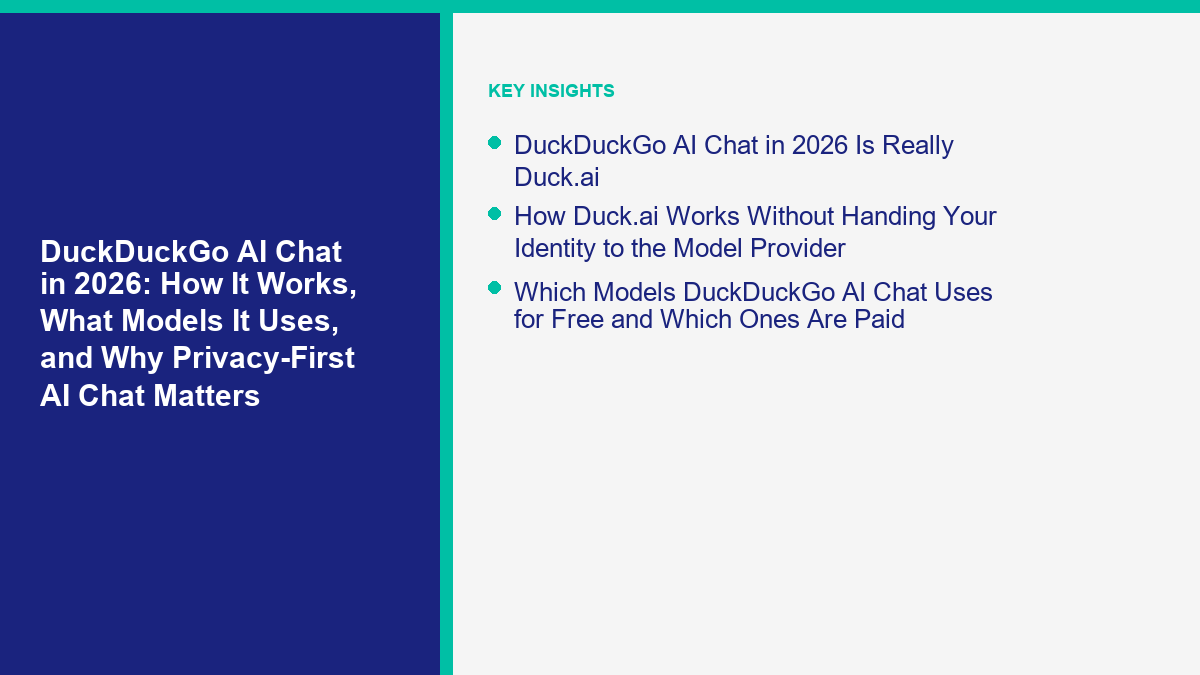
Trò chuyện AI DuckDuckGo vào năm 2026: Cách hoạt động, các mô hình sử dụng và lý do tại sao trò chuyện AI ưu tiên quyền riêng tư lại quan trọng
DuckDuckGo AI Chat đã trở thành một trong những sản phẩm AI thú vị nhất vào năm 2026 vì một lý do đơn giản: nó giải quyết một vấn đề mà hầu hết các ứng dụng AI vẫn coi là thứ yếu. Quyền riêng tư không bị chôn vùi trong menu cài đặt ở đây. Nó là điểm nhấn. Nếu bạn muốn một cách nhanh chóng để trò chuyện với nhiều mô hình AI hiện đại mà không cần xây dựng một tài khoản vĩnh viễn khác, cung cấp một hệ thống bộ nhớ khác, hoặc gắn liền danh tính của bạn với mỗi yêu cầu, Duck.ai xứng đáng được xem xét nghiêm túc.
Nếu bạn vẫn đang tìm kiếm duck duck go ai chat, duckduckgo ai chat, hoặc thậm chí duckduckgo chatbot, sản phẩm bạn đang tìm kiếm hiện nay là Duck.ai. Tôi đã kiểm tra các trang trợ giúp hiện tại của DuckDuckGo, tài liệu đăng ký, danh sách trên App Store, và các nguồn so sánh về 12 tháng 4 năm 2026, sau đó kiểm tra chéo tài liệu hiện tại của OpenAI và Microsoft để đánh giá này phản ánh sản phẩm thực tế năm 2026 thay vì phiên bản 2024 mà nhiều bài tổng hợp vẫn đang mô tả.
Phiên bản ngắn gọn là: Duck.ai không phải là trợ lý có nhiều tính năng nhất, và nó không phải là không gian làm việc mạnh mẽ nhất cho các tệp, nghiên cứu sâu, hoặc hợp tác nhóm. Nó là một trong những trải nghiệm trò chuyện AI ưu tiên quyền riêng tư sạch nhất trên thị trường. Nếu mục tiêu thực sự của bạn là tự động hóa hướng tới khách hàng trên Facebook Messenger, Instagram, hoặc trang web của bạn thay vì trò chuyện cá nhân riêng tư, đó là một công việc hoàn toàn khác, và bạn sẽ nhận được giá trị thực tiễn nhiều hơn từ Xem Các Hướng Dẫn Của Chúng Tôi.
DuckDuckGo AI Chat vào năm 2026 Thực sự là Duck.ai
Một trong những điều đầu tiên khiến mọi người bối rối là việc đặt tên. Những người tìm kiếm vẫn gõ duckduckgo ai chat, nhưng các trang sản phẩm hiện tại và tài liệu trợ giúp của DuckDuckGo định vị trải nghiệm dưới Duck.ai tên. Tổng quan trợ giúp hiện tại cho biết Duck.ai cho phép bạn có những cuộc trò chuyện riêng tư với các mô hình trò chuyện AI bên thứ ba được ẩn danh bởi DuckDuckGo, và tài liệu tính năng AI của công ty cho biết cả Duck.ai và Search Assist đều là các tính năng AI tùy chọn chứ không phải là những phần không thể tránh khỏi của công cụ tìm kiếm.
Phần tùy chọn đó quan trọng hơn những gì nghe có vẻ. DuckDuckGo là một trong số ít sản phẩm internet tiêu dùng lớn nói rõ rằng không phải ai cũng muốn AI được bật liên tục. Các trang trợ giúp hiện tại của nó giải thích rằng bạn có thể ẩn Duck.ai khỏi kết quả tìm kiếm, tắt các tính năng AI từ cài đặt, và thậm chí sử dụng noai.duckduckgo.com nếu bạn muốn trải nghiệm tìm kiếm DuckDuckGo với các tính năng AI được tắt và hình ảnh do AI tạo ra được lọc càng nhiều càng tốt.
Nó cũng thực sự là một không cần tài khoản sản phẩm cho việc sử dụng cơ bản. Trang tiếp cận AI của DuckDuckGo cho biết cả Duck.ai và Search Assist đều miễn phí sử dụng, ẩn danh, và không yêu cầu tài khoản. Điều đó khiến sản phẩm cảm thấy khác biệt so với ChatGPT và Microsoft Copilot, cả hai đều dựa nhiều hơn vào lịch sử, bộ nhớ, cá nhân hóa và ngữ cảnh đã lưu dựa trên tài khoản. Duck.ai vẫn có một lớp đăng ký trả phí, nhưng trải nghiệm miễn phí cơ bản không bắt đầu với một bức tường đăng ký.
Có một điểm nhỏ cần biết. Tài liệu hướng dẫn bắt đầu của DuckDuckGo cho biết bạn không cần chia sẻ thông tin cá nhân để đăng ký, và bạn không cần tạo tài khoản để đăng ký. Nhưng nếu bạn muốn kích hoạt một đăng ký trả phí trên các thiết bị bổ sung, DuckDuckGo có thể yêu cầu địa chỉ email chỉ cho quy trình xác thực thiết bị bổ sung đó. Điều đó vẫn là một mô hình danh tính nhẹ hơn nhiều so với mẫu AI tiêu dùng thông thường.
Cách Duck.ai hoạt động mà không giao cho nhà cung cấp mô hình danh tính của bạn
Đây là phần khiến Duck.ai trở thành một trang web không chỉ đơn thuần là một lớp bọc khác.
Tài liệu về quyền riêng tư của DuckDuckGo cho biết Duck.ai loại bỏ siêu dữ liệu cá nhân trước khi các yêu cầu được gửi đến các nhà cung cấp mô hình. Về mặt thực tiễn, công ty cho biết địa chỉ IP của bạn và các siêu dữ liệu cá nhân khác sẽ bị xóa trước khi yêu cầu đến tay các nhà cung cấp như OpenAI, Anthropic và Together.ai. Yêu cầu xuất hiện với nhà cung cấp mô hình như đến từ DuckDuckGo chứ không phải từ bạn với tư cách là người dùng cá nhân. DuckDuckGo cũng cho biết họ có các thỏa thuận với các nhà cung cấp mô hình hạn chế cách dữ liệu trò chuyện ẩn danh có thể được sử dụng và yêu cầu xóa khi không còn cần thiết để cung cấp phản hồi, tối đa trong vòng 30 ngày, với một số ngoại lệ về an toàn và pháp lý hạn chế.
Đó là một tư thế mặc định mạnh mẽ hơn so với mô hình AI tiêu chuẩn cho người tiêu dùng. Tài liệu trợ giúp hiện tại của OpenAI cho biết các cuộc trò chuyện ChatGPT cá nhân có thể được sử dụng để cải thiện các mô hình trừ khi bạn chọn không tham gia, và bạn cần sử dụng Kiểm soát Dữ liệu hoặc Trò chuyện Tạm thời nếu bạn không muốn điều đó. Câu hỏi thường gặp về quyền riêng tư của Microsoft cho Copilot tiêu dùng cho biết các cuộc trò chuyện được lưu trữ theo mặc định và có thể được sử dụng cho các mục đích được mô tả trong Tuyên bố Quyền riêng tư của Microsoft, bao gồm khắc phục sự cố, giám sát, phân tích, cải tiến và cung cấp dịch vụ.
Duck.ai also documents exactly what it shares with model providers. The current help page says DuckDuckGo shares today’s date, your timezone, and a preferred unit system based on global region. It says it privately guesses region with a GEO::IP lookup without saving your actual IP or precise location. If you explicitly turn on the optional Use Approximate Location setting, Duck.ai can also share a city-level location guess so answers can be more locally relevant. The setting is off by default.
That means the privacy story is real, but it is not magic. Your prompt content still goes to an AI model provider so the model can answer it. DuckDuckGo is reducing the identity trail around the prompt. It is not turning an internet AI service into an offline local model on your laptop. That distinction matters if you handle legal material, medical data, source code, credentials, or anything else that should never leave a controlled environment.
Which Models DuckDuckGo AI Chat Uses for Free and Which Ones Are Paid
Model access is where the 2026 version of Duck.ai is much better than its older reputation.
DuckDuckGo’s newer Duck.ai overview page, crawled just days before this review, lists a broader free lineup than some older help pages still show. According to that newer overview, the current free model mix includes Claude 4.5 Haiku, Llama 4 Scout, Mistral Small 3 24B, GPT-4o mini, GPT-5 mini, và gpt-oss-120b. Trang trợ giúp cụ thể cho các mẫu cũ vẫn hiển thị danh sách ngắn hơn tập trung vào Claude 4.5 Haiku, Llama 4 Scout, Mistral Small 3 24B, và GPT-4o mini. Sự không khớp này mạnh mẽ gợi ý rằng DuckDuckGo đang cập nhật tài liệu trợ giúp theo các lịch trình khác nhau, vì vậy cái nhìn tổng quan mới hơn là bức tranh tốt hơn về những gì người dùng miễn phí có thể truy cập ngay bây giờ.
Người đăng ký trả phí nhận được sự nhảy vọt thú vị hơn. Các trang trợ giúp đăng ký hiện tại của DuckDuckGo nói rằng Thêm nữa người đăng ký nhận được GPT-4o, GPT-5.2, Claude Sonnet 4.5, và Llama 4 Maverick. Chuyên nghiệp người đăng ký nhận được mọi thứ trong Plus, cộng với Claude Opus 4.6, higher reasoning effort than Plus, and 2x higher usage limits than Plus. You can also switch your default model from the left sidebar, which makes Duck.ai more flexible than most privacy-branded tools that lock you to one house model.
That multi-model access is one of Duck.ai’s most underrated strengths. If you care about privacy but still want to compare model behavior, Duck.ai lets you do that without maintaining separate subscriptions to every major AI vendor. In 2026, that is not a trivial convenience. GPT-style models, Claude-style models, open-weight models, and smaller fast models still have noticeably different personalities. Being able to swap among them in one interface is genuinely useful.
Duck.ai tier
Current model access checked April 12, 2026
What it is good for
Sự đánh đổi chính
Miễn phí
Claude 4.5 Haiku, Llama 4 Scout, Mistral Small 3 24B, GPT-4o mini, GPT-5 mini, gpt-oss-120b
Fast Q&A, summarizing pasted text, trying different model styles without signing up
Daily usage caps and lower ceilings on the strongest reasoning models
Thêm nữa
Everything in Free plus GPT-4o, GPT-5.2, Claude Sonnet 4.5, and Llama 4 Maverick
Heavier writing, coding, reasoning, and side-by-side model comparison
Still not a full productivity workspace with rich document tooling
Chuyên nghiệp
Everything in Plus plus Claude Opus 4.6, higher reasoning effort, and 2x higher usage limits than Plus
People who want the strongest Duck.ai setup without buying several separate AI subscriptions
Value depends on whether you care enough about privacy and model variety to justify the jump
Who Should Use Duck.ai in 2026 and Who Should Skip It
Use Duck.ai if you want an AI assistant that feels disposable in the good sense. Open it, ask something, compare models, wipe it, move on. That is especially appealing if you are tired of every AI app trying to become your permanent memory system.
Use Duck.ai if privacy is not a slogan for you. If you routinely hesitate before pasting something into ChatGPT because you do not want it tied to your account history, Duck.ai solves a real psychological and operational problem. The fact that it is no-account by default matters. The fact that it strips metadata matters. The fact that it does not train on chats matters.
Use Duck.ai if you like model comparison. Free users already get a surprisingly useful set of models, and paid users get a genuinely strong mix. If you like seeing how the same prompt behaves across Claude-style, GPT-style, and open-weight options, Duck.ai is cleaner than maintaining several separate apps.
Skip Duck.ai if your workflow is built around files. The no-PDF, no-spreadsheet limitation is not a side note. It is a category limit.
Skip Duck.ai if you want the deepest research workflow. Copilot and ChatGPT both do more around web-grounding, rich output, and document-centric work. Duck.ai is good at chat. It is not trying to become your entire research operating system.
Skip Duck.ai if you need a customer-facing chatbot platform. This is the biggest misconception I see around private AI chat tools. A good personal AI assistant is not the same thing as a deployable customer messaging stack. If your next move is building live business conversations across Messenger, Instagram, and website chat, compare actual channel platforms rather than trying to stretch a consumer AI app into that role. The clean place to start is Xem giá cả của MessengerBot.
Where MessengerBot Fits If You Need AI in Customer Conversations
Duck.ai is built for private personal AI chat. MessengerBot is built for customer conversations across channels. Those are related ideas, but they are not the same product category.
If you are testing prompts privately, comparing models, or summarizing things for yourself, Duck.ai makes sense. If you need to automate replies on Facebook Messenger, Instagram, or your trang web của họ, you need channel logic, flow design, routing, subscriber management, human handoff, broadcasting, and operational controls. That is where dedicated chatbot platforms win.
The reason this matters is simple. A private assistant can get away with ambiguity. A customer-facing bot cannot. It needs deterministic flow steps for pricing questions, lead capture, appointment routing, order status, FAQ handoff, and escalation. If the project in your head is already moving from “Which AI chat app should I use?” to “How do I automate real conversations customers are having with my business?”, that is the point where a private chat tool stops being enough.
That is also where plan depth matters. If your team needs the heavier workflow side of multi-channel automation, this is the point to Upgrade to MessengerBot Pro rather than piling more expectations onto a consumer AI chat interface that was never designed to run your inboxes.
If You Recommend Chatbot Tools to Clients, Readers, or Other Businesses
There is a practical business angle here too. A lot of agencies, consultants, creators, and tutorial publishers now spend half their time explaining the difference between private AI assistants and deployable chat automation tools. If that is already part of your work, you do not need to leave the monetization side as an afterthought. You can Tham gia Chương Trình Liên Kết Của Chúng Tôi and turn those recommendations into something measurable instead of letting them disappear into free advice.
Official Sources Checked for This Review on April 12, 2026
DuckDuckGo AI Chat có miễn phí vào năm 2026 không?
Có. Duck.ai miễn phí sử dụng, không cần tài khoản cho quyền truy cập cơ bản, và DuckDuckGo cho biết cả Duck.ai và Search Assist đều là các tính năng AI tùy chọn miễn phí. Phiên bản miễn phí có giới hạn sử dụng hàng ngày, trong khi người đăng ký trả phí có giới hạn cao hơn và quyền truy cập vào mô hình mạnh mẽ hơn.
DuckDuckGo AI Chat hiện đang sử dụng những mô hình nào?
DuckDuckGo’s current Duck.ai overview lists Claude 4.5 Haiku, Llama 4 Scout, Mistral Small 3 24B, GPT-4o mini, GPT-5 mini, and gpt-oss-120b for free users. Paid Plus subscribers get GPT-4o, GPT-5.2, Claude Sonnet 4.5, and Llama 4 Maverick, while Pro adds Claude Opus 4.6 plus higher reasoning effort and higher limits.
Duck.ai có lưu trữ các cuộc trò chuyện của bạn hoặc đào tạo các mô hình AI dựa trên chúng không?
DuckDuckGo says Duck.ai does not record or store your chats on its side and does not use them to train AI models. Chat history is local on your device by default, with optional end-to-end encrypted Sync & Backup if you want it. That is a much stronger default privacy posture than most consumer AI chat apps.
DuckDuckGo AI Chat có tốt hơn ChatGPT về quyền riêng tư không?
For default consumer privacy, yes. Duck.ai’s main advantage is that it anonymizes prompts, strips personal metadata before sending prompts to providers, does not use chats for model training, and does not require an account for basic use. ChatGPT gives you more workspace features, but OpenAI says consumer chats may be used to improve models unless you opt out or use Temporary Chat.
Duck.ai có thể thay thế hoàn toàn ChatGPT hoặc Microsoft Copilot không?
It can for light personal chat, brainstorming, model comparison, and privacy-sensitive everyday questions. It usually cannot if your workflow depends on PDFs, spreadsheets, deep file analysis, broader research tooling, or a richer productivity workspace. Duck.ai is best treated as a privacy-first assistant, not as the universal answer to every AI task.
The practical takeaway is simple. Free Duck.ai is not just a teaser anymore. It is a real product for light daily use. Paid Duck.ai becomes more compelling if you specifically want privacy plus access to stronger frontier models, not if you want the most powerful productivity suite overall.
What DuckDuckGo Subscription Costs in 2026 and Why the Pricing Page Looks Slightly Confusing
Pricing is where a lot of old reviews are already stale.
DuckDuckGo’s current How much does DuckDuckGo cost? help page still summarizes the paid subscription as $9.99 per month or $99.99 per year. That is accurate for the lower paid tier, but it is no longer the whole story. The current U.S. Apple App Store listing for DuckDuckGo shows in-app purchases for DuckDuckGo (Plus, Monthly) at $9.99, DuckDuckGo (Plus, Yearly) at $99.99, DuckDuckGo (Pro, Monthly) at $19.99, và DuckDuckGo (Pro, Yearly) at $199.99.
So if you see an article saying DuckDuckGo has a single paid plan at $9.99, that article is behind the 2026 product split. The company’s newer subscription help pages clearly describe Thêm nữa và Chuyên nghiệp as two separate plans, even though some older help material still collapses pricing into one generic subscription summary. That is the kind of product transition that creates a lot of bad AI comparison content, because writers quote one page and miss the rest of the documentation.
There is also a bundle logic to keep in mind. You are not paying only for AI chat. DuckDuckGo describes the subscription as a four-in-one service that includes a VPN, advanced AI models in Duck.ai, personal information removal, and identity theft restoration. That makes the price easier to justify for people who already want a privacy bundle. It makes the price harder to justify if all you want is the single best AI chat tool and you do not care about the VPN or privacy services at all.
Availability is limited by region as well. DuckDuckGo’s current subscription help pages say the subscription is available in the United States, United Kingdom, European Union, and Canada, with local pricing for supported non-U.S. markets. Advanced Duck.ai models can be accessed from any browser, but the VPN and some other subscription features are managed through the DuckDuckGo browser.
For value, here is the honest read. At $9.99 per month, Plus is one of the more interesting AI-adjacent deals if you already want a privacy bundle. At $19.99 per month, Pro starts competing more directly with single-vendor AI subscriptions, so the privacy angle needs to matter to you for it to feel like a win.
DuckDuckGo AI Chat Privacy Claims That Actually Matter
Privacy marketing is usually vague. Duck.ai’s useful part is that the company makes several concrete claims you can evaluate.
First, DuckDuckGo says your chats are not recorded or stored by Duck.ai itself. The main privacy page says Duck.ai does not record or store chats, and that conversations are not used to train chat models by DuckDuckGo or the underlying providers. That is the core promise most people care about.
Second, DuckDuckGo separates prompt content from identifying metadata. The company says personal metadata such as IP address is removed before the prompt goes to the model provider. In other words, the provider may see the content of the prompt, but not the normal consumer-service identity trail attached to it.
Third, Duck.ai makes chat history local by default. DuckDuckGo’s recent chats documentation says chat history is stored locally on your device by default. That is a much better default than building the whole product around cloud-stored, account-tied conversation history.
Fourth, Sync & Backup is optional and end-to-end encrypted. If you want cloud-style continuity, DuckDuckGo says you can enable Sync & Backup to store up to 1,000 conversations on a secure DuckDuckGo server with end-to-end encryption, where decryption keys remain only on your devices. That is a cleaner privacy design than simply pushing everything into plain account history by default.
Fifth, voice chat has its own explicit privacy explanation. DuckDuckGo says voice chat is private, anonymized, not used to train AI models, and that audio is not stored by DuckDuckGo or OpenAI after the session ends. It also explains the real caveat most companies would rather bury: your voice is inherently biometric data, even if the service is designed not to identify you from it.
Those are meaningful claims. They do not make Duck.ai invincible or appropriate for every sensitive use case, but they put it in a different category from assistants that default to cloud history, personalized memory, and model-improvement training unless you go turn that behavior off.
Where the Privacy Story Has Real Limits
This is the part most soft-focus reviews skip. Duck.ai is private by consumer AI standards. That does not mean you should treat it like an air-gapped secure environment.
If you type confidential information into Duck.ai, the model provider still receives the prompt content so it can generate a response. DuckDuckGo says the provider does not get personally identifiable information tied to you, but the prompt itself is still prompt content. If your risk model says a document must never leave your device or organization boundary, Duck.ai does not solve that problem.
DuckDuckGo is also clear that it does not filter or modify the responses received from the model. That matters. Privacy-first does not mean source-grounded, citation-checked, or less hallucination-prone. Duck.ai’s model providers still have their own moderation policies, but DuckDuckGo says it does not rewrite or sanitize the raw model responses itself.
Feature depth is another limit. Duck.ai’s current file upload help page says it supports image uploads only on some models and does not support non-image files such as PDFs or spreadsheets. If your daily AI workflow revolves around dropping in docs, tables, slide decks, and files for analysis, Duck.ai is simply not in the same class as ChatGPT or Copilot for that kind of work.
There is one more practical limit: usage caps. Duck.ai is free, but the company says there is a daily usage limit and does not publish a neat universal message number because different models cost different amounts per prompt. That is sensible engineering, but it also means heavy users will hit the ceiling faster than they expect if they treat free Duck.ai like an unlimited premium assistant.
Recent Chats, Sync, and Data Retention Are Better Than Most People Realize
One of the easiest ways to understand Duck.ai is to stop thinking of it as a permanent cloud notebook and start thinking of it as a privacy-first chat tool with optional persistence.
DuckDuckGo’s current recent chats page says your Duck.ai chat history is private and cannot be accessed by DuckDuckGo or model providers. By default, chat history is stored locally on your device so you can refer back to it later. You can disable chat history entirely in settings if you want a cleaner footprint. You can also delete individual chats, clear them with the Fire Button, or wipe them by clearing browser data.
There are some useful operational details tucked into that help page. You can pin up to five chats to the top of the list, and those pinned chats will not be deleted by the Fire Button inside Duck.ai. Retention also depends partly on your browser or app. DuckDuckGo specifically notes that Safari and the DuckDuckGo browser on Mac and iOS may automatically delete local chat history if you go more than seven days without visiting Duck.ai. That is a meaningful behavior difference from browser to browser, and it is exactly the kind of thing power users should know before relying on local history.
If you want cross-device continuity, Sync & Backup is available as a free optional feature. DuckDuckGo says it stores up to 1,000 conversations privately on a secure server with end-to-end encryption, while the decryption keys stay on your devices. That means DuckDuckGo says it still cannot read your chats even when you choose backup and sync.
This is probably the most underappreciated design choice in the whole product. Duck.ai is not forcing you into a false choice between zero history and fully exposed cloud history. It gives you local storage first, encrypted backup if you want it, and explicit controls around deletion. That is a much more adult privacy model than the usual consumer AI trade where convenience always wins by default.
How to Set Up DuckDuckGo AI Chat for a Private Daily Workflow
If you want to test Duck.ai properly, do not just ask it one gimmick question and move on. Use a short setup flow that shows whether the product fits your real work.
Open Duck.ai directly and test the free tier first. Since no account is required for basic use, start without signing into anything. That shows you the actual low-friction value of the product.
Run the same prompt across at least three different models. Try a summarization prompt, a planning prompt, and a technical reasoning prompt. Claude-style models often feel different from GPT-style models, and smaller open models often behave differently again.
Check the settings before you build a habit around the tool. Confirm whether chat history is on, whether Sync & Backup is on, and whether approximate location is enabled. Decide deliberately instead of accepting defaults without looking.
Use sensitive prompts carefully even though the product is privacy-first. Anonymized does not mean local. Keep secrets, private keys, unreleased contracts, and anything legally sensitive out of the prompt box unless you have cleared that workflow properly.
Test feature boundaries early. Try image generation, try voice if you care about it, and verify whether you need PDF or spreadsheet support. Many people figure out too late that Duck.ai is deliberately lighter than a full AI workspace.
Decide whether you actually need paid Duck.ai or just like the idea of it. If the free models already handle your daily prompts, paying may not change much. If you keep wishing you had stronger reasoning models and higher limits, that is the moment to consider Plus or Pro.
My own practical advice is to treat Duck.ai like a private first-pass assistant. It is great for early drafting, quick explanation, model comparison, prompt testing, and low-friction thinking. It is less compelling as your only serious research environment or document-analysis workspace. If you use it with that expectation, it makes a lot more sense.
Voice Chat, Image Generation, and the Feature Gaps You Will Notice Fast
Duck.ai has gone beyond plain text chat, but it still keeps a lighter feature footprint than the biggest consumer AI apps.
Bật voice, DuckDuckGo’s help page says voice chat is private, anonymized, and not used for model training. It also says the audio is not stored by DuckDuckGo or OpenAI after the chat ends. The technical flow matters here: DuckDuckGo says voice chat connects you to an OpenAI model through an encrypted relay connection that DuckDuckGo cannot decrypt, while OpenAI handles the live listening, transcription, and generated spoken response. The same page notes that voice chat is available in the DuckDuckGo browser and in most third-party browsers, with Firefox support still listed as coming soon.
Bật images, DuckDuckGo’s help docs say you can create AI-generated images by choosing New Image inside Duck.ai and prompting from there. Follow-up edits are supported through more prompts. As with text and voice, there is a daily limit, and paid subscribers get higher usage limits than free users.
Bật uploads, the product is more constrained. DuckDuckGo’s file upload documentation says Duck.ai currently supports image uploads with some models, but does not support non-image file types like PDFs or spreadsheets. That is a big dividing line. ChatGPT and Copilot are both pushing much harder into file-based workflows. Duck.ai is still primarily a privacy-first chat layer, not a document-heavy workbench.
That does not make Duck.ai weak. It just makes it specialized. If you want quick AI conversation, model choice, and strong privacy defaults, the current feature set is enough. If you want one tool that can be your researcher, spreadsheet explainer, PDF analyst, slide helper, and cross-app work assistant, Duck.ai is not trying to win that category.
DuckDuckGo AI Chat vs ChatGPT: Privacy Wins, Workspace Features Lose
Comparing Duck.ai with ChatGPT only by answer quality is lazy. The real difference is product philosophy.
ChatGPT in 2026 is the fuller workspace. OpenAI’s current pricing page says the miễn phí tier includes limited access to its flagship GPT-5, web search, file uploads, voice, image tools, custom GPT use, and projects. Plus is $20 per month, và Pro is $200 per month. That is a much wider product surface than Duck.ai. If you live inside files, voice, advanced tools, projects, tasks, custom GPTs, or agent-like workflows, ChatGPT is the more capable environment.
But ChatGPT’s privacy defaults are weaker. OpenAI’s current help center says individual ChatGPT conversations may be used to train models unless you opt out. It also says Temporary Chat is required if you want a blank-slate conversation that does not appear in history, use memory, or contribute to model improvement. In other words, privacy is available, but it is not the default operating posture in the same way Duck.ai makes it the default.
That makes the choice pretty clear by use case.
Duck.ai is better if: you want no-account access, stronger anonymity, less persistent identity around prompts, and an easy way to compare models privately.
ChatGPT is better if: you want a richer productivity workspace with documents, projects, tasks, deeper tool integration, and a more mature ecosystem of power-user features.
There is also a pricing story hiding here. For a pure AI subscription, ChatGPT Plus at $20 per month is still easier to justify if you want the most flexible single-vendor assistant. Duck.ai Pro at $19.99 per month gets interesting if you care about privacy and multi-model access, but it is really strongest when you value the whole DuckDuckGo subscription bundle rather than AI alone.
I would put it this way. ChatGPT feels like the better digital office. Duck.ai feels like the better private scratchpad. If you try to make one do the other’s job, the comparison gets unfair quickly.
DuckDuckGo AI Chat vs Bing and Microsoft Copilot: Better Anonymity, Weaker Web Superpowers
If you still think in terms of “Bing AI,” the important naming update is old but still worth stating clearly. Microsoft said on December 1, 2023 mà Microsoft Copilot was formerly Bing Chat và Bing Chat Enterprise. In 2026, that old Bing AI idea mostly lives on through the broader Copilot product family and through Bing features like Copilot Search.
Microsoft Copilot is stronger than Duck.ai in a few obvious areas. Microsoft’s current consumer Copilot features page highlights Copilot Voice, tạo hình ảnh, Deep Research, file uploads, app connectors, and context-rich visual answers. Microsoft’s current Microsoft 365 pricing page also says paid consumer subscriptions such as Microsoft 365 Personal at $99.99 per year, Family at $129.99 per year, và Premium at $199.99 per year come with higher Copilot usage than free access.
For search-heavy work, Copilot also has a structural advantage. Microsoft explicitly positions Copilot Search as an experience that goes beyond a traditional list of links with contextual answers, summaries, and deeper exploration. If your day is full of web-grounded lookups, product comparisons, shopping research, or broad information gathering, Copilot is trying harder than Duck.ai to be a search-powered assistant rather than a privacy wrapper around several models.
But the privacy posture is looser. Microsoft’s privacy FAQ for consumer Copilot says conversations are saved by default, and that Microsoft uses them for the limited purposes described in the Microsoft Privacy Statement to provide the service, troubleshoot, diagnose bugs, monitor, analyze, and improve performance. That is a very different promise from Duck.ai’s “we do not record or store your chats and do not use them to train models” position.
So the right comparison is not which brand sounds smarter. It is which tradeoff you actually want. Copilot gives you stronger web-facing features, richer answer cards, more visible research tooling, and better file support. Duck.ai gives you a much cleaner anonymity model and a lower-friction path to multi-model private chat.
Tính năng
Duck.ai
ChatGPT
Microsoft Copilot
Basic free access
Yes, with no account required for basic use
Yes, but the product strongly pushes account-based history and features
Yes, free access exists, though the broader experience leans heavily on Microsoft account identity
Default privacy posture
No chat recording or storage by Duck.ai, no model training on chats, anonymized relay
Consumer chats may be used to train models unless you opt out or use Temporary Chat
Consumer conversations are saved by default and used per Microsoft’s privacy statement for service operation and improvement
Model choice
Strong multi-model choice in one interface
Mostly one-vendor ecosystem, though with multiple OpenAI model options by plan
Less about explicit model shopping, more about Microsoft’s unified assistant experience
Files
Images only on supported models; no PDFs or spreadsheets
Strong file upload and analysis support
File uploads supported, especially strong inside Microsoft workflows
Voice and images
Yes, with daily limits and privacy-focused handling
Yes, with broader tool depth on paid plans
Yes, with strong voice and image creation emphasis
Paid entry point
Plus $9.99/mo, Pro $19.99/mo in current U.S. App Store listing
Plus $20/mo
Free plus higher-usage access through current Microsoft 365 consumer plans
Phù hợp nhất
Privacy-first personal AI chat
All-purpose AI workspace
Web-grounded and Microsoft-connected assistant work
Residential remodelers divide their attention among job-site work, inspections, subcontractors, and permitting. Homeowners still need a clear way to ask about a kitchen, bathroom, basement, or outdoor project and understand when to expect a reply. An inquiry without a...
Chúng tôi sử dụng cookie để đảm bảo rằng chúng tôi mang đến cho bạn trải nghiệm tốt nhất trên trang web của mình. Nếu bạn tiếp tục sử dụng trang này, chúng tôi sẽ giả định rằng bạn hài lòng với điều đó.



 Tiếng Việt
  English
  Tagalog
  简体中文
简体中文  العربية
  हिन्दी
  Português do Brasil
  Español de México
  Français
  বাংলা
বাংলা  香港中文
香港中文  繁體中文
繁體中文  Nederlands
  Deutsch
  Bahasa Indonesia
  日本語
日本語  한국어
한국어  Polski
  Русский
  Español