
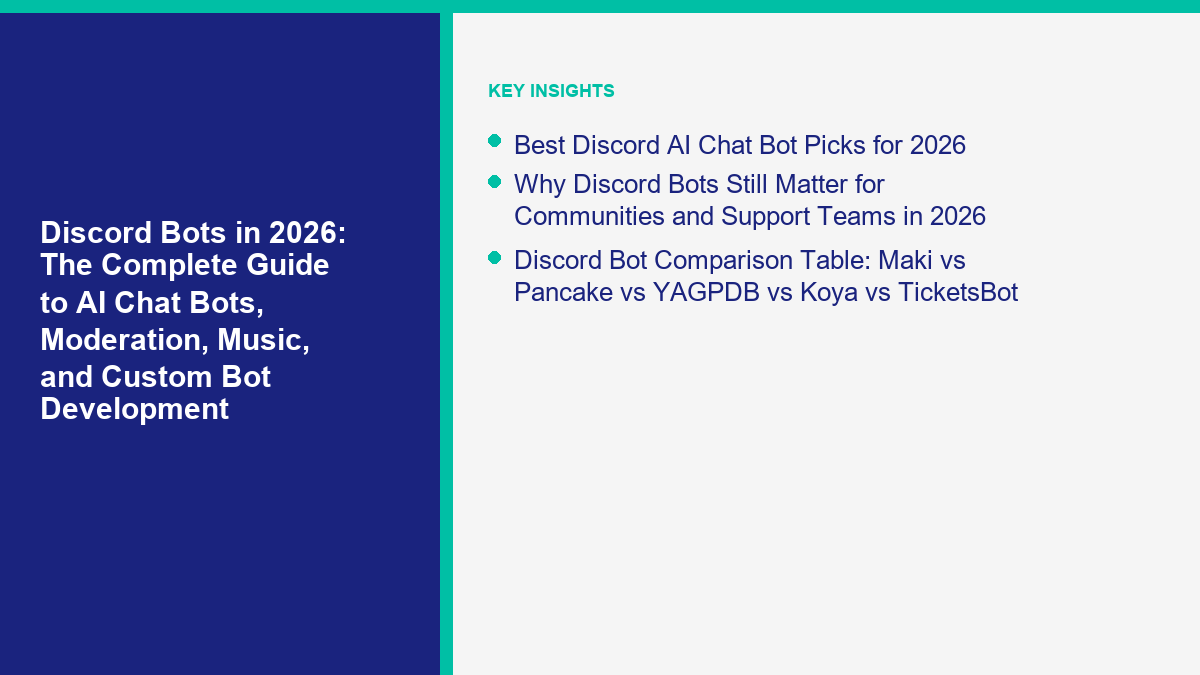
在2026年,Discord 机器人建议变得更加难以信任,因为这个词 机器人 现在涵盖了四种非常不同的工具。有时它指的是经典的管理机器人。有时它指的是带有几个实用命令的音乐机器人。有时它指的是专门为员工工作流程设计的票务系统。有时它指的是一个真正的 discord ai 聊天机器人 由大型语言模型、知识库和自定义命令支持,这些命令更像是产品而不是业余脚本。.
这就是为什么通常的“十大 Discord 机器人”列表并不是很有用。实际的问题不是哪个机器人拥有最长的功能页面。实际的问题是哪个机器人能够解决您服务器当前所需的确切工作,而不将设置、权限和管理变成一个副项目。一个有音乐之夜的游戏服务器需要的东西与处理客户票务的支持服务器不同。一个有入职流程的创作者社区与构建在 Discord 中回答产品问题的 AI 助手的 SaaS 团队有不同的优先事项。.
在本指南中,我审查了当前的官方产品页面、定价页面、支持文档和关于 2026 年 4 月 12 日. 这在这里很重要,因为价格、限制和货币化规则的变化比旧的汇总所承认的要频繁得多。Discord 自己的公开材料现在将该平台框定为 每月超过 2 亿活跃用户 和 每天超过 9000 万活跃用户, 这足够大,以至于机器人选择现在影响真实的支持、商业和社区运营,而不仅仅是在一个旁边服务器中的有趣命令。我大量使用的来源包括Discord的 商业通讯, 它的 2025年12月2日的新闻稿, 该 Discord开发者平台文档, 以及当前的官方站点 Maki, 煎饼, YAGPDB, Koya, 和 TicketsBot.
如果 Discord 只是您正在构建的自动化堆栈的一部分,请在阅读时记住这一点。能够在服务器内部良好运作的机器人并不一定擅长处理网站聊天、Instagram 私信或 Facebook Messenger 跟进。对于该工作流程的无代码部分,您可以 浏览我们的教程 在您锁定 Discord 层之后。.
2026 年最佳 Discord AI 聊天机器人推荐
如果您想先得到直接的答案,这里就是。最好的 discord ai 聊天机器人 对于大多数现成的社区服务器是 Maki Pro, 因为它当前的高级功能组合将管理、工单、自动化、分析和 AI 功能整合在一个应用中。如果您主要的问题是严重的管理和可编程逻辑,, YAGPDB 仍然是这个列表中最锋利的工具。如果您的服务器围绕音乐和轻量级实用命令而存在,, 煎饼 仍然是最简单的低成本选择之一。如果您的团队最关心欢迎流程、品牌入职和社交提醒,, Koya 感觉比 Maki 更简洁。如果工单至关重要,专用的 票务 Discord 机器人 例如,TicketsBot 通常比强迫通用机器人充当帮助台更安全.
- 最佳全能 AI 准备选择: Maki Premium Pro 适合希望在一个地方拥有 AI 功能、票务、分析和广泛自动化的服务器.
- 最佳 moderation 和自定义自动化选择: YAGPDB 适用于自动化、信息流和高级自定义命令.
- 最佳音乐优先选择: 煎饼 如果您主要关心自动播放、低音增强、音量控制和低月费.
- 最佳入门和社区品牌选择: Koya 用于欢迎卡、排名卡、警报和清洁的高级层级。.
- 最佳票务选择: TicketsBot 当支持工作流程、记录和员工操作比一体化的新奇功能更重要时。.
- 最佳完全自定义的 AI 选项: 使用您自己的 Discord 应用程序 应用程序命令, 最小化 网关意图, 以及托管的推理堆栈。.
大多数买家往往搞错的一件事是:AI 通常不是在 Discord 服务器中创造价值的第一个功能。干净的入职、角色分配、管理、工单路由和可靠的命令比一个可以流利聊天但权限薄弱且缺乏工作流程纪律的机器人产生更多的日常价值。当您的服务器已经有足够的活动以至于员工需要总结、可搜索的知识、分类或引导答案时,AI 层才开始变得有意义。.
为什么Discord机器人在2026年仍然对社区和支持团队重要
Discord不再是一个主要用于玩笑命令和背景音乐的地方。Discord自己的公共商业材料现在谈论 每月超过 2 亿活跃用户 以及超过 每月15亿小时的游戏时间, 而它在2025年12月的商业公告中表示该平台服务于 每天超过 9000 万活跃用户. 这些数字不仅仅是爱好者的数字。它们足够大,以至于支持团队、游戏工作室、创作者社区、SaaS产品和机构现在将Discord视为一个重要的自有渠道。.
该平台本身也为开发者提供了比旧版Discord指南所反映的更多空间。Discord当前的 应用命令文档 使得斜杠命令、消息命令和用户命令成为一流的表面。您可以发布一个像真正应用程序一样运行的机器人,而不是强迫所有内容通过旧的前缀命令。Discord的 高级应用文档 also spells out how developers can sell app subscriptions and one-time purchases, with availability called out for developers in the US, UK, and EU. That matters if you are building a commercial bot, not just installing one.
From a server-owner angle, this changes the buying criteria. A bot is no longer just a moderation add-on. It can be part of onboarding, support, monetization, creator retention, documentation search, internal ops, or community analytics. That is why a good bot decision in 2026 starts with workflow mapping, not with whichever app has the flashiest home page animation.
The other shift is that users expect cleaner surfaces now. Prefix spam feels old fast. If a bot cannot expose slash commands clearly, keep permissions understandable, and avoid cluttering channels, it feels dated no matter how many features it technically has. That is one reason Pancake, YAGPDB, Koya, and Maki feel so different in practice even when their feature lists overlap on paper.
Discord Bot Comparison Table: Maki vs Pancake vs YAGPDB vs Koya vs TicketsBot
| Bot | Current scale or footprint | Current paid starting point | 最擅长的功能 | 需要注意的事项 | 最佳契合 |
|---|---|---|---|---|---|
| Maki | Maki says it is used in more than 1.5 million servers | $7/month 每30天的高级版,, $10/月 for Premium Pro | 集成了 AI 功能、审核、工单、分析、音乐、等级和自动化的一体化服务器堆栈 | 如果您只需要一两个功能,广泛的范围可能会显得繁重;AI 功能位于更高的计划中 | 希望通过一个付费机器人覆盖大多数服务器操作的社区 |
| 煎饼 | 长期运行的实用工具和音乐机器人,带有简单的高级页面 | 每月 $2 每30天的高级版,, 每月 $4 适用于 Patreon 机器人 | 音乐播放控制,轻量级实用工具,简单的高级升级 | 官方 FAQ 仍然以前缀命令为中心,例如 p!help, 感觉比斜杠优先的应用程序更老 |
小型到中型服务器,主要想要音乐和一些实用命令 |
| YAGPDB | 主页当前列出 3,579,591 个已加入的服务器 | 通过出售的高级特权 Patreon 和 Discord;Patreon 从 $5/月 | 自动管理、信息源、正则表达式友好的自定义命令、自我分配角色、开源灵活性 | 用户界面功能齐全,但不够精致;可能会让不喜欢配置工作的管理员感到不知所措 | Technical moderators, ops-heavy communities, and admins who want programmable behavior |
| Koya | Premium page says it is trusted by 3.6M+ Discord servers | EUR 4.99/month for Premium or EUR 11.99/month for Pro before annual discounts | Welcome cards, levels, social alerts, branded onboarding, ticketing, clean premium ladder | Less AI-forward than Maki; deeper ops users may still prefer YAGPDB for raw configurability | Community servers that care about onboarding polish and predictable premium upgrades |
| TicketsBot | Dedicated ticketing product with dashboard, forms, transcripts, surveys, and whitelabel path | Premium and whitelabel tiers are documented in 官方文档; pricing is sold through Patreon and dashboard purchase flows | Ticket workflows, support operations, archives, staff processes, and support analytics | Narrower scope than an all-in-one bot; you will likely still want a separate moderation bot | Support teams, customer communities, gaming staff teams, and creator management servers |
| Custom build | Whatever you design | $5/月 on Railway Hobby or $7/month for a Render Starter web service before AI usage costs | Exact workflows, AI memory, private knowledge retrieval, custom monetization, and branded UX | You own uptime, moderation bugs, rate limits, token security, and maintenance forever | Teams with clear product requirements or agencies building repeatable client bots |
The table shows the category split clearly. Pancake is cheap and narrow. TicketsBot is narrow and operational. YAGPDB is deep and configurable. Koya is polished and brand-friendly. Maki is the closest thing to a paid all-in-one commercial Discord operating system. A custom build wins only when your workflow is specific enough that every hosted bot feels like a compromise.
If you are choosing between Maki and Koya, the real split is not feature count. It is where the product emphasis sits. Maki currently leans harder into depth, AI, and broader modules. Koya feels more disciplined around onboarding, alerting, and community presentation. If you are choosing between YAGPDB and either of those, the real question is how much manual configuration you are willing to own.
Maki Discord Bot: Best for All-in-One Servers That Want AI Features
Messenger 是由 Meta Platforms, Inc.(前身为 Facebook, Inc.)开发的广泛使用的消息服务,旨在实现用户之间的无缝沟通。它允许个人发送文本消息、交换照片、视频、贴纸、音频文件和文档。用户还可以对消息进行反应,并与各种机器人进行互动,以增强互动体验。 maki discord bot is the strongest fit in this list for admins who want one bot to do almost everything and are willing to pay for that convenience. Maki’s current homepage says it is used in more than 1.5 million servers, and its premium page now shows a clear commercial ladder: Premium at $7 per month 和 Premium Pro at $10 per month, both billed monthly including VAT, with a 14-day money-back guarantee on the paid tiers. That is not cheap in the context of classic Discord utility bots, but it is also not enterprise pricing.
What makes Maki interesting in 2026 is not just the breadth of modules. It is the specific way those modules line up. On the current premium page, Maki highlights AI moderation, app customization, extensive server analytics, higher automation limits, custom commands, economy tools, giveaways, scheduled messages, sticky messages, and ticketing. The same feature matrix shows meaningful jumps between free and paid usage limits, including 100 automations, 100 custom commands, 100 active giveaways, 和 100 scheduled messages on Premium. That gives Maki a very different feel from bots that are basically one premium switch attached to one feature set.
The AI angle matters, but it is easy to misread. Maki does not become the best choice simply because the premium page says Premium Pro includes access to all AI features. The real win is that the AI layer sits on top of a bot that already covers the operational basics well. If you install an AI bot that chats nicely but does not help with onboarding, moderation, tickets, or activity loops, it will feel impressive for a week and then become background noise. Maki has a better shot at staying useful because the AI layer is wrapped around server utility instead of replacing it.
There is still a cost to that breadth. Maki can be too much bot for a simple server. If you only need moderation, two welcome messages, and a basic level system, you do not need a product with analytics, AI unlocks, music, economy, tickets, and automation depth. That is where some admins overspend. They buy Maki because it looks future-proof, then use 10% of it. That is not a Maki problem. That is a buying-discipline problem.
Maki is the bot I would pick when the server has crossed out of hobby mode and into actual operations: a creator community with staff, a game community with tickets and moderation, a branded onboarding flow, or a product community that expects more than basic commands. If you want a bot that can grow with the server without forcing you into three separate products on day one, Maki has a strong 2026 case.
Pancake Discord Bot: Best for Music Commands and Lightweight Utility
Messenger 是由 Meta Platforms, Inc.(前身为 Facebook, Inc.)开发的广泛使用的消息服务,旨在实现用户之间的无缝沟通。它允许个人发送文本消息、交换照片、视频、贴纸、音频文件和文档。用户还可以对消息进行反应,并与各种机器人进行互动,以增强互动体验。 pancake discord bot is almost the opposite of Maki in spirit. Pancake’s official premium page is short, direct, and a little old-school in a way that can actually be refreshing. It sells two paid tiers: Premium at $2 per month with features like volume control, bass boost, autoplay, and a patron role, plus a Patreon Bot tier at $4 per month that includes an exclusive Patreon bot. That makes Pancake one of the lower-friction paid options in the category.
The official FAQ is also revealing in a good way. It still explains usage through prefix commands such as p!help, and troubleshooting guidance still assumes a fairly classic Discord bot mental model. That tells you what Pancake is and what it is not. It is not trying to reinvent Discord app UX. It is a practical, long-running utility bot that still works well for music and a handful of server tasks, especially if you do not care about being on the bleeding edge of slash-command design.
If your main use case is music, Pancake remains one of the easier recommendations because the paid features map directly to that job. Volume control, bass boost, autoplay, and a dedicated Patreon bot are understandable upgrades. You do not have to read through an enterprise-looking comparison table to figure out what you are buying. That sounds simple, but it is a real advantage when you are managing a smaller community that does not want operational sprawl.
The downside is obvious. Pancake is not the answer when someone says they want a modern discord ai 聊天机器人, a serious ticket system, or deep staff workflows. Its strength is narrowness. That is good if narrowness matches your server. It is bad if you are secretly asking Pancake to behave like a help desk, moderation framework, and AI assistant at the same time.
My practical rule for Pancake is simple. Pick it if your server identity is lightweight, music-heavy, or casual enough that a cheap utility bot still makes sense. Skip it if your next three roadmap items are AI help, support queues, advanced onboarding, or cross-channel customer operations.
YAGPDB Discord Bot: Best for Automod, Feeds, and Advanced Custom Commands
Messenger 是由 Meta Platforms, Inc.(前身为 Facebook, Inc.)开发的广泛使用的消息服务,旨在实现用户之间的无缝沟通。它允许个人发送文本消息、交换照片、视频、贴纸、音频文件和文档。用户还可以对消息进行反应,并与各种机器人进行互动,以增强互动体验。 yagpdb discord bot still holds a specific kind of respect because it feels built by people who actually care about moderation and configurable behavior, not just premium conversion. The current homepage lists 3,579,591 个已加入的服务器 and describes YAGPDB as an advanced configurable Discord bot with feeds, self-assignable roles, automod, custom commands, and general moderation. It also still says the project is open source, which matters more than it sounds. Open source is not just a philosophical badge here. It signals that YAGPDB is fundamentally more comfortable with power users than the average commercial bot landing page is.
The core strengths have not changed, but they still matter in 2026. YAGPDB’s homepage and help materials emphasize fast Reddit feeds, fast YouTube feeds, fast Twitch feeds, advanced automod, and custom commands with triggers that can match starts-with, contains, exact match, or regex. That last part is where YAGPDB keeps earning its place. Many bots advertise custom commands, but fewer make them genuinely expressive enough to feel like a server-automation layer instead of a fancy autoresponder.
Premium still makes YAGPDB more serious rather than merely more cosmetic. The official premium perks page lists custom avatar and banner changes per server, triggering custom commands on message edit, bulk role removal and assignment, custom Twitch announcement support, and increased limits across the board. It also now explicitly lists private threads for tickets as a premium exclusive, which is important if you want to stretch YAGPDB into lightweight support workflows. The same page shows the custom command cap rising from 100 to 250, Reddit feeds from 20 to 1000, YouTube feeds from 10 to 250, and Twitch feeds from 3 to 15.
Pricing is less polished than Maki or Koya because YAGPDB sells premium through Discord purchase flows and Patreon rather than a clean SaaS-style pricing page. The Patreon membership page currently starts at $5 per month, which is still reasonable given the ceiling on custom behavior. What you are paying for here is not shine. You are paying for control.
The tradeoff is that YAGPDB is easier to respect than to recommend blindly. If your admins enjoy configuration, moderation logic, and rule systems, YAGPDB is excellent. If they want something friendlier and more visual, YAGPDB can feel like work. That is not a flaw. It just means the discord bot developer mindset helps even when you are only configuring it, not coding against the API.
Koya Discord Bot: Best for Welcome Cards, Social Alerts, and Clean Premium Upgrades
Messenger 是由 Meta Platforms, Inc.(前身为 Facebook, Inc.)开发的广泛使用的消息服务,旨在实现用户之间的无缝沟通。它允许个人发送文本消息、交换照片、视频、贴纸、音频文件和文档。用户还可以对消息进行反应,并与各种机器人进行互动,以增强互动体验。 koya discord bot is one of the clearest examples of a bot that understands how communities actually present themselves. Koya’s current premium page says it is trusted by 3.6M+ Discord servers, which puts it in the serious-scale category immediately. More importantly, the product page communicates value in a clean way. Premium is currently listed at EUR 4.99 per month, while Pro is EUR 11.99 per month, with annual discounts available. That makes it easier to reason about than bots that bury pricing behind a support server or a Patreon wall.
Koya’s strongest case is that it feels like a community-design bot, not just a utility dump. The premium page leans hard on full bot and rank-card customization, advanced image customization for announcements, levels, message builders, custom commands, auto roles, reaction roles, auto nicks, social alerts, ticketing, action builders, and log mapping. Even the sample UI on the page sells a certain kind of server identity: branded welcome cards, custom bot presentation, and polished onboarding.
The feature limits also show how Koya wants to be used. On the current plans comparison, Premium includes 100 custom commands, 50 messages, 20 auto roles, 10 YouTube channels, 10 Twitch channels, 10 Reddit feeds, 和 20 ticket panels. Free is not useless either. The same comparison lists 3 ticket panels, 20 custom commands, and limited onboarding tools on the free plan, which means you can validate the fit before paying.
The Pro tier is where Koya becomes especially interesting for agencies, branded communities, and larger projects. Pro currently includes full bot customization 和您的 own custom bot. That matters if brand consistency is part of the server’s identity or if you do not want users interacting with a generic third-party bot profile. Plenty of admins say they care about this only after the community matures. Koya at least gives them a direct upgrade path when that day comes.
If Maki feels like the best all-in-one bot for a feature-hungry operator, Koya feels like the best all-in-one bot for a community builder who cares about presentation and onboarding discipline. That is a meaningful difference. Choose Koya when your server growth depends on making new members feel oriented and engaged quickly, not just on piling up commands.
TTS Discord Bot Options: Native Discord TTS vs Dedicated Voice Bots
这个短语 tts discord bot covers two very different things, and mixing them up creates a lot of bad setups. The first option is Discord’s own built-in /tts command. Discord’s official Text-to-Speech 101 article says users can type /tts before a sentence to have it read aloud, and that the output follows the system-level voice settings of the platform in use. The same doc also explains that listeners can configure TTS playback for all channels, only the currently selected channel, or never.
That means native Discord TTS is free, simple, and fine for lightweight accessibility or small alert-style use cases. It also means it is a poor substitute for a real voice-channel TTS workflow. If your plan is to pipe text channel messages into voice chat, support multiple voice providers, offer premium voices, or support stream-like readouts in shared voice channels, Discord’s built-in TTS is not enough. It was never meant to be a full voice experience layer.
That is where a dedicated TTS bot comes in. One current example is HornBot, whose Patreon membership page currently lists paid access starting at about $1 per month, 以及 Classic (1 server) tier at about $2.99 per month. HornBot’s membership perks describe access to multiple TTS platforms, including Microsoft, Google Cloud, Azure, and FakeYou, plus server-level premium voice options. That is much closer to what people usually mean when they ask for a TTS bot inside Discord.
The operational rule is simple. Use built-in /tts if you want basic message readout and do not care about voice-channel automation. Use a dedicated tts discord bot if spoken output is part of the server experience, especially for streaming communities, accessibility-heavy communities, or multilingual groups that need better voice options than the operating system default. Either way, lock TTS down to trusted channels or roles early. Voice spam gets old faster than text spam.
Ticket Discord Bot Options for Support, Sales, and Staff Queues
一个 票务 Discord 机器人 is where a lot of communities accidentally discover whether they are running a hobby server or a real support operation. Tickets look simple until staff need claims, transcripts, surveys, analytics, private follow-up, and a workflow that does not break when moderators rotate. This is also the point where many admins regret treating “ticketing” as just another checkbox on a multipurpose bot.
The cleanest dedicated option in this guide is TicketsBot. Its official perks table is unusually clear. Even the free tier includes unlimited tickets, forms, ticket claiming, and automatic archives, but it caps the number of ticket panels at 3. Premium raises that to unlimited panels and adds statistics, branding removal, autoclose, exit surveys, live dashboard updates, and direct dashboard messaging. Whitelabel adds custom bot identity. That is the kind of feature shape you want from a support-first product.
Maki and Koya both handle tickets, but they frame them as one part of a bigger product. Maki’s current comparison shows free users limited to 1 ticket per user 和 1 ticket category, with Premium expanding categories to 10. Koya’s current plans show 3 ticket panels on free and 20 ticket panels on Premium, plus transcript generation and ticket claiming in the paid tiers. YAGPDB can now support ticket workflows through private threads for tickets on premium servers, but ticketing is still not the center of the product’s identity.
| Ticket option | 最佳使用案例 | Current evidence from official docs | Watch out for |
|---|---|---|---|
| TicketsBot | Support-heavy communities, creator management, gaming staff workflows, customer service | Free includes forms and claiming; premium adds unlimited panels, stats, autoclose, surveys, dashboard messaging, and whitelabel path | You will likely still want a separate moderation or utility bot |
| Koya | Community servers that want tickets plus onboarding and alerts in one product | Free includes 3 ticket panels; Premium expands to 20 and adds more customization depth | Best when tickets are one workflow among many, not the whole support stack |
| Maki | All-in-one paid server operations | Free limits tickets per user and category count; Premium raises limits and adds broader automation around tickets | Easy to overbuy if support is your only real need |
| YAGPDB | Technical teams that want tickets folded into a wider ops bot | Premium page explicitly lists private-thread tickets plus high automation limits | Setup is more operator-focused than support-agent-friendly |
My recommendation is blunt here. If tickets affect customer experience, refunds, support SLAs, or internal staff coordination, use a dedicated ticket bot first and layer a moderation bot beside it. If tickets are just occasional member-help requests in a community server, Koya or Maki is often enough. That split saves a lot of future rework.
How to Build a Custom Discord AI Chat Bot Without Painting Yourself Into a Corner
Custom bot development is where a lot of people underestimate the platform and overestimate their first draft. Building a serious discord ai 聊天机器人 in 2026 is not hard because Discord’s tooling is immature. Discord’s tooling is actually fairly good now. It is hard because most custom bots start with a vague goal like “answer questions” instead of a narrow list of jobs with strict permissions and clear failure modes.
Start with Discord’s current interaction model, not with an old tutorial that routes everything through legacy message parsing. The Application Commands docs are the right starting point. Discord now treats slash commands, user commands, and message commands as native surfaces. The same docs note that commands can be authorized with the applications.commands scope, and if your app does not actually need a bot user in the guild for a feature, you do not always need to treat every interaction like a full bot install problem. That is a cleaner mental model than older guides that assume the bot account is the center of everything.
Intents matter too. Discord’s Gateway docs say intents are required as of v8 and privileged intents must be toggled in the Developer Portal before use. That one detail should shape your architecture early. If your AI bot only needs slash commands and tightly scoped lookups, do not ask for more message visibility than necessary. The easiest way to make a bot feel invasive or brittle is to over-collect data just because a tutorial told you to.
Here is the build order that works best in practice:
- Define jobs, not vibes. Decide whether the bot is a support assistant, a moderation helper, a documentation search tool, a role-routing assistant, or a staff summarizer. Do not launch with all of those at once.
- Design the command surface first. Map the slash commands, user commands, and message actions before you write model prompts. If the command UX is muddy, the AI layer will not save it.
- Keep intents minimal. Only request the gateway events you genuinely need. Over-scoped bots are harder to secure, harder to explain, and harder to get approved internally.
- Constrain the AI with known data. Pull from approved docs, FAQs, role metadata, or tagged message archives. A raw general chatbot is less useful than a narrow bot that can answer reliably.
- Add staff fallback paths. If confidence is low, route to a ticket, a staff role, or a known help channel instead of hallucinating with style.
- Ship in one staging server first. You need permission tests, moderation tests, and cooldown tests before the app touches a production community.
Cost is the other thing people wave away until launch week. Hosting is not expensive, but it is not zero. Railway’s official billing docs currently list Hobby at $5 per month as a minimum usage commitment, and Render’s pricing page lists a Starter web service at $7 per month. That gives you a realistic floor for an always-on custom bot before you add vector storage, logging, or model inference costs. If that looks like unnecessary engineering for your actual goal, it probably is. In that case, compare the no-code side and 查看MessengerBot定价 before you build infrastructure you do not really want to own.
If you plan to monetize the bot directly, Discord’s Premium Apps overview is required reading. Discord now supports app subscriptions and one-time purchases, but the policies, onboarding, and payout structure still need to be designed around real product operations, not just a clever command list. Build monetization after you prove the workflow, not before.
When Hiring a Discord Bot Developer Makes More Sense Than Another Plugin
这个短语 discord bot developer gets searched when admins are already feeling the limits of plug-and-play tools. Usually that means one of five things is happening. You need the bot to talk to an internal database or CRM. You need retrieval over private docs. You need role logic or monetization that hosted bots cannot express cleanly. You need your own branded bot identity at scale. Or you are tired of stitching together three bots and a spreadsheet to do one coherent job.
This is the point where another plugin often creates more friction than it solves. Once your requirements include private knowledge, billing, staff escalation, audit logging, or customer-facing automation, you are not really buying a bot anymore. You are commissioning a small product. That changes the standard for who should build it.
If you hire a developer, ask for deliverables that prove they understand Discord as an operating environment, not just JavaScript or Python syntax. The short list should include:
- A command map showing which features live in slash commands, user commands, and message actions
- A permissions matrix covering admin-only actions, staff actions, public actions, and channel restrictions
- An intents plan that explains exactly why each gateway intent is needed
- A fallback design for AI failures, API outages, and low-confidence responses
- A logging and audit plan for moderation, tickets, and staff interventions
- A deployment and rollback plan with hosting, secrets handling, and monitoring spelled out
The biggest mistake here is hiring someone who can technically build a bot but has no feel for community moderation or Discord UX. That is how you end up with a clever backend and a miserable command surface. A real Discord bot developer should be able to explain why a feature belongs in a slash command instead of a text parser, when to avoid privileged intents, and how the bot should fail safely when the AI layer does not know enough to answer.
If your needs are still basic, do not hire yet. If your roadmap already sounds like a mini product spec, hiring is often cheaper than months of improvised admin work.
Discord Bot Launch Checklist for Permissions, Safety, and Long-Term Maintenance
Whatever bot you choose, this is the checklist that prevents most avoidable pain. I would use it for Maki, Koya, YAGPDB, Pancake, TicketsBot, and any custom bot.
- Keep public commands, moderator commands, and staff-only workflows in separate channels or clearly separate permission scopes.
- Audit every requested permission before install. If a bot asks for more than the workflow needs, stop and question it.
- Use slash commands when available so users can discover the bot without memorizing syntax.
- Turn off or hide modules you are not using. A shorter bot surface is easier to moderate and easier to teach.
- Set cooldowns and anti-spam rules before you invite the wider server to use the bot.
- Test ticketing, transcripts, and escalation paths with staff accounts before a real user hits them.
- For AI features, define what the bot should refuse to answer and where it should hand off to humans.
- Keep a staging server for updates, especially if you rely on custom commands, automations, or AI prompts.
- Review pricing pages every quarter. Bot products change limits quietly, and annual discounts can hide future cost creep.
- Document the bot for staff. The best automation in the world still fails if only one admin knows how it works.
That last point matters more than people admit. The fastest way for a community bot stack to decay is to let it live only in one admin’s memory. Good bots feel boring once they are stable. That is exactly what you want.
Where MessengerBot Fits If Your Users Also Message You Outside Discord
Discord is excellent for community operations, fan servers, support communities, private groups, and product discussion. It is not always the best place to run your entire messaging strategy. If your users also ask questions on Facebook Messenger, Instagram, or your website, pushing all of that logic into a Discord bot usually creates the wrong architecture. The cleaner approach is to let Discord handle the community layer and use a separate automation stack for direct customer messaging on owned channels.
That is the point where MessengerBot makes sense. If the Discord bot is mainly routing people to owned support or sales channels, and you need stronger automation on Messenger, Instagram, or your website, Upgrade to MessengerBot Pro for the channel mix that Discord itself does not cover well. That is not about replacing Discord. It is about not forcing one bot platform to do every job badly.
Need More Than a Discord Bot for Client or Community Work?
If you build automation stacks for clients, creators, or business communities, keep the Discord layer focused and reusable. You can 加入我们的联盟计划 if you recommend bot tooling as part of your work, and you can 浏览我们的教程 if you want implementation ideas for Messenger, Instagram, and website chat alongside Discord.
常见问题
2026年最好的Discord AI聊天机器人是什么?
如果您想要一个具有人工智能功能的现成机器人,并且具备真实的服务器操作,Maki Pro 是本指南中最强大的全能选项。如果您需要私有知识检索、内部工具或自定义工作流程,定制机器人通常优于任何托管产品。.
Maki还是Koya更适合一个正在发展的社区服务器?
当你想要深度、人工智能功能、分析和广泛的自动化时,Maki 更好;而当品牌化的入职、欢迎流程、警报和演示比将每一个可能的功能挤入一个仪表板更重要时,Koya 更好。.
如果我主要想要一个音乐机器人,Pancake 还有意义吗?
是的。Pancake 仍然适合音乐重的或休闲的服务器,因为它的高级套餐价格便宜,付费功能直接对应于音乐播放需求,如自动播放、低音增强和音量控制。它只是不适合 AI、票务或复杂的员工工作流程。.
哪个票务 Discord 机器人最适合支持团队?
TicketsBot 通常是支持操作集中时最安全的起点,因为其产品围绕面板、表单、档案、记录、调查和仪表板工作流程构建。Koya、Maki 和 YAGPDB 都可以处理票务,但它们在票务仅是更广泛社区机器人内部的一种工作流程时效果最佳。.
我什么时候应该雇佣一个Discord机器人开发者,而不是添加更多插件?
当您的需求包括私人知识、计费、CRM 集成、品牌机器人身份或托管机器人无法清晰建模的 AI 工作流时,请雇用开发人员。如果您只是添加欢迎消息、审核和一些命令,托管机器人仍然是更快的选择。.

 简体中文
简体中文  English
  Tagalog
  العربية
  हिन्दी
  Português do Brasil
  Español de México
  Français
  বাংলা
বাংলা  香港中文
香港中文  繁體中文
繁體中文  Nederlands
  Deutsch
  Bahasa Indonesia
  日本語
日本語  한국어
한국어  Polski
  Русский
  Español
  Tiếng Việt