
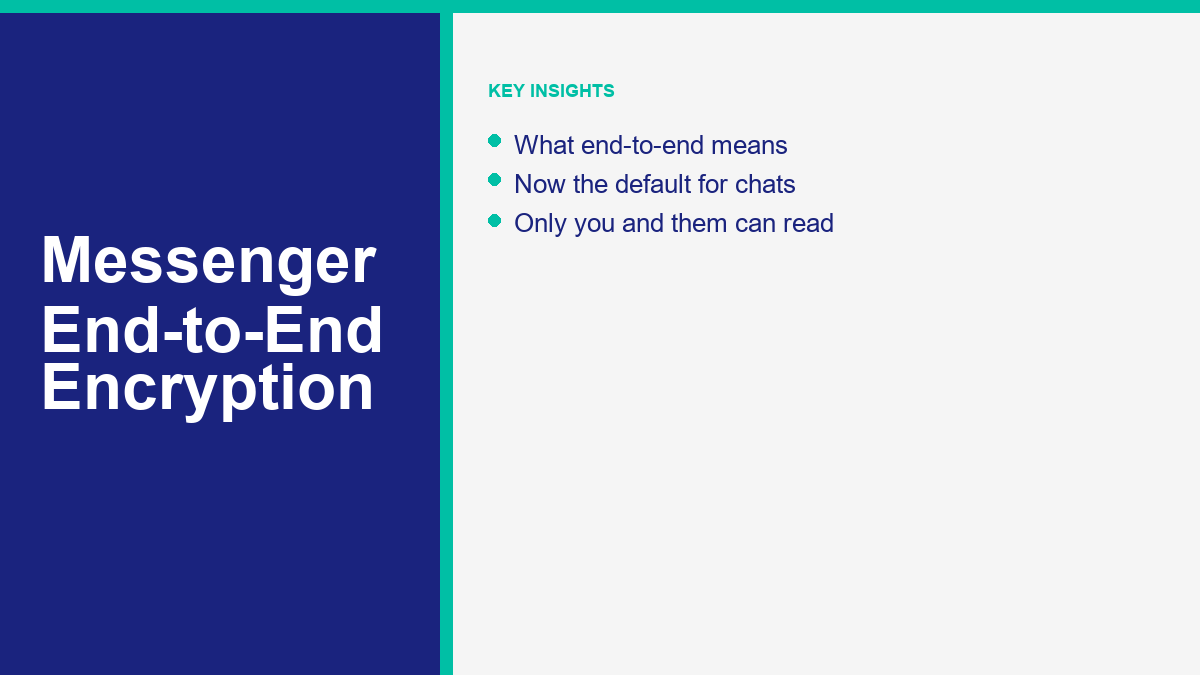
Meta has rolled out default end-to-end encryption for personal messages and calls on Facebook Messenger, transforming how you secure your private conversations. With this update, your messages, photos, videos, and voice recordings are fully encrypted from the moment they leave your device until they arrive at the recipient’s phone. This means that nobody outside your chat can read or listen to them, not even Meta itself.
This transition marks a major security update for millions of people. While standard chat protocols secure data while it is traveling to a server, end-to-end encryption ensures that the data is encrypted all the way from sender to receiver. The cryptographic keys required to unlock your chat history reside solely on your personal devices. This prevents unauthorized interception at any point along the delivery route.
However, default encryption also changes how your chat backups are managed. Because Meta cannot access your messages, you need to set up Secure Storage to prevent losing your chat history when you switch to a new phone or log in from a secondary computer. If you have noticed new alerts prompting you to create a six-digit PIN or noticed a padlock icon next to your contact’s profile, your account has already received this upgrade. This guide walks you through the technical details of how the security layer works, how to confirm your chats are secure, and how to manage your recovery keys.
What End-to-End Encryption Means in Messenger
To understand what end-to-end encryption means for your daily messaging, you must look at how standard chat platforms handle data transmission. Typically, when you send a message, it is encrypted as it moves from your device to the platform’s servers. Once the message reaches the server, the platform decrypts it, processes it, and then encrypts it again to send it to your contact. While this keeps your messages safe from network snoopers on public Wi-Fi, it leaves your data readable by the server operator. If the platform’s servers are compromised, your messages could be exposed.
End-to-end encryption changes this dynamic entirely. Under this protocol, your device uses mathematical algorithms to lock your messages before they enter the network. The only keys capable of unlocking these messages are stored directly on your phone, tablet, or desktop computer. The message remains encrypted throughout its entire journey. Even when the data passes through Meta’s routing servers, it exists only as unreadable ciphertext. Meta cannot decrypt your private chat history, and neither can any third party.
This security framework relies on a combination of public-key cryptography and the Signal protocol. When you start an encrypted session with a contact, your devices exchange public keys while keeping the corresponding private keys secret. When you write a text, your device uses your friend’s public key to encrypt the message. Once the message arrives at their device, their private key decrypts it. This process happens instantly behind the scenes for every message, photo, video, and audio call.
By keeping the private keys on your local storage, this architecture eliminates the risk of centralized data breaches exposing your private conversations. If someone were to intercept your data traffic or access the cloud servers routing the messages, they would only find encrypted blocks of text that are impossible to read without your device’s private keys. This local key management is the foundation of modern digital privacy, ensuring that your communication remains strictly between you and your contact.
Furthermore, because the keys are generated locally, they are tied to your specific hardware. If you log in on a new device, that device must go through a verification process to join the encrypted chain. This ensures that a malicious actor cannot simply guess your password and download your chat history on another device without your approval.
Messenger Made E2EE the Default – What Changed
Meta began testing end-to-end encryption years ago as an opt-in feature called “Secret Conversations.” You had to manually start a separate thread with a contact to secure it. If you forgot to toggle the setting, your messages remained unencrypted on Meta’s servers. However, Meta transitioned to making end-to-end encryption the default standard for all one-on-one personal chats and calls, removing the need for manual setup.
This shift required a massive overhaul of the application’s underlying infrastructure. Because the servers could no longer read your messages, many features had to be rewritten to run locally on your phone rather than on Meta’s servers. For example, generating link previews, rendering stickers, and searching your chat history now happen directly on your device. This change means your phone does more computational work locally to preserve the features you expect from a messaging app.
The transition also merged your standard chat threads with your secret conversations. Instead of maintaining two separate threads with the same person, you now see a single, continuous conversation that is encrypted by default. This makes the user experience much cleaner, as you do not have to manage duplicate chat windows.
However, this server-blind approach introduces a new challenge for chat history. Previously, when you logged into a new phone, Meta’s servers would instantly sync your entire chat history from the cloud. With default encryption, Meta’s servers do not hold a copy of your decrypted messages to send to your new phone. To address this, Meta introduced Secure Storage, a system that encrypts your backups before storing them in the cloud, requiring you to set up a personal recovery method like a six-digit PIN to download your chat history on a new device.
” alt=”Technical breakdown showing how default encryption processes messages locally on user devices rather than on cloud servers”/>
This structural change also means that Meta cannot assist you in recovering messages if you lose access to your recovery keys. The safety of your chat history is now in your hands. This is a trade-off between absolute privacy and convenience, as the responsibility for maintaining access keys shifts from the platform to the individual user.
How to Tell If a Chat Is End-to-End Encrypted
Because the update rolled out gradually to accounts worldwide, you should verify whether your individual chat threads have been upgraded to the encrypted protocol. The app provides several visual indicators to help you confirm the security status of your conversations.
First, look at your main chat list. If a thread is encrypted, you will see a small gray padlock icon next to the contact’s name or profile picture. This icon indicates that the conversation is secured by default. Inside the chat window itself, you will also notice a system banner when the thread is first updated, stating that your messages and calls are secured with end-to-end encryption.
Second, you can check the details section of any conversation. Tap the contact’s profile picture at the top of the chat, then scroll down to the security options. Look for a section labeled “End-to-end encryption” or “Verify security.” In this menu, you will see a list of active keys for both your device and your contact’s device.
Third, you can compare these keys to verify that no middle-man is intercepting your connection. The security keys are displayed as a series of numbers or a QR code. If you and your contact view this screen at the same time, the numbers on your screen should match the numbers on theirs exactly. You can also scan their QR code to confirm a match. If the numbers match, it proves that your communication channel is secure and that your keys have not been altered.
Additionally, standard threads that are not yet encrypted will lack these indicators. If you notice a chat does not have a padlock icon, it may be because one of you is using an outdated version of the app. Keeping your app updated ensures that your chats are upgraded to the secure protocol as soon as they are eligible. It is also common for chats with business accounts to lack encryption, as business pages require unencrypted channels to process automated customer requests.
How to Turn On / Confirm Encryption
Because Meta has made end-to-end encryption the default standard, you do not need to perform any special steps to turn it on for most of your personal chats. The app automatically upgrades your threads as both your account and your contact’s account receive the infrastructure update. However, you can manually confirm the settings and trigger the upgrade if a thread is not yet encrypted.
To confirm the encryption status on an Android or iOS device, open the app and select the chat you want to check. Tap the contact’s name at the top of the screen to open the chat details. Tap “End-to-end encryption” or “Verify security.” If the screen shows a series of numbers and states that the chat is encrypted, the feature is active. If the option is missing or shows that the chat is unencrypted, you should ensure that both you and your contact have updated your mobile applications to the latest version.
If you are communicating with someone whose account has not yet received the default update, you can still start a secure conversation manually. To do this, open your chat list and tap the pen icon in the top right corner to start a new message. Toggle the padlock icon in the top right corner to the “on” position, then select the contact you wish to message. This opens a dedicated secret conversation that is end-to-end encrypted, even if your standard thread is not.
If you find that other core options are missing from your Facebook experience, you can read our detailed guide on why your Facebook does not have Marketplace to resolve those issues.
Once the default encryption is activated, it remains the permanent setting for that specific thread. You cannot turn off encryption for individual personal chats once they have been upgraded. Meta enforces this protocol to protect user privacy across the network. If your app is up to date but you are still missing advanced capabilities, check our guide on why your Messenger does not have Meta AI to find a solution.
” alt=”Messenger security settings interface showing the verification of encryption keys and device lists”/>
Keep in mind that if you use multiple devices, such as a phone, a tablet, and a web browser on a desktop computer, each device must be verified separately to access the encrypted thread. This device-level authentication is a core component of the security protocol, preventing unauthorized hardware from reading your messages.
Secure Storage and Your PIN (Backing Up Encrypted Chats)
One of the most significant changes introduced with default end-to-end encryption is how your chat history is backed up. In the past, Meta stored your chat history in a decrypted format on their servers. When you logged in from a new device, your messages synced automatically. Now, because your messages are encrypted, Meta cannot read them or restore them for you. If you switch to a new phone without setting up a backup, your old messages will be lost forever.
To prevent this data loss, you must set up Secure Storage. Secure Storage is a secure backup system that encrypts your chat history before saving it in Meta’s cloud servers. To access this backup when setting up a new device, you must provide a secret key that only you know. The app offers several ways to set up this recovery key:
- A Six-Digit PIN: You create a private PIN that you must enter whenever you register a new device to access your chat history.
- A 40-Character Recovery Code: The app generates a long string of letters and numbers that you must save in a safe place, such as a password manager.
- Cloud Backup: You can store your recovery key in your Google Drive (on Android) or iCloud (on iOS) to bypass manual PIN entry on verified devices.
To set up Secure Storage, open the app, tap your profile icon or the menu icon, and navigate to “Privacy & safety.” Select “End-to-end encrypted chats” and tap “Secure storage.” Tap “Turn on secure storage” and select your preferred recovery method. If you choose to create a PIN, make sure it is a number you will remember, as Meta cannot reset it for you if you lose it.
If you ever need to restore your chat history on a new phone, log in to your account, and the app will prompt you to enter your six-digit PIN or upload your recovery code. Once verified, your device will download the encrypted backup from Meta’s servers and decrypt it locally, restoring all your past conversations.
Privacy-conscious individuals looking to strengthen their account security may also want to check out our walkthrough on fixing Facebook profile lock missing options to secure their profile contents.
By taking these steps to back up your keys, you ensure that your history remains accessible while maintaining the highest level of privacy. It is best practice to generate both a PIN and write down the 40-character recovery code as a physical backup in case your cloud storage accounts become inaccessible.
What Features Work Differently in Encrypted Chats
While Meta has worked to ensure that most features function normally under the encrypted protocol, some tools behave differently or are temporarily limited due to the technical constraints of local encryption.
First, media handling requires more processing on your device. When you send a link, the preview is generated by your phone fetching the webpage metadata directly, rather than Meta’s servers parsing the link. This can sometimes cause a slight delay in link previews appearing. Additionally, search functions operate locally, meaning the app must build a text index on your device’s storage. If you clear your app storage, you may have to wait for the app to re-index your messages before you can search through them again.
Second, third-party integrations and developer tools work differently. In standard chat threads, business pages can easily connect automated bots to handle customer inquiries, route messages, and process orders. However, because end-to-end encryption is designed for private one-on-one personal communications, business pages using advanced messaging APIs operate on a separate channel. Standard business pages do not use end-to-end encryption for their customer interactions so that they can integrate CRM systems, help desks, and automated tools.
If you want to build custom automated responses for your business page, you can browse our Step-by-Step Tutorials for detailed setup guides.
To automate your messaging on Facebook, you can See Our Plans and select a tier that fits your business scale.
Understanding these structural differences helps you plan your messaging setup. If you are using the app for personal conversations, default encryption protects your data. If you are running a business page, you will continue to use the standard business APIs to connect your automated systems without encryption barriers. This separation ensures that business operators can still leverage analytical tools and database integrations while keeping personal conversations private.
Additionally, some legacy features such as games within the chat interface, group polls, and certain third-party extensions might show inconsistent behavior or require updates from the developers to function in an encrypted environment. As the software updates continue, compatibility will improve, but checking feature availability inside the chat menu will confirm what is currently active.
Troubleshooting Encrypted Chats
As accounts adapt to default encryption, you may run into technical glitches or synchronization errors. Here are the most common problems and how to fix them.
A frequent issue is the “Waiting for this message. This may take a moment” placeholder. This error occurs when your device has not yet exchanged the necessary cryptographic keys with your contact’s device. This usually happens if you log in from a new phone and the other person is offline, or if their app has not updated. To resolve this, ask the other person to open their app. Once both devices connect to the network, they will exchange keys, and the message content will load.
Another common problem is forgotten PINs. If you forget your Secure Storage PIN, you can reset it, but only from a device that is already logged in and has access to your chat history. To do this, open the app on your primary phone, go to settings, select “Privacy & safety,” tap “End-to-end encrypted chats,” then “Secure storage.” From there, tap “Reset PIN” and enter a new six-digit code. If you do not have an active device and have lost your PIN, you will not be able to restore your old messages on a new phone.
If you experience synchronization issues where messages show up on your mobile app but are missing from your desktop web browser, you must authorize the desktop browser. When you log in on a computer, the browser will ask you to verify your identity using your mobile device. Open the app on your phone, approve the login, and enter your Secure Storage PIN on your computer to download your chat history.
For other account issues related to missing features, you can check our instructions for Facebook Dating not showing up to resolve activation errors.
Sometimes, clear cached data in the mobile app can resolve verification loops. On Android, you can go to your system settings, locate the app manager, select the app, and tap “Clear Cache.” On iOS, offloading the app and reinstalling it can resolve deeper database synchronization issues. Keeping your operating system and application updated to the latest release will prevent most of these cryptographic errors and ensure a seamless experience.
常见问题
How do I reset my Messenger PIN if I forgot it?
You can reset your PIN if you have at least one device that is already signed in and showing your chat history. Open the app on that device, tap the menu icon, and select the settings gear. Go to “Privacy & safety,” tap “End-to-end encrypted chats,” select “Secure storage,” and choose “Reset PIN.” If you do not have access to an active, logged-in device and did not save your 40-character recovery code, you will not be able to recover your backed-up chat history on a new phone.
Why are some of my old messages missing after getting a new phone?
This happens if you did not enable Secure Storage on your old phone, or if you logged into your new phone but did not enter your recovery PIN or code. Because Meta does not save your decrypted messages on their servers, they cannot sync your chat history to a new device without your recovery key. To restore your chats, make sure you have turned on Secure Storage in your app’s privacy settings and enter your PIN when setting up the new device.
Can I turn off end-to-end encryption in Messenger?
You cannot turn off default end-to-end encryption for one-on-one personal chats. Meta has implemented this security protocol as the permanent standard for personal communications across the platform. If you want to communicate without encryption, you must use other channels, such as sending messages to a business page, which uses a standard, unencrypted API to allow for business integrations and automated replies.
Does Messenger end-to-end encryption apply to group chats?
Yes, end-to-end encryption applies to group chats as well, but the rollout timeline and behavior may vary. Group chats must have all members on updated versions of the app that support the encrypted protocol. If a group chat has been upgraded, you will see the padlock icon in the group details, and all text and media shared within that group will be secured.
Why does it say “waiting for this message” in my chat?
This warning appears when your device is waiting for the sender’s device to come online and send the cryptographic key needed to decrypt the message. This often happens if one of you recently reinstalled the app or logged in on a new device. The message will typically display once both you and the other person are online at the same time with updated versions of the application.

 简体中文
简体中文  English
  Tagalog
  العربية
  हिन्दी
  Português do Brasil
  Español de México
  Français
  বাংলা
বাংলা  香港中文
香港中文  繁體中文
繁體中文  Nederlands
  Deutsch
  Bahasa Indonesia
  日本語
日本語  한국어
한국어  Polski
  Русский
  Español
  Tiếng Việt