
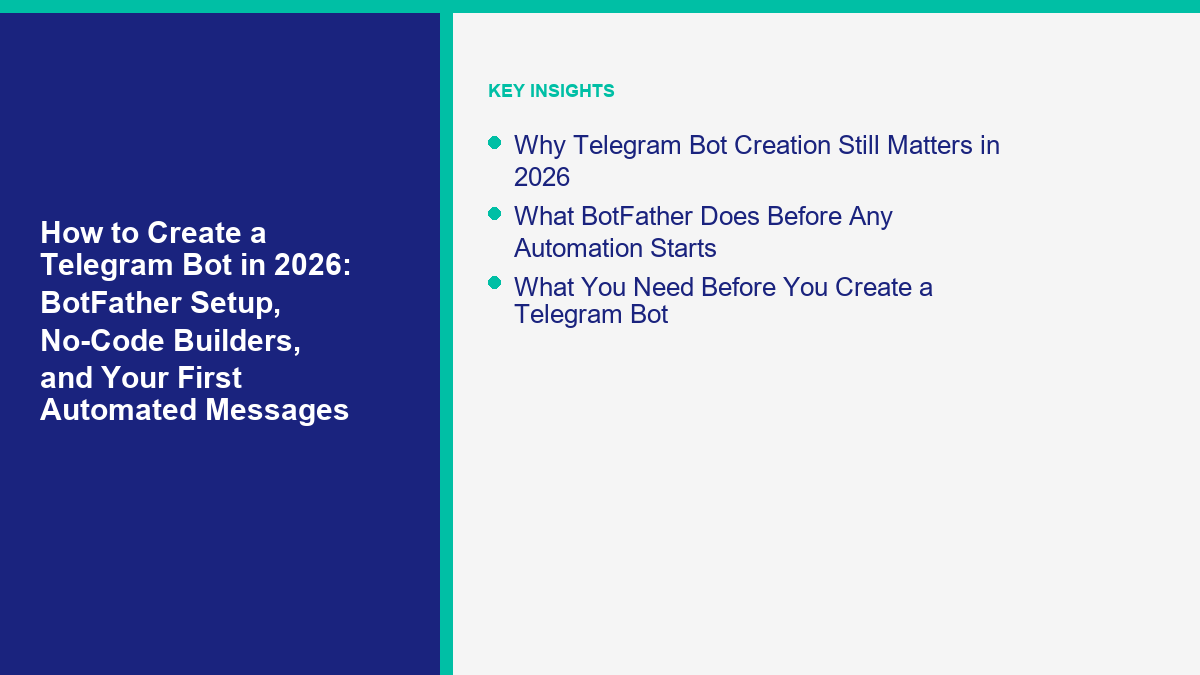
如果您想要 create a Telegram bot in 2026, the fastest honest path is still this: use BotFather to create the bot account, decide whether you want a no-code builder or custom code, then launch one narrow workflow before you start dreaming about an all-purpose AI assistant. That sounds simple because it is simple. The messy part is that most beginner guides stop too early. They show /newbot, paste a token, and act like the bot is finished.
It is not. BotFather gives you the bot identity, the username, the token, and a few core settings. It does 表示收件人已打開消息線程。Messenger 不會 give you the actual reply logic. Telegram’s own Bots FAQ still frames the default path as BotFather plus your backend server through the API, which is exactly why no-code platforms matter for non-developers and busy teams who do not want to babysit infrastructure from day one. If you already know you want the code-first route with webhooks and deployment, jump to our code-first Telegram Bot API walkthrough. This guide stays on the beginner side: BotFather, builders, and first automation.
Telegram is also not a niche channel anymore. Telegram’s official FAQ says the app is now one of the top five most downloaded apps in the world with 超過 10 億活躍用戶, and Telegram’s bot platform introduction says the platform hosts 超過 1000 萬個機器人 and is free for users and developers. That is a real ecosystem, not a side project platform. If your buyers actually live in Facebook DMs, Instagram, or on-site chat instead of Telegram, compare that workflow with 查看 MessengerBot 價格 before you build around the wrong channel just because Telegram feels more open.
Why Telegram Bot Creation Still Matters in 2026
Telegram is still one of the cleanest places to make a bot because the product already expects utility. People open Telegram to follow channels, join groups, run commands, receive alerts, and interact with bots that feel more like small tools than like marketing gimmicks. That changes what you can ship. A Telegram bot can work as a support router, booking bot, lead screener, premium content assistant, member onboarding flow, or alert engine without needing a separate mobile app.
The platform mechanics are still unusually friendly. Telegram’s Bot Features guide says users see a 開始 button the first time they open a chat with your bot, and the menu button can expose commands without forcing people to type them manually. Telegram also supports deep links like https://t.me/your_bot?start=pricing and group install links like ?startgroup=welcome, which makes onboarding much cleaner than the average “just message us” setup.
There is also a useful 2026 reality check here. Telegram’s Bot API changelog shows 機器人 API 9.6 於 2026 年 4 月 3 日. That does not mean every beginner needs to study the changelog. It does mean you should expect screenshots and older tutorials to drift out of date faster than they used to. If a builder or blog post looks frozen in 2023, be skeptical. Telegram itself is still moving.
The practical question is not “Can I make a Telegram bot?” You can. The practical question is “Should your first bot live in Telegram?” Telegram wins when the conversation is part of the product: alerts, communities, onboarding, simple commands, gated content, or lightweight support. Telegram loses when your lead flow actually starts inside Meta ads, Facebook Pages, Instagram DMs, or a website widget. That is why channel fit matters before setup speed.
What BotFather Does Before Any Automation Starts
Here is the part most first-time builders miss: BotFather is account setup, not conversation design. It registers the bot, reserves the username, issues the token, and lets you manage profile details, permissions, and commands. Your automated behavior still has to live somewhere else.
Telegram’s documentation makes this pretty clear if you read it literally. In the Bots FAQ, Telegram says the working path is to set up a bot account with @BotFather and then connect it to a backend through the API. That is the default developer route. If you are technical, that is fine. If you are not, that is why you use a Telegram bot builder like SendPulse, ManyChat, Flow XO, or BotHelp.
That distinction helps you avoid two bad beginner mistakes:
- Mistake one: thinking the bot is finished when BotFather returns a token.
- Mistake two: choosing a builder before you know what the bot actually needs to do.
A better mental model is this:
| Layer | What it handles | What it does not handle |
|---|---|---|
| BotFather | Name, username, token, commands, profile details, basic permissions | Conversation logic, CRM sync, lead capture, AI replies, analytics |
| No-code builder | Welcome flows, triggers, buttons, user fields, broadcasts, basic AI, integrations | Full custom app behavior, low-level API control, highly custom backends |
| Custom code | Anything the Bot API supports, plus your own business logic | Fast beginner setup, drag-and-drop editing, easy handoff for non-technical teams |
If your first reaction is “I just need a bot to answer the top five questions and maybe capture leads,” a no-code builder is usually the right middle path. If your first reaction is “I need custom webhooks, queueing, role-based logic, and full control over every API call,” use code. If your first reaction is “I just want a bot link and slash commands live in 10 minutes,” BotFather alone is enough for the shell, but not for the finished experience.
在創建Telegram機器人之前你需要的事項
You can make the account in a few minutes. You cannot make a useful bot in a few minutes unless you prepare a few decisions first.
- One clear job for the bot. Support, booking, lead capture, member onboarding, alerts, or premium content delivery. Pick one.
- A Telegram account you control. You need a normal Telegram account to use BotFather and manage the bot.
- A username you can keep. Telegram’s FAQ says usernames use
a-z,0-9, and underscores. For bots, builders like SendPulse and ManyChat both instruct users to choose a unique username ending in機器人或_bot. - A safe place to store the token. Password manager, secure notes, or at minimum a private environment file. Not a screenshot folder. Not a public doc.
- A first-run message. The first reply users see should explain the bot’s job in one sentence and offer the next action immediately.
You also need to decide where the bot will live:
- Private chat only if the bot is for support, lead capture, or personal utilities.
- Groups if the bot needs to moderate, onboard, or answer in a community.
- Channels or Telegram Business if the bot is part of a publishing or business workflow.
Telegram’s introduction page is blunt about one constraint that shapes everything else: bots cannot start conversations with users. A user has to add the bot to a group or message it first. That single rule changes how you think about acquisition. Your bot link, QR code, website CTA, channel post, and email button matter because they are the bridge into the first message. You are not cold-DMing your way into attention here.
Quick prep checklist
- Write a bot name that says what the bot does.
- Reserve a short, brand-safe username.
- Draft one welcome line and three menu choices.
- Decide whether the bot needs group access.
- Decide whether you want a builder or custom code after BotFather.
How to Create a Telegram Bot in BotFather Step by Step
This is the beginner setup path that still works cleanly in 2026.
Open BotFather and create the bot account
- Open Telegram and search for @BotFather.
- 輕觸 開始.
- 發送
/newbot. - Enter the public display name users will see.
- Enter a unique username for the bot.
- Copy the token BotFather returns.
SendPulse’s current Telegram setup guide still mirrors the cleanest BotFather flow for beginners: open @BotFather, hit 開始, send /newbot, choose the name, choose a unique username ending with 機器人, then copy the token. Once the bot is created, Telegram gives you the shareable t.me/<bot_username> link right away.
Screenshot cue: capture the BotFather success screen with the bot name and the public link. Blur the token completely. Do not partially blur it. Do not leave the first few characters visible. Treat it like a password.
使用 /mybots before you share anything
Most people rush the share link and skip the profile. That makes the bot feel unfinished in under five seconds. Open /mybots, select your bot, and finish the obvious public pieces first.
/setdescriptionfor the full “what this bot does” summary./setabouttextfor the short profile line./setuserpicfor the avatar./setcommandsfor the slash-command menu./setjoingroupsif the bot should or should not be installable in groups./setprivacyif the bot needs to see more than command-level group activity.
Keep the description plain. “Get support, view pricing, or book a demo” is strong. “Your intelligent digital growth assistant” is weak. Telegram users decide quickly whether a bot is useful. The description should answer that question immediately.
Set commands while the bot is still empty
Telegram’s Bot Features guide recommends supporting a few basic commands, and Telegram surfaces them in the UI. That is free usability. Use it. A new Telegram bot feels much easier when people can tap instead of guess.
/start - open the main menu
/help - explain what the bot can do
/pricing - show plans or packages
/book - request a booking or callback
/support - route to support
You do not need five commands for every bot. You need three to five commands that match the bot’s first version. If the bot only does one job, the menu should look small and intentional.
Screenshot cue: show the slash-command list inside the live bot chat on mobile. This is one of the fastest ways to make the article feel practical because readers can compare their interface with a working result.
Store the token like infrastructure, not like a setup note
A leaked Telegram bot token is not a minor housekeeping problem. It is control of the bot. If the token ends up in a public repo, a shared screenshot, or a client-facing document, rotate it and update every connected tool immediately. If you connect the bot to a builder later, the builder will also depend on that token staying current.
This is also where a lot of “my automation stopped working” tickets come from. ManyChat’s Telegram setup docs explicitly tell users to refresh the token if Telegram settings stop saving or content stops sending. That is not just a ManyChat issue. It is a general Telegram bot hygiene issue.
How to Finish Your Telegram Bot Setup So It Looks Real
Creating the bot is only half of beginner setup. The second half is the part that keeps the bot from feeling like an empty shell.
Make the bot link usable
Telegram’s FAQ explains how t.me links work: once you set a username, people can open t.me/username and jump straight into the chat without knowing your phone number. That is your default sharing link. Put it on your site, in an email footer, inside a QR code, or anywhere your audience already clicks.
If you need the bot to open a specific path, use deep links. Telegram’s Bot Features guide documents private-chat links like https://t.me/your_bot?start=pricing and group install links like https://t.me/your_bot?startgroup=welcome. Telegram says the parameter can be up to 64 characters and can use A-Z, a-z, 0-9, underscores, and hyphens.
| Link type | 範例 | Best use |
|---|---|---|
| Standard bot link | https://t.me/your_bot |
General share links from websites, bios, and emails |
| Private deep link | https://t.me/your_bot?start=pricing |
Route users into a specific welcome path |
| Group install link | https://t.me/your_bot?startgroup=welcome |
Add the bot to a group with context |
The clean beginner move is to create at least two links on day one:
- A plain
t.melink for general sharing. - A deep link for the one action that matters most, like pricing, booking, or support.
Test the first-run experience from a second account
Owners always overestimate how understandable their bot is. Open the bot from a second Telegram account or ask a teammate to test it cold. Make sure these five things work:
- The profile image looks legitimate.
- The description explains the job clearly.
- The Start button appears.
- The command menu is visible and short.
- The first reply tells the user what to do next.
If you want to compare broader bot-building patterns after this Telegram-specific setup, 瀏覽我們的教程. The channels differ, but the strongest first-run experiences always do the same thing: explain the job, show the next action, and avoid dead ends.
How to Send Your First Automated Messages Without Writing Code
This is where BotFather stops and your real bot begins. Your first automation does not need AI, CRM sync, or a giant flowchart. It needs one clean welcome message, three obvious choices, one fallback, and one human or form handoff.
Use this first-message structure
A practical starter flow looks like this:
- User opens the bot and taps 開始.
- The bot sends one short sentence explaining what it does.
- The bot offers three options with commands, buttons, or quick replies.
- Each option either answers a question or collects one piece of useful data.
- Anything unexpected gets routed back to the main menu or to a human path.
Here is a simple support-style example:
Hi, I can help with pricing, account questions, or booking a demo.

Choose one:
- Pricing
- Support
- Book a call
That is enough for a first live version. Do not turn the first message into a pitch deck. The user does not need your origin story. They need the shortest path to the job they came for.
The easiest no-code automation path for beginners
If you do not want to write code, the builder flow is usually:
- Create the bot in BotFather.
- Copy the token.
- Open the builder and choose Telegram as the channel.
- Paste the token and connect the bot.
- Create a welcome flow and a fallback reply.
- Add one trigger per core use case.
SendPulse’s current Telegram documentation is a good example of the no-code shape. It tells you to create or find the bot token in BotFather, go to 聊天機器人, connect Telegram, paste the token, then build scenarios from a default welcome flow, standard reply, and unsubscribe flow. It also supports builder elements for buttons, filters, and AI agents if you want to add more than static replies later.
That builder-first structure is why most beginners should not jump straight into webhooks. A visual builder gives you working automation faster, lets you see branches, and makes edits much easier when the bot owner is not technical.
The first three flows worth building
- Welcome flow: explains what the bot does and offers the main menu.
- Fallback flow: catches unexpected input and resets the conversation.
- One high-value flow: pricing, booking, support, or lead capture.
After that, add one new branch only when you can answer yes to this question: “Do real users keep asking for this?” If the answer is no, do not build it yet.
What to automate first and what to leave to a human
Strong first automation candidates:
- Pricing ranges
- 營業時間
- Booking links
- Basic onboarding steps
- Order or status lookup instructions
- Top-five FAQ answers
Weak first automation candidates:
- Angry support cases
- Billing disputes
- Anything regulated or high-risk
- Open-ended technical diagnosis
- Requests that require judgment, negotiation, or exception handling
Here is the rule I would use: automate repetition, not nuance. The moment the conversation needs empathy, exceptions, or account-level judgment, send it to a person or a form.
The Best Telegram Bot Builder Options to Compare in 2026
Not every no-code tool is trying to solve the same problem. Some are Telegram-first. Some are multichannel builders that happen to support Telegram. Some are better for simple menus, while others are really automation engines with a bot layer on top.
The table below focuses on current public pricing and official product pages checked April 12, 2026. Pricing changes often, especially around annual discounts and contact limits, so treat these as current starting points, not permanent numbers.
| 工具 | 最佳用途 | Official starting price | 突出的地方 | 主要權衡 |
|---|---|---|---|---|
| BotFather only | Creating the bot account and basic settings | $0 platform fee | Fastest way to register a bot, set commands, and claim your t.me 連結 |
No real automation by itself |
| SendPulse | Beginners who want a real free tier and an easy visual builder | Free tier, then Pro from $12/month monthly or $9.60/month annual at 500 subscribers | 3 chatbots, 500 subscribers, and 10,000 messages/month on Basic; welcome flow, triggers, AI Agent, templates | Subscriber-based pricing climbs as list size grows |
| ManyChat | Teams that want Telegram plus Instagram or Messenger in one workspace | Free plan, then Essential from $17/month monthly or $14/month annual | Telegram is included in Essential, which supports up to 2 channels and unlimited automations | Essential includes only 250 active contacts before overage pricing |
| Flow XO | Logic-heavy workflows and teams that want more integration depth | Standard plan at $25/month, plus interaction-based scaling | Connects to Telegram, websites, and multiple other channels; useful if you think in workflows, not just chat menus | Feels more technical than a pure beginner builder |
| BotHelp | Telegram-first sales funnels, broadcasts, and subscriber growth | $18/month for 1,000 subscribers | Telegram-first positioning, built around broadcasts, funnels, and contact growth | Less familiar to general chatbot buyers outside Telegram-heavy markets |
| Botmother | Multichannel operators who want one builder across Telegram and other messengers | Free Test plan, then Start at $49/month for 1 live bot | Telegram, Telegram Business, Facebook, Instagram, WhatsApp, and more inside one builder | Higher entry price than beginner-first tools |
Pricing and feature citations: Telegram’s 機器人平台介紹, SendPulse’s messenger pricing 並 Telegram setup guide, ManyChat’s Billing FAQ, 基本計劃, 和 Telegram connection guide, Flow XO’s pricing help page, official pricing references, 和 Telegram Business support page, BotHelp’s 定價頁面 並 Telegram product page, and Botmother’s 定價頁面 並 platforms page.
Which builder I would choose for different beginner situations
If you want the simplest balance of cost, free testing, and a real flow builder, SendPulse is the easiest beginner recommendation in this set. Its free plan is not fake. The official pricing page says you can run up to 3 chatbots, 500 subscribers, 和 10,000 messages per month for free, which is enough to validate a real use case before you start paying.
If you already know Telegram is only one channel in a larger DM strategy, ManyChat is stronger. ManyChat’s docs say Telegram is one of the channels you can build on, and the Essential plan supports up to 2個渠道 from Instagram, TikTok, Messenger, and Telegram. That makes ManyChat a better fit when Telegram is part of a wider audience mix instead of the whole business.
If your bot is drifting into “workflow engine” territory with webhooks, integrations, and cross-channel logic, Flow XO starts to make more sense. It is not the prettiest beginner tool, but it is useful if you need more control without going fully custom on day one.
If your use case is aggressively Telegram-first, especially broadcasts, subscriber funnels, and lead generation, BotHelp 並 Botmother are both worth a real look. BotHelp is cheaper at the entry tier and positions itself very directly as a Telegram growth and automation platform. Botmother costs more to start, but it is stronger if you want one bot architecture across Telegram and other messengers later.
If your actual business need is Facebook Messenger, Instagram, and website chat instead of Telegram, do not force a Telegram builder into that role. That is where a purpose-built Meta and website stack is usually faster. If that is your real shape of work, compare Upgrade to MessengerBot Pro before you spend hours adapting a Telegram-first build to a Meta-first audience.
BotFather vs No-Code Builder vs Custom Code: Which Build Path Fits
People usually ask this question too early, but it is still worth answering cleanly.
Use BotFather plus a builder when
- You want the bot live this week, not after a development sprint.
- You need menus, auto-replies, broadcasts, tags, and simple lead capture.
- Non-technical teammates need to edit the bot later.
- You want to test demand before paying for custom development.
Use BotFather plus custom code when
- You need full control over the Bot API.
- You need custom webhooks, internal systems, or unusual logic.
- You expect the bot to become product infrastructure rather than just automation.
- You want your own analytics, queues, retries, and security model.
Stay on BotFather only when
- You are claiming the bot identity now and will automate later.
- You only need the link, commands, and public profile live.
- You are still validating whether the bot deserves deeper work.
The clean decision rule is simple: if the bot needs to 工作 for real users today, BotFather alone is not enough. If the bot needs to scale and behave like software, a builder may not be enough forever. Pick the smallest path that can do the job now without blocking the likely next step.
Beginner Mistakes That Break Telegram Bots Early
Most early Telegram bot failures are not technical. They are setup and scope failures.
Treating the token like a bookmark
The token is a credential. If the token leaks, rotate it. If a builder stops working after a token change, update the token there too. Do not keep the only copy inside one person’s Telegram chat history.
Writing an empty first message
“Hello” is not a useful opening. Neither is “Welcome to our intelligent assistant.” The first message should explain the job and show the next action. Readers can forgive a plain interface much faster than they can forgive uncertainty.
Adding too many commands
A long command menu makes the bot feel harder, not smarter. Telegram already helps you surface commands. Use that advantage for clarity, not clutter.
Forgetting that users must start the bot first
Telegram’s bot docs are explicit: bots cannot start conversations with users. If nobody is messaging the bot, that is often an acquisition problem, not a bot bug. Improve your t.me links, deep links, QR codes, and calls to action.
Turning off privacy mode without knowing why
If the bot is entering groups, leave privacy mode on unless you have a clear reason to read more of the room. A lot of beginners disable it just because the option exists, then end up managing more noise and permissions than the bot actually needs.
Trying AI before the basic flows work
This is the trap that burns time fastest. If your /start flow, fallback, and booking or support path are not solid yet, AI will not save the bot. It will just hide weak structure behind fancier responses.
Choosing Telegram because it is technically interesting
Telegram is fun to build on. That does not automatically make it the right place for your customers. If the real conversations happen in Facebook and Instagram, your clever Telegram bot can still be the wrong business move. Agencies run into this constantly. If that sounds familiar and you sell automation services around Meta messaging, 加入我們的聯盟計畫 instead of forcing every client into a Telegram-shaped stack.
The Launch Checklist Before You Share Your Bot Link
Run this once before you put the bot on your site, in your bio, or in a campaign.
- 身份: name, avatar, description, and About text are finished.
- Commands:
/startand the main menu options are set. - Token: stored somewhere secure and updated in every connected builder.
- 鏈接: standard
t.melink and at least one deep link are tested. - First message: one sentence, three choices, clear next step.
- Fallback: unknown messages go somewhere useful.
- Group settings: privacy mode and join-group permissions match the real use case.
- Human path: a real person, form, or escalation route exists when the bot cannot finish the job.
- 渠道適配: you are sure Telegram is where the audience wants this conversation to happen.
If you cannot check the last line honestly, stop and fix that first. A well-built bot on the wrong channel still underperforms a simpler bot on the right one.
When Telegram Is the Wrong First Channel
Telegram is strong when the conversation starts from a link, a community, a channel, or repeat usage around utility. It is weaker when the lead source is already inside Meta or on your site and you mainly need business messaging, customer support, comment automation, or DM follow-up tied to that environment.
Use Telegram first if you are building for:
- Communities and memberships
- Alerts and notifications
- Lead magnets or premium content delivery
- Command-driven tools and micro-utilities
- Audiences that already share
t.melinks naturally
Use Messenger, Instagram, or website chat first if you are building for:
- Facebook Page support
- Instagram DM lead capture
- Website conversion and live chat
- Meta ad to message funnels
- Businesses whose customers never open Telegram for support
That is the real channel decision. The best bot builder is not the one with the most boxes on the pricing table. It is the one that sits where your audience already expects to interact.
If you want more step-by-step automation walkthroughs after this Telegram setup, 瀏覽我們的教程.
If your real need is Messenger, Instagram, or website automation rather than Telegram, compare 查看 MessengerBot 價格 and consider whether it makes more sense to Upgrade to MessengerBot Pro instead of forcing a Telegram-first build into a Meta-first job.
If you run client automation projects and want a cleaner revenue path around Messenger and Instagram services, 加入我們的聯盟計畫.
Sources and Pricing Checked April 12, 2026
- Telegram 常見問題
- Telegram bot platform introduction
- Telegram Bot Features guide
- Telegram Bot API changelog
- Telegram Bots FAQ
- SendPulse messenger pricing
- SendPulse Telegram chatbot guide
- ManyChat Billing FAQ
- ManyChat Essential plan
- ManyChat channel signup options
- ManyChat Telegram connection guide
- Flow XO pricing help page
- Flow XO official pricing reference
- Flow XO Telegram Business Bots
- BotHelp pricing
- BotHelp for Telegram
- Botmother pricing
- Botmother platforms
- Botmother payment plans
- Botmother first bot guide
常見問題
我該如何在 2026 年免費創建一個 Telegram 機器人?
Open Telegram, search for @BotFather, tap 開始, send /newbot, choose a name and unique username, and save the token BotFather returns. That part is still free. Telegram’s official bot platform page says the platform is free for users and developers. What starts costing money is automation software, hosting, AI APIs, or advanced integrations around the bot.
我需要編程技能才能製作 Telegram 機器人嗎?
不需要自己創建機器人帳戶。您可以在 BotFather 中無需代碼地完成這一操作。如果您將機器人連接到像 SendPulse、ManyChat、BotHelp、Flow XO 或 Botmother 這樣的無代碼構建器,則基本的歡迎流程也不需要代碼。如果您想要自定義的網絡回調、深度後端集成或對原始 Bot API 的完全控制,通常需要代碼。.
初學者最佳的 Telegram 機器人建構工具是什麼?
對於大多數初學者來說,最乾淨的起點是與項目形狀相匹配的工具。如果您想要真正的免費層和簡單的視覺構建器,SendPulse 是一個不錯的選擇。如果 Telegram 只是更大 Telegram 加上 Instagram 或 Messenger 設置中的一個渠道,則 ManyChat 更好。BotHelp 更加以 Telegram 為主。Flow XO 更適合工作流程密集的構建。當您想要在 Telegram 和其他幾個消息應用之間使用一個構建器時,Botmother 是有意義的。.
Telegram 機器人可以主動發送第一條消息給用戶嗎?
No. Telegram’s bot documentation says bots cannot start conversations with users. A user has to message the bot first or add it to a group. That is why your t.me links, QR codes, website CTAs, channel posts, and onboarding prompts matter so much.
我的第一個 Telegram 機器人應該自動化什麼?
從一個重複性高價值的工作開始:定價菜單、支持常見問題解答、預訂請求流程、潛在客戶捕獲路徑或會員入門流程。第一個版本應該快速解決一個明顯的問題。一旦這個有效,然後再添加人工智慧、CRM同步或更多分支。.
 香港中文
香港中文  English
  Tagalog
  简体中文
简体中文  العربية
  हिन्दी
  Português do Brasil
  Español de México
  Français
  বাংলা
বাংলা  繁體中文
繁體中文  Nederlands
  Deutsch
  Bahasa Indonesia
  日本語
日本語  한국어
한국어  Polski
  Русский
  Español
  Tiếng Việt