
尋找類似 ChatGPT 的 AI 與尋找最佳 ChatGPT 競爭者並不相同。.
大多數在應用程式中輸入 chat gpt、類似 chatgpt 的聊天機器人或類似 chatgpt 的網站的人並不是在尋找一份龐大的購買指南。他們想要的是熟悉的感覺。他們想要相同的乾淨聊天框、相同的「隨便問」工作流程、相同的寫作、頭腦風暴、編碼、檔案處理、語音和圖像的混合,但不想被鎖定在 OpenAI。.
這就是本文的角度。我檢查了公共定價頁面、幫助文檔以及供應商於 2026 年 4 月 10 日發布的模型或應用可用性說明。其中一些工具是真正的 ChatGPT 風格助手。有些是包裝器,將您路由到多個前沿模型。有些是您可以在本地運行的開放權重模型系列。如果您想要更商業化的「我應該買哪個產品來替代 ChatGPT?」版本的主題,請閱讀 更深入的 ChatGPT 替代品比較. 本文專注於相似性,而非純粹的競爭。.
為什麼人們尋找類似 ChatGPT 的 AI(以及他們實際想要什麼)
在並排比較這些工具後,模式顯而易見:當人們要求類似 ChatGPT 的 AI 時,他們很少指的是原始基準性能。他們通常指的是四種情況之一。.
首先,他們想要相同的低摩擦體驗。. ChatGPT 讓現代 AI 聊天介面感覺正常。打開應用程式,輸入問題,上傳檔案,來回對話,獲得有用的答案。感覺接近 ChatGPT 的工具更像是在複製這種節奏,而不是任何一個基準分數。.
其次,他們想要熟悉的輸出質量。. ChatGPT 仍然位於「幾乎在所有方面都表現良好」的範疇。尋找類似工具的讀者通常希望有一個可以撰寫電子郵件、解釋電子表格、總結 PDF、腦力激盪內容,並在不需要特殊模式的情況下修正一段代碼的模型。.
第三,他們想要更便宜或免費的同樣習慣。. 許多這些搜尋來自於那些達到消息限制的人,不想再訂閱 $20,或者希望在 OpenAI 被限速時有一個備用選項。.
第四,他們想要更多控制權。. 這就是開放模型的重要性。許多要求類似 ChatGPT 的 AI 的讀者其實是在問,「我可以在自己的機器上,或在不與某家公司綁定的工具內獲得 ChatGPT 風格的質量嗎?」“
這也是為什麼這篇文章需要與現有的 ChatGPT 替代方案文章保持分開。替代方案文章是一個更廣泛的市場比較。這篇文章回答了一個更狹隘的問題:一旦你開始使用它,還有什麼實際上像 ChatGPT 一樣運作?
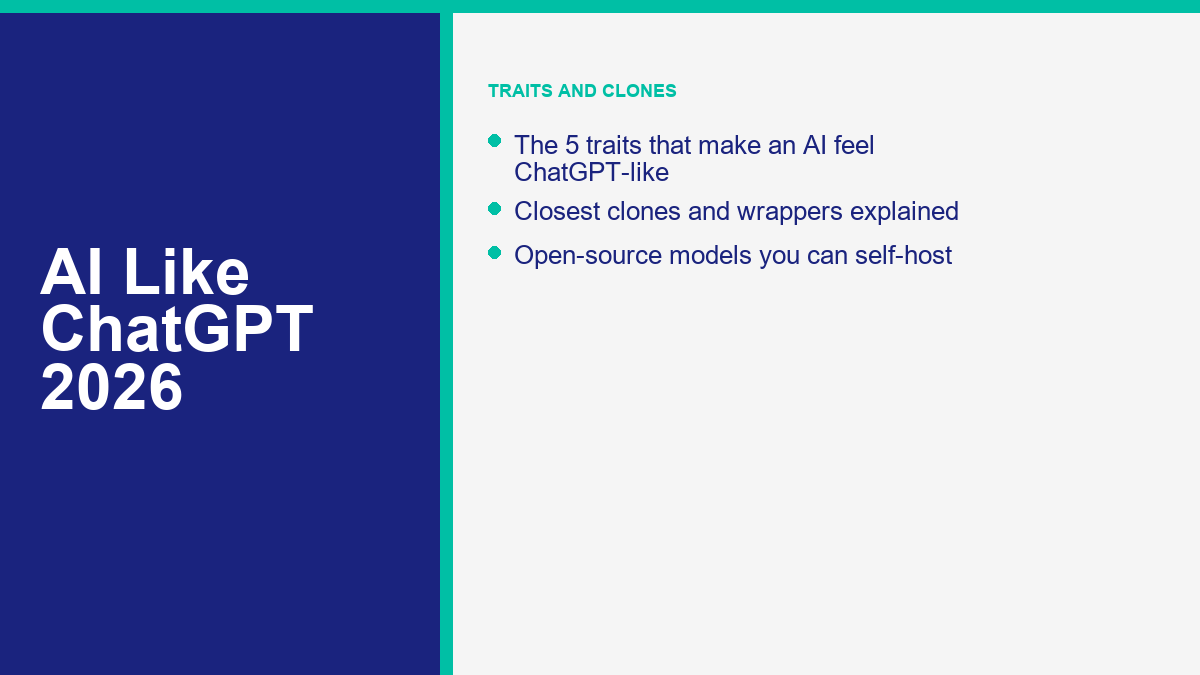
使 AI 感覺像 ChatGPT 的因素:五個重要特徵
許多工具都很智能。但在日常使用中,實際上感覺像 ChatGPT 的工具卻少之又少。這五個特徵最為重要。.
- 一個乾淨的通用聊天工作流程。. 這個工具必須讓正常對話變得簡單。提出問題,進行細化,上傳背景,繼續進行。如果產品首先感覺像是一個搜索引擎、一個玩具或一個模型選擇器,那麼它就不再像 ChatGPT。.
- 強大的線索連貫性。. ChatGPT 的運作是因為後續問題感覺自然。最好的替代品能夠很好地保持上下文,讓你可以說「縮短它」、「將其與昨天的版本進行比較」或「將其轉換為要點」,而無需重述所有內容。.
- 不僅僅是文本。. 在 2026 年,ChatGPT 不僅僅是一個文本框。人們期望有語音、文件上傳、圖像理解、網頁查詢,至少還有某種多模態能力。僅僅處理純文本的工具感覺像是舊一代的克隆品。.
- 可用的免費或入門計劃。. 如果產品在五分鐘內感覺很棒,然後就崩潰到付費牆,那麼它並不能很好地取代 ChatGPT 的習慣。熟悉感包括定價的舒適度。.
- 精緻的默認語氣。. ChatGPT 是主流,因為它落在中間:有幫助、相當中立、不太機械化、不太奇怪。這比許多模型實驗室的市場營銷所承認的更重要。.
This is why Perplexity can beat ChatGPT for research without feeling that similar overall, and why Character.AI can feel conversational without being a good ChatGPT substitute for work. Similarity is about the whole product, not just the model under the hood.
Closest Clones: Tools That Mirror ChatGPT’s Interface and Behavior
If your main goal is “give me something that feels familiar on day one,” start here.
Claude Is the Closest Overall Match
Claude is still the easiest answer for people who want another polished general-purpose assistant. Anthropic’s public pricing page shows a free tier, Claude Pro at $20 per month or $17 per month billed annually, and Max tiers at $100 or $200 per month. The core app is available on web, iOS, Android, and desktop, which matters because part of the ChatGPT feel is having the same assistant everywhere.
Where it is better: long-form writing, editing, careful reasoning, and dense file work. Claude usually sounds calmer and more deliberate than ChatGPT when you hand it messy notes or a big document. Where it is worse: heavy users run into session limits sooner than they expect, and Claude still feels a little less broad than ChatGPT when you want the biggest all-in-one consumer tool stack.
Gemini Feels Like ChatGPT With a Stronger Google Layer
Gemini is the other obvious answer because the product flow is so similar: open app, ask anything, attach content, use voice, keep a thread going. Google’s public plan pages show a free tier and Google AI Pro at $19.99 per month, with higher-end tiers above that. The exact named model exposed inside Gemini changes by plan and rollout, but the public pages clearly position the paid tier around Google’s stronger Pro-class models and much higher usage limits.
Where it is better: Gmail, Docs, Drive, Chrome, Android, camera-based help, and live multimodal interactions. If your digital life already runs through Google, Gemini can feel more useful than ChatGPT even when the raw chat feel is similar. Where it is worse: Google bundles and renames features often, so the product can feel slightly harder to track than ChatGPT or Claude if you just want one simple subscription.
Mistral Le Chat Is the Cheapest Polished ChatGPT-Like App
Mistral does not get as much mainstream attention in the US as Claude or Gemini, but Le Chat feels surprisingly close to the ChatGPT habit. Mistral’s official Le Chat launch notes still position most features as free, with Pro starting at $14.99 per month, plus iOS and Android apps. That lower entry price matters if you want a real assistant rather than a model playground.
Where it is better: speed, multilingual work, cleaner pricing, and a lighter feel. Le Chat is one of the fastest tools in normal everyday prompting. Where it is worse: smaller ecosystem, less mindshare, and less confidence from third-party app integrations. It feels like ChatGPT’s leaner European cousin, not the platform with the biggest consumer gravity.
DeepSeek Feels Like a Budget ChatGPT Clone That Actually Works
DeepSeek belongs in the closest-clone conversation because the interface is familiar and the pricing is unusually aggressive. DeepSeek’s official site currently offers free access to DeepSeek-V3.2 on web and app, and the API docs list DeepSeek-V3.2 at 128K context with pricing around $0.28 per 1M input tokens on cache miss and $0.42 per 1M output tokens. That is the kind of value that keeps developers and power users interested.
Where it is better: price-to-performance, coding value, and “good enough for daily work without paying flagship rates.” Where it is worse: polish, trust, and product smoothness. DeepSeek can absolutely feel ChatGPT-like, but it still feels more like a strong budget workhorse than the cleanest premium assistant.
Poe Is the Best Multi-Model Clone if You Hate Being Locked to One Vendor
Poe is different from the tools above because it is not one lab’s assistant. It is a routing layer across many models. Poe’s official pages show free daily points, paid subscriptions starting at $4.99 per month, and subscriber context lengths up to 2M tokens for supported bots. On the same platform you can jump between GPT, Claude, Gemini, DeepSeek, Qwen, image tools, video tools, and thousands of user-created bots.
Where it is better: flexibility, model sampling, and convenience. If your real complaint with ChatGPT is “I wish I could swap brains without changing apps,” Poe is excellent. Where it is worse: consistency. ChatGPT feels like one assistant. Poe feels like a control room.
You.com deserves a quick mention here too. It can feel ChatGPT-like in surface design, but in 2026 it is better thought of as an agent-and-research workspace than a direct one-to-one clone.
Better-Than-ChatGPT for Specific Tasks: When an Alternative Wins
The tools below are not always the closest clones. They still matter because they beat ChatGPT at specific jobs.
Perplexity Wins When You Need Search, Citations, and Verifiable Answers
Perplexity is less like ChatGPT in vibe, but better for live research. Official Perplexity help docs list a free tier, Pro at $20 per month or $200 per year, and Max at $200 per month or $2,000 per year. Those same help docs show the current advanced model mix inside paid plans, including Sonar, GPT-5.2, Claude Sonnet 4.6, and Gemini 3.1 Pro, with Max users getting access to even more premium models.
Where it is better: web research, citations, product comparisons, and “show me where that came from” work. Perplexity turns the open web into something you can actually audit fast. Where it is worse: pure chat feel. It is less relaxed, less assistant-like, and less elegant for long drafting than Claude or ChatGPT.
You.com Wins If You Want Search, Agents, and Model Choice in One Workspace
You.com’s current official plans page shows a free plan, Pro at $20 per month or $15 per month billed annually, and Max at $200 per month or $175 per month billed annually. The same page lists access to web, iOS, and Android, multi-model support, custom agents, and context windows up to 64K on Pro and 200K on Max.
Where it is better: agent-style workflows, live web answers, custom agents, and giving power users more knobs to turn. Where it is worse: the free tier is narrow, and the product can feel more like a productivity cockpit than a friendly everyday assistant.
Pi Wins for Natural Voice and Emotional Tone
Pi is still the most human-feeling conversational app in this group. Inflection continues to present it as a personal AI available across devices, and the iOS App Store listing shows it as a free app with live voice conversation. Pi is not trying to be a full ChatGPT replacement for work. That is exactly why it stands out.
Where it is better: reflective conversation, low-pressure idea sorting, voice-first use, and emotional tone. Where it is worse: research depth, structured work, citations, coding, and file-heavy tasks. Pi feels like an AI you talk with, not an AI you build a workday around.
Character.AI Wins for Personality, Roleplay, and Long Casual Chats
Character.AI is free to use, and its current c.ai+ page lists Plus at $9.99 per month or $94.99 per year. The paid tier promises better memory, access to the latest and best models, unlimited voice calls, and priority access. The free product is still active and still good at what it was built for: immersive conversation.
Where it is better: character-driven chats, roleplay, language practice, fandom use, and entertainment. Where it is worse: factual reliability and productivity. Character.AI can feel superficially similar to ChatGPT because the UI is still a chat app, but it is a very different tool once the work gets serious.
If your real question is not “what AI feels like ChatGPT?” but “which chatbot platform should I use for customer conversations or automation?”, skip consumer assistants and read the 聊天機器人平台比較. Personal AI assistants and business bot platforms solve different problems.
Open-Source Models You Can Run Locally That Match GPT-4-Class Quality
This section needs one important correction: when most people say “open-source ChatGPT alternative,” they usually mean open-weight models. That is the more accurate label for Llama, most Qwen releases, and many Mistral releases. The practical question is still the same: can you run AI like ChatGPT locally and keep control of the stack?
Llama Is Still the Safest Local Starting Point
Meta’s open source AI pages keep Llama at the center of its public open-model story, and the Llama ecosystem still has the widest compatibility across local runners, cloud hosts, and community tooling. That matters more than hype. If you want the least risky place to start a local setup, Llama is still it.
Where it is better: compatibility, community support, and broad deployment options. Where it is worse: out-of-the-box polish. Llama is a model family, not a finished ChatGPT-style product by itself.
Qwen Is the Most Interesting Open Model Family Right Now
Qwen has gotten much harder to ignore. Qwen Studio is free, the official Qwen site now points users to web, iOS, Android, macOS, and Windows apps, and recent Qwen releases include open-weight families such as Qwen3 and Qwen3.5. Qwen’s March 2026 public notes also position Qwen3.5-Omni as a native multimodal line with 256K long-context input.
Where it is better: multilingual performance, coding, agentic behavior, and open-model ambition. Where it is worse: English-market polish and pricing clarity. Qwen’s API pricing is usage-based and region-dependent on Alibaba Cloud, which is honest but harder to summarize than a flat US consumer subscription.
Mistral’s Open Models Are the Efficient Local Option
Mistral’s current models overview includes open releases such as Mistral Small 4, Mistral Large 3, Magistral Small, and smaller Ministral variants. That mix makes Mistral attractive for people who want locally runnable models that still feel modern instead of purely experimental.
Where it is better: efficiency, multilingual work, and a cleaner path for privacy-conscious teams that do not want a giant US platform by default. Where it is worse: hobbyist ecosystem depth. You can absolutely build around Mistral, but Llama still has the bigger local community footprint.
DeepSeek Open Releases Are the Value Picks if You Have the Hardware
DeepSeek is a great reminder that local quality is no longer a toy conversation. The company has open releases around its reasoning and general model lines, and the official docs keep emphasizing strong price-performance and open availability around the DeepSeek family.
Where it is better: reasoning value and developer enthusiasm. Where it is worse: hardware appetite. If you want local DeepSeek to feel frontier-class, you need more machine than most casual users expect.
HuggingChat Is the Easiest Way to Test Open Models Before You Commit to Local Setup
HuggingChat matters because it removes setup friction. Hugging Face’s docs for copying HuggingChat note that a free account works, while Pro is useful for access to some larger models, and Hugging Face Pro itself is publicly listed at $9 per month. That makes HuggingChat the easiest place to see whether you actually like open models before you start managing GPUs or local runtimes.
Where it is better: experimentation, variety, and discovering the open model world fast. Where it is worse: consistency. It is a great lab bench, not the most stable daily replacement for ChatGPT.
One practical rule saves a lot of disappointment here. Models in the 7B to 14B class can feel surprisingly good on consumer hardware when quantized well. The moment you want a local setup that consistently feels close to premium ChatGPT sessions on hard tasks, you are usually looking at larger Qwen, DeepSeek, Llama, or Mistral variants and much heavier hardware. That is why so many people start with hosted open-model sandboxes before going local.
Free AI Like ChatGPT That Actually Work Without a Subscription
The free options are better in 2026 than they were even a year ago. The catch is that “free” can mean three very different things: a real everyday free plan, a point-based sample, or an open-model playground that is free until traffic gets weird.
| 工具 | Free reality | Best free use | 主要重點 |
|---|---|---|---|
| Claude | Real free tier | Writing, editing, file summaries | Usage caps arrive fast for heavy sessions |
| Gemini | Real free tier | Google-centric everyday work | Best features sit in paid AI plans |
| DeepSeek | Free web and app access | Cheap-feeling everyday chat and coding | Less polished than top consumer apps |
| Qwen Studio | Free app and web access | Trying strong open models without paying | Polish and pricing clarity are uneven |
| HuggingChat | Free playground | Testing open-source model styles | Consistency depends on model availability |
| Poe | Free daily points | Sampling many models in one place | Premium bots burn points quickly |
If you want the short answer, the best free tools that still feel close to ChatGPT are Claude, Gemini, DeepSeek, and Qwen Studio. Claude gives the cleanest writing experience. Gemini gives the most ecosystem leverage. DeepSeek gives the best value feel. Qwen gives you a surprisingly capable free route into the open-model world.
If your real requirement is zero signup, not just zero subscription, that is a different filter. Use our guide to 無需註冊的免費 AI 聊天 for that. If you want the wider $0 market view instead, the better companion read is 今天可用的最佳免費 AI 聊天機器人:.
The tools that look free but stop feeling free first are usually Poe, Perplexity, and You.com. All three are good products. All three become much more convincing once you accept that the paid tier is the real product.
Mobile Apps Like ChatGPT: Which Ones Are Worth Downloading
Some of the best ChatGPT-like alternatives are only average on desktop and excellent on phones. That is worth separating out because plenty of readers looking for apps like ChatGPT care more about the mobile experience than the browser tab.
- Claude: Worth downloading if you want serious writing, file reading, and clean answers on mobile. It still feels like the best “work brain in your pocket” option.
- 雙子座: The best mobile pick if camera input, live voice, Android integration, and Google app handoffs matter to you.
- Perplexity: The best research app to keep on your phone because it turns dead moments into sourced answers fast.
- Pi: The best pure voice companion app. If you like talking through ideas rather than typing them, Pi still stands out.
- Character.AI: Worth it for personality and long casual sessions, not for serious productivity.
- Poe: Great if your phone is where you compare models and want one app instead of six.
- Mistral Le Chat: Better than its visibility suggests if you want a fast, lighter general assistant on mobile.
- Qwen and DeepSeek: Worth trying if you care about free access and open-model-adjacent capability more than absolute polish.
If I had to narrow that down to three installs for most people, I would pick Claude, Gemini, and Perplexity. Then I would add Pi only if voice matters a lot, or Poe only if model-switching matters more than a single consistent assistant personality.
Image, Voice, and Multimodal AIs That Match ChatGPT’s Capabilities
ChatGPT’s lead used to be simple chat quality. Now the comparison is broader. People expect image understanding, voice, live back-and-forth, web grounding, and some kind of file or camera support.
Gemini is the closest match on multimodal breadth. Its public support pages keep emphasizing text, voice, image, camera, and connected app workflows across Android and iPhone. If you want the “talk, show, upload, keep going” style that made ChatGPT popular, Gemini is the nearest mainstream match.
Claude is better for serious file and image reasoning than for flashy media generation. Anthropic’s product is strongest when you hand it screenshots, PDFs, notes, charts, or draft documents and want a smart answer back. It feels more like a work assistant than a creative media toy.
Perplexity is strongest when multimodal work starts with research. It is not the most cinematic app in this group, but it is excellent when the task is “use the web, sources, and the latest models to help me understand this file or topic.”
Qwen is the open-model wildcard here. Qwen’s newest public releases now span multimodal and omnimodal work in a way that makes it one of the most important open families to watch. It does not yet have the smoothest consumer brand feel in English markets, but the capability story is real.
Pi and Character.AI win on conversational voice feel, not total capability breadth. They are good at making AI feel less stiff. They are not the tools I would hand someone for image-heavy research or document work.
Poe is useful because it cheats in the smartest possible way. Instead of building one perfect multimodal stack, it gives you access to many of them inside one app. That makes Poe a strong pick for people who want one place to reach text, image, video, and voice models without committing to one vendor’s worldview.
Honest Comparison Table: 12 AIs Ranked by How Close They Feel to ChatGPT
This ranking is about familiarity, not absolute intelligence. A lower-ranked tool may still be the better product for your use case.
| 排名 | AI | How close it feels to ChatGPT | Verified price and availability, April 10, 2026 | Where it is better | Where it is worse |
|---|---|---|---|---|---|
| 1 | Claude | 9.5/10 | Free; Pro $20/mo or $17/mo annual; Max $100/$200 monthly; web, iOS, Android, desktop | Writing, long files, careful reasoning | Usage caps and a smaller mainstream tool stack than ChatGPT |
| 2 | Gemini | 9.1/10 | Free; Google AI Pro $19.99/mo; web, Android, iOS; stronger Pro-class models on paid plans | Google ecosystem, camera, live multimodal help | Feature naming and rollout complexity |
| 3 | Mistral Le Chat | 8.7/10 | Free; Pro from $14.99/mo; web, iOS, Android | Speed, multilingual work, lower entry cost | Smaller ecosystem and less product gravity |
| 4 | DeepSeek | 8.4/10 | Free on web and app; API around $0.28 in and $0.42 out per 1M tokens; DeepSeek-V3.2 on web, app, API | Value, coding, price-to-performance | Polish and trust feel behind top consumer apps |
| 5 | Qwen | 8.1/10 | Qwen Studio free; apps on web, iOS, Android, macOS, Windows; API pricing varies by region and model | Multilingual, open-weight releases, coding and multimodal ambition | Less polished English-market product experience |
| 6 | Poe | 7.9/10 | Free daily points; paid plans starting at $4.99/mo; web, iOS, Android, macOS; up to 2M context on supported bots | Many models in one app | No single stable assistant personality |
| 7 | You.com | 7.6/10 | Free; Pro $20/mo or $15/mo annual; Max $200/mo or $175/mo annual; web, iOS, Android | Agents, search, custom workflows | Free plan is narrow and the product feels more like a cockpit |
| 8 | Perplexity | 7.1/10 | Free; Pro $20/mo or $200/yr; Max $200/mo or $2,000/yr; web and mobile; advanced models vary by plan | Research, citations, current answers | Search-first feel, less natural as a pure chat replacement |
| 9 | HuggingChat | 6.8/10 | Free; Hugging Face Pro $9/mo optional; web-first open-model playground | Open-source experimentation | Inconsistent daily-driver feel |
| 10 | Llama | 6.5/10 | Meta AI is free; local costs depend on hardware or host; open-model ecosystem rather than one fixed app | Control, local deployment, community support | Not a polished ChatGPT-style product by itself |
| 11 | Pi | 6.0/10 | Free; personal AI app available across devices | Voice and emotional tone | Weak for research, files, and technical work |
| 12 | Character.AI | 5.6/10 | Free; c.ai+ $9.99/mo or $94.99/yr; web, iOS, Android | Personality, roleplay, long casual chats | Factuality and work-focused usefulness |
Two notes on that table. First, I ranked by user experience familiarity, not lab prestige. Second, I did not force fake precision where vendors do not offer it. Qwen’s API pricing varies by region and model, and Google’s exact named model exposure shifts by plan and rollout. Pretending those are as static as a $20 monthly plan would be less honest, not more useful.
Which One to Pick Based on Your Use Case
If you want the fastest recommendation, use this shortlist.
- Pick Claude if you want the closest all-around replacement for ChatGPT.
- Pick Gemini if you already live in Gmail, Docs, Drive, Search, and Android.
- Pick Mistral Le Chat if you want a cheaper polished assistant with less bloat.
- Pick Perplexity if research and citations matter more than chat feel.
- Pick Poe if you want access to many frontier models in one subscription.
- Pick Qwen or Llama if local control and open-weight models are the real goal.
- Pick DeepSeek if value and coding matter more than polish.
- Pick Pi if you want a voice-first AI companion.
- Pick Character.AI if you want personality and roleplay, not a productivity tool.
Before you pay for anything, run this five-step filter:
- Decide whether you want a clone, a specialist, or a local model. Those are different purchases.
- Run the same real prompt through three tools. Do not benchmark with a toy question. Use an actual document, actual code, or an actual work task.
- Check whether web citations matter. If yes, Perplexity jumps way up the list.
- Check whether mobile matters more than desktop. If yes, Gemini, Claude, Pi, and Perplexity pull ahead.
- Be honest about budget. Free plans are good now, but some are real everyday products and some are just sample mode.
If you want the broader market view after this, go back to the 更深入的 ChatGPT 替代品比較. That article is better for deciding what to buy across the whole category. This one should help you answer the narrower question first: what else actually feels like ChatGPT when you start using it?
If your real goal is not another personal AI tab but a system that handles customer conversations on channels you already own, compare the 聊天機器人平台比較 然後 查看 MessengerBot 價格. Consumer AI chat and business messaging automation overlap less than most roundup posts make it sound.
常見問題
哪種人工智慧最像 ChatGPT?
Claude is the AI that feels most like ChatGPT overall in 2026. It has the closest mix of polished chat flow, strong writing, file work, and general-purpose usefulness. Gemini is the next closest mainstream option, especially if you already use Google’s apps every day.
有沒有免費的 AI 像 ChatGPT 一樣運作?
是的。Claude、Gemini、DeepSeek 和 Qwen Studio 都提供免費選項,這些選項在沒有訂閱的情況下仍然感覺非常有用。Claude 是寫作和一般聊天質量方面最強的免費選擇,而 DeepSeek 是如果你關心編碼和成本效益的話,最具性價比的免費選項。.
我可以在自己的電腦上運行像 ChatGPT 這樣的 AI 嗎?
是的,但體驗取決於模型大小和您的硬體。Llama、Qwen、Mistral 和 DeepSeek 都有可以在本地運行的開放權重模型選項。較小的模型在消費者機器上運行良好,但如果您想要在困難任務上接近高端 ChatGPT 質量的體驗,通常需要更強的 GPU 或更輕的託管設置。.
2026年最好的ChatGPT替代品是什麼?
If “best” means closest overall replacement, Claude is still the strongest answer. If “best” means best for research, it is Perplexity. If “best” means best for Google users, it is Gemini. If “best” means best open-weight option to run locally, Qwen and Llama are the most practical starting points.
有任何類似於 ChatGPT 的手機應用程式值得使用嗎?
是的。根據您的目標,Claude、Gemini、Perplexity、Pi、Poe 和 Mistral Le Chat 都值得下載。Gemini 最適合多模態的移動幫助,Claude 最適合認真的工作,Perplexity 最適合研究,而 Pi 最適合如果您主要想要自然的語音對話。.


 香港中文
香港中文  English
  Tagalog
  简体中文
简体中文  العربية
  हिन्दी
  Português do Brasil
  Español de México
  Français
  বাংলা
বাংলা  繁體中文
繁體中文  Nederlands
  Deutsch
  Bahasa Indonesia
  日本語
日本語  한국어
한국어  Polski
  Русский
  Español
  Tiếng Việt