
這個 zendesk vs intercom decision looks simple until you put real support volume, real procurement rules, and real AI usage on the same spreadsheet. On the surface, both products promise modern omnichannel support, AI help, automation, analytics, and a cleaner customer experience. In practice, they are still built with different instincts. Zendesk is closer to a full service operating system. Intercom is closer to an AI-first digital support platform that happens to be widening into a help desk.
I reviewed official pricing pages, Help Center documentation, and plan details from both companies on 2026年4月12日. That date matters here because both products have changed meaningfully in the last year, especially around AI packaging. If you are comparing intercom vs zendesk using a 2024 buying guide, you are almost certainly using the wrong cost model.
One quick reality check before we get into the platform details: neither product is 無需註冊. These are enterprise support systems, not consumer chat apps. Intercom currently offers a 14天免費試用,無需信用卡, 而Zendesk繼續提供一個 14天免費試用, 但對於計劃擴展的運營團隊來說,這兩者都不是一個真正的永久免費選擇。.
這篇文章故意保持狹窄。它是為了支持領導者、RevOps團隊和創始人比較兩個認真的客戶服務平台,而不是隨意瀏覽通用的AI工具。如果您想在此之後獲得更廣泛的市場地圖,包括更新的AI助手和輕量級自動化工具,請從 完整的聊天機器人比較. 開始。在這裡,工作更簡單:找出哪個平台在價格、AI質量、渠道和遷移痛點都得到平等重視後實際上獲勝。.
為什麼在2026年Zendesk與Intercom的決策感覺更困難
在2026年,企業支持平台的決策變得更加困難,因為產品的趨同足以讓買家感到困惑。Zendesk現在對AI代理、Copilot、質量保證和人力資源管理的討論變得更加積極。Intercom現在對下一代幫助台工作流程、電話、票務、多品牌支持和結構化服務操作的討論變得更加積極。如果您僅僅閱讀首頁,兩家供應商聽起來似乎解決了完全相同的問題。.
They do not. Zendesk still feels strongest when support is a true operating function with queues, routing rules, SLAs, brands, voice, skills, reporting layers, and teams that need to manage work across email, calls, and messaging from one control plane. Intercom still feels strongest when support is digital-first, the AI layer is central to the business case, and the team wants fast setup with less admin overhead.
這很重要,因為許多買家實際上並不是在問,“我更喜歡哪個標誌?” 他們在問一個更具操作性的問題:
- 在我們擁有 50、200 或 1000 名代理商的情況下,哪個平台會更穩定?
- 哪個 AI 代理在不將項目變成六個月實施的情況下更易於使用?
- 哪種定價模式在財務會議中更容易辯護?
- 哪個平台對渠道、分析和遷移的痛苦妥協要求最少?
一旦你以這種方式框定比較,答案就會變得更清晰。Zendesk 不再僅僅是 “較舊的企業選擇”,Intercom 也不再僅僅是 “即時聊天公司”。但它們仍然因不同的原因而獲勝,如果你忽略這一點,你最終會過度購買一個平台或低估另一個平台。.
2026 年的 Zendesk:套件、AI 代理和快速定制的清晰定價
Zendesk 2026 的故事實際上是兩個故事建立在同一平台之上。第一個故事是熟悉的套件定價階梯。官方的 Zendesk 頁面仍然顯示 每位代理每月 $55 的套件團隊, 每位代理每月 $89 的套件增長, 和 Suite Professional at $115, 所有按年計費,企業定價通過銷售處理 (Zendesk FAQ 軟體頁面)。第二個故事是 AI 包裝層: Suite + Copilot 專業版每位代理每月 $155, Suite + Copilot 企業版每位代理每月 $209, 以及一個獨立的 Copilot 附加功能每位代理每月 $50 按年計費 (Zendesk 定價).
這個區分很重要,因為 Zendesk 不再將 AI 視為一個簡單的附加功能。一些 AI 功能現在已包含在 Suite 和 Support 計劃中,而更深層的 AI 代理和 Copilot 層仍然進入捆綁或附加定價。Zendesk 自己的幫助文檔表示,所有 Suite 和 Support 計劃都包括訪問 AI 代理功能,包括對話機器人和文章自動回覆,並且使用量現在以 automated resolutions rather than the older Answer Bot or MAU model (Zendesk automated resolutions help article).
The important detail most comparison posts skip is the included AI allowance. Zendesk says current plans include a baseline number of automated resolutions: 5 per agent per month on Team, 10 per agent per month on Growth, 和 15 per agent per month on Enterprise. The same help article also says plans have a maximum of 10,000 allocated automated resolutions per year. That means Zendesk’s entry-level AI is generous enough to test, but large AI-heavy programs quickly stop fitting inside the included allowance and move into add-on or overage territory that is not fully public on the pricing page.
Zendesk’s operational strengths are still easy to see once you get below the marketing layer. Suite Team already includes messaging with live chat, proactive messaging, a customer and internal knowledge base, phone support with call routing, automated phone ticket creation, voicemail, call recording, and social messaging including Instagram, WhatsApp, Slack, and more. Suite Professional adds live and custom analytics, skills-based routing, side conversations, and customer satisfaction surveys on public feature pages and plan documentation (Zendesk featured pricing page; About omnichannel routing).
Zendesk is also still deeper on classic service operations. Omnichannel routing works across email, calls, and messaging. Agents can use a single unified status. On Growth plans and above, routing can factor in SLA timing. On Professional plans and above, routing can also use priority and skills. Side conversations are available on Professional and above. Multiple ticket forms are available from Growth upward. Those are not flashy features, but they matter more in real support orgs than another glossy AI demo.
The analytics story is another reason enterprises still default to Zendesk. Zendesk Explore Lite is bundled with Suite Team and Growth, Explore Professional with Suite Professional, and Explore Enterprise with Suite Enterprise. That gives Zendesk a clear ladder from basic reporting to more serious service intelligence without forcing teams to bolt analytics on from a separate vendor (About Zendesk Explore plan types).
Its weaknesses are just as real. Zendesk’s AI pricing is less transparent than Intercom’s. Advanced AI agents are still effectively quote-driven. Voice and channel coverage are broad, but not always instantly modelable from one clean public calculator. And while Zendesk can absolutely work for digital-first teams, it still carries more operational weight. If your support motion is mainly chat, email, and self-serve with minimal phone complexity, Zendesk can feel like more platform than you strictly need.
The short version is this: Zendesk in 2026 is still the safer buy when service complexity is the problem. It is a weaker buy when speed, simplicity, and AI cost clarity are the problem.
Intercom in 2026: Fin, Workflows, and Pricing Built for Digital-First Teams
Intercom’s 2026 positioning is cleaner than Zendesk’s because the pricing page makes the product thesis obvious right away. The current public page shows three customer service plans: Essential at $29 per seat per month, Advanced at $85, 和 Expert at $132, all billed annually. Every plan includes access to Fin AI Agent, which is priced at $0.99 每個結果 (Intercom 價格).
Intercom’s plan packaging is easier to explain than Zendesk’s. Essential is the small-team entry point. Advanced is where workflows, round-robin assignment, multiple inboxes, and private or multilingual Help Center support start to look like a real support operation. Expert adds the things larger teams actually ask procurement about: SSO and identity management, HIPAA support, service level agreements, multibrand Messenger, multibrand Help Center, workload management, team office hours, and more advanced controls (Intercom plans explained).
Fin is the main reason Intercom is on so many shortlists right now. Official Intercom materials describe Fin as an AI agent that answers email, live chat, phone, WhatsApp, social, and more, can take action on external systems, and can be configured through Procedures for more complex, multi-step tasks like refunds or subscription issues. Intercom is also unusually direct about what counts as a billable AI event: a Fin outcome is charged once per conversation when Fin resolves the issue or executes a Procedure that ends in a resolution or intentional handoff.
That pricing clarity is not a tiny detail. It changes how finance teams model the product. Intercom tells you the seat price. It tells you Copilot is $29 per agent per month billed annually. It tells you the Pro analytics and quality layer is 每月 $99 and includes analysis of 1,000 conversations. It tells you Fin on Zendesk or Salesforce is also $0.99 每個結果, with a 50-outcome monthly minimum and no extra seat, setup, or integration fees. That is cleaner than most enterprise AI pricing in 2026.
Intercom’s channel design is also more transparent than a lot of competitors. All plans include free unlimited live chat, support email, in-app chats, banners, and tooltips. Inbound WhatsApp conversations are also free. SMS, bulk email, bulk WhatsApp, phone segments, and outbound message channels are billed on a usage basis. For US teams, Intercom’s public usage-based channel documentation currently starts SMS at $0.06 per segment for the first 500 segments, while UK pricing starts at $0.09 per segment in the first tier (Usage-based channels).
The product’s biggest strength is time to value. Intercom says Fin can be set up in under an hour on your current help desk, and the company explicitly supports Fin on Zendesk, Salesforce, HubSpot, Freshworks, Dixa, Front, Zoho, Sprinklr, and Gorgias. That means Intercom is no longer just a rip-and-replace choice. It is also a layer you can test on top of your existing support stack.
Its main weakness is that the digital-first DNA is still visible. Intercom is much better at enterprise support in 2026 than it was a few years ago, but it is still less naturally suited than Zendesk to phone-heavy, queue-heavy, deeply ticket-centric operations. Some of the classic enterprise guardrails, especially SLAs and identity features, sit only on Expert. That makes the low $29 headline less relevant for serious procurement than it first appears.
The honest bottom line: Intercom in 2026 is the sharper product if your support team lives online, wants a better AI agent immediately, and values public pricing transparency. It is the weaker default if your support org already behaves like a contact center.
The Feature-by-Feature Comparison Table That Shows the Real Tradeoffs
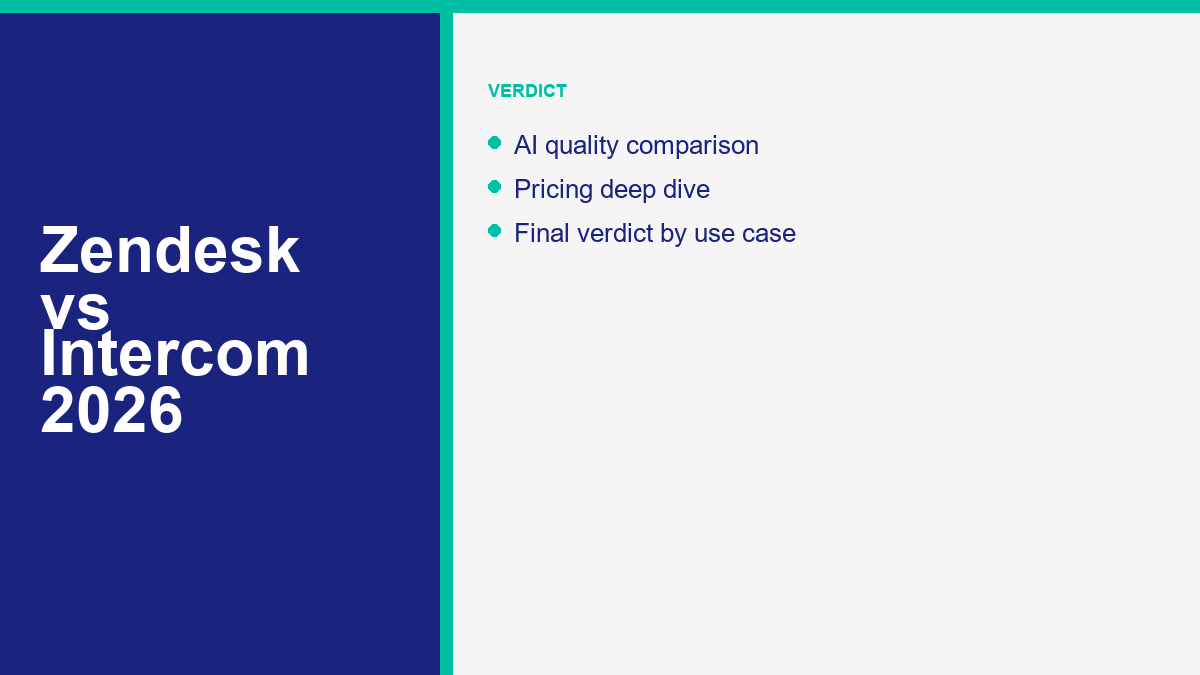
Plenty of zendesk or intercom comparison posts flatten this into a vibe check. That is not useful. The real question is which product introduces the least damaging compromise for your support model. The table below uses April 12, 2026 official documentation and pricing pages.
| 能力 | Zendesk | Intercom | Practical edge |
|---|---|---|---|
| No sign up required | 否 | 否 | No one; both are enterprise systems |
| Permanent free plan | 否 | 否 | No one |
| 免費試用 | 14 days | 14 days, no credit card | Intercom |
| Lowest public paid entry | 每位代理每月 $55 的套件團隊 | Essential at $29 per seat per month | Intercom |
| Most relevant public enterprise-ready tier | Suite Professional at $115, Enterprise through sales | Expert at $132 per seat per month | Intercom for transparency, Zendesk for depth |
| AI agent pricing model | Included baseline automated resolutions plus add-ons or overages | 每個 Fin 結果 $0.99 | Intercom |
| Agent assist pricing | Copilot 附加功能每位代理每月 $50 | Copilot add-on at $29 per agent per month | Intercom |
| 電子郵件支援 | 是的 | 是的 | Tie |
| Live chat and messaging | Yes, core Suite capability | Yes, included on all plans | Tie |
| 電話支援 | Native and deeper for service teams | Supported, but more usage-based and digital-first | Zendesk |
| Included channel support with add-on options and five numbers in Suite | Supported, inbound conversations free, outbound usage-based | Tie, with different billing logic | |
| Social messaging | Instagram, WhatsApp, Slack, and more on public feature pages | Social supported, but not marketed as deeply in routing docs | Zendesk |
| 知識庫 | Customer and internal knowledge base in Suite | Public Help Center on all plans; private and multilingual from Advanced | Zendesk |
| 工作流程自動化 | Strong ticketing and routing automation | Strong workflows and round-robin from Advanced | Tie |
| Skills-based routing | Yes, on Professional and above | No equivalent published on plan page | Zendesk |
| SLA management | Yes, stronger service-desk orientation | Expert only | Zendesk |
| Multibrand support | Yes, deeper historical support for brand complexity | Expert only for multibrand Messenger and Help Center | Zendesk |
| SSO and identity management | Enterprise-oriented SSO options | Expert only | Zendesk |
| Analytics depth | Explore Lite, Professional, and Enterprise ladder | Pre-built reports plus Pro add-on analytics | Zendesk |
| AI visibility tools | QA and WFM sold separately | Pro add-on includes CX Score, Topics, Recommendations, Monitors, Custom Scorecards | Intercom |
| Migration friendliness | Possible, but often API-heavy | Better official migration guidance | Intercom |
| Public pricing clarity | Good on seats, weaker on advanced AI usage | Very good overall | Intercom |
| 最佳契合 | Complex omnichannel service operations | Digital-first AI customer support | Depends on support model, not brand prestige |
Which AI Agent Is Actually Better in 2026: Zendesk AI or Intercom Fin?
This is where the comparison gets interesting, because the answer depends on whether you mean the better AI agent or the better AI-enabled support platform. Those are not the same thing.
Intercom Fin is ahead on the AI agent side. Intercom publishes a much cleaner billing model, a much clearer definition of what counts as a result, and a much clearer story around deployment. Fin can answer across email, live chat, phone, WhatsApp, social, and more. It can hand off to humans in the preferred inbox. It supports Procedures for multi-step tasks. It can take action on external systems. It can also be deployed on top of non-Intercom help desks, including Zendesk itself. That is a serious advantage because it lowers the cost of proving value.
Zendesk’s AI is stronger when you zoom out from the bot itself and look at how AI fits into the entire service workflow. Zendesk auto assist uses procedures, public help center articles, similar solved tickets, and generic LLM knowledge to make suggestions to agents. Zendesk AI agents also tie more naturally into the ticketing, routing, knowledge, and QA structure the rest of the product is already built around (About auto assist).
That distinction matters in the real world. Intercom Fin is easier to champion when leadership wants visible AI wins fast. Zendesk AI is easier to champion when leadership wants AI inside a larger service operating model that already depends on queues, routing logic, performance management, and broader governance.
Language handling is another subtle point. Intercom’s own Fin documentation is explicit that language mismatches between the customer’s browser and your knowledge sources can block answers unless real-time translation is enabled. That is not a flaw so much as a reminder that Fin behaves like an AI product you tune. Zendesk behaves more like AI embedded into a service suite you administer. Both approaches can work. The operational posture is different.
If you want one clean winner for AI in 2026, Intercom Fin wins. It is clearer to price, quicker to pilot, and more obviously built as the centerpiece of the product story. If you want the better AI-enhanced service operating system, Zendesk wins. That is the most honest split.
If your actual buying project is less “replace the whole support stack” and more “reduce repetitive service workload with AI,” the broader 人工智慧客戶服務 guide is the better companion read because it covers where AI agents save money and where they still need guardrails.
What It Really Costs at 50, 200, and 1000 Agents
This is the section most readers care about and the section most comparison posts fudge. So here are the assumptions up front:
- All pricing below uses annual billing and public April 12, 2026 price points.
- Zendesk calculations use Suite Professional 並 Suite + Copilot Professional because that is the lowest public tier where the product starts to feel enterprise-ready for analytics and routing.
- Intercom calculations use 先進的 plus optional Copilot because that is the lowest tier where workflows and multiple inboxes become real. I note Expert separately where relevant.
- For AI-agent usage, I model a steady volume of 10 AI resolutions or Fin outcomes per agent per month. Zendesk publicly discloses included automated-resolution baselines and a 10,000-per-year allocation cap, but it does not publish the full large-scale overage math on the main pricing page.
| Team size | Modeled AI volume | Zendesk Suite Professional | Zendesk Suite + Copilot Professional | Zendesk public AI allowance signal | Intercom Advanced | Intercom Advanced + Copilot | Intercom Fin cost at modeled volume | Intercom total with Copilot + Fin |
|---|---|---|---|---|---|---|---|---|
| 50 agents | 6,000 outcomes per year | $69,000 per year | $93,000 per year | Within the public 10,000-per-year cap | $51,000 per year | $68,400 per year | $5,940 per year | $74,340 per year |
| 200 agents | 24,000 outcomes per year | $276,000 per year | $372,000 per year | Exceeds the public 10,000-per-year cap | $204,000 per year | $273,600 per year | $23,760 per year | $297,360 per year |
| 1000 agents | 120,000 outcomes per year | $1,380,000 per year | $1,860,000 per year | Far above the public 10,000-per-year cap | $1,020,000 per year | $1,368,000 per year | $118,800 per year | $1,486,800 per year |
Three things jump out immediately.
First, Intercom is usually cheaper at the base seat level for digital-first teams. That is not a surprise. Even before you touch Fin, Intercom Advanced undercuts Zendesk Suite Professional by a wide margin at 50, 200, and 1000 agents. Add Copilot, and Intercom still remains cheaper than Zendesk’s public Copilot bundle.
Second, Intercom’s AI costs are easier to forecast because the meter is explicit. If Fin resolves 6,000 conversations in a year, you can price it. If it resolves 120,000, you can price that too. Zendesk gives you included AI capacity, which is good, but once you move beyond the included allocation and into serious AI volume, the public cost model gets much less visible.
Third, if you need Intercom Expert for SSO, HIPAA support, SLAs, multibrand Messenger, and identity controls, the cost gap shrinks. Intercom Expert plus Copilot works out to $96,600 per year at 50 agents, $386,400 at 200 agents, 和 $1,932,000 at 1000 agents before Fin outcomes. That still does not automatically make Zendesk cheaper, but it does move the comparison from “Intercom is obviously lower cost” to “Intercom is lower cost if its operating model still fits.”
The practical read is this: Intercom has the better public TCO story. Zendesk may still have the better operational TCO for teams that would otherwise need extra tools, extra routing workarounds, or more reporting layers to make Intercom behave like a mature service operation. If you want a more general framework for when usage pricing becomes dangerous, the 聊天機器人定價指南 breaks down the billing patterns that quietly blow up budgets.
Where Each Platform Wins on Omnichannel Coverage: Email, Chat, Phone, Social, and Messaging
Both platforms can reasonably claim omnichannel support in 2026. The difference is how broad the channel model is and how naturally the channels fit the rest of the product.
Zendesk still wins on pure channel breadth inside a service operation. Its public feature pages make clear that Suite includes email, messaging with live chat, proactive messaging, phone support with call routing, automated phone ticket creation, voicemail, call recording, text messaging, and social messaging including Instagram, WhatsApp, Slack, and more. Zendesk also documents omnichannel routing across email, calls, and messaging, with unified agent status and higher-tier routing based on SLA timing, priority, and skills. That is a mature service-ops answer, not just a channel checklist.
Intercom’s channel mix is more elegant if your support posture is web-first and app-first. All plans include live chat, support email, in-app chats, banners, and tooltips. Inbound WhatsApp conversations are free to use. SMS, phone, bulk email, and bulk WhatsApp are usage-based. That is a good design for teams that want lighter fixed seat costs and are comfortable paying more only when certain channels actually get used.
The tradeoff is predictable. Zendesk feels better when phone and messaging need to coexist inside one queue and one routing brain. Intercom feels better when chat, email, in-app support, and AI self-service are the center of gravity, and voice is important but not the whole operating model.
My winner here is Zendesk. Intercom is fully credible on omnichannel support now, but Zendesk still has the more complete service-platform interpretation of omnichannel.
Why Zendesk Still Has the Edge on Reporting and Analytics Depth
Reporting is where flashy AI positioning stops mattering and service maturity starts mattering. Support leaders do not just need dashboards. They need answers to questions like:
- Which queues are missing SLA targets?
- Which channels are consuming the most expensive human time?
- Which skills or brands create the longest handle times?
- Which AI deflections are truly resolved versus quietly abandoned?
Zendesk is still better built for those questions. Explore gives Zendesk a reporting ladder instead of a reporting checkbox. Lite comes with Team and Growth. Professional comes with Suite Professional. Enterprise comes with Suite Enterprise. Public pricing pages also call out live and custom analytics on higher tiers. Add Zendesk Quality Assurance at $35 per agent per month and Workforce Management at $25, and you have a fairly complete reporting and performance stack inside the same vendor family.
Intercom is not weak here. All plans include pre-built reports, and the Pro add-on at $99 per month gives you CX Score, Topics, Recommendations, Monitors, and Custom Scorecards. That is useful, especially for teams that want tighter visibility into AI performance and conversation quality. But it still feels more like strong conversation intelligence layered onto a digital support product than a full analytics operating system for a large support org.
So the winner is Zendesk. If your exec team cares about deep service analytics, custom reporting, and performance management as much as they care about AI resolution rates, Zendesk remains the stronger choice.
How Hard It Is to Switch Between Zendesk and Intercom
Switching between the two platforms is possible. It is not easy. Anyone telling you otherwise has probably never had to migrate automations, SLAs, article structures, custom fields, historical conversations, and team habits at the same time.
Intercom’s documentation is better for inbound migration. Its official historical migration guide explicitly walks through planning, mapping, setup, export and import scripting, and the decision of whether Zendesk records should become Intercom conversations or Intercom tickets. It also calls out the need to create or import contacts first and then map the rest of the data correctly (Historical data migration to Intercom).
Zendesk is more fragmented here. Its current Data importer is still described in Help documentation as an open beta for importing CSV data into users, organizations, and custom object records. That is helpful, but it is not the same as a first-class Intercom-to-Zendesk migration path for complete support history. In practice, deeper migrations into Zendesk often involve API work, staging, mapping, and more manual QA than teams expect (Zendesk Data importer help article).
If you have to move, use this checklist before you sign the contract:
- Audit every custom field, macro, workflow, SLA, queue, and article before export. Missing metadata is what breaks migrations, not just missing tickets.
- Decide early whether old records should land as tickets, conversations, or archived reference data. That changes your mapping logic and your reporting later.
- Import people and organizations before you import historical work. Broken identity mapping creates the ugliest cleanup jobs.
- Rebuild one production-like workflow end to end before you migrate the full account. Routing and automations fail in quiet ways.
- Run both systems in parallel for a short overlap period if the business can tolerate it. It is the safest way to catch reporting and handoff issues.
- Freeze major admin changes during the migration window. Teams love to keep “improving” the source system mid-move, and that is how mappings drift.
If I have to pick a winner on migration friendliness, Intercom wins. Not because migrations are easy there, but because the company is more direct about the work involved and its documentation is more migration-shaped.
Final Verdict: Which Platform Wins by Company Size and Use Case
Here is the clean verdict most buyers are actually looking for.
For digital-first SaaS companies and online businesses with 10 to 100 agents, Intercom wins. The seat pricing starts lower, the AI story is better, the trial is cleaner, and the time to value is faster. If your support team mainly handles chat, email, in-app questions, and self-serve workflows, Intercom is the better buy.
For support teams with mixed email, chat, phone, and structured ticket routing at 50 to 300 agents, Zendesk wins. This is the part of the market where classic service operations begin to matter. Omnichannel routing, phone depth, analytics, SLA logic, skills, and service workflow maturity start beating a prettier AI story.
For large enterprise support orgs above 300 agents, Zendesk usually wins the platform decision and Intercom wins the AI-agent argument. If you need one system to run the whole operation, Zendesk is still the stronger platform. If you already have a service stack and mainly want to improve automated resolution quality fast, Fin is easier to justify.
For teams making AI the headline KPI in 2026, Intercom wins. Fin is easier to pilot, easier to forecast, and easier to explain to non-technical executives. It is the better answer if the question on the board slide is “How fast can we automate more support?”
For teams making service governance, reporting depth, and operational control the headline KPI, Zendesk wins. AI matters there too, but it is not the only problem to solve. Zendesk remains better when the support machine itself is the product you are buying.
For small businesses, Intercom is the better default in 2026. Its $29 Essential plan is a lower-risk starting point, and its AI packaging makes more sense for smaller digital teams. The exception is obvious: if the business already knows it needs phone-heavy service, deeper ticketing, or more formal queue management, Zendesk is still the safer early choice. If your shortlist has already expanded beyond these two platforms, the 適合小型企業的最佳聊天機器人 roundup is the faster next step.
When Zendesk or Intercom Is More Platform Than You Need
If your real workload is lighter website support, repeat FAQs, or channel-specific automation rather than a full enterprise service desk, both products may be more platform than you need. In that case, 查看 MessengerBot 價格.
常見問題
Which is better, Zendesk or Intercom in 2026?
Intercom 更適合大多數希望更快部署 AI、較低的起始座位成本和更清晰的用量計費的數位優先支持團隊。Zendesk 更適合需要更強大的全通道路由、更強的報告、電話深度和更成熟的服務運營的企業。.
How much does Zendesk cost compared to Intercom?
截至2026年4月12日,Zendesk 公開列出每位代理每月按年計費的 Suite Team 為 $55,Suite Growth 為 $89,以及 Suite Professional 為 $115,Suite + Copilot Professional 為 $155,Suite + Copilot Enterprise 為 $209。Intercom 列出 Essential 為 $29,Advanced 為 $85,以及 Expert 為 $132,每個座位每月按年計費,另外 Fin 為每個結果 $0.99,Copilot 為每位代理每月 $29。.
在2026年,哪個平台擁有更好的AI功能?
Intercom 在 2026 年擁有更好的獨立 AI 代理,因為 Fin 更容易定價、易於操作,並且對產品更為核心。如果您同樣重視路由、分析、知識、質量保證和支持治理,那麼 Zendesk 擁有更好的 AI 驅動服務平台,與您對聊天機器人解決率的關注一樣重要。.
我可以輕鬆地在這兩個平台之間切換嗎?
不可以。您可以切換,但這是一個中到高複雜度的遷移。Intercom 提供了更清晰的官方遷移指導,以便導入歷史數據。Zendesk 可以導入 CSV 數據並支持遷移項目,但完整的票證、工作流程和報告遷移通常需要比團隊預期更多的 API 工作和質量保證。.
哪一個對小型企業更好?
對於2026年大多數小型企業來說,Intercom 是更好的預設選擇,因為入門價格較低,並且該產品在聊天和電子郵件支持方面能更快達到價值。Zendesk 更適合那些已經知道自己需要電話支持、正式的工單系統以及更複雜服務操作的小型企業。.

 香港中文
香港中文  English
  Tagalog
  简体中文
简体中文  العربية
  हिन्दी
  Português do Brasil
  Español de México
  Français
  বাংলা
বাংলা  繁體中文
繁體中文  Nederlands
  Deutsch
  Bahasa Indonesia
  日本語
日本語  한국어
한국어  Polski
  Русский
  Español
  Tiếng Việt