
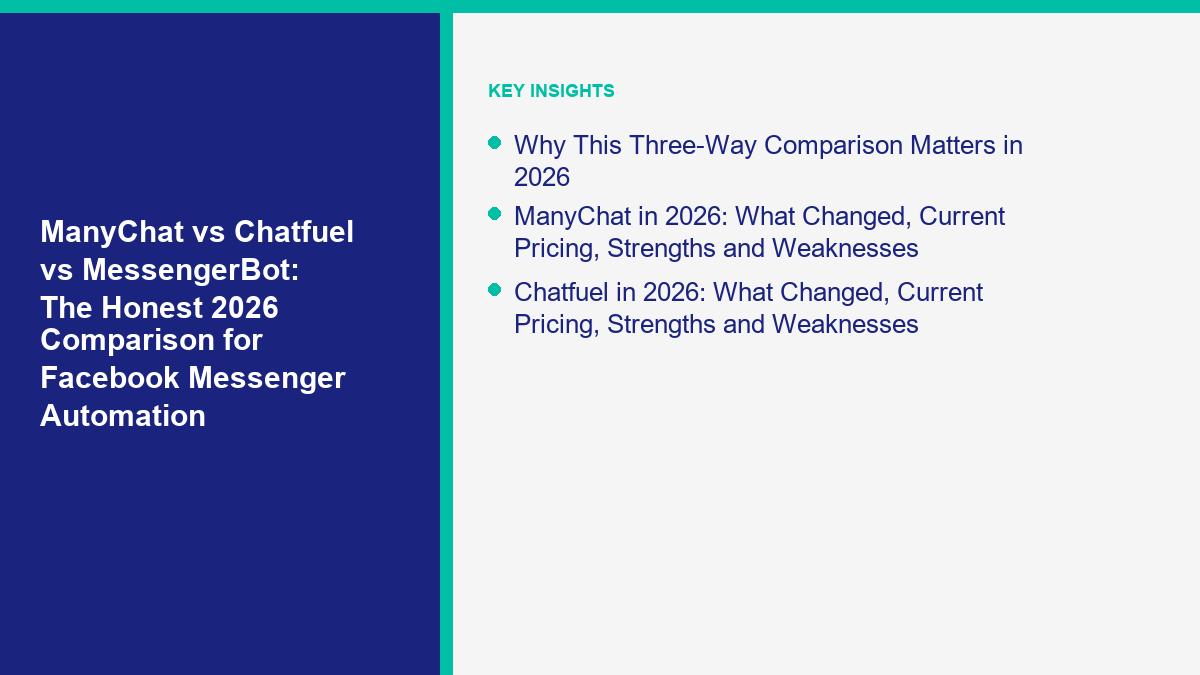
舊的 ManyChat 與 Chatfuel 辯論較容易,因為這兩個工具更容易分類。然而在 2026 年,這已不再成立。ManyChat 現在分為舊版的公開定價頁面和較新的幫助中心計劃模型。Chatfuel 現在將自己定位為跨多個渠道的 AI 商業助手,但其官方定價頁面仍然不像一個乾淨的目錄。與此同時,MessengerBot.app 更加專注於 Facebook Messenger 工作流程、平坦的公開定價,以及小型企業通常最終需要支付的功能堆疊:流程、表單、網站聊天、廣播、整合和電子商務支持.
我查看了所有三個平台的官方定價頁面和計劃文檔, 2026 年 4 月 12 日. 這個日期在這裡很重要,因為這個類別變化很快。如果您在選擇 ManyChat 或 Chatfuel,或者試圖決定哪個是適合真正商業的最佳 Messenger 機器人平台,過時的定價並不是一個小細節。它會改變整個推薦。一個在標題中看起來便宜的工具,當活躍聯絡人激增、WhatsApp 成為必需品,或當您意識到公開頁面和幫助文檔描述了不同的購買路徑時,可能會變得昂貴.
這篇文章故意保持狹窄。它不是另一個巨型機器人總結。這是一場針對特別關心 Facebook Messenger 自動化及附近 Meta 渠道的團隊的對決。如果您想在這之後獲得更廣泛的市場觀點,包括更廣泛的 AI 助手和以網站為首的支持堆疊,請閱讀 完整的聊天機器人比較. 在這裡,我回答一個更實際的問題:這三個平台中哪一個在設置速度、實際渠道覆蓋和定價現實都達到同一電子表格後,最容易被證明是合理的。.
在我們進入細節之前,先做一個快速的現實檢查:這些工具都不是 無需註冊. 它們是商業平台。它們需要一個 Facebook 頁面、權限、已保存的流程、連接的渠道和收件箱規則。相關的免費問題不是您是否可以匿名使用它們。相關的免費問題是免費進入點是否真實、持續多久,以及當機器人開始做有用的工作後,帳單會發生什麼。.
為什麼這三方比較在 2026 年很重要
These three platforms are close enough to overlap and different enough to create bad buying decisions when people lump them together. ManyChat is still the easiest product to recommend when Instagram DMs, comment-to-message funnels, and creator-style lead magnets drive the business. Chatfuel is the most AI-forward of the three in how it talks about the product and in how it packages replies, bookings, and assistance across social channels. MessengerBot.app is the most Messenger-specific in how it sells and structures the platform, which matters more than it sounds when Facebook Page conversations are the actual operational workload.
The second reason this comparison matters is pricing transparency. On 2026 年 3 月 2 日, ManyChat published new plan documentation for newer accounts, but on 2026 年 4 月 12 日 its public pricing page in a US browser still displayed the older Free, Pro, and Elite framing. Chatfuel has a different version of the same problem. Its public pricing page rendered as a single $69 per month all-in-one plan when I checked it, while its Help Center also documented separate Fuely Super and Fuely Max active-contact plans starting at $39 和 $59. MessengerBot.app has the most sales-page language of the three, but its actual price points are easier to spot.
The third reason is intent. A lot of buyers are not really asking chatfuel vs manychat in the abstract. They are asking one of three narrower questions:
- Which tool lets a non-technical person launch a useful Messenger and Instagram workflow fastest?
- Which tool is safest to budget once customer activity becomes consistent every month?
- Which tool gives the best balance of AI help, rule-based automation, and human handoff without dragging the team into enterprise-software overhead?
Once you frame the decision that way, the recommendations get clearer. ManyChat still wins some categories decisively. Chatfuel still has a real edge if you want more AI-first positioning. MessengerBot.app still makes more sense for some Facebook-first businesses than either of the better-known brands. If you already suspect ManyChat’s pricing shape is the main issue, our guide to ManyChat 替代品 covers the broader switch list. This article stays on the tighter three-platform call.
ManyChat in 2026: What Changed, Current Pricing, Strengths and Weaknesses
ManyChat changed more than either of the other two in the last few months, not because the builder suddenly became unrecognizable, but because the pricing story split in half. On 2026 年 4 月 12 日, the public ManyChat pricing page still showed the older structure: 免費, Pro starting at $15 per month, 以及 Elite with custom pricing, with the page still describing Free as a way to engage up to 1,000 contacts at no charge and Pro as a plan that scales with contact count (ManyChat pricing page).
At the same time, ManyChat’s official Help Center now describes a newer plan model introduced on 2026 年 3 月 2 日 for accounts created on or after that date. Under that newer model, the platform lists Free at $0 with 25 Active Contacts, Essential at $17 per month for 250 Active Contacts, Pro at $39 per month for 2,500 Active Contacts, Business at $99 per month for 7,500 Active Contacts, and Advanced at $199 per month for 25,000 Active Contacts. ManyChat’s Billing FAQ also says workspaces created before March 2, 2026 may still be on the legacy structure for now, which explains why two people can check official ManyChat pricing on the same day and see different realities (免費計劃; Essential plan; 專業計劃; Business plan; Advanced plan; Billing FAQ).
That pricing split is the biggest thing that changed, but it is not the only one. ManyChat is also much more openly a multichannel automation platform now, not just a Messenger builder with Instagram bolted on later. The newer plan docs position Facebook Messenger, Instagram, TikTok, Telegram, WhatsApp, SMS, and email as parts of one account strategy, with the lower tiers deliberately limiting channel count and Inbox seats. That tells you what ManyChat is optimizing for in 2026: creator and SMB social automation first, broader sales and support workflows second, and deep Facebook-only specialization less than before.
Its strengths are still obvious once you open the product. ManyChat remains the easiest of these three for a non-technical user to understand on day one. The interface is polished, the public documentation is still the cleanest of the group, the templates are practical, and the Instagram side is especially mature. Comment triggers, Story replies, lead magnets, basic segmentation, broadcasts, and lightweight handoff flows are still exactly where ManyChat feels strongest. If your team is mostly trying to turn social engagement into leads without building a mini support operation, ManyChat still earns its reputation.
The weak spots are also clearer than they used to be. First, pricing predictability is worse than the polished UI makes it seem. Whether you are on the newer Active Contact model or the legacy scaling structure, the product is still built to charge more as real engagement grows. Second, Facebook Messenger is no longer the whole center of gravity. That is not automatically bad, but it does mean the product is not as single-mindedly Messenger-first as MessengerBot.app. Third, some capabilities serious teams eventually care about, especially API depth and more advanced operating room, sit higher in the plan stack than many small businesses expect.
If you want a real free entry point, ManyChat still gives the best free start of these three, even with the current pricing confusion. If you want one blunt summary, it is this: ManyChat is the best-designed starter platform in this comparison, but also the platform most likely to trigger billing questions once your automations are actually working. If staying free or nearly free is the priority for a little longer, our roundup of 免費聊天機器人建構工具 is the better follow-up read.
Chatfuel in 2026: What Changed, Current Pricing, Strengths and Weaknesses
Chatfuel’s biggest 2026 change is positioning. The current product no longer looks like a classic Messenger-bot builder that happens to support other channels. The public pricing page now frames Chatfuel as an AI Business Assistant across WhatsApp, Instagram, TikTok, website widgets, and social channels more broadly. When I checked the live public pricing page on 2026 年 4 月 12 日 in a US browser, it showed one simple plan at $69 per month, 一個 7 天免費試用, unlimited contacts, no team-member limits, and all channels included in one plan (Chatfuel 定價).
That sounds simple until you compare it with Chatfuel’s own Help Center, which currently documents a different pricing structure under the Fuely brand. The official plans article lists a free trial, Fuely Super using GPT-5 mini from $39 per month for 150 active contacts, Fuely Max using GPT-5 from $59 per month for 150 active contacts, and Enterprise as a custom path. The same help article says pricing should be verified in the Billing tab for the most precise account-level numbers. In plain English, Chatfuel has not landed on one crystal-clear public pricing story yet, and that is not a tiny footnote for a buyer trying to forecast costs (Chatfuel Help plans).
There is one more wrinkle. Chatfuel’s Facebook product page still advertises that you can automate the first 50 conversations for free. So depending on which official Chatfuel surface you land on, the product is being pitched as a single $69 all-in-one assistant, as a set of active-contact AI plans from $39, or as a Facebook automation tool with the first 50 conversations free. That does not mean the product is weak. It means the procurement story is messy enough that I would not buy Chatfuel in 2026 without checking the Billing tab or getting written confirmation from sales first (Chatfuel Facebook page).
With that caveat out of the way, Chatfuel has real strengths. It is the most AI-forward product in this comparison. Even its pricing language is centered on AI assistance, client replies, booking, reminders, and a personal business assistant living in your pocket. If your team wants the bot to feel more conversational, more always-on, and more like an AI coworker than a classic rule-based funnel, Chatfuel has the clearest story. It also covers the broadest obvious channel spread out of the box in public marketing language: WhatsApp, Instagram, TikTok, website, and Facebook-facing automation.
Chatfuel is also strong when the business use case is repetitive sales and appointment handling. Booking flows, CRM-like contact history, automatic reminders, lead capture, and shared access make it appealing to service businesses, clinics, education providers, and sales teams that live inside direct messages. If your real shortlist is chatfuel vs manychat and the deciding factor is whether the bot should feel more like a smart agent than a social-marketing builder, Chatfuel is the more AI-heavy answer.
The weaknesses are different from ManyChat’s. ManyChat’s weakness is that the billing math can creep. Chatfuel’s weakness is that the billing story is harder to trust quickly because the official pages are not aligned. It is also less clearly a Facebook Messenger specialist now than it once was. Messenger support is there, but the product narrative is broader and increasingly WhatsApp-and-AI-centered. That is great if you want that direction. It is less ideal if what you really need is one clean Facebook Page automation stack with predictable operating rules.
The honest bottom line on Chatfuel is this: the product itself is more interesting in 2026 than a lot of people realize, but the price-verification step takes longer than it should. If you want the most AI-forward of the three, Chatfuel is in the conversation. If you want the clearest pricing and the most obviously Messenger-first positioning, it is not the easy winner.
MessengerBot.app in 2026: What Changed, Current Pricing, Strengths and Weaknesses
The most interesting thing about MessengerBot.app in 2026 is what did 無法 change. While ManyChat and Chatfuel both moved harder toward multichannel positioning and AI-heavy product language, MessengerBot.app still reads like a Facebook Messenger business platform first. It has expanded features around website chat, forms, ecommerce, SMS, email, and Instagram, but the product page still feels built for people who start from a Facebook Page and then ask what else the platform can do, not the other way around.
Its public pricing is also the cleanest of the three once you cut through the sales language. On 2026 年 4 月 12 日, the pricing page showed 每30天NT$19.99的高級方案, 每30天NT$49.99的專業方案, 以及 Agency at $299.99 per 30 days, with annual options at $199.99, $499.99, 以及 $2999.99. The same page also pushes a free trial and highlights an introductory discount structure rather than pretending the product is free forever (MessengerBot定價).
The feature stack is broader than the brand gets credit for. The pricing page lists a visual flow builder, scheduled sends, analytics, JSON API plus Zapier, Google Sheets integration, web-view forms, website chat, persistent menu, subscriber management, Messenger ecommerce stores, abandoned cart recovery, email tools, SMS tools, Facebook comment automation, and Instagram chatbot features on higher tiers. That is a serious list for a platform that still starts at under twenty dollars every 30 days on the public entry plan.
MessengerBot’s core strength is budget predictability for Messenger-first teams. The public plans are not tied to active-contact billing the way ManyChat’s new model is, and the public page does not force you into the same pricing ambiguity Chatfuel currently has. If your main operational pain is Facebook Page messages, lead capture, repeat FAQs, auto replies, comment automation, and simple customer follow-up, MessengerBot.app is easier to forecast in a real budget meeting than either of the other two.
It also wins on channel honesty. MessengerBot.app is not pretending to be the most elegant omnichannel AI assistant on the market. It is selling workflows. For a lot of businesses, that is a feature, not a limitation. Structured flow builders, menus, web forms, integrations, and ecommerce actions usually create fewer embarrassing support moments than a bot that sounds smart but guesses wrong. If your business runs through predictable questions and repeatable paths, deterministic automation is often more useful than the smartest possible wording engine.
The weak spots are real too. MessengerBot does not have ManyChat’s beginner polish. The interface and pricing page copy feel more direct-response than software-minimalist. There is no true permanent free tier, only a free trial. And if your whole automation strategy revolves around Instagram-first creator funnels or WhatsApp as a major sales channel, MessengerBot is not as obviously natural a fit from the public product story as ManyChat or Chatfuel. Instagram support is present on higher tiers, but WhatsApp is not the center of the public messaging.
So the fair read is straightforward. MessengerBot.app is not the best choice because it beats everyone at everything. It is the best choice for a narrower buyer: someone whose business is still very Messenger-centric, who wants flat public pricing, and who would rather buy a practical automation stack than an AI-forward brand story.
The Feature-by-Feature Comparison Table That Shows the Real Tradeoffs
This is where the manychat vs chatfuel question usually gets answered too loosely. A Messenger buyer does not just need a winner. They need to know what type of complexity each platform introduces. The table below uses the official sites reviewed on April 12, 2026 and focuses on what a real buyer would notice before and after launch.
| 能力 | ManyChat | Chatfuel | MessengerBot.app | 實際優勢 |
|---|---|---|---|---|
| 無需註冊 | 否 | 否 | 否 | No one; this is a business-software category |
| 免費起始選項 | Yes, real free tier | Trial or limited free conversations | Free trial only | ManyChat |
| Trial policy | Free tier, plus plan ambiguity by account type | 7 天免費試用 | 免費試用 | ManyChat for free entry, Chatfuel for clear trial length |
| 公共付費入場價格 | $15 legacy public page or $17 new-account docs | $69 public pricing page, with Help docs also listing $39 Super plans | $19.99 每 30 天 | MessengerBot.app for clear low paid entry |
| Pricing clarity | Split between public page and Help docs | Split between public page and Help docs | Most straightforward public pricing | MessengerBot.app |
| 主要計費計量器 | Contacts or Active Contacts depending on account path | Plan story currently mixed between all-in-one and active-contact pricing | Flat plan tiers | MessengerBot.app for budget predictability |
| Facebook Messenger depth | Strong, but not the only product focus anymore | Supported, but broader AI social story now leads | Core product identity | MessengerBot.app |
| Instagram automation | Excellent | Strong | Available on higher tiers | ManyChat |
| WhatsApp 支援 | Available on paid tiers | A core part of the public pitch | Not a core public selling point | Chatfuel |
| 網站聊天 | Available, but not the main buying reason | Included in public pitch | Included in feature stack | Chatfuel and MessengerBot.app |
| Comment auto-reply and social triggers | Very polished | Strong | Included, especially on Facebook and Instagram tiers | ManyChat |
| 視覺流程構建器 | Excellent and easiest to learn | Solid, more AI-centered framing | Strong and practical | ManyChat for ease, MessengerBot.app for Messenger-first focus |
| AI 功能 | Hybrid AI plus automation | Most AI-forward positioning | Workflow-first, less AI-branded | Chatfuel |
| Human handoff and inbox use | Good, seat-limited by plan | No seat limit on public pricing page | Team access grows with tiers | Chatfuel on public seat flexibility |
| API and integrations | Best access higher in stack | Present, but pricing path needs confirmation | JSON API plus Zapier on public feature list | MessengerBot.app for obvious SMB access |
| Ecommerce support | Good for social selling | Useful for lead capture and booking-heavy sales | Strong with cart and store features | MessengerBot.app for Messenger-commerce workflows |
| Broadcasts and sequences | Mature | Present | Present | ManyChat by polish |
| 分析與報告 | Strong for social campaign iteration | Adequate and sales-oriented | Practical, less polished | ManyChat |
| Best for a solo creator | Excellent | Good if AI-style replies matter | Usable, but less naturally creator-first | ManyChat |
| Best for a Facebook-first local business | Good | Good | Excellent | MessengerBot.app |
| Best for a mixed Meta plus WhatsApp operation | Strong | Strong | Less clear publicly | ManyChat or Chatfuel |
The pattern is not subtle once the table is laid out. ManyChat is the cleanest beginner platform. Chatfuel is the most AI-forward and the strongest public WhatsApp-first story. MessengerBot.app is the most Facebook Messenger-native and the easiest to budget from the outside. That is why any honest answer to best messenger bot platform has to start with channel priority, not brand recognition.
Ease of Use: Which Platform a Non-Technical Person Should Pick
If you are choosing for a founder, marketer, or admin who is not technical, ManyChat is still the easiest first pick. That is the simplest truthful answer in this whole comparison. The interface is cleaner, the builder logic is easier to follow, the help docs are better organized, and the free starting path reduces fear. If a non-technical person wants to be live this week with a simple comment-to-message workflow, ManyChat offers the fewest chances to get lost.
Chatfuel is not hard, but it asks for a slightly different mindset. The product language leans much more heavily into AI assistance, automated replies, booking, and business operation. That can feel easier if your team thinks in terms of the bot handling the task directly, but it can feel less grounded if what you really need is a visible step-by-step funnel you can inspect and tweak. The platform is approachable. It is just less naturally tutorial-friendly than ManyChat for a true beginner.
MessengerBot.app sits in the middle. It is less polished than ManyChat on first impression, but it is not harder in the way enterprise software is harder. It is more that you feel the product’s practical, builder-heavy nature immediately. You are choosing menus, forms, flows, widgets, broadcasts, integrations, and page limits. For some non-technical users that is actually a benefit because the software feels literal. For others it feels less guided. If you pick MessengerBot and want the shortest path from blank dashboard to usable flow, the MessengerBot tutorial is the right next read.
My non-technical recommendation by user type is simple:
- Pick ManyChat first if you are a creator, coach, local business marketer, or ecommerce owner who wants the smoothest learning curve and the safest free starting point.
- Pick Chatfuel first if you want the bot to act more like an AI assistant and you expect bookings, reminders, or AI-style replies to be central from day one.
- Pick MessengerBot.app first if Facebook Messenger is the main inbox and you care more about practical workflow coverage than the prettiest onboarding.
Ease of use matters most in the first week. After that, pricing shape and channel fit matter more. That is why ManyChat wins the setup race but does not automatically win the long-term buying decision.
Pricing Comparison: Free Tiers, Paid Plans, and Hidden Costs
Pricing is where the three platforms separate most sharply. ManyChat gives the best free start, but the most confusing current public-versus-documented pricing story. Chatfuel gives the most AI-heavy packaging, but the least settled official pricing narrative. MessengerBot.app gives the cleanest public monthly numbers, but no forever-free path. That is the real comparison, not just which headline looks cheapest.
| 平台 | What you can start with | Public paid entry | What makes the bill grow | Hidden cost or buyer trap |
|---|---|---|---|---|
| ManyChat | Real free tier | $15 legacy public page or $17 new-account docs | Contacts or Active Contacts, depending on account path | Pricing confusion between legacy and new plans can make budgeting messy |
| Chatfuel | 7-day trial and some official pages mention limited free conversations | $69 public page, while Help docs list Fuely Super from $39 | Plan tier, active-contact buckets, or enterprise needs depending on path | Official pricing surfaces do not line up cleanly, so buyers need confirmation |
| MessengerBot.app | 免費試用 | $19.99 每 30 天 | Jumping to Pro or Agency for more pages, team scale, and Instagram features | No permanent free tier, so testing phase is shorter |
ManyChat’s free tier is still the easiest recommendation if you are testing demand. Even with the public documentation split, it remains the only one of these three that clearly supports a real free starting point rather than a trial-led path. But the moment the workflow becomes important, ManyChat can become the hardest of the three to explain to finance because the billing meter depends on contact activity and, in practice, on which plan model your account is using.
Chatfuel is the opposite problem. The bill may or may not be fine for your business, but the amount of detective work needed before purchase is higher than it should be. That does not make Chatfuel overpriced in every case. It makes it harder to pre-approve with confidence. For some companies that is manageable. For others it is exactly the kind of ambiguity that delays buying or forces an unnecessary backup shortlist.
MessengerBot.app is easiest to defend when you already know your business is Messenger-first. Premium at $19.99 每 30 天 looks competitive against ManyChat’s paid entry and much lower than Chatfuel’s currently rendered public plan. The catch is that free-first buyers will not love it, and businesses that need WhatsApp to be central from the start will still find more obvious fit in ManyChat or Chatfuel.
If you are mainly shopping for the longest no-cost runway, not for the strongest Messenger-first production setup, compare a few more 免費聊天機器人建構工具 before you commit. If you are already past the free-test stage, the better question is which pricing model you want to live with once customers keep coming back every week.
Instagram and WhatsApp Support: Who Covers Which Channels
If Instagram is a major revenue channel, ManyChat still has the cleanest case. This is where its category leadership still feels earned. The product is built around the kinds of triggers social marketers actually use: comments, story replies, lead magnets, follow-up messages, and lightweight segmentation. If your question is manychat or chatfuel and Instagram is the whole reason you are buying, ManyChat usually feels more polished while Chatfuel feels more AI-heavy.
For WhatsApp, the balance shifts. Chatfuel now makes WhatsApp a central part of its public product story, not a side feature. ManyChat supports WhatsApp on paid plans, but it still feels like part of a broader multichannel package rather than the headline identity of the platform. MessengerBot.app, at least from the public pricing page reviewed on April 12, 2026, does not position WhatsApp as a primary reason to buy. That does not mean WhatsApp is impossible in every scenario. It means that if WhatsApp is mission-critical, the safer public choices are ManyChat and Chatfuel.
MessengerBot.app is strongest when the channel order is different: Facebook Messenger first, website chat second, Instagram as a useful add-on, and broader automation coverage after that. For a lot of small businesses, that is the real world. They are not running a giant omnichannel play. They are answering Facebook Page messages, capturing leads, following up on forms, and reducing manual replies. In that setup, MessengerBot’s public channel mix is enough, and the lack of a loud WhatsApp-first sales story is not a dealbreaker.
So if your decision tree starts with channels, use this rule. Pick ManyChat for Instagram-first growth. Pick Chatfuel when WhatsApp and AI-style social assistance are core. Pick MessengerBot.app when Facebook Messenger is still where most useful conversations begin.
AI and Automation Quality: Who Has the Smartest Bot
The smartest bot is not always the one that sounds the most human. In business messaging, smart usually means three things at once: the bot answers the common question correctly, routes the odd case without breaking the conversation, and does not create cleanup work for a human later. That is why this category is more nuanced than a simple LLM contest.
Chatfuel is the most obviously AI-first platform in this comparison. The public site sells an AI assistant, not just a flow builder, and the Help Center plan docs explicitly frame Fuely Super around GPT-5 mini and Fuely Max around GPT-5. If your definition of smart is flexible replies, booking assistance, reminders, conversational back-and-forth, and a bot that feels more agent-like, Chatfuel has the strongest public pitch. For businesses that want the bot to absorb repetitive conversations rather than just steer people through buttons, that matters.
ManyChat takes a more hybrid path. Its AI features are useful, but the product still feels grounded in automation logic, triggers, fields, tags, and controlled flow design. That is a real advantage when accuracy matters more than flair. ManyChat can feel less smart than Chatfuel in a sales demo while producing fewer messy outcomes in a live social marketing funnel because the underlying automation model is easier to constrain. That is why ManyChat still feels so dependable for comment-to-DM work, lead magnets, and common FAQ paths.
MessengerBot.app is the least flashy on the AI front, and for some teams that will sound like a weakness. In practice, it depends on the job. MessengerBot is strongest when you want repeatable automation with clear business rules: collect details, tag the person, send the right flow, route to a human, trigger a form, sync a sheet, recover a cart, send a follow-up. That is not the same kind of intelligence Chatfuel is selling, but it often produces more predictable outcomes for Facebook Page operations. If a bot getting smarter mostly means becoming freer to improvise, that is not always a win in support or lead handling.
So who has the smartest bot? If you mean the most AI-forward assistant, Chatfuel. If you mean the best balance of AI and structured control, ManyChat. If you mean the most operationally dependable Messenger automation stack, MessengerBot.app. That is also why there is no single universal winner here.
Final Verdict: Which Platform for Which Use Case
If you want one clear recommendation for the average non-technical buyer, ManyChat is still the safest first test. It remains the easiest to learn, the strongest free starting point, and the most polished for Instagram-heavy social automation. If your company is creator-led, ecommerce-led, or social-marketing-led, ManyChat still makes a lot of sense even with the 2026 pricing confusion.
If you want the most AI-forward option and you are comfortable doing one extra pricing-verification step before purchase, Chatfuel is the most interesting alternative. It feels more like an assistant than a traditional Messenger flow builder, and it has a stronger public WhatsApp story than the other two. The price-verification friction is real, but so is the upside if your business wants AI-style replies, booking, and multichannel automation more than classic funnel building.
If Facebook Messenger is still your actual operational center, MessengerBot.app is the cleaner business buy. It has the clearest public pricing, the most Messenger-native product identity, and a strong practical feature stack for forms, website chat, ecommerce, integrations, and workflow automation. It is not the best free-first option, and it is not the prettiest onboarding. But for a Messenger-first business, it is often the easiest to justify after the test phase.
Use this quick filter before you commit:
- Choose ManyChat if you want the smoothest setup, the best free entry, and the strongest Instagram-first experience.
- Choose Chatfuel if you want the most AI-heavy platform and your business needs strong WhatsApp, Instagram, and assistant-style automation.
- Choose MessengerBot.app if you want flat public pricing and your real workload still starts in Facebook Messenger.
- Do not choose yet if you still cannot answer which channel drives most conversations, whether you need WhatsApp on day one, or how much monthly customer activity you expect.
The honest answer to manychat vs chatfuel vs MessengerBot is not one brand name. It is a matching exercise. ManyChat wins the beginner and creator case. Chatfuel wins the AI-forward multichannel case. MessengerBot.app wins the Messenger-first value case. If that last category sounds like your business, compare the current plan tiers on 查看 MessengerBot 價格 and make the choice based on your real page count, channel mix, and workflow depth, not on whoever has the loudest homepage.
常見問題
在2026年,ManyChat和Chatfuel哪個更好?
For most non-technical users, ManyChat is better because it is easier to learn, has a real free starting path, and stays stronger on polished Instagram and social funnel automation. Chatfuel is better if you want a more AI-forward assistant style, stronger public WhatsApp positioning, and you do not mind confirming pricing before buying because the official pricing surfaces are still inconsistent.
MessengerBot.app 是 ManyChat 的一個好替代方案嗎?
Yes, especially for businesses that are still heavily Facebook Messenger-first. MessengerBot.app is a strong alternative when you want flatter public pricing, practical automation tools like forms, website chat, ecommerce actions, and integrations, and you do not need ManyChat’s best-in-class free tier or creator-focused Instagram polish.
哪個 Messenger 機器人平台提供最佳的免費方案?
ManyChat has the best true free tier of these three. Chatfuel gives a trial and some official pages mention limited free conversations, while MessengerBot.app is a free-trial platform rather than a forever-free platform. If your first priority is testing without paying, ManyChat is the easiest starting point.
我可以在 Instagram 上使用 ManyChat、Chatfuel 和 MessengerBot 嗎?
Yes, but not at the same depth or with the same emphasis. ManyChat is the strongest Instagram-focused option overall, Chatfuel is also strong and more AI-forward, and MessengerBot.app includes Instagram tools on higher tiers. If Instagram is the main channel, ManyChat is still the safest first choice.
對於非技術人員來說,哪個平台最容易使用?
ManyChat is still the easiest for a non-technical person because the builder, documentation, templates, and onboarding are more polished than the other two. MessengerBot.app is workable but more literal and builder-driven, while Chatfuel is approachable yet asks users to think more in terms of AI assistance than classic step-by-step flow design.


 繁體中文
繁體中文  English
  Tagalog
  简体中文
简体中文  العربية
  हिन्दी
  Português do Brasil
  Español de México
  Français
  বাংলা
বাংলা  香港中文
香港中文  Nederlands
  Deutsch
  Bahasa Indonesia
  日本語
日本語  한국어
한국어  Polski
  Русский
  Español
  Tiếng Việt