
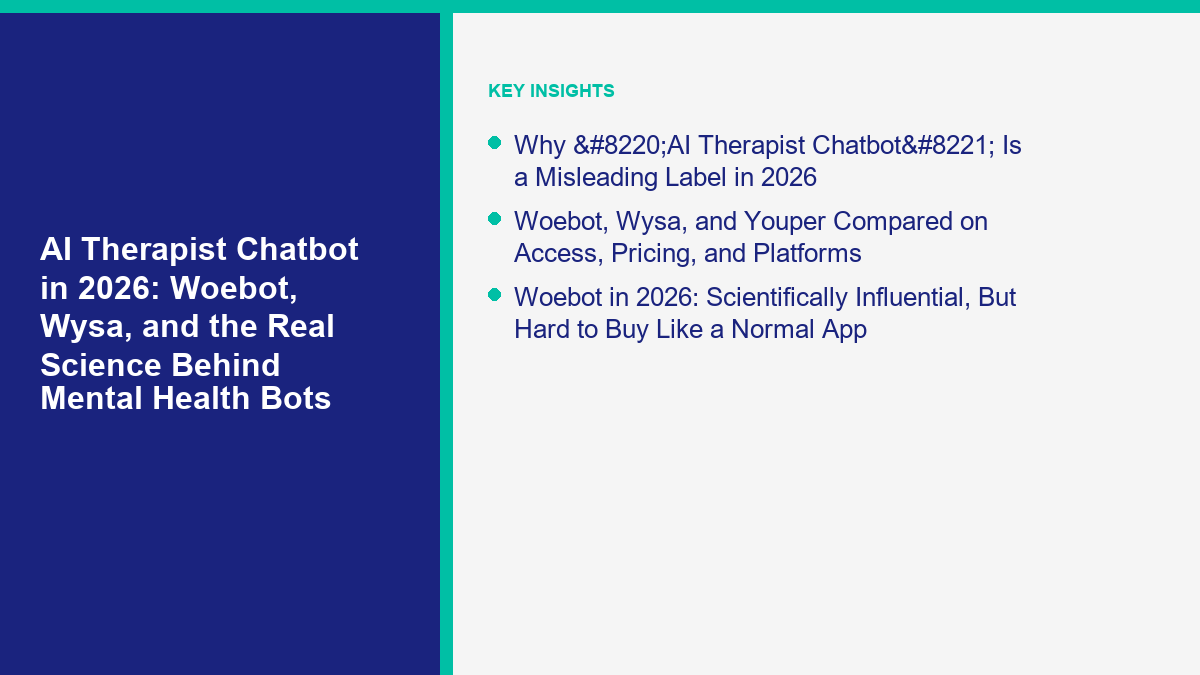
إذا كنت تبحث عن روبوت محادثة معالج نفسي بالذكاء الاصطناعي في عام 2026، ستواجه مشكلة تصنيف تقريبًا على الفور. بعض المنتجات هي تطبيقات مساعدة ذاتية عامة يمكنك تنزيلها في دقيقتين. بعضها أدوات قريبة من العيادات متاحة فقط من خلال صاحب العمل أو الدراسة أو نظام الصحة. وبعضها عبارة عن دفاتر ملاحظات مزاجية مع واجهة متعاطفة. وبعضها لا يزال يتم تسويقه بلغة العلاج على الرغم من أن الشركة نفسها تقول إن البرنامج ليس بديلاً عن الرعاية المهنية.[1][2][5][9]
لهذا السبب تشعر جولات “أفضل روبوت علاج بالذكاء الاصطناعي” بالسطحية. غالبًا ما تجمع بين Woebot وWysa وYouper وتطبيقات الرعاية الذاتية الأحدث في سلة واحدة، ثم تتصرف كما لو كنت تختار بين بدائل المعالج القابلة للتبادل. أنت لست كذلك. الإطار الأكثر صدقًا هو هذا: روبوت محادثة للصحة النفسية يمكن أن يكون مفيدًا للتفكير المنظم، وتمارين على نمط CBT، وتتبع العادات، والدعم بين الجلسات، لكن تصميم المنتج، وموقف الخصوصية، والأدلة السريرية تختلف كثيرًا حسب البائع. حتى أقوى التطبيقات لا تزال ترسم خطًا صارمًا حول الأزمات، والتشخيص، والأدوية، والمرض العقلي الشديد.[6][9][2]
إليك النسخة المختصرة بعد مراجعة الصفحات الرسمية للمنتجات والدراسات الحالية في 12 أبريل 2026. Wysa هو الخيار الأقوى المتاح للجمهور إذا كنت تريد تطبيق مساعدة ذاتية منظم وموجه بالأدلة مع تدريب اختياري. Woebot لا يزال مهمًا علميًا، ولكن بالنسبة للمستهلكين العاديين، فهو في الغالب علامة تجارية مع أبحاث سابقة وولوج محدود للجمهور، وليس اشتراكًا عاديًا للخدمة الذاتية. Youper هو أنظف بوت خفيف الوزن يعكس الحالة المزاجية، لكنه ذكاء اصطناعي بالكامل ويقول ذلك بوضوح. Earkick يمتلك واحدة من أقوى حملات التسويق التي تركز على الخصوصية، ومع ذلك تُظهر علامة الخصوصية في متجر التطبيقات لماذا يجب عليك دائمًا قراءة الإفصاحات عن البيانات، وليس فقط النص الرئيسي.[8][1][9][10]
إذا كان مشروعك الفعلي هو بناء مساعد دعم آمن للعملاء على القنوات الاجتماعية أو الويب، وليس استبدال معالج نفسي،, تصفح دوراتنا التدريبية أولاً. تعتبر بوتات الصحة النفسية واحدة من أوضح الأمثلة على لماذا تهم السيطرة على النطاق، وقواعد التصعيد، والإفصاح الصادق عن الذكاء الاصطناعي أكثر من جعل البوت يبدو طليقًا عاطفيًا.
لماذا “بوت المعالج النفسي بالذكاء الاصطناعي” هو تسمية مضللة في عام 2026
العبارة روبوت محادثة معالج نفسي بالذكاء الاصطناعي يتصدر التصنيف لأن الناس يفهمونه على الفور، وليس لأنه دقيق سريريًا. معظم المنتجات في هذه الفئة ليست معالجين مرخصين، ولا تشخص، ولا تصف العلاج، وليست مناسبة لرعاية الأزمات. تقول Wysa إن تطبيقها مخصص للمساعدة الذاتية والمراقبة الذاتية للصحة النفسية، وليس بديلاً عن النصيحة الطبية المهنية، وليس لحالات الأزمات أو مشاكل الصحة النفسية الشديدة والمستمرة. تقول Youper إن التطبيق لا يقدم قياسات تشخيصية أو نصائح علاجية، وليس بديلاً عن الرعاية المهنية، ولا يمكنه تقديم تدخل في الأزمات. تقول Woebot Health إن منتجاتها الحالية هي مكملات للرعاية السريرية، وليست بدائل لها، وتقول بشكل محدد إن منتجاتها لم يتم تقييمها أو الموافقة عليها من قبل إدارة الغذاء والدواء.[5][9][2]
That sounds like legal caution, but it is also good product truth. Therapy is not just content delivery. A human clinician tracks risk over time, notices when you are avoiding a topic, sees contradictions you are missing, brings professional judgment to diagnosis and treatment planning, and knows when a symptom cluster suggests mania, psychosis, trauma escalation, substance misuse, or medical comorbidity. A chatbot can simulate empathy. It cannot take professional responsibility for your care.
There is also a technical reason the label is messy. The strongest ai counselor chatbot products are not always the most open-ended ones. Wysa’s own FAQ says its AI uses a combination of rule-based algorithms and large language modeling, and that different institutional versions use different mixes of rule-based and LLM-powered chat. Woebot’s technology page says the system has historically used expert-authored conversations written by clinicians and conversational designers, with machine learning and NLP used to select the right intervention, while the company is only exploring LLMs for future iterations. In other words, some of the safer products are safer precisely because they are more constrained than a generic chatbot.[5][3]
That matters for buyers. If you want a chatbot that can freestyle like a general-purpose AI assistant, you may get more expressive language but less predictable safety. If you want a structured ai therapy bot, you are often buying guardrails on purpose.
مقارنة Woebot و Wysa و Youper من حيث الوصول والأسعار والمنصات
إليك أبسط طريقة لمقارنة الخيارات الرئيسية التي يبحث عنها الناس في عام 2026. أنا أفصل بين وصول المستهلك والسمعة السريرية لأنهما لم يعودا نفس الشيء، خاصة بالنسبة لـ Woebot.
| Bot | الوصول العام في أبريل 2026 | المنصات | لقطة أسعار حالية | خيار الدعم البشري | التحقق من الواقع الرئيسي |
|---|---|---|---|---|---|
| Woebot Health | ليس تطبيقًا عاديًا للمستهلكين. تقول Woebot إن المستخدمين الجدد يحتاجون إلى رمز وصول للدراسة أو الشريك، بينما تقول الأسئلة الشائعة أيضًا إن التطبيق تم إيقافه في 30 يونيو 2025 ولا يمكن إنشاء حسابات جديدة. | نشر الشركاء أو مقدمي الخدمة أو أصحاب العمل أو الدراسات بدلاً من التسجيل العام المفتوح. | لا يوجد سعر مستهلك عام مدرج. | بشكل غير مباشر، من خلال المزود أو المنظمة التي تقدم الوصول. | أفضل علامة تجارية بحثية معروفة في الفئة، ولكنها الأقل توفرًا للجمهور لمتسوقي التطبيقات العاديين.[1][2] |
| Wysa | متاحة للجمهور وما زالت أسهل روبوت محادثة للصحة النفسية يمكن التوصية به لمستخدمي المساعدة الذاتية. | أندرويد، iOS، والويب وفقًا لأسئلة وأجوبة Wysa. | محادثة AI مجانية للبدء. حاليًا، يسرد متجر تطبيقات iPhone في الولايات المتحدة المشتريات المميزة بما في ذلك $19.99 شهريًا، حزم سنوية بسعر $74.99 و$99.99، وخطة مدرب مع أدوات بسعر $99.99 في الشهر. | نعم. تقول Wysa إن التدريب متاح في بعض المواقع وموقعها العام يعلن عن 4 جلسات مباشرة في الشهر في فئة المدرب. | أفضل مزيج عام من الأدوات المنظمة، لغة الأدلة، والدعم البشري الاختياري، ولكن لا يزال ليس للأزمات أو الأمراض النفسية الشديدة.[5][6][8] |
| Youper | متاحة للجمهور. | iPhone وiPad في قائمة متجر التطبيقات الحالية. | مجانية للتثبيت؛ يسرد متجر التطبيقات Youper Premium بسعر $7.99. | لا يتم الإعلان عن طبقة معالج نفسي بشري عامة في قائمة التطبيق الحالية؛ يقول التطبيق إن جميع الردود يتم إنشاؤها بواسطة AI. | Very accessible for mood tracking and journaling, but it is fully AI and explicitly not a medical or crisis service.[9] |
| Earkick | متاحة للجمهور. | iPhone, iPad, Apple Watch, and iMessage on the current App Store listing. | The App Store currently shows Earkick Premium at $14.99 monthly, with annual listings at $44.99, $89.99, and $107.99 depending on package, plus smaller paid options. | No therapist layer in the public listing. | Strong privacy-first branding and broad platform presence, but its App Store privacy label is more complicated than the headline copy suggests.[10] |
What jumps out is how different the buying motion is. Woebot is now closer to a digital health platform story. Wysa is still an app-store story with optional coaching. Youper is a low-friction personal support app. Earkick is a privacy-first mental fitness app with more subscription variation than its clean branding suggests. That is why “best AI therapist chatbot” is not one decision. It is at least four.
This is also where consumer mental health apps feel very different from business chatbot SaaS. Public self-help apps often mix free chat, premium tool libraries, coaching add-ons, and promo-price SKUs. If you want a clean contrast with flat business messaging tiers, عرض تسعير MessengerBot. The pricing logic is much easier to model when the product is channel automation instead of a mix of self-help content and emotional support.
Woebot in 2026: Scientifically Influential, But Hard to Buy Like a Normal App
Woebot still has one of the strongest brand names in this category because its early research was unusually visible. The 2017 JMIR randomized controlled trial is still one of the papers people cite first when they talk about chatbots and mental health. In that study, 70 young adults ages 18 to 28 were randomized to either two weeks of Woebot interactions or an information-only ebook from the National Institute of Mental Health. The Woebot group showed a significant reduction in depression symptoms over the study period, and participants engaged with the chatbot a lot for such a short intervention, averaging just over 12 interactions in two weeks.[11]
That paper still deserves attention. It was early, it was concrete, and it made a serious argument that a conversational agent could deliver a narrow CBT-style intervention in a way people would actually use. But the 2026 shopping reality is very different from the 2017 research reality. Woebot Health’s own support page says new users in the United States must be part of a study or have an access code from a provider, employer, or other partner, and a linked FAQ on the same site says the Woebot app was retired on June 30, 2025 and new accounts can no longer be created.[1]
For an ordinary consumer looking for an روبوت محادثة معالج نفسي بالذكاء الاصطناعي, that means Woebot is no longer the obvious default recommendation even if you admire the science. It is not a normal download-first product anymore. Woebot’s current solutions page makes the company’s direction much clearer: Access Accelerator for clinicians, population-health tools for payers, EMR integration, patient-reported outcomes, validated scales such as PHQ-8 and PHQ-9, and custom resources for specific populations. That is not a mass-market app pitch. That is a digital behavioral health infrastructure pitch.[2]
The biggest practical takeaway is that Woebot is strongest when a health system or employer is wrapping it inside a broader care pathway. It is much weaker as a recommendation for someone who just wants to try a mental health chatbot this weekend. If your insurer, university, or provider offers it, great. If not, you are probably comparing Wysa, Youper, or another public app instead.
There is one more important nuance here. Woebot’s solutions page says the company’s current population-specific products are not evaluated, cleared, or approved by the FDA and do not replace clinical care. That sentence matters more than the marketing. It tells you exactly how the company wants these products used: as adjunct support, not as autonomous therapy.[2]
Wysa in 2026: Still the Best Public AI Therapy Bot for Structured Self-Help
If you want the public app that feels most serious without pretending to be a therapist replacement, Wysa is still the strongest answer. The reason is not magic empathy. It is product discipline. Wysa’s FAQ says the app is available on Android, iOS, or the web, uses a mix of rule-based logic and large language modeling depending on version, and is intended for emotional wellbeing support, self-help, and self-monitoring. That is a grounded promise. It is broad enough to be useful and narrow enough to avoid obvious overclaiming.[5]
Wysa also makes a cleaner public distinction between AI support and human support than most competitors. The public “for individuals” page says coaching is available right inside the app, and the coached tier includes 4 live sessions per month plus support between sessions. That does not make Wysa equivalent to weekly psychotherapy, but it does make the escalation path more realistic than a pure self-serve bot. If you know you need a little more than journaling but a lot less than full clinical treatment, that middle layer is useful.[6]
The live pricing is a little messier than the homepage copy suggests, which is common for subscription apps. On the current US iPhone App Store listing, Wysa is free to download and shows a set of in-app purchases that includes Wysa Premium monthly at $19.99, annual premium options at $74.99 and $99.99, a one-month premium package at $9.99, and Premium Plus at $99.99 per month. The important buying point is not picking apart every SKU. It is understanding the stack: free AI chat at the bottom, premium tool access in the middle, and human coaching at the top.[8]
Wysa is also honest about its boundary conditions. Its FAQ says the app is not recommended for crisis situations and is not suitable for people with severe and enduring mental health problems. Its public site says the AI can screen for distress and surface crisis resources, but the same page also says Wysa cannot offer medical or clinical advice and is not designed to assist with severe mental health emergencies. That is the right product line. If a bot cannot safely manage a situation, it should redirect, not improvise.[5][6]
The result is that Wysa feels less like an artificial therapist and more like a structured mental fitness tool with optional guided support. In this category, that is a compliment.
The Clinical Evidence Is Better Than Most AI Categories, but Still Smaller Than the Marketing
The science behind mental health bots is not fake. It is just easy to oversimplify. Woebot’s 2017 randomized controlled trial is still one of the best-known examples of a chatbot producing measurable symptom improvement in a real study design. The treatment was short, only two weeks, but it showed that a conversational format could improve engagement and reduce depression symptoms in a college-age population compared with an information-only control.[11]
Wysa’s evidence base is also more serious than many buyers realize. Wysa’s clinical evidence page says the company has more than 36 peer-reviewed publications, 8 clinical trials, 6 service evaluations, and 13 real-world studies. More importantly, the current evidence page points to an independent peer-reviewed clinical trial in JMIR involving people with chronic diseases. The 2024 paper shows a four-week Wysa intervention in adults with arthritis or diabetes, with 68 participants included in the analysis and significant reductions in depression and anxiety in the treatment group, but no change in stress. The authors also reported that users liked many app features while disliking some of the chatbot’s conversational abilities, which is exactly the kind of mixed result that makes a paper worth reading.[7][12]
Step back from individual brands and the bigger picture still looks promising, but modest. A 2025 systematic review and meta-analysis of chatbot-delivered interventions for young people identified 29 interventional studies, including 13 randomized controlled trials. The meta-analysis found a statistically significant reduction in distress, but not a significant improvement in broader psychological well-being. Another 2024 rapid review focused on college students found nine studies with 1,082 participants, and eight of the nine reported statistically significant improvements in anxiety, depression, or well-being. Those are encouraging results. They are not a blank check to call an app therapy.[13][15]
The most useful recent overview is the 2025 systematic review that charted mental health chatbots from rule-based systems to LLM-based systems. It looked at 160 studies from 2020 through 2024 and found that LLM-based bots surged to 45% of new studies in 2024, but only 16% of those LLM studies had gone through clinical efficacy testing. Most were still in early validation. That is the exact split most buyers miss. Product marketing moved fast. Clinical validation did not move at the same speed.[14]
So yes, there is real science here. There are randomized trials. There are measurable symptom changes. There is good evidence that a well-designed mental health chatbot can help some people with low mood, anxiety, distress, and emotional self-management. But there is a big difference between “helpful for some users in a bounded use case” and “safe therapist substitute for everyone.”
Where the Research Still Falls Short, Especially for Newer LLM-Driven Bots
Here is the part most review articles soften too much: the evidence base is still uneven. Many studies are short. Many focus on low-acuity symptoms rather than severe disorders. Many measure self-reported symptom changes over a few weeks, not durable outcomes over six or twelve months. And a lot of the better-known studies still involve company employees as coauthors or participants who already opted into a paid app.[11][16]
You can see that clearly in the major brand papers. The Woebot 2017 trial included Woebot-affiliated authors. The 2021 Youper observational study included Youper employees and shareholders, looked at 4,517 paying users who had opted into research, and found symptom decreases in the first two weeks of use. That is interesting, and the sample size is substantial, but it is not the same evidence class as a long independent randomized clinical trial with an active comparator and broader clinical oversight.[11][16]
The Wysa chronic disease trial is stronger on independence, which is one reason it stands out, but even there the study was four weeks long and involved 68 participants. That is enough to matter. It is not enough to settle every question about durability, adverse effects, or which symptom profiles do worst with chatbot-only support. The same paper also notes that some participants disliked the bot’s conversational abilities. That detail matters because a chatbot can score well on symptom reduction and still feel thin, repetitive, or annoying in daily use.[12]
The architecture review from 2025 sharpens the concern for newer LLM-centered apps. LLM-based mental health chatbots are arriving faster than the evidence pipeline can validate them. If only 16% of LLM studies have gone through clinical efficacy testing and most are still in early validation, then a lot of the category is being purchased on plausibility, not on mature clinical proof.[14]
That does not mean the category is useless. It means a serious buyer should ask better questions:
- Was the study randomized or just observational?
- How long did the intervention last?
- What was the control condition?
- Were severe symptoms excluded from the study?
- Were company employees involved in authorship or funding?
- Did the paper measure actual symptom change, not just satisfaction or engagement?
- Did the product have a human escalation path?
If a vendor cannot answer those questions clearly, you are not looking at a clinically mature product. You are looking at a promising experiment.
Privacy Is Where the Mental Health Chatbot Category Gets Real Very Fast
Privacy questions hit differently when the chat log is about panic, shame, grief, trauma, or compulsive thoughts instead of generic productivity prompts. The problem is that words like “private,” “anonymous,” and “secure” can all be true in a limited sense while still hiding practical tradeoffs about data collection, model training, institutional reporting, or tracking labels.
Wysa is one of the clearer vendors here. Its FAQ says the company does not request your personal data, chats are private, and if you accidentally send identifying details such as an email address or phone number, Wysa says it will irreversibly redact that information from its system within 24 hours. The same FAQ also says anonymized, summarized population-level information may be shared with institutional partners, and that anonymized messages may occasionally be used to train Wysa’s AI. That is not a scandal. It is exactly the kind of nuance users should know before they type something deeply personal.[5]
Woebot’s privacy page takes a different angle. The company says chat transcripts are not shared with third parties except to provide or improve the service or to protect people, and says it never sells or shares personal data with advertisers. That is strong language, and better than many consumer apps. But you still need to notice the exception structure. “Not shared except…” is not the same thing as “nobody else ever touches this.” It is closer to a responsible healthcare-style privacy posture than to pure on-device privacy.[4]
Youper is clearer than many apps about the fact that you are talking to AI, not a person. The privacy picture is less minimalist than some users may expect. Apple’s current App Store label says Youper may use usage data to track you across apps and websites owned by other companies, and may collect data linked to your identity including email address, user ID, product interaction data, and diagnostics. That does not automatically make the app unsafe. It does mean “private journal with AI” should not be read as “nothing identifiable is collected.”[9]
Earkick is the most useful cautionary example. Its current App Store marketing copy says “no registration,” “no tracking,” and “no stored data,” with everything staying on device or in secure iCloud. But the same App Store page also shows Apple’s privacy label stating that usage data may be used to track you across apps and websites owned by other companies, and that health and fitness data, contact info, contacts, user content, usage data, and diagnostics may be collected though not linked to identity. The lesson is not “Earkick is lying.” The lesson is that privacy promises need to be checked in both the marketing copy and the platform disclosure.[10]
If you are choosing a روبوت محادثة للصحة النفسية, the practical privacy checklist is simple:
- Check whether the app asks for real names, email addresses, or phone numbers.
- Read the App Store or Google Play privacy labels, not just the homepage.
- Find out whether conversations may be used to train the AI.
- See whether institutional versions share trend data with employers, schools, or insurers.
- Look for export and deletion controls before you ever need them.
- Decide in advance which topics you are comfortable entering into an app.
Most people do those checks after they are emotionally invested in the bot. That is backwards. Do them first.
When an AI Therapy Bot Can Be Genuinely Useful
For all the caution above, it would be wrong to dismiss the whole category. A good ai therapy bot can be genuinely useful in a handful of situations, especially if you already understand what it is for.
The best use case is low-friction support between other parts of life. Think of late-night rumination when you want a grounding exercise, not a diagnosis. Think of a CBT prompt that helps you reframe catastrophic thinking. Think of logging mood patterns for two weeks before a therapy appointment so you show up with a clearer picture of sleep, triggers, and stress. Think of a coach-like nudge to do a breathing exercise instead of doomscrolling for an hour. That is where these apps can earn their keep.
Wysa is especially good when you want structured exercises and a care library. Youper is good when you want emotional reflection, mood tracking, and short guided conversations. Woebot is worth using if your provider or organization gives you access, especially because it is designed to fit into a broader care pathway rather than pretending to be a one-app answer. Earkick is attractive if you want a broader self-care toolkit and watch-based check-ins, though I would be stricter about privacy review there.[5][9][2][10]
The strongest pattern in the literature fits that practical use. These systems seem best at improving access, reducing friction, and supporting low-acuity self-management. They are not strongest where professional assessment, relational depth, or crisis judgment are the core task.[13][14]
My rule of thumb is simple. Use a chatbot for repetition, reflection, and routine. Use a person for interpretation, diagnosis, and risk.
When You Need a Real Therapist, Psychiatrist, or Crisis Service Instead
This is the boundary that matters most. A chatbot is the wrong tool if you are dealing with suicidal thoughts, self-harm urges, hallucinations, mania, abuse, rapid functional decline, medication questions, or symptoms that are becoming dangerous to you or other people. It is also the wrong tool if you already notice that the app is becoming your only emotional outlet while your real-world functioning is getting worse.
The companies largely agree on this. Wysa says the app is not recommended for crisis situations and severe, enduring mental health problems. Youper says it cannot provide crisis intervention and directs users to 988, Crisis Text Line, and emergency services. Woebot says it does not provide crisis counseling and that concerning-language detection is not a real-time intervention service.[5][9][2]
That should reset expectations. The right comparison is not “bot versus therapist.” The right comparison is “support tool versus clinical care.” A bot may help you hold on between appointments. It should not be the only thing holding you together.
There is also a subtler failure mode that does not always look dramatic at first: delay. An ai counselor chatbot can feel helpful enough that you keep postponing the harder step of seeing a licensed professional. That delay is fine when your problem is mild stress and you are getting better. It is risky when symptoms are persistent, escalating, or beginning to affect sleep, work, school, relationships, eating, safety, or substance use.
If the app keeps you moving toward help, great. If it keeps you from getting help, it has become part of the problem.
How to Evaluate an AI Therapist Chatbot Before You Trust It With Personal Stuff
You do not need to run a clinical trial at home, but you should test any روبوت محادثة للصحة النفسية with more skepticism than a normal wellness app. This one-hour process is enough to surface most of the important differences.
- Check the crisis boundary first. Find the disclaimer before the signup flow. If the app buries its crisis language or makes it hard to find help resources, that is a bad sign.
- Map the real access model. Ask whether it is public self-serve, partner-only, or coaching-backed. Woebot fails this test for ordinary shoppers because its science reputation is stronger than its current public availability.
- Read the privacy label on the store page. Do not rely on homepage claims about anonymity or privacy.
- Stress-test the conversation. Try awkward, ambiguous prompts. See whether the bot becomes repetitive, overly agreeable, or strangely confident.
- Test one practical skill flow. Ask for a grounding exercise, a thought-challenging prompt, and a journaling structure. This is where Wysa usually feels more useful than pure free-chat bots.
- Check deletion and export controls. You should know how to erase your history before you need to.
- Decide your red-line topics. Medication, trauma details, legal risk, abuse, and suicidal thoughts belong with a human professional or crisis service, not with a chatbot experiment.
This is the same discipline good operators use when they test any support automation. The difference is that emotional vulnerability raises the stakes. If you are automating customer conversations instead of mental health care, the logic is similar and the risk profile is lower. That is exactly why emotionally sensitive use cases are a useful design lesson for anyone building conversational systems.
What Businesses Should Learn From Therapy Bots Before Automating Messenger, Instagram, or Website Support
This article is about mental health bots, but the design lessons transfer directly to business messaging. The products that hold up best are not the ones that try to sound most human. They are the ones that keep scope clear, disclose when AI is involved, route risky cases to people, and avoid making claims they cannot support.
That is relevant if you run support on Facebook Messenger, Instagram, or a website. The wrong move is building a bot that improvises empathy across edge cases with no escalation. The right move is designing a narrow assistant that can answer FAQs, gather context, tag conversations, and hand off cleanly when a human needs to step in. If your support workflows are getting complex enough that channel control matters more than generic chat intelligence, Upgrade to MessengerBot Pro for routing and operations, not for pseudo-therapy.
Therapy bots also show why language constraints are a feature, not a bug. A customer support bot should not diagnose, speculate, or invent certainty either. It should make the next safe step obvious. That can mean showing a return policy. It can mean collecting the order number. It can mean routing a billing dispute to a real person. In a wellness context, it can mean refusing to posture as a clinician.
If you advise brands, agencies, or client accounts on this kind of automation, the category is worth studying even if you never deploy a mental health flow yourself. It teaches you where AI confidence turns into liability.
So Which AI Therapist Chatbot Is Actually Best in 2026?
If you mean “best public app I can use right now for structured emotional support,” the answer is Wysa. It has the best mix of availability, structured self-help, evidence language, and optional human backup. If you mean “most important brand in the research history of this category,” the answer is still Woebot, but that does not make it the best consumer recommendation in April 2026 because public access is limited. If you mean “best lightweight AI journal and reflection app,” Youper is the cleanest fit. If privacy marketing is your main filter, Earkick is interesting, but you should audit its data disclosures more carefully than its homepage tone might suggest.[5][1][9][10]
The bigger answer is that no روبوت محادثة معالج نفسي بالذكاء الاصطناعي should be evaluated as if the only question is how human it sounds. The real questions are simpler and more important:
- Can it help with a bounded problem such as reflection, mood tracking, or skill practice?
- Does the evidence actually match the marketing?
- Are the privacy tradeoffs clear before you type anything sensitive?
- Does it push you toward human care when your situation needs human care?
If the answer to those questions is yes, a mental health chatbot can be worth using. If the answer is mostly vibes, polished branding, and therapy language without clear limits, skip it.
Need a Safer Automation Playbook for Customer Messaging Instead?
The healthiest lesson from this whole category is that bots work best when they stay inside a clearly defined job. For business messaging, that usually means lead capture, support triage, follow-up, routing, FAQs, and handoff rather than trying to imitate a clinician or confidant. If that is the problem you are actually solving, start with the basics, then scale only when the workflow proves itself.
Use these next steps in order: عرض تسعير MessengerBot if you need the tier breakdown, تصفح دوراتنا التدريبية if you want implementation walkthroughs, and انضم إلى برنامج الشركاء الخاص بنا if you help clients choose or deploy chatbot platforms for a living.
Sources and Research References
All product availability, pricing, App Store, and company-policy details were checked on April 12, 2026. Clinical evidence links point to the latest accessible official or peer-reviewed source available during drafting.
- Woebot Health – App Support
- Woebot Health – Solutions
- Woebot Health – Technology Overview
- Woebot Health – Privacy Policy
- Wysa – FAQ (Clinical Program)
- Wysa – For Individuals
- Wysa – Clinical Evidence and Research
- Apple App Store – Wysa: Mental Wellbeing AI
- Apple App Store – Youper
- Apple App Store – Earkick: Self Care AI Coach
- JMIR Mental Health – Woebot Randomized Controlled Trial (2017)
- JMIR Formative Research – Effectiveness of a Mental Health Chatbot for People With Chronic Diseases: Randomized Controlled Trial (2024)
- PubMed – Chatbot-Delivered Interventions for Improving Mental Health Among Young People: A Systematic Review and Meta-Analysis (2025)
- PubMed – Charting the Evolution of Artificial Intelligence Mental Health Chatbots From Rule-Based Systems to Large Language Models: A Systematic Review (2025)
- PubMed – Effectiveness of Artificial Intelligence Chatbots on Mental Health and Well-Being in College Students: A Rapid Systematic Review (2024)
- PubMed – Acceptability and Effectiveness of Artificial Intelligence Therapy for Anxiety and Depression (Youper): Longitudinal Observational Study (2021)
الأسئلة الشائعة
هل روبوت الدردشة المعالج الذكي هو نفس الشيء كالعلاج الحقيقي؟
لا. أقوى روبوتات الدردشة للصحة النفسية هي أدوات دعم للتأمل الذاتي، وتمارين على نمط العلاج السلوكي المعرفي، وتتبع المزاج، والمساعدة بين الجلسات. إنها لا تحل محل العلاج المرخص، أو التشخيص، أو إدارة الأدوية، أو خدمات الأزمات.
أي روبوت دردشة معالج بالذكاء الاصطناعي هو الأفضل للمستخدمين العاديين في عام 2026؟
ويسا هو الخيار العام الأفضل لمعظم المستخدمين العاديين في عام 2026 لأنه لا يزال متاحًا على نطاق واسع، ويقدم أدوات مساعدة ذاتية منظمة، ولديه طبقة تدريب اختيارية. ووبوت مهم علميًا، لكنه لم يعد أسهل تطبيق للمستهلكين للوصول إليه.
هل ووبوت أفضل من ويسا؟
ليس لمعظم المستخدمين العموميين في أبريل 2026. لا يزال لدى Woebot مصداقية بحثية مهمة، لكن Wysa هي التوصية الأفضل إذا كنت بحاجة إلى تطبيق يمكنك استخدامه فعلاً الآن دون مزود أو رمز دراسة.
هل روبوتات الدردشة للصحة النفسية خاصة؟
أحيانًا، لكن الخصوصية تختلف كثيرًا. تحتاج إلى التحقق مما إذا كانت التطبيق تجمع معرفات، تستخدم بيانات المحادثة لتدريب الذكاء الاصطناعي الخاص بها، تشارك بيانات الاتجاهات مع الشركاء المؤسسيين، أو تظهر تتبعًا في ملصق الخصوصية الخاص بمتجر التطبيقات.
متى يجب أن أتوقف عن استخدام روبوت العلاج بالذكاء الاصطناعي وأتصل بمختص بشري؟
توقف عن الاعتماد على الروبوت وحده إذا كنت تعاني من أفكار انتحارية، أو إيذاء النفس، أو هلوسة، أو هوس، أو إساءة، أو أسئلة حول الأدوية، أو تفاقم الأعراض الشديدة، أو إذا كانت التطبيق أصبح بديلاً للرعاية التي تعرف أنك بحاجة إليها بالفعل.


 العربية
  English
  Tagalog
  简体中文
简体中文  हिन्दी
  Português do Brasil
  Español de México
  Français
  বাংলা
বাংলা  香港中文
香港中文  繁體中文
繁體中文  Nederlands
  Deutsch
  Bahasa Indonesia
  日本語
日本語  한국어
한국어  Polski
  Русский
  Español
  Tiếng Việt