
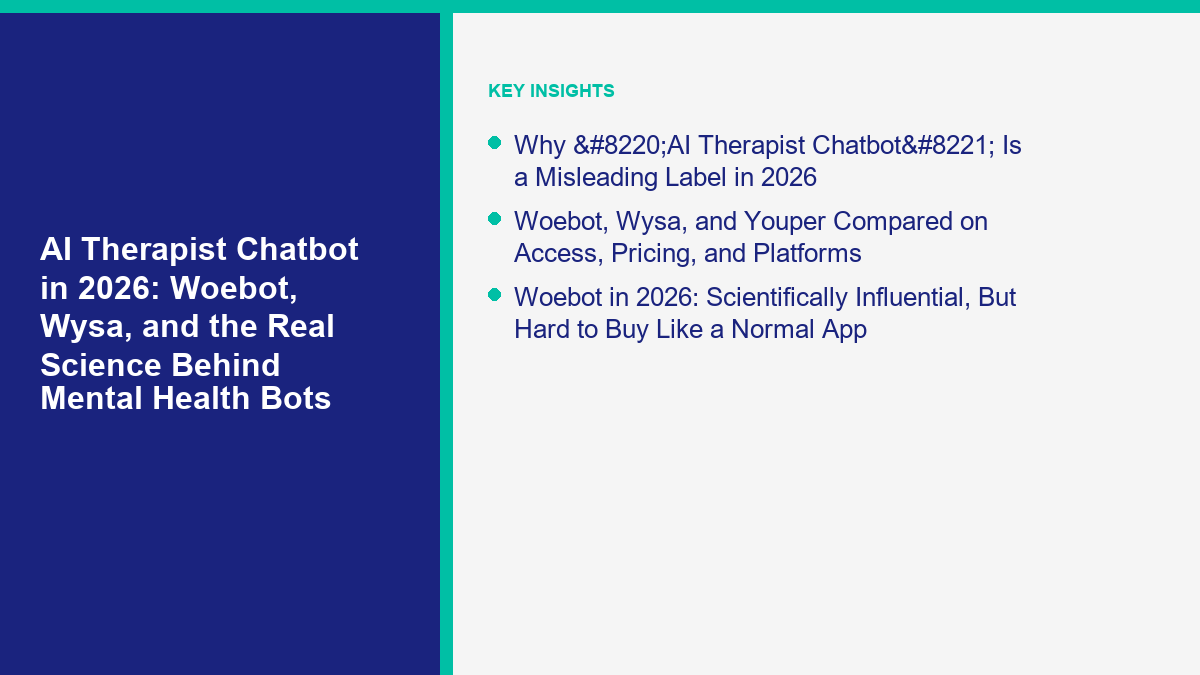
如果你在 2026 年搜索一个 人工智能治疗师聊天机器人 ,你几乎立即就会遇到一个类别问题。有些产品是可以在两分钟内下载的公共自助应用程序。有些是仅通过雇主、研究或健康系统提供的临床相关工具。有些实际上是带有同理心界面的情绪日志。而有些仍然用治疗语言进行营销,即使公司本身表示该软件并不能替代专业护理。.[1][2][5][9]
这就是为什么通常的“最佳人工智能治疗机器人”汇总感觉肤浅的原因。它们常常将 Woebot、Wysa、Youper 和更新的自我护理应用程序归为一类,然后表现得好像你在选择可互换的治疗师替代品。你并不是。更诚实的框架是这样的:一个 心理健康聊天机器人 可以用于结构化反思、认知行为疗法风格的练习、习惯跟踪和会话间支持,但产品设计、隐私立场和临床证据因供应商而异。即使是最强大的应用程序也在危机、诊断、药物和严重心理疾病方面划定了明确的界限。.[6][9][2]
这是在 2026 年 4 月 12 日审查官方产品页面和当前研究后的简短版本。. Wysa 如果你想要一个结构化、以证据为导向的自助应用程序,并且有可选的辅导,. Woebot 仍然在科学上很重要,但对于普通消费者来说,它主要是一个具有遗留研究和有限公共访问的品牌,而不是一个正常的自助订阅。. Youper 是最干净的轻量级情绪反思机器人,但它完全是人工智能,并明确表示这一点。. Earkick 拥有最强的隐私优先营销宣传之一,但其应用商店隐私标签显示了为什么你应该始终阅读数据披露,而不仅仅是英雄文案。.[8][1][9][10]
如果你的实际项目是为社交或网络渠道的客户构建一个安全的支持助手,而不是替代治疗师,, 浏览我们的教程 首先。心理健康机器人是为什么范围控制、升级规则和诚实的人工智能披露比让机器人听起来情感流畅更重要的最明显例子之一。.
为什么“人工智能治疗师聊天机器人”在2026年是一个误导性标签
这个短语 人工智能治疗师聊天机器人 排名靠前是因为人们可以立即理解它,而不是因为它在临床上是精确的。这个类别的大多数产品不是持证治疗师,不进行诊断,不开处方,也不适合危机护理。Wysa表示其应用程序旨在用于自助和心理健康的自我监测,而不是替代专业医疗建议,也不适用于危机情况或严重和持久的心理健康问题。Youper表示该应用程序不提供诊断测量或治疗建议,不是专业护理的替代品,也无法提供危机干预。Woebot Health表示其当前产品是临床护理的辅助,而不是替代品,并特别表示其产品未经过FDA评估、批准或认证。.[5][9][2]
这听起来像是法律上的谨慎,但这也是良好的产品真相。治疗不仅仅是内容的传递。人类临床医生会随着时间的推移跟踪风险,注意到你在回避的话题,看到你遗漏的矛盾,带来专业的判断来进行诊断和治疗计划,并知道何时症状群体暗示躁狂、精神病、创伤升级、物质滥用或医学共病。聊天机器人可以模拟同理心,但无法对你的护理承担专业责任。.
标签混乱还有一个技术原因。最强大的 人工智能咨询聊天机器人 产品并不总是最开放式的。Wysa自己的常见问题解答中说,它的人工智能使用基于规则的算法和大型语言模型的组合,并且不同的机构版本使用不同的基于规则和LLM驱动的聊天组合。Woebot的技术页面表示,该系统历史上使用的是由临床医生和对话设计师撰写的专家撰写的对话,利用机器学习和自然语言处理选择合适的干预措施,而该公司仅在探索LLM以供未来迭代。换句话说,一些更安全的产品之所以更安全,恰恰是因为它们比通用聊天机器人更受限制。.[5][3]
这对买家很重要。如果你想要一个可以像通用人工智能助手那样自由发挥的聊天机器人,你可能会得到更具表现力的语言,但安全性却不那么可预测。如果你想要一个结构化的 人工智能治疗机器人, ,你通常是故意购买保护措施。.
Woebot、Wysa 和 Youper 在访问、定价和平台上的比较
这是比较人们在 2026 年实际搜索的主要选项的最简单方法。我将消费者访问与临床声誉分开,因为这两者不再是同一回事,尤其是对于 Woebot 来说。.
| Bot | 2026 年 4 月的公共访问情况 | 平台 | 当前定价快照 | 人工支持选项 | 主要现实检查 |
|---|---|---|---|---|---|
| Woebot Health | 不是一个普通的自助消费者应用。Woebot 表示新用户需要研究或合作伙伴访问代码,而其常见问题解答也表示该应用于 2025 年 6 月 30 日退役,无法再创建新账户。. | 合作伙伴、提供者、雇主或研究部署,而不是公开注册。. | 没有列出公共消费者价格。. | 间接通过提供访问的提供者或组织。. | Best known research brand in the category, but the weakest public availability for ordinary app shoppers.[1][2] |
| Wysa | Publicly available and still the easiest mainstream mental health chatbot to recommend to self-help users. | Android, iOS, and web according to Wysa’s FAQ. | Free AI chat to start. The US iPhone App Store currently lists premium purchases including $19.99 monthly, annual packages at $74.99 and $99.99, and a coach-plus-tools plan at $99.99 per month. | Yes. Wysa says coaching is available in some locations and its public site advertises 4 live sessions per month in the coached tier. | Best public mix of structured tools, evidence language, and optional human backup, but still not for crisis or severe mental illness.[5][6][8] |
| Youper | Publicly available. | iPhone and iPad on the current App Store listing. | Free to install; the App Store lists Youper Premium at $7.99. | No public human therapist layer is advertised in the current app listing; the app says all responses are generated by AI. | Very accessible for mood tracking and journaling, but it is fully AI and explicitly not a medical or crisis service.[9] |
| Earkick | Publicly available. | iPhone, iPad, Apple Watch, and iMessage on the current App Store listing. | The App Store currently shows Earkick Premium at $14.99 monthly, with annual listings at $44.99, $89.99, and $107.99 depending on package, plus smaller paid options. | No therapist layer in the public listing. | Strong privacy-first branding and broad platform presence, but its App Store privacy label is more complicated than the headline copy suggests.[10] |
What jumps out is how different the buying motion is. Woebot is now closer to a digital health platform story. Wysa is still an app-store story with optional coaching. Youper is a low-friction personal support app. Earkick is a privacy-first mental fitness app with more subscription variation than its clean branding suggests. That is why “best AI therapist chatbot” is not one decision. It is at least four.
This is also where consumer mental health apps feel very different from business chatbot SaaS. Public self-help apps often mix free chat, premium tool libraries, coaching add-ons, and promo-price SKUs. If you want a clean contrast with flat business messaging tiers, 查看MessengerBot定价. The pricing logic is much easier to model when the product is channel automation instead of a mix of self-help content and emotional support.
Woebot in 2026: Scientifically Influential, But Hard to Buy Like a Normal App
Woebot still has one of the strongest brand names in this category because its early research was unusually visible. The 2017 JMIR randomized controlled trial is still one of the papers people cite first when they talk about chatbots and mental health. In that study, 70 young adults ages 18 to 28 were randomized to either two weeks of Woebot interactions or an information-only ebook from the National Institute of Mental Health. The Woebot group showed a significant reduction in depression symptoms over the study period, and participants engaged with the chatbot a lot for such a short intervention, averaging just over 12 interactions in two weeks.[11]
That paper still deserves attention. It was early, it was concrete, and it made a serious argument that a conversational agent could deliver a narrow CBT-style intervention in a way people would actually use. But the 2026 shopping reality is very different from the 2017 research reality. Woebot Health’s own support page says new users in the United States must be part of a study or have an access code from a provider, employer, or other partner, and a linked FAQ on the same site says the Woebot app was retired on June 30, 2025 and new accounts can no longer be created.[1]
For an ordinary consumer looking for an 人工智能治疗师聊天机器人, that means Woebot is no longer the obvious default recommendation even if you admire the science. It is not a normal download-first product anymore. Woebot’s current solutions page makes the company’s direction much clearer: Access Accelerator for clinicians, population-health tools for payers, EMR integration, patient-reported outcomes, validated scales such as PHQ-8 and PHQ-9, and custom resources for specific populations. That is not a mass-market app pitch. That is a digital behavioral health infrastructure pitch.[2]
The biggest practical takeaway is that Woebot is strongest when a health system or employer is wrapping it inside a broader care pathway. It is much weaker as a recommendation for someone who just wants to try a mental health chatbot this weekend. If your insurer, university, or provider offers it, great. If not, you are probably comparing Wysa, Youper, or another public app instead.
There is one more important nuance here. Woebot’s solutions page says the company’s current population-specific products are not evaluated, cleared, or approved by the FDA and do not replace clinical care. That sentence matters more than the marketing. It tells you exactly how the company wants these products used: as adjunct support, not as autonomous therapy.[2]
Wysa in 2026: Still the Best Public AI Therapy Bot for Structured Self-Help
If you want the public app that feels most serious without pretending to be a therapist replacement, Wysa is still the strongest answer. The reason is not magic empathy. It is product discipline. Wysa’s FAQ says the app is available on Android, iOS, or the web, uses a mix of rule-based logic and large language modeling depending on version, and is intended for emotional wellbeing support, self-help, and self-monitoring. That is a grounded promise. It is broad enough to be useful and narrow enough to avoid obvious overclaiming.[5]
Wysa also makes a cleaner public distinction between AI support and human support than most competitors. The public “for individuals” page says coaching is available right inside the app, and the coached tier includes 4 live sessions per month plus support between sessions. That does not make Wysa equivalent to weekly psychotherapy, but it does make the escalation path more realistic than a pure self-serve bot. If you know you need a little more than journaling but a lot less than full clinical treatment, that middle layer is useful.[6]
The live pricing is a little messier than the homepage copy suggests, which is common for subscription apps. On the current US iPhone App Store listing, Wysa is free to download and shows a set of in-app purchases that includes Wysa Premium monthly at $19.99, annual premium options at $74.99 and $99.99, a one-month premium package at $9.99, and Premium Plus at $99.99 per month. The important buying point is not picking apart every SKU. It is understanding the stack: free AI chat at the bottom, premium tool access in the middle, and human coaching at the top.[8]
Wysa is also honest about its boundary conditions. Its FAQ says the app is not recommended for crisis situations and is not suitable for people with severe and enduring mental health problems. Its public site says the AI can screen for distress and surface crisis resources, but the same page also says Wysa cannot offer medical or clinical advice and is not designed to assist with severe mental health emergencies. That is the right product line. If a bot cannot safely manage a situation, it should redirect, not improvise.[5][6]
The result is that Wysa feels less like an artificial therapist and more like a structured mental fitness tool with optional guided support. In this category, that is a compliment.
The Clinical Evidence Is Better Than Most AI Categories, but Still Smaller Than the Marketing
The science behind mental health bots is not fake. It is just easy to oversimplify. Woebot’s 2017 randomized controlled trial is still one of the best-known examples of a chatbot producing measurable symptom improvement in a real study design. The treatment was short, only two weeks, but it showed that a conversational format could improve engagement and reduce depression symptoms in a college-age population compared with an information-only control.[11]
Wysa’s evidence base is also more serious than many buyers realize. Wysa’s clinical evidence page says the company has more than 36 peer-reviewed publications, 8 clinical trials, 6 service evaluations, and 13 real-world studies. More importantly, the current evidence page points to an independent peer-reviewed clinical trial in JMIR involving people with chronic diseases. The 2024 paper shows a four-week Wysa intervention in adults with arthritis or diabetes, with 68 participants included in the analysis and significant reductions in depression and anxiety in the treatment group, but no change in stress. The authors also reported that users liked many app features while disliking some of the chatbot’s conversational abilities, which is exactly the kind of mixed result that makes a paper worth reading.[7][12]
Step back from individual brands and the bigger picture still looks promising, but modest. A 2025 systematic review and meta-analysis of chatbot-delivered interventions for young people identified 29 interventional studies, including 13 randomized controlled trials. The meta-analysis found a statistically significant reduction in distress, but not a significant improvement in broader psychological well-being. Another 2024 rapid review focused on college students found nine studies with 1,082 participants, and eight of the nine reported statistically significant improvements in anxiety, depression, or well-being. Those are encouraging results. They are not a blank check to call an app therapy.[13][15]
The most useful recent overview is the 2025 systematic review that charted mental health chatbots from rule-based systems to LLM-based systems. It looked at 160 studies from 2020 through 2024 and found that LLM-based bots surged to 45% of new studies in 2024, but only 16% of those LLM studies had gone through clinical efficacy testing. Most were still in early validation. That is the exact split most buyers miss. Product marketing moved fast. Clinical validation did not move at the same speed.[14]
So yes, there is real science here. There are randomized trials. There are measurable symptom changes. There is good evidence that a well-designed mental health chatbot can help some people with low mood, anxiety, distress, and emotional self-management. But there is a big difference between “helpful for some users in a bounded use case” and “safe therapist substitute for everyone.”
Where the Research Still Falls Short, Especially for Newer LLM-Driven Bots
Here is the part most review articles soften too much: the evidence base is still uneven. Many studies are short. Many focus on low-acuity symptoms rather than severe disorders. Many measure self-reported symptom changes over a few weeks, not durable outcomes over six or twelve months. And a lot of the better-known studies still involve company employees as coauthors or participants who already opted into a paid app.[11][16]
You can see that clearly in the major brand papers. The Woebot 2017 trial included Woebot-affiliated authors. The 2021 Youper observational study included Youper employees and shareholders, looked at 4,517 paying users who had opted into research, and found symptom decreases in the first two weeks of use. That is interesting, and the sample size is substantial, but it is not the same evidence class as a long independent randomized clinical trial with an active comparator and broader clinical oversight.[11][16]
The Wysa chronic disease trial is stronger on independence, which is one reason it stands out, but even there the study was four weeks long and involved 68 participants. That is enough to matter. It is not enough to settle every question about durability, adverse effects, or which symptom profiles do worst with chatbot-only support. The same paper also notes that some participants disliked the bot’s conversational abilities. That detail matters because a chatbot can score well on symptom reduction and still feel thin, repetitive, or annoying in daily use.[12]
The architecture review from 2025 sharpens the concern for newer LLM-centered apps. LLM-based mental health chatbots are arriving faster than the evidence pipeline can validate them. If only 16% of LLM studies have gone through clinical efficacy testing and most are still in early validation, then a lot of the category is being purchased on plausibility, not on mature clinical proof.[14]
That does not mean the category is useless. It means a serious buyer should ask better questions:
- Was the study randomized or just observational?
- How long did the intervention last?
- What was the control condition?
- Were severe symptoms excluded from the study?
- Were company employees involved in authorship or funding?
- Did the paper measure actual symptom change, not just satisfaction or engagement?
- Did the product have a human escalation path?
If a vendor cannot answer those questions clearly, you are not looking at a clinically mature product. You are looking at a promising experiment.
Privacy Is Where the Mental Health Chatbot Category Gets Real Very Fast
Privacy questions hit differently when the chat log is about panic, shame, grief, trauma, or compulsive thoughts instead of generic productivity prompts. The problem is that words like “private,” “anonymous,” and “secure” can all be true in a limited sense while still hiding practical tradeoffs about data collection, model training, institutional reporting, or tracking labels.
Wysa is one of the clearer vendors here. Its FAQ says the company does not request your personal data, chats are private, and if you accidentally send identifying details such as an email address or phone number, Wysa says it will irreversibly redact that information from its system within 24 hours. The same FAQ also says anonymized, summarized population-level information may be shared with institutional partners, and that anonymized messages may occasionally be used to train Wysa’s AI. That is not a scandal. It is exactly the kind of nuance users should know before they type something deeply personal.[5]
Woebot’s privacy page takes a different angle. The company says chat transcripts are not shared with third parties except to provide or improve the service or to protect people, and says it never sells or shares personal data with advertisers. That is strong language, and better than many consumer apps. But you still need to notice the exception structure. “Not shared except…” is not the same thing as “nobody else ever touches this.” It is closer to a responsible healthcare-style privacy posture than to pure on-device privacy.[4]
Youper is clearer than many apps about the fact that you are talking to AI, not a person. The privacy picture is less minimalist than some users may expect. Apple’s current App Store label says Youper may use usage data to track you across apps and websites owned by other companies, and may collect data linked to your identity including email address, user ID, product interaction data, and diagnostics. That does not automatically make the app unsafe. It does mean “private journal with AI” should not be read as “nothing identifiable is collected.”[9]
Earkick is the most useful cautionary example. Its current App Store marketing copy says “no registration,” “no tracking,” and “no stored data,” with everything staying on device or in secure iCloud. But the same App Store page also shows Apple’s privacy label stating that usage data may be used to track you across apps and websites owned by other companies, and that health and fitness data, contact info, contacts, user content, usage data, and diagnostics may be collected though not linked to identity. The lesson is not “Earkick is lying.” The lesson is that privacy promises need to be checked in both the marketing copy and the platform disclosure.[10]
If you are choosing a 心理健康聊天机器人, the practical privacy checklist is simple:
- Check whether the app asks for real names, email addresses, or phone numbers.
- Read the App Store or Google Play privacy labels, not just the homepage.
- Find out whether conversations may be used to train the AI.
- See whether institutional versions share trend data with employers, schools, or insurers.
- Look for export and deletion controls before you ever need them.
- Decide in advance which topics you are comfortable entering into an app.
Most people do those checks after they are emotionally invested in the bot. That is backwards. Do them first.
When an AI Therapy Bot Can Be Genuinely Useful
For all the caution above, it would be wrong to dismiss the whole category. A good 人工智能治疗机器人 can be genuinely useful in a handful of situations, especially if you already understand what it is for.
The best use case is low-friction support between other parts of life. Think of late-night rumination when you want a grounding exercise, not a diagnosis. Think of a CBT prompt that helps you reframe catastrophic thinking. Think of logging mood patterns for two weeks before a therapy appointment so you show up with a clearer picture of sleep, triggers, and stress. Think of a coach-like nudge to do a breathing exercise instead of doomscrolling for an hour. That is where these apps can earn their keep.
Wysa is especially good when you want structured exercises and a care library. Youper is good when you want emotional reflection, mood tracking, and short guided conversations. Woebot is worth using if your provider or organization gives you access, especially because it is designed to fit into a broader care pathway rather than pretending to be a one-app answer. Earkick is attractive if you want a broader self-care toolkit and watch-based check-ins, though I would be stricter about privacy review there.[5][9][2][10]
The strongest pattern in the literature fits that practical use. These systems seem best at improving access, reducing friction, and supporting low-acuity self-management. They are not strongest where professional assessment, relational depth, or crisis judgment are the core task.[13][14]
My rule of thumb is simple. Use a chatbot for repetition, reflection, and routine. Use a person for interpretation, diagnosis, and risk.
When You Need a Real Therapist, Psychiatrist, or Crisis Service Instead
This is the boundary that matters most. A chatbot is the wrong tool if you are dealing with suicidal thoughts, self-harm urges, hallucinations, mania, abuse, rapid functional decline, medication questions, or symptoms that are becoming dangerous to you or other people. It is also the wrong tool if you already notice that the app is becoming your only emotional outlet while your real-world functioning is getting worse.
The companies largely agree on this. Wysa says the app is not recommended for crisis situations and severe, enduring mental health problems. Youper says it cannot provide crisis intervention and directs users to 988, Crisis Text Line, and emergency services. Woebot says it does not provide crisis counseling and that concerning-language detection is not a real-time intervention service.[5][9][2]
That should reset expectations. The right comparison is not “bot versus therapist.” The right comparison is “support tool versus clinical care.” A bot may help you hold on between appointments. It should not be the only thing holding you together.
There is also a subtler failure mode that does not always look dramatic at first: delay. An 人工智能咨询聊天机器人 can feel helpful enough that you keep postponing the harder step of seeing a licensed professional. That delay is fine when your problem is mild stress and you are getting better. It is risky when symptoms are persistent, escalating, or beginning to affect sleep, work, school, relationships, eating, safety, or substance use.
If the app keeps you moving toward help, great. If it keeps you from getting help, it has become part of the problem.
How to Evaluate an AI Therapist Chatbot Before You Trust It With Personal Stuff
You do not need to run a clinical trial at home, but you should test any 心理健康聊天机器人 with more skepticism than a normal wellness app. This one-hour process is enough to surface most of the important differences.
- Check the crisis boundary first. Find the disclaimer before the signup flow. If the app buries its crisis language or makes it hard to find help resources, that is a bad sign.
- Map the real access model. Ask whether it is public self-serve, partner-only, or coaching-backed. Woebot fails this test for ordinary shoppers because its science reputation is stronger than its current public availability.
- Read the privacy label on the store page. Do not rely on homepage claims about anonymity or privacy.
- Stress-test the conversation. Try awkward, ambiguous prompts. See whether the bot becomes repetitive, overly agreeable, or strangely confident.
- Test one practical skill flow. Ask for a grounding exercise, a thought-challenging prompt, and a journaling structure. This is where Wysa usually feels more useful than pure free-chat bots.
- Check deletion and export controls. You should know how to erase your history before you need to.
- Decide your red-line topics. Medication, trauma details, legal risk, abuse, and suicidal thoughts belong with a human professional or crisis service, not with a chatbot experiment.
This is the same discipline good operators use when they test any support automation. The difference is that emotional vulnerability raises the stakes. If you are automating customer conversations instead of mental health care, the logic is similar and the risk profile is lower. That is exactly why emotionally sensitive use cases are a useful design lesson for anyone building conversational systems.
What Businesses Should Learn From Therapy Bots Before Automating Messenger, Instagram, or Website Support
This article is about mental health bots, but the design lessons transfer directly to business messaging. The products that hold up best are not the ones that try to sound most human. They are the ones that keep scope clear, disclose when AI is involved, route risky cases to people, and avoid making claims they cannot support.
That is relevant if you run support on Facebook Messenger, Instagram, or a website. The wrong move is building a bot that improvises empathy across edge cases with no escalation. The right move is designing a narrow assistant that can answer FAQs, gather context, tag conversations, and hand off cleanly when a human needs to step in. If your support workflows are getting complex enough that channel control matters more than generic chat intelligence, Upgrade to MessengerBot Pro for routing and operations, not for pseudo-therapy.
Therapy bots also show why language constraints are a feature, not a bug. A customer support bot should not diagnose, speculate, or invent certainty either. It should make the next safe step obvious. That can mean showing a return policy. It can mean collecting the order number. It can mean routing a billing dispute to a real person. In a wellness context, it can mean refusing to posture as a clinician.
If you advise brands, agencies, or client accounts on this kind of automation, the category is worth studying even if you never deploy a mental health flow yourself. It teaches you where AI confidence turns into liability.
So Which AI Therapist Chatbot Is Actually Best in 2026?
If you mean “best public app I can use right now for structured emotional support,” the answer is Wysa. It has the best mix of availability, structured self-help, evidence language, and optional human backup. If you mean “most important brand in the research history of this category,” the answer is still Woebot, but that does not make it the best consumer recommendation in April 2026 because public access is limited. If you mean “best lightweight AI journal and reflection app,” Youper is the cleanest fit. If privacy marketing is your main filter, Earkick is interesting, but you should audit its data disclosures more carefully than its homepage tone might suggest.[5][1][9][10]
The bigger answer is that no 人工智能治疗师聊天机器人 should be evaluated as if the only question is how human it sounds. The real questions are simpler and more important:
- Can it help with a bounded problem such as reflection, mood tracking, or skill practice?
- Does the evidence actually match the marketing?
- Are the privacy tradeoffs clear before you type anything sensitive?
- Does it push you toward human care when your situation needs human care?
If the answer to those questions is yes, a mental health chatbot can be worth using. If the answer is mostly vibes, polished branding, and therapy language without clear limits, skip it.
Need a Safer Automation Playbook for Customer Messaging Instead?
The healthiest lesson from this whole category is that bots work best when they stay inside a clearly defined job. For business messaging, that usually means lead capture, support triage, follow-up, routing, FAQs, and handoff rather than trying to imitate a clinician or confidant. If that is the problem you are actually solving, start with the basics, then scale only when the workflow proves itself.
Use these next steps in order: 查看MessengerBot定价 if you need the tier breakdown, 浏览我们的教程 if you want implementation walkthroughs, and 加入我们的联盟计划 if you help clients choose or deploy chatbot platforms for a living.
Sources and Research References
All product availability, pricing, App Store, and company-policy details were checked on April 12, 2026. Clinical evidence links point to the latest accessible official or peer-reviewed source available during drafting.
- Woebot Health – App Support
- Woebot Health – Solutions
- Woebot Health – Technology Overview
- Woebot Health – Privacy Policy
- Wysa – FAQ (Clinical Program)
- Wysa – For Individuals
- Wysa – Clinical Evidence and Research
- Apple App Store – Wysa: Mental Wellbeing AI
- Apple App Store – Youper
- Apple App Store – Earkick: Self Care AI Coach
- JMIR Mental Health – Woebot Randomized Controlled Trial (2017)
- JMIR Formative Research – Effectiveness of a Mental Health Chatbot for People With Chronic Diseases: Randomized Controlled Trial (2024)
- PubMed – Chatbot-Delivered Interventions for Improving Mental Health Among Young People: A Systematic Review and Meta-Analysis (2025)
- PubMed – Charting the Evolution of Artificial Intelligence Mental Health Chatbots From Rule-Based Systems to Large Language Models: A Systematic Review (2025)
- PubMed – Effectiveness of Artificial Intelligence Chatbots on Mental Health and Well-Being in College Students: A Rapid Systematic Review (2024)
- PubMed – Acceptability and Effectiveness of Artificial Intelligence Therapy for Anxiety and Depression (Youper): Longitudinal Observational Study (2021)
常见问题
AI治疗师聊天机器人与真实治疗是一样的吗?
不。这些最强大的心理健康聊天机器人是自我反思、认知行为疗法风格的练习、情绪追踪和会话间帮助的支持工具。它们不能替代持证治疗、诊断、药物管理或危机服务。.
2026年,哪款AI治疗师聊天机器人最适合普通用户?
Wysa 是 2026 年大多数普通用户的最佳公共选择,因为它仍然广泛可用,提供结构化的自助工具,并且有一个可选的辅导层。Woebot 在科学上很重要,但它不再是最容易访问的消费应用程序。.
Woebot 比 Wysa 更好吗?
在2026年4月不适合大多数公众用户。Woebot仍然具有重要的研究可信度,但如果您需要一个可以在没有提供者或研究代码的情况下实际使用的应用程序,Wysa是更好的推荐。.
心理健康聊天机器人是私密的吗?
有时,但隐私差异很大。您需要检查该应用是否收集标识符,是否使用对话数据来训练其人工智能,是否与机构合作伙伴共享趋势数据,或是否在其应用商店隐私标签中显示跟踪信息。.
我应该在什么时候停止使用人工智能治疗机器人并联系专业人士?
如果您正在经历自杀念头、自残、幻觉、狂躁、虐待、药物问题、严重症状加剧,或者如果该应用程序正在成为您已经知道需要的护理的替代品,请不要仅依赖机器人。.



 简体中文
简体中文  English
  Tagalog
  العربية
  हिन्दी
  Português do Brasil
  Español de México
  Français
  বাংলা
বাংলা  香港中文
香港中文  繁體中文
繁體中文  Nederlands
  Deutsch
  Bahasa Indonesia
  日本語
日本語  한국어
한국어  Polski
  Русский
  Español
  Tiếng Việt