
Vor zwei Jahren war dies eine einfachere Diskussion. Chatbots waren billig, steif und hauptsächlich nützlich für die Bearbeitung von FAQs. Live-Chat fühlte sich menschlicher, flexibler und teurer an. Im Jahr 2026 ist diese klare Trennung verschwunden. Ein guter Chatbot kann jetzt Richtlinienfragen beantworten, Leads qualifizieren, Bestelldetails sammeln, eine Rückerstattungsanfrage weiterleiten und das vollständige Transkript an einen Menschen übergeben. Live-Chat gewinnt immer noch, wenn Nuancen, Beruhigung oder Abschlussfähigkeiten wichtig sind. Die eigentliche Frage ist also nicht mehr “Welches Tool ist besser?” sondern “Welche Ebene sollte den Kunden zuerst treffen?”
Hier ist die praktische Antwort, die die meisten Unternehmen benötigen: Wenn Ihr Posteingang repetitiv ist und Nachrichten außerhalb der Geschäftszeiten wichtig sind, amortisiert sich die Automatisierung durch Chatbots in der Regel schneller, als die Eigentümer erwarten. Wenn Ihr Verkaufsprozess beratend, reguliert oder hochpreisig ist, verdient Live-Chat weiterhin seinen Platz. Aber für die meisten kleinen und mittelständischen Unternehmen ist das stärkste Setup hybrid. Lassen Sie den Bot den schnellen, wiederholbaren, reibungslosen Teil des Gesprächs übernehmen. Lassen Sie einen Menschen eingreifen, wenn der Käufer wertvoll ist, das Problem kompliziert ist oder der Kunde eindeutig eine Person möchte.
Preise und Benchmark-Referenzen in diesem Artikel wurden am 10. April 2026 mit öffentlichen Produktseiten, Benchmark-Berichten von Anbietern und offiziellen Recherchen überprüft. Wo ich Konversionszahlen verwende, gebe ich an, ob die Zahl aus einem breiten Benchmark oder einer Fallstudie eines Anbieters stammt, da dies nicht dasselbe ist.
Warum Chatbot vs Live-Chat 2026 immer noch eine echte Geschäftsentscheidung ist
Viele Vergleichsbeiträge tun so, als wäre diese Debatte bereits beendet und KI hätte standardmäßig gewonnen. Das sagt die Datenlage jedoch nicht. Gartner berichtete im August 2025, dass Self-Service und Live-Chat auf dem besten Weg sind, traditionelle Kanäle bis 2027 als die wertvollsten Technologien im Kundenservice zu übertreffen. Das ist ein nützlicher Hinweis, weil es zeigt, wo Support-Leiter tatsächlich ihre Wetten platzieren: nicht auf eine magische KI-Schicht, sondern auf eine Mischung aus schnellem Self-Service und menschlich unterstütztem Chat.
Auch die Erwartungen der Kunden sind gestiegen. Der Zendesk CX Trends 2026 Bericht sagt, dass 74% der Verbraucher jetzt 24/7-Service erwarten, weil KI existiert, und 86% sagen, dass Reaktionsfähigkeit und genaue Lösungen stark beeinflussen, ob sie kaufen. Das schafft die zentrale Spannung. Kunden wollen sofortige Antworten, aber sie wollen keine Sackgassen. Ein Chatbot ist hervorragend in der Sofortantwort. Ein Mensch ist besser bei Mehrdeutigkeiten. Wählen Sie die falsche erste Schicht, und Sie geben entweder zu viel für menschliche Zeit aus oder frustrieren die Kunden genau dann, wenn die Absicht am stärksten ist.
| Ansatz | Wo es gewinnt | Wo es scheitert | Beste Passform |
|---|---|---|---|
| Chatbot zuerst | Sofortige Antworten, 24/7-Abdeckung, niedrige Grenzkosten, starke FAQ- und Lead-Erfassungsleistung | Schwach bei Randfällen, emotionalen Beschwerden, Verhandlungen und Fragen außerhalb des Skripts | Hochvolumige repetitive Unterstützung, Lead-Erfassung außerhalb der Geschäftszeiten, Bestellstatus, Buchungen, Qualifizierung |
| Live-Chat zuerst | Menschliches Urteilsvermögen, Vertrauensaufbau, komplexe Fehlersuche, Verkaufsgespräche mit echtem Nuancen | Teuer in der Personalbesetzung, schwer 24/7 abzudecken, Warteschlangen bilden sich schnell bei hohem Volumen | Hochpreisige Verkäufe, regulierte Branchen, beratender Einkauf, Premium-Support mit niedrigem Volumen |
| Hybrid | Schnelle erste Antwort, niedrigere Arbeitskosten, bessere Weiterleitung, bessere Abdeckung außerhalb der Geschäftszeiten, sauberere Eskalationen | Erfordert mehr Disziplin bei der Einrichtung, da Abläufe und Übergaben gut gestaltet sein müssen | Die meisten KMUs, E-Commerce-Marken, SaaS-Teams, lokale Dienstleistungen und Messenger-first-Unternehmen |
Eine schnelle Realitätserklärung, bevor wir tiefer gehen: Ernsthafte Support-Software gehört nicht zur Kategorie “keine Anmeldung erforderlich”. Wenn ein Anbieter Geschäftschat so bewirbt, schauen Sie wahrscheinlich auf eine Demo, nicht auf ein Betriebssystem. Echte Support-Workflows benötigen gespeicherten Kontext, Kanalberechtigungen, Weiterleitungsregeln, Berichterstattung und einen offensichtlichen Übergabepfad.
Wenn das Problem, das Sie zu lösen versuchen, die Supportkosten und nicht nur die Kanalwahl betrifft, lesen Sie unseren Leitfaden zur KI-Kundenbetreuung darüber hinaus. Er geht tiefer auf Bot-Abwehr, Qualität der Wissensdatenbank und das ROI-Modell des Supports hinter diesen Zahlen ein.
Wie moderne Chatbots tatsächlich funktionieren, wenn sie richtig eingerichtet sind
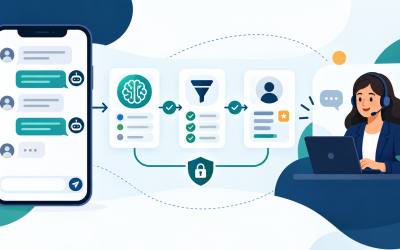
Der größte Fehler, den ich in dieser Debatte sehe, ist, “Chatbot” wie eine einzige Sache zu behandeln. In der Praxis sind die meisten Geschäftschatbots im Jahr 2026 ein Stapel aus drei verschiedenen Systemen, die zusammenarbeiten: einer Konversationsschicht, einer Wissensschicht und einer Eskalationsschicht. Wenn eine dieser Schichten schwach ist, fühlt sich der gesamte Bot schlecht an.
Regelbasierte Menüs sind nach wie vor wichtiger, als die meisten Menschen zugeben
Selbst mit besserer KI verwenden die schnellsten Bots immer noch Struktur. Sie begrüßen den Benutzer, bieten 3 bis 5 klare Einstiegsmöglichkeiten und reduzieren Verwirrung, bevor der Freitextteil überhaupt beginnt. Das klingt altmodisch, aber es funktioniert. Wenn jemand Hilfe bei einer Bestellung, den Öffnungszeiten, der Rückgabepolitik, der Buchung oder einem menschlichen Agenten möchte, lassen Sie ihn nicht beweisen, dass er es will, indem er mit einem großen Sprachmodell von einem leeren Bildschirm spricht. Geben Sie ihm eine saubere Eingangstür.
Das ist auch für die Konversion wichtig. Ein Käufer, der um 22:30 Uhr auf einer Produktseite landet und auf “Versand” oder “Demo buchen” klickt, zeigt gerade jetzt Absicht. Ein strukturierter Bot kann diese Absicht sofort warm halten. Das ist kein Hype. Das ist einfach Reibung zu entfernen.
KI-Retrieval ist das, was einen Bot nützlich erscheinen lässt, anstatt scripted
The newer part of the stack is retrieval. A good support bot now pulls answers from approved sources such as FAQ pages, help docs, PDFs, product pages, shipping policy, appointment rules, or internal support notes. That is why some bots feel surprisingly competent and others feel vague. The model is only half the story. The knowledge base is the other half.
For a small business, this is the practical dividing line between a useful chatbot and an embarrassing one. If your help content is thin, inconsistent, or outdated, the bot will sound generic. If your source material is clean, specific, and current, the bot can answer with real precision. Most bad chatbot experiences are not caused by “AI being dumb.” They are caused by businesses feeding the bot weak content.
Escalation Rules Decide Whether the Bot Saves Money or Creates Churn
The third layer is where the serious money gets made or lost. A bot has to know when to stop. Refund demands, billing disputes, repeated failed answers, account access issues, and emotionally charged complaints should not be trapped in automation. They should move to a human fast, with context attached.
That is why the strongest chatbot setups in 2026 are not “replace the team” systems. They are first-response and first-resolution systems. The bot handles what is repetitive, obvious, or time-sensitive. The person handles what is risky, valuable, or emotionally loaded.
HubSpot says its Customer Agent currently resolves 65% of conversations and cuts resolution time by 39% across more than 8,000 activated customers. Intercom says Fin resolves an average of 67% of customer queries across more than 7,000 paying teams. Those are strong numbers, but notice what they imply: even good AI systems still leave a meaningful share of work for humans. That is normal. It is also why hybrid is usually the right design, not a compromise.
What Live Chat Really Looks Like Behind the Widget
Live chat looks simple from the outside. A chat bubble appears, a person replies, the customer gets help. The cost comes from everything behind that bubble: staffing, shift coverage, queue management, QA, coaching, after-chat notes, routing, coverage during lunch or weekends, and the reality that people ask harder questions than your FAQ page can answer.
LiveChat’s latest customer service benchmark gives a useful picture of how real-time chat actually behaves in production. Across the businesses in its report, the average first response time was 35 seconds, the average chat lasted 8 minutes and 25 seconds, and businesses were available for 17 hours and 58 minutes per day on average. Queue waiting time averaged 4 minutes and 18 seconds, and the queue dropout rate was 27.4%.
That last number matters more than people think. More than one in four customers left the queue before reaching an agent. So when a live-chat advocate says human chat converts better, that may be true once the customer reaches a real person. But the queue is part of the experience too. If your team cannot answer quickly, live chat turns into a visible delay machine.
Live Chat Software Is Usually Cheap. Labor Is What Hurts
The software bill is not the main problem. Dedicated live chat tools still start at fairly approachable prices. LiveChat starts at $19 per month on Starter and $49 per seat per month on Team, billed annually. Freshchat has a free tier and Growth starts at $19 per agent per month billed annually. The expensive part is the person sitting behind the tool.
The U.S. Bureau of Labor Statistics puts the median pay for customer service representatives at $20.59 per hour. For planning math, I would not stop there. Add a conservative 30% for payroll tax, software, scheduling overhead, management time, and the basic cost of keeping a support function running, and you are at about $26.77 per hour in loaded labor cost. That is still a modest estimate for many US and UK teams.
Now combine that loaded labor rate with actual chat time. A live chat conversation that lasts 8 minutes and 25 seconds is not really an 8-minute cost. It includes pre-chat context, concurrent chat juggling, after-chat notes, routing, and follow-up. That is why live chat feels inexpensive in vendor pricing tables but expensive in payroll.
There is one more hidden cost most small businesses miss: live chat creates a promise. The moment you show the widget, customers assume a person might answer now. If you only staff it lightly, or only during certain hours, the gap between expectation and reality can damage trust faster than a slower but honest asynchronous channel.
Chatbot vs Live Chat Cost Over 12 Months With Real Numbers
Let us put real planning math on the table. The model below is not a fantasy “AI replaces the whole team” spreadsheet. It is a grounded SMB example using current public pricing and operating benchmarks.
Assumptions for the 12-month model:
- The business handles 1,200 inbound chat conversations per month.
- The average live chat conversation lasts 8 minutes and 25 seconds, based on LiveChat’s benchmark report.
- Loaded human support cost is $26.77 per hour, using the BLS median CSR wage of $20.59 plus 30% overhead. That overhead is my planning assumption.
- Live chat software reference is LiveChat Team at $49 per seat per month billed annually, with two seats.
- Chatbot software reference is MessengerBot Pro at $499.99 per year on current public pricing.
- Hybrid resolution assumes the bot fully handles 65% of conversations before human handoff. That is based on current HubSpot and Intercom public performance data, used here as a planning benchmark rather than a guarantee.
- Live agent time includes a 20% buffer for after-chat work, routing, and operational drag.
| Model | Annual software cost | Annual labor cost | Estimated 12-month total | What the number assumes |
|---|---|---|---|---|
| Chatbot only | $499.99 | $2,569.92 | $3,069.91 | MessengerBot Pro plus about 8 hours per month of bot tuning, review, and exception handling |
| Live chat only | $1,176.00 | $64,878.48 | $66,054.48 | 1,200 chats per month, 8 minutes 25 seconds per chat, 20% ops buffer, and two Team seats |
| Hybrid chatbot plus live chat | $1,675.99 | $22,707.47 | $24,383.46 | Bot resolves 65% of conversations, humans handle the remaining 35%, with the same labor assumptions |
The headline is obvious. The software costs barely matter compared with labor. Live chat only is more than 21 times the cost of the chatbot-only model in this scenario. The hybrid model costs far more than bot-only, but it is still about 63% cheaper than running live chat alone. That is why the wrong debate is “bot or human?” The right debate is “how much of the queue should still require a human in real time?”
Also notice what the table does not claim. It does not say bot-only is the best experience. It says bot-only is the cheapest operating model. Those are different things. If your team sells bespoke services, high-ticket products, or anything that depends on trust-building, a pure cost answer can easily be the wrong answer.
If you run a UK team, swap in your loaded hourly rate and rerun the math. The exact totals will change, but the ranking usually will not. Labor remains the dominant cost driver. Software stays the smaller line item.
Response Speed, Coverage, and the New 24/7 Expectation
Speed is where chatbots have the cleanest advantage. A bot answers instantly at 2 p.m., 2 a.m., weekends, holidays, and lunch breaks. Live chat only answers quickly when someone is staffed, available, and not already handling other conversations. That does not make live chat bad. It just means human speed is conditional and bot speed is not.
Zendesk’s 2026 report found that 74% of consumers now expect 24/7 service because AI exists. That is not saying customers expect a human at every hour. It is saying they now assume a business should offer some useful response at every hour. This is the standard AI raised for everyone, including companies that still prefer human-first service.
LiveChat’s benchmark is useful here too. Businesses were available for an average of 17 hours and 58 minutes per day. That is pretty good, but it is still not round-the-clock coverage. Even on a channel built for real-time support, most teams are leaving meaningful time uncovered.
Where live chat wins is the quality of the second minute, not the first second. Once a real agent is in the thread, they can interpret tone, combine multiple facts, reassure an anxious buyer, or adapt on the fly in a way most bots still cannot. So if the question is strictly “Who answers fastest?” the bot wins. If the question is “Who handles a weird, emotional, high-value case better after minute one?” the human still wins.
The operational goal is to combine those strengths. Let the bot own the first second. Let the human own the difficult minute.
Do Customers Prefer Chatbots or Human Agents?
This is where the answer gets more nuanced than either side likes to admit.
On one hand, LiveChat’s benchmark report shows chatbot satisfaction at 64.7%, slightly above the 64.2% average CSAT for human-handled chats. That tells you something useful: when a bot is deployed on the right kind of issue, customers do not automatically hate it. For straightforward questions, speed and clarity can matter more than whether a person typed the answer.
On the other hand, Pega’s February 2026 consumer research across North America and the UK found that 66% prefer human-led support, 77% say they often or always achieve better outcomes with humans, and only 2% want to interact exclusively with generative AI chatbots. Gladly’s 2026 consumer report sharpens the point: 88% say AI got their issue resolved, but only 22% preferred the company afterward. In a separate Gladly analysis, 59% said they prefer AI as a first stop for support, but 57% expect a clear path to a human within five AI exchanges and 54% will walk away after 10 minutes of getting nowhere.
Put those numbers together and the pattern is pretty clear. Customers are not anti-bot. They are anti-trap. They will happily start with automation if it is fast, accurate, and obviously reversible. They get angry when the bot wastes time, repeats itself, or blocks access to a human.
So which one do customers actually prefer? For simple, transactional, time-sensitive issues, they often prefer the speed of a bot. For complex, emotional, or expensive decisions, they prefer a person. If you force them to choose one mode for every scenario, satisfaction drops. If you match the mode to the job, satisfaction usually holds.
Why the Hybrid Chatbot Plus Live Chat Model Usually Wins
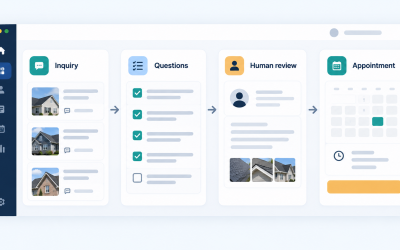
Hybrid works because it separates the conversation into two jobs. The first job is speed: greet, route, answer basics, collect details, and qualify intent. The second job is judgment: reassure, troubleshoot, negotiate, make exceptions, or close. Bots are excellent at the first job. Humans are still better at the second.
The strongest hybrid setups I have seen are not complicated. They usually follow a simple pattern:
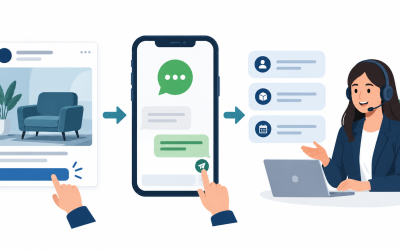
- The visitor lands on the site or opens Messenger and gets an instant bot greeting with a few high-intent options.
- The bot answers common questions, captures order numbers or contact details, and tags the conversation by intent.
- If the issue stays inside the approved lane, the bot finishes it.
- If the issue is valuable, complex, or clearly emotional, the conversation moves to live chat with context attached.
- The human sees the history, avoids asking the same questions again, and picks up at the useful part of the conversation.
This is also where a lot of the real conversion lift shows up. The best revenue outcomes usually come from instant qualification plus timely human follow-up, not from a bot or an agent working in isolation.
| Quelle | Reported result | What it suggests |
|---|---|---|
| LiveChat / Auto Accessories Garage case study | 485% conversion boost for chat users, plus nearly 400% higher per-session value | Real-time human help can dramatically lift conversions on high-consideration ecommerce pages |
| Tidio / Pearl Lemon case study | 30% increase in website-to-lead conversions and 70+ additional monthly leads | Bot-led qualification can recover demand that would otherwise leave silently |
| Tidio / Pastreez case study | 70% conversion rate on customer inquiries through chat | Fast chat responses can turn high-intent product questions into orders |
Those are vendor case studies, not universal averages, so do not treat them like guaranteed lift. But they do make one thing hard to deny: chat works best when speed and human follow-through meet at the same moment. A bot captures and routes. A person closes or calms. That is the model most businesses should actually build.
When Chatbot-Only or Live-Chat-Only Is the Right Call
There are still situations where a pure approach makes sense. You do not need to force hybrid if your business model clearly leans one direction.
Use Chatbot Only When the Work Is Mostly Repetitive and Transactional
- More than half your inbound questions are the same 10 to 20 questions every week.
- Your customers mainly want hours, pricing ranges, order status, booking links, shipping rules, or simple qualification.
- After-hours coverage matters more than real-time human reassurance.
- You can handle exceptions through callbacks, email follow-up, or next-business-day review.
- Your margin does not support keeping live agents on chat all day.
This is common in local services, booking-driven businesses, lean ecommerce teams, and Messenger-heavy businesses that mostly need fast routing plus one clean human backup path.
Use Live Chat Only When Trust and Nuance Are the Product
- Your average sale is high enough that even a few extra conversions justify staffing.
- Most conversations require clarification, diagnosis, or consultative advice.
- You work in a regulated or trust-sensitive category such as legal, financial, healthcare-adjacent, or complex B2B service.
- Your monthly volume is still low enough that staffing chat is cheaper than designing and maintaining automation.
- Your brand position depends on white-glove service more than speed at scale.
If you read both lists and feel like your business belongs in both, that is your answer. You probably need the hybrid model.
If you are still shopping broadly rather than deciding between channels, this roundup of the bester Chatbot für kleine Unternehmen is the right next read. It is useful when you need to compare software categories, not just pick the service model.
Best Chatbot and Live Chat Platforms Worth Shortlisting
There is no universal winner here because the front door matters. A Messenger-first business should not shop the same stack as a website-first SaaS company. Still, these are the tools I would put on a practical shortlist based on current public pricing and fit.
| Ansatz | Plattform | Public starting price checked April 10, 2026 | Beste Passform | Main watch-out |
|---|---|---|---|---|
| Chatbot zuerst | MessengerBot.app | Premium $19.99 per 30 days; Pro $49.99 per 30 days | Facebook Messenger-first businesses that also want flows, forms, broadcasts, website chat, and clean handoff logic | Less ideal if your main buying journey happens on website live chat rather than inside Meta channels |
| Chatbot zuerst | Tidio | Free plan; Starter $24.17 per month; Growth from $49.17 per month | Website-first teams that want live chat, ticketing, and AI in one place | Useful AI capability often means stacking plan cost with AI quota cost |
| Live-Chat zuerst | LiveChat | Starter from $19 per month; Team from $49 per seat per month; ChatBot add-on from $52 per month | Teams that need dedicated real-time website chat and proactive sales conversations | Software is affordable, but labor becomes the real bill very quickly |
| Live-Chat zuerst | Freshchat | Free for up to 10 agents; Growth $19 per agent per month billed annually | Budget-conscious omnichannel teams that want to start free and add live support depth later | AI and advanced routing economics need to be modeled separately as volume grows |
| Hybrid | HubSpot Customer Agent | Free live chat tools; Customer Agent outcome pricing moving to $0.50 per resolved conversation from April 14, 2026 | CRM-centered teams that want bot, handoff, and customer history in one system | Best value shows up when you already operate inside HubSpot, not when you buy it only for chat |
| Hybrid / enterprise | Intercom | Essential from $29 per seat per month; Fin AI Agent at $0.99 per resolved outcome | Mature support teams that want strong AI resolution plus agent workflow depth | Outcome pricing is transparent, but it gets expensive fast at scale |
The honest recommendation depends on the channel that already matters to you. If Facebook Messenger is one of your real sales or support surfaces, MessengerBot is the easiest place to start because the workflow is already aligned to how Messenger businesses actually operate. If your website is the main front door, Tidio, LiveChat, or HubSpot usually make more sense. If you need a true support-ops platform with AI deeply embedded, Intercom is stronger than most SMB tools, but it is priced like it knows that.
Also pay attention to which products are genuinely free and which are only free to test. HubSpot and Freshchat both give you real free starting points. Tidio has a free plan too. None of the serious business-grade options here are “no sign up required,” and that is fine. You want configuration, saved context, and reporting in production.
If Messenger Is One of Your Core Channels, Start With a Hybrid Build
For most businesses on Messenger, the smartest first build is not a giant AI project. It is one welcome flow, one FAQ layer, one lead or support form, and one clear human handoff path. That is enough to test whether automation is reducing response time, improving lead capture, and lowering repetitive work without boxing customers into a bad experience. If you want to compare the current MessengerBot tiers before you map that out, MessengerBot-Preise anzeigen. Start with the smallest setup that gives you bot coverage plus a human escape hatch. That is usually where the ROI becomes obvious.
Häufig gestellte Fragen
Ist ein Chatbot besser als Live-Chat für kleine Unternehmen?
In der Regel ja, was Kosten und Abdeckung betrifft. Ein Chatbot ist besser, wenn die meisten Ihrer eingehenden Nachrichten wiederholend sind, Nachrichten außerhalb der Arbeitszeiten wichtig sind und Sie eine sofortige erste Antwort benötigen, ohne ein Team den ganzen Tag über zu beschäftigen. Live-Chat ist besser, wenn Ihre Verkaufs- oder Supportgespräche so nuanciert sind, dass ein Mensch offensichtlich einen Mehrwert bietet. Für die meisten kleinen Unternehmen ist die beste Antwort hybrid: zuerst Bot, dann Mensch, wenn nötig.
Bevorzugen Kunden Chatbots oder menschliche Agenten?
Kunden bevorzugen in der Regel Chatbots für schnelle, einfache Aufgaben und menschliche Agenten für komplexe oder emotionale Probleme. Jüngste Verbraucherforschung von Pega zeigt insgesamt eine klare menschliche Präferenz, aber Unterstützungsbenchmarks zeigen auch, dass gut implementierte Bots in routinemäßigen Gesprächen mit menschlicher CSAT gleichziehen oder diese leicht übertreffen können. Kunden hassen keine Bots. Sie hassen es, in ihnen gefangen zu sein.
Kann ein Chatbot ein Live-Chat-Team ersetzen?
Ein Chatbot kann einen bedeutenden Teil der repetitiven Live-Chat-Arbeit ersetzen, aber nicht das gesamte Team in den meisten Unternehmen. Er kann häufig gestellte Fragen, den Bestellstatus, Buchungen, die Erfassung von Leads und grundlegendes Routing sehr gut bearbeiten. Er sollte nicht die einzige Anlaufstelle für Beschwerden, Rechnungsstreitigkeiten, komplizierte Fehlersuche oder hochpreisige beratende Verkäufe sein.
Was ist der Kostenunterschied zwischen Chatbot und Live-Chat?
Die Softwarelücke ist klein. Die Arbeitslücke ist riesig. Im 12-Monats-Modell in diesem Artikel erzielte ein Chatbot-erstes Setup etwa $3.070, ein hybrides Setup etwa $24.383 und ein reines Live-Chat-Modell etwa $66.054. Die genauen Summen hängen von Ihrem Volumen und den Löhnen ab, aber die Arbeitskosten sind fast immer die dominierenden Kosten im Live-Chat.
Sollte ich sowohl einen Chatbot als auch einen Live-Chat auf meiner Website verwenden?
Ja, wenn Sie genügend Volumen haben, um es zu rechtfertigen, und genügend Komplexität, dass ein Bot nicht jedes Gespräch führen sollte. Die stärkste Konfiguration ist normalerweise ein Chatbot plus Live-Chat: Der Bot antwortet sofort, qualifiziert das Problem, sammelt Kontext und übergibt schwierige oder wertvolle Fälle an einen Menschen. Diese Kombination bietet Ihnen eine bessere Geschwindigkeit, bessere Abdeckung und bessere Kostenkontrolle als die Verwendung eines der beiden Werkzeuge allein.
 Deutsch
  English
  Tagalog
  简体中文
简体中文  العربية
  हिन्दी
  Português do Brasil
  Español de México
  Français
  বাংলা
বাংলা  香港中文
香港中文  繁體中文
繁體中文  Nederlands
  Bahasa Indonesia
  日本語
日本語  한국어
한국어  Polski
  Русский
  Español
  Tiếng Việt