
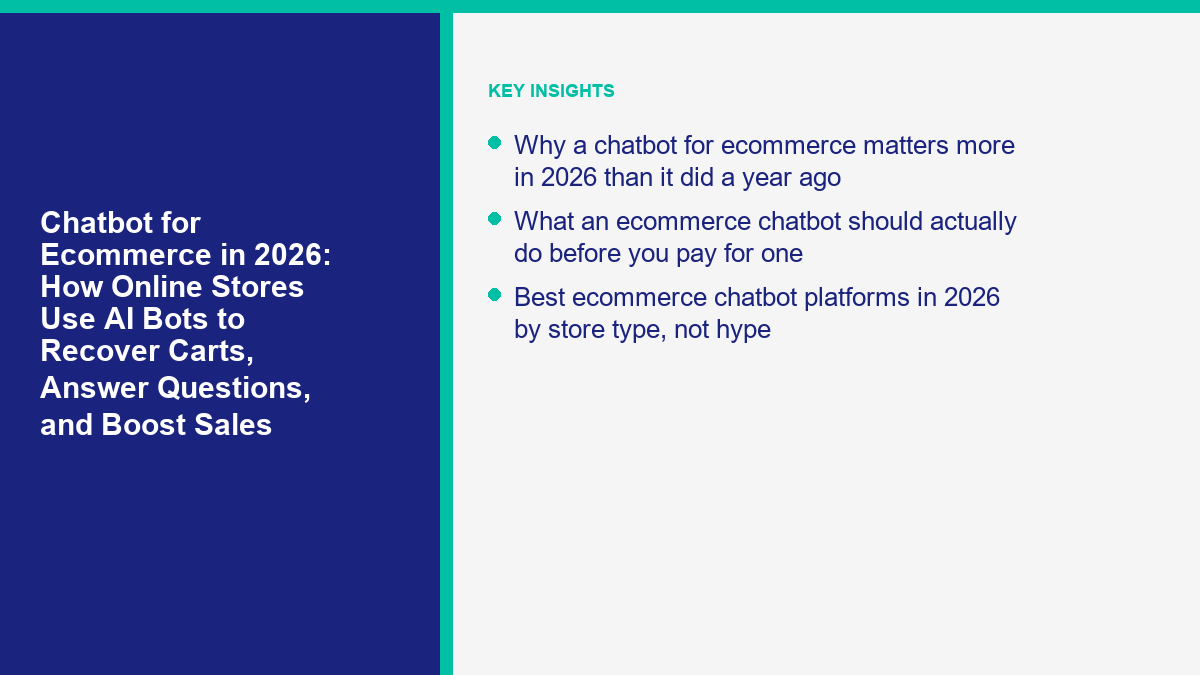
Un chatbot para ecommerce se gana su lugar en tres situaciones: cuando un comprador duda, cuando un carrito es abandonado y cuando el soporte se convierte en un obstáculo para la conversión. Todo lo demás es secundario.
Las versiones útiles de 2026 no son burbujas de chat genéricas con un poco de pulido de IA. Saben qué hay en el carrito, pueden obtener el estado del pedido, pueden recomendar el producto adecuado en lugar de un bestseller aleatorio y entregan la conversación a una persona antes de que el cliente quede atrapado en un mal bucle.
Ese es el marco para este artículo. Revisé páginas de precios públicos, documentos de ayuda, listados de mercado e informes de tendencias de 2026 el 12 de abril de 2026 de MessengerBot, Shopify, Tidio, Gorgias, ManyChat, WooCommerce, Baymard y Zendesk. Si quieres una visión general más amplia del mercado primero, comienza con nuestra guía de chatbot de ecommerce multiplataforma. Este artículo es más específico y práctico: cómo elegir e implementar un chatbot para ecommerce sin convertir tu tienda en un montón de aplicaciones desconectadas.
Por qué un chatbot para ecommerce importa más en 2026 que hace un año
La razón más simple sigue siendo la dolorosa: las tiendas siguen pagando por tráfico que no convierten. La última referencia de abandono de carrito de Baymard establece la tasa de abandono documentada promedio en 70.22%, actualizada en septiembre de 2025. El desglose de abandono de 2025 de Baymard es aún más útil para la planificación porque muestra la fricción detrás del número: 39% de compradores que abandonan porque los costos adicionales son demasiado altos, 21% porque la entrega es demasiado lenta, 19% porque no confían en el sitio con los detalles de su tarjeta, 19% porque el sitio quiere que creen una cuenta, y 18% porque el proceso de pago se siente demasiado largo o complicado (Baymard).
Esos son problemas de conversación tanto como problemas de diseño. El costo de envío, el tiempo de entrega, la duda sobre el tamaño, el ajuste del producto, la confianza en el pago, la política de devoluciones y la confusión en el proceso de pago son exactamente las preguntas que un buen bot puede responder mientras el comprador aún está decidiendo en lugar de después de que se cierra la pestaña.
El lado de las expectativas también ha cambiado. La investigación de tendencias CX 2026 de Zendesk dice 74% que los consumidores ahora esperan que el servicio al cliente esté disponible 24/7 porque existe la IA, y 86% que la capacidad de respuesta más la resolución precisa influyen fuertemente en las decisiones de compra (Tendencias de CX de Zendesk 2026, sala de prensa de Zendesk). Si tu tienda todavía trata el chat como un bonito complemento para el horario de oficina, estás operando por debajo de la expectativa del cliente antes de que la conversación incluso comience.
Hay un segundo cambio en 2026 que importa tanto como el primero: la pila de comercio electrónico se está volviendo conversacional por defecto. El informe de comercio conversacional 2026 de Gorgias dice que la IA ya maneja 31% interacciones de clientes para marcas de comercio electrónico que utilizan su plataforma y se espera que alcance 47% dentro de dos años. El mismo informe dice 79% que las marcas informan que el comercio conversacional impulsado por IA aumentó las ventas y las tasas de compra, mientras que los clientes de Gorgias registraron más de 350 millones de conversaciones de compradores en 2025 y casi 10 millones de esas se convirtieron en una compra (informe de Gorgias, resumen de tendencias de Gorgias).
Los informes de proveedores siempre necesitan un poco de escepticismo, pero la dirección es difícil de perder. Las tiendas ya no se preguntan si el chat pertenece al comercio electrónico. Se preguntan qué parte del embudo debería ser conversacional primero: descubrimiento, recuperación de carrito, soporte post-compra o compra repetida.
La respuesta honesta es que no todas las tiendas necesitan un gran agente de compras de IA desde el primer día. La mayoría de las tiendas necesitan un chatbot para comercio electrónico que solucione primero una fuga costosa, demuestre ROI y luego se expanda. Eso generalmente significa carritos abandonados, recomendaciones de productos, seguimiento de pedidos o triage de devoluciones.
What an ecommerce chatbot should actually do before you pay for one
The easiest way to overbuy software is to shop by feature count. The better way is to ask what job the bot must perform, what store data it needs, and which number it should move in the business. If you cannot answer those three questions, you are not buying a chatbot for ecommerce. You are buying hope.
| Caso de uso | Data the bot must have | Main KPI | What goes wrong when setup is weak |
|---|---|---|---|
| Recuperación de carritos abandonados | Cart contents, consented contact path, checkout or cart link, suppression after purchase | Recovered orders and recovered revenue | It sends generic reminders to anonymous shoppers and over-discounts good buyers |
| Recomendaciones de productos | Catalog, tags, variants, inventory status, bundle logic | Assisted conversion rate and assisted AOV | It recommends irrelevant products and feels like a worse search bar |
| Order tracking | Order ID, customer verification, fulfillment status, carrier tracking | Ticket deflection and first-response speed | It cannot verify identity and pushes customers into a human queue anyway |
| Returns and exchanges | Policy rules, order state, reason codes, escalation path | Time to resolution and CSAT | It treats every return like a canned FAQ and creates angry customers |
| Post-purchase follow-up | Purchase history, replenishment timing, exclusions, segmentation | Repeat purchase rate and LTV | It blasts the same offer to everyone and trains customers to ignore it |
This is why the phrase shopping bot can mean very different things. For one merchant it means a Messenger sales flow that nudges a buyer back into checkout. For another it means an on-site AI assistant trained on WooCommerce product data. For a larger brand it means an AI agent inside a help desk that can answer pre-sale and post-sale questions while also editing orders or triggering returns.
Here is the practical rule: if the bot does not have your product data, your fulfillment data, and a visible human handoff, it will struggle the moment the conversation becomes commercially important. If you are still in the build phase, Explora Nuestros Tutoriales before you automate five workflows at once. Launching one well-instrumented flow beats launching a full fake-AI concierge every time.
Best ecommerce chatbot platforms in 2026 by store type, not hype
Pricing and product details below were checked against public pages on April 12, 2026. I am not ranking these platforms as generic AI tools. I am comparing them for actual ecommerce work: cart recovery, product discovery, support deflection, and revenue-driving conversations.
| Plataforma | Precio inicial público | Mejor ajuste | Strongest ecommerce use | Principal compensación |
|---|---|---|---|---|
| MessengerBot.app | Premium $19.99 por 30 días | WooCommerce and Meta-first stores | Messenger automation, website chat, abandoned cart recovery, one-click WooCommerce sync | Less helpdesk-centric than Gorgias for large service teams |
| Shopify Inbox | Gratis | Shopify stores that want a native baseline | Cart-aware chat, instant answers, product links, order context, discount sharing | Shopify only, with lighter automation depth than specialist tools |
| Tidio | Free; Starter $24.17 per month; Lyro AI Agent from $32.50 per month | Website-first Shopify and WooCommerce stores | Order status, product cards, AI support, cart-recovery flows, on-site recommendations | Modular pricing can stack as support and AI usage grow |
| Gorgias | Starter $10 per month; Basic $60 per month; Pro from $300 per month plus AI automation fees | Support-heavy ecommerce teams | Unified helpdesk, returns and refunds, order edits, revenue reporting, AI agent | Usage-based cost climbs quickly once ticket or automation volume grows |
| ManyChat | Free; 2026 Pro plan docs show $39 per month for newer accounts, while public pricing views still vary by region and account age | Instagram and Messenger driven selling | DM funnels, comment-to-message flows, social nurture, reactivation | Pricing is in transition and tied to active-contact growth |
| WooCommerce-native AI tools | Amaya Chatbot AI PRO $49 per year; AI Product Recommendations $39 per year; Product Recommendations $99 per year | WooCommerce stores that mainly need on-site guidance | Catalog-trained chat, AI shopping assistance, upsells, cross-sells, recommendation blocks | You still need separate support or DM automation if your store sells across channels |
Fuentes: Ver precios de MessengerBot, Shopify Inbox, Shopify Inbox App Store listing, Ver precios de MessengerBot, precios de Gorgias, Gorgias billing docs, ManyChat 2026 plan guide, ManyChat Pro plan details, ManyChat pricing page, Amaya Chatbot AI PRO, AI Product Recommendations, Woo Product Recommendations.
Two observations matter here. First, the cheapest tool is rarely the cheapest system once you include overages, extra seats, AI usage, or the second app you need because the first one only solved half the problem. Second, platform fit matters more than brand awareness. Shopify Inbox is excellent if you want native Shopify chat. It is the wrong answer if most of your selling happens through Messenger. MessengerBot makes sense if Facebook conversations and WooCommerce sync are central. It is not the best first buy if your real problem is a support operation that already behaves like a ticket queue.
ManyChat deserves a special note because its pricing is in transition. ManyChat’s help center says it introduced a new pricing model on 2 de marzo de 2026 with Free, Essential, Pro, Business, and Advanced plans for newer accounts, and its Pro plan page lists $39 por mes for monthly billing with 2,500 active contacts. At the same time, ManyChat’s public pricing page crawler snapshot still shows Pro starting at $15 por mes and warns that plan availability varies by region and account age. That is not a deal-breaker. It just means you should verify the exact bill before you compare it with flat-price tools.
If your shortlist now includes MessengerBot, the cleanest next step is to Ver precios de MessengerBot and compare its flat public tiers against the more variable contact-, ticket-, or automation-based models above.
How to choose the right sales chatbot for your store architecture
This part is where most ecommerce teams make a category mistake. They compare a website support bot, a Shopify-native chat tool, a Messenger marketing platform, and a WooCommerce recommendation plugin as if they all solve the same job. They do not.
Use this framework instead:
- Choose Shopify Inbox first if you run a Shopify-only store, need a free starting point, and want native cart and order context without adding another system immediately. Shopify says Inbox is free, and its App Store listing says faster responses can improve conversion by up to 69% while 70% of Inbox conversations are with customers making a purchase decision (Shopify Inbox, Tienda de aplicaciones de Shopify).
- Choose Tidio first if your site is the main selling surface and you want one tool that handles live chat, AI support, order status, and product recommendations across Shopify or WooCommerce. Tidio’s current pages are unusually clear about Shopify order-status actions, WooCommerce product cards, and AI product recommendations for WooCommerce (Tidio Shopify order status, Tidio WooCommerce integration, Tidio WooCommerce recommendations).
- Choose Gorgias first if your support team already thinks in tickets, macros, SLAs, and post-purchase workflows. Gorgias is often the right buy when order edits, refunds, returns, and omnichannel support are already complex enough that a basic chatbot would just create a second inbox.
- Choose MessengerBot first if Facebook Messenger is a true sales and support channel, not an afterthought, and your store runs on WooCommerce or sells through Meta plus website chat together. MessengerBot’s public pricing page is explicit about abandoned cart recovery, one-click WooCommerce sync, website chat, JSON API + Zapier, and zero revenue share for ecommerce stores (Ver precios de MessengerBot).
- Choose ManyChat first if your growth engine is social DM selling: Instagram comments, story replies, click-to-message ads, and re-engagement sequences that eventually push buyers into checkout.
- Choose a WooCommerce-native AI plugin first if your main bottleneck is on-site product discovery, not multichannel support. A small WooCommerce store with a complex catalog may get faster value from Amaya or AI Product Recommendations than from a larger service suite.
The real decision is not “Which ecommerce chatbot has the most AI?” It is “Where does buying friction show up in this store, and which software sits closest to that friction?” Get that right and even a modest plan pays back quickly. Get it wrong and you end up paying for features that live in the wrong channel.
The abandoned-cart recovery flow that works without training shoppers to wait for coupons
Most cart-recovery setups fail for one of two reasons. Either they fire a single generic reminder and call it strategy, or they jump straight to a discount and train buyers to abandon on purpose. A better ecommerce chatbot sequence mirrors how hesitation actually develops.
Baymard’s 2025 abandonment reasons help here. Extra costs, delivery timing, trust, forced account creation, and a complicated checkout are the major friction points. That means the bot should not just remind the shopper that a cart exists. It should resolve the most likely objection at the right moment.
| Tiempo | Objetivo | Message content | Qué evitar |
|---|---|---|---|
| Exit intent or cart hesitation | Catch confusion before the session ends | Shipping estimate, return-policy shortcut, fit help, checkout reassurance | Forcing an email gate before helping |
| 1 hour | Recover distracted shoppers | Product image, direct checkout link, concise reminder | Giving away margin immediately |
| 24 hours | Resolve the objection | Delivery estimate, product-fit help, review snippet, inventory status | A long block of promotional copy |
| 72 hours | Force a decision or open support | Time-bound incentive, support handoff, last-call inventory cue | Another “you forgot something” message |
The first message should feel like recovery, not persuasion. Something as simple as “You left this in your cart. Want to pick up where you stopped?” is usually enough. At one hour, many shoppers were interrupted, not unconvinced.
The second message is where a chatbot de ventas actually earns its keep. If you sell apparel, answer sizing. If you sell supplements, answer compatibility or routine questions. If you sell furniture, address delivery timing and returns. If you sell electronics, handle compatibility anxiety before it turns into comparison shopping on another site.
The third message is where you make a disciplined decision. Either the economics support a small incentive, or the shopper needs a human answer. Do not send a fourth, fifth, and sixth generic reminder and pretend persistence is strategy. A strong three-step flow is usually enough to tell you whether the cart was recoverable.
Tidio’s cart tracking guidance is useful here because it separates Shopify’s built-in path from non-Shopify implementation. Shopify users can enable abandoned-cart tracking directly in Tidio settings, while non-Shopify stores add a short script and then attach the flow (Tidio abandoned cart tracking). Shopify’s own help center also makes an important distinction: abandoned checkout automation applies after the customer has entered checkout details, not to every anonymous cart browser, and its default template sends an email after a wait period unless you change it in Flow or the new Messaging automation (Shopify abandoned checkout automation, Shopify Flow trigger).
That difference matters because a chatbot for ecommerce can cover both layers. It can help in-session before the shopper vanishes, and it can follow up after the checkout is abandoned if you have the right consent and identity path.
A quick launch checklist:
- Suppress buyers the moment checkout completes.
- Segment by cart value so high-margin and low-margin buyers do not get the same offer.
- Measure recovered revenue, not just clicks or replies.
- Keep shipping, returns, and sizing answers one tap away inside the conversation.
- Test one variable at a time: timing, incentive, or objection-handling copy.
How AI product recommendations raise order value without feeling random
Most stores say they use recommendations when what they really have is a generic “you may also like” block under the product page. A real ecommerce chatbot does something harder and more useful: it asks, narrows, compares, and explains.
This matters most when the shopper is thinking one of these thoughts:
- I do not know which version fits me.
- I want the right accessory, not a random add-on.
- The product I wanted is out of stock, so what is the closest substitute?
- How much more do I need for free shipping?
Shopify Inbox already supports product links, cart insight, and discount sharing during chat, which is enough for lightweight assisted selling (Shopify Inbox). Tidio now has a dedicated WooCommerce product-recommendation feature that lets Lyro recommend products, compare alternatives, and suggest complementary items based on the conversation (Tidio WooCommerce recommendations). On the WooCommerce-native side, AI Product Recommendations positions itself as an AI shopping assistant plus recommendation engine, and Woo Product Recommendations focuses on smart upsells, frequently bought together logic, and rule-based placement across cart, checkout, and thank-you pages (AI Product Recommendations, Woo Product Recommendations).
The pattern that works is simple:
- Ask two or three qualifying questions. Fit, budget, style, usage, compatibility, or gift intent usually gets you enough context.
- Show no more than three products at a time. The bot should reduce decision load, not recreate the category page.
- Explain the recommendation. “Best for warm weather and wide fit” converts better than a bare SKU.
- Use bundles and thresholds intelligently. Accessories, refills, and threshold nudges work when they feel useful, not forced.
- Track assisted orders separately. Recommendation lift usually appears in chatbot-assisted orders first, not in the whole store average overnight.
This is where a shopping bot becomes more than automation. It acts like a competent in-store associate. It does not ask the buyer to search harder. It helps them choose faster.
One more practical point: if your catalog is tiny and obvious, a lightweight rule-based flow may beat an expensive AI stack. The bigger the catalog and the more pre-sale questions your team fields, the more valuable AI-guided recommendations become.
Order tracking and returns automation usually pay back faster than flashy AI
If your inbox is full of “Where is my order?” and “Can I change my shipping address?” questions, you do not need a futuristic AI vision before you automate. You need a clean self-service layer and a reliable handoff path.
Shopify gives you a solid baseline. Shopify Inbox includes a default Track my order instant answer, and Shopify’s help center shows that customers can already receive order-status updates through the store’s order status page, emails, and the Shop app once tracking exists (Shopify Inbox instant answers, Shopify order tracking). Tidio adds a Shopify smart action that can verify shoppers through email, order ID, and zip code, then return payment, fulfillment, purchased items, and tracking details in chat. Its help docs also note that Growth-plan users can cancel orders, submit refunds, and change the shipping address directly inside Tidio for eligible Shopify orders (Tidio order status action, Tidio Shopify order management).
Gorgias goes further because it is designed as an ecommerce support operating system, not just a chat widget. Its current pricing page and billing docs position AI Agent around pre-sale and post-sale FAQs, returns and refunds, order edits, subscriptions, and product recommendations, with automation billed by resolved interactions on top of helpdesk usage (precios de Gorgias, Gorgias billing docs).
The ROI math is not complicated. Suppose your store handles 1,000 support conversations a month, y 55% are repetitive order-status, shipping-window, or return-policy questions. That is 550 conversations. At a blended handling cost of $4 each, that queue costs around $2,200 a month. If the bot fully automates just 60% of that repetitive slice, you remove 330 manual touches or about $1,320 in monthly handling cost before you even count faster response times.
That is why order tracking is usually the first support automation I would ship after cart recovery. It is easy to test, easy to verify, and easy for a customer to trust when the answer is accurate.
Where stores go wrong is trying to automate emotionally loaded exceptions with the same confidence. Wrong item, damaged item, high-value refund dispute, and fraud suspicion should not stay in the bot lane for long. The good pattern is simple triage: collect the order number, identify the issue type, answer the easy part, then move complex cases to a person with all the context attached.
How to set up a chatbot for Shopify without overbuilding the stack
Shopify is the cleanest environment to start in because the native tools are good enough to prove value before you buy more software. That matters. A lot of merchants jump straight to a third-party platform when Shopify already gives them enough signal to find out whether chat is moving revenue.
- Start with the first job, not the first app. Pick one of these: pre-purchase Q&A, abandoned checkout recovery, order tracking, or product guidance. If the bot has no clear job, it becomes a polite distraction.
- Install Shopify Inbox and turn on the basics. Shopify positions Inbox as a free business chat app built into the admin, with product links, discount sharing, AI-generated answers, and message classification (Shopify Inbox).
- Configure instant answers before you touch AI. Your baseline set is usually shipping time, return policy, order tracking, and one product-fit question. Shopify’s instant-answer docs note that the Track my order option is included by default (Centro de ayuda de Shopify).
- Use abandoned checkout automation for the checkout layer. Shopify’s current docs say the new abandoned checkout automation lives in the Shopify Messaging app, defaults to a 10-hour wait on a second automation, and is limited to Online Store and Buy Button channels (Shopify Messaging automation).
- Add a website-first specialist only when the native layer is obviously thin. Tidio is the most balanced next step for many Shopify stores because it gives you order-status actions, cart flows, AI replies, and support structure without immediately forcing a full helpdesk migration.
- Move to Gorgias when support operations become the harder problem. If agents need deeper routing, macros, revenue attribution, order operations, and omnichannel ticketing, this is usually the point where Inbox stops being enough.
- Test every flow on mobile. Most Shopify traffic is still mobile-heavy. A chatbot that blocks product media, hides the add-to-cart button, or demands too much typing on a phone is hurting the store while pretending to help it.
- Instrument assisted revenue and support deflection separately. Do not use one dashboard number to judge a sales flow and a support flow. Track them differently.
There is also a 2026 Shopify-specific reason to clean up product data now instead of later. Shopify’s help center says its agentic storefront experience for ChatGPT is available to eligible stores today, while other AI channels such as Microsoft Copilot and Google AI Mode or Gemini remain in early access depending on eligibility and settings. In other words, your product feed and policy data are becoming conversation inputs for AI channels outside your site, not just inside it (Shopify agentic storefronts).
That does not mean every Shopify merchant should rush into AI-channel commerce. It does mean messy product titles, weak variant data, vague shipping rules, and outdated FAQ content are becoming more expensive problems than they used to be.
How to set up a chatbot for WooCommerce when your store sells through both the site and Messenger
WooCommerce is more flexible than Shopify, but that flexibility comes with more decision-making. There is no single native answer. You choose between website-first chat, Messenger-first automation, or a hybrid stack that combines on-site product guidance with social conversations.
If your WooCommerce store mainly sells on-site and the main friction is product discovery, Amaya Chatbot AI PRO and AI Product Recommendations are interesting because they stay close to the catalog. Amaya positions itself as a product-catalog trained AI chatbot with a WooCommerce-native widget and a $49 per year Pro tier. AI Product Recommendations lists $39 per year and combines an AI shopping assistant with personalized and upsell recommendations. Woo’s own Product Recommendations extension lists $99 per year and focuses on smart upsells, frequently bought together logic, analytics, and placement across product, cart, checkout, and thank-you pages (Amaya Chatbot AI PRO, AI Product Recommendations, Recomendaciones de Productos).
If your WooCommerce store sells through Facebook Page messages, click-to-Messenger ads, or ongoing Messenger conversations, the better fit is often MessengerBot. Its public pricing page explicitly includes abandoned cart recovery tools, website chat, one-click WooCommerce integration, JSON API + Zapier, Google Sheets sync, and zero revenue share for ecommerce stores (Ver precios de MessengerBot).
This is the build order I would use for most WooCommerce stores:
- Clean the catalog first. Product titles, variants, attributes, shipping details, and policy pages need to be usable by both the bot and the customer.
- Decide whether the primary conversation starts on the website or in Messenger. That one choice will shape the software stack more than any AI feature checkbox.
- Connect the catalog and test product answers. If the bot cannot answer a basic product-fit question correctly, do not turn it loose on cart recovery yet.
- Wire abandoned-cart or cart-hesitation events. The follow-up should know which product was viewed or left behind.
- Add order-status and policy shortcuts. Even a sales-oriented bot needs a post-purchase layer or the same buyers come back to ask shipping questions later.
- Test human handoff in the exact edge cases that create refunds. Wrong size, broken item, late delivery, exchange request, and payment failure are the minimum set.
MessengerBot is especially strong in the WooCommerce-plus-Meta scenario because it reduces the number of tools you need to wire together just to cover website chat, Messenger engagement, cart recovery, and comment automation. If your store has outgrown a starter Meta workflow and needs more pages, widgets, or multichannel headroom, this is usually the point where you Upgrade to MessengerBot Pro instead of stacking a second platform on top of the first.
The mistake to avoid is mixing a website-only AI plugin with a Messenger-led sales motion and expecting one of them to behave like the other. They are solving different parts of the funnel. Pick the conversation origin first, then layer the second system only if the numbers justify it.
The ROI model a chatbot for ecommerce needs to pass before you scale it
Store owners often hear that chatbots boost sales, increase conversion, lift order value, and reduce support costs all at once. Sometimes they do. The problem is that teams hear those outcomes as a promise instead of a stack of smaller effects that need to be measured separately.
Use this model instead:
Monthly chatbot value =
+ recovered cart revenue
+ incremental assisted-order revenue
+ repeat-purchase revenue influenced by chat
+ support cost avoided
- software fees
- usage fees
- setup and maintenance time
Now run conservative numbers.
| Base | Número mensual |
|---|---|
| Pedidos | 700 |
| Valor promedio de pedido | $78 |
| Ingresos mensuales | $54,600 |
| Conversaciones de soporte | 900 |
Then add realistic chatbot effects:
| Mejora | Assumption | Impacto mensual |
|---|---|---|
| Carritos recuperados | 40 recovered orders at $78 AOV | $3,120 revenue |
| Recommendation lift | 160 assisted orders with 15% higher AOV | $1,872 revenue |
| Desviación de soporte | 250 repetitive conversations automated at $4 each | $1,000 cost avoided |
| Pedidos repetidos post-compra | 18 extra repeat purchases at $78 | $1,404 revenue |
| Total gross monthly value | Revenue plus avoided cost | $7,396 |
Against a $54,600 revenue base, that is a meaningful lift without using fantasy assumptions. Even if software and message fees cost several hundred dollars a month, the payback is still attractive.
The biggest modeling mistake is mixing store-wide results with chatbot-assisted results. If a recommendation flow lifts AOV by 20%, that usually means assisted orders, not the whole store overnight. If a cart sequence converts at 18%, that means reachable shoppers with identity and permission, not every anonymous visitor who vanished. Honest math beats inflated screenshots every time.
It is also worth separating revenue from cost avoidance. A support-heavy store may justify a chatbot mostly through ticket deflection and faster service. A DTC brand running paid social may justify it mostly through recovered carts and pre-sale guidance. Same category, different ROI story.
The mistakes that make ecommerce bots feel smart in demos and useless in production
The fastest way to waste money on a chatbot for ecommerce is to confuse a polished interface with a working system. Production failures are usually not model failures. They are setup failures.
- Buying AI before fixing product and policy data. If your catalog is messy, the bot will be messy faster than a human.
- Using the same script for pre-sale chat and post-purchase support. Product guidance, order tracking, and return triage are different jobs.
- Leading every recovery flow with a discount. That conditions customers to abandon in order to get paid for waiting.
- Hiding the human handoff. Good bots reduce workload. Bad bots block access to help.
- Measuring vanity metrics. Opens, clicks, and chat volume are not the same as recovered revenue, assisted AOV, or true deflection.
- Ignoring mobile UX. If the widget covers product images or checkout buttons, you are paying to reduce conversion.
- Automating sensitive exceptions too aggressively. Damaged orders, chargeback risks, or high-value disputes need a person quickly.
- Not clarifying billing triggers. Contacts, tickets, conversations, and AI resolutions are four different pricing models with four different scaling risks.
This is why small, well-scoped launches keep outperforming broad AI rollouts. Start with one flow that maps cleanly to revenue or support savings. Get the instrumentation right. Then expand.
When MessengerBot is the right ecommerce chatbot to implement first
MessengerBot is not the right answer for every store. It is the right answer when your store actually sells through Meta conversations, needs WooCommerce sync, or wants website chat plus Messenger automation under one roof without moving straight into a ticket-priced helpdesk.
The public MessengerBot pricing page is unusually specific about the things ecommerce operators care about: abandoned cart recovery tools, website chat, one-click WooCommerce integration, JSON API + Zapier, payment-provider support, visual flow building, and zero revenue share for ecommerce stores. The Premium plan is listed at $19.99 cada 30 días, and the Pro plan at $49.99 cada 30 días, with higher limits on pages, widgets, and broader capabilities (Ver precios de MessengerBot).
That makes MessengerBot especially practical for three situations:
- WooCommerce stores that want Meta plus website chat in one system.
- Facebook Page driven businesses where Messenger is already a real support and sales inbox.
- Teams that prefer public flat pricing over ticket or automation resolution billing.
If that sounds like your setup, use the next step that matches your maturity level. If you are still comparing tiers, Ver precios de MessengerBot. If you want implementation detail before you buy anything, Explora Nuestros Tutoriales. If you are already running enough stores, pages, or widgets that the starter tier is tight, Upgrade to MessengerBot Pro. And if you build ecommerce chatbot systems for client stores or recommend tools as part of your agency work, Únete a nuestro programa de afiliados so referrals are structured instead of informal.
Preguntas frecuentes
¿Cuál es el mejor chatbot para ecommerce en 2026?
No hay un ganador universal porque la herramienta adecuada depende de dónde ocurre la fricción en la compra. Shopify Inbox es el mejor punto de partida nativo gratuito para las tiendas de Shopify. Tidio es la mejor opción general para sitios web en Shopify y WooCommerce. Gorgias es más fuerte una vez que las operaciones de soporte ya son complejas. MessengerBot es una mejor opción cuando Messenger y WooCommerce son centrales para las ventas y el soporte. Los complementos de IA nativos de WooCommerce tienen sentido cuando la orientación del producto en el sitio es más importante que la automatización multicanal.
¿Puede un chatbot realmente recuperar carritos abandonados?
Yes, but only if it has the right timing and the right data. Strong flows recover distracted shoppers first, answer objections second, and only use incentives when margin supports it. Generic reminders underperform because they do not address the reason the shopper left. The best sequences tie the follow-up to shipping, trust, fit, stock, or checkout friction instead of repeating the same reminder three times.
¿Deben las tiendas de Shopify usar Shopify Inbox o un chatbot de comercio electrónico de terceros?
Start with Shopify Inbox if you need a free native baseline and want to validate whether chat is moving revenue or support savings. Add a third-party tool when you clearly need deeper automation, stronger AI, or broader support operations. Tidio is usually the next step for website-first stores. Gorgias is the next step for support-heavy teams. If most selling happens through Messenger or Instagram before checkout, a social or Messenger-first tool can be the better fit.
¿Cuál es la mejor configuración de chatbot de WooCommerce para una tienda pequeña o mediana?
That depends on the channel mix. If the site is the main buying surface and shoppers need help choosing products, a WooCommerce-native AI tool such as Amaya or AI Product Recommendations can work well. If Facebook Messenger is a real sales or support channel and you want website chat plus WooCommerce sync in one place, MessengerBot is usually the cleaner stack. For website-first support plus AI automation, Tidio is the most balanced option.
¿Cuánto debería costar un chatbot de comercio electrónico?
The useful answer is not a single number but a pricing model. Some tools are flat tiered plans, some bill by contacts, some by tickets, and some by AI-resolved conversations. In the current public market, entry pricing ranges from free for Shopify Inbox to around $20 to $50 per month for many SMB tools, while support-heavy platforms can move into the hundreds quickly. The real question is whether the chatbot creates more recovered revenue and avoided support cost than the software and usage fees remove.


 Español de México
  English
  Tagalog
  简体中文
简体中文  العربية
  हिन्दी
  Português do Brasil
  Français
  বাংলা
বাংলা  香港中文
香港中文  繁體中文
繁體中文  Nederlands
  Deutsch
  Bahasa Indonesia
  日本語
日本語  한국어
한국어  Polski
  Русский
  Español
  Tiếng Việt