
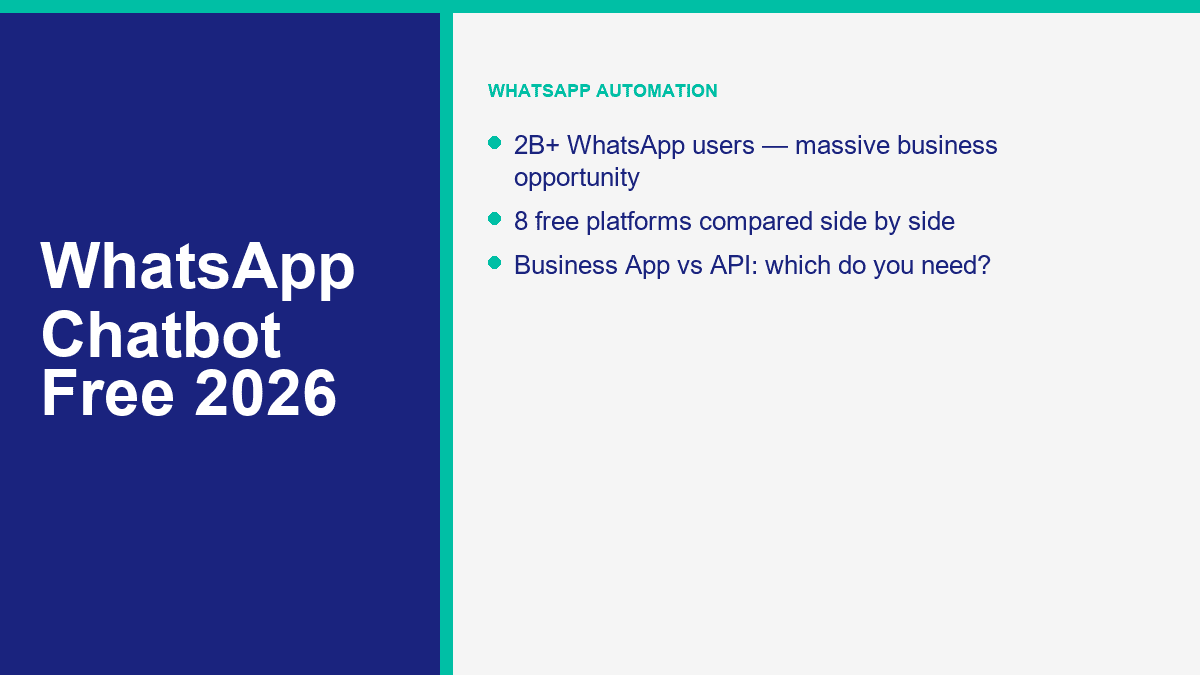
If you search for a free WhatsApp chatbot in 2026, you will often find guides that confuse three fundamentally different things: the completely free WhatsApp Business app, automated chatbot software that offers a short trial, and developer tools that are free to test but not practical for a local store that just wants an automated greeting today. This confusion is why so many business owners think they are signing up for a free tool, only to hit a paywall the second they try to send an automated order update.
The honest answer is straightforward. If you want a truly free WhatsApp chatbot setup without any hidden recurring software fees, your only real option is the WhatsApp Business app. It is entirely free to download and use. It allows you to configure automated greeting messages, away messages, and quick replies. It is not a fully branching artificial intelligence that can pull live inventory from your website, but it is enough automation to stop you from manually typing the same opening hours twenty times a day.
If, however, your business needs a bot that qualifies leads with multiple questions, routes different requests to different team members, sends approved outbound notifications when an order ships, and executes a clean human handoff when a customer gets stuck, you are moving into WhatsApp Business Platform territory. That level of functionality requires a third-party no-code chatbot builder, which usually means a software fee plus Meta’s per-message fees once the initial free trial or testing sandbox expires.
In this guide, we are looking specifically at the no-code, low-cost automation paths. If you want to understand the larger technical landscape, read our broader WhatsApp bot building guide. Here, we will focus on what is actually free right now, the exact steps to build your auto-replies, how to manage the transition from the free app to a paid platform, and how to maintain the critical human touch your customers still expect.
Understanding the Split: WhatsApp Business App vs. Platform
The first mistake most small businesses make is trying to build API-level automation on the free consumer app or the free business app. To avoid wasting hours on setup tutorials that will not work for your account type, you must understand the exact split in Meta’s ecosystem.
La WhatsApp Business app is designed for the solo operator or the very small team. It is a standalone application you install on a phone, though it now supports linked web devices. It is completely free. It is built for a human to read and reply to messages, augmented by a few lightweight automation features. You cannot plug a visual drag-and-drop flow builder into the free app. You cannot connect it directly to your CRM to trigger automatic cart abandonment messages. It is an inbox, not a developer endpoint.
La WhatsApp Business Platform, historically called the API, is the programmatic layer. It has no interface of its own. It is the connection layer that lets a supported tool connect to WhatsApp. This is what you need if you want to build visual conversation flows, handle hundreds of concurrent chats, assign conversations to a remote support team, or send proactive template messages outside the standard 24-hour customer service window. While you can sometimes access the API for free during a trial, running a production business on it carries costs.
How to Build a Truly Free Setup in the Business App
Here is how to set up your free automation in under twenty minutes:
First, secure a dedicated business phone number. Mixing personal and business chats in one inbox is a recipe for missed leads and privacy mistakes. Install the WhatsApp Business app and verify that dedicated number. Next, fill out the business profile completely. A blank profile makes automated messages feel like spam. Add your logo, business hours, website, email address, and a clear description of what you sell. When the automated greeting fires, the customer can tap the profile and see legitimate business details.
Now, configure the greeting message. This is the first touchpoint when a new customer messages you, or when an existing customer messages you after 14 days of inactivity. Keep it highly functional. Do not just say “Hello.” Say, “Hi, thanks for reaching out to Smith Plumbing. We are here to help. Are you looking to book an appointment, ask about pricing, or check our service areas? Let us know below.” You are guiding their next response to match the quick replies you are about to build.
Then, set up the away message. The away message is crucial for managing expectations. Set the away message to trigger outside your listed business hours. A strong away message looks like this: “Thanks for your message! We are currently closed. Our hours are 9 AM to 5 PM Monday through Friday. We will review your message first thing tomorrow morning. If you need our price list, type /prices.”
The real power of the free app lies in quick replies. Quick replies allow you to save long answers and trigger them with a simple keyboard shortcut. Think about the five questions you answer every single day. Usually, these are inquiries about location, pricing, booking procedures, shipping times, or refund policies. Build a detailed, friendly quick reply for each. When a customer asks about shipping, you type “/ship” and the app instantly fills the chat with your three-paragraph shipping policy and a tracking link.
Finally, use labels to route the conversations. Labels act as a lightweight CRM. Tag chats as “New Lead,” “Pending Payment,” “VIP Customer,” or “Requires Follow Up.” While the app won’t automatically move people between these stages based on their replies, combining labels with quick replies creates a highly disciplined manual workflow that feels instantaneous to the customer. The result is an inbox that feels organized rather than reactive.
When Does a Chatbot Require a Paid API Path?
The free app is brilliant for early-stage speed, but it has a hard ceiling. You will know it is time to move to a no-code chatbot builder connected to the API when one of the following pain points becomes unbearable.
The most obvious trigger is multi-step lead qualification. If your process requires asking a customer for their name, then their email, then their budget, and then their preferred service date, the free app requires a human to sit there and ask each question sequentially. A no-code bot builder can ask those questions instantly, validate the answers, and drop the qualified lead into a spreadsheet or CRM without a human ever touching the keyboard. If your team is spending hours acting as human intake forms, the API path will pay for itself immediately.
Another trigger is the need for multi-agent support. The free app allows a primary phone and a handful of linked devices, but it does not have collision detection, assignment rules, or internal agent notes. If two of your employees accidentally reply to the same customer at the same time, the customer sees both messages. A proper API-driven inbox routes the chat to one specific agent, locks it so others cannot interfere, and allows the team to leave private notes behind the scenes.
The third major trigger is outbound notifications. If you want to automatically send a WhatsApp message when a Shopify order ships, or when a consulting appointment is exactly 24 hours away, the free app cannot do it. Those are programmatic triggers that require the API and approved template messages. If speed to lead or automated follow-up is your primary goal, you must upgrade.
The Importance of a Clean Human Handoff
The single biggest mistake businesses make with automation is trapping the customer. A chatbot should be a helpful assistant, not a barricade protecting your support team from the public. If a bot cannot solve the problem, it must elegantly pass the conversation to a real person.
A clean human handoff requires three things. First, the escape hatch must be visible. Do not hide the “Talk to a human” option deep in a submenu. If you present a menu of choices, the final choice should almost always be an escalation path. Second, the bot must collect context before handing over. It should ask, “I will transfer you to our team. Could you briefly describe the issue so they can help you faster?” This saves the human agent from having to start the conversation from scratch. Third, the bot must manage expectations. It should say, “Thanks. A team member will reply within 2 hours,” rather than just disappearing into silence.
If you want to see how to structure these transitions effectively, review our ejemplos de guiones de chatbot. The tone should always remain helpful and transparent. Never pretend the bot is a human, and never make the customer fight the bot to get real support.
Privacy, Consent, and Opt-In Basics
WhatsApp is a highly personal channel. People use it to talk to their families and friends. Because of this intimacy, Meta enforces strict rules regarding consent, and local privacy laws like the GDPR or CCPA add further requirements. It is an invite-only space, and you must respect the boundaries.
You cannot buy a list of phone numbers, upload them to your chatbot platform, and start blasting promotional messages. That is a fast track to getting your WhatsApp Business Account permanently banned. You must secure active, explicit opt-in from the user. They must clearly agree to receive WhatsApp messages from your specific business. This usually happens via a checkbox on your website checkout page, a lead form, or when the user initiates the conversation themselves through a Click-to-WhatsApp ad.
Once they are in the conversation, your bot must respect their privacy. Do not ask for highly sensitive personal data unless it is absolutely required for the service, and ensure your privacy policy explicitly covers WhatsApp communication. Furthermore, you must provide a simple way to opt out. If a user types “STOP,” your system must immediately cease automated outbound messaging and respect their choice.
A Practical Cost and Fit Checklist
Before you invest time into building a flow, run through this checklist to determine if you should stay on the free app or move to a trial API platform:
- Daily Chat Volume: Are you handling fewer than 30 new inquiries a day? If yes, the free app with quick replies is likely sufficient. If you are handling 100+ daily chats, the manual labor cost eclipses the API cost, making the upgrade necessary.
- Intent Complexity: Are most questions simple FAQs like “What time do you open?” The free app can handle this. If inquiries require deep qualification before a quote can be given, you need a visual bot builder.
- System Integration: Does the chat need to automatically update a central CRM, or trigger an external email sequence? The free app cannot do this; you must use the API to connect your systems.
- Team Size: Is one person managing the phone? The free app works perfectly. Are three support agents trying to coordinate replies simultaneously? You need an API-connected shared inbox with collision detection.
- Budget Reality: Are you prepared to pay a monthly subscription fee for the software platform, plus Meta’s usage-based template messaging fees once the trial ends? If the answer is no, stay on the completely free app and refine your manual processes.
If you realize you need a broader approach that includes website chat alongside WhatsApp, it is wise to map your chatbot workflow design across all channels before committing your entire budget to a single-channel tool.
Preguntas Frecuentes
¿Puedo construir un chatbot de WhatsApp completamente gratis?
Yes, but only in a restricted, manual sense. The truly free route is using the WhatsApp Business app’s built-in greeting messages, away messages, and quick replies. If you want advanced features like branching conversational menus, API integrations, and team routing, you will need a third-party platform. These platforms generally only offer temporary free trials or highly limited sandboxes, meaning production use will eventually incur costs.
¿Cuál es la diferencia entre la aplicación de WhatsApp Business y la API?
The WhatsApp Business app is a free, standalone application meant for small businesses to manually message customers, utilizing basic auto-replies. The WhatsApp Business API (Platform) is the backend infrastructure that connects to external software. It has no user interface of its own and is required if you want to deploy a visual chatbot builder, manage thousands of chats, or integrate with a CRM.
How do I set up automated replies on WhatsApp Business?
In the free WhatsApp Business app, navigate to Settings, then Business Tools. Here you can easily configure your Greeting Message (sent to new customers or after 14 days of inactivity), your Away Message (sent automatically outside business hours), and Quick Replies (keyboard shortcuts for frequently used, long-form answers).
¿Es legal usar chatbots en WhatsApp para negocios?
Yes, provided you strictly follow Meta’s business messaging policies and local privacy regulations like the GDPR or CCPA. You must secure clear opt-in consent before sending proactive messages, use approved templates for outreach outside the 24-hour service window, and respect opt-out requests immediately. Cold outreach to purchased lists is expressly forbidden and will result in an account ban.
¿Cuál es la mejor plataforma de chatbot de WhatsApp gratuita para principiantes?
For an absolute beginner with zero budget, the WhatsApp Business app itself is the best starting point because it is fast, free, and robust enough for basic triage. If you have outgrown the app and specifically want to test a visual, no-code flow builder, treat its free tier as a testing period rather than a permanent, zero-cost solution.



 Español
  English
  Tagalog
  简体中文
简体中文  العربية
  हिन्दी
  Português do Brasil
  Español de México
  Français
  বাংলা
বাংলা  香港中文
香港中文  繁體中文
繁體中文  Nederlands
  Deutsch
  Bahasa Indonesia
  日本語
日本語  한국어
한국어  Polski
  Русский
  Tiếng Việt