

Un spammeur de dm instagram en 2026, il n'y a rarement qu'un seul bot maladroit envoyant “bonjour cher” à des comptes aléatoires. Il s'agit généralement d'un mélange de faux profils de soutien, de scripts assistés par IA, de spam de vendeurs de croissance, d'appâts romantiques, de faux contacts de collaboration et d'équipes d'escroquerie qui savent exactement comment pousser les gens d'Instagram vers Telegram, WhatsApp, des portefeuilles crypto ou de fausses pages de connexion. La formulation s'est améliorée. L'intention n'a pas changé. L'objectif reste de voler l'attention, les identifiants, l'argent ou la confiance.
L'ampleur de ce problème n'est plus hypothétique. La FTC a déclaré le 6 octobre 2023 que les consommateurs ont signalé avoir perdu $2,7 milliards à cause des escroqueries sur les réseaux sociaux depuis 2021, plus que tout autre moyen de contact, Facebook et Instagram apparaissant à plusieurs reprises dans les plaintes concernant les achats, les investissements et les romances (FTC). Meta a ensuite déclaré le 11 mars 2026 qu'il avait supprimé plus de 159 millions d'annonces frauduleuses en 2025 et a supprimé 10,9 millions de comptes sur Facebook et Instagram liés à des centres de fraude criminelle (Meta).
C'est pourquoi cette mise à jour adopte un angle plus étroit qu'un récapitulatif générique des chatbots Instagram. Je ne vais pas expliquer comment envoyer des messages directs en masse à des inconnus. C'est la mauvaise question, et c'est le chemin le plus rapide vers des demandes de messages, des rapports, des conversions faibles et un risque pour le compte. Ce guide concerne quatre tâches pratiques : comment identifier un spammeur de DM Instagram, comment renforcer les contrôles intégrés d'Instagram, comment sécuriser votre compte si vous avez déjà cliqué sur quelque chose de mauvais, et comment construire une automatisation de DM légitime qui réagit à l'intention de l'utilisateur au lieu de faire semblant.
Si vous avez seulement besoin du décompte plus large entre bots et vraies personnes après cela, gardez notre guide plus large sur les bots dans les DM Instagram ouvert dans un autre onglet. Cet article reste plus concis. Il traite des schémas de spammeurs, de la défense de la boîte de réception, et de la ligne entre une automatisation utile et un comportement qui semble suspect parce qu'il l'est.
Vérification de la réalité des spammeurs de DM Instagram pour avril 2026
La façon la plus claire de penser à ce sujet est que le spam n'est pas seulement un mauvais texte. Le spam est un modèle de permission défaillant. Un chatbot Instagram légitime a une trace de permission. L'utilisateur a répondu à une Story, commenté un Reel, cliqué sur une annonce DM, tapé sur un ig.me link, or sent the first message. An instagram dm spammer tries to skip that trail and jump straight to the pitch.
- Random blasting is not modern automation. It is the fastest way to look like a scam account, because the platform and the recipient both treat it like one.
- Message Requests and Hidden Requests matter more than most people think. If the sender is not approved, your first line of defense is usually where the message lands, not whether it exists at all.
- Official Instagram DM automation is still event-driven. The safest triggers are comments, Story replies, Story mentions, inbound DMs, and click-to-message flows.
- Meta is clearly treating scam DMs as a live product problem. Sur February 11, 2026, Meta said it now shows warnings in Messenger and Instagram DMs for potentially suspicious interactions or cold outreach from people you do not know (Meta).
- Teen defaults are a clue adults should copy. Meta said on April 8, 2025 que 97% of Instagram teens aged 13 to 15 kept the default restrictions on Teen Accounts, and 94% of US parents said those protections would be helpful (Meta).
- Good automation converts better because it is narrower. One contextual DM after a real trigger beats a cold sequence every time.
There is another current stat worth keeping in mind if you run a business or creator account. In its December 4, 2025 account-support update, Meta said new account hacks had decreased by more than 30% globally across Facebook and Instagram, and the relative success rate of hacked-account recovery had increased by more than 30% in the US and Canada (Meta). That does not mean you can relax. It means platform security is getting better, while spam and impersonation tactics are getting more polished. Your own setup still matters.
If you remember one sentence from this article, make it this one: a useful Instagram DM feels like a reply to intent, not a shortcut around it. That single test will help you judge both suspicious inbound messages and your own outbound automation plans.
How to Tell an Instagram DM Spammer From a Legit Chatbot
The fastest way to separate good automation from bad automation is to follow the permission trail. Ask what triggered the message, what identity the sender is claiming, and what the sender wants you to do before trust has been earned. A legitimate business bot usually tells you what just happened. A spammer usually tells you what they want next.
| DM pattern | How it usually starts | What it is trying to exploit | Best next move |
|---|---|---|---|
| Legit comment or Story reply automation | References the post, Reel, Story, keyword, or ad you just interacted with | Real intent that already exists | Verify the trigger and continue if it matches |
| Fake support or fake Meta notice | Claims your account is at risk, suspended, reported, or under review | Fear and urgency | Do not click; verify inside the app and report the message |
| Fake collab or creator deal | Flatters you fast, then pushes a file, payment step, or off-platform contact | Ego, money, and speed | Check the sender’s real brand identity before replying |
| Growth-service spammer | Promises followers, likes, leads, or guaranteed income | Vanity and impatience | Ignore, restrict, or block |
| Romance, investment, or “job” bait | Starts casually, then quickly moves to Telegram, crypto, or account data | Emotional trust or easy-money temptation | End the chat and report it |
Follow the permission trail before you read the pitch
Most people evaluate suspicious DMs in the wrong order. They read the promise first and the context second. Flip that. A legitimate chatbot normally has a reason to exist in your inbox. Maybe you commented PRICE on a Reel. Maybe you replied to a Story. Maybe you tapped a click-to-DM ad. Maybe you messaged the business first. If none of those things happened, the message starts in a low-trust state immediately.
That does not mean every unexpected DM is automatically malicious. It means the burden of proof sits with the sender. Real businesses can usually pass that test fast. The profile is coherent, the message references something specific, and the next step stays inside a familiar path. Spammers fail because their first move is almost always generic, transferable, and built to work on a hundred people at once.
Check whether the account can survive basic scrutiny
An instagram dm spammer often improves the opening line before improving the account behind it. That is why the profile still tells on them. Watch for thin bios, copied posts, incoherent highlights, new-looking feeds pretending to be established brands, strange follower-to-following ratios, or engagement that looks purchased. If the account claims to be support for a recognizable brand, it should look like that brand. If it claims to be a creator manager, agency, or partnership lead, it should have a verifiable trail outside one DM.
This matters even more now that AI can smooth the copy. You can no longer rely on bad grammar as your main filter. Plenty of scam accounts can write clean English. What they still struggle with is identity depth. The account, domain, payment path, contact history, and message flow do not line up.
Push the conversation off-script and see what breaks
One of the best field tests is still to send a harmless reply that forces context. Ask which post they mean. Ask where they found you. Ask them to summarize the offer in one sentence. Ask a question that a real business could answer in seconds. If the chat loops, stalls, or shoves you back toward the same button, the same file, or the same off-platform contact, you are probably looking at automation or scripted fraud rather than a useful chatbot.
A real DM system can usually bend. A spammer flow usually cannot. That is true whether the backend is old-school templates or a newer AI wrapper. The pressure is still heading to the same place: the link, the wallet, the login page, the download, or the “agent” who suddenly needs to move the conversation elsewhere.
Watch the exit ramp
The destination tells you almost as much as the message. A legitimate business bot will often keep you on a normal path: a booking page, an FAQ flow, a product link on the brand’s domain, a one-screen lead form, or a shared inbox handled through Meta tools. An instagram dm spammer loves hard exits. Telegram. WhatsApp. “My manager.” A tiny deposit. A Google Form asking for unnecessary data. A fake copyright appeal page. A zip file. A DocuSign-style page that does not belong to DocuSign.
The earlier the sender tries to force that exit, the worse the risk. Good automation usually earns the next click. Bad automation tries to steal it.
Know the five inbound patterns that waste the most time right now
In April 2026, the spam patterns that show up most often in Instagram DMs still fall into a few recognizable buckets.
- Fake Meta support: “Your page violated policy,” “your account will be removed,” or “appeal now” messages that try to steal credentials.
- Fake collaboration outreach: flattering brand-deal language followed by a suspicious link, attachment, or “processing fee.”
- Growth spam: follower sellers, view sellers, lead sellers, and “safe engagement” offers that are usually neither safe nor useful.
- Romance-to-investment drift: a casual or affectionate opener that quickly becomes a crypto or trading pitch.
- Fake jobs and easy-money offers: especially “remote assistant,” “brand promoter,” and “earn daily from your phone” scripts.
The FTC’s older-adult fraud report released on December 30, 2025 said social media was the most common contact method reported in investment scams affecting consumers of all ages, while older adults alone reported losing $2.4 billion to fraud in 2024 overall (FTC). That is not Instagram-specific, but it lines up exactly with what these inbox patterns are trying to do: warm you up socially, then move the real damage off-platform.
If you want the short rule, use this: if the DM asks you to trust before it gives you proof, treat it like a spammer until proven otherwise.
How to Activate Instagram Settings That Cut Spam Fast
Most users wait too long to tune Instagram’s safety settings because they assume the platform should solve spam invisibly. It does not work that way. Instagram gives you a few strong levers, but you still have to set them deliberately. If your inbox feels noisier than it should, start here before you install anything else.
Send unknown people to Requests instead of your attention
Instagram’s help page on who can send messages says that if you message someone who does not follow you, the message may appear as a message request depending on their settings, and future messages go directly to the inbox only after the request is accepted (Centre d'aide Instagram). That is the right mental model for defense too. You do not need every stranger’s DM in your main mental workspace. You need it one layer away until it proves it deserves more.
Inside Messages and story replies, review your Message controls. If you are a creator or business owner who gets regular spam, the default should lean restrictive, not generous. Requests exist for a reason.
Turn Hidden Words into a spam sink
Instagram’s help page for hiding unwanted comments and message requests says the platform can hide content that may be disrespectful, offensive, or scammy, and that teen accounts have those protections switched on by default (Centre d'aide Instagram). That should tell you everything you need to know. If Meta thinks scammy requests are common enough to default-hide for teens, adults running public accounts should stop treating Hidden Words like an optional cosmetic filter.
Use it for:
- Repeated growth-seller terms
- Spammy finance and crypto bait phrases
- Adult-spam vocabulary
- Known fake-support phrases if your account has been targeted before
This will not catch every message. It does reduce repeat nuisance volume, which is the real win. Spam defense is usually about lowering the number of low-value decisions you have to make in a week.
Use Restrict when you want quiet control
Restrict remains one of Instagram’s best underused tools. Instagram’s help page says restricted users cannot see when you are online or whether you have read their messages, their future messages move to Message Requests, and you do not get notifications for future comments from them (Centre d'aide Instagram). That is excellent for repeat nuisances, low-grade harassment, and borderline spam where you do not want the friction of a block-and-recreate cycle.
Utilisez Restrict when the person is annoying and recurring. Use Bloquer when the account is clearly malicious, impersonating, or worthless to keep around.
Block smarter, not just faster
Instagram’s block help says you can block the person’s account and also other existing or future accounts they may create (Centre d'aide Instagram). That matters because a real instagram dm spammer often rotates profiles. If an account is clearly a scam profile, there is no prize for leaving the door open. Block it aggressively and move on.
Where people get sloppy is blocking without documenting. If the account impersonated a brand, threatened an account takedown, or sent a malicious URL, capture a screenshot first. That gives you something to report, something to share with teammates, and something to compare if the same operation comes back under a different name.
Audit third-party access before you blame the inbox
A surprising amount of spam trouble starts outside the message thread itself. Someone linked a junk browser extension, a fake “growth tool,” or a low-trust automation app that wanted credentials instead of a proper connection flow. If you ever shared your login with a tool that promised cold outreach, mass DM, account warming, or follower scraping, assume that decision increased your risk even if the tool did not openly steal the account.
The safer path is boring on purpose: professional account, clean permissions, official or reputable integrations, and no password-sharing shortcuts. If Instagram plus Facebook messaging is part of your business stack, compare supported options before you improvise. The fastest way to do that is to Voir les tarifs de MessengerBot and compare it against the cost of using two or three untrusted point tools badly.
If you clicked a bad link, treat it as a security event
Do not keep treating the chat like a messaging annoyance once you have clicked a suspicious link, shared a code, or downloaded a file. It is now an account-security issue.
- Change your password immediately.
- Check two-factor authentication and turn it on if it is not already active.
- Review login activity and device history.
- Remove suspicious third-party access.
- Tell anyone else who shares the account.
- Report the message and the profile.
- Use Meta’s support and recovery flow if access is unstable.
Meta’s March 19, 2026 update said the Meta AI support assistant is rolling out globally on Facebook and Instagram for account issues such as password resets and privacy settings, and its earlier support update said the centralized support hub is already rolling out on both apps (Meta; Meta). Use those paths. Do not keep negotiating with the scammer in DMs.
The eight-setting cleanup I recommend for most public accounts
- Review Message controls and make Requests do more filtering.
- Turn on Hidden Words for comments and message requests.
- Restrict repeat nuisance accounts instead of arguing with them.
- Block obvious scam profiles and capture evidence first.
- Tighten mention and tag settings if spam mentions are common.
- Mute messages from borderline accounts you do not want to block yet.
- Audit connected apps and remove anything that looks like a shortcut tool.
- Turn on 2FA and know where the support hub lives before you need it.
That checklist is not glamorous. It works anyway. Most people do not need a miracle anti-spam app. They need to stop leaving Instagram at its loosest possible settings.
How to Activate a Safe Instagram Chatbot Without Acting Like a Spammer
This is the part businesses usually get wrong. They hear “Instagram chatbot” and immediately imagine a DM cannon. That is not what compliant automation looks like. A safe Instagram chatbot is a response layer. It answers after a trigger the user created. It does not invent demand out of thin air.
Instagram’s help pages say professional accounts are the business layer and recommend connecting a business Facebook Page to get the most from Instagram’s business tools (Centre d'aide Instagram; Centre d'aide Instagram). Meta also says connecting a Page and professional Instagram account lets you manage comments and Instagram Direct messages from Inbox in Messenger or Meta Business Suite (Centre d'aide Facebook). That is the supported lane. Stay in it.
Use one of the five trigger types that still make sense
- Inbound DM: the person messages your account first.
- Story reply: the person replies to or reacts to your Story.
- Story mention: the person tags your account in their Story.
- Comment-to-DM: the person comments on a post, Reel, ad, or live content and receives one private reply.
- Click-to-message entry: the person arrives from an ad, chat link, QR code, or clear CTA.
If your plan does not start from one of those triggers, you are no longer building a helpful chatbot. You are drifting toward spammer behavior, even if you personally would describe it as “outreach.”
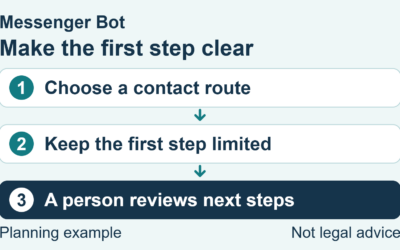
Keep the first DM to one screen and one job
The first automated message should answer the question the user just created. If the user commented PRICE, send the price sheet or the right next step. If they replied to a Story about availability, answer availability. If they mentioned your brand in a Story, thank them and offer one relevant follow-up. The moment the first message tries to do three jobs at once, it starts feeling like automation in the bad sense.
A good first DM usually does three things only:
- Names the trigger.
- Delivers the promised thing.
- Offers one obvious next action.
A bad first DM does the opposite. It ignores the trigger, asks for data too early, and tries to start a longer funnel before the person has even decided the brand is useful.
Do not fake the messaging windows
ManyChat’s help article updated on February 17, 2026 says Meta’s 24-hour et 7-day messaging windows still define how Messenger and Instagram conversations can continue, and the 7-day window is for messages sent manually by a human agent (ManyChat Help). Respond.io’s March 5, 2026 Instagram overview says messages sent after 24 hours are tagged with HUMAN_AGENT, while outbound messaging still depends on the contact having replied in the last 7 days (respond.io).
That matters because a lot of bad advice still treats the human-agent path as a loophole for automation. It is not. If the person goes quiet, your system should slow down, not get more aggressive. Forced follow-up is one of the clearest ways a legitimate chatbot turns into an instagram dm spammer.
Use comment-to-DM the way the platform actually intends
ManyChat’s February 16, 2026 comments trigger guide says that sending a private message after a comment does not automatically open the 24-hour window; that window opens only after the user interacts with the message, such as replying or clicking a quick reply (ManyChat Help). Chatfuel’s Instagram messaging rules say new contacts who comment on a post or Reel get one DM, and no extra messages can be sent until they reply (Chatfuel Help). Respond.io’s private-replies guide says the same feature is limited to one private message per comment and must be sent within 7 days of the comment (respond.io).
That is exactly what good DM design should look like anyway. One comment-triggered DM is enough to prove interest or lose it. If your offer is strong, the user will reply. If the user does not reply, the solution is not “more automation.” The solution is better copy, tighter targeting, or a better CTA in the original content.
Story automation should feel responsive, not haunted
ManyChat’s Story Reply Trigger and Story Mention Reply Trigger docs, both updated in February 2026, make two useful things clear. First, Story replies and reactions can start a DM flow. Second, Story mention automation only works when the mention comes from a public Instagram profile, and you can delay the first message to make the response feel more natural (ManyChat Help; ManyChat Help).
That delay feature matters more than it seems. Not because you should pretend a human typed the reply, but because instant robotic timing can make a good DM feel like the wrong kind of automation. A short pause plus a specific reply usually creates a better customer experience than immediate generic enthusiasm.
The six-step activation plan I recommend for most brands
- Switch to a professional account.
- Connect the right Facebook Page if your stack expects it.
- Choose one trigger only for the first workflow.
- Write a first message that fits on one screen and names the trigger.
- Require one user action before the deeper flow continues.
- Add one clear human handoff path for anything complicated.
If your operation needs Instagram alongside Facebook Messenger, website chat, forms, and more structured routing, that is the point where stack decisions matter. A broader system often beats a pure Instagram-only gadget because it reduces the temptation to improvise with risky tools later. That is why the right question is rarely “What is the strongest DM sender?” It is usually “What is the smallest legitimate stack that covers the real workload?”


 Français
  English
  Tagalog
  简体中文
简体中文  العربية
  हिन्दी
  Português do Brasil
  Español de México
  বাংলা
বাংলা  香港中文
香港中文  繁體中文
繁體中文  Nederlands
  Deutsch
  Bahasa Indonesia
  日本語
日本語  한국어
한국어  Polski
  Русский
  Español
  Tiếng Việt