चैटबॉट क्या है? 2026 के लिए सरल अंग्रेजी में चैटबॉट कैसे काम करते हैं, उनके प्रकार, और हर व्यवसाय को इसकी आवश्यकता क्यों है


Most people do not start by asking about architecture. They start with a very practical problem: if someone messages your business at 11:47 p.m., who answers? If that answer is “nobody until tomorrow,” you are already behind the way customers behave in 2026.

That is why the question चैटबॉट क्या है matters so much right now. A chatbot is no longer just a novelty sitting in the corner of a website. It can qualify a lead from Facebook Messenger, answer product questions on Instagram, recover an abandoned cart on a website, route a support issue to a human, or pull an answer from your help center without making the customer dig for it.

The simple definition is this: a chatbot is software that talks with a person through text or voice to complete a job. Sometimes that job is small, like telling someone your opening hours. Sometimes it is bigger, like collecting booking details, finding the right product, or resolving a support conversation end to end.

I checked the pricing pages, help docs, and product documentation for the tools and stats in this guide on 12 अप्रैल, 2026. Where I cite vendor performance numbers, treat them as public vendor-reported figures, not a guarantee that every business will get the same outcome. The goal here is not hype. It is to give you a useful mental model so you can tell the difference between a chatbot that saves time and one that just creates more work.

Chatbot Meaning in Plain English: What a Chatbot Actually Is

If you still want the shortest possible answer to what is chatbot, here it is: a chatbot is a conversation layer on top of software, content, or business processes. A person asks for something in natural language or through buttons, and the bot responds, guides, or acts.

That definition matters because people use the word चैटबॉट का अर्थ in three different ways. Some mean a simple rule-based auto-reply. Some mean an AI assistant that can understand free-form questions. Others mean any chat widget on a website, even if it is just live chat with no automation. Those are not the same thing.

A real chatbot usually has three traits:

  • It accepts conversational input, whether that is text, buttons, quick replies, or voice.
  • It follows logic to decide what should happen next.
  • It returns a response, an action, or a handoff instead of just showing static information.

So a support form is not a chatbot. A static FAQ page is not a chatbot. A live chat box with only human agents is not a chatbot either. The bot part starts when software handles some part of the exchange automatically.

The easiest way to think about it is this: a chatbot is a digital front desk. It greets, routes, answers, collects, and escalates. The only real question is how much it understands and how much control you want it to have.

How Chatbots Work Without the Buzzword Fog

Under the hood, most chatbots still follow the same basic loop even when the marketing page makes them sound magical. A user sends a message. The system interprets it. The bot decides what should happen next. It fetches information or triggers an action. Then it replies.

The difference between a weak chatbot and a useful one is not that the loop changes. It is that the interpretation layer, the decision layer, and the data source get better. In 2026, that usually means one of two setups: a rule engine, or an AI model plus a rules layer.

  1. इनपुट: the user clicks a button, writes a message, replies to an Instagram Story, comments on a post, or opens a website chat widget.
  2. Interpretation: the bot figures out what the user likely wants. A rule-based bot does this with keywords and branches. An AI bot does it with intent detection, classification, or large language models.
  3. निर्णय: the bot chooses the next step. That could be a canned answer, a form, a button set, an FAQ search, a CRM lookup, or a transfer to a human.
  4. क्रिया: the system may tag a lead, create a ticket, show a product, schedule a call, or query an order system.
  5. उत्तर: the user gets text, media, buttons, a confirmation, or a handoff message.

This is why chatbot quality depends on more than the model. If the content is outdated, the bot answers outdated information. If the integrations are weak, the bot cannot actually do anything useful. If the fallback logic is bad, the customer gets trapped in a loop. Good bots do not just sound natural. They move people toward resolution.

A strong business chatbot also needs an escape hatch. When confidence is low, policy is sensitive, or emotion runs high, the right move is often a clean handoff with context preserved. The fastest way to lose trust is forcing every conversation through automation just because you can.

What Is an AI Chatbot and What Makes It Different From a Rule-Based Bot?

When people ask what is ai chatbot, they are usually trying to understand whether modern chatbots are basically ChatGPT for business. Sometimes that is close. Often it is not.

An AI chatbot uses machine learning, natural language understanding, or large language models to interpret what the user means and generate or select a response. A rule-based chatbot does not really “understand” language in the same way. It follows predefined buttons, keywords, conditions, and branches.

The practical difference is simple. A rule-based bot is predictable. An AI bot is flexible. A rule-based bot stays inside the path you designed. An AI bot can handle more ways of asking the same question, summarize, explain, personalize tone, and keep going when the user does not follow a script.

The catch is that AI also introduces risk. If it is not grounded in your actual business content, it can answer confidently and still be wrong. That is why the best 2026 business setups are usually hybrid: AI handles messy language, while rules and integrations control actions, handoffs, and policy-sensitive steps.

अप्रोच How it answers Best at Main weakness
नियम-आधारित चैटबॉट Buttons, triggers, keywords, and decision trees Lead capture, appointment flows, simple routing Breaks when users go off-script
AI चैटबॉट LLMs, intent detection, retrieval, and generated replies Natural language support, FAQ handling, nuanced questions Can hallucinate or drift without guardrails
Hybrid chatbot AI for language, rules for actions and safety Real business automation across support and sales Needs stronger setup and testing discipline

If you remember one thing, make it this: AI is not automatically better. It is better when the conversation is messy, repetitive, knowledge-heavy, or highly varied. Rule-based is still better when the path must be tight, measurable, and safe.

The Five Chatbot Types You Will Run Into in 2026

Businesses usually do not choose between “chatbot” and “no chatbot.” They choose between different kinds of chatbots. That choice matters because each type solves a different operational problem.

Menu and button bots are the cleanest starting point. They show quick replies, categories, and guided paths. These work well when you want customers to choose from known options instead of typing open-ended questions.

नियम-आधारित चैटबॉट add conditions, tags, keywords, forms, and branching logic. These are common on Facebook Messenger and Instagram because they make lead qualification, comment-to-DM flows, and booking journeys easy to control.

AI FAQ bots answer free-text questions by searching or retrieving information from a knowledge base, help center, website pages, or uploaded documents. These are the bots people usually picture when they ask about AI customer service.

Action bots go beyond answers and do work. They can book meetings, reset passwords, update CRM fields, collect order IDs, or create support tickets. This is where integrations start to matter more than fancy copy.

Hybrid multichannel bots combine flows, AI answers, and backend actions across channels like website chat, Facebook Messenger, Instagram, WhatsApp, and email. This is where a lot of serious SMB automation is heading because the customer no longer stays on one channel.

There are voice bots too, of course, but for most small and mid-size businesses the day-to-day buying decision is still about text-first automation. If your team mainly handles social messages and web chat, voice is usually not the first problem to solve.

Why Chatbots Matter More in 2026: Speed, Context, and 24/7 Expectations

This is the part that changed fastest. Customers are now used to asking questions in chat instead of hunting through site navigation, waiting on hold, or filling out a slow contact form. The expectation is not just speed. It is speed with continuity.

Adobe’s 2026 AI and Digital Trends consumer report says 25% of customers now cite AI-powered platforms like ChatGPT as a top research tool, 44% would rely on AI for instant customer service, and 70% say personalized offers and recommendations still need to feel human rather than robotic (Adobe 2026 AI and Digital Trends report; Adobe summary).

Zendesk’s 2026 CX Trends research shows the operational side of that expectation. According to Zendesk, 81% of customers want agents to continue the conversation without backtracking, 74% get frustrated when they have to repeat information, and 95% expect an explanation for AI-made decisions. Zendesk also says 85% of CX leaders believe one unresolved issue is enough to lose a customer (Zendesk 2026 CX Trends release).

Then there is the vendor outcome data. HubSpot says Breeze Customer Agent already resolves 65% of conversations and cuts resolution time by 39% across more than 8,000 customers who have activated it, and HubSpot moved its pricing to $0.50 प्रति हल की गई बातचीत starting April 14, 2026 (HubSpot company news, April 2, 2026). Tidio says Lyro can solve up to 67% of customer problems (Tidio मूल्य निर्धारण).

You do not have to accept every vendor claim at face value to see the pattern. Chatbots matter more now because customers are already behaving as if fast, conversational help should exist. If you are not offering it, you are forcing the user back into a slower workflow than the rest of the market is training them to expect.

That does not mean every business needs a giant AI support program. It means every business should at least know which conversations are repetitive enough, high-intent enough, or time-sensitive enough to automate well.

What Chatbots Do Well and Where They Still Fail

Good chatbots are not general-purpose minds. They are specialists. They do best when the conversation maps to a repeatable business job.

  • What chatbots do well: instant first response, lead qualification, FAQ coverage, routing, booking, order lookups, collecting structured data, and sending the next step without delay.
  • What they do poorly: ambiguous exceptions, high-stakes policy interpretation, emotionally charged complaints, and any answer that depends on missing or stale data.
  • What AI chatbots improve: understanding phrasing variation, summarizing complex answers, detecting intent, and making support feel less brittle.
  • What AI chatbots still need help with: grounding, permissions, action approval, escalation, and source freshness.

This is why the strongest chatbot strategy is rarely “automate everything.” The better strategy is “automate the repeatable front half, then route the risky edge cases cleanly.” That protects customer trust and keeps your team from spending all day on messages the bot should have handled.

A useful rule of thumb: if you can predict the top 20 questions customers ask every week, you can probably automate a meaningful chunk of them. If every conversation requires judgment, negotiation, or exception handling, the chatbot should support the human team, not replace it.

The Best Chatbot Use Cases for Sales, Support, and Lead Capture

Most businesses do not need a chatbot everywhere on day one. They need it in the places where response time and repetition already hurt revenue or support quality.

Website lead capture is the obvious first use case. A bot can greet visitors, ask one or two qualifying questions, collect contact details, and route high-intent leads to a calendar or sales rep. That usually beats a dead contact form because the user gets momentum instead of silence.

Facebook Messenger and Instagram automation are especially strong when your traffic starts on social. Comment-to-DM flows, auto-replies, story responses, welcome sequences, and limited-time campaign flows all benefit from structured automation. The customer is already in a messaging mindset, so asking them to keep going in chat feels natural instead of forced.

Support deflection is the next big one. If people keep asking about shipping, returns, business hours, pricing, onboarding steps, or account basics, a chatbot can take the repetitive layer off your inbox. Freshchat, HubSpot, Tidio, Zendesk, and Intercom all lean hard into this use case in their 2026 product and pricing pages because it is where AI support economics are most visible.

Booking and intake works well too. Service businesses, clinics, agencies, and real estate teams can use bots to collect need, location, timing, and contact method before a human ever joins the thread. That makes handoff faster and cleaner.

Ecommerce pre-sales and post-purchase help is another high-return area. Bots can answer product questions, guide shoppers to a category, recover abandoned carts, and handle simple order-status conversations. If you want practical channel-by-channel examples after this guide, हमारे ट्यूटोरियल ब्राउज़ करें.

The best first use case is usually the one your team complains about most. If sales hates slow lead response, automate lead capture first. If support is drowning in the same five questions, automate FAQ and routing first. Start with pain, not with what sounds impressive in a demo.

What a Chatbot Costs in 2026: The Pricing Models That Shape Your Budget

Chatbot pricing is harder to compare in 2026 because vendors are no longer billing the same unit. One tool charges per seat. Another charges per active contact. Another charges per AI session. Another charges per successful resolution. If you compare only the homepage sticker price, you will make the wrong call.

There are five pricing models you will see most often:

  • Flat monthly software fee: easiest to forecast. Common for simpler social automation tools.
  • Per contact: attractive when your engaged audience is small, but it grows with campaign activity.
  • प्रति सीट: standard help desk logic, fine for agent teams, less fun when access spreads across departments.
  • Per conversation or session: better aligned to usage, but volatile during seasonal spikes.
  • Per outcome or resolved conversation: attractive when the bot genuinely solves issues, but you need strong measurement and trust in the vendor’s definition of success.

Here are real public examples checked on April 12, 2026. MessengerBot’s public pricing starts at $19.99 प्रति 30 दिन प्रीमियम के लिए और $49.99 प्रति 30 दिन for Pro (मेसेंजरबॉट मूल्य निर्धारण देखें). ManyChat’s newer pricing model, introduced March 2, 2026 for newer accounts, starts at $17/महीना आवश्यक के लिए और $39/महीना for Pro, with active-contact limits and overages (ManyChat subscription guide, आवश्यक, प्रो).

Tidio starts at $24.17/महीना for Starter, while its Lyro AI Agent starts at $32.50/month from 50 AI conversations (Tidio मूल्य निर्धारण). Intercom starts at ₹29 प्रति सीट प्रति माह billed annually for Essential and prices Fin at $0.99 प्रति परिणाम (इंटरकॉम मूल्य निर्धारण; Fin outcomes). HubSpot Service Hub Starter starts at $15 प्रति सीट प्रति माह, while Breeze Customer Agent moved to $0.50 प्रति हल की गई बातचीत starting April 14, 2026 on eligible Professional and Enterprise tiers (HubSpot Service Hub; HubSpot outcome-based pricing update).

Freshchat has a मुफ्त plan for up to 10 agents, Growth from $19 प्रति एजेंट प्रति माह billed annually, and Freddy AI Agent at $49 प्रति 100 सत्र after the first 500 included sessions (Freshchat pricing). Zendesk’s AI-first bundle starts at प्रति एजेंट प्रति माह $155 billed annually for Suite + Copilot Professional, while Advanced AI Agents are sales-priced (Zendesk मूल्य निर्धारण). Landbot’s USD page shows Starter at $45/महीना या $36/month billed annually for website and Facebook Messenger bots (Landbot pricing USD).

For custom AI-heavy web bots, Botpress uses a usage-based model with $0 + AI spend to start and $89 + AI spend for Plus (बॉटप्रेस मूल्य निर्धारण). Chatfuel’s Business plan starts at $23.99/month with extra conversations at $0.02 each (Chatfuel की कीमतें).

The big lesson is not that one tool is cheapest. It is that the right billing model depends on your use case. If you want predictable social automation and web chat for a lean team, a flatter pricing structure is easier to live with. If you want AI to resolve support at scale, usage or outcome pricing can still be worth it. If you want the MessengerBot baseline before comparing anything else, मेसेंजरबॉट मूल्य निर्धारण देखें.

2026 Chatbot Platform Comparison by Price, Channels, and Best Fit

This table is meant to save you from tab chaos. These tools are not identical, and they do not bill the same way, but the table gives you a practical starting point. Public prices below are the visible entry points I found on April 12, 2026 for the US market or USD pages where available.

One caution before you use it: vendor AI performance claims and public starter prices are helpful for orientation, not for final budgeting. Seats, contacts, AI sessions, channels, onboarding, and annual billing can change the real invoice quickly.

प्लेटफार्म सर्वश्रेष्ठ फिट Public starting price मुख्य बिलिंग लॉजिक Channel strength What to watch
MessengerBot Facebook Messenger, Instagram, and website automation for SMBs प्रीमियम $19.99 प्रति 30 दिन फ्लैट योजना स्तर Strong on social messaging plus website chat Better for practical automation than enterprise help desk workflows
मैनीचैट Creators, social lead gen, Instagram and Messenger growth आवश्यक $17 प्रति माह सक्रिय संपर्क और ओवरएज Very strong on Instagram and Messenger automations New plan availability depends on account age and region
Tidio SMB support with AI add-ons and website chat स्टार्टर $24.17 प्रति माह Billable conversations plus AI quota Strong on web support and help desk style workflows AI and flow add-ons change the real monthly total
Intercom AI-first customer service teams प्रति सीट प्रति माह $29, वार्षिक बिलिंग सीट मूल्य निर्धारण के साथ $0.99 प्रति फिन परिणाम Strong on support operations and omnichannel service Outcome pricing is powerful but can scale fast
हबस्पॉट CRM-centered sales and support teams Service Hub Starter $15 per seat per month Seat pricing plus HubSpot Credits and agent outcomes on higher tiers Strong if your CRM context already lives in HubSpot Customer Agent needs Professional or Enterprise plus credits
Freshchat Support teams that want lower-cost omnichannel chat Free; Growth $19 per agent per month billed annually Seat pricing plus AI session packs Supports website, Facebook Messenger, Instagram, and more Freddy AI usage is separate from base seats
जेंडेस्क Larger service teams with mature support operations Suite + Copilot Professional $155 per agent per month billed annually Seat bundle plus AI add-ons or enterprise sales pricing Enterprise service breadth and governance Usually too heavy for simple social lead automation
लैंडबॉट Visual website and Messenger bot building Starter $45 per month Tiered plans with chat and AI allowances Strong for guided web journeys and Facebook Messenger WhatsApp and higher usage push cost up quickly
बॉटप्रेस Custom AI web agents and developer-led builds $0 plus AI spend; Plus $89 plus AI spend Workspace fee plus model usage Flexible for custom web AI experiences Budgeting depends on usage and builder skill
चैटफ्यूल Social messaging automation with conversation-based pricing बिजनेस $23.99 प्रति माह Conversation quota plus overages Good for Instagram, WhatsApp, and Facebook automation Per-conversation overages matter if campaigns spike

Sources checked April 12, 2026: मेसेंजरबॉट मूल्य निर्धारण देखें, ManyChat subscription guide, Tidio मूल्य निर्धारण, इंटरकॉम मूल्य निर्धारण, Intercom Fin outcomes, HubSpot Service Hub, HubSpot Customer Agent update, Freshchat pricing, Zendesk मूल्य निर्धारण, Landbot pricing USD, बॉटप्रेस मूल्य निर्धारण, y Chatfuel की कीमतें.

How to Choose the Right Chatbot for Your Business

The right chatbot is usually obvious once you stop asking for the “best tool” in general and start asking what job needs to be done first.

Start with the first business job, not the biggest dream. If your problem is slow lead response from ads and social traffic, you want a bot that is good at guided flows, qualification, and fast follow-up. If your problem is repetitive support volume, you want stronger knowledge search, better handoff, and reporting around resolution.

Then look at your primary channel. A social-first business has different needs than a help-center-first SaaS team. If most conversations happen on Facebook Messenger, Instagram, and website chat, a tool built for messaging automation makes more sense than a heavyweight enterprise desk. If the work lives in tickets, email, and complex support queues, the service stack matters more.

After that, ask five practical questions:

  • How open-ended are the conversations? The more variation users bring, the more AI and better retrieval matter.
  • How risky are the answers? The more compliance, refunds, or policy exceptions are involved, the more you need guardrails and handoff control.
  • How clean is your source content? AI support is only as good as your docs, FAQs, and product information.
  • How much budget volatility can you tolerate? Flat plans are easier to forecast than outcome or session pricing.
  • Who will maintain the bot? A no-code flow builder is very different from a custom AI agent stack with model spend and versioning.

If you do not know where to start, default to the narrowest use case with the clearest payoff. A chatbot that reliably books demos or handles the top five support questions is better than a broad AI assistant that sounds smart and resolves nothing.

How to Launch Your First Chatbot in Seven Practical Steps

This is where most teams overcomplicate things. You do not need a massive bot roadmap to get value. You need one contained workflow that matters.

  1. Pick one job. Choose a single outcome like lead qualification, booking, FAQ handling, or comment-to-DM automation. If you give the bot five jobs on day one, it will do all five badly.
  2. Collect the real questions. Pull actual messages from support, sales, DMs, and live chat. The right script comes from real phrasing, not from what your team imagines people ask.
  3. Choose the right channel mix. Build where the volume already is. For many small businesses, that means website chat plus Facebook Messenger or Instagram, not an everywhere-at-once rollout.
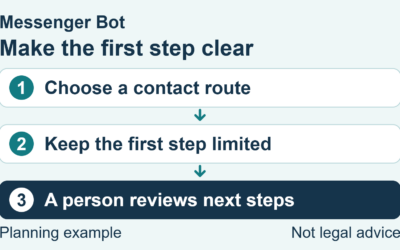
  4. Write the fallback before the happy path. Decide what the bot says when it is unsure, what counts as a handoff, and how human context gets preserved.
  5. Connect the action layer. A bot gets useful when it can save data, tag contacts, trigger follow-up, create a ticket, or send the user somewhere helpful.
  6. Test off-script messages. Do not just test the perfect button path. Try slang, short replies, typos, vague questions, emotional complaints, and unexpected combinations.
  7. Measure one business metric and one experience metric. For example, demo bookings plus handoff rate, or resolved conversations plus CSAT.

If you want implementation walk-throughs instead of strategy, हमारे ट्यूटोरियल ब्राउज़ करें. The most important thing is to launch something measurable fast enough that you learn from real traffic, not from internal guessing.

A first chatbot should feel a little boring from the inside. That is usually a good sign. Boring bots that handle real work beat flashy bots that only perform in demos.

The Chatbot Metrics That Tell You if Automation Is Actually Helping

A lot of chatbot dashboards are full of vanity numbers. Messages sent, sessions opened, and total impressions can look impressive while the actual experience gets worse. Measure outcomes instead.

For lead generation, the key numbers are completion rate, qualified lead rate, booked meetings, and speed to first reply. A chatbot that talks a lot but captures bad leads is not helping sales. For support, the important numbers are resolution rate, containment rate, handoff rate, time to resolution, and customer satisfaction.

There are also two metrics teams forget until the bot starts creating problems:

  • Stale answer rate: how often the bot uses outdated pricing, policies, or steps because content was not refreshed.
  • Forced escape rate: how often users type “human,” repeat themselves, or abandon the conversation after an unhelpful bot turn.

If you are on an outcome-based AI platform, inspect how the vendor defines success. Intercom charges per Fin outcome. HubSpot moved Customer Agent to resolved-conversation pricing. Those models can be attractive, but only if the definition matches what your team considers a real resolution.

The cleanest measurement model is simple: did the bot reduce wait time, reduce repetitive manual work, and move more people toward a real business outcome? If the answer is no, the automation needs fixing even if the dashboard looks busy.

Common Chatbot Mistakes That Make Good Brands Sound Bad

The first mistake is pretending a chatbot is smarter than it is. Customers are surprisingly forgiving when a bot is clear, fast, and honest. They are not forgiving when it sounds confident, misses the point, and hides the human handoff.

The second mistake is buying AI before cleaning up content. If your help docs are wrong, duplicated, inconsistent, or missing, an AI bot just scales the confusion faster.

The third mistake is forcing every conversation into the same flow. A paid-ad lead, a returning customer, and an angry support ticket should not all get the same opening script. Context matters.

The fourth mistake is measuring only cost savings. Yes, automation can reduce manual workload. But if the bot creates higher drop-off, lower trust, or more escalations because it is hard to escape, the savings are fake.

The fifth mistake is ignoring transparency. Zendesk’s 2026 report found that customers increasingly expect explanations for AI decisions. Adobe’s 2026 report found that people still want AI-assisted brand experiences to feel human. That means tone, source quality, and disclosure all matter. A bot that feels deceptive, generic, or manipulative will underperform even when the core logic is sound.

The last mistake is trying to make the bot your entire customer experience strategy. It is not. It is one layer. The handoff, the CRM, the follow-up, the knowledge base, and the human team still determine whether the overall experience feels competent.

Where MessengerBot Fits if You Need Facebook Messenger, Instagram, and Website Chat in One Place

If your business lives in social messaging instead of a giant enterprise support queue, MessengerBot sits in a very practical part of the market. Its public pricing and feature pages are built around the things smaller teams usually care about first: a visual flow builder, website chat, automation templates, integrations, and social-channel automation without requiring an enterprise help desk rollout (मेसेंजरबॉट मूल्य निर्धारण देखें).

MessengerBot’s current pricing starts at $19.99 प्रति 30 दिन प्रीमियम के लिए और $49.99 प्रति 30 दिन for Pro. The pricing page also highlights features like website chat, Instagram chatbot access, JSON API plus Zapier, scheduled sends, analytics, comment automation, and a visual flow builder. That makes it a sensible fit when the job is lead capture, campaign automation, social messaging, and website chat rather than deep enterprise ticket orchestration.

Compared with a tool like Intercom or Zendesk, MessengerBot is not trying to be the center of a large service operation. Compared with AI-builder platforms like Botpress, it is easier to approach if you want practical no-code messaging flows more than a custom AI project. Compared with ManyChat and Chatfuel, it plays in a similar social-automation lane, with the website layer and pricing model appealing to teams that want a predictable plan structure.

If your business starts small and the channel mix grows, the sensible move is not always switching platforms. Sometimes it is just adding more capacity and features once the first automation proves itself. If you reach that point and need the MessengerBot Pro tier, you can Upgrade to MessengerBot Pro.

The honest fit is this: MessengerBot makes the most sense when you want to automate conversations across Facebook Messenger, Instagram, and your website without turning the project into a full-scale service-software migration.

A Practical Next Step if You Want to Build Instead of Keep Researching

If you have read this far, you probably do not need more theory. You need one good first use case. Pick the channel where customers already message you, map the top questions or lead flow, and launch a contained bot that can be measured in bookings, qualified leads, or resolved conversations. If MessengerBot matches that channel mix, मेसेंजरबॉट मूल्य निर्धारण देखें.

If you are an agency, consultant, or creator recommending chatbot software to clients and audiences, there is also a straightforward monetization angle. You can हमारे सहयोगी कार्यक्रम में शामिल हों and turn implementation knowledge into recurring revenue instead of leaving that value on the table.

अक्सर पूछे जाने वाले प्रश्नों

सरल शब्दों में चैटबॉट क्या है?

एक चैटबॉट ऐसा सॉफ़्टवेयर है जो लोगों से टेक्स्ट या वॉयस के माध्यम से बात करता है ताकि प्रश्नों का उत्तर दे सके, उन्हें चरणों के माध्यम से मार्गदर्शन कर सके, या बुकिंग, रूटिंग और समर्थन जैसी क्रियाएँ पूरी कर सके। कुछ चैटबॉट सरल नियम-आधारित प्रवाह होते हैं, जबकि अन्य प्राकृतिक भाषा को समझने के लिए एआई का उपयोग करते हैं।.

चैटबॉट और एआई चैटबॉट में क्या अंतर है?

एक नियमित चैटबॉट अक्सर निश्चित नियमों, बटनों और स्क्रिप्ट्स का पालन करता है। एक एआई चैटबॉट अधिक प्राकृतिक वाक्यांशों को समझ सकता है, स्रोतों की खोज कर सकता है, उत्तर उत्पन्न कर सकता है, और अधिक खुले प्रश्नों को संभाल सकता है। व्यावहारिक रूप से, 2026 में कई बेहतरीन व्यवसाय बॉट हाइब्रिड सिस्टम हैं जो भाषा के लिए एआई और नियंत्रण के लिए नियमों का उपयोग करते हैं।.

क्या चैटबॉट्स केवल बड़े कंपनियों के लिए उपयोगी हैं?

नहीं। छोटे व्यवसाय अक्सर तेजी से मूल्य प्राप्त करते हैं क्योंकि उनके पास आमतौर पर स्वचालित करने के लिए स्पष्ट दोहरावदार बातचीत होती है, जैसे कि लीड कैप्चर, बुकिंग, खुलने का समय, सामान्य प्रश्न, और सामाजिक संदेशों का पालन। सबसे अच्छा प्रारंभिक बिंदु एक संकीर्ण कार्यप्रवाह है जिसमें स्पष्ट लाभ होता है।.

2026 में एक चैटबॉट की लागत कितनी होगी?

प्रवेश स्तर के चैटबॉट उपकरण अभी भी प्रति माह $20 से $50 के तहत शुरू होते हैं, लेकिन मूल्य निर्धारण प्लेटफ़ॉर्म और बिलिंग मॉडल के अनुसार भिन्न होता है। कुछ उपकरण स्थिर मासिक शुल्क लेते हैं, जबकि अन्य संपर्कों, सीटों, सत्रों या सफल AI परिणामों के आधार पर शुल्क लेते हैं। सही सवाल केवल स्टिकर मूल्य नहीं है, बल्कि यह है कि कौन सा मूल्य निर्धारण मॉडल आपकी ट्रैफ़िक और टीम के लिए उपयुक्त है।.

क्या एक चैटबॉट फेसबुक मैसेंजर, इंस्टाग्राम और एक वेबसाइट पर काम कर सकता है?

हाँ, कई आधुनिक चैटबॉट प्लेटफ़ॉर्म मल्टीचैनल तैनाती का समर्थन करते हैं। सटीक सेटअप विक्रेता पर निर्भर करता है, लेकिन सामाजिक-केंद्रित उपकरण और समर्थन प्लेटफ़ॉर्म अब वेबसाइट चैट, फेसबुक मैसेंजर, इंस्टाग्राम, व्हाट्सएप और ईमेल के संयोजनों को कवर कर सकते हैं। चुनौती चैनल की उपलब्धता के बारे में कम है और अधिकतर चैनलों के बीच लॉजिक, हैंडऑफ़ और सामग्री को सुसंगत बनाए रखने के बारे में है।.


संबंधित आलेख

hi_INहिन्दी