
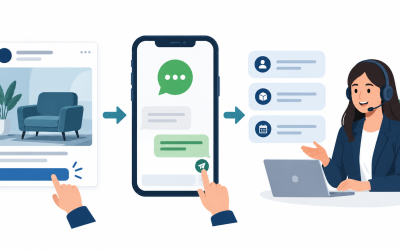
Sebagian besar tim masih menggunakan kata chatbot seolah-olah kategori tersebut tidak pernah berubah. Itu berubah. Pada tahun 2026, chatbot AI percakapan bukanlah pohon keputusan dengan salinan yang lebih baik. Ini adalah lapisan orkestrasi yang menggabungkan model bahasa, pengambilan, aturan bisnis, tindakan sistem, dan penyerahan manusia menjadi satu sistem operasi untuk percakapan pelanggan.
Perbedaan itu penting karena kesalahan pembelian sangat mahal. Alat otomatisasi DM sosial, agen AI meja layanan, agen asli CRM, dan pembangun kustom semuanya dapat memasarkan diri mereka sebagai AI percakapan sekarang. Mereka tidak dapat dipertukarkan. Jika Anda membutuhkan daftar pendek produk-vs-produk, baca perbandingan chatbot teratas. Jika keuangan sudah menginginkan rentang anggaran dan model penagihan, langsung saja ke rincian harga chatbot. Artikel ini menangani pertanyaan kategori: apa arti sebenarnya dari AI percakapan, mengapa bot berbasis aturan kehilangan pijakan, seperti apa tumpukan perusahaan yang nyata, dan bagaimana tim dapat mencapai produksi tanpa membangun mainan FAQ yang mahal.
Klaim dan tolok ukur platform di sini telah diverifikasi terhadap halaman produk publik dan laporan vendor pada 10 April 2026. Di mana hasil berasal dari HubSpot, Intercom, Salesforce, Zendesk, atau vendor lainnya, perlakukan mereka sebagai tolok ukur kinerja yang dilaporkan vendor, bukan jaminan universal. Itu masih berguna. Ini memberi tahu Anda apa yang sebenarnya dilihat oleh platform terkemuka dan pelanggan mereka di lapangan saat ini.
Jika masalah utama Anda adalah biaya dukungan pelanggan yang sempit daripada arsitektur perusahaan, bacaan selanjutnya yang tepat adalah implementasi layanan pelanggan AI panduan. Halaman ini mencakup lebih dari sekadar layanan pelanggan. Ini mencakup dukungan, penjualan, kualifikasi prospek, pengalihan, tindakan yang terhubung dengan CRM, tata kelola, dan model pengukuran yang sebenarnya digunakan oleh operator.
Apa Arti Sebenarnya dari Chatbot AI Percakapan di 2026
Chatbot AI percakapan di 2026 adalah sistem yang memahami bahasa bebas, mengambil konteks bisnis yang relevan, memutuskan tindakan apa yang tepat, dan baik menjawab, bertindak, atau mengeskalasi. Kata penting di sini adalah sistem. Pembeli masih mengalami kerugian ketika mereka hanya mengevaluasi demo model dan mengabaikan tumpukan yang mengelilinginya.
Gartner melaporkan pada Desember 2024 bahwa 85% pemimpin layanan pelanggan mengharapkan untuk menjelajahi atau melakukan pilot AI generatif percakapan yang berhadapan dengan pelanggan pada 2025, dan lebih dari 75% mengatakan kepemimpinan eksekutif sudah menekan mereka untuk mengimplementasikannya. Itu menjelaskan urgensi pengeluaran. Itu tidak menjelaskan apakah penerapan itu baik. Kesenjangan antara minat pilot dan kualitas produksi adalah tepat di mana sebagian besar program menang atau gagal.Gartner).
Apa yang diharapkan pelanggan juga berubah. Laporan Tren CX Zendesk 2026, berdasarkan tanggapan dari lebih dari 11.000 konsumen dan pemimpin bisnis di 22 negara, menemukan bahwa 81% konsumen ingin perwakilan melanjutkan dari tempat mereka berhenti, 74% merasa frustrasi ketika harus mengulangi informasi, dan 67% mengharapkan dukungan mencerminkan interaksi sebelumnya. Kefasihan saja tidak cukup untuk mencapai standar itu. Kontinuitas diperlukan.Zendesk).
Itulah sebabnya definisi kategori sekarang lebih luas daripada “bot yang mengobrol.” Sebuah platform AI percakapan yang nyata perlu melakukan lima pekerjaan sekaligus:
- Memahami bahasa alami, termasuk parafrase, pertanyaan lanjutan, dan konteks parsial.
- Mendasarkan jawaban pada konten yang disetujui, bukan hanya memori model.
- Melakukan tindakan berguna di dalam sistem bisnis seperti CRM, tiket, pemesanan, atau pencarian identitas.
- Mengetahui kapan kepercayaan rendah dan segera menyerahkan.
- Meningkatkan melalui analitik, tinjauan transkrip, dan pembaruan pengetahuan.
Apa pun yang kurang dari itu masih bisa berguna, tetapi itu bukan yang dimaksudkan oleh para pemimpin kategori ketika mereka menganggarkan untuk AI percakapan perusahaan pada tahun 2026. Itu adalah alat otomatisasi yang terprogram, pembangun bot saluran tunggal, atau asisten AI umum tanpa kerangka operasional di belakangnya.
| Apa yang diminta oleh pembeli | Apa yang biasanya mereka maksud | Apa yang sebenarnya harus dilakukan oleh platform |
|---|---|---|
| “Chatbot yang terdengar manusia” | Balasan alami yang tidak terasa rapuh | Gunakan pengambilan, aturan kebijakan, dan respons yang berbasis sumber agar kelancaran tidak berubah menjadi halusinasi |
| “Bot yang mengurangi tiket” | Mengalihkan pekerjaan dukungan yang berulang | Menyelesaikan niat dengan volume tinggi, menangkap data terstruktur, dan meningkatkan dengan konteks |
| “Bot yang membantu penjualan” | Kualifikasi niat dan mempercepat pembeli | Menjawab pertanyaan harga, mengarahkan berdasarkan kecocokan akun, dan menulis aktivitas kembali ke CRM |
| “Chatbot perusahaan” | Keamanan, auditabilitas, dan kontrol lintas sistem | Terapkan tata kelola, identitas, izin, analitik, dan pengabaian manusia di seluruh saluran |
Satu poin praktis lagi: penerapan bisnis yang serius tidak “memerlukan pendaftaran.” Frasa itu masih milik demo AI konsumen dan eksperimen obrolan ringan. AI percakapan produksi memerlukan saluran, izin, akses data, aturan cadangan, dan pelaporan. Pilot gratis ada. Tingkat gratis ada. Otomatisasi perusahaan tanpa pendaftaran tidak ada.
AI Percakapan vs Chatbot Berbasis Aturan: Arsitektur yang Mengubah
Bot berbasis aturan dibangun di sekitar jalur yang telah ditentukan. Mereka bekerja ketika ruang masalah sempit, bahasanya dapat diprediksi, dan bisnis nyaman memaksa pengguna ke dalam menu. Mereka gagal ketika orang mengetik niat yang sama dengan lima cara berbeda, melompat topik di tengah jalan, atau mengajukan pertanyaan yang tidak diperkirakan oleh desainer.
AI percakapan mengubah mode kegagalan. Model ini biasanya dapat memahami apa yang dimaksud pengguna, tetapi masih bisa gagal dengan menggunakan sumber yang salah, melewatkan kebijakan, atau terdengar yakin ketika seharusnya meningkatkan. Itu masih merupakan titik awal yang lebih baik untuk sebagian besar perusahaan karena kegagalan sekarang dapat dikelola. Anda dapat meningkatkan konten, menyesuaikan pengambilan, memperketat kebijakan, dan memeriksa transkrip. Dengan pohon keputusan yang dikodekan keras, begitu pengguna keluar dari jalur, pengalaman hanya mati.
| Dimensi | Chatbot berbasis aturan | Chatbot AI Percakapan | Implikasi operasional |
|---|---|---|---|
| Penanganan input | Tombol, kata kunci, niat kaku | Bahasa alami, parafrase, konteks multi-langkah | Cakupan lebih tinggi dengan skrip yang lebih sedikit |
| Sumber jawaban | Salinan statis yang ditulis ke dalam alur | Pengambilan pengetahuan ditambah logika bisnis | Tim konten sama pentingnya dengan pembangun bot |
| Penanganan pengecualian | Loop cadangan atau jalan buntu | Jelaskan, kutip, arahkan, atau eskalasi | Pengguna terjebak lebih sedikit jika serah terima dirancang dengan baik |
| Tindakan sistem | Biasanya terbatas atau rapuh | Panggilan API, pembaruan CRM, pemesanan, pembuatan kasus, pemicu alur kerja | Bot mulai mempengaruhi pendapatan dan operasi, bukan hanya FAQ |
| Pemeliharaan | Pengeditan alur setiap kali bahasa berubah | Penyempurnaan pengetahuan, perbaikan kebijakan, tinjauan transkrip | Kepemilikan beralih dari pembangun kampanye ke operasi lintas fungsi |
| Kesesuaian terbaik | Alur deterministik sederhana | Percakapan yang kompleks, bervariasi, atau dengan volume tinggi | Sebagian besar perusahaan membutuhkan keduanya, tetapi tidak dalam lapisan yang sama |
Nuansa pentingnya adalah bahwa logika berbasis aturan tidak usang. Itu berpindah ke bawah tumpukan. Sistem percakapan yang baik masih menggunakan kontrol deterministik untuk pemeriksaan identitas, aturan pengembalian dana, persetujuan, kelayakan, penafian yang diatur, dan langkah-langkah alur kerja yang kritis. Perbedaannya adalah bahwa aturan sekarang berada di dalam sistem percakapan yang lebih luas alih-alih mendefinisikan seluruh pengalaman.
HubSpot menjelaskan perbedaan ini dengan jelas di halaman pelanggan-agennya: chatbot tradisional mengikuti skrip, sementara agen AI dirancang untuk memahami konteks, merespons secara alami, dan mengarahkan masalah kompleks ketika dukungan manusia diperlukan (HubSpot). Itulah pergeseran arsitektur nyata tahun 2026. AI menangani bahasa dan ambiguitas. Aturan menangani keselamatan, kebijakan, dan determinisme.
Empat Lapisan yang Dibutuhkan Setiap Tumpukan AI Percakapan Perusahaan
Perusahaan yang membeli AI percakapan sebagai kategori produk tunggal biasanya kurang membangun salah satu dari empat lapisan. Kemudian pilot terlihat mengesankan di sandbox dan membuat frustrasi di produksi. Tumpukan yang bertahan memiliki empat lapisan, masing-masing dengan pemilik, anggaran, dan pola kegagalan yang berbeda.
| Lapisan | Apa yang dilakukannya | Kegagalan umum | Pemilik utama |
|---|---|---|---|
| Lapisan percakapan | Saluran, titik masuk, desain percakapan, pengalihan, UX serah terima | Jendela obrolan yang menarik tetapi tanpa jalur aksi yang berguna | CX, pertumbuhan, atau produk digital |
| Lapisan kecerdasan | Pilihan model, pengambilan, kebijakan prompt, evaluasi, logika kepercayaan | Halusinasi, jawaban yang samar, cakupan topik yang buruk | Platform AI atau operasi teknis |
| Lapisan sistem bisnis | CRM, tiket, identitas, data pesanan, pemesanan, alur kerja, basis pengetahuan | Bot dapat berbicara tetapi tidak dapat melakukan apa pun yang berguna | Applications, RevOps, service ops, IT |
| Governance layer | Security, privacy, audit, QA, analytics, compliance, rollback controls | Fast launch followed by security panic or metric confusion | Security, legal, data governance, ops leadership |
The mistake I see most often is overinvesting in the intelligence layer because that is where the demos live. Buyers spend weeks debating model quality and almost no time deciding which CRM fields are safe to expose, which intents must escalate, which articles are canonical, or who signs off on post-launch answer reviews. That is backwards. Once the models are reasonably strong, operational design is the bigger differentiator.
The second common mistake is collapsing channel strategy into one idea of “chat.” Messenger, website chat, email, WhatsApp, in-app help, and voice each create different expectations. A lead-generation assistant on paid-traffic landing pages is not the same operating system as an authenticated support agent inside an account portal. If you need ideas for where conversational AI actually creates money or removes friction, the best starting point is this roundup of revenue use cases, then map only the first one or two to your stack.
When these four layers are present, the category becomes much easier to evaluate. You stop asking “Which chatbot is smartest?” and start asking better questions: Which platform fits our systems? Which channels matter first? Which actions can the agent safely take? Who owns knowledge freshness? Which metrics will prove this is working?
Real ROI Math From Deployments at HubSpot, Intercom, and Salesforce Customers
Most ROI decks are too clean. They assume every automated interaction is a full cost saving and every AI answer is equally valuable. That is not how real deployments work. The useful way to model ROI is to anchor on public customer outcomes, then translate those into capacity, revenue, or cost implications using your own labor and conversion assumptions.
The examples below are vendor-reported results. The math in the third column is a planning model, not a vendor promise.
| Penerapan | Public result | What the math means | What it usually proves |
|---|---|---|---|
| HubSpot / Nutribees | HubSpot quotes Nutribees saying Breeze Customer Agent reduced tickets handled by support by 77% while improving conversion through 24-hour support | If a team handles 10,000 repetitive tickets a month, a 77% reduction means only 2,300 still need agent time. At a planning assumption of $5 per human-handled ticket, that is a monthly difference of about $38,500 before software and setup costs. | Support ROI and revenue lift can happen together when the bot answers buying questions after hours |
| Intercom / Synthesia | Intercom says Fin resolved more than 6,000 conversations in six months, saved over 1,300 hours, and pushed self-serve support as high as 87% | At $30 fully loaded support labor per hour, 1,300 hours is about $39,000 in recovered capacity. Fin outcome fees on 6,000 resolutions would be about $5,940 at Intercom’s public $0.99 rate, before seat costs. | Outcome pricing looks expensive until resolution volume is paired with real labor recovery |
| Salesforce / Asymbl | Salesforce says Asymbl sees $1.5 million in cost savings, 3,789% ROI, and 1,000+ leads handled per week by Agentforce | The large ROI is not just model quality. It comes from replacing hiring and tool sprawl inside a live sales workflow. The math works because the agent acts in the same CRM, data, and collaboration stack as the human team. | Sales automation pays back fastest when the agent can qualify, route, and update records without leaving the system of record |
Sumber: HubSpot Breeze Customer Agent, Intercom Pricing, Salesforce Asymbl story.
The more durable ROI formula looks like this:
Net annual value = labor capacity recovered + incremental conversions + lower response-time cost + lower tool sprawl cost minus platform fees + implementation + knowledge maintenance + governance overhead.
That last part matters. Conversational AI is not free after launch. You pay in platform fees, content maintenance, transcript review, QA, and sometimes API usage. Buyers who ignore that create inflated business cases. Buyers who include it still usually like the math because repetitive conversation work is so expensive when humans do all of it manually.
HubSpot’s April 2, 2026 update is a good example of how pricing models changed. HubSpot said Breeze Customer Agent already resolves 65% of conversations across more than 8,000 activated customers, cuts resolution time by 39%, and moves to $0.50 per resolved conversation starting April 14, 2026. Intercom prices Fin at $0.99 per outcome. Salesforce now offers conversation pricing at $2 per customer-facing conversation or Flex Credits at $500 per 100,000 credits. The lesson is simple: ROI is no longer about whether AI works at all. It is about matching the pricing model to the kind of work you are trying to automate (HubSpot; Intercom; Salesforce).
If finance wants a deeper pricing model after this section, use the rincian harga chatbot next. This pillar is about category economics and architecture, not a line-by-line procurement worksheet.
Top Conversational AI Platforms Compared by Use Case
This is where many pillar guides drift into a generic top-10 list. That is the wrong format for this topic. The useful comparison is by operating model and use case, not by one blended score. If you want a full head-to-head ranking, the perbandingan chatbot teratas handles that. Here, the goal is to show where each conversational AI platform class fits.
| Platform | Titik awal publik | Tingkat gratis atau uji coba | Kesesuaian terbaik | Wrong fit |
|---|---|---|---|---|
| MessengerBot.app | Premium di $19.99 per 30 hari | Uji coba gratis | Messenger-first lead capture, FAQ automation, website chat, and SMB workflows that need predictable pricing | Deep enterprise service governance, large internal IT workflows, or highly regulated custom agent stacks |
| HubSpot Service Hub + Breeze | Starter from $15 per seat, Professional from $100 per seat, Enterprise from $150 per seat | Free tools and 14-day trial | CRM-first mid-market teams that want service, sales, and marketing data on one platform | Teams that do not want to operate inside HubSpot as the system of record |
| Intercom + Fin | $29 per seat annually plus $0.99 per Fin outcome | Uji coba gratis 14 hari | B2B SaaS and digital support teams that want fast AI deflection with strong helpdesk workflows | Buyers who need very low flat pricing at high support volume |
| Zendesk | Suite + Copilot Professional at $155 per agent monthly, billed annually | Uji coba gratis | Large support organizations that care about governance, QA, workforce management, and enterprise service operations | Simple social automation or low-budget SMB launches |
| Salesforce Agentforce | $2 per conversation, $500 per 100,000 Flex Credits, or $125 per user add-ons | Foundations tier available for free | Complex enterprise workflows, CRM-native action taking, and industries with heavy process logic | Teams that need to go live next week with minimal administration |
| ManyChat | Pro from $15 per month | Free plan up to 1,000 contacts | Instagram and Facebook DM marketing, creator funnels, comment-to-message automation | Formal enterprise service desks or cross-system case orchestration |
| Botpress | Plus at $89 per month plus AI spend | Pay-as-you-go free tier | Teams that want a custom agent framework with more build control | Operators who want a turnkey support stack with minimal technical lift |
Sumber: Lihat Harga MessengerBot, HubSpot Service Hub, Intercom Pricing, Harga Zendesk, Salesforce Agentforce Pricing, ManyChat Pricing, Botpress Pricing.
The decision logic is simpler than the market makes it sound:
- Choose a channel-first platform when your revenue starts in social inboxes and lightweight website chat.
- Choose a service-first platform when ticketing, QA, SLAs, and deflection economics matter more than campaign automation.
- Choose a CRM-native platform when the real value comes from writing back into customer records, workflows, and pipeline.
- Choose a builder when your differentiation is the workflow itself and you have the team to own it.
If you are buying below enterprise scale, this is also where budgeting changes the shortlist. The dedicated obot obrolan terbaik untuk bisnis kecil roundup goes deeper on the under-$10M revenue end of the market, where ease of setup and predictable billing matter more than enterprise controls.
How to Build a Production-Grade Conversational AI Chatbot in 90 Days
Most 90-day chatbot plans fail because they start with tooling instead of scope. The right first move is not “pick a model.” It is “pick one repetitive, high-volume, measurable conversation class with a clear source of truth and a clean escalation path.” That is how you ship something real in three months.
| Minggu | Main objective | Required output |
|---|---|---|
| Minggu 1 | Choose one launch use case and one backup use case | Signed scope, owner list, baseline KPI sheet |
| Minggu 2 | Mine transcripts and tickets for top intents | Intent taxonomy, top escalation reasons, current service baseline |
| Minggu 3 | Audit and clean source content | Approved knowledge set, content gaps, content owners |
| Minggu 4 | Design integration boundaries | CRM fields, API access plan, identity and permission map |
| Week 5 | Write conversation policy and escalation rules | Prompt policy, compliance rules, fallback logic, handoff matrix |
| Week 6 | Build the first working assistant on one channel | Prototype connected to knowledge, routing, and one human inbox |
| Week 7 | Add business actions | Read-only CRM context, one safe write action, logging enabled |
| Week 8 | Run transcript-based QA and adversarial tests | Test pack, failure log, approved launch blockers list |
| Week 9 | Train agents and operations leads | Escalation runbook, transcript review process, weekly operating cadence |
| Week 10 | Soft-launch to limited traffic or one business unit | Pilot dashboard, live transcripts, daily tuning cycle |
| Week 11 | Expand coverage only after failure modes are known | Updated knowledge, revised prompts, channel rollout decision |
| Week 12 | Connect measurement to revenue and service outcomes | Deflection, conversion, CSAT, transfer, and cost views in one dashboard |
| Week 13 | Executive review and second-use-case plan | Go-forward roadmap, ownership model, next 90-day backlog |
The week-by-week structure is not bureaucracy. It is what keeps an AI assistant from turning into a support liability. Week 3 is where many projects quietly die because the source content is bad. Week 8 is where overconfident demos get corrected. Week 9 is where operations teams learn that agent handoff design matters as much as model quality.
Use this checklist before you call the first release production-ready:
- One clearly named launch use case with a measurable business outcome.
- Approved source content, not scraped leftovers from outdated docs.
- At least one human handoff path that preserves transcript context.
- Defined confidence or policy triggers for escalation.
- Named owners for knowledge, QA, security, and channel operations.
- Post-launch review cadence, usually daily at first and weekly after stabilization.
Could some teams ship faster? Yes. Salesforce says reMarkable launched its customer service agent in three weeks, but that story only makes sense because the team tightly scoped the first set of questions, ran rapid feedback loops, and had implementation support close to the product. Most enterprises still need the fuller 90-day window to handle data, approvals, and change management responsibly (Salesforce reMarkable story).
Integration Stack: CRM, Knowledge Base, and Escalation Patterns
The cleanest way to think about integration is this: CRM provides context, the knowledge base provides grounded answers, and escalation patterns protect the experience when the first two are not enough. Remove any one of those and the bot becomes either blind, unreliable, or dangerous.
CRM Context Should Be Useful, Not Maximal
The best CRM integration is not “give the model everything.” It is “give the assistant the minimum fields needed to help well.” Account tier, plan, open ticket count, last order date, renewal date, locale, owner, and recent case status are often enough to make a bot feel informed. Dumping every note, every custom field, and every internal comment into the model context is how privacy and answer quality both get worse.
Knowledge Base Quality Usually Beats Model Upgrades
Gartner found that 61% of service leaders had a backlog of articles to edit, and more than one-third had no formal process for revising outdated content. That is the real reason many conversational AI deployments disappoint. The model is not the main problem. The content is stale, duplicated, or too vague to support reliable retrieval (Gartner).
The enterprise pattern that works looks like this:
- Published articles handle public questions and policy answers.
- Structured internal SOPs handle operational steps and exception rules.
- Content is tagged by product, audience, lifecycle stage, and market.
- The bot cites or logs its source so reviewers know what answer was grounded on.
Escalation Is a Product Decision, Not a Failure
Bad bots hide the escape hatch because teams are chasing containment. Good bots escalate early enough to protect trust. The handoff should carry the conversation transcript, detected intent, confidence level, user identity, source material used, and any actions already attempted. That one design choice is the difference between a customer feeling helped and a customer feeling trapped.
| Integration component | Minimum viable pattern | Production-grade pattern |
|---|---|---|
| CRM | Read contact and account basics | Read/write selected fields, owner routing, lifecycle-aware responses |
| Knowledge base | FAQ retrieval from approved articles | Cited answers, versioned content, gap reporting, source governance |
| Escalation | Transfer to queue or inbox | Intent-based routing, transcript summary, SLA-aware handoff, human override |
| Action layer | Create a ticket or form submission | Secure workflow execution such as booking, renewal routing, refunds, or refill requests |
That integration pattern is also why channel-first tools and enterprise service platforms often coexist. A Messenger workflow may own top-of-funnel capture, while a helpdesk AI agent owns authenticated service. The architecture question is not which single tool wins. It is which tool owns which layer of the customer journey without creating duplicate logic.
Data Privacy, Compliance, and the Model Selection Decision
Model selection is not really a model question. It is a governance question disguised as a model question. The right choice depends on what data the assistant sees, what actions it can take, where it runs, and how explainable the output needs to be for auditors, customers, and internal reviewers.
Zendesk’s 2026 CX Trends report found that 95% of consumers expect clear explanations for AI-made decisions, while 80% of CX leaders say transparency will soon be required for any customer-facing AI. That means privacy and explainability are no longer side documents for procurement. They are part of the product experience itself (Zendesk).
| Deployment choice | Best when | Pertukaran utama |
|---|---|---|
| Vendor-managed AI agent | You need speed, built-in analytics, and standard service workflows | Less control over the full model stack |
| CRM-native agent | Customer context and workflow actions matter more than model experimentation | Higher dependency on one platform ecosystem |
| Builder with bring-your-own model | You need workflow flexibility, model portability, or custom orchestration | More engineering and evaluation overhead |
| Private or highly isolated deployment | You handle regulated data, strict residency requirements, or sensitive internal workflows | Higher implementation and maintenance cost |
For US, UK, and EU teams, the questions worth asking before selection are straightforward:
- What customer data enters prompts, logs, memory, or analytics stores?
- Can you control retention, deletion, and redaction by region?
- What audit trail exists for model output, handoff, and system actions?
- Can the assistant cite sources and explain the basis of its answer?
- Which actions are deterministic and which remain probabilistic?
- How quickly can you revoke access, roll back prompts, or disable a channel?
Regulated teams should also separate answer generation from action execution. Let the model classify, draft, or recommend. Let policy logic and workflow controls decide whether a refund is issued, a case is opened, or a status changes in a system of record. Salesforce’s Department of Labor announcement is a useful example of the direction regulated deployments are moving: verified knowledge, deterministic guardrails, sandboxed testing, and governed data rather than free-form agent autonomy (Salesforce / U.S. Department of Labor).
The practical rule is simple. If a mistake can create legal, financial, or safety risk, keep the final action deterministic or human-approved. Conversational AI can still do most of the expensive work before that point.
Measuring Success: The 10 Metrics That Actually Predict Revenue Impact
Vanity metrics still dominate bot dashboards. Sessions opened, messages sent, and average conversation length do not tell leadership much. Revenue impact shows up when the measurement model ties the conversation to labor saved, conversion lifted, or service friction removed. If you want the full formulas and benchmarks, read the dedicated chatbot ROI metrics guide after this section. Here is the shorter enterprise operating view.
| Metrik | Mengapa ini penting | What bad looks like |
|---|---|---|
| 1. Automation or deflection rate | Shows how much work the assistant keeps away from humans | High number with rising complaints or hidden escape paths |
| 2. Resolution rate | Measures completed outcomes, not just engagement | Looks strong until reopen or repeat-contact rates are checked |
| 3. Human handoff rate | Shows how often the bot reaches its limit | Too high means low utility; too low can mean users are trapped |
| 4. First response time | Captures the speed advantage conversational AI should create | No meaningful improvement over live-agent queues |
| 5. Time to resolution | Reflects total customer effort, not just first reply speed | Fast greeting, slow actual outcome |
| 6. Knowledge gap rate | Shows where content is missing or weak | The same unanswered topics appear every week |
| 7. Containment-adjusted CSAT | Keeps cost savings honest by pairing automation with experience quality | Containment rises while satisfaction falls |
| 8. Qualified lead rate | Critical for conversational AI used in pipeline generation | More form fills, no lift in sales-accepted opportunities |
| 9. Revenue influenced or protected | Connects faster answers to closed-won, renewals, or saved accounts | Bot is busy but commercial impact stays invisible |
| 10. Cost per resolved conversation | Lets finance compare AI, human, and blended support economics | Usage-based billing drifts upward without corresponding value |
Intercom’s current measurement model is a good example of how the market is getting more precise. It defines automation rate as involvement rate multiplied by resolution rate, which is a much better operating metric than raw containment because it distinguishes coverage from effectiveness. If the bot only touches a small share of eligible conversations, a high resolution rate can still leave little business impact (Intercom).
Zendesk adds a second lesson: analytics is becoming part of the ROI story, not a separate reporting layer. In its 2026 CX Trends report, 82% of leaders said promptable analytics unlock insights in seconds that previously took weeks. That matters because conversational AI programs need faster tuning loops than legacy service reporting ever required (Zendesk).
The operating rule is simple: never celebrate automation in isolation. Pair every efficiency metric with one experience safeguard and one revenue metric. That is how you avoid turning a cost-saving tool into a quiet churn engine.
Common Enterprise Failures and How to Avoid Them
The same failure patterns show up across enterprise conversational AI programs, regardless of whether the platform is HubSpot, Intercom, Zendesk, Salesforce, Botpress, or a custom stack. The surface details change. The mechanics do not.
| Failure pattern | What it looks like in production | How to avoid it |
|---|---|---|
| Starting too broad | The bot tries to cover sales, service, onboarding, and billing on day one and does none of them well | Launch one high-volume use case first and expand only after transcript review |
| Bad knowledge hygiene | Conflicting answers, stale policy references, repeated escalations on the same topic | Assign content ownership and build an update cycle before go-live |
| Containment obsession | Customers cannot reach a human easily, CSAT drops, repeat contacts rise | Measure containment with CSAT, reopen rate, and transfer friction |
| Integration theater | The assistant can answer questions but cannot create value in systems of record | Add one useful action early, even if it is only case creation or booking |
| No post-launch owner | The pilot works for three weeks, then quality drifts and nobody tunes it | Name a permanent operational owner, not just a project sponsor |
| Model-first procurement | Teams spend weeks on benchmark debates and ignore channel, workflow, or governance fit | Evaluate around use case, systems, and action safety before model preference |
| Compliance afterthoughts | Legal or security stops rollout after the pilot already has executive visibility | Review data paths, retention, and approval controls before build week |
| No tuning loop | Known failure topics repeat because nobody mines transcripts or updates content | Run daily review during pilot, then weekly topic-based optimization |
There is also a softer failure that does real damage: teams buy conversational AI for the wrong department. A marketing team buys a support-grade platform and underuses it. A service team buys a social funnel tool and expects enterprise deflection. A technical team buys a builder with no operator ready to own it. The category looks confusing because these are different jobs pretending to be one market.
Salesforce’s reMarkable story is useful here because it shows the opposite pattern. The company did not try to automate everything. It started with a manageable question set, reviewed failures in short sprints, adjusted tone and scope quickly, and only then widened coverage. That is how enterprise AI avoids becoming theater (Salesforce reMarkable story).
The mature posture is not “launch the smartest bot.” It is “launch the most governable system that can safely automate real work, then widen scope once the failure modes are boring.” That is what separates a pilot from a program.
If your highest-volume conversations still start on Facebook Messenger, Instagram, or your website widget, MessengerBot.app is the practical fit: visual flows, website chat, forms, broadcasts, human takeover, and pricing that is easier for SMB and mid-market teams to forecast than usage-heavy enterprise tools. You can Lihat Harga MessengerBot, revisit the perbandingan chatbot teratas if you are still shortlisting vendors, or use the rincian harga chatbot if procurement needs a cleaner budget model first.
Pertanyaan yang Sering Diajukan
Apa itu chatbot AI percakapan dan bagaimana perbedaannya dengan chatbot biasa?
Chatbot AI percakapan menggunakan pemahaman bahasa alami, pengambilan, dan integrasi sistem untuk menginterpretasikan permintaan terbuka, menjawab dari sumber yang disetujui, dan mengambil atau mengarahkan tindakan. Chatbot berbasis aturan biasa biasanya mengikuti alur skrip, kata kunci, atau jalur tombol. Perbedaan praktisnya adalah fleksibilitas: AI percakapan menangani variasi dengan lebih baik, sementara bot berbasis aturan paling kuat ketika jalurnya harus tetap deterministik.
Berapa biaya untuk menerapkan chatbot AI percakapan untuk sebuah perusahaan?
Biaya perusahaan tergantung pada model harga dan kedalaman integrasi. Pada April 2026, Intercom secara publik menetapkan harga Fin di $0.99 per hasil, HubSpot mengumumkan Breeze Customer Agent di $0.50 per percakapan yang diselesaikan mulai 14 April 2026, dan Salesforce mencantumkan harga percakapan Agentforce di $2 per percakapan. Selain biaya platform, perusahaan harus menganggarkan untuk implementasi, pembersihan pengetahuan, tinjauan keamanan, analitik, dan optimisasi yang berkelanjutan.
Berapa lama waktu yang dibutuhkan untuk membangun chatbot AI percakapan dari awal?
Penerapan pertama yang siap produksi biasanya memerlukan waktu sekitar 90 hari ketika Anda memasukkan pemilihan ruang lingkup, penambangan transkrip, pembersihan pengetahuan, integrasi, QA, desain eskalasi, peluncuran pilot, dan pengukuran. Pilot yang sederhana dapat diluncurkan lebih cepat, tetapi pilot tidak sama dengan peluncuran perusahaan yang terkelola.
Platform AI percakapan mana yang terbaik untuk layanan pelanggan?
Untuk layanan pelanggan, kecocokan yang paling kuat tergantung pada model operasi Anda. Intercom kuat untuk dukungan SaaS, Zendesk kuat untuk organisasi layanan besar, HubSpot cocok untuk tim yang mengutamakan CRM, dan Salesforce cocok untuk alur kerja perusahaan yang kompleks. Jika volume dukungan Anda terpusat pada Facebook Messenger atau alur obrolan situs web yang ringan, MessengerBot.app bisa menjadi pilihan operasional yang lebih baik daripada suite layanan yang berat.
Bisakah chatbot AI percakapan menggantikan seluruh tim dukungan pelanggan saya?
Tidak ada operator serius yang seharusnya merencanakan penggantian penuh. Tujuan yang lebih realistis adalah mengotomatiskan pekerjaan lini pertama yang berulang, memperpendek waktu penanganan, meningkatkan cakupan setelah jam kerja, dan mengarahkan manusia menuju percakapan yang kompleks atau bernilai tinggi. Penempatan terbaik menghilangkan repetisi bernilai rendah sambil membuat agen manusia lebih efektif, bukan tidak relevan.
 Bahasa Indonesia
  English
  Tagalog
  简体中文
简体中文  العربية
  हिन्दी
  Português do Brasil
  Español de México
  Français
  বাংলা
বাংলা  香港中文
香港中文  繁體中文
繁體中文  Nederlands
  Deutsch
  日本語
日本語  한국어
한국어  Polski
  Русский
  Español
  Tiếng Việt