
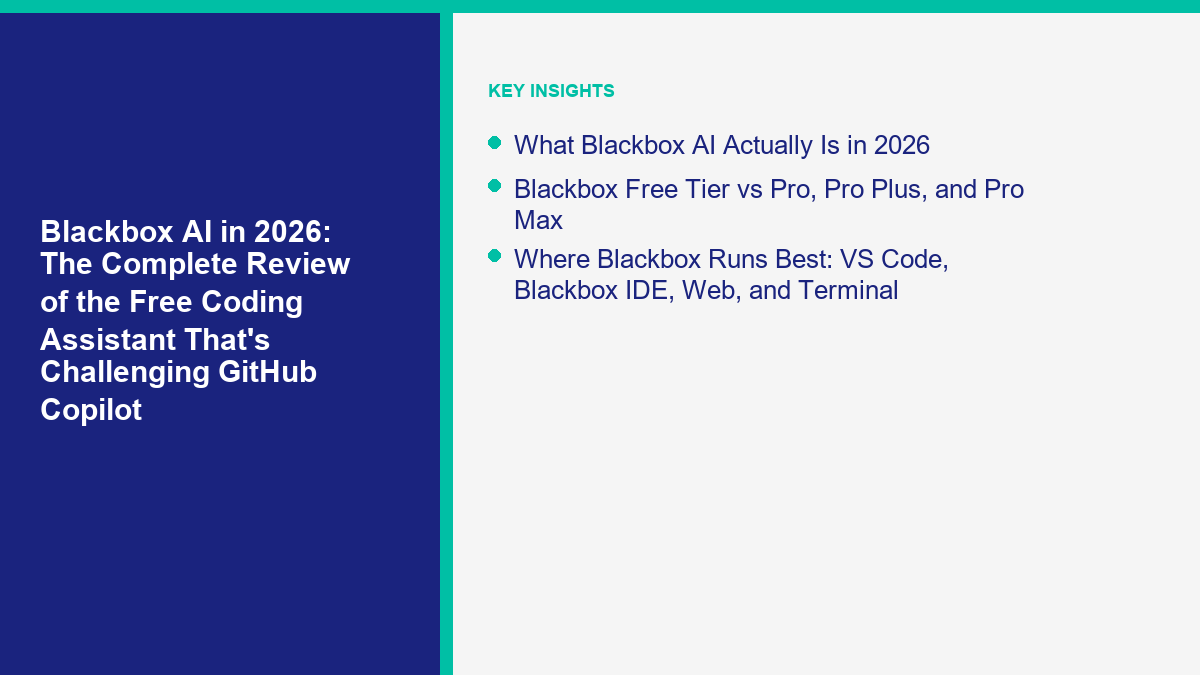
Blackbox AI pada tahun 2026 bukanlah produk yang sama seperti yang diingat banyak pengembang dari fase “copy code dari video dan cuplikan”. Versi saat ini berusaha menjadi sebuah ai pengkodean blackbox platform: agen VS Code, IDE mandiri, agen jarak jauh berbasis browser, alat terminal, akses API, dan orkestrasi multi-agen yang dapat mengarahkan satu tugas ke beberapa sistem pengkodean sekaligus.[1][7] Perubahan itu adalah keseluruhan cerita. Jika Anda meninjau Blackbox seolah-olah itu hanya sebuah plugin autocomplete, Anda akan melewatkan apa yang sebenarnya dijual sekarang.
Saya memeriksa halaman harga resmi Blackbox, dokumen produk, daftar Marketplace Visual Studio saat ini, dokumentasi rencana langsung GitHub Copilot, dan halaman harga serta keamanan Cursor saat ini di 13 April 2026. Artikel ini sempit dengan sengaja. Jika Anda ingin peta kategori yang lebih luas, gunakan perbandingan chatbot AI kami yang lebih luas untuk pengkodean. Halaman ini adalah ulasan yang terfokus ulasan ai blackbox: tier gratis vs tier berbayar, pencarian kode dan autocomplete, kecocokan VS Code, kompromi privasi, kesiapan perusahaan, dan di mana Blackbox sebenarnya berada dibandingkan dengan GitHub Copilot dan Cursor.
Satu catatan praktis lagi sebelum kita masuk ke alat itu sendiri. Asisten pengkodean dan platform chatbot produksi bukanlah pembelian yang sama. Blackbox dapat membantu Anda menulis pengendali webhook, logika pengalihan prospek, validasi, dan pengujian. Ini tidak menggantikan lapisan pengiriman untuk Facebook Messenger, Instagram, atau obrolan situs web. Jika itu adalah jalur pembangunan Anda, Jelajahi Tutorial Kami sambil Anda membaca, karena alur kerja yang bersih biasanya adalah AI untuk kode, lalu platform untuk bot yang menghadapi pelanggan secara langsung.
Apa Itu Blackbox AI Sebenarnya di 2026
Deskripsi akurat yang paling sederhana adalah ini: Blackbox sekarang adalah lapisan orkestrasi untuk agen pengkodean, bukan hanya asisten tunggal. Beranda mengatakan platform ini berjalan di enam permukaan, terminal, IDE, cloud, API, seluler, dan pembangun, dan membingkai produk di sekitar eksekusi multi-agen otonom alih-alih obrolan satu-model.[1] Daftar Visual Studio Marketplace mendorong cerita yang sama bahkan lebih keras: satu ekstensi, 15+ agen pengkodean, 300+ model, kontrol browser, eksekusi terminal, dukungan MCP, dan lapisan juri yang memilih antara keluaran.[7]
Itu penting karena argumen terkuat Blackbox bukanlah “penyelesaian inline saya 7% lebih baik.” Argumennya adalah “berhenti membeli langganan pengkodean terpisah dan jalankan sistem agen ganda melalui satu antarmuka.” Halaman marketplace secara harfiah memposisikan Blackbox sebagai tempat untuk menjalankan Claude Code, Codex, Gemini, Goose, OpenCode, dan Blackbox bersama-sama daripada memilih satu untuk selamanya.[7] Itu adalah pitch yang sangat berbeda dari GitHub Copilot, yang pada dasarnya masih tentang menempatkan AI di dalam GitHub dan alur kerja IDE mainstream, atau Cursor, yang pada dasarnya tentang membangun editor terbaik yang pertama kali menggunakan AI.
Ini juga menjelaskan mengapa pendapat tentang Blackbox sangat bervariasi. Jika seorang pengembang menginstalnya dengan harapan sebagai pengganti Copilot yang sederhana, produk ini bisa terasa luas. Jika pengembang yang sama menginginkan pilihan model, agen jarak jauh, verifikasi berbasis browser, dan permukaan alur kerja yang lebih luas tanpa harus mengelola lima langganan, Blackbox mulai masuk akal.
Skalanya juga tidak sepele. Daftar saat ini di Visual Studio Marketplace menunjukkan 2.539.409 instalasi dan menggambarkan ekstensi ini sebagai gratis, sementara situs Blackbox sendiri mengatakan produk ini “semua gratis untuk memulai” dan dipasarkan kepada lebih dari 30 juta pengembang.[7][1] Saya akan menganggap jumlah instalasi sebagai sinyal yang lebih konkret, karena itu terlampir pada daftar pasar yang aktif daripada angka kebanggaan di beranda.
Jadi kerangka yang tepat untuk ini ulasan ai blackbox bukan “apa itu bisa menghasilkan kode?” Setiap alat serius dalam kategori ini bisa. Pertanyaan yang berguna lebih tajam: apakah Blackbox membuat penyebaran agen lebih mudah dikelola, apakah titik masuk gratis cukup nyata untuk diuji dengan jujur, apakah alur kerja VS Code cukup baik untuk dipertahankan, dan apakah kontrol privasi dan perusahaan cukup jelas untuk pekerjaan serius?
What Blackbox AI Free Actually Means Right Now
Blackbox AI currently describes its coding-agent platform as gratis untuk memulai, but that phrase should not be read as a promise that every model, agent, or usage level is unlimited. The safest interpretation is that you can begin evaluating the product without assuming that production-scale use will remain free.
Checked on August 31, 2026, the current public surfaces separate two different buying questions:
- Product access: Blackbox presents its coding tools across the IDE, command line, application interface, and agent workflows as free to start. The public pages do not currently provide a stable, detailed free-quota table that applies to every account.
- API and enterprise inference: The current API page presents a catalog of more than 300 models through one endpoint. The current pricing page describes token-based rates and enterprise commitments rather than a universal free allowance.
That distinction matters. A free entry point in the product does not prove that a particular model, automated workflow, or programmatic workload has no usage cost. It also means older screenshots or reviews that list fixed consumer plan names and prices may not describe the offer shown to a new account today.
For a fair free-tier test, record the offer displayed when the account is created, run one small task, and compare the usage view before and after. That gives you account-specific evidence without assuming that an older promotion or another user’s allowance applies to you.
Before relying on Blackbox AI free access for regular work, verify three things inside your own account: which product surface you are using, which model or agent is selected, and what usage or billing limit the dashboard shows. If you are testing the application or editor, begin with a small non-critical task and check the usage view afterward. If you are building through the API, review the current per-model rates before sending a larger workload.
Resmi Blackbox API page explains the current programmatic model catalog and routing surface. The official Blackbox pricing page shows the current token and enterprise pricing structure. Because the public offer can change and account eligibility can differ, treat those live pages and your authenticated dashboard as the source of truth instead of assuming that a past free-tier limit or subscription price still applies.
Tingkat Gratis Blackbox vs Pro, Pro Plus, dan Pro Max
Hal pertama yang salah dalam kebanyakan ulasan adalah nama rencana. Hingga 13 April 2026, Blackbox melakukan tidak pemasaran rencana yang secara harfiah disebut “Premium” di halaman harga publiknya. Tangga konsumen adalah gratis untuk memulai, kemudian Pro, Pro Plus, dan Pro Max, dengan Enterprise ditangani secara terpisah.[2][3] Jika Anda mencari “Blackbox Premium,” Anda sebagian besar melihat penamaan yang lebih lama dan ulasan yang lebih lama.
Cerita gratis itu nyata, tetapi tidak sepenuhnya transparan. Halaman IDE Blackbox mengatakan IDE itu gratis dengan akses ke Grok Code Fast. Daftar pasar VS Code mengatakan ekstensi itu gratis, tanpa kartu kredit, tanpa kunci API yang diperlukan. Apa yang dilakukan halaman harga publik tidak memberikan Anda tabel kuota rapi untuk penggunaan gratis seperti yang dilakukan GitHub Copilot Free.[3][7][8] Itu adalah kekurangan jujur pertama dalam seluruh produk. Anda dapat memulai secara gratis, tetapi anggaran batasnya lebih kabur daripada seharusnya.
| Rencana | Harga publik pada 13 April 2026 | Apa yang menonjol | Penangkapan utama | Kesesuaian terbaik |
|---|---|---|---|---|
| Mulai gratis | titik masuk $0 | Ekstensi VS Code gratis untuk diinstal; IDE gratis dengan Grok Code Fast; tidak diperlukan kunci API atau kartu kredit untuk memulai | Tidak ada tabel kuota publik yang bersih untuk perencanaan serius | Mencoba Blackbox di satu repositori sebelum mengeluarkan uang |
| Pro | $10/bulan | $20 kredit model, akses ke semua model chat, agen suara, dan permintaan agen gratis tanpa batas dengan Minimax-M2.5 | Nilai yang kuat, tetapi penggunaan di perbatasan masih bergantung pada kredit, bukan sihir | Pengembang solo yang ingin variasi model dengan biaya murah |
| Pro Plus | $20/bulan | $40 kredit, eksekusi multi-agen, pembangun aplikasi, agen pengkodean di lebih dari 35 IDE, web dan terminal, Slack, enkripsi obrolan E2E | Di sinilah produk menjadi menarik, yang juga berarti tingkat berguna yang sebenarnya tidak benar-benar adalah rencana $10 bagi banyak orang | Pengembang yang benar-benar menginginkan penawaran orkestra Blackbox |
| Pro Max | $40/bulan | Kolaborasi tim, penagihan terpusat, kontrol keamanan lanjutan, SAML SSO, analitik, dukungan prioritas | Sekarang Anda membayar lebih seperti alat tim, bukan tambahan pengkodean kasual | Tim kecil yang ingin satu vendor di seluruh model dan agen |
| Perusahaan | Kustom | Opsi pelatihan keluar secara default, opsi penyebaran di tempat, dukungan khusus, SLA kustom | Memerlukan proses penjualan dan tinjauan keamanan yang lebih mendalam | Organisasi dengan persyaratan pengadaan, kepatuhan, atau kedaulatan |
Halaman harga publik juga menunjukkan sebuah promosi bulan pertama 80% untuk Pro, yang menurunkan bulan pertama menjadi $2 per 13 April 2026.[2] Itu berguna jika Anda menginginkan percobaan berbayar dengan risiko rendah, tetapi saya tidak akan membuat keputusan pembelian tahunan berdasarkan promo sementara. Angka yang lebih penting adalah tarif bulanan normal dan apa yang dibukanya.
Nuansa yang lebih besar adalah bagaimana Blackbox merumuskan fitur “tanpa batas”. Halaman harga menekankan permintaan agen gratis tanpa batas dengan Minimax-M2.5, tetapi juga secara terpisah melampirkan $20, $40, atau $80 kredit ke Pro, Pro Plus, dan Pro Max untuk akses ke kumpulan model yang lebih luas.[2] Itu tidak menipu, tetapi itu berarti “tanpa batas” sebagian besar berlaku untuk jalur model gratis tertentu, bukan untuk setiap model frontier yang mungkin Anda inginkan selama sesi pengkodean yang lebih berat.
Bacaan praktis saya sederhana. Gratis bagus untuk evaluasi, Pro adalah sampler murah, Pro Plus adalah tingkat pertama di mana identitas nyata Blackbox muncul, dan Pro Max adalah di mana Blackbox mulai terlihat seperti opsi pengadaan tim. Jika Anda hanya membandingkan harga sticker, Blackbox terlihat agresif. Jika Anda membandingkan produk yang benar-benar diinginkan oleh pengguna serius, kontes sebenarnya adalah Blackbox Pro Plus di $20 versus GitHub Copilot Pro di $10 atau Cursor Pro di $20.
Tempat Terbaik Blackbox Beroperasi: VS Code, Blackbox IDE, Web, dan Terminal
Pilihan desain produk terbesar Blackbox adalah penyebaran permukaan. Itu tidak otomatis baik atau buruk. Itu hanya berarti Anda perlu memilih pintu yang tepat.
Jika Anda sudah tinggal di VS Code, the extension is the easiest way in. The live marketplace listing says the agent can create and edit files, run commands, use a browser, and work with your permission at each step. It also supports adding files, folders, Git commits, URLs, and screenshots as conversation context, which is more useful than it sounds when you are debugging across code, docs, and UI state.[7]
If you are willing to use a dedicated editor, the Blackbox IDE is the cleaner showcase. The IDE page describes a full-featured editor with inline AI chat, multi-file context, real-time code generation, real-time collaboration, project-wide indexing, and compatibility with many VS Code extensions.[3] That is important because it means Blackbox is no longer just piggybacking on another editor. It wants to own the full interaction loop.
If your work benefits from asynchronous execution, the cloud and remote agent surfaces are where Blackbox starts looking more differentiated. The homepage and cloud docs emphasize remote agents that can run in the browser, monitor progress, manage pull requests, and work without your local machine being the bottleneck.[1][15] That matters more for long-running tasks than it does for simple inline completions.
And if you are a terminal-heavy developer, Blackbox’s CLI and API story make more sense than the old extension-first positioning. The homepage explicitly pitches terminal use, automatic PR creation, and CI/CD integration, while the API docs show OpenAI-compatible chat completions and provider routing with data policy controls.[1][4]
The weakness of this multi-surface strategy is consistency. GitHub Copilot has a simpler answer: stay inside GitHub, VS Code, and mainstream IDEs. Cursor has a simpler answer too: use the Cursor editor and agent surfaces. Blackbox gives you more options, but that also means more product surface to learn and more places where feature behavior can differ.
If you want the shortest practical recommendation, it is this. Use the VS Code extension first if you are evaluating Blackbox. Switch to the Blackbox IDE only if the multi-file and collaboration layer is clearly saving you time. Jump straight to cloud or terminal workflows only when you already know you want autonomous, long-running task execution.
How Blackbox Handles Code Search, Context, and Autocomplete
The phrase “code search” means different things depending on which decade of dev tools you grew up in. If you mean literal grep replacement, that is not Blackbox’s core story. If you mean finding the right files, imports, types, tests, commits, and surrounding project context so an agent can modify code more intelligently, that is exactly what Blackbox is trying to sell.
The Blackbox IDE page says the editor indexes the entire project, including imports, types, tests, and dependencies, so suggestions respect the architecture and coding patterns of the repo.[3] The VS Code listing makes the same point in a different way by letting you attach files, folders, Git commits, web URLs, and screenshots directly to a conversation.[7] That is Blackbox’s code search story in 2026: less “search box first,” more “context retrieval for agent execution.”
Autocomplete is similar. Blackbox’s public pages now lean harder on phrases like inline AI chat, real-time code generation, dan inline diffs than on old-school autocomplete branding.[3] Based on that public product surface, Blackbox is moving up-stack from token-by-token completion toward context-heavy editing and agent loops. That is good news if you want broader code transformation. It is less clear-cut if your main benchmark is “how good is the next line prediction on a fast local edit loop?”
Here is the practical split I see after reading the live pages. Blackbox is strongest when context retrieval, command execution, and multi-agent comparison matter more than microscopic completion latency. If your daily flow is mostly “type, accept suggestion, keep typing,” GitHub Copilot still feels like the more natural category benchmark because it was built around inline assistance first and still documents that surface cleanly.[8][9]
There is also a review-angle truth most vendor pages avoid: richer code search and context systems increase both upside and downside. When Blackbox has the right files, the output can feel uncannily on track. When you feed it noisy or incomplete context, the agent can confidently optimize the wrong thing and go farther in that wrong direction because it has the tools to execute, test, and self-correct against the wrong objective. That is why controllable autonomy and file approval controls matter so much in this product.[7]
So if you came here specifically asking whether Blackbox has “code search,” the answer is yes, but not in the classic standalone search-engine sense. Its modern value is semantic codebase context plus agent execution. That is a stronger promise than raw search. It is also a riskier one if you are sloppy about scope.
Which Languages and Stacks Blackbox Supports Best
The public Blackbox IDE FAQ lists the mainstream set most teams actually care about: TypeScript, Python, Go, Rust, Java, C++, Ruby, PHP, and more.[3] That is enough to tell you Blackbox is not a niche JavaScript toy. It is built for general software development, and the VS Code extension’s model-agnostic design reinforces that.
What Blackbox does tidak publish, at least on the sources reviewed here, is a clean feature-by-language support matrix. GitHub does. GitHub’s language support docs explicitly list core languages such as C, C++, C#, Go, Java, JavaScript, Kotlin, PHP, Python, Ruby, Rust, Scala, Swift, and TypeScript, and then show which GitHub features support each of them.[10] That difference matters more in enterprise buying than casual testing. Procurement teams like matrices.
For a solo developer or small startup, the lack of a perfect language matrix is not fatal. If you build in common web, backend, or mobile-adjacent stacks, Blackbox is clearly aiming at you. If your work is in a niche domain language, an old legacy stack, or a specialized framework where small syntax errors waste hours, the safer move is to treat Blackbox’s public language list as a broad compatibility signal and then run a proof on your own repo.
The same advice applies to infrastructure work. Blackbox is broad enough for normal backend, frontend, API, and test-generation tasks. It is not positioned around one ecosystem the way Amazon Q is positioned around AWS or GitHub Copilot is positioned around GitHub. That flexibility is helpful, but it also means the burden of validation lands more on you.
If your stack is mostly TypeScript, Python, Go, Java, or standard full-stack web work, I would not worry much. If your stack is specialized, the product pages are not specific enough to skip a live test. That is not a dealbreaker. It is just the honest answer.
Blackbox AI Accuracy Review: Where It Feels Sharp and Where It Still Misses
There is no honest way to give you a fake universal accuracy score here. Blackbox’s public pages are feature-heavy, not eval-heavy. So the only useful accuracy review is a workflow review: does Blackbox pull the right context, make sensible edits, recover from bad first passes, and stay reliable enough that it saves more time than it creates?
Based on the live product surface, Blackbox has three clear strengths. First, it can work with richer context than a plain chat tab because the IDE indexes the project and the extension lets you attach repo artifacts directly.[3][7] Second, it can do more than suggest code. The extension can run commands, browse the app, and self-correct against outputs.[7] Third, it can compare multiple agents and models instead of betting everything on one answer path.[1][7]
That makes Blackbox look strong on jobs like:
- Drafting boilerplate across several files
- Generating tests and then rerunning them after failures
- Refactoring routine glue code with a human reviewing the diff
- Comparing more than one model’s approach to the same feature
- Working across code plus browser state in one loop
Where it still deserves caution is the exact place its marketing is most ambitious: autonomy. Once an agent can read files, edit code, run shell commands, and use a browser, a bad assumption can travel farther before you stop it. Blackbox does mitigate that with granular approval controls for file edits, file creation, command execution, and file reads in the VS Code extension.[7] That is good product design. It is also an admission that higher autonomy raises the blast radius when the model misunderstands the assignment.
My own rule for Blackbox is the same rule I use for every serious coding agent now: trust it with drafts, iteration, and repair loops; do not trust it with silent merge authority. If you keep prompts narrow and review the diff, Blackbox’s broader agent surface is an advantage. If you throw a vague request at it and hope the judge layer magically saves you, you will eventually pay for that laziness.
Compared with GitHub Copilot and Cursor, the accuracy tradeoff looks like this. Copilot is usually easier to trust in small, inline, incremental edits because its workflow is conservative and familiar. Cursor is stronger when you want a single editor to plan, inspect, debug, and execute deeply against the codebase.[11] Blackbox is most attractive when you think model diversity and multi-agent comparison will improve outcomes enough to justify the added complexity. That is a credible thesis. It is not a universal one.
Blackbox vs GitHub Copilot: Price, Workflow, and Team Fit
This is the comparison most readers actually care about, and it is tighter than the old “Blackbox is free, Copilot is paid” framing. GitHub Copilot now has a meaningful Gratis tier with 2,000 completions and 50 chat or agent requests per month. Paid plans start at $10/bulan for Pro, $39/bulan for Pro+, and then scale to $19 per granted seat for Business and $39 per granted seat for Enterprise.[8][9] That means Copilot is not easy to dismiss on price anymore.
| Dimensi | Blackbox AI | GitHub Copilot | My read |
|---|---|---|---|
| Free entry | Free to start, but no simple public quota table | $0 with 2,000 completions and 50 chat or agent requests per month | Copilot is much clearer if you want predictable free evaluation |
| Cheapest serious paid tier | Pro at $10, but Pro Plus at $20 is where multi-agent value really starts | Pro at $10 with cloud agent, code review, premium models, and unlimited included-model chats | Copilot Pro is the easier low-friction buy for most solo devs |
| Core product thesis | Many agents and many models, one orchestration layer | AI woven into GitHub, PRs, and mainstream IDEs | Blackbox is broader in agent strategy, Copilot is tighter in workflow placement |
| Editor and platform support | 35+ IDEs plus web and terminal on paid tiers | GitHub, VS Code, Visual Studio, Xcode, JetBrains, Neovim, Eclipse, Raycast, SSMS, Zed, and more | Both are broad, but Copilot documents platform support more cleanly |
| Model access | 300+ models and 15+ agents through one platform | Strong model roster inside Copilot, with premium-request budgeting | Blackbox wins on sheer variety, Copilot wins on tighter guardrails |
| Team admin clarity | Pro Max and Enterprise expose billing, SSO, analytics, advanced controls | Business and Enterprise are deeply documented with policy controls, audit logs, and seat-based pricing | Copilot is easier to procure if your team already lives in GitHub |
The strongest case for blackbox vs github copilot is not that Blackbox is cheaper. It is that Blackbox is more ambitious. The marketplace listing says you can run multiple coding agents in parallel, compare outputs, and even let the platform merge multi-agent workstreams.[7] Copilot, by contrast, is better when the winner is already obvious: you use GitHub, you review pull requests in GitHub, you work in VS Code or another mainstream IDE, and you want AI to sit inside that exact route.
There is also a major documentation difference. GitHub publishes a cleaner public map of what you are buying: plans, premium requests, models, supported IDEs, supported languages, policy controls, and enterprise fit are all spelled out in a way that reduces ambiguity.[8][9][10] Blackbox has rich features, but you have to stitch together pricing, docs, and marketplace pages to get the full picture.
Privacy is the other important split. GitHub’s current plans page says data is excluded from training by default, but the same live page’s FAQ also says that starting on April 24, 2026, GitHub may use interactions from Copilot Free, Pro, and Pro+ users to train and improve its models unless those users opt out in account settings.[8] That does not make Copilot unsafe. It does mean privacy-conscious teams need to read the details instead of relying on one bullet point. Blackbox’s privacy knobs are discussed later in this review, but its public story is less contradictory and more configurable, especially at the enterprise and API layers.[2][4]
If your team already lives inside GitHub, I still think Copilot is the easier default. If you want one subscription that can pit agents against each other, switch models constantly, and work across IDE, terminal, cloud, and browser surfaces, Blackbox is the more interesting bet. Interesting and easier are not the same thing.
Blackbox vs Cursor: Orchestration vs Editor Depth
The Blackbox versus Cursor decision is cleaner than the Copilot comparison because the products are trying to win in different ways.
Cursor’s product page is unapologetically editor-first. It says Cursor deeply learns your codebase, runs subagents in parallel, supports planning, design, debugging, terminal commands, MCP, plugins, skills, and cloud agents, and spans the full development lifecycle from planning to code review.[11] The pricing page backs that up with a simple ladder: Hobby free, Pro at $20/bulan, Pro+ at $60/month, Ultra at $200/month, and Teams at $40/user/month with shared chats, rules, billing, analytics, privacy mode controls, RBAC, and SAML/OIDC SSO.[12]
Blackbox, by contrast, is selling breadth of agent orchestration. Cursor is selling depth of one editor and one agent system. That difference shows up everywhere.
If you want a single workspace that plans, asks clarifying questions, indexes your repo, executes in the background, debugs with runtime data, and keeps the whole loop inside one coherent editor, Cursor is the better product story.[11] If you want the freedom to dispatch tasks across several agent families and compare outputs without buying each stack separately, Blackbox has the more unusual value proposition.[7]
Pricing sharpens the comparison. Blackbox Pro Plus is $20/bulan, the same nominal monthly price as Cursor Pro, and that is probably the fairest head-to-head tier because that is where Blackbox unlocks multi-agent execution and coding agent access across 35+ IDEs, web, and terminal.[2][12] At the same price, the question becomes philosophical: do you want many agents and models in one platform, or do you want the strongest AI-native editor experience?
For most full-time developers, I think Cursor still wins the “I want my editor to become the primary AI workbench” argument. The public product page is simply more coherent on repo understanding, planning, debugging, and lifecycle coverage.[11] Blackbox feels more like a control tower for agent variety. That can be powerful, especially if you like comparing models. It can also feel noisier if you just want one tool to understand the repo and help you ship.
On privacy and enterprise signaling, Cursor is more explicit. Its pricing page says privacy mode can be enabled even on personal plans, and its security page says Cursor is SOC 2 Type II certified and that privacy mode guarantees code data is never stored by model providers or used for training.[12][13] Blackbox has meaningful privacy controls too, but the public security posture is more distributed across docs rather than summarized in one buyer-friendly page.
If I had to reduce the comparison to one line, it would be this: pick Cursor if you want the best AI-first editor, pick Blackbox if you want the broadest agent marketplace inside one coding workflow.
Privacy, Zero Data Retention, and the Real Security Questions
This is where Blackbox gets more interesting than many quick reviews admit.
The API docs say Blackbox supports Zero Data Retention on a per-request basis through a zdr parameter, tracks endpoint-specific provider policies, and takes a conservative stance when provider policy is unclear by assuming the endpoint both retains and trains on data.[4] That last point is important. It means Blackbox is not pretending every provider behaves identically. The docs are explicit that privacy depends on the endpoint and routing policy.
The same ZDR page also says Blackbox itself has a ZDR policy and does not retain prompts.[4] For Codex models routed through Blackbox, the docs go further and say toko is enforced to false and encrypted reasoning items are used so no intermediate state is persisted.[4] That is a real technical privacy story, not just vague marketing fluff.
The desktop side goes even harder. The end-to-end encryption docs claim local encryption before transmission, private keys that never leave the computer, no server access to sensitive information, anonymous-only analytics, local audit logs, offline mode, and the ability to exclude files via .blackboxignore.[5] If those are the surfaces you plan to use, Blackbox’s privacy position looks stronger than many people expect.
But there is a real caveat, and it is the one I would put in front of any security team: Blackbox is privacy-capable, not privacy-simple. The desktop app, the API, the VS Code extension, and the cloud agent surface are not automatically identical in how they handle data, and the docs themselves make clear that provider routing policies matter.[4] So the right question is not “does Blackbox have privacy?” It is “which Blackbox surface, which provider route, and which controls are we enabling?”
The pricing page helps a little here. It says Pro Plus and above include E2E chat encryption, while Enterprise adds training opt-out by default, SAML SSO, advanced security controls, and on-prem deployment.[2] That is useful, but it also means the strongest privacy and admin features are not centered in the cheapest tier.
For comparison, Cursor’s public security posture is simpler to parse. Cursor says privacy mode can be enabled by free or Pro users, is forced on Teams, and guarantees code data is never stored by model providers or used for training. Cursor also surfaces SOC 2 Type II certification plainly on the public security page.[12][13] GitHub’s privacy story is deeply documented, but you have to read closely because the live plans page says data is excluded from training by default while the FAQ section on the same page says user interactions may be used for training starting on April 24, 2026 unless the user opts out.[8]
The practical advice is straightforward:
- Gunakan
.blackboxignorefor sensitive paths - Keep approval controls on for file and command actions on private repos
- Enable ZDR where your workflow supports it
- Do not assume desktop encryption claims automatically cover every cloud or provider path
- Make procurement and security teams review the exact surface you plan to deploy
If you follow those rules, Blackbox can be workable for serious code. If you ignore them and treat “AI coding tool” as one undifferentiated blob, you will not actually know what your privacy posture is.
Is Blackbox Ready for Enterprise Teams?
Blackbox is closer to enterprise-ready than older reviews suggest, but that does not mean every enterprise will prefer it.
The public pricing page says Pro Max includes team collaboration, centralized billing and management, advanced security controls, SAML SSO, priority support, and usage analytics.[2] The enterprise page then expands that story with RBAC, audit logging, AES-256 at-rest encryption, SSO with identity providers, flexible deployment models, private cloud, on-prem options, and uptime figures ranging from 99.9% untuk 99.95% depending on support tier.[6]
The deployment options are the part that will matter to regulated buyers. The enterprise docs explicitly describe cloud deployment, private cloud deployment, dan on-premise deployment, including cases where data never leaves your network and air-gapped operation is possible.[6] That is a serious signal. Many AI coding tools never get beyond generic “enterprise security” language.
Blackbox also says enterprise pilots can start with a 30-day proof of concept and that enterprise plans include training opt-out by default, custom SLAs, and dedicated support.[2][6] For organizations that want one vendor sitting above several model providers, that is a plausible buying story.
The hesitation is not that the enterprise feature list is weak. It is that the public proof layer is thinner than some competitors. Cursor surfaces SOC 2 Type II plainly on its public security page.[13] GitHub’s enterprise controls and policies are documented in a deeply structured way, which helps legal, procurement, and platform teams move faster.[9] Blackbox’s public materials are rich, but they feel more like a mix of marketing, docs, and feature pages than a single clean trust center.
That does not mean Blackbox is not enterprise-capable. It means enterprise buyers will want to push past the homepage faster. Ask for the architecture review, the exact deployment path, the provider routing story, the audit trail details, and the written commitments attached to the plan you are actually purchasing. Blackbox looks promising for enterprise. It still needs the same diligence every serious AI coding platform now deserves.
How to Test Blackbox on a Real Project Before You Pay
The fastest way to waste a week with any coding AI is to evaluate it on toy prompts. “Build a todo app” is useless. You need a real task from a real repo.
- Start in VS Code, not in the abstract. Install the free extension and use the same editor you already trust. That reduces the number of variables during the test.[7]
- Pick one job with a clear finish line. Good examples are: fix a flaky test, add one API route, refactor one handler, or write validation around an existing form flow.
- Feed Blackbox explicit context. Attach the exact files, folders, or commit history that define the task. Blackbox is built around context selection. Use that advantage instead of forcing it to guess.[7][3]
- Keep permission gates on. Let the agent propose edits and commands, but review them. The product literally gives you granular approval controls. Use them during evaluation.[7]
- Ask for execution, not just explanation. Make it write the patch, run the tests, read the failure, and try again. Blackbox’s value is in the full loop, not just the chat answer.[7]
- Run the same task in one competitor. Compare the exact task against GitHub Copilot Free or Cursor Hobby so you learn whether Blackbox’s extra complexity is actually buying you anything.[8][12]
- Only pay after two useful wins. One good answer proves nothing. Two successful outcomes on real work is the better signal that a paid plan might stick.
That last step matters because Blackbox’s main value proposition, orchestration across models and agents, only pays off if it reduces actual rework for halaman Anda repo. If the extra choices just create more noise, a narrower tool might be better.
When Blackbox Is a Smart Buy for Messenger, Instagram, and Website Bot Work
Blackbox is a useful coding assistant for messaging builds when the task is technical glue. Think webhook validation, payload normalization, CRM sync logic, lead-scoring helpers, FAQ cleanup scripts, analytics transforms, or test scaffolding around message routing. Those are the kinds of jobs where a context-aware coding agent can save real time.
It is much less useful as a replacement for the live bot platform itself. A model can help you write a Messenger webhook handler. It cannot, by itself, become your production stack for channel permissions, comment automation, broadcasts, forms, inbox routing, analytics, and non-developer team management. That is where you stop shopping for a coding agent and start shopping for deployment software.
If you are pricing the customer-facing side of the project, Lihat Harga MessengerBot. If your rollout has already outgrown starter-level automation and you need a deeper production setup, Upgrade to MessengerBot Pro. The clean pattern is still the same: use Blackbox to speed up the code you would rather not hand-write line by line, then use a dedicated platform to run the live Messenger, Instagram, or website experience.
This distinction is exactly why this article sits next to, not on top of, the broader coding-assistant content. Blackbox can make developers faster. MessengerBot is what turns that faster code into a system customers can actually interact with.
Final Verdict: Who Should Use Blackbox AI in 2026
Blackbox AI is a serious product in 2026. It is no longer interesting only because it is cheap or because it has a free on-ramp. It is interesting because it is trying to become the control plane for multiple coding agents and model families at once.
That ambition creates both upside and friction. The upside is obvious: broad model access, multi-agent comparison, coding across IDE, terminal, browser, and cloud, and a stronger privacy story than many people expect once you read the actual docs.[2][4][5] The friction is also obvious: pricing and free usage are less transparent than GitHub Copilot, the product surface is wider than Cursor, and the public documentation requires more synthesis than some buyers will like.
Blackbox is a smart buy if:
- You want one subscription sitting above several coding agents and models
- You like comparing outputs instead of committing to one model vendor
- You want browser, terminal, IDE, and cloud agent workflows in one place
- You are comfortable reviewing diffs and managing autonomy carefully
Blackbox is probably not your best first buy if:
- Your team already lives entirely inside GitHub and wants the lowest-friction rollout
- You want the clearest free quota story and the cleanest public enterprise docs
- You mainly care about the best single AI-native editor experience
- You need a tool that feels simple before it feels powerful
My bottom line is straightforward. Blackbox is better than the old reputation suggests, but its best use case is still specific. GitHub Copilot remains the pragmatic default for GitHub-heavy teams. Cursor remains the best single-editor experience for many power users. Blackbox wins when you believe orchestration, model breadth, and multi-surface agent workflows are worth learning. For the right developer, that is a real advantage. For the wrong one, it is just more knobs.
Build the Logic Faster, Then Put the Bot Where Customers Actually Message You
Use Blackbox to speed up webhook code, integrations, test generation, and debugging. When the project needs a live Messenger, Instagram, or website chatbot with the operational layer already handled, Lihat Harga MessengerBot. If you build these systems for clients, teams, or audiences and want to monetize that expertise, Bergabung Dengan Program Afiliasi Kami.
Pertanyaan yang Sering Diajukan
Apakah Blackbox AI benar-benar gratis pada tahun 2026?
Ya, tetapi cerita gratisnya sedikit membingungkan. Ekstensi VS Code gratis untuk diinstal tanpa kartu kredit, dan halaman Blackbox IDE mengatakan bahwa IDE ini gratis dengan akses ke Grok Code Fast. Masalahnya adalah Blackbox tidak menerbitkan tabel kuota gratis yang sederhana seperti yang dilakukan GitHub Copilot Free, jadi tingkat gratisnya lebih mudah dicoba daripada dianggarkan dengan tepat.
Apakah Blackbox AI lebih baik daripada GitHub Copilot?
Blackbox lebih baik jika Anda menginginkan satu platform yang dapat mengarahkan pekerjaan di berbagai model dan agen pengkodean, membandingkan keluaran, dan beroperasi di IDE, terminal, browser, dan permukaan cloud. GitHub Copilot lebih baik jika tim Anda sudah beroperasi di GitHub dan menginginkan jalur penyebaran yang paling mudah, dokumentasi rencana yang lebih jelas, dan integrasi yang lebih erat dengan permintaan tarik dan alur kerja IDE utama.
Apakah Blackbox AI berfungsi di VS Code?
Ya. Daftar Visual Studio Marketplace saat ini menunjukkan Blackbox sebagai ekstensi VS Code dengan lebih dari 2,5 juta instalasi. Ini dapat mengedit file, menjalankan perintah, menggunakan browser, menerima konteks proyek seperti file dan komit, dan beroperasi dengan kontrol persetujuan per aksi.
Apakah Blackbox AI aman untuk kode perusahaan?
Ini bisa terjadi, jika Anda mengkonfigurasinya dengan benar. Blackbox mendokumentasikan kontrol retensi data nol, pengalihan ZDR per permintaan, enkripsi ujung-ke-ujung desktop, dukungan .blackboxignore, dan opsi perusahaan seperti pelatihan opt-out secara default dan penyebaran di tempat. Bagian pentingnya adalah memastikan tim Anda memahami permukaan Blackbox mana dan kontrol data mana yang sebenarnya digunakan, alih-alih mengasumsikan setiap mode berperilaku dengan cara yang sama.
Haruskah saya memilih Blackbox AI atau Cursor untuk pengembangan penuh waktu?
Pilih Cursor jika Anda menginginkan editor berbasis AI yang paling kuat dan pengalaman alat tunggal yang lebih terintegrasi untuk merencanakan, mengkode, melakukan debugging, dan meninjau pekerjaan dalam satu lingkungan. Pilih Blackbox jika Anda menginginkan orkestrasi agen yang lebih luas, lebih banyak variasi model, dan satu platform yang dapat mengoordinasikan beberapa sistem pengkodean tanpa membuat Anda membeli masing-masing secara terpisah.
Sources Used for This Review
- Blackbox AI homepage
- Blackbox AI pricing
- Blackbox AI IDE
- Blackbox AI docs: Zero Data Retention
- Blackbox AI docs: End-to-end encryption
- Blackbox AI docs: Enterprise
- Visual Studio Marketplace: BLACKBOX AI for VS Code
- GitHub Copilot plans and pricing
- GitHub Docs: plans for GitHub Copilot
- GitHub Docs: language support
- Cursor product page
- Harga kursor
- Cursor security
- Blackbox AI docs: Remote Agents

 Bahasa Indonesia
  English
  Tagalog
  简体中文
简体中文  العربية
  हिन्दी
  Português do Brasil
  Español de México
  Français
  বাংলা
বাংলা  香港中文
香港中文  繁體中文
繁體中文  Nederlands
  Deutsch
  日本語
日本語  한국어
한국어  Polski
  Русский
  Español
  Tiếng Việt