
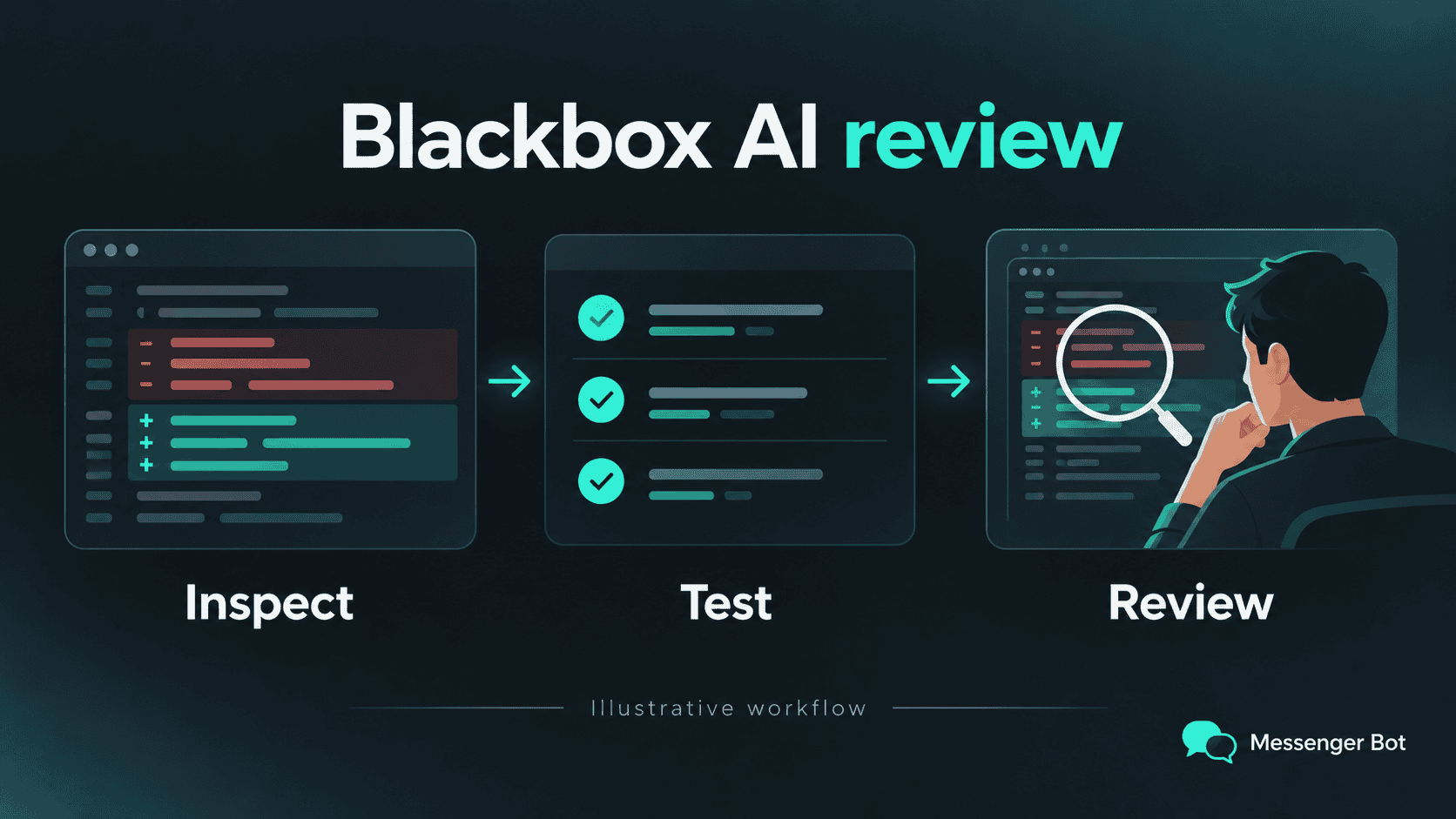
Blackbox AI is worth evaluating by the coding work you need done, not by an old promise of a free editor extension. Its official website now says the VS Code integration has been discontinued and points readers to the terminal-based CLI and Agents API instead. That changes the first question in a Blackbox AI review: which current workflow can you actually use, and what will one complete task cost?
This source-based review was checked on October 12, 2026. It is not a hands-on performance ranking, an independent security certification, or a guarantee of access for a particular account. It separates current vendor descriptions from suggested evaluation steps. Older subscriptions, saved extensions and promotional screenshots should not be treated as today’s offer without account-specific confirmation.
For developers, the useful comparison is a reviewable patch against a clear requirement. For business owners, the useful result is a customer conversation that staff can maintain. If you mainly want to organize answers rather than write software, our interactive chat planning guide explains that different buying decision. A coding tool is not automatically a live customer-service system.
What Changed in Blackbox AI’s Coding Workflow
The most consequential update is explicit: the official VS Code lifecycle notice says the integration is discontinued. The old IDE address also redirects to that notice. A past marketplace listing or installation count does not override a current product notice. This review therefore no longer recommends that extension as the starting point for a new evaluation.
The notice does not tell us the status of every historic account, locally installed copy or legacy subscription. It also does not establish a discontinuation date for each previous product. If your team already uses an older setup, ask what support and billing terms apply to that exact setup. Avoid changing a working repository solely because a guide describes a different offer.
Blackbox’s current terminal page describes a coding CLI with planning, proposed changes and multi-agent workflows. Its Agents API page describes remote coding tasks that can produce proposed repository changes. Its Router page describes model requests through a compatible interface. These are related products, but running a coding task is not the same thing as receiving a model response. A response still needs application logic, permissions and testing before it becomes a useful software change.
This distinction also protects the comparison with other tools. An editor, a remote coding workspace and a model-routing service solve different parts of the development loop. Compare the workflow you intend to buy, not the largest feature count on a landing page. A broader catalog cannot prove fewer defects, lower overall cost or faster completion on your project.
Choose Between Terminal Work, Model Requests and Remote Tasks
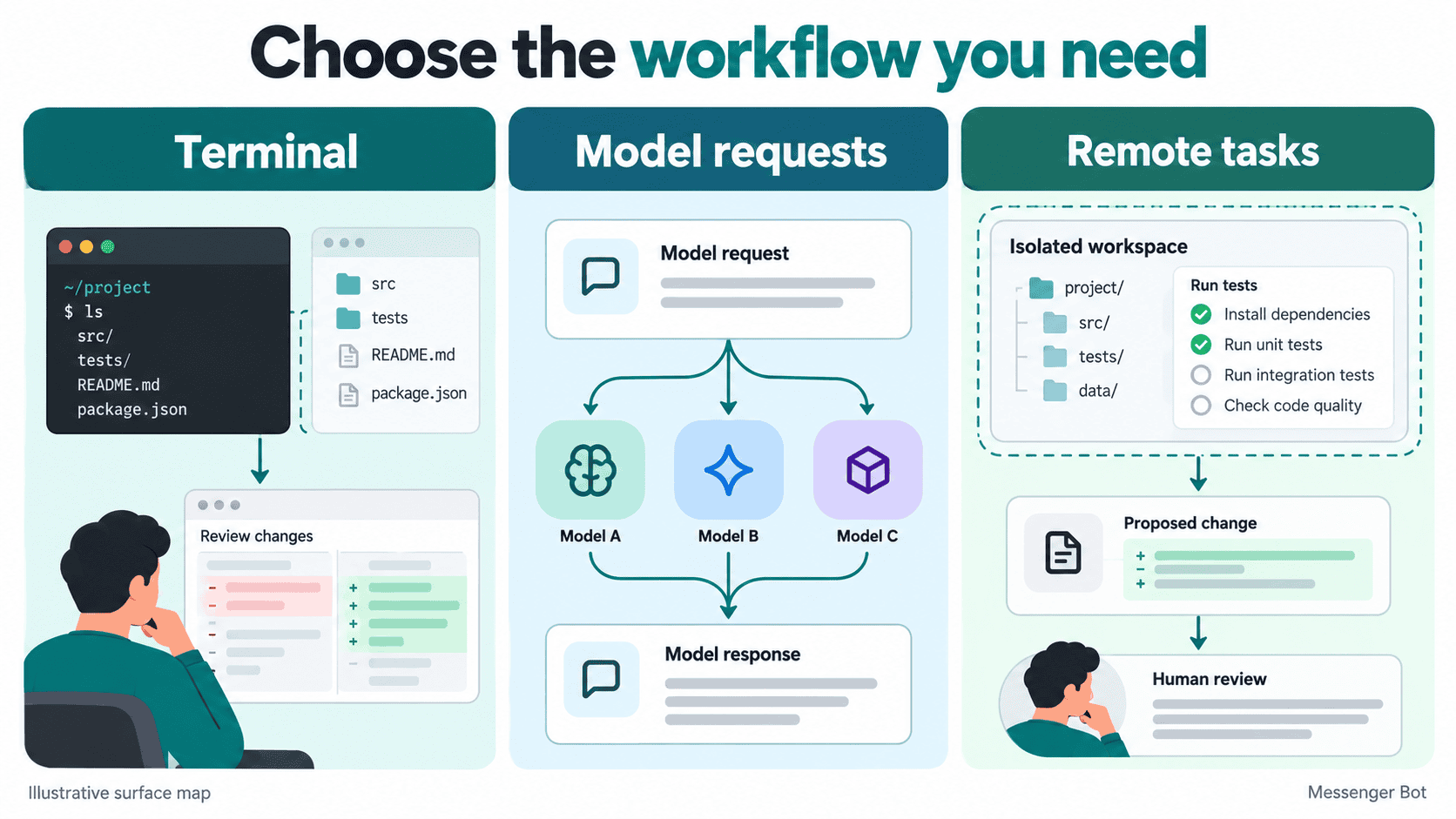
Start by naming the missing step in your current workflow. Do you need help inspecting local files, a model response inside an application, or a remote task that prepares a patch? Those choices require different permissions and different acceptance tests. The illustration below shows conceptual choices, not a screenshot or a promise that one request runs every option in parallel.
| Workflow | Current source description | What to verify before adoption |
|---|---|---|
| Terminal-based coding | The official CLI page describes planning and reviewable code changes. | Supported installation, account access, file permissions, selected tools and usage limits. |
| Model requests | The Router page describes a compatible request interface and model routing. | The exact model, request features, metering and allowed data policy for that route. |
| Remote coding tasks | The Agents API page describes remote runs and proposed repository changes. | Repository access, branch policy, sandbox restrictions, concurrency and human review. |
| Older VS Code integration | The current official notice says it is discontinued. | Do not assume a historic installation is a currently supported new-user option. |
For a local trial, use a disposable copy of a small project without confidential information. Record the starting commit and keep the original checkout untouched. A coding agent should receive the smallest set of files needed for the task, rather than unrestricted access to everything on your computer. Review any proposed command before allowing it to run.
For a remote trial, the boundary shifts to repository credentials, branches and the remote environment. A proposed pull request is useful evidence only after someone checks its diff and tests. Do not equate the presence of a branch, a successful task label or a generated summary with approval to merge. Preserve the ability to reject the entire attempt without changing your active application.
For model requests, choose a harmless example and check that the response format matches your application’s needs. Do not start by replacing an entire production integration. A familiar request format does not guarantee identical tool behavior, context handling, error responses or streaming semantics for every model. Those details need a test of the exact selected route.
Is Blackbox AI Free, and Which Pricing Applies?
The current public pricing page presents an Enterprise agreement with a commitment and per-token reference rates. It does not substantiate the old universal consumer subscription table previously used in this article. The Agents API page also describes Enterprise licensing. These observations do not prove that every legacy account or promotional allowance has disappeared. They mean this review cannot promise a free coding workload or reuse old consumer prices as current.
Separate three questions: can you download a client, can your account access a feature, and can it run that feature without a charge? Those are not interchangeable. A downloadable or open-source client may still rely on a metered service. A sign-in screen does not establish an included quota. A previous subscription receipt does not establish the terms offered to a different account today.
Before evaluating Blackbox AI free access, save the offer displayed to your own account and the applicable terms. Note the product surface, billing period, included allowance, overage behavior and expiration. If any item is missing, ask for clarification rather than assuming unlimited use. Avoid entering payment details merely to discover a limit that the offer did not explain.
For an Enterprise discussion, ask how the commitment is measured, which workloads consume it, what happens to unused balance, and whether a limit actually stops further consumption. An alert and a hard spending cap are different controls. Check the agreement for both. This is a buying checklist, not a claim that a particular control is available on every account.
Use the official pricing and commitment page for the current quote structure. Use the offer and written agreement for your own account to decide whether it fits your budget. Do not compare a temporary allowance with another tool’s normal subscription as though both were stable monthly costs.
Calculate the Cost of a Complete Coding Task
Count the whole task, not only the first answer. A prompt can include instructions, attached files and previous conversation context. A failed attempt may require another prompt and more generated output. Repeatedly attaching the same large repository can change the economics even when the request sounds small. The relevant number is the cost of a reviewed result, including unsuccessful attempts.
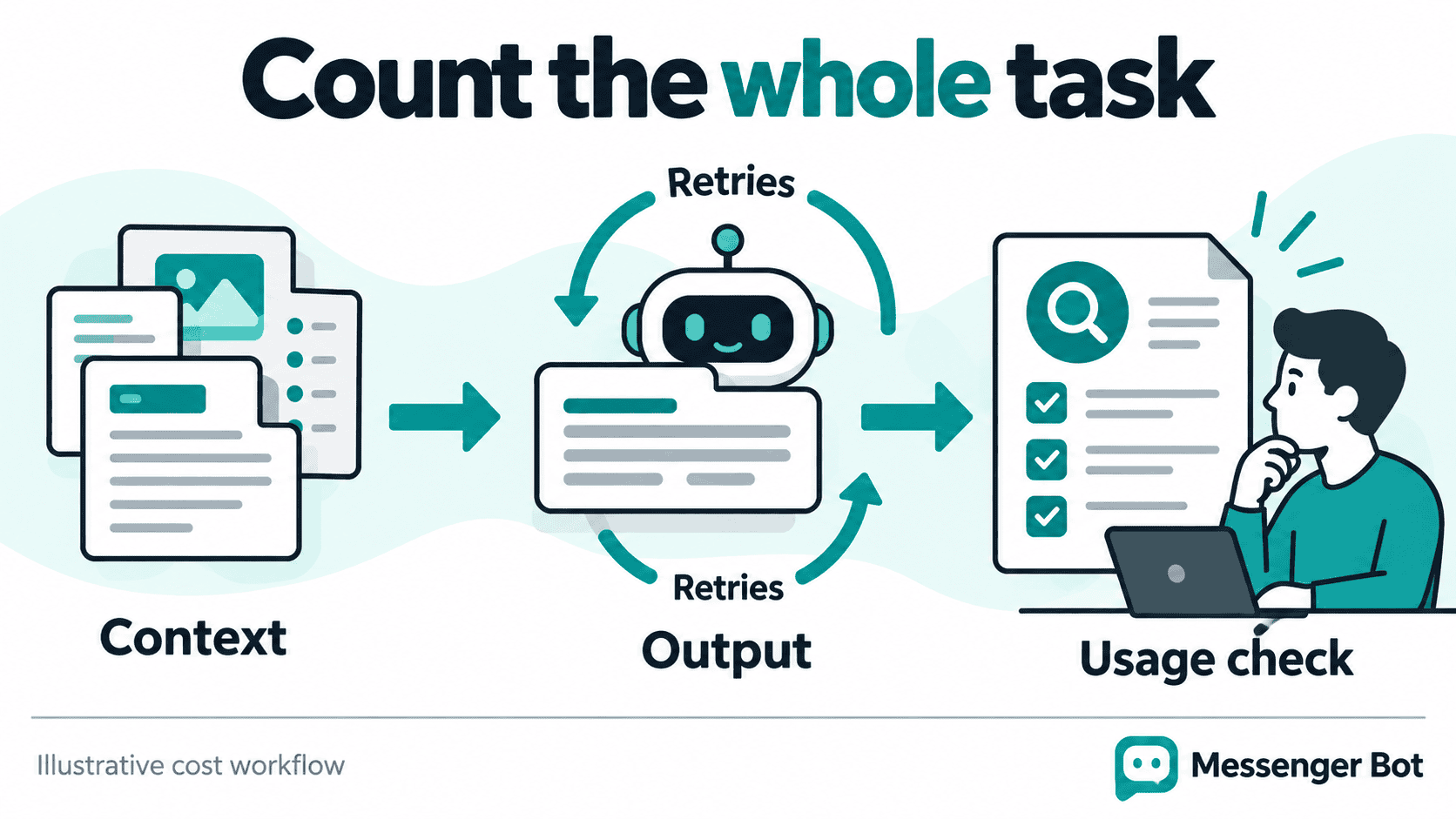
A simple budgeting model is input tokens divided by one million times the applicable input rate, plus output tokens divided by one million times the output rate. If the route meters cached input separately, use that separate rate only for usage the billing record actually classifies as cached. Add every attempt. Then reconcile the estimate with the observed usage record; the estimate is not an invoice.
Keep a compact task log with the selected workflow, model, starting state, number of attempts, reported usage and review outcome. Do not include secrets or customer messages in that log. If you switch models halfway through, record the change rather than averaging unrelated rates. If the service adds remote execution or another charge category, include it according to the applicable terms.
Context management is a practical way to make that test informative. Give the agent the relevant handler, its interface and its tests before attaching an entire codebase. Ask it to identify missing context before editing. Keep a short statement of the acceptance conditions. This does not guarantee lower charges, but it makes it easier to explain why a task required another attempt.
Time has a cost too. Record review and repair time separately from model usage. A low metered charge can still be a poor result if a developer spends hours undoing unrelated changes. Conversely, a larger task may be worthwhile if it produces a small, understandable patch that passes meaningful checks. Evaluate that tradeoff using your own work, not a universal savings percentage.
Test One Repository Change with Clear Acceptance Conditions
A useful Blackbox AI accuracy test begins with a known starting state and a bounded task. Choose a small bug or validation rule whose correct behavior you can describe. Write the expected input and output before asking for a patch. Include an ordinary case, an invalid case and a boundary case. If you cannot explain the correct result, the agent’s confident explanation will not supply the missing requirement.
Run the existing relevant tests first. Save which ones passed and which already failed, so an unrelated pre-existing failure does not get blamed on the new patch. Then ask for the smallest change that satisfies the requirement. State which files may change and which behavior must remain intact. Do not give the agent merge, deployment, messaging or payment authority as part of a coding trial.
Review the diff before accepting the result. Look for unrelated dependency changes, deleted validation, weakened assertions and tests that merely repeat the generated implementation. A green test proves only what that test checks. Keep at least one independent expected result that does not come from the agent’s own explanation. Run the affected tests again from the final files, not from a remembered earlier attempt.
For an event parser, use invented payloads. Check missing fields, unexpected types and repeated events. For a reporting helper, use a small fixture whose totals you can calculate independently. For a user-interface change, inspect the changed interaction and its error state. These are example tasks, not evidence that this review executed Blackbox or connected it to a live customer account.
At the end, classify the attempt as accepted, needs repair or rejected. Preserve the initial state and the final diff. Count success only when the task passes its stated conditions and someone understands the resulting change. Stop an attempt that drifts into unrelated work rather than giving it broader permissions to finish an undefined objective.
Evaluate Languages, Context and Code Quality on Your Stack
The official CLI description lists major languages and frameworks, but a broad compatibility statement is not a measured language-by-language accuracy score. Your application’s versions, libraries and conventions matter. Test the environment you actually maintain. Do not infer reliable handling of a legacy framework from a generic claim of broad language support.
Begin with a task that exercises the project’s real interfaces. A typed application needs type checks, not merely plausible syntax. A database-backed application needs fixture tests for scoped reads and writes, not an explanation that a query looks correct. A script that processes dates needs tests around time zones and missing values. Select checks that expose the kinds of mistakes costly to your team.
Keep dependencies explicit. Ask the tool to identify the existing version before using a method from newer documentation. Review any proposed package addition for necessity and maintenance implications. Do not let an assistant silently upgrade the project to fit its preferred example. That can make a small feature appear complete while creating a separate compatibility problem.
When context is incomplete, a useful assistant should ask or inspect within the allowed scope. Treat invented file names, nonexistent methods and unsupported configuration as failures to repair. If it cannot distinguish a documented capability from an assumption, narrow the task. More autonomous steps are not a substitute for a correct understanding of the application.
Compare Blackbox AI, GitHub Copilot and Cursor Fairly
Compare one equivalent task from the same starting state. Use the same acceptance conditions and the same allowed files. If one tool receives complete tests and another receives only a sentence, the comparison measures your setup more than the tools. Keep the review independent of the agent that produced the patch.
For a broader shortlist, our coding-assistant comparison explains the differences between chat, editor and repository-task workflows. Use it to define equivalent conditions before comparing Blackbox with another tool; the shortlist does not establish a universal accuracy or productivity winner.
GitHub’s current plans page includes a free plan and paid options, supported development environments and usage-credit information. Cursor’s current pricing page includes individual and team choices with usage terms. Neither page proves a universal winner. Avoid carrying April-era request allowances or feature assumptions into an October purchase without checking the current offer.
Use the official Copilot plan comparison and official Cursor plan comparison alongside the exact Blackbox offer. Compare account eligibility, required workflow, usable limits, permissions and total task cost. Record any trial or promotion separately from ongoing terms.
For an editor-centered workflow, the quality of incremental suggestions and diff review may matter most. For remote work, repository isolation and reviewable output may be more important. For programmatic model requests, response compatibility and predictable errors may dominate. A tool that fits one route need not fit all three. There is no justified “best for everyone” verdict in a source-only review.
If a team comparison requires several people, let each use a small approved fixture rather than private customer data. Gather their accepted changes, repair time and rejection reasons. Those results can guide a buying decision. Do not turn a small evaluation into a claim of statistically proven accuracy, security or productivity for other organizations.
Review Privacy by Product Surface and Exact Route
Blackbox’s routing documentation describes endpoint-specific data policies and a per-request zero-data-retention preference. It says unknown policies are treated conservatively and describes an in-memory caching exception. The Router page separately qualifies policy enforcement by what the selected service supports. These are vendor statements about particular workflows, not an independent audit of every Blackbox product.
For sensitive work, identify what leaves the local environment, which service processes it and which controls apply to that exact route. Read both the current technical documentation and the written agreement. Do not assume a desktop encryption statement covers a remote task, or that a retention preference controls the application’s own logs, local history and generated files.
Ask how fallback works if the preferred model is unavailable. An allowed fallback should satisfy the same data requirements, not merely return an answer quickly. Confirm what happens when no eligible route exists. A failure that stops safely may be preferable to a result obtained through a route your organization did not approve.
Use invented code and synthetic data until that review is complete. Remove credentials, private customer identifiers and confidential documents from trial context. Keep file access narrow and review command permissions. These precautions are general evaluation practices; they do not make a vendor independently certified or guarantee that all risks are removed.
The official retention-routing documentation provides the scoped claims to investigate alongside the Router’s stated limitations. If your organization requires a written deployment or compliance commitment, obtain that exact agreement. Marketing wording alone is not the acceptance test.
Keep Coding Assistance Separate from Customer Conversations
A coding assistant may help draft a parser, a validation helper or a test fixture. That does not establish a working connection to Facebook Messenger, Instagram or a website chat channel. Customer-facing operation also requires the appropriate account permissions, supported workflow, staff ownership and a safe response when automation cannot answer.
For a business inquiry flow, first decide which questions have approved answers and when a person takes over. Keep the trial focused on one business result, such as routing an unfamiliar question to staff without inventing an answer. Our Messenger Bot business workflow guide covers that planning step. It is a different evaluation from judging a generated code patch.
This review does not establish a direct Blackbox integration, voice-call integration, website-widget deployment or any account entitlement in Messenger Bot. Do not infer those capabilities from the presence of a coding example. Confirm the channel and workflow available to your account before promising a feature to a customer.
If you are choosing a platform to manage business conversations, Check Current Pricing and test the supported flow for your own account. The useful next step is a clear requirement and a controlled trial, not a promise that one coding tool will supply the entire operational system.
A Practical Blackbox AI Evaluation Checklist
Before paying or expanding a trial, collect a small decision record that another team member can understand. Separate verified observations from vendor descriptions and open questions. A feature list alone is not a decision. The following checklist keeps access, cost, quality and privacy in the same evaluation without pretending they are already proven.
- Name the workflow. Specify terminal coding, model requests or remote tasks. Do not use a discontinued integration as the assumed starting point.
- Confirm the offer. Record account eligibility, allowance, metering, renewal and any expiry. Mark unclear terms as unresolved.
- Bound the task. Choose one small change, allowed files and independent acceptance tests. Use a disposable starting state.
- Protect the data. Use synthetic inputs and review permissions. Do not supply customer records or credentials to establish a trial.
- Inspect the result. Review the diff, run the relevant checks and reject unrelated changes. Keep delivery authority separate.
- Reconcile usage. Count failed attempts and review time as well as the reported model usage. Compare the observed record with your budget.
- Decide the next step. Accept a bounded result, request a specific repair or stop. Do not expand permissions to compensate for unclear requirements.
Revisit the record when the product surface, contract, selected model or project changes. A successful small trial remains evidence for that trial, not automatic acceptance of a larger autonomous workflow. That is the most useful verdict available here: Blackbox AI has current coding and model-request surfaces to investigate, but the old free-extension framing is no longer a reliable purchasing guide.
Frequently Asked Questions
Is Blackbox AI free in 2026?
The current public pricing page presents Enterprise commitments and token rates, not a universal free coding allowance. Check the offer for your exact account and workflow. This does not establish the status of every legacy subscription or promotion.
Can I still start with Blackbox’s VS Code integration?
The current official notice says the VS Code integration is discontinued and points to the CLI and Agents API. Do not assume an old listing or installed copy is a supported starting point for new users.
Is Blackbox AI better than Copilot or Cursor?
This source-based review does not establish an accuracy or productivity winner. Compare the same bounded task, permissions, tests, review effort and observed cost in the workflow you intend to use.
Can Blackbox AI process confidential company code?
Review the exact product surface, route, retention controls and written agreement before sharing confidential code. Vendor privacy descriptions are not an independent certification. Use synthetic inputs until your organization’s requirements are satisfied.
Does using Blackbox connect it to Messenger Bot?
No direct integration is established by this review. Drafting code and operating customer conversations are separate tasks. Confirm the supported channel, permissions and account workflow before relying on a live connection.
Primary Sources for This Review
Sources checked October 12, 2026: the official VS Code lifecycle notice, terminal documentation, Agents API description, pricing page, Router description and retention-routing documentation; GitHub’s Copilot plans and Cursor’s pricing. Product notices and offers can change. The recommendations above are a proposed evaluation method, not results of a live coding trial.
The official terminal documentation substantiates the local coding surface; the current remote-task description separately states its Enterprise licensing. Account-specific access, measured performance, security acceptance and final costs remain matters to verify in a bounded evaluation.
 English
  Tagalog
  简体中文
简体中文  العربية
  हिन्दी
  Português do Brasil
  Español de México
  Français
  বাংলা
বাংলা  香港中文
香港中文  繁體中文
繁體中文  Nederlands
  Deutsch
  Bahasa Indonesia
  日本語
日本語  한국어
한국어  Polski
  Русский
  Español
  Tiếng Việt