
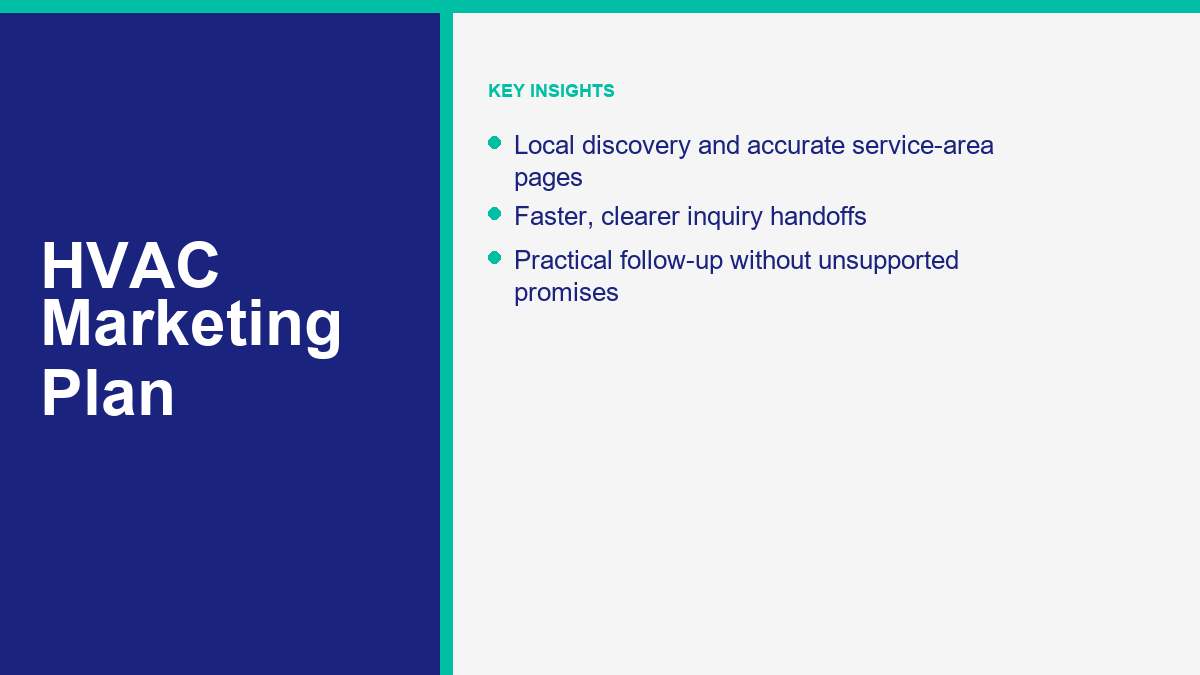
Every day, homeowners wake up to freezing houses or sweltering living rooms. When they reach for their phones to find help, they aren’t looking for a clever advertising slogan—they are looking for a rapid, reliable response. The American Marketing Association’s marketing definition describes marketing as the activity and processes for creating, communicating, delivering, and exchanging offerings that have value. For a local heating and cooling contractor, this academic definition translates into something much more grounded: being visible when a customer is in distress, providing a clear path to request service, and delivering that service dependably.
HVAC marketing, especially for small to mid-sized contractors, is frequently misunderstood. Many business owners assume that a successful HVAC marketing strategy requires a massive budget, complex funnels, or aggressive promotional tactics. However, the most effective marketing for HVAC businesses is often rooted in operational excellence. It is about how quickly your front-desk or dispatch team can reply to a frantic message about a broken air conditioner in mid-July. You do not need to pretend to be an agency or promise impossible return-on-investment metrics. Instead, your goal is to build a practical plan for faster lead response and better booking follow-up. This article provides a repeatable way to turn local discovery and incoming questions into a human-reviewed next step, ensuring that your team can focus on the jobs that match your expertise and service area.
The Crucial Role of Speed in Your HVAC Digital Marketing
When we discuss HVAC digital marketing, the conversation almost inevitably shifts toward search engine optimization (SEO), pay-per-click advertising, and social media presence. While these are critical components of local discovery, they only represent the top of the funnel. Driving traffic to your website or Google Business Profile is a wasted effort if incoming inquiries sit unread for hours. In the home service industry, the first company to respond meaningfully to a homeowner often wins the job.
Customer expectations have shifted toward faster acknowledgment of a problem. If your front desk is overwhelmed with phone calls during a seasonal rush, online leads—whether they come through a web form, a social media message, or a chat widget—can easily fall through the cracks. This is where speed to lead response time becomes the defining metric of your marketing strategy for HVAC.
Speed to lead does not mean a technician arrives at the house in five minutes. It means the customer’s inquiry is acknowledged, their basic information is captured, and they are given a clear expectation of what happens next. If a customer messages your business at 2:00 AM because their furnace stopped working, they know you are closed. However, an automated system that acknowledges their message, asks for their address, and assures them that the dispatch team will review it at 7:00 AM provides immense peace of mind. This simple act of responsive communication prevents the homeowner from immediately contacting three of your competitors. By focusing your HVAC marketing on responsive, helpful communication, you build trust before the truck ever leaves the lot.
Local Discovery and Building Service-Area Pages
Before you can respond to a lead, the homeowner must be able to find you. Local discovery is the bedrock of any solid HVAC marketing strategy. For small contractors, this begins with a properly configured Google Business Profile. Google’s documentation on representing a local service-area business is clear: you must accurately reflect the geographic boundaries where you actually run calls. Claiming a service area that takes three hours to drive across will not only frustrate customers who eventually hear that they are out of bounds, but it can also harm your local search visibility.
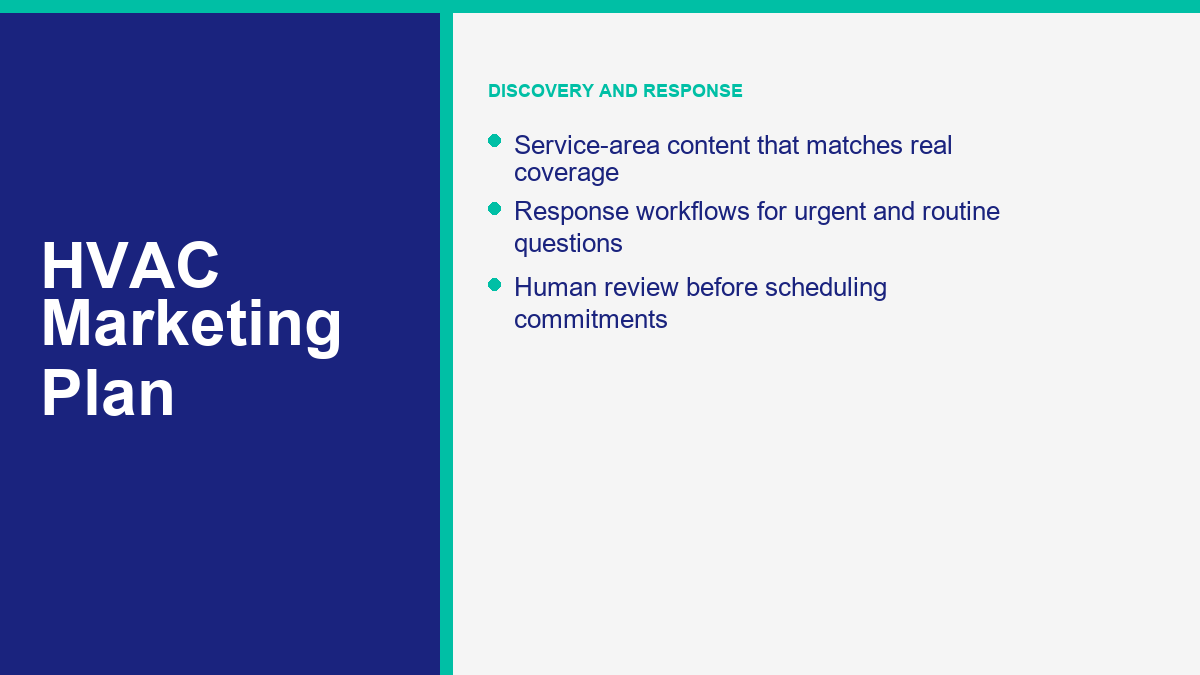
To support your Google Business Profile, your website should feature dedicated service-area pages. Google’s service-area guidance is a useful reference for keeping those locations accurate. These pages act as localized nets, capturing homeowners searching for AC repair or furnace service in specific towns. A practical approach to building these pages involves avoiding generic, duplicated content. Instead, provide specific examples of the types of systems you frequently service in that specific town. For instance, if you operate in a region where historical homes primarily use boiler heating, your service-area page for that town should prominently feature your expertise in boiler repair and maintenance.
Furthermore, these local discovery points should clearly guide the visitor on how to get in touch. Whether you use a traditional phone number, a contact form, or an interactive chat solution, the call to action must be unambiguous. The SBA’s marketing and sales guidance provides a practical planning baseline for matching the message to the customer and the channel. Some customers prefer to call, while others, perhaps at work or occupied with children, prefer to send a text or a digital message. Ensuring your digital footprint accommodates these preferences is a fundamental aspect of marketing for HVAC.
Creating Practical Workflows with Lead Generation Chatbots
When a customer decides to reach out via your website or social media, the transition from discovery to conversation must be seamless. Small HVAC contractors often run lean operations, meaning the owner, the lead technician, and the dispatcher might all be wearing multiple hats. In such environments, relying entirely on manual responses for every single inquiry can lead to bottlenecks.
This is where integrating technology like untuk menghasilkan prospek can revolutionize your front-desk operations. A well-configured Messenger Bot does not replace your human team; it supports them. Think of it as a digital receptionist that never sleeps, never takes a lunch break, and always asks the right questions in the right order.
The workflow is straightforward: A homeowner clicks to message your business on your website. Instead of staring at a blank email form, they are greeted by a friendly, automated prompt. The bot can immediately begin capturing the necessary details required to open a ticket. By standardizing this initial intake process, your human dispatchers receive neatly packaged lead profiles rather than vague emails stating a system is broken. It is crucial to note that Messenger Bot operates within the bounds of data gathering and preliminary communication. It does not send SMS messages on its own, it does not control your HVAC dispatch software, and it does not make binding schedule commitments. The business always keeps its own phone, calendar, dispatch, and approved information authoritative. The tool exists simply to accelerate the initial response and structure the incoming data.
Handling Incoming Questions and Qualifying Leads
Not all incoming inquiries are equal, and an effective HVAC marketing strategy must account for lead qualification. A frantic call about a flooded basement due to a backed-up condensation line is very different from someone inquiring about the cost of a routine fall maintenance check. By implementing a systematic approach to prioritizing better-fit opportunities, your team can allocate resources where they are needed most urgently and profitably.
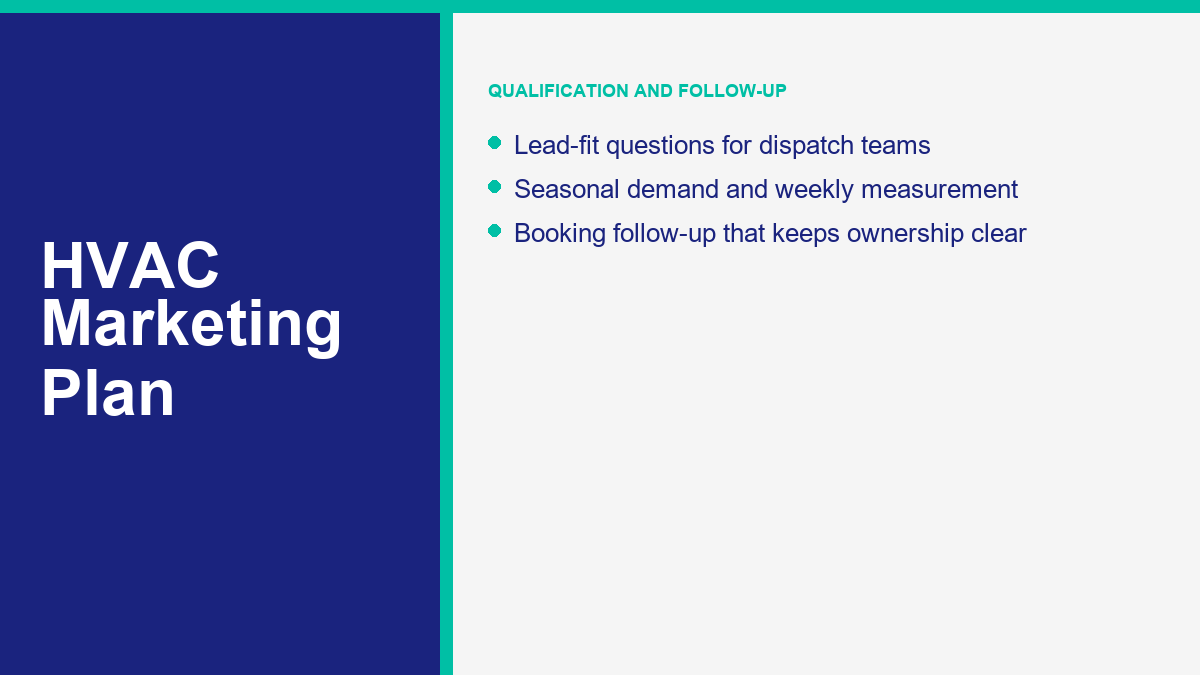
A practical qualification workflow involves asking three to four targeted questions during the initial digital interaction. Examples of effective qualification questions include:
- Are you currently without heating or cooling, or is this a proactive inquiry?
- What is the approximate age of your current system?
- Are you looking for a repair on an existing unit, or an estimate for a full replacement?
- What is the zip code of the property requiring service?
When a Messenger Bot handles these questions, it acts as a filter. If a customer provides a zip code outside of your approved service area, the bot can politely inform them that they are outside the coverage zone, saving your dispatcher a phone call. If the customer indicates an emergency situation in the middle of winter, the system can flag that interaction for immediate human review. This level of qualification ensures that when your staff does step into the conversation, they are armed with the context needed to provide an accurate, helpful response.
Seamless Booking Handoff and Customer Reminders
Once an inquiry has been captured and qualified, the handoff to the human team must be frictionless. The customer has answered the initial questions and is now waiting for a definitive answer on availability and pricing. At this stage, your human dispatcher reviews the gathered information and takes over the conversation. Because the preliminary data is already organized, the dispatcher can immediately look at the company calendar and propose a specific time window.
It is important to reiterate that your business maintains absolute control over the final booking. While an automated system can prepare the customer, only your team can confirm that a technician is actually available to drive to that neighborhood on Tuesday afternoon. You must not make exact performance promises or guarantees through automated channels; the human element remains essential for final validation and scheduling.
After the appointment is confirmed in your primary dispatch software, follow-up becomes the next critical phase of HVAC marketing. A customer who has booked an appointment still needs reassurance. Utilizing appointment reminder templates helps reduce no-shows and cancellations. A simple follow-up message—sent manually by your team or triggered through your approved communication platform—demonstrates professionalism. Clear, consistent follow-up reassures the homeowner that they made the right choice, which is the ultimate goal of any marketing strategy for HVAC.
Navigating Seasonal Demand and Conducting Weekly Reviews
The HVAC industry is famously subject to extreme seasonal fluctuations. Your HVAC digital marketing efforts must adapt to the shifting priorities of summer and winter. In July, your messaging should focus heavily on emergency AC repairs and fast response times. In October, the focus should shift to furnace tune-ups and preventative maintenance.
To manage this effectively, small contractors should implement a weekly marketing and operations review. This does not require a boardroom or a ten-page report. A practical weekly review for an HVAC owner involves looking at a few key metrics:
- Reviewing Unanswered Questions: Did any leads slip through the cracks over the weekend? If so, why?
- Updating Seasonal Messaging: Does the automated greeting still mention spring preparation when there is snow on the ground?
- Analyzing Response Times: How long did it take, on average, for a human to review and reply to qualified leads?
- Adjusting Service Area Coverage: Are you receiving too many requests from a town 40 miles away? If so, adjust your geographic targeting.
By making this review a weekly habit, you ensure that your marketing for HVAC remains closely tied to your actual operational capacity. It prevents situations where you are spending money to generate leads that your team simply cannot service.
Build a Simple HVAC Marketing Measurement Loop
A useful measurement loop does not require a large analytics department. It starts with one agreed definition for each stage of the customer journey: a visit, a qualified inquiry, a human-reviewed conversation, a booked appointment, and a completed job. When every team member uses the same definitions, the owner can see whether a slow month is caused by lower visibility, slower response, weak qualification, or limited field capacity. That distinction keeps the next marketing decision practical.
Record the source of each inquiry in a consistent way. A customer may arrive through a local search, a service-area page, a referral, a social message, or a direct phone call. The source does not need to be complicated; a short dropdown or a required note is enough. Pair that source with the response time, the question the customer asked, and the outcome of the handoff. Over several weeks, the pattern will show which channels bring useful conversations and which ones need a clearer offer or a better follow-up path.
Review the loop every week and keep the decisions small. If response time is the problem, improve the intake and alert process before buying more traffic. If visitors reach a page but do not ask a question, rewrite the call to action and clarify the service area. If qualified inquiries are plentiful but bookings are limited, ask the dispatcher whether scheduling windows or pricing explanations are creating friction. This approach keeps HVAC marketing connected to customer care instead of treating traffic as the only measure of progress.
- Track inquiry source, response time, qualification outcome, and booking outcome with the same labels each week.
- Compare seasonal demand with available technician and dispatcher capacity before increasing promotion.
- Choose one change to test, define the observation period, and record what actually changed.
Write Service Messages That Set Clear Expectations
Good HVAC marketing answers the customer’s immediate question without pretending to know what has not been inspected. A message can acknowledge the discomfort, ask for the basic details needed for triage, and explain when a human will review the conversation. It should not diagnose a dangerous condition, promise an arrival time that has not been confirmed, or quote a final price before the team has the information required to do so.
Use plain language that works for a stressed homeowner. “Tell us whether the system is running, what room is affected, and the best way to reach you” is more useful than a slogan about innovative service. If the business does not cover a requested location or service type, offer a respectful fit check and invite the customer to choose the option that matches their needs. A clear boundary protects trust while keeping the conversation helpful.
Every channel should carry the same basic promise: the business will review the request, confirm what it can do, and make the next step clear. The FTC’s advertising basics are a useful reminder to support claims with what the business can actually substantiate. That discipline is especially important for emergency language, savings claims, service guarantees, and statements about response times.
Before publishing a new promotion, read it as if you were a homeowner who has never met the company. Can the reader tell what service is offered, where it is available, how to request help, and what happens next? If any answer is unclear, fix the message before adding another channel. Clear expectations reduce avoidable back-and-forth and give the human team better conversations to review.
Choose the Next Test Without Overpromising
Once the measurement loop and service messages are in place, choose tests that answer one business question at a time. A local service-area page can test whether a specific town produces qualified inquiries. A seasonal maintenance page can test whether preventative language attracts requests before an emergency. A faster response workflow can test whether more inquiries reach a human reviewer. These tests are stronger when the page, message, and follow-up rule are changed together and the observation window is written down.
Use a simple test brief: state the customer segment, the problem being addressed, the page or message being changed, the expected behavior, and the safety check. Do not label a result a win because impressions increased if qualified inquiries or booked work did not. Likewise, do not abandon a helpful page because one week was quiet during a weather change. HVAC demand moves with seasons, outages, household budgets, and local events, so compare like periods and record the conditions around the result.
Keep the winning language reusable but do not copy it word for word across every town. Each service-area page should explain the local coverage, the relevant systems, and the next step in a way that reflects the actual operation. A small library of approved questions, response examples, and follow-up templates lets the team improve quickly without making unsupported claims. That is how a practical HVAC marketing program compounds: better discovery creates better conversations, and better conversations create clearer evidence for the next decision.
Pertanyaan yang Sering Diajukan
How do I promote my HVAC business?
Promoting your HVAC business effectively starts with local visibility and operational responsiveness. Ensure your Google Business Profile is completely filled out, accurate, and regularly updated with photos of your team and trucks. Build specific service-area pages on your website. Most importantly, promote your business by being the fastest, most reliable communicator in your local market. Use tools that allow you to capture leads immediately and qualify them quickly, ensuring that every marketing dollar spent results in a captured opportunity rather than a missed call.
Is HVAC becoming oversaturated?
While there are many contractors in the market, the HVAC industry is rarely oversaturated with businesses that provide exceptional, rapid customer service. Many local markets have numerous companies, but a significant portion of them struggle to answer the phone or reply to digital messages promptly. By focusing your HVAC marketing strategy on speed to lead response time and clear, transparent communication, you easily differentiate your business from competitors who rely solely on their legacy reputation but fail to adapt to modern customer expectations.
Why is the HVAC industry struggling?
The HVAC industry frequently faces challenges related to skilled labor shortages, supply chain disruptions, and the erratic nature of seasonal demand. When an extreme weather event occurs, every contractor in town is suddenly overwhelmed with requests. These struggles highlight why efficient front-desk operations and smart lead qualification are so critical. By using structured intake processes and automated preliminary questioning, struggling businesses can reduce the administrative burden on their dispatchers, prioritize the most urgent or profitable jobs, and navigate industry-wide challenges with greater resilience.

 Bahasa Indonesia
  English
  Tagalog
  简体中文
简体中文  العربية
  हिन्दी
  Português do Brasil
  Español de México
  Français
  বাংলা
বাংলা  香港中文
香港中文  繁體中文
繁體中文  Nederlands
  Deutsch
  日本語
日本語  한국어
한국어  Polski
  Русский
  Español
  Tiếng Việt