
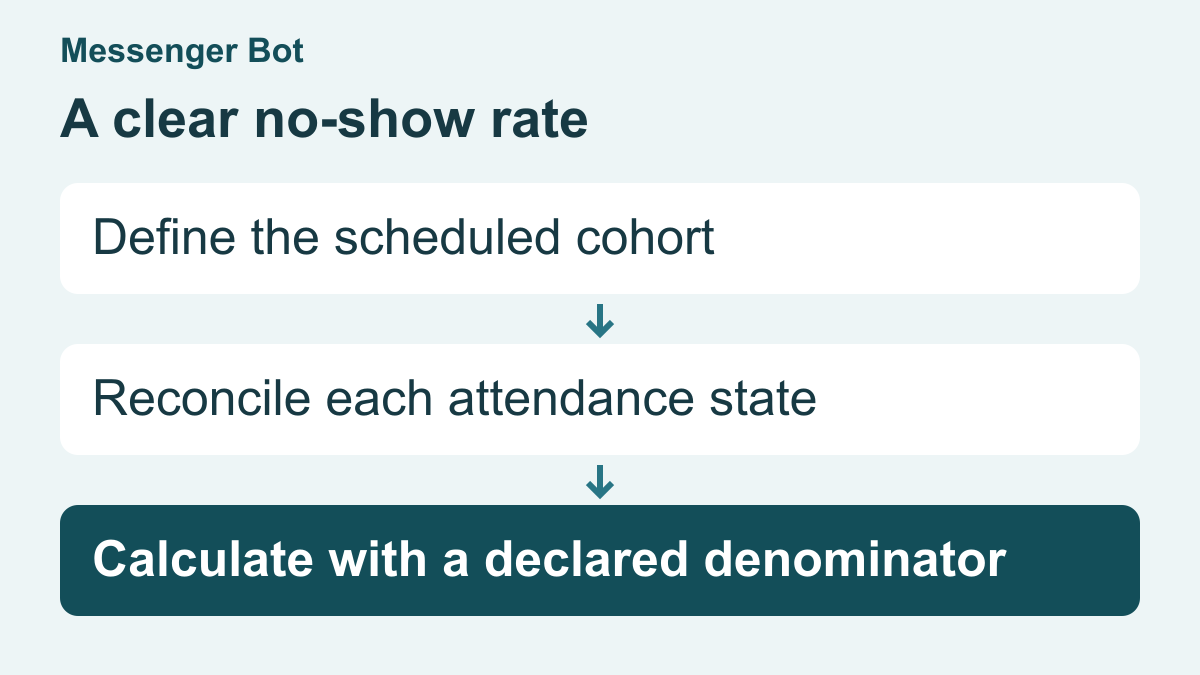
Define a missed appointment before counting it
A useful no-show rate starts with a shared definition of attendance. For a salon, gym, consultant or repair business, cancellation, rescheduling and an unannounced absence describe different events. Agree on those states before comparing weekly or monthly percentages. Otherwise, a change in staff recording habits can look like a change in customer behavior.
Use confirmed no-show only when an accepted appointment existed and actual attendance evidence meets your business’s disclosed definition of non-attendance. Keep advance cancellations and reschedules separate. There is no universal arrival cutoff in this guide. Record what happened rather than assigning a motive to the customer.
Assign someone to record the final state from check-in, service or dispatch evidence. An unanswered reminder is not a missed appointment: the customer might still attend. If nobody can verify attendance, use unknown until the record is checked. Do not silently turn missing replies into no-shows or remove those bookings from a report.
Pair that attendance definition with clear reminder templates so customers know the place, time and change-request route. The following five states form this guide’s measurement convention. Keep the rules available to whoever records the appointment; a percentage is only comparable when those rules stay consistent.
| Attendance State | Operational Definition |
|---|---|
| Attended | The client arrived according to the business’s disclosed attendance definition and received the scheduled service. |
| Confirmed No-Show | The client held an accepted booking, did not attend according to the disclosed attendance definition, and provided no advance notice. |
| Cancelled | The client or business released the reserved slot prior to the start time without scheduling an immediate replacement. |
| Rescheduled Away | The original appointment occurrence was moved to a distinct future or past scheduled start time. |
| Unknown / Unresolved | The scheduled appointment time elapsed, but operational records lack documented attendance verification. |
These are measurement categories, not judgments about customers. A status tells you how an occurrence resolved; it does not establish why it happened.
Choose one cohort, period and counting unit
Define the cohort—the appointments included in one report—by their scheduled start times in a named local timezone. Do not use the date a customer asked to book, an invoice was issued or an export was downloaded. Those dates answer different questions. Record the period alongside every result.
Use an inclusive start and an exclusive next-period start. For a hypothetical October report in New York, include starts from October 1 at midnight up to, but not including, November 1 at midnight in America/New_York. That rule avoids overlapping periods and missing the seconds after an imprecise end-of-day cutoff.
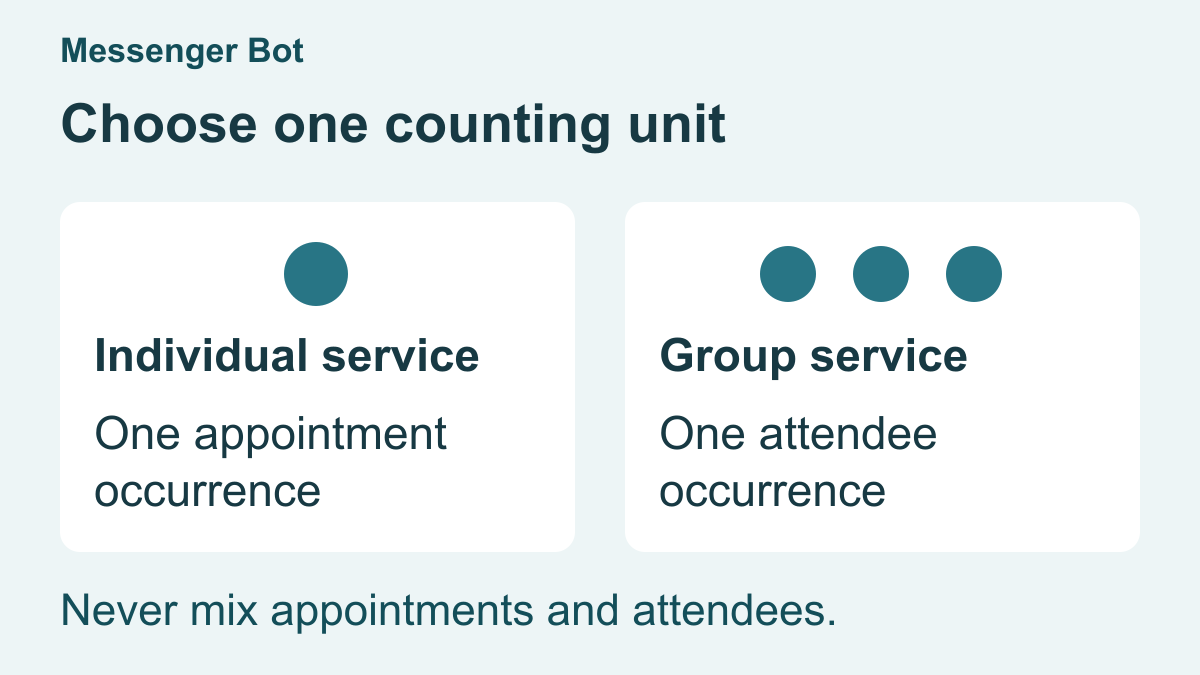
For individual services, count appointment occurrences: each accepted visit scheduled for a particular start time. A hypothetical salon with 50 accepted haircut occurrences has 50 units before attendance states are assigned. Count genuine visits, not unique customers; one customer can have more than one appointment.
For participant attendance in a group service, use attendee occurrences. In a hypothetical gym class with ten accepted attendee bookings and two confirmed absences, the attendee rate is 2/10, or 20 percent. A session-level utilization measure is possible, but it is a separate measure. Never add session counts to participant counts in one denominator.
ビジネスにおける Calendly meeting attendance documentation says no-show status is included in Meetings CSV exports and group invitees can be marked individually. Those are examples of explicit status and counting units—not claims about Messenger Bot attendance tracking.
Before assigning attendance states, exclude calendar entries that are not accepted customer appointments:
- Unfilled calendar capacity: Open slots where no customer ever booked or requested service.
- Internal administrative blocks: Reserved calendar time for staff meetings, breaks, cleaning, or equipment maintenance.
- Tentative unaccepted inquiries: Inbound booking requests that staff or clients never formally confirmed or accepted.
- Duplicate system entries: Accidental double entries created by calendar synchronization conflicts or repetitive software imports.
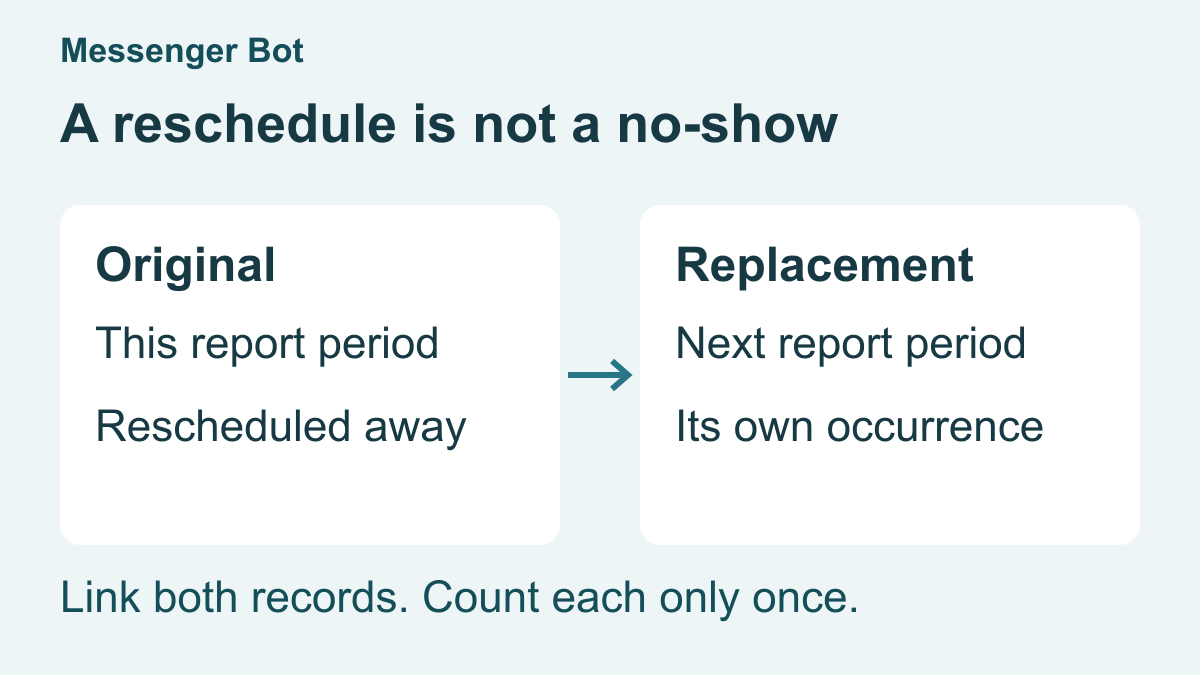
Keep a genuine replacement occurrence separate from its original. In a hypothetical reschedule from October 12 to October 26, the original is rescheduled away and the replacement has its own final state. Both belong to October if those are their scheduled starts. If the replacement starts in November, it belongs to November instead. Link the records, count each once and do not mistake two occurrences for two unique customers.
Calculate no-show rate from reconciled counts
This guide chooses a scheduled-cohort convention: confirmed no-shows divided by all reconciled, accepted occurrences originally scheduled to start in the period. It is an editorial measurement choice, not a universal industry rule. Name the convention before comparing it with another report.
Under the scheduled-cohort convention, the calculation uses the following formula:
Scheduled-Cohort No-Show Rate = (Confirmed No-Shows / Reconciled Scheduled Occurrences) × 100
Only confirmed no-shows enter the numerator. The denominator includes attended, confirmed no-show, cancelled, rescheduled-away and unknown states when membership of the scheduled cohort reconciles. Omitting a state changes the denominator and therefore the question the percentage answers.
ビジネスにおける Square appointments reporting documentation says its team performance metrics exclude appointments cancelled or marked no-show. Check report-selection rules before treating an export as your whole scheduled cohort. This does not describe every scheduling report or prescribe a universal formula.
Consider this hypothetical salon month. These are invented counts for arithmetic, not customer records, an industry benchmark or a promised outcome. The five states reconcile to 100 accepted occurrences:
| Attendance Category | Occurrence Count | Percentage of Scheduled Cohort | Role in Rate Calculation |
|---|---|---|---|
| Attended | 80 | 80.0% | Included in denominator; excluded from numerator |
| Confirmed No-Show | 10 | 10.0% | Included in denominator; sole component of numerator |
| Cancelled | 6 | 6.0% | Included in denominator; excluded from numerator |
| Rescheduled Away | 4 | 4.0% | Included in denominator; excluded from numerator |
| Unknown / Unresolved | 0 | 0.0% | Audited to zero; no unresolved records remain |
| Total Reconciled Cohort | 100 | 100.0% | Complete scheduled cohort denominator |
Applying the scheduled-cohort formula to this hypothetical dataset yields:
Scheduled-Cohort No-Show Rate = (10 / 100) × 100 = 10.00%
Here, 80 + 10 + 6 + 4 + 0 = 100. All required counts reconcile, so the scheduled-cohort example is calculable.
An alternative attended-or-no-show denominator uses only attended and confirmed no-show occurrences. In the same hypothetical example, that denominator is 80 + 10 = 90:
Attended-or-No-Show Rate = (10 / 90) × 100 ≈ 11.11%
The two percentages describe the same ten no-shows using different denominators. An 11.11 percent result is not a new increase over 10 percent. If you retain both measures, label each formula and keep its history separate. Do not splice them into one trend line.
Operational datasets also encounter mathematical edge cases that require disciplined handling:
- Zero denominator periods: If a business was closed for renovations or holiday shutdown and scheduled zero appointments during a reporting period, the denominator is zero. In mathematics, division by zero is undefined. The no-show rate for that period is not calculable; it is never zero percent. Reporting zero percent falsely implies that appointments took place and all clients attended.
- Unresolved or unknown records: When unknown records exist in a cohort where membership and overall counts reconcile, report the rate as provisional: divide confirmed no-shows by the complete scheduled cohort (which includes unknown records in the denominator), and prominently disclose the unknown count alongside the percentage. If cohort membership or required counts cannot reconcile, the metric must be formally reported as Unknown / not calculable, regardless of whether missing records represent a majority or a minority of the cohort. Never silently remove unknown rows or invent an arbitrary reporting threshold.
Reconcile cancellations and reschedules
Check what happens to historical occurrence data when staff change the live schedule. A calendar may keep an audit history or may only export its current state. Verify the actual fields rather than assuming that moving a booking destroys its history or that every application preserves it.
Keep the minimum history needed in a protected measurement record, such as an appropriate export or restricted spreadsheet. You do not have to leave old cancelled slots on the active calendar. Preserve original start, final state and a minimal replacement link without copying unnecessary customer messages or contact details.
In another hypothetical check, deleting six cancellations from a 100-occurrence report leaves 94 rows. Ten no-shows then appear as 10/94, approximately 10.64 percent, instead of 10/100, or 10 percent. The attendance did not change; the reporting population did. Reconcile the population before interpreting a movement.
To preserve historical integrity without hindering daily scheduling, staff should follow three explicit rules in their measurement records when an appointment is rescheduled:
- Preserve the original occurrence: Record the original calendar slot at its original start datetime in your measurement log, updating its final status to “Rescheduled Away.”
- Create a distinct replacement occurrence: Generate a distinct appointment record for the new date and time. In your measurement records, this replacement is its own genuine accepted occurrence and may resolve to any final state (attended, confirmed no-show, cancelled, rescheduled again, or unknown).
- Link the audit relationship: If your system supports internal notes or record linking, cross-reference the replacement record with the identifier of the original booking. This maintains a traceable occurrence history without double-counting capacity.
The table below outlines common record-keeping distortions that affect no-show calculations, along with the operational corrections required to maintain data integrity:
| Common Record-Keeping Practice | Operational Distortion | Reconciled Data Correction |
|---|---|---|
| Deleting cancelled entries from reporting logs | Artificially reduces the scheduled cohort denominator, exaggerating the calculated no-show percentage. | Retain the original entry in measurement records and mark its final status as “Cancelled” with a timestamp of the request. |
| Treating unconfirmed reminder replies as no-shows | Conflates lack of message engagement with physical absence, risking operational confusion and invalid metrics. | Verify physical attendance at the service location; record “Confirmed No-Show” only after applying the business’s disclosed attendance policy. |
| Reassigning rescheduled slots without logging the original date | Removes evidence of scheduled capacity from the original cohort and complicates multi-period tracking. | Mark original occurrence as “Rescheduled Away” in its cohort; log the replacement as a distinct occurrence in its own cohort with linked identifiers. |
| Grouping advance cancellations with confirmed no-shows | Blurs the operational distinction between advance notice (which allows slot recovery) and absence without notice. | Maintain separate classifications for advance cancellations and confirmed no-shows to evaluate communication patterns honestly. |
| Filtering cohorts by booking timestamp instead of start time | Places advance bookings into past reporting cycles, corrupting monthly cohort comparisons and seasonal tracking. | Filter all reporting cohorts strictly by scheduled service start datetime within the declared local timezone. |
If an export cannot recover the original start or distinguish replacements from duplicates, record that limitation. Do not invent missing history merely to produce a percentage.
Compare like with like before interpreting a change
A rate describes a relationship between counts. It does not explain the cause of a change. Start by checking whether both periods use the same unit, attendance rules, source records and denominator. Then inspect possible differences in service mix and calendar context.
In a hypothetical 20-appointment cohort, one confirmed no-show gives 5 percent and two give 10 percent. The rate doubled, but the count increased by one. Show numerator and denominator alongside the percentage so a small-cohort fluctuation is not mistaken for a large operational change.
Compare like service types where the data allows it. A salon’s shorter appointments and longer visits might have different attendance patterns; check the counts rather than assuming which performs better. An aggregate can change when the proportions of service types change, even when individual segment rates stay stable.
Booking lead time is another variable to inspect, not a proven cause. Separate shorter- and longer-lead bookings only when there are enough records for a useful comparison. Do not infer customer commitment or predict attendance from lead time alone.
Note holidays, weather, opening hours and seasonality when interpreting a period. Where history is available, compare similar calendar periods and explain remaining differences. A matched observational comparison can still have confounders. A lower rate is not causal proof that reminders worked; it cannot by itself isolate their effect.
Use the findings to review customer communication
Use the findings to improve the clarity of customer communication. An attendance report does not tell you a customer’s motives. Review the confirmation and change-request journey without treating the percentage as a reason to blame customers or claim a guaranteed remedy.
The first area to audit is the clarity and completeness of your booking confirmation messages. When a customer books an appointment, do they receive clear, accessible information regarding the visit? Review your messaging touchpoints to ensure they provide:
- Precise physical location and parking instructions: Does the confirmation specify building suites, entry landmarks, or parking garage details, or does it leave first-time visitors searching for an entrance?
- Preparation and arrival guidelines: Are clients clearly informed if they need to arrive early to complete check-in steps, bring specific materials, or prepare equipment?
- Timezone transparency: For virtual consulting sessions or businesses operating across regional borders, does every confirmation and reminder clearly specify the local timezone?
- Assigned service provider details: Does the client know who will be meeting or assisting them, establishing clear professional expectations before arrival?
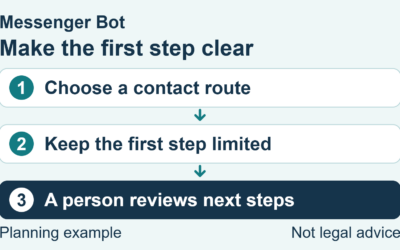
Check the route for requesting a change: can a customer find it, understand it and reach a monitored contact point? Confirm who reviews requests and when. A change request is not a confirmed new booking until the responsible person or verified scheduling system accepts it.
チャットボットを planning a scheduling handoff, keep preferred times distinct from confirmed appointments and tell customers when staff will review a request. Verify the actual booking process before offering availability or automatic confirmations. Attendance calculations remain in your reviewed appointment records.
Test one reversible communication improvement at a time, such as clearer directions or a more obvious change-request route. Record the date, audience and definition used, then review comparable counts. Do not promise that new wording reduces missed visits. Check whether the message was understood as well as whether the attendance pattern changed.
Keep a practical appointment-measurement checklist
Use the following checklist each reporting cycle. Retain the formula and definition version so a new staff member can reproduce the same result.
- Define the reporting window and timezone: Explicitly state the start and end dates using a half-open interval (inclusive start datetime, exclusive next-period start datetime) and the exact local timezone (e.g., America/New_York) based on scheduled service start datetime.
- Select and isolate your counting unit: Confirm whether the report tracks individual appointment occurrences or group attendee occurrences. Never combine both units in the same calculation.
- Filter for accepted customer bookings: Include only genuine, confirmed client bookings originally scheduled to take place within the declared period.
- Remove non-appointment calendar entries: Audit and exclude open calendar slots, internal administrative blocks, tentative unaccepted inquiries, and duplicate calendar entries.
- Reconcile one final attendance state per occurrence: Verify that every scheduled occurrence resolves into exactly one of five states: attended, confirmed no-show, cancelled, rescheduled away, or unknown, based on actual arrival evidence and disclosed attendance policies.
- Verify occurrence mathematical balance: Sum the counts of all five attendance categories and confirm that the total matches the original scheduled cohort denominator exactly.
- Document and isolate unknown entries: If any records lack verified attendance, record their absolute count and label the calculation as provisional. If records cannot reconcile, report the rate as Unknown / not calculable.
- Execute the scheduled-cohort calculation: Divide confirmed no-shows by the total reconciled scheduled occurrences and multiply by 100. Record the formula version and methodology alongside the final percentage.
- Store privacy-minimal aggregate summaries: Retain high-level category counts and calculated percentages for historical reporting. Do not store unneeded personal customer data, contact details, or private appointment notes in measurement archives.
Keep calculation and messaging responsibilities clear. To see customer-conversation examples, Explore business conversation examples. For available plans, Check Current Pricing. Neither page substitutes for checking your appointment data or verifying your scheduling process.
No-show rate questions
How do I calculate no-show rate?
To calculate the scheduled-cohort no-show rate, divide the number of confirmed no-shows by the total number of reconciled scheduled appointment occurrences for that period and multiply by 100. For example, if a salon schedules 100 accepted client appointments in a month defined by an exact timezone and half-open period boundary, and 10 appointments end in a confirmed no-show, the scheduled-cohort no-show rate is 10 divided by 100, which equals 10.00 percent. Always disclose the declared reporting period, local timezone, and the denominator convention used in the calculation.
Do cancellations and rescheduled appointments count as no-shows?
No, advance cancellations and rescheduled appointments do not count in the numerator as no-shows because the client provided advance notice before the scheduled appointment start time. Under the scheduled-cohort convention, however, they remain in the denominator as reconciled scheduled occurrences that did not result in an attended visit. If you use an alternative attended-or-no-show denominator, cancellations and reschedules are excluded from the denominator, but that formula must be explicitly labeled and never compared directly to a scheduled-cohort rate.
Should group sessions be counted by meeting or by attendee?
Group sessions should be counted by attendee occurrences rather than meeting occurrences to reflect reserved capacity and individual attendance accurately. For example, if a gym hosts a group class with 10 booked participant spots and two clients fail to attend without notice, recording two confirmed no-shows against 10 scheduled attendee occurrences yields a 20.00 percent attendee no-show rate. Meeting-level measures may be separately tracked for facility utilization, but they should never be combined with participant attendance counts in the same calculation.
What if appointment records are missing or the denominator is zero?
If appointment attendance records are unresolved, classify those entries as unknown. When cohort membership reconciles, report the calculation as provisional while prominently disclosing the count of unknown records alongside the rate. If cohort membership or required counts cannot reconcile, report the rate as Unknown / not calculable regardless of whether missing records represent a majority or a minority of the cohort. When a business schedules zero appointments during a period, the rate is mathematically undefined and not calculable rather than zero percent.
Does a lower no-show rate prove that reminders worked?
A lower no-show rate alone does not prove that reminders caused the improvement, because shifts in service mix, booking lead times, seasonal demand, weather conditions, and customer composition can also influence attendance. To evaluate whether communication refinements make a difference, compare identical service categories across comparable time periods and treat observational comparisons with care rather than assuming immediate causality from an isolated percentage change.

 日本語
日本語  English
  Tagalog
  简体中文
简体中文  العربية
  हिन्दी
  Português do Brasil
  Español de México
  Français
  বাংলা
বাংলা  香港中文
香港中文  繁體中文
繁體中文  Nederlands
  Deutsch
  Bahasa Indonesia
  한국어
한국어  Polski
  Русский
  Español
  Tiếng Việt