
문구 충돌이 이제 진짜 문제입니다. 공급업체는 모든 것을 AI 에이전트라고 부르고, 팀은 모든 언어 모델을 챗봇이라고 부르며, 예산 소유자는 동일한 작업을 해결하지 않는 제품을 비교하게 됩니다. 고객 서비스 리더는 실제로 필요한 것이 핸드오프 규칙이 있는 기반 지원 에이전트일 때 생성형 AI를 요청할 수 있습니다. 마케팅 팀은 실제로 필요한 것이 더 빠른 콘텐츠 생성, 이미지 제작 또는 제안서 초안 작성일 때 대화형 AI를 요청할 수 있습니다.
그렇기 때문에 대화형 AI와 생성형 AI 질문이 2026년에 1년 전보다 더 중요해집니다. 이는 2026년 4월 11일 기준으로 시장에 두 범주 모두에서 강력한 제품이 가득하지만, 비용 모델, 운영 모델 및 위험 프로필은 여전히 매우 다르기 때문입니다. 이후 더 넓은 아키텍처와 롤아웃 뷰가 필요하다면, 우리의 대화형 AI 기업 가이드. 이 기사는 카테고리 경계 자체에 더 집중합니다.
저는 트레이드오프에 대해 직접적으로 말할 것입니다: 생성형 AI는 순수한 새로운 콘텐츠를 생성하는 더 넓은 모델 카테고리인 반면, 대화형 AI는 일반적으로 메모리, 기반, 비즈니스 규칙 및 핸드오프를 통해 시간 경과에 따른 상호작용을 관리하도록 설계된 더 좁은 비즈니스 시스템 카테고리입니다. 그렇기 때문에 생성형 AI와 대화형 AI 논쟁은 실제로 범위에 관한 것입니다: 모델 카테고리 대 시스템 카테고리. 하나가 다른 하나를 강화할 수 있습니다. 그들은 서로 교환할 수 없습니다.
빠르게 결정해야 한다는 현재의 압박감은 현실입니다. Gartner는 2026년 2월 18일, 91%의 고객 서비스 리더들이 2026년에 AI를 구현하라는 경영진의 압박을 받고 있다고 보고했으며, Zendesk의 2026 CX 트렌드 연구는 22개국의 11,000명 이상의 소비자와 비즈니스 리더를 대상으로 한 결과, 81%의 소비자들이 담당자가 중단한 부분에서 이어서 진행하기를 원하고, 74%는 정보를 반복해야 할 때 불만을 느낀다고 밝혔습니다 (가트너; Zendesk). 이러한 것은 추상적인 트렌드가 아닙니다. 이는 동시에 나타나는 구매 압박과 고객 기대입니다.
2026년 대화형 AI와 생성형 AI 질문이 중요한 이유
대부분의 이사회에서는 이 질문이 철학적으로 들립니다. 그러나 실제로는 불필요한 지출을 피하는 것에 관한 것입니다. 만약 귀하가 일반 목적의 모델 구독을 구매하는데, 진짜 병목 현상이 야간 지원 해결에 있다면, 인상적인 데모와 약한 운영을 경험하게 될 것입니다. 만약 귀하가 팀이 주로 더 빠른 글쓰기, 요약, 코딩, 연구 또는 이미지 생성을 필요로 할 때 무거운 고객 대화 플랫폼을 구매한다면, 스택을 과도하게 구축하게 되고 채택이 느려질 것입니다.
The market signals explain why teams keep collapsing the terms together. Gartner’s February 2026 survey shows AI is now a top-down mandate for service leaders, not an optional pilot. Zendesk’s 2026 data shows customers no longer judge AI only by fluency. They judge it by continuity, memory, accuracy, and first-contact resolution. That pushes companies toward systems that can do more than generate a polished paragraph (가트너; Zendesk).
The confusion also shows up in procurement language. A lot of RFPs still ask for “ChatGPT for customer service” or “a generative chatbot” as if the product category is obvious. It is not. A support agent that can resolve order status, change account details, quote policy language, and escalate with the full transcript is not the same category as a creative assistant that drafts campaigns or summarizes documents. The surface looks similar because both often live behind a chat box. The operating requirement underneath is completely different.
There is another 2026 factor: buyers are now comparing outcome-priced systems against token-priced models. That means category mistakes get expensive faster. A model API might look cheap at pilot stage, then turn into an engineering project plus governance project plus prompt-tuning project. A purpose-built conversational platform might look more expensive on paper, then beat the DIY route because routing, analytics, handoff, and content controls are already there.
If your next step is vendor selection rather than concept clarification, use our 챗봇 플랫폼 비교 after this. The rest of this article is about choosing the right AI type before you shortlist software.
What Conversational AI Really Is (Beyond Marketing Slides)
Conversational AI is not simply “AI that can chat.” It is a system designed to manage a conversation in a useful way across one or more turns, usually to complete a business job. That job might be answering support questions, qualifying leads, booking appointments, routing inquiries, collecting structured information, or deciding when a human should take over.
A real conversational AI stack usually has four layers working together. First, it needs language understanding so the system can interpret free-form input instead of relying only on buttons or keywords. Second, it needs context so it can keep track of what the user is trying to do. Third, it needs grounded knowledge and business actions, which means pulling from approved content and, when appropriate, calling workflows or APIs. Fourth, it needs control, which means escalation rules, confidence thresholds, analytics, and a way for humans to intervene.
That is why a modern support bot that actually works does not behave like a blank model prompt. It recognizes intent, asks clarifying questions, checks the knowledge source, follows a policy boundary, and either resolves the issue or hands it to a person with context. Tidio’s current Lyro documentation describes exactly this style of system: it uses AI and natural language processing to have human-like conversations, can ask follow-up questions, grounds itself on configured data sources, and redirects to a human agent when the answer is beyond the available data (티디오).
HubSpot’s Breeze customer agent is another clean example of the category. It is not pitched as a writing assistant. It is pitched as a customer-facing agent that can answer pricing questions, qualify buyers, resolve issues against company context, and escalate when needed. In other words, the product is built around managed interactions, not open-ended generation for its own sake (HubSpot).
The easiest way to spot conversational AI in the wild is to ask a simple question: what business event is the system responsible for changing? If the answer is “resolve more tickets,” “book more demos,” “route more leads correctly,” “deflect repetitive chats,” or “keep the conversation going across channels,” you are looking at conversational AI.
- It is channel-aware. Messenger, Instagram, website chat, WhatsApp, in-app chat, email, and voice are part of the design, not an afterthought.
- It is stateful. The system has to remember what has already been asked and what the user is trying to finish.
- It is operational. It needs analytics, ownership, content updates, and safe handoff to humans.
- It is measured on business outcomes such as containment, resolution, lead quality, response time, and customer satisfaction.
That makes conversational AI much closer to a business workflow layer than a clever chat demo. The language model can matter a lot, but by itself it is not the whole product.
What Generative AI Really Is (And Why It Is Not Just ChatGPT)
Generative AI is the broader category. It refers to systems that generate net new outputs from learned patterns in training data: text, code, images, audio, video, summaries, classifications, synthetic variants, and increasingly tool-using actions wrapped around those outputs. ChatGPT is one famous product in that category. It is not the category itself.
This distinction matters because many high-value business uses of generative AI do not look like customer chat at all. A finance team using an internal data assistant to analyze company metrics, a legal team summarizing contract differences, a design team using Adobe Firefly to generate brand-safe visual concepts, or an engineering team using a code assistant to refactor documentation are all using generative AI. None of those are primarily conversational AI deployments.
OpenAI’s January 29, 2026 write-up on its own in-house data agent is a good illustration. The system was built so internal teams across Engineering, Data Science, Finance, and Research could ask complex questions in natural language and get analysis back quickly, with the agent reasoning over company context, data, memory, and retrieval. That is a generative AI system applied to internal knowledge work, not a customer-facing conversational automation stack (오픈AI).
Adobe Firefly shows the same point from the creative side. It is generative AI because the core task is producing or transforming media. The product now spans image, video, audio, and design generation, and Adobe’s public Firefly plans continue to package that as a creative production workflow, not as a support or lead-routing system (Adobe Firefly).
That is why “generative AI vs ChatGPT” is the wrong frame. ChatGPT is one conversational interface sitting on top of a broader generative capability set. Claude, Gemini, Firefly, code copilots, document copilots, and internal analytics agents are all expressions of the same wider model category: systems that create, transform, summarize, or reason over content.
Another practical distinction is that generative AI is often narrower in workflow ownership. It may generate a strong answer, a draft, a chart, an image, or a recommendation, but it is not automatically the system of record for the conversation, the escalation logic, or the service workflow. That is why many teams start with generative AI for internal productivity before they trust it with customer-facing conversations.
So if the main output you need is a draft, a summary, an image, a report, a code snippet, a plan, or an analysis, you are usually in generative AI territory first. If the main output you need is a resolved interaction over a live channel, you are usually moving toward conversational AI.
The Technical Differences: Architecture, Training, and Output Modes
The cleanest technical way to think about the difference is this: generative AI is primarily a model capability, while conversational AI is primarily a system design pattern. A conversational system may use one or more generative models underneath, but it adds orchestration that the model alone does not provide.
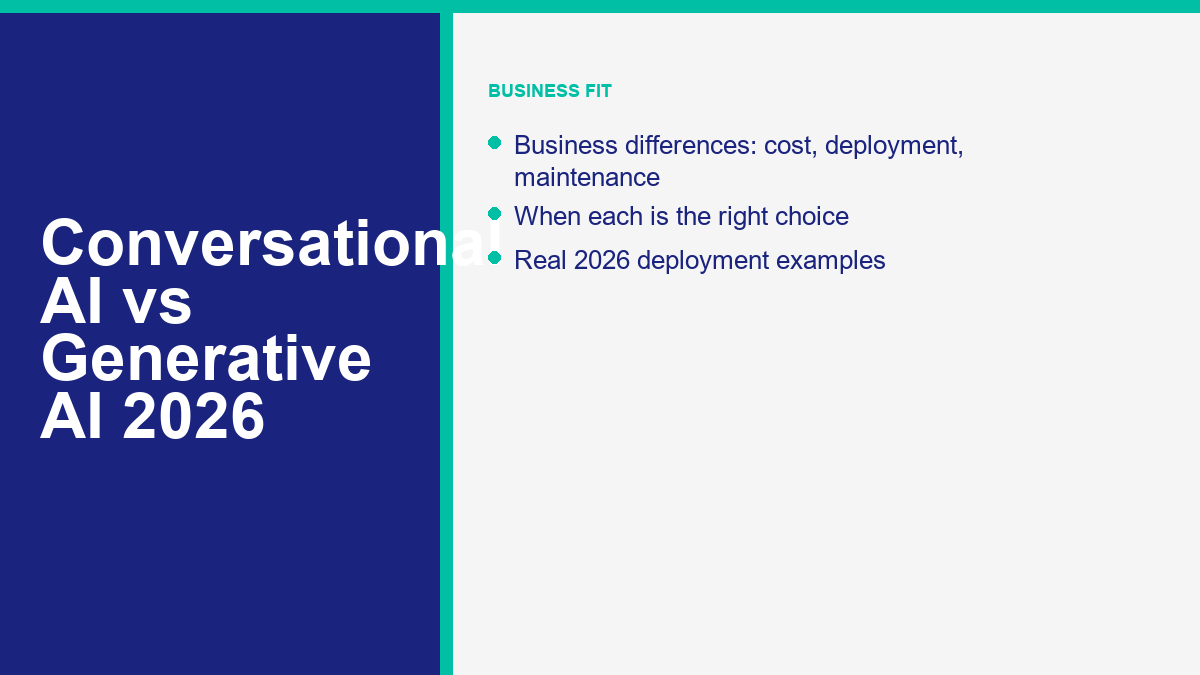
| Dimension | 대화형 AI | 생성적 AI |
|---|---|---|
| Primary job | Manage a live interaction and move it toward a business outcome | Create or transform content, reasoning traces, or media outputs |
| Core unit of design | Dialogue state, channel logic, retrieval, workflow, and escalation | Model behavior, prompt design, tool use, and output quality |
| Training emphasis | Often combines model pretraining with domain grounding, policies, and runtime rules | Large-scale pretraining and post-training for text, code, image, audio, or multimodal generation |
| Runtime components | Knowledge base, memory, handoff logic, API calls, identity checks, analytics | Prompting, retrieval, tools, and optional fine-tuning or adapters |
| Failure mode | Wrong route, bad escalation, broken workflow, low-confidence answer in a live journey | Hallucination, weak draft, bad image, inconsistent reasoning, wrong formatting |
| Success metric | Resolution, containment, conversion, response time, handoff quality | Accuracy, usefulness, creativity, quality, speed, token efficiency |
The training difference is usually misunderstood. A lot of people assume conversational AI must be a separately trained special model. Sometimes it is not. In 2026, many production conversational systems are wrappers around strong general models, but they add retrieval-augmented generation, policy controls, workflow execution, memory, and business-context injection at runtime. That is why a customer agent can feel much more reliable than the exact same foundation model in a blank chat window.
The output mode also changes everything. Generative AI is happy producing a report, a draft email, a synthetic image, a transcript summary, or a code block and stopping there. Conversational AI usually cannot stop there. It has to decide what happens next. Does it ask a follow-up? Cite the article? Trigger the order lookup? Open the case? Hand the conversation to a human? Log the lead source? That next-step discipline is where the system becomes conversational AI instead of just a capable model.
Evaluation changes with that architecture. A generative AI team may evaluate response quality, hallucination rate, latency, token spend, or benchmark performance. A conversational AI team still cares about those things, but the operating metrics shift toward first-contact resolution, fallback rate, automation coverage, average handle time, transfer reason, and CSAT. One is mostly evaluating content generation. The other is evaluating a service or sales process.
There is also a determinism gap. When the task is “write a first draft of a partner email,” variance is often acceptable. When the task is “tell a customer whether they qualify for a refund under policy,” variance is risky. That is why strong conversational deployments still keep deterministic controls around policy edges even when the natural language layer is generative.
The technical bottom line is simple: if you need language generation only, buy or build for generation. If you need language plus controlled execution inside a live interaction, buy or build for conversation.
The Business Differences: Deployment, Maintenance, and Cost
This is where the category choice becomes very concrete. Generative AI usually enters the business through seats or API usage. Conversational AI usually enters through channels, agents, conversations, outcomes, contacts, or platform plans. Those pricing units shape how teams pilot, forecast, and govern the product.
| 도구 | 카테고리 | Public pricing signal checked April 2026 | What the price unit tells you |
|---|---|---|---|
| OpenAI API | 생성적 AI | GPT-5.4 is priced at $2.50 per 1M input tokens and $15 per 1M output tokens (오픈AI) | You are buying model computation, not a finished conversation system |
| Anthropic API | 생성적 AI | Claude Sonnet 4 is listed at $3 per MTok input and $15 per MTok output, while Sonnet 4.6 is listed at the same rates (앤트로픽) | You are paying for inference and model quality, then building the workflow around it |
| Google Gemini API | 생성적 AI | Gemini 2.5 Flash is listed at $0.30 per 1M input tokens and $2.50 per 1M output tokens (구글) | Low model cost can still become a larger engineering and governance project |
| Intercom Fin | 대화형 AI | Essential starts at $29 per seat per month billed annually, and Fin AI Agent is $0.99 per outcome (인터컴) | You are paying for a managed support workflow plus a performance-linked automation layer |
| HubSpot Breeze Customer Agent | 대화형 AI | HubSpot announced on April 2, 2026 that starting April 14, 2026 Breeze Customer Agent moves to $0.50 per resolved conversation, down from $1.00 per conversation (HubSpot) | You are buying a CRM-grounded agent that is priced on successful outcomes, not raw output |
| Tidio Lyro | 대화형 AI | Lyro starts at $32.50 per month from 50 conversations, and Tidio also says Lyro Connect starts from $0.50 per conversation (티디오; Lyro) | The platform is packaging a managed support conversation layer, not just a model endpoint |
| MessengerBot.app | 대화형 AI | Premium is listed at $19.99 per 30 days and Pro at $49.99 per 30 days (메신저봇 가격 보기) | The value proposition is channel automation, flow control, and messaging operations for a fixed platform fee |
The maintenance pattern follows the same divide. With generative AI, the recurring work is prompt management, model selection, guardrails, evaluation, access control, and cost monitoring. With conversational AI, the recurring work is channel management, knowledge freshness, workflow tuning, escalation review, transcript QA, and ownership across support or revenue operations.
That is why the cheaper-looking option is not always the cheaper deployment. A token-priced model can be a brilliant choice when your workflow is internal and your output is a draft or analysis. It becomes less brilliant when your team now has to build authentication, response policies, routing, analytics, multilingual controls, and human handoff from scratch. The model bill is only one line item. The integration work is the other bill people forget.
HubSpot’s April 2026 update makes this tension unusually explicit. The company says Breeze Customer Agent already resolves 65% of conversations and cuts resolution time by 39% across more than 8,000 customers who have activated it, then ties pricing directly to resolved conversations instead of raw usage (HubSpot). That pricing model only makes sense because HubSpot is selling a conversational workflow connected to CRM context, not just inference.
That means that, as of April 11, 2026, the practical budgeting rule is this: generative AI usually wins the fastest pilot because the barrier to entry is low. Conversational AI usually wins the faster production rollout when the job is channel automation, service resolution, or structured lead handling. If your team is comparing feature depth, channel support, and platform fit now, move next to the 챗봇 플랫폼 비교.
When Conversational AI Is the Right Choice for Your Use Case
Conversational AI is the right choice when the interaction itself is the product you are trying to improve. That usually means there is a live customer, prospect, member, patient, or user on the other side, and the business cares what happens next in that specific journey.
Customer service is the clearest example. If the goal is to resolve repetitive tickets, pull order or account context, guide the user through troubleshooting, and escalate edge cases cleanly, you want a conversational system. The model still matters, but the real value comes from the surrounding controls. That is why purpose-built support agents from Intercom, HubSpot, Zendesk, Tidio, and similar vendors talk so much about knowledge sources, handoff, channels, and confidence management instead of only model quality.
Lead qualification is another strong fit. A generic generative model can write a beautiful follow-up. It cannot, by itself, enforce your qualification path, capture the right fields, route high-intent prospects to the right rep, and keep the exchange on-brand across Messenger, website chat, and email without extra system design. Conversational AI platforms are built for that kind of stateful progression.
Use conversational AI first when most of the following are true:
- You need continuity across multiple turns, not just one great answer.
- You need the system to follow a fixed business objective such as book, qualify, resolve, route, or escalate.
- You need human handoff with transcript and context, not a dead-end fallback.
- You need channel support across live chat, Messenger, Instagram, WhatsApp, email, or voice.
- You need policy control, approved content, and auditability because the answer affects service, compliance, or revenue.
This is also where buyer discipline matters. Teams often over-index on “human-like” conversation and under-index on controlled outcomes. For service leaders, the real question is not whether the bot sounds polished. It is whether it resolves the top repetitive intents, knows when to stop, and hands off without making the customer repeat themselves. If that is your current debate, our AI vs human decision framework covers the handoff line in more detail.
Small and mid-market businesses usually get the fastest wins from conversational AI when they start narrow. One after-hours support flow. One lead-capture path. One booking workflow. One order-status path. Then expand once the numbers justify it. If you are in that phase right now, the tactical rollout playbook is in our AI 고객 서비스 구현 가이드.
The short version is simple: if the business problem starts with “we keep having the same conversation at scale,” conversational AI is usually the right first category.
When Generative AI Is the Right Choice for Your Use Case
Generative AI is the right choice when the business value comes from creating, transforming, summarizing, or reasoning over content rather than managing a structured live interaction. This includes a lot of work that executives now care about: proposal drafting, sales enablement, document summarization, meeting notes, internal search, code generation, image creation, campaign ideation, and analytics exploration.
If your marketing team needs first drafts of landing-page copy, your product team needs release-note summaries, your legal team needs clause comparisons, or your creative team needs visual concepting, you are not really shopping for conversational AI. You are shopping for a model capability plus the right workspace, governance, and connectors.
That is where generative AI usually gives faster time to first value. You can start with a seat-based assistant, an internal copilot, or an API-backed workflow without first designing a full support or messaging operating model. The implementation is still not trivial, but the system does not need the same channel logic, escalation paths, or dialogue-state discipline that customer-facing conversation systems need.
OpenAI’s internal data agent example shows how far this can go. The value is not that the system chats. The value is that employees can ask natural-language business questions and get grounded analysis back quickly, with the system reasoning over data, memory, and context layers (오픈AI). That is classic generative AI value: faster cognition and content synthesis, not support automation.
Adobe Firefly is the same story in creative operations. The output is imagery, video, audio, and design work, so the business case is production speed, variation, and brand-safe asset generation, not conversation management (Adobe Firefly). A strong generative deployment often lives inside existing tools people already use, which reduces change management friction.
Choose generative AI first when most of the following are true:
- The output is a document, idea, image, analysis, or code artifact.
- The user is internal, or the task is assistant-led rather than customer-journey-led.
- You care more about speed of creation than live-channel orchestration.
- You are comfortable governing prompts, permissions, and outputs without building a full conversation workflow.
- You want to experiment widely before narrowing to a repeatable process.
One more practical rule: if the work could just as easily happen in a document pane, spreadsheet sidebar, IDE, or creative studio as in a chat window, that is usually a sign you are in generative AI territory. The chat interface is incidental. The generation capability is the thing you are buying.
The Hybrid Pattern: When Both Work Together (The Most Common 2026 Setup)
The most common 2026 production setup is not conversational AI or generative AI in isolation. It is a hybrid. The conversational layer handles the workflow, channel, memory, escalation, and business goal. The generative layer handles the language understanding, answer generation, summarization, and sometimes tool planning underneath.
This hybrid pattern is showing up everywhere because it solves the two obvious failure modes at once. Pure scripted conversation feels brittle and expensive to maintain. Pure generative chat feels flexible but risky in high-stakes business journeys. Hybrid systems use generation where ambiguity is useful and controls where precision is required.
A healthy hybrid architecture usually looks like this:
- The user enters through a live channel such as Messenger, website chat, or email.
- The system interprets the request with a foundation model or classifier.
- Retrieval pulls the approved content, customer history, or policy context.
- Workflow logic decides whether to answer, ask a clarifying question, perform an action, or escalate.
- The system logs the conversation, measures the outcome, and uses transcript review to improve the next round.
That is already how leading support products position themselves. Intercom says Fin combines its customer-service-specific AI architecture with analysis, training, testing, and deployment controls. HubSpot positions Breeze as a customer-facing agent connected to Smart CRM data. Tidio describes Lyro as an AI agent grounded on your support content with human handoff when the answer is outside the available data (인터컴; HubSpot; 티디오).
Messenger-first businesses use the same pattern in a lighter-weight form. A platform such as MessengerBot can own the live messaging experience, flows, forms, broadcasts, and handoff while an underlying generative layer helps with understanding or drafting replies where appropriate. That is often a better design than exposing a raw model directly to customers and hoping the interaction stays on track.
The hybrid lesson is important because it answers the false either-or framing. In a production environment, conversational AI and generative AI often sit in different layers of the same stack. The smart buying question is not “which one wins?” It is “which layer is the job-to-be-done demanding first?”
Real 2026 Examples: What Top Brands Actually Deploy
The most useful public case studies, as of April 11, 2026, all point in the same direction: serious brands are deploying narrow, grounded systems tied to live workflows, not generic AI theater. You should still treat vendor case studies as vendor-reported, but the pattern is clear enough to be instructive.
Formula 1 is using Salesforce Agentforce for fan service and personalization. Salesforce says F1 is seeing 80% faster response times, a 50% reduction in call handling time, and first-call resolution above 95%, supported by unified data across more than 100 sources for its 24 million known fans. Salesforce also announced on March 3, 2026 that Formula 1 launched a new Agentforce-powered fan companion to explain the 2026 technical regulations for its broader audience of 827 million global fans (Salesforce F1 story; Salesforce press release).
Asymbl is using Agentforce on the sales side, not just service. Salesforce says the company is handling 1,000+ leads per week with Agentforce, increasing prospect engagement 427%, and reporting $1.5 million in cost savings with a claimed ROI of 3,789% (Salesforce Asymbl story). That is a textbook hybrid case: conversational interaction on the surface, generative reasoning plus CRM execution underneath.
Nutribees gives a useful HubSpot example. On HubSpot’s own Breeze page, the company quotes Nutribees saying Breeze customer agent lowered the number of tickets handled by customer support by 77% while also improving conversion rate through 24-hour support (HubSpot). That is not a content-generation use case. It is a customer-conversation operating model.
Deliverect 그리고 Jobber show the same trend on Intercom. Intercom’s customer stories page quotes Deliverect saying 86.7% of support requests are being resolved through self-serve support, while Jobber says it has resolved over 5,000 customer inquiries through Fin AI Agent (Intercom customer stories). Again, the metric is resolution, not prompt beauty.
For a pure generative AI contrast, look back at the OpenAI internal data agent example. The agent helps internal teams move from question to insight in minutes and is used across Engineering, Finance, Research, and Go-To-Market. That is not a support bot. It is a knowledge-and-analysis engine built on generative AI capabilities (오픈AI).
The pattern across these examples is the part buyers should pay attention to. Top brands are usually not deploying a naked model into a customer journey. They are deploying a controlled conversation layer, grounded on their own data and content, then using generative AI inside that layer where it adds flexibility. That is the real 2026 setup.
How to Pick the Right AI Type for Your Specific Business Problem
If you want a fast decision rule, stop asking “which AI is more advanced?” and ask what your business actually needs the system to deliver. The right AI type usually becomes obvious once you define the unit of value.
| If your main goal is… | Start with… | Because… |
|---|---|---|
| Resolve customer questions across chat, messaging, or support channels | 대화형 AI | You need routing, state, grounding, and human handoff |
| Generate drafts, summaries, proposals, images, or internal analysis | 생성적 AI | You need creation speed and model capability more than live workflow control |
| Qualify leads or guide buyers through a repeatable funnel | 대화형 AI | You need progression, capture, routing, and measurement across turns |
| Give employees a smarter internal assistant over company knowledge | 생성적 AI | The output is insight and synthesis, not a customer-facing journey |
| Handle support or sales conversations with flexible language but strict controls | 하이브리드 | You need generative fluency inside a managed conversational system |
The checklist below is the one I would use before approving budget:
- Define the output. Is it a resolved interaction, or is it generated content?
- Define the risk of being wrong. A bad image prompt and a bad refund answer are not the same class of failure.
- Define the system boundary. Does the AI need to act in your CRM, inbox, or messaging channel, or just produce a draft for a person?
- Define the owner. Support ops can usually own conversational AI. RevOps, product, or knowledge teams often own generative copilots. Hybrid systems need shared ownership.
- Define the price unit you can govern. Tokens, seats, contacts, outcomes, and channels create very different budgeting behavior.
- Define the fallback. If the AI fails, who or what catches the failure?
If your answers cluster around channels, journeys, routing, and measurable interaction outcomes, buy conversational AI. If your answers cluster around drafts, content, search, analysis, or internal productivity, buy generative AI. If both are true, design the hybrid intentionally instead of pretending one product label covers everything.
For Messenger-first teams, this usually becomes a very practical software decision. If the work starts in Facebook Messenger, website chat, forms, or structured DM automation, compare a purpose-built conversation platform against the manual load your team still carries. If you are past theory and into live platform selection, 메신저봇 가격 보기.
If your business problem is repetitive Messenger or website conversations rather than open-ended content generation, do not buy a blank model endpoint first and hope the workflow sorts itself out later. Start with the channel layer that can actually route, capture, and escalate, then add generation where it helps. The fastest place to sanity-check that path is to 메신저봇 가격 보기.
자주 묻는 질문
대화형 AI와 생성형 AI의 차이점은 무엇인가요?
생성적 AI는 텍스트, 코드, 이미지, 오디오, 비디오 또는 분석을 생성하는 더 넓은 모델 범주입니다. 대화형 AI는 일반적으로 메모리, 기초, 워크플로우 논리 및 인간 인계와 함께 시간에 따라 실시간 상호작용을 관리하기 위해 구축된 더 좁은 시스템 범주입니다. 많은 대화형 AI 제품은 기본적으로 원시 생성 도구가 제공하지 않는 제어 계층을 추가하지만, 그 밑에 생성적 AI를 사용합니다.
ChatGPT는 대화형 AI인가요, 아니면 생성형 AI인가요?
ChatGPT는 주로 대화형 인터페이스를 가진 생성 AI 제품입니다. 특정 운영 작업(예: 지원 또는 리드 자격 부여)을 위한 비즈니스 규칙, 채널 논리, 검색, 메모리 및 에스컬레이션 제어로 포장될 때만 대화형 AI 시스템의 일부가 됩니다.
고객 서비스에 더 좋은 것은 대화형 AI인가요, 아니면 생성형 AI인가요?
고객을 대상으로 하는 서비스의 경우, 대화형 AI가 보통 해결, 라우팅, 연속성 및 인계에 맞게 설계되어 있기 때문에 더 나은 첫 번째 선택입니다. 생성 AI는 고객 서비스에서도 여전히 가치가 있지만, 일반적으로 더 넓은 대화형 시스템 내의 언어 엔진으로 또는 에이전트를 위한 내부 조종사로서 가장 효과적입니다.
대화형 AI와 생성형 AI를 결합할 수 있나요?
네. 사실, 그것이 가장 일반적인 2026년 생산 패턴입니다. 대화형 레이어는 워크플로우, 채널, 정책 및 에스컬레이션을 처리하고, 생성 레이어는 언어 이해, 답변 초안 작성, 요약 및 유연한 추론을 처리합니다.
대화형 AI와 생성형 AI 중 어느 것이 배포하는 데 더 비쌀까요?
생성적 AI는 좌석이나 API 호출로 시작할 수 있기 때문에 파일럿 비용이 종종 더 저렴합니다. 대화형 AI는 채널 관리, 분석, 워크플로우 및 인계가 포함되어 있기 때문에 초기 비용이 더 많이 들 수 있습니다. 그러나 지원 또는 메시징 운영의 경우, 대화형 AI는 사용 사례에 맞게 시스템 설계가 이미 구축되어 있기 때문에 운영 비용이 더 저렴할 수 있습니다.



 한국어
한국어  English
  Tagalog
  简体中文
简体中文  العربية
  हिन्दी
  Português do Brasil
  Español de México
  Français
  বাংলা
বাংলা  香港中文
香港中文  繁體中文
繁體中文  Nederlands
  Deutsch
  Bahasa Indonesia
  日本語
日本語  Polski
  Русский
  Español
  Tiếng Việt