
Een Messenger bot in 2026 is geen gimmick en het is niet zomaar een instant auto-reply. Voor een echt bedrijf is het de eerste responslaag voor Facebook Pagina berichten, advertentie-gedreven gesprekken, commentaar-naar-bericht stromen, leadcaptatie, ondersteuning triage, en follow-up na kantooruren. Het goede nieuws is dat je geen code hoeft te schrijven om er een te bouwen die klanten daadwerkelijk helpt. Het slechte nieuws is dat veel beginners nog steeds bots op de verkeerde manier bouwen: te veel takken, te veel tekst, geen menselijke overdracht, en geen tests buiten het perfecte demo-pad.
De snelste manier om een nuttige bot live te krijgen, is om kleiner te denken dan je wilt. Begin met één taak. Misschien is die taak het beantwoorden van openingstijden, het verzamelen van offerte-aanvragen, het routeren van boekingsvragen, of mensen naar de juiste ondersteuningsoptie sturen. Zodra die eerste stroom werkt, voeg je tags, AI, integraties, analytics en geavanceerde routering toe. Die bouwvolgorde is belangrijk. Als je het overslaat, wordt de bot ingewikkeld voordat hij nuttig wordt.
Deze tutorial doorloopt de exacte voortgang die ik zou gebruiken voor een eerste serieuze bouw: wat een Messenger bot nu doet, wat je nodig hebt voordat je de bouwer aanraakt, hoe je je eerste stroom maakt, hoe je voorkomt dat gesprekken breken, wanneer je AI toevoegt, hoe je de bot verbindt met een Facebook Bedrijfspagina, hoe je het goed test, en waar webhooks, API's en analytics belangrijk beginnen te worden.
Wat een Messenger Bot Eigenlijk Doet in 2026
De eenvoudigste definitie is dit: een Messenger-bot is een systeem dat een bericht ontvangt, de intentie van de gebruiker herkent en het gesprek naar de volgende nuttige actie duwt. Die actie kan een antwoord, een formulier, een knopdruk, een boekingsverzoek, een overdracht voor ondersteuning of een opvolgtag zijn die je team vertelt wat te doen.
Dat lijkt voor de hand liggend, maar het is waar de meeste beginners in de war raken. Ze denken dat een bot één ding is. In de praktijk zijn er drie niveaus van Messenger-automatisering, en elk lost een ander probleem op.
| Bottype | Wat het goed afhandelt | Het beste voor | Hoofdlimiet |
|---|---|---|---|
| Basis automatische reactie | Nieuwe berichten begroeten, ontvangst bevestigen, één link of één bedrijfsdetail delen | Zeer kleine pagina's die alleen na kantooruren dekking nodig hebben | Geen echte vertakking, geheugen of logica voor het vastleggen van leads |
| No-code flow bot | FAQs, lead qualification, menu choices, forms, tags, routing, and human handoff | The first serious business setup | Needs clean structure and deliberate conversation design |
| AI-assisted bot | Flexible answers, intent detection, multilingual help, summaries, and smarter routing | Teams with higher message volume or wider question variety | Needs guardrails or it will answer too broadly and make mistakes |
For most businesses, the no-code flow bot is the correct starting point. It is structured enough to stay accurate and flexible enough to do real work. AI becomes useful after you already know the main questions people ask and the paths they should take. If you add AI before you understand the flow, you are letting the tool guess before you have defined success.
A good Messenger bot in 2026 usually does some mix of these jobs: answer repetitive questions, capture contact details, tag the conversation by topic, hand complex issues to a human, sync data to a sheet or CRM, and keep response time fast even when nobody on the team is online. If your build does not do at least one of those jobs clearly, it is probably too decorative and not operational enough.
What You Need Before Starting Your First Messenger Bot
Voordat je iets bouwt, verzamel de input die de bot nauwkeurig maakt. De bouwinterface is niet het moeilijke deel. Het moeilijke deel is weten wat de bot moet zeggen, wanneer hij moet stoppen en waar het gesprek naartoe moet gaan.
De minimale stack voor een werkende eerste lancering
- Een actieve Facebook Bedrijfspagina met het toestemmingsniveau dat je in staat stelt om berichten en integraties te beheren.
- Een MessengerBot-account en een duidelijk idee van welke pagina je eerst wilt verbinden.
- Één primaire doel voor de bot, zoals het vastleggen van leads, ondersteuning triage, boekingsverzoeken of FAQ-antwoorden.
- Een korte lijst van je top 10 tot 20 binnenkomende vragen en de exacte antwoorden die je wilt dat de bot geeft.
- Één menselijke overdrachtbestemming, zoals een team inbox, support e-mail, verkoopvertegenwoordiger of boekingslink.
- Minstens één testgebruikersaccount dat niet het pagina-beheerdersaccount is, zodat je de echte klantweergave kunt testen.
- Optioneel maar nuttig: een Google Sheet, CRM, kalender of e-commerce systeem dat je later misschien wilt verbinden.
Als die lijst saai aanvoelt, is dat een goed teken. Messenger-bots werken beter wanneer de opstellingsmaterialen saai en specifiek zijn. Vage doelen produceren vage stromen. “Ik wil klantgesprekken automatiseren” is te breed. “Ik wil dat de bot basisinformatie over prijzen beantwoordt, contactgegevens verzamelt en gekwalificeerde leads naar de boekingskalender doorstuurt” is bruikbaar.
Kies één gebruiksscenario voordat je de Flow Builder opent
De gemakkelijkste overwinningen voor beginners komen meestal uit een van de vier starterworkflows:
- FAQ-bot: openingstijden, basisprijzen, verzending, beschikbaarheid, locatie en veelvoorkomende beleidsregels.
- Lead capture-bot: naam, e-mail, telefoon, type service, budget of voorkeurstijd voor een afspraak.
- Boekingsbot: leid de gebruiker naar de juiste service en geef vervolgens door naar een kalender of boekingspagina.
- Support triage-bot: sorteren van gebruikers in orderproblemen, accountproblemen, terugbetalingsvragen, technische hulp of menselijke ondersteuning.
The reason to start with one of those is simple: each one has a clear success condition. Either the bot answered the question, captured the lead, booked the appointment, or routed the case correctly. That makes the first launch easier to test and much easier to improve.
How to Create Your First Messenger Bot Without Coding
Your first bot does not need AI, APIs, or ten branching scenarios. It needs a welcome message, a few strong choices, one data-capture step, and one reliable human fallback. If you want a shorter setup walk-through before you go deeper here, start with our no-code chatbotgids and then come back for the advanced parts.
Start With a Flow So Small You Can Explain It in One Sentence
A beginner-friendly first flow might sound like this: “When someone messages the Page, ask what they need, route them to one of four options, answer the basics, collect contact details if they want help, and let them request a human at any point.” That is enough. If you can explain the flow in one sentence, you can usually build it cleanly.
Build the First Version in This Order
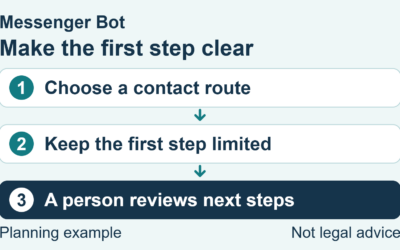
- Create the welcome message. Keep it short. Tell the user what the bot can help with right now, not everything the company has ever done.
- Add three to five menu choices. Good starters are Pricing, Book a Demo, Order Help, Talk to Support, or Talk to a Human.
- Write one clear response per choice. Each response should either solve the question or move the person to the next step.
- Add one capture step. Ask for email, phone, order number, or service type only when it helps the next action.
- Tag or label the conversation. This is what lets you report on intent later and route users correctly.
- Add a fallback path. If the user types something unexpected, the bot should offer help options instead of freezing.
- Add a human handoff option. Never make people fight the bot to reach a person.
Most first-time builders fail on step three. They write responses like website paragraphs. Messenger is not a brochure. It is a mobile conversation. Short blocks, obvious buttons, and next-step clarity matter more than impressive copy.
A First Messenger Flow That Works for Real Businesses
Welcome message
|
+-- Pricing
|   -> Share the short pricing explanation
|   -> Ask whether the user wants a quote, a plan comparison, or a human
|
+-- Book
|   -> Ask which service or product they want
|   -> Capture name plus preferred date
|   -> Send to booking page or team handoff
|
+-- Support
|   -> Ask what type of issue it is
|   -> Capture order number or account email if needed
|   -> Route to help content or human support
|
+-- Talk to a Human
    -> Confirm handoff path and expected response window
That flow is simple, but it does real work. It answers intent, captures context, and keeps the user moving. Once you have that foundation, you can add more branches for language options, product categories, geographic routing, or returning-customer logic. If you want more platform-specific examples for menus, forms, and flow patterns, Bekijk Onze Tutorials after you finish this article.
How to Build Conversation Flows That Do Not Break Under Real Messages
The moment you show a bot to real users, they stop behaving like the clean little demo paths in your head. They tap the wrong button. They type half a question. They send only a screenshot. They ask for pricing in the middle of a support flow. They want a human before they answer the first prompt. A working conversation flow assumes all of that will happen.
Write for Taps First and Typing Second
Buttons, quick replies, and short guided choices are easier to complete than open text. That does not mean you ban typed questions. It means you reduce unnecessary typing where the next step is predictable. If there are only four common reasons people message you, make those four reasons tappable.
A strong rule here is one screen, one decision. If the user has to read a wall of text and then guess what to do next, the flow is already weaker than it should be. Short copy wins because it reduces hesitation.
Every Branch Needs an Escape Hatch
There are three escape hatches every serious bot needs: a fallback reply for unknown inputs, a restart option, and a human route. If any one of those is missing, the flow will trap people. Trapped users do not think “the logic tree needs improvement.” They think the business is ignoring them.
The fallback message should do more than say “I did not understand.” It should recover the conversation. A better version sounds like this: “I can help with pricing, support, booking, or a human handoff. Which one do you need?” That gives the user a clean way back into the system.
Name Your Tags and Fields Like You Expect Another Human to Read Them
Once the bot starts collecting data, sloppy naming creates problems fast. Use simple field names such as intentie, lead_source, support_topic, order_id, preferred_time, en handoff_requested. Avoid vague labels like info1 of step3value. Those names feel harmless during setup and become painful once you are trying to debug integrations or read reports.
A clean bot is not just the one with the nicest customer-facing copy. It is the one where the internal logic is readable. That matters even more once multiple people on your team touch the same workspace.
Use a Conversation Checklist Before You Publish New Paths
- Does each message block have one clear purpose?
- Does every branch tell the user what happens next?
- Can the user request a human without hunting for the option?
- Is there a fallback if the user types something unexpected?
- Are you asking only for data that helps the next step?
- Are the tags and fields named clearly enough for reporting and debugging?
If you run that checklist before every launch, your bot will already be better than most first builds.
How to Add AI to Your Messenger Bot Without Letting It Drift Off Script
AI is useful in Messenger, but only when you decide where flexibility helps and where accuracy matters more than creativity. The safest beginner move is not to let AI answer everything. The safest move is to give AI narrow jobs first.
Start With AI Jobs That Improve the Flow, Not Replace It
The best early AI use cases are intent detection, suggested replies, answer summarization, multilingual rephrasing, and knowledge-base style answers to repetitive questions. Those are high-value tasks because they make the bot feel smarter without giving it full control of the conversation.
For example, if a user types “I still have not received my package and I ordered last Tuesday,” the AI layer can classify that as an order-status issue and push the user into the correct support branch. That is a much safer use of AI than letting it invent a shipping policy on the fly.
Define the Topics AI Can Answer and the Topics It Must Escalate
Set explicit boundaries. AI can handle business hours, product basics, service explanations, qualification questions, or simple troubleshooting. It should escalate billing disputes, refunds, legal issues, account security, highly specific order problems, or anything that depends on data it does not have.
A good rule is this: if the answer could create financial, compliance, or trust problems when wrong, AI should summarize and route, not decide. You do not need to fear AI. You need to scope it.
Make AI Produce Structured Output When Possible
One of the easiest ways to keep AI useful is to make it feed the flow instead of replacing the flow. Ask it to classify intent, detect urgency, choose a known route, or summarize the user’s issue for a human handoff. Structured output is easier to test and easier to trust than open-ended answers.
That matters for global audiences too. If your Page gets messages in multiple languages, AI can help normalize the intent and route the user into the same underlying flow. The bot feels more flexible, but your operational structure stays clean.
Review AI Conversations Every Week at the Start
The first sign that an AI layer is too loose is a rising fallback rate or more human corrections inside the thread. Review real conversations, especially the ones that ended in frustration, repeated questions, or manual overrides. Most AI tuning problems show up quickly: the model was too verbose, too confident, or too willing to answer outside the approved scope.
Think of AI as an accelerator for a good flow, not a rescue plan for a bad one. If the non-AI version is confusing, the AI version usually becomes confusing faster.
How to Connect Your Bot to a Facebook Business Page Correctly
Connecting the bot to the Page is usually straightforward, but this is where beginners create avoidable problems. The interface labels and permission wording change more often than most tutorials admit, so the safest mindset is to focus on the outcome: the bot needs authorized access to the Page’s messaging layer, and you need to test that access with a non-admin user.
Check Access Before You Troubleshoot the Bot
If the Page does not connect, the problem is often not the flow builder at all. It is Page access. Make sure the account doing the connection has the right level of control for messaging, integrations, and connected assets. If your company uses Meta Business Manager, confirm you are working inside the correct business asset group and not a personal Page view with incomplete permissions.
This sounds administrative, but it saves hours. A surprising number of “the bot is broken” issues are really “the wrong account connected the wrong Page with partial access.”
Connect One Page First, Then Expand
If you manage multiple Pages, connect only one at the start. Build and test the first bot in a single environment. Once you know the flow works, you can clone or adapt it for other Pages with less risk. Multi-Page setups become much easier once the naming, routing, and permission model is already proven.
Verify the Entry Points After the Page Is Connected
Do not stop at “connected successfully.” Test how the conversation starts from the places real users actually come from:
- Direct Page message button
- Messenger inbox on mobile
- Comment-to-message campaigns if you use them
- Click-to-Messenger ads if that is part of your funnel
- Website widget if your Messenger setup is paired with on-site chat
A bot that works only from one entry point is not ready. The welcome message, menu, and next-step logic should feel consistent no matter how the conversation began.
Reconnect If Permissions or Ownership Change
If the Page owner changes, the primary admin changes, passwords are rotated, or the business asset structure gets cleaned up, expect to recheck the connection. Do not wait until the bot silently stops doing something important. Re-authentication is normal in connected systems. Treat it like maintenance, not a crisis.
How to Test Your Messenger Bot Before Launch
Testing is where a tutorial stops being theory. A bot is only ready when it survives messy input, not when it passes your favorite demo path. The best launch habit is to test the bot like three different people: the ideal customer, the confused customer, and the impatient customer.
Test the Happy Path, the Messy Path, and the Escape Path
The happy path is the obvious one. A user chooses the expected option, answers each prompt correctly, and reaches the intended outcome. That path matters, but it is not enough.
The messy path is where the user types instead of tapping, gives incomplete information, asks a second question mid-flow, or disappears and comes back later. The escape path is where the user wants a human immediately, restarts the conversation, or asks something the bot cannot answer. Those two paths are what tell you whether the bot is production-ready.
Use This Pre-Launch Checklist
- Test on mobile and desktop. Messenger is mobile-first, so phone testing is mandatory.
- Test with a non-admin account. Admin views can hide customer-facing problems.
- Try at least 20 real phrases. Use the exact language customers actually send.
- Break the flow on purpose. Skip steps, type nonsense, and change topics mid-thread.
- Verify every form field. Make sure the captured data lands where you expect.
- Check the handoff path. Confirm the user can reach a human without friction.
- Review delays and formatting. Messages should appear in a clean order and read naturally.
- Document known limits. Write down what the bot does not handle yet.
I also recommend saving screenshots or sample transcripts from the first testing round. They become your baseline for future edits. If a later version introduces a bug, you will have a clean reference point for what used to work.
Do Not Launch Every Branch on Day One
One of the smartest beginner moves is to leave some nice-to-have paths unpublished until the core flow is stable. It is better to launch one excellent FAQ and lead-capture bot than a giant unfinished tree with eight weak branches. Scope control is part of testing.
Advanced Messenger Bot Features That Make the System Actually Useful
Once the basic flow works, this is where the bot starts acting less like a chat widget and more like a real system. Webhooks, APIs, and integrations are how Messenger conversations begin to affect the rest of the business.
Use Webhooks When You Need Real-Time Events Outside the Bot
A webhook sends data out when something happens. A new lead arrives. A user picks a support category. A booking request is submitted. A handoff is requested. Instead of checking the bot manually, you push that event to another system instantly.
This is especially useful when sales teams, support teams, or dashboards need the data in real time. If you want the developer-side event flow, payload structure, and response handling in more detail, start with our webhook setup guide.
Use APIs When the Bot Needs Live Data Back
APIs are the other half of the equation. A webhook pushes data out. An API pulls data in or sends a request for an action. That matters when the bot needs to look up order status, check appointment availability, validate a coupon, fetch account details, or create a CRM record.
The easiest way to think about it is this: if the bot only needs fixed answers, flows are enough. If the bot needs fresh data from another system, you are moving into API territory.
Start With No-Code Integrations Before Custom Development
Most beginners do not need a custom app on day one. Start with the integrations that reduce manual work fastest: Google Sheets, calendar tools, simple CRM sync, ecommerce handoff, or email notifications. Those connections already solve a lot of business problems without turning the bot project into a software project.
A typical progression looks like this:
- Launch the first working flow.
- Send lead data to a sheet or CRM.
- Tag users by intent and source.
- Connect one live lookup, such as booking availability or order status.
- Add webhook-based notifications for urgent cases.
- Only then consider custom code for advanced business logic.
A Simple Event Payload Example
{
  "subscriber_id": "123456789",
  "intent": "support_order_status",
  "page_source": "facebook_page",
  "customer_email": "user@example.com",
  "handoff_requested": true
}
That is not complicated, and that is the point. Advanced automation becomes manageable when the data leaving the bot is predictable. The cleaner your fields are in the beginner stage, the easier this stage becomes.
How to Monitor Bot Performance With Analytics That Matter
A lot of bot dashboards show activity without showing usefulness. Message count alone does not tell you whether the bot saved time, captured leads, or reduced support load. What you want are metrics tied to outcomes.
| Statistiek | What It Shows | Why It Matters |
|---|---|---|
| Conversation start rate | How often people engage after seeing the entry point | Tells you whether the invitation and channel fit are strong enough |
| Goal completion rate | How many users reach the intended outcome | Shows whether the flow actually works |
| Fallback rate | How often users hit an unknown or weak response | Exposes missing logic, weak copy, or poor intent handling |
| Human handoff rate | How often people need escalation | Shows where automation stops being useful |
| Lead capture rate | How many conversations turn into usable contact records | Critical for sales, service, and follow-up ROI |
| Response time | How quickly the bot gives the first useful answer | Speed is one of the biggest reasons to automate Messenger |
If you are just starting, review the data weekly. Read the conversations with the highest friction. Look for the points where people go silent, ask the same question again, or request a human. Those moments tell you where the flow needs work.
Track One Business Goal Per Flow
Do not judge a support bot and a lead bot by the same scoreboard. A support flow should be measured by resolution, fallbacks, and handoffs. A lead flow should be measured by completion, qualification, and captured details. One of the easiest ways to confuse yourself is to mix all conversation types into one generic dashboard.
Use Analytics to Improve the Script, Not Just Report on It
Analytics should change the build. If fallback rate is high on pricing questions, rewrite the pricing branch. If people ask for a human immediately after the third prompt, shorten the path. If AI answers are too long, constrain them. If a lead form loses people at the phone-number step, move that question later or make it optional.
The best operators do not treat analytics like a vanity panel. They treat it like a weekly edit list.
Common Beginner Mistakes That Create Broken Messenger Bots
Trying to automate the whole business on day one. That is the fastest path to a messy bot. Start with one job, prove it, then expand.
Writing long paragraphs instead of chat-ready copy. Messenger is a fast interface. Short prompts, obvious actions, and mobile-friendly phrasing beat formal marketing copy almost every time.
Hiding the human option. A bot is supposed to reduce friction, not trap people in a maze. If the user wants a person, make that route visible.
Skipping fallback design. Real users never stay inside the script. Without recovery messages, the flow breaks as soon as someone types freely.
Collecting too much information too early. Ask for only what the next step needs. Every unnecessary field lowers completion rate.
Using vague tags and field names. Your future reporting, integrations, and debugging all depend on readable internal labels.
Adding AI before the base flow is stable. AI should enhance a working structure, not hide structural confusion.
Testing only with your own perfect inputs. The bot has to survive rushed, messy, incomplete, and impatient messages.
Ignoring analytics after launch. A bot is not finished when it goes live. The first two weeks usually reveal the best improvements.
Forgetting that platform rules and permissions change. Messenger policies, Page access settings, and business asset controls do not stay frozen. Review them before major campaigns and before assuming the bot is the problem.
The Fastest Way to Launch a Messenger Bot That Still Scales Later
Build one narrow flow first: a welcome message, three to five choices, one data-capture step, one fallback, and one human handoff. Test it with real messages, tune it for a week, then add AI or integrations only where they remove actual manual work. That sequence is what keeps a beginner project from turning into a cleanup project. When you are ready to compare plan limits, features, and the next upgrade path for a live build, Bekijk de prijzen van MessengerBot.
Veelgestelde Vragen
Is het moeilijk om te leren hoe je een Messenger-bot bouwt?
Not if you start with one narrow use case. Most beginners can understand the basics in an afternoon and launch a simple bot the same day. The harder part is not the tool. It is deciding what the bot should handle, what it should hand off, and how to keep the flow short enough for real users.
Heb ik programmeervaardigheden nodig voor een Messenger-bot tutorial?
No. You can build a working Messenger bot with a visual flow builder, buttons, forms, and basic integrations without writing code. Coding only becomes useful when you want custom APIs, complex webhooks, or deeper business logic tied to other systems.
Hoe lang duurt het om Messenger-botbouw te leren?
Je kunt de beginnerslaag in een paar uur leren en een eerste werkende flow bouwen in 20 tot 30 minuten zodra je vragen en antwoorden klaar zijn. Goed worden in flowontwerp, testen, AI-veiligheidsmaatregelen en analytics kost meestal een paar dagen van echt gebruik en een week of twee van iteratie.
What’s the best Messenger bot for beginners?
Voor een Facebook-eerst bedrijf is MessengerBot.app een van de gemakkelijkste startpunten omdat de flowbouwer visueel is, het opzetpad geen code vereist, en je kunt beginnen met eenvoudige menu's voordat je AI of integraties toevoegt. De beste beginners-tool is degene die overeenkomt met je belangrijkste kanaal, maar als Messenger de belangrijkste taak is, is een Messenger-eerste platform de schoonste plek om te beginnen.
Kan ik een Messenger-bot monetiseren?
Ja, maar de praktische manier om een Messenger-bot te monetiseren is via zakelijke resultaten, niet spam. Een bot kan leads vastleggen, afspraken boeken, verlaten gesprekken herstellen, ondersteuning bieden bij e-commerce follow-up, prospects kwalificeren en de werklast van ondersteuning verminderen. Die winsten worden omzet wanneer de flow is gekoppeld aan een echt product, dienst of verkoopproces.

 Nederlands
  English
  Tagalog
  简体中文
简体中文  العربية
  हिन्दी
  Português do Brasil
  Español de México
  Français
  বাংলা
বাংলা  香港中文
香港中文  繁體中文
繁體中文  Deutsch
  Bahasa Indonesia
  日本語
日本語  한국어
한국어  Polski
  Русский
  Español
  Tiếng Việt