
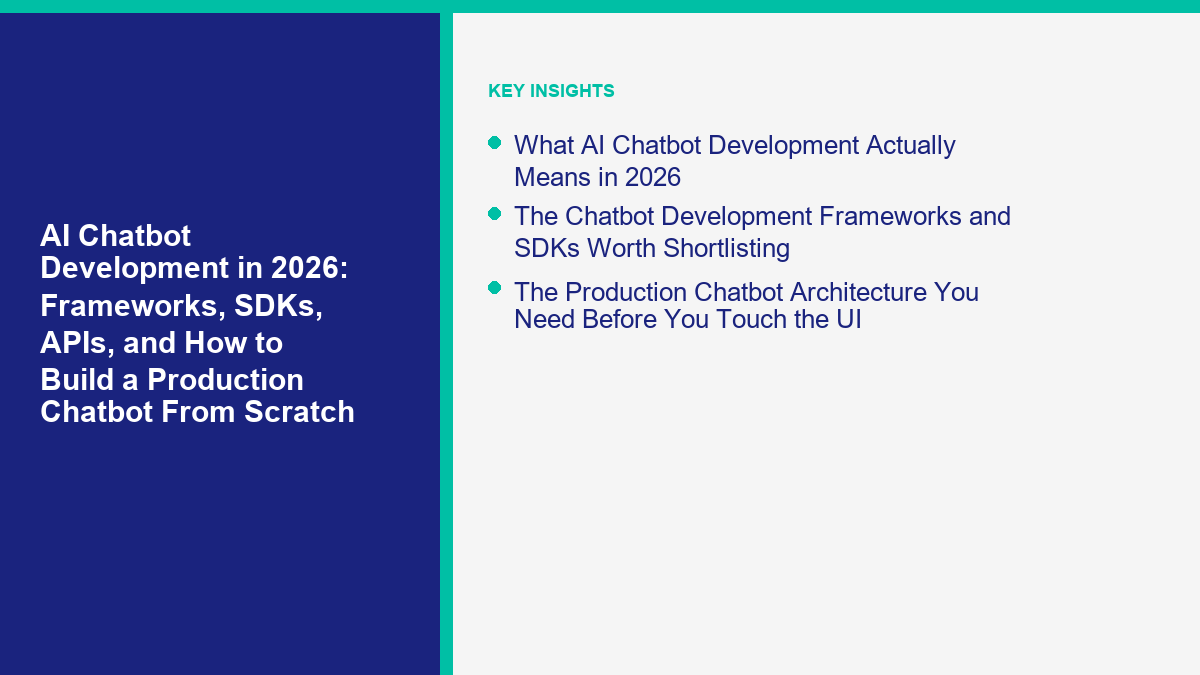
AI chatbot ontwikkeling in 2026 gaat niet voornamelijk om het schrijven van een betere systeemprompt. Het echte werk is beslissen hoe berichten in je stack komen, hoe de bot de volgende actie kiest, waar kennis vandaan komt, welke toolaanroepen zijn toegestaan, hoe de status wordt bewaard, wat wordt gelogd en wanneer een mens de controle moet overnemen. Als die onderdelen zwak zijn, zal de bot er in een demo slim uitzien maar in productie falen.
Ik heb de officiële documentatie en prijs pagina's gecontroleerd die in dit artikel worden genoemd op 12 april 2026. Het huidige landschap is meer uitgesproken dan een jaar geleden. OpenAI richt zich nu op productie chatbots met de Responses API en rekent modeltokens apart van het gebruik van tools; GPT-4.1 staat genoteerd op $2.00 input en $8.00 output per 1M tokens, terwijl GPT-4.1 mini is $0.40 input en $1.60 output. LangSmith begint nog steeds bij $0 per stoel met 5k traceringen inbegrepen, en Plus is $39 per stoel. Botpress begint bij $0 plus AI-uitgaven, met Plus op $79 per maand, jaarlijks gefactureerd. MessengerBot Premium is $19.99 per 30 dagen, Pro is $49,99 per 30 dagen, en het bureau is $299,99 per 30 dagen. Azure AI Bot Service toont nog steeds onbeperkte standaardkanaalberichten op zowel Gratis als S1, maar de oude Bot Framework SDK stopte met het aannemen van ondersteuningsverzoeken na 31 december 2025 en Microsoft wijst nieuwe agentbouwers nu naar de Microsoft 365 Agents SDK.[1][2][3][4][9][13][15][16][18]
Dat is belangrijk omdat er nu twee heel verschillende intenties schuilgaan onder hetzelfde trefwoord. Als je drag-and-drop bouwers, sjablonen en minimale code-eigendom wilt, lees dan onze gids voor AI-chatgenerator zonder code. Dit artikel is voor de andere taak: bouw ai chatbot systemen als ontwikkelaar, kies de juiste chatbot ontwikkelingsframework, en krijg een bot live zonder je backend in prompt spaghetti te veranderen. Als je belangrijkste leveringsdoel Facebook Messenger, Instagram en websitechat is en je wilt niet elke webhook en implementatie-edge case zelf bezitten, begin dan met het controleren van Bekijk de prijzen van MessengerBot.
Wat AI Chatbot Ontwikkeling Eigenlijk Betekent in 2026
De zin ai chatbot ontwikkeling betekende vroeger een van de twee dingen: bouw een intentie-bot met trainingszinnen, of voeg een LLM toe aan een chatbox en hoop dat het zich gedraagt. Geen van beide definities is nu goed genoeg. In productie is een chatbot een conversatiedienst. Het moet routeren, ophalen, verifiëren, uitvoeren, uitleggen, herstellen en doorgeven. Dat is softwarearchitectuur, niet alleen promptontwerp.
Een productiechatbot heeft meestal minstens zeven lagen:
- Ingang: website-widgetgebeurtenissen, Facebook Messenger-webhooks, Instagram-berichten, CRM-triggers of interne app-gebeurtenissen.
- Sessie en identiteit: conversation IDs, user IDs, auth state, page context, and tenant boundaries.
- Routing: rules, intents, LLM classification, or graph transitions that decide the next action.
- Knowledge and tools: retrieval, APIs, database lookups, order status tools, booking tools, or policy documents.
- Reactiegeneratie: the final natural-language answer, button set, or escalation message.
- Observeerbaarheid: traces, model cost, tool latency, hallucination review, failed steps, and handoff rate.
- Safety and control: schema validation, rate limits, allowlists, refusal rules, and human takeover.
That is why the best developer stacks in 2026 are hybrid. You still use deterministic logic for known workflows like refund requests, lead qualification, appointment booking, opt-ins, and account lookups. You use LLMs where language is messy: rewriting, summarizing, extracting slots from natural phrasing, answering grounded questions, or choosing among tools. Pure rules are too brittle for open-ended support. Pure generation is too risky for transactions.
It also helps to separate the types of SDK you are actually choosing. A chatbot sdk can mean a model SDK such as the OpenAI Python or JavaScript library, an orchestration SDK such as LangGraph or Semantic Kernel, or a channel SDK like what you need to ship on Messenger, Instagram, or a website widget. Teams get confused when they compare those categories as if they solve the same problem. They do not. One decides how the model thinks, one decides how the workflow runs, and one decides how messages reach users.
The best mental model is simple: your model is not your architecture. The architecture decides whether the model has a chance to succeed.
The Chatbot Development Frameworks and SDKs Worth Shortlisting
You do not need a spreadsheet with thirty logos. You need a shortlist that matches the kind of chatbot you are actually building. The five names in the prompt are still relevant in 2026, but for different reasons than many buying guides suggest.
| Stack | What it is in 2026 | Openbaar startpunt | Beste pasvorm | Belangrijkste kanttekening |
|---|---|---|---|---|
| OpenAI API | Model API plus Responses, structured outputs, tool calling, and evals | GPT-4.1 mini at $0.40 input and $1.60 output per 1M tokens | Custom backends that want maximum control | You own orchestration, storage, handoff, and channel plumbing |
| LangChain + LangGraph | High-level agent abstractions on top of a lower-level stateful graph runtime | Open-source core, LangSmith from $0 per seat | Teams that need graphs, middleware, tracing, and durable execution | Easy to overbuild if your workflow is really just form logic plus retrieval |
| Rasa | Deterministic flow engine with LLM support and strong control over behavior | Public enterprise pricing not listed on the product page | Compliance-heavy or process-heavy assistants | Higher setup and operations overhead than hosted builders |
| Botpress | Hosted builder with webchat, channels, API/SDK options, and AI spend passthrough | $0 plus AI spend, Plus at $79 billed annually | Teams that want hosted speed with technical escape hatches | Still requires product ownership, not just visual flow design |
| Microsoft Bot Framework | Legacy SDK stack for existing bots, now archived and no longer maintained | Azure AI Bot Service Free tier plus Azure infra costs | Maintaining older Microsoft bot estates | Not the place I would start a new 2026 build |
| MessengerBot | Managed cross-channel platform for Facebook Messenger, Instagram, and websites | Premium $19,99 per 30 dagen | Teams that want channel deployment faster than they want infra ownership | Less flexible than a full custom backend for proprietary agent logic |
Public pricing and positioning checked April 12, 2026 from official pages.[2][4][7][8][9][10][13][15][16][18]
Why OpenAI API Is the Default Starting Point for Custom Builds
OpenAI’s current platform story is cleaner than the old mix of chat, assistants, and ad hoc wrappers. The official docs describe the Responses API as the main interface for generating responses, handling stateful interactions, and extending model behavior with built-in tools and function calling. That makes it a practical base layer if you want to own the bot as software instead of buying a full builder platform.[1]
The key reason to start here is not hype. It is contract quality. OpenAI now gives you tool calling, structured outputs, evals, and a pricing model that is transparent enough to forecast. That does not mean every team should stop there. It means the raw API layer is usable enough now that you can build serious workflows without five extra abstraction layers on day one.
When LangChain and LangGraph Add Real Value
LangChain helps when your bot is no longer a single prompt plus a couple of API calls. The current docs make the split fairly clear: create_agent gives you a production-ready agent implementation, and that implementation runs on LangGraph under the hood. LangGraph is the lower-level orchestration runtime for durable execution, streaming, human-in-the-loop review, and other stateful workflow needs.[7][8]
That means you should not reach for LangGraph just because the word “graph” sounds advanced. Use it when the bot has long-running tasks, retries, checkpoints, approval states, or multiple tool paths that need to be inspectable. If your chatbot is basically a router, a knowledge retriever, and a form collector, plain application code may still be simpler.
Why Rasa Still Matters for High-Control Chatbots
Rasa’s strongest 2026 argument is not old-school intent classification. It is control. The product page now leans hard into CALM, structured flows, recovery patterns, and deterministic logic around LLMs. The Flow Policy docs are even more explicit: Flow Policy is a state machine that deterministically executes the business logic defined in flows and manages conversation state through a dialogue stack.[10][11]
If your assistant touches compliance rules, policy exceptions, approvals, internal tools, or workflows that auditors will eventually inspect, that matters more than marketing gloss. The tradeoff is speed. Rasa is rarely the fastest way to get a friendly FAQ bot live. It is often the right way to ship a workflow bot that needs to stay on rails.
Where Botpress Fits Best
Botpress sits in a useful middle lane. It is hosted, its pricing is public, its AI spend is billed at provider cost without markup, and it exposes both a visual studio and enough API/SDK surface to stay relevant after the first prototype. The pricing page also makes clear that human handoff, insights, proactive webchat prompts, and code-first agent development all live in the same product story.[13]
That makes Botpress attractive for startups and internal product teams that want to move faster than a fully custom stack but do not want to get trapped in a rigid SMB-only builder.
How to Read Microsoft’s Bot Story in 2026
The most important Microsoft fact is a date, not a feature: the Bot Framework SDK is archived and support tickets stopped being serviced on 31 december 2025. Microsoft now points developers toward the Microsoft 365 Agents SDK for new agent work. That SDK handles conversation management, channel/client management, and authentication, while letting you orchestrate with Semantic Kernel or Agent Framework. When I checked on April 12, 2026, Microsoft’s Agent Framework guidance described C# and Python support in public preview for that orchestration layer.[16][17]
The practical reading is simple. Keep Bot Framework only if you already have it. Do not choose it for a greenfield chatbot unless a migration path or Microsoft-specific constraint makes that unavoidable.
The Production Chatbot Architecture You Need Before You Touch the UI
The interface is the last thing I would design. A chatbot that looks polished but has no internal contract usually turns into a maintenance sink. Before buttons, personas, or typing indicators, decide what a single turn of conversation is allowed to do.
A solid production architecture usually looks like this:
- Channel receiver: webhook or widget event endpoint normalizes inbound messages into one internal event format.
- Conversation state store: session data, customer identity, active goal, slots, and last safe action live outside the model.
- Router: rule engine, classifier, or graph node decides whether the turn is informational, transactional, or escalation-worthy.
- Retrieval and tool layer: documents, FAQs, search indexes, and backend actions are exposed through narrow interfaces.
- Responslaag: the model or template generates the next answer under a clear schema.
- Audit layer: logs, traces, tool latency, token cost, and failure reasons are captured for review.
The most common mistake is letting the model directly decide all of that in free text. A better pattern is to force the model to emit structured state changes. OpenAI’s structured outputs docs are useful here because they explicitly promise JSON-schema adherence, which is exactly what you want for routers, slot fillers, and action selectors.[5]
{
  "channel": "website",
  "goal": "refund_request",
  "slots": {
    "order_id": null,
    "reason": null
  },
  "next_action": "ask_order_id",
  "handoff_required": false,
  "risk_flags": []
}
That kind of schema does three useful things. It makes the bot testable, because you can assert against actions instead of vibes. It makes the bot safer, because backend code can reject impossible transitions. And it makes channel rendering simpler, because your website widget, Facebook Messenger layer, and Instagram layer can all map from the same internal decision object.
If you are building with LangGraph, that state object naturally becomes part of the graph state. If you are building with Rasa, it becomes the conversation’s deterministic flow context. If you are building directly on the OpenAI API, it becomes the contract between your router, tools, and responder. Same principle, different stack.
The UI should sit on top of that architecture, not substitute for it.
How to Choose Models, APIs, and Tools Without Burning Budget
A lot of teams overspend because they use one large model for every task in every turn. That is lazy architecture. Not every chatbot step needs the same level of reasoning.
OpenAI’s current model pages make a practical split easy. GPT-4.1 is positioned as the strongest non-reasoning model with a 1M-token context window and tool support, at $2.00 input en $8.00 output per 1M tokens. GPT-4.1 mini keeps the same 1M-token context window, stays strong at instruction following and tool calling, and drops to $0.40 input en $1.60 output per 1M tokens.[3][4]
For most production bots, that suggests a tiered design:
- Small or medium model for routing: classify the turn, extract slots, decide tool eligibility, or detect escalation.
- Larger model for synthesis only when needed: complex support explanations, policy summaries, or multi-tool answer composition.
- No model at all for deterministic turns: known commands, menu choices, authenticated account actions, and button-led flows.
The tool layer matters just as much as the model layer. OpenAI’s pricing page shows that built-in tools have their own economics: web search is $10 per 1,000 calls, file search tool calls are $2.50 per 1,000 calls plus $0.10 per GB per day for storage after the free tier, and Code Interpreter or Hosted Shell containers are billed per 20-minute session based on container size.[2] That means a chatbot can stay cheap on token spend and still become expensive if you allow tool calls on every turn.
The practical rule is this: tool calls should be earned, not assumed. Do not run retrieval when the question is already covered by structured state. Do not call web search when your internal knowledge base is the source of truth. Do not let the model trigger order lookup, refund initiation, or CRM writes without schema validation and permission checks.
If you need orchestration help here, LangChain’s agent stack and LangGraph’s runtime can help you inject context, middleware, memory stores, and tool wrappers in a way that stays inspectable. If you do not need that yet, plain application code plus the OpenAI SDK is often cleaner.[7][8]
How to Build an AI Chatbot From Scratch Without Creating a Prompt Spaghetti Mess
If I had to build a production chatbot from zero this week, this is the order I would use. Not because it is academically pure, but because it minimizes rework.
- Pick one business job. Start with one narrow goal like lead qualification, appointment booking, order tracking, or support deflection. A chatbot that tries to sell, support, onboard, and upsell on day one usually does all of them badly.
- Define the state schema before the prompt. Write down the fields you need to finish the job: user ID, goal, required slots, last action, allowed tools, escalation flag, and completion status.
- Build a router that outputs actions, not prose. Use rules, buttons, or structured model outputs to decide
ask_question,call_tool,search_docs,handoff, offinal_answer. - Wrap every backend action in an idempotent tool. Checking inventory, logging a lead, fetching an order, or opening a ticket should be independently testable and safe to retry.
- Add retrieval only where grounding matters. Product policies, support articles, pricing FAQs, and procedural content belong in retrieval. Account balances and live order status do not.
- Separate channel rendering from bot logic. The internal action should be the same whether the user came from website chat, Facebook Messenger, or Instagram. Only the presentation layer should differ.
- Create fallback routes on purpose. You need at least a clarification path, a safe refusal path, and a human handoff path.
- Log everything from the first day. Prompt changes are not manageable if you do not have traces, tool payloads, and user-visible outputs stored in one place.
This is where frameworks either help or get in the way. OpenAI gives you the raw primitives. LangGraph helps once your steps need to persist, branch, retry, or pause. Rasa helps if the flow itself is the product and reliability matters more than improvisation. Botpress helps if you want that stack mostly hosted. MessengerBot helps if your real bottleneck is shipping the channel experience itself, not designing the entire orchestration layer.[1][8][11][13][18]
The thing most teams underestimate is how early the maintenance cost appears. The first version feels fast. The second week is where the real work starts: prompt regressions, unexpected user phrasings, tool timeouts, duplicate webhook deliveries, stale knowledge, and support staff asking why the bot sounds confident when it is wrong. Build for that week, not just the first demo.
NLU, Routing, and Grounding That Keep a Production Chatbot Reliable
Natural language understanding is not dead. It just moved up a layer. In 2026, the question is not “intent classifier or LLM?” The question is “which parts of understanding should stay deterministic, and which parts benefit from flexible language parsing?”
Rasa’s current design is a good example of the modern answer. Flow Policy deterministically runs the business logic, while LLM-driven dialogue understanding can translate messy user language into commands that move the conversation forward. That is the right split for any chatbot that handles money, sensitive requests, policy constraints, or multi-step forms.[11]
You can reproduce the same pattern on other stacks:
- Deterministic entry points: buttons, menus, slash commands, and known intents for common high-confidence routes.
- Structured extraction: use a model to pull slot values, route labels, or action plans under a schema.
- Grounded answering: retrieve trusted documents and require the final answer to stay within them.
- Escalatieregels: low confidence, high-risk topic, angry customer language, repeated repair loops, or missing data should trigger handoff.
OpenAI’s structured outputs feature is especially useful here because it gives you reliable type-safety and explicit refusals. That is not just a developer convenience. It is what lets you distinguish “I could not parse this safely” from “the model invented an answer that happens to look valid.”[5]
Grounding needs equal discipline. Retrieval is not magic. If your knowledge base is outdated, poorly chunked, or filled with duplicative marketing copy, the bot will still answer badly. A good support or sales bot usually has separate corpora for policy, product facts, troubleshooting steps, and internal operating instructions. It should also log which document chunks were used, so reviewers can see whether the bad answer came from retrieval, reasoning, or the underlying source content.
The fastest way to improve answer quality is usually not another prompt tweak. It is cleaning the source material, narrowing the allowed tools, and adding better router outputs.
How to Deploy One Bot Across Facebook Messenger, Instagram, and Website Chat
Channel work is where a lot of otherwise solid chatbot builds become messy. The backend might be fine, but the message transport, formatting differences, and identity mapping start leaking into business logic. That is a design mistake.
The cleaner pattern is to normalize every inbound event into one internal envelope:
{
  "channel": "instagram",
  "external_user_id": "1789...",
  "conversation_id": "ig:1789...",
  "message_type": "text",
  "text": "I need help with my order",
  "attachments": [],
  "timestamp": "2026-04-12T18:34:21Z"
}
Once you do that, the router and tool layer no longer need to care whether the turn came from Meta or from your site. They only care about the internal contract.
Website chat is usually the easiest place to start. You control the widget, the pace of deployment, and the surrounding page context. Botpress leans into that with a customizable webchat and a React library that requires React 18 or higher. MessengerBot also gives you website chat inside the same platform that handles Meta channels, which is useful if your goal is unified lead capture and support rather than custom frontend engineering.[14][18]
Facebook Messenger and Instagram are different. The conversational surface looks simple to end users, but the implementation burden is higher: channel events, permission scopes, webhook reliability, message format constraints, and account or page mapping all matter. That is why a lot of teams build the conversation core themselves and then use a managed platform or channel-specific product for the last mile.
If you would rather spend your time on flows, offers, and support logic than on cross-channel setup details, Bekijk Onze Tutorials. That is the more practical next step once you know the architecture and want help getting the channel layer live.
The big rule is to keep channel formatting separate from intent and action logic. Quick replies, carousels, button limits, and attachment types belong in adapters. Order lookup, lead capture, and support flows belong in the core bot.
Testing and Evals That Catch Problems Before Users Do
A chatbot without an eval set is still a prototype. You need an automated way to tell whether a prompt tweak, retrieval change, model switch, or tool refactor made the system better or worse.
OpenAI’s platform now includes Evals as a first-class API surface for creating, managing, and running evaluations. That matters because chatbot quality problems are rarely visible from unit tests alone. You need scored conversations, expected outcomes, and repeatable runs against real examples.[6]
LangSmith is relevant here too because its public pricing page explicitly bundles tracing, online and offline evals, annotation queues, monitoring, and alerting into the developer workflow. That combination is why LangChain stacks often feel easier to debug than hand-rolled agent loops that only log final text.[9]
Rasa is also worth studying on testing discipline. The current test conversion docs recommend running the conversion command against 30 to 50 sample conversations per skill or use case, then reviewing and augmenting the generated end-to-end tests with human judgment. That is a good baseline even if you are not using Rasa. Real conversations should shape your tests.[12]
My minimum production eval pack for a customer-facing chatbot looks like this:
- Happy-path tasks: the bot completes the top 10 workflows end to end.
- Ambiguous phrasing: users ask the same thing in sloppy or indirect language.
- Tool failure drills: API timeout, malformed tool payload, auth error, missing database row.
- Grounding checks: the answer stays inside approved source content.
- Escalation checks: the bot knows when to stop and hand off.
- Safety checks: it refuses unsupported, risky, or policy-breaking requests.
Do not skip transcript review. Evals catch regression. Humans catch weirdness. You need both.
Monitoring, Rollbacks, and Cost Controls for Live Chatbot Systems
Going live is not the finish line. It is the start of the operational phase. This is where a lot of chatbot projects quietly die, because nobody budgeted for monitoring, redaction, or rollback discipline.
Your monitoring stack should answer five questions fast:
- Did the bot answer correctly?
- Did the bot use the right tool?
- How much did the turn cost?
- How long did the turn take?
- Should the conversation have gone to a human?
That sounds obvious, but a lot of teams only log the final answer. That is not enough. You need prompt version, model, retrieved chunks, tool inputs and outputs, error objects, latency, and handoff flags. If a conversation went wrong, a reviewer should be able to replay the decision path without guessing.
Rollbacks also need discipline. Do not change the prompt, the tool schema, and the retrieval index on the same deploy if you want to know what caused a regression. Ship one class of change at a time. Keep prompt and graph versions explicit. Shadow test major changes against a replay set before they touch real users.
On cost control, the important metric is rarely raw token spend. It is usually cost per resolved conversation of cost per successful task. A more expensive model can still be cheaper overall if it reduces retries, handoffs, or wasted tool calls. The opposite is also true: a cheap model becomes expensive when it creates two extra follow-up turns and then sends the user to an agent anyway.
If your custom build has already proven demand and the next bottleneck is broader page coverage, more widgets, or deeper Instagram support rather than bespoke orchestration, Upgrade to MessengerBot Pro only when that operational load is real. That is the right reason to move up-market: because the current deployment is working, not because the feature list looks impressive.
2026 Pricing Comparison for OpenAI, LangChain, Rasa, Botpress, Microsoft, and MessengerBot
The list-price view below is useful, but only if you read it correctly. List price tells you entry cost. It does not tell you ownership cost. A cheap API can still be expensive once you add engineering time, eval tooling, hosting, monitoring, and support review.
| Platform | Huidig openbaar startpunt | Main billing logic | What that price does not include |
|---|---|---|---|
| OpenAI API | GPT-4.1 mini at $0.40 input and $1.60 output per 1M tokens | Per-token model billing plus tool charges | Your app hosting, state store, observability stack, channel adapters, and support ops |
| OpenAI built-in tools | Web search $10 per 1k calls, file search tool calls $2.50 per 1k, file storage $0.10 per GB-day | Usage based | Model tokens are billed separately from tool usage |
| LangSmith | Developer $0 per seat, Plus $39 per seat | Seat plus trace volume | Your actual model spend and deployment environment |
| Rasa | No self-serve public list price on the product page | Enterprise sales motion plus your infra choice | Implementation and operations ownership are the real budget line |
| Botpress | $0 plus AI spend, Plus $79 billed annually | Platform fee plus provider-cost AI spend | Conversation design, knowledge maintenance, and human support processes |
| Azure AI Bot Service | Free tier with unlimited standard channels and 10k premium messages per month on Free | Azure service plus App Service and related Azure resources | Actual premium-channel cost is region-calculated, plus app hosting and telemetry |
| MessengerBot | Premium $19,99 per 30 dagen | Flat feature tiers | Deeply custom orchestration beyond what the platform is built to manage |
Pricing references checked April 12, 2026.[2][4][9][10][13][15][18]
The useful takeaway is this: custom stacks often look cheap at low volume because raw token costs can be tiny. Then the real cost shows up in engineering time, prompt QA, trace review, and channel maintenance. Managed platforms often look more expensive up front, but they remove a lot of hidden operational work. Neither path is universally better. It depends on whether your constraint is budget, control, speed, or compliance.
When Building Custom Is Worth It and When MessengerBot Is the Faster Move
Build custom when one of these is true:
- You need proprietary business logic across multiple internal systems.
- You need strict control over tool access, hosting, redaction, and auditability.
- You are building the chatbot as a product, not just using it as a channel.
- You expect the workflow graph to evolve into something closer to an application than a support widget.
Use a managed platform first when one of these is true:
- Your main channels are Facebook Messenger, Instagram, and website chat.
- Your team needs leads, replies, and basic support flows faster than it needs a custom agent runtime.
- You do not want to maintain every channel adapter, deployment edge case, and user-management detail yourself.
- You want predictable flat pricing more than low-level orchestration control.
MessengerBot is strongest in that second category. The current pricing page lists Premium with one Facebook account, five pages, one chat widget, one eCommerce store, website chat, Visual Flow Builder, JSON API plus Zapier, forms, persistent menus, and subscriber tooling. Pro expands page count, chat widgets, stores, and Instagram chatbot access. That is not the same thing as a full developer framework, and it should not be judged as one. It is a deployment platform for businesses that mainly need conversational automation across Meta channels and the web.[18]
That is also why this article and the no-code guide should not compete. If your job is owning the entire architecture, stay here. If your job is shipping business conversations fast with less code ownership, the builder route is usually smarter.
The Version-One Launch Checklist for AI Chatbot Development
The fastest way to miss a launch is to keep improving a bot that has never been forced into a narrow production shape. Version one should be boring in the right places.
- One core job: pick the single workflow that matters most.
- One state contract: write the schema before the prompt.
- One safe retrieval corpus: do not dump your entire website into the first index.
- One human handoff path: make escalation obvious and test it.
- One replayable eval set: keep a golden dataset of real conversations.
- One observability layer: traces, tool logs, cost, latency, and prompt versions in one place.
- One rollback plan: prompt version, tool version, and retrieval version should be separable.
- One cost alarm: watch tool calls and long conversations, not just token totals.
- One channel at a time: prove the core logic before multiplying adapters.
If you want the shortest route from idea to cross-channel launch, Bekijk de prijzen van MessengerBot and compare it honestly against the engineering ownership described above. If the first live build works and you outgrow the base tier, Upgrade to MessengerBot Pro when the added widgets, channel capacity, or Instagram features are actually needed. If you build chatbot systems for clients, agencies, or consulting projects, Sluit je aan bij ons affiliate programma once you have a repeatable deployment process. That should be an upside, not the reason you chose the platform.
Veelgestelde Vragen
Wat is het beste framework voor de ontwikkeling van AI-chatbots in 2026?
Het beste framework hangt af van de taak. OpenAI API is het schoonste ruwe startpunt voor op maat gemaakte builds, LangChain en LangGraph helpen wanneer workflows stateful en meervoudig zijn, Rasa is het sterkst wanneer controle en deterministische stromen belangrijk zijn, en Botpress is nuttig wanneer je gehoste snelheid wilt met ontwikkelaarsuitgangen.
Heb ik LangChain nodig om een AI-chatbot te bouwen met de OpenAI API?
Nee. Veel productie-bots zijn eenvoudiger en gemakkelijker te onderhouden met directe applicatiecode plus de OpenAI SDK. Voeg LangChain of LangGraph toe wanneer je grafische orkestratie, middleware, duurzame uitvoering, tracing of complexere toolworkflows nodig hebt.
Is het Microsoft Bot Framework in 2026 nog steeds de moeite waard om mee te beginnen?
Niet voor de meeste greenfield-projecten. Microsoft heeft het Bot Framework SDK gearchiveerd en is gestopt met het ondersteunen van supporttickets vanaf 31 december 2025. Voor nieuw werk stuurt Microsoft ontwikkelaars naar de Microsoft 365 Agents SDK.
Hoeveel kost het om een AI-chatbot vanaf nul te bouwen?
De kosten van het ruwe model kunnen verrassend laag zijn, vooral bij kleinere modellen zoals GPT-4.1 mini, maar dat is slechts één kostenpost. De werkelijke kosten komen voort uit engineeringtijd, hosting, tracering, testen, onderhoud van de retrieval, menselijke beoordeling en kanaaldeployment. De verborgen kosten zijn meestal eigendom, niet tokens.
Wanneer moet ik MessengerBot gebruiken in plaats van een aangepaste chatbotstack?
Gebruik MessengerBot wanneer je belangrijkste doel is om snel werkende gesprekken op Facebook Messenger, Instagram en websites te verzenden, met minder eigenaarschap van kanalen en infrastructuur. Bouw op maat wanneer je chatbot een product is, eigen orkestratie nodig heeft of strengere backend- en compliance-eisen heeft.
Sources and Pricing References
All references below were checked on April 12, 2026. Where a Microsoft or vendor page includes a cutoff date or future-facing note, that exact date is stated in the article.
- OpenAI Responses API Reference
- OpenAI API Pricing
- OpenAI GPT-4.1 Model Page
- OpenAI GPT-4.1 Mini Model Page
- OpenAI Structured Outputs Guide
- OpenAI Evals API Reference
- LangChain Agents Documentation
- LangGraph Overview
- LangSmith Plans and Pricing
- Rasa Platform Product Page
- Rasa Flow Policy Documentation
- Rasa Test Case Conversion Documentation
- Botpress Pricing
- Botpress Webchat React Library
- Azure AI Bot Service Pricing
- Microsoft Bot Framework SDK Overview and Archive Notice
- Microsoft 365 Agents SDK with Semantic Kernel and Agent Framework
- Bekijk de prijzen van MessengerBot
 Nederlands
  English
  Tagalog
  简体中文
简体中文  العربية
  हिन्दी
  Português do Brasil
  Español de México
  Français
  বাংলা
বাংলা  香港中文
香港中文  繁體中文
繁體中文  Deutsch
  Bahasa Indonesia
  日本語
日本語  한국어
한국어  Polski
  Русский
  Español
  Tiếng Việt