

What “AI Conversation Websites” Actually Means in 2026
The landscape of web-based artificial intelligence has transitioned from a novel experiment into a fundamental utility for professionals, students, and businesses alike. Only a few years ago, accessing advanced artificial intelligence required software development expertise, complex API configurations, or navigating clunky command-line interfaces. Today, consumer-facing portals allow anyone to interact with sophisticated neural networks through simple browser tabs. These portals, collectively referred to as ai conversation websites, have evolved far beyond basic text completion text boxes. They are now dynamic digital workspaces that combine natural language processing with web search engines, sandboxed code environments, interactive canvases, and multimodal processing units.
When selecting the best ai conversation site, it helps to understand what is happening behind the interface. When you type a query, the website does not simply look up an answer in a pre-written database. Instead, it processes your input through a large language model that predicts the most logical, contextually appropriate sequence of words based on its training. In 2026, these platforms have become highly specialized. Some focus entirely on speed and real-time retrieval, while others prioritize deep analytical reasoning, creative writing assistance, or technical coding execution. Understanding these nuances is essential for choosing the correct tool for your specific workflow.
The consolidation of the AI sector has led to a standard design pattern across most platforms. A typical interface features a sidebar tracking chat history, a primary message window, and an input box that accepts text, documents, code snippets, or images. However, the capabilities under the hood vary drastically. A site that excels at drafting clear, professional emails might struggle with complex mathematical reasoning, while a search-focused platform might fail to generate creative narrative prose. As user expectations rise, matching the correct platform to the specific task is the key to maximizing efficiency and getting accurate results.
Furthermore, these platforms now integrate workspace features such as side-by-side document editing, interactive diagram rendering, and real-time environment compilation. This shift means users no longer just copy-paste text back and forth between applications. Instead, they collaborate with the system directly inside the web interface, refining code, editing drafts, and structuring datasets in real time. As these tools become more interactive, they function less like passive answer boxes and more like active collaborators in daily workflows.
How These Platforms Actually Differ
To evaluate various platforms, one must look past marketing taglines and focus on the technical variables that dictate performance. When analyzing how ai chat platforms compared perform in everyday environments, four core pillars emerge: model architecture, context window size, web search integration, and multimodal processing.
Model Architecture and Logic Flow
The core intelligence of any conversation website depends on the underlying model architecture. Some platforms rely on monolithic models designed to handle a broad range of general queries. Others utilize mixture-of-experts systems, which route your prompt to specialized subnetworks based on whether you are asking for python debugging, a translation, or a historical summary. Recently, developers have focused heavily on reasoning models. These models spend additional time calculating logical steps before displaying a response, making them highly effective for logical deduction, mathematical troubleshooting, and scientific analysis, though they are slower than traditional chat models. These reasoning models display their thought processes in collapsible drop-down menus, allowing users to verify the analytical steps taken to arrive at a conclusion.
Context Windows and Memory Management
The context window represents the total volume of text a model can process during a single interaction. This includes your prompt, the files you upload, and the previous turns of the conversation. Context is measured in tokens, which are small word fragments. A model with a small context window will quickly forget what was discussed at the beginning of a long chat session, leading to repetitive or irrelevant answers. Conversely, models with large context windows can analyze entire books, hours of codebase files, or massive spreadsheets in a single prompt. However, simply having a large context window does not guarantee accurate recall. The model must also possess high retrieval accuracy to find specific details buried deep within large volumes of uploaded text, a capability often tested using the needle-in-a-haystack evaluation method.
Search Integration and Live Web Access
Static training data restricts an AI’s knowledge to a specific cutoff date. To address this, many platforms integrate web search functionality. When you ask a query about recent events, the platform converts your question into search queries, runs them through web indexes, and parses the top results to draft its answer. The accuracy of this process depends on how well the platform filters out spam, ranks trustworthy sources, and synthesizes contradictory information. A platform with poor search integration will often present outdated details or hallucinate facts based on mismatched search results. High-quality search-enabled conversation sites provide clear inline citations linking directly to the source domains, allowing users to verify facts manually.
Multimodal Support and File Processing
Modern workflows involve more than just raw text. Users frequently upload screenshots, spreadsheets, charts, and audio files. The degree to which a platform processes these inputs is a major differentiator. Some platforms merely perform optical character recognition to extract text from images, while others possess native visual intelligence, allowing them to analyze charts, trace design layouts, and identify patterns in visual media. The ability to run code in a sandboxed environment to analyze uploaded data files also separates advanced workspaces from basic chat interfaces. For example, a multimodal platform can parse a photo of a handwritten whiteboard diagram and automatically convert it into a structured database schema or a vector graphic file.
Best AI Conversation Websites for Everyday Use
Conducting an honest ai chatbot comparison 2026 requires looking closely at the primary platforms dominating the market. Each has developed a distinct identity and feature set tailored to specific user groups.
ChatGPT (OpenAI)
As the pioneer of the modern conversation interface, ChatGPT remains a versatile choice. It balances quick conversational responses with deep reasoning modes suitable for complex tasks. The platform features an integrated workspace that allows users to write code, build custom templates, and execute data analysis tasks within a sandboxed environment. Its strength lies in its generalist performance, performing consistently well across writing, coding, and logical analysis. However, its free tier can experience resource constraints during peak periods, and the model’s tone can occasionally feel overly polished or formulaic without custom instructions. Users can build their own custom versions of the chat interface for specific workflows, which helps tailor the model’s default behavior to match specific brand guides or technical standards. For general productivity, it remains a central benchmark against which other platforms are evaluated.
Claude (Anthropic)
Claude has established a strong reputation for producing natural, nuanced text that avoids many of the repetitive styling patterns common in generative models. It is highly favored by writers, editors, and researchers due to its ability to parse complex academic papers and maintain a consistent stylistic tone. The platform features a workspace tool called artifacts, which renders documents, code, and diagrams in a side-by-side view, keeping the main chat clear. While Claude is an exceptional tool for ai chat for research and writing, its free version features strict rate limits that can restrict heavy use throughout the day. Its strength in code syntax, long document summaries, and analytical reports makes it a favorite among software engineers and technical writers who require high-precision output. The model’s answers tend to feel less robotic and more closely aligned with human editorial standards.
Gemini (Google)
Gemini stands out for its integration with Google’s search engine and web workspace tools. This connection makes it highly effective for tasks requiring real-time web retrieval, mapping locations, or importing data directly from spreadsheets and documents. Furthermore, Gemini offers some of the largest context windows available on the consumer market, allowing users to upload massive files that would overwhelm other interfaces. Its performance is optimized for real-time information retrieval, making it highly competitive for current events, though its creative styling is sometimes more direct and less detailed than its competitors. For researchers working with large datasets, the ability to upload hours of video or millions of words of text directly into the chat pane provides an unmatched capability. It functions as an analytical scanner that quickly points out relevant sections within massive media files.
Copilot (Microsoft)
Copilot is designed to integrate closely with office productivity suites and web search systems. It relies on Microsoft’s search infrastructure to supply highly referenced answers, complete with citations. Because it is built directly into operating systems and office software, it is a convenient option for users seeking quick summaries, document drafts, and spreadsheet formulas without opening separate browser tabs. Its interface prioritizes structured task completion, though it can feel more restrictive and less conversational than standalone platforms. For business users already operating within a corporate ecosystem, Copilot provides an easy entry point that connects directly to daily email systems and internal documents, streamlining basic writing tasks. The primary value lies in its convenience and proximity to standard office tools rather than its conversational depth.
Perplexity AI
Perplexity AI takes a search-first approach to conversation. Instead of focusing on creative text generation, it functions as an answering engine that queries the web, compiles multiple sources, and outputs a structured answer with clear citations. Users can follow up with natural language questions to refine their search. It is an excellent choice for research, news tracking, and factual verification. However, it is not designed for creative drafting, long-form storytelling, or complex programming, as its primary purpose is information gathering rather than content creation. By presenting sources upfront, it helps reduce the risk of hallucination that is common in purely generative systems. For users who need to verify facts quickly, Perplexity functions as an advanced, conversational search index that replaces standard keyword queries with structured syntheses.
Free vs Paid: What You Actually Give Up on the Free Tier
Most AI platforms offer both free and paid subscription options. While free ai chat tools have improved significantly, they come with built-in limitations that affect professional use. The primary trade-off involves model access. Free tiers typically route users to smaller, faster models that lack the advanced reasoning, logical debugging, and large context windows of premium models. During times of high traffic, free users may experience latency or temporary service interruptions, as priority bandwidth is allocated to paying members. Furthermore, data upload features on free accounts are often constrained, preventing users from analyzing large PDFs or complex spreadsheets.
Paid tiers, generally structured as monthly subscriptions, grant priority access to state-of-the-art models and advanced logic tools. These premium tiers also include higher rate limits, larger document upload capacities, and access to beta features like custom instructions, web analysis tools, and code environments. For users who only require quick email proofreading or basic search assistance, the free tiers are usually sufficient. However, professionals relying on these tools for daily programming, massive document analysis, or intensive content production will find that the time saved by a paid tier easily offsets the cost. Additionally, paid tiers often include higher privacy standards, allowing users to opt out of data training more easily.
Another major distinction lies in API access and advanced workspace customizations. While a free user relies strictly on the default web interface, premium subscribers often get early access to experimental features, such as voice modes, image generators, and collaborative workspace documents. Paid accounts also experience fewer message caps, meaning you can sustain long, complex debugging or writing sessions without being blocked or downgraded to slower models mid-workflow. If your work depends on consistent performance and uninterrupted access, relying solely on free services can introduce unpredictable bottlenecks into your day.
Best Use Cases: Practical Applications for These Tools
Maximizing the utility of conversation websites requires understanding where they provide the most value. Rather than treating them as magic boxes that can do everything, successful users treat them as specialized virtual assistants.
AI Chat for Research and Writing
For academic and professional writing, these platforms serve as powerful editing partners. Instead of asking the AI to write an entire report from scratch—which often results in generic, low-value text—users get better results by using the platform to organize rough notes, refine drafts, or translate complex jargon into plain language. Research tasks benefit from using AI to summarize long reports, pull key themes from transcripts, and identify logical gaps in drafts. When using ai chat for research and writing, verifying references remains a crucial step, as models can occasionally hallucinate source details. By structuring prompts to ask for critiques rather than outright drafts, you can preserve your unique voice while polishing grammar and sentence flow.
Brainstorming and Concept Mapping
AI tools are highly effective for overcoming blank-page syndrome. By prompting a model to generate multiple structural outlines, marketing angles, or naming ideas, users can quickly find directions they might not have considered. You can instruct the model to adopt specific personas—such as a critical editor, a skeptical customer, or a project manager—to test your ideas from different perspectives. This interactive workflow helps refine concepts before dedicating significant time to development. For example, you can ask a model to challenge your project plan by highlighting potential logistical risks or identifying overlooked costs, converting the chat window into a collaborative sandbox.
Self-Guided Learning and Explanations
For educational purposes, conversation websites act as customizable tutors. If you are struggling to understand a complex concept, you can ask the model to explain it using simple analogies or break it down for a beginner. You can follow up with specific questions, ask for practical examples, or request a practice quiz to test your comprehension. This interactive loop makes learning new subjects much faster than reading static textbooks. Whether you are studying historical events, complex scientific systems, or language grammar, the ability to ask follow-up questions in real-time creates an active learning environment that adapts to your learning speed.
Coding Assistance and Debugging
For software development, these platforms speed up debugging and boilerplate generation. Developers use them to write repetitive code blocks, translate functions between programming languages, and explain cryptic compiler errors. By running code samples in the chat or explaining logical bugs, users can quickly identify errors that might take hours to find manually. However, reviewing and testing all generated code remains essential to prevent security vulnerabilities or logical errors in production environments. Software development tools built into these platforms also allow for live execution of Python scripts, enabling quick data visualization and file operations directly inside the chat interface.
Privacy Considerations When Chatting With Any AI Platform
When using any AI conversation website, it is crucial to understand what happens to the information you type into the prompt box. By default, most consumer-facing AI services retain your chat history and use those conversations to retrain future models. This means that if you paste sensitive code, proprietary business data, or private customer records into the chat, there is a risk that information could influence future model outputs or be reviewed by human moderators. Understanding how your data is handled is a prerequisite for professional use.
To protect your privacy, you should take several steps. First, look through the settings menu of the platform you are using to locate data sharing and history options. Most platforms allow you to turn off history tracking or opt out of data sharing for training purposes. Second, consider using developer API portals or specialized team workspaces. These business-tier services usually operate under strict data privacy agreements that guarantee your data will never be stored or used for model training. As a general rule, never input information into a public AI chat that you would not want to be made public. Furthermore, some platforms offer regional data compliance settings, allowing users under strict regulations to ensure their data remains hosted within specific jurisdictions.
It is also wise to audit the third-party integrations or plugins you enable within these platforms. When you grant a chat assistant permission to search the web, access your email inbox, or link with external file systems, you are potentially sharing data with multiple entities. Each external system has its own privacy policies that may not match the primary platform’s standards. By practicing data minimization—only sharing the exact text or data necessary to complete the current task—you can leverage these productivity tools without exposing sensitive corporate or personal details.
Common Mistakes People Make Choosing an AI Chat Platform
One of the most frequent mistakes is assuming that all AI platforms are essentially the same. Because many tools share similar layouts, users often expect them to perform identically. In practice, a model optimized for conversational writing will struggle with complex mathematics, while a search-first model will produce dry, overly academic drafts. Selecting a tool without matching it to the specific task leads to poor results and frustration. For instance, using a model known for creative writing to perform financial calculations can lead to subtle logic errors that are difficult to spot.
Another error is relying on outdated reviews or benchmarks. The AI field moves rapidly, and models that led the market six months ago may now be outclassed by newer updates. Users should regularly test different platforms on their standard workflows rather than sticking with one service out of habit. Additionally, many users ignore the difference between consumer chat interfaces and developer API access, missing out on the cost savings and privacy protections that APIs provide for high-volume tasks. Finally, over-reliance on a single platform can create workflow bottlenecks when that service experiences downtime or alters its pricing structures.
How to Evaluate a New AI Conversation Site Before Relying On It
With new platforms launching frequently, having a systematic way to evaluate them is useful. First, verify the source of the model. Is the site running its own proprietary models, or is it a wrapper using APIs from established providers? Wrappers can add useful features, but they also introduce an extra point of failure and potential privacy risks. Second, test the model’s accuracy on factual queries. Ask questions with known, slightly obscure answers to see if the platform cites reliable sources or hallucinates plausible-sounding errors. A reliable platform should provide direct links to sources and allow you to verify its claims easily.
Next, evaluate the platform’s speed and user interface stability. A model that takes a full minute to generate a response may not fit a fast-paced coding workflow, even if its answers are highly detailed. Finally, check the site’s data policy. Ensure there are clear opt-out settings for data training and that the company behind the site has a transparent business model. If a platform is completely free with no clear path to monetization, you should assume your conversational data is being commercialized. Evaluating support resources, developer documentation, and the frequency of system updates can also give you a good indication of the platform’s long-term viability.
When a Business Chatbot Makes More Sense Than a General AI Chat Website
While general AI conversation websites are excellent tools for personal productivity, research, and individual task execution, they are not designed to manage customer interactions for a business. A general-purpose AI chat website requires manual input for every prompt, lacks direct integration with business backend databases, and can produce unpredictable outputs that do not align with brand guidelines. For businesses, relying on a consumer chat tool to handle customer support or sales leads is inefficient and carries operational risks. If a customer asks a general AI tool about a missing package, the system cannot verify internal shipping databases without custom integrations.
This is where specialized conversational interfaces become necessary. A business chatbot operates within predefined logic gates, ensuring that it delivers consistent, accurate information about pricing, product availability, and company policies. It connects directly to business systems like CRMs, scheduling tools, and helpdesk software, allowing it to perform actions like updating a customer’s order status or scheduling a booking. For companies aiming to deploy automated workflows on customer channels, utilizing dedicated platforms to access Các tính năng của MessengerBot Pro provides a direct way to build reliable, structured customer paths that general conversation sites cannot support.
Moreover, business-focused systems provide detailed analytics, conversation transcript reviews, and handoff protocols that ensure a smooth transition when a customer needs to speak with a live representative. General conversation sites offer none of these administrative features. They do not track customer satisfaction scores, nor do they allow multiple agents to collaborate on the same client thread. Transitioning from generic productivity assistants to customized customer support bots allows companies to scale their communications while protecting their brand reputation and keeping interactions structured.
Setting Up Automated Conversations for Your Own Business or Messenger Page
Deploying automated chat systems on platforms like Facebook Messenger or your website is a practical step toward improving response times and customer satisfaction. The process begins by mapping out the most common customer journeys. Identify the primary questions your customers ask—such as operating hours, location details, return policies, and pricing options—and draft clear, concise responses for each query. By collecting these common queries, you establish the foundation of your automated script, ensuring the bot handles the majority of simple questions without human intervention.
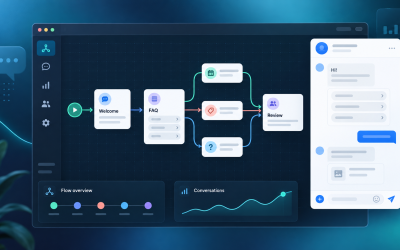
Next, design the logic flow of the conversation. Instead of relying on open-ended AI text generation that can drift off-topic, structure the interaction with interactive buttons, quick replies, and clear options. This keeps the customer on track and ensures they get the information they need quickly. Always include a fallback option that allows the customer to request a transfer to a human support agent when their query requires personalized assistance. By combining structured workflows with automated triggers, you can handle high volumes of customer inquiries without increasing your support staff’s workload. Testing these paths regularly with actual user queries will help you refine the logic and improve the overall completion rate.
Câu hỏi Thường gặp
What is the difference between a general AI conversation site and a business chatbot?
A general AI conversation site is a productivity tool designed for individual tasks like research, writing, and coding, relying on open-ended prompts. A business chatbot is a structured system designed to handle customer service, automate business workflows, and integrate with company databases under strict guidelines.
Can free AI chat tools be used for commercial work?
Yes, most platforms allow commercial use of their free versions, but users must adhere to rate limits and data retention policies. For high-volume business operations, paid subscriptions or API integrations are recommended to ensure reliability and data privacy.
How do I prevent my chats from being used to train AI models?
Most platforms offer settings to disable chat history or opt out of data sharing for training purposes. Alternatively, using enterprise accounts or developer APIs generally ensures that your data remains private and is not used to train future models.
Why do different AI chat platforms compared yield different answers for the same prompt?
Each platform is trained on different datasets, uses different algorithms for weighting information, and may apply varying levels of search integration or reasoning steps, resulting in distinct output styles and analytical depth.
How does a large context window benefit research and writing tasks?
A large context window allows you to upload extensive documents, such as complete reports or code files, and ask the model to analyze, summarize, or edit them without forgetting details from earlier sections of the text.
Những điểm chính
- AI conversation websites have evolved into collaborative workspaces that combine model logic, live search, and file analysis.
- Platforms differ significantly in reasoning capabilities, context length, multimodal support, and search quality.
- Matching the correct platform to your specific task (such as writing, deep research, or coding) is key to achieving optimal results.
- Data privacy remains a crucial consideration, requiring users to manage history settings and understand data retention policies.
- For customer-facing interactions, businesses require structured chatbots with database integrations rather than general-purpose conversational sites.


 Tiếng Việt
  English
  Tagalog
  简体中文
简体中文  العربية
  हिन्दी
  Português do Brasil
  Español de México
  Français
  বাংলা
বাংলা  香港中文
香港中文  繁體中文
繁體中文  Nederlands
  Deutsch
  Bahasa Indonesia
  日本語
日本語  한국어
한국어  Polski
  Русский
  Español