
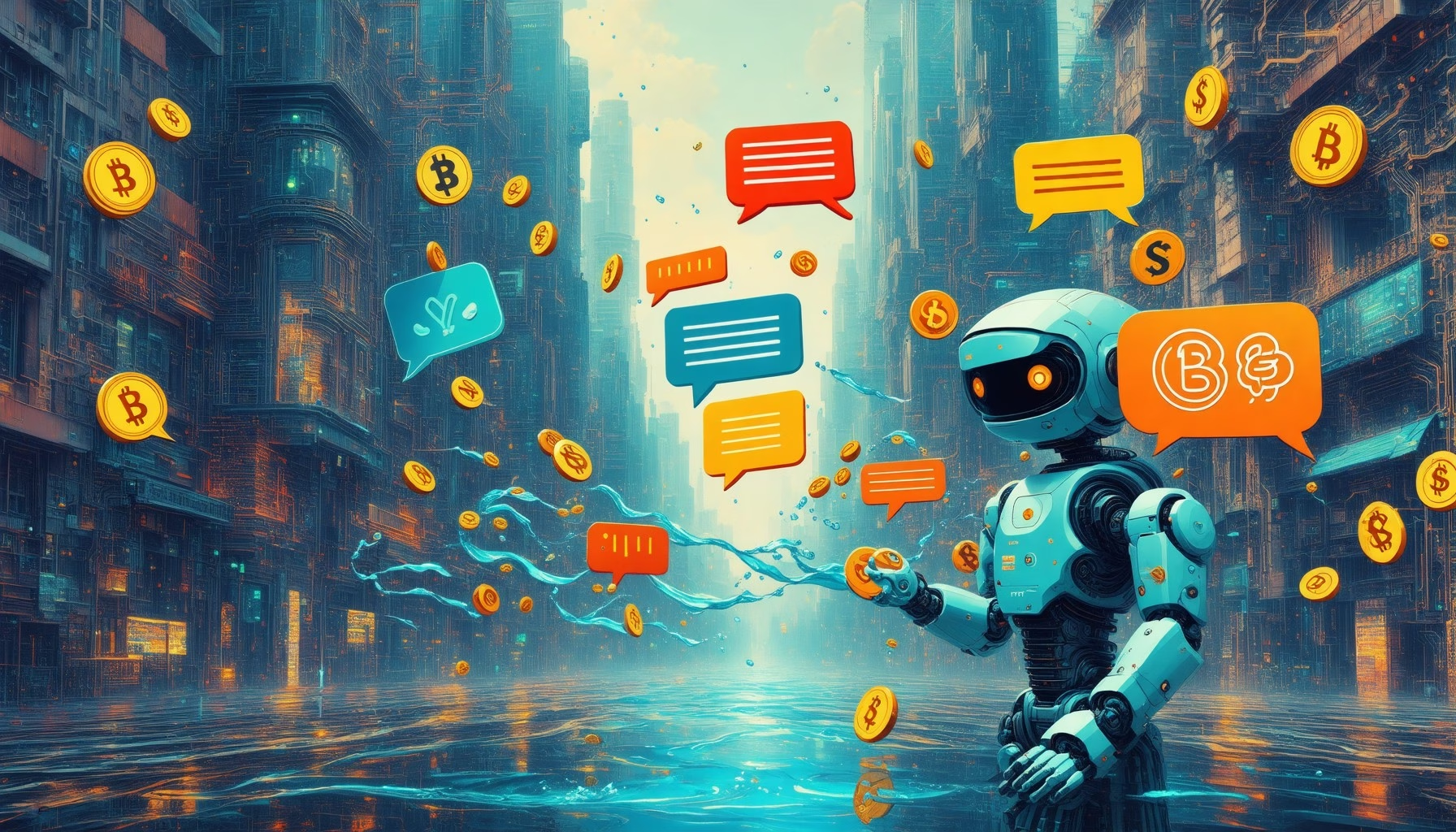
如果你搜索过 如何在 GCash Messenger 中赚钱, 你可能并不是在问一个简单的问题。大多数读者的意思是四种情况之一:通过基于 Messenger 的微任务机器人赚钱,通过 Messenger 销售产品并在 GCash 中收款,通过 Messenger 聊天推销联盟产品,或者建立一个 Messenger 机器人,将对话转化为潜在客户和销售。这些是非常不同的收入模式。第一种模式仍然可以产生小额支付。最后三种模式才是持久的收入所在。.
此更新是为 2026 年 4 月 12 日, 我使用了在写作之前可以验证的最新公共信号。广泛的市场仍然存在。DataReportal 的 数字 2026:菲律宾 报告显示,该国有 9800 万互联网用户 和 9580 万社交媒体用户身份 截至 2025 年底。GCash 自己的网站显示 9400 万菲律宾人使用过 GCash 而且有 600万商家和社交卖家 在这个应用上。这告诉你受众是真实的,支付渠道也是真实的。被夸大的部分是随机的Messenger赚钱应用是整个机会的想法。.
这里是大多数低质量帖子跳过的直白版本:Messenger本身仍然是一个重要的商业渠道,但最容易赚到的钱通常是 不 整天点击神秘任务。Meta报告称 2025年12月平均有35.8亿家庭日活跃用户 在2025年12月平均 $200.97亿 的2025年全年收入,主要来自广告。在2026年1月的另一份更新中,Meta表示 美国的点击消息广告收入同比增长超过50% 在2025年第四季度,并且 Business AIs in Mexico and the Philippines were already handling more than one million weekly conversations. That matters because it shows where the stable money is: leads, sales, follow-up, and business messaging, not magical APKs with no owner.
So this guide does three jobs at once. First, it shows the real ways people still earn money through Messenger and GCash in 2026. Second, it separates live but fragile earning-bot routes from obvious traps. Third, it shows how to move from unstable payout-chasing into a setup that can keep paying next month too.
Key Takeaways for Earning Money in GCash Messenger in 2026
- Messenger still matters in the Philippines. DataReportal says the country had 95.8 million social media user identities in late 2025, so the audience is not the problem.
- GCash is still the default payout rail. GCash says 94 million Filipinos have used the app and 6 million merchants and social sellers are already active there.
- The safest Messenger income comes from selling, affiliate offers, or client work. Microtask bots can still pay, but the ceiling is low and the trust level is lower.
- Random APK downloads are the wrong place to start. Google said in February 2026 that Play Protect now scans over 350 billion Android apps daily and identified more than 27 million new malicious apps from outside Google Play in 2025.
- Messenger scam pressure is high enough that Meta is adding new warnings inside the app. In March 2026, Meta said it was expanding advanced scam detection on Messenger to more countries and had removed over 159 million scam ads in 2025.
- If you only want small side cash, use tiny withdrawals and fast exits. If you want real money, copy the business side of Messenger, not the recruiter side.
How to Earn Money in GCash Messenger Without Choosing the Wrong Model
The phrase “earn money in GCash Messenger” gets messy because it blends together stable models and unstable ones. The stable models are boring in the best way: you sell something, refer something, or automate something. The unstable models are the flashy ones: tasks, referrals, growing dashboard balances, and payout promises that change by wave.
The fastest way to get clear is to split the market into four buckets.
| Messenger income model | How the money actually comes in | Typical payout speed | Realistic range | 风险等级 | Who it fits best |
|---|---|---|---|---|---|
| Messenger microtask bots | Small tasks, ad views, or referral activity credited to a dashboard | Fast if payouts are still live | Usually PHP 20 to PHP 80 a day solo, sometimes higher with referrals | 高 | Readers who only want a small test and accept volatility |
| Affiliate offers in Messenger | Commission when a tracked click, lead, or sale converts | Medium的AI部分 | Can beat a week of microtasks with one or two qualified conversions | Medium的AI部分 | Creators, community admins, and people who can explain tools clearly |
| Social selling through Messenger plus GCash | You close product or service sales in chat and collect with GCash | 快速 | Depends on margin, but three or four profitable sales often beat an entire week of task clicking | Medium的AI部分 | Filipino sellers, resellers, and service providers |
| Building Messenger automation for businesses | You charge for setup, lead handling, follow-up, or campaign support | Medium的AI部分 | One small setup fee can outperform a month of low-end bot payouts | Medium to low | Freelancers, marketers, and anyone who wants a repeatable skill |
If you only look at the first row, Messenger earning looks thin and risky. If you look at the last three rows, the picture changes fast. A reseller who closes four chats in a week with a PHP 150 margin each already cleared PHP 600. A service provider who charges PHP 3,000 to PHP 8,000 for a small automation setup just out-earned many microtask users for the month. An affiliate who sends one buyer to the right SaaS or course offer can outpace several days of ad-view tasks. That is why I never treat Messenger as a task platform first. I treat it as a conversion platform first.
The right question is not “Can Messenger make me money?” It clearly can. The right question is “Which Messenger model gives me the best ratio of payout to risk?” In 2026, the answer is still the same: selling, affiliate, and client-service models are the healthy version. Task bots are the high-noise, low-control version.
If your real goal is to build the stable version of this, not just gamble on the next payout wave, compare the tool stack and cost side before you do anything else. 查看MessengerBot定价 when you want to see what the business-grade route looks like instead of another recruiter screenshot.
The Real Daily Numbers, Not the Screenshot Numbers
Here is where expectations usually get broken. A solo user on low-end task bots usually lands in the PHP 20 to PHP 80 per day zone if the bot is still paying and the tasks are not dead. A more active user rotating across two or three bots might push PHP 80 to PHP 200 on a better day, but the hourly rate is still weak once you count downtime, link failures, and delayed withdrawals. The larger numbers you see in Facebook comments usually come from referrals, not from raw task value.
Now compare that to Messenger selling or affiliate work. If one chat closes a PHP 1,000 product with a 10% margin, that is PHP 100 from one good conversation. If one affiliate conversion pays PHP 300 or more, that can be the best result from the whole week compared with button-mashing inside an unstable bot panel. The difference is not just income ceiling. It is also control. You can improve a sales script. You cannot negotiate with a random release-fee scam.
The Fastest Way to Decide Which Route Fits You
- If you have no audience, no product, and no service yet, a microtask bot can be a small experimental entry point, but keep the stakes tiny.
- If you already run a Facebook page, group, or content account, you are wasting leverage if you only chase task payouts.
- If you are good at explaining tools, affiliate offers are usually a better bet than rotating bot acronyms every two weeks.
- If you are willing to learn setup work, Messenger automation for businesses is the cleanest long-term income model on this page.
Are Messenger Bots Real, or Are They Just Another GCash Trap?
Messenger bots are absolutely real. The problem is that the word real hides three very different categories.
| – 该字段用于你想销售的产品类别。 | What it looks like in practice | How money flows | Main danger |
|---|---|---|---|
| Real business automation | Pages, campaigns, lead capture, order support, FAQs, follow-up sequences | Sales, bookings, upsells, lead qualification, subscriptions | Weak offer or poor follow-up, not platform collapse |
| Real but fragile earning bots | Tasks, credits, withdrawal threshold, recruiter links, GCash screenshots | Ad traffic, microtasks, and referral commissions | Payment delay, changing rules, clone links, low ceiling |
| Fake or scam clones | APK links in DMs, unlock fees, release fees, broken ownership trail | Money flows from users to scammers | You lose both time and cash |
That distinction matters more in 2026 because Meta itself is telling you scam pressure is still rising inside messaging channels. In a March 11, 2026 newsroom update, Meta said it was launching new anti-scam tools across Facebook, WhatsApp, and Messenger, expanding advanced scam detection on Messenger, and had removed 超过1.59亿个欺诈广告 in 2025. In a separate May 2025 update about investment and payment scams, Meta said it had detected and disrupted more than seven million accounts associated with scam centers across several countries, including the Philippines. That is not abstract policy talk. It is a sign that “earn money in Messenger” is a phrase scammers know people will click.
At the same time, the business side of Messenger remains very real. In January 2026, Meta said click-to-message ad revenue growth accelerated and that business AI conversations in the Philippines were already happening at more than one million chats per week. That is the healthiest clue in the whole market. Real money on Messenger still follows the same old rule: businesses pay for attention, replies, qualified leads, and conversions. So if you want a sane strategy, build around that side of the system.
This is why I do not give a single yes-or-no answer when readers ask whether messenger bots are real. The honest answer is:
- Yes, business bots are real and profitable.
- Yes, some Messenger earning waves are real enough to pay small amounts.
- Yes, scammers copy both of those ideas aggressively.
Once you accept that, the right behavior becomes obvious. You stop asking “Is this bot real?” in the abstract and start asking “Where is the money coming from, who owns the route, what is the first safe withdrawal, and what happens if support disappears?”
The Five Signals I Use Before I Believe Any Messenger Income Pitch
The 2026 Messenger Legitimacy Screen
- There is a clear owner, page, company, or working support path behind the offer.
- The earnings logic makes business sense. Sales, leads, affiliate commissions, and paid campaigns make sense. “Watch random ads forever” mostly does not.
- The first payout can be tested at a small amount without paying a fee.
- The route does not require a mystery APK from a Messenger or Telegram chat.
- The proof includes a full path, not just a cropped GCash screenshot floating in comments.
If a Messenger income pitch fails two or more of those tests, I stop there. There is no reason to keep rationalizing a route that already wants too much trust upfront.
How to Build a Messenger Flow That Can Actually Pay You
The current content structure for this post used to ask awkward questions like “How to be a messenger bot?” The practical version of that question is much more useful: how do you set up a Messenger flow that produces income instead of pennies? Here is the no-fluff answer.
- Choose one monetization path before you open the bot builder. Pick affiliate offers, social selling, appointment booking, or client service. Do not try to automate everything at once.
- Define the one action that should happen in chat. Maybe the user asks for price, requests a product list, books a slot, or clicks an affiliate link. If the conversation has no clear next action, the bot will feel busy but not profitable.
- Build a short qualification flow. Ask the minimum useful questions. What product do they want? What budget range? Are they ready to pay now or later? Short flows convert better than endless menus.
- Connect your offer to a payment or tracking outcome. For direct selling, that can be GCash instructions or order confirmation. For affiliate work, that means tracked links and follow-up content. For services, that means a booking or lead handoff.
- Set a follow-up rule. Most money in Messenger comes from the second message, not the first. Follow up after 10 minutes, after a few hours, and the next day if the prospect did not buy.
- Measure the numbers that matter. Track reply rate, click rate, completed orders, and qualified leads. Ignore vanity metrics that do not move money.
- Refine the weak step, not the whole system. If people reply but do not buy, your offer or proof is weak. If they do not reply at all, your opener is weak. Diagnose the actual leak.
This process is much less exciting than downloading a “new legit earning app,” but it is far more defensible. It is also the only route on this page that gets stronger as you improve. You can tighten your opening line. You can improve your FAQ. You can add remarketing. You can test price presentation. That is real work, but it compounds.
Here is a simple example. Say you sell secondhand gadgets or online services and close conversations through Messenger. Your bot can greet the user, ask what unit or service they need, show price ranges, answer payment questions, and push hot leads to a human closer. If you close just two or three qualified buyers a week, that already beats what many users get from unstable task panels. If you are working with affiliate offers, the same logic applies. The bot pre-qualifies, handles common objections, and gets the click from the people most likely to convert.
If you need the technical path instead of guesswork, 浏览我们的教程. That is a better use of your time than learning the rules of another payout wave that could disappear before month-end.



 简体中文
简体中文  English
  Tagalog
  العربية
  हिन्दी
  Português do Brasil
  Español de México
  Français
  বাংলা
বাংলা  香港中文
香港中文  繁體中文
繁體中文  Nederlands
  Deutsch
  Bahasa Indonesia
  日本語
日本語  한국어
한국어  Polski
  Русский
  Español
  Tiếng Việt