
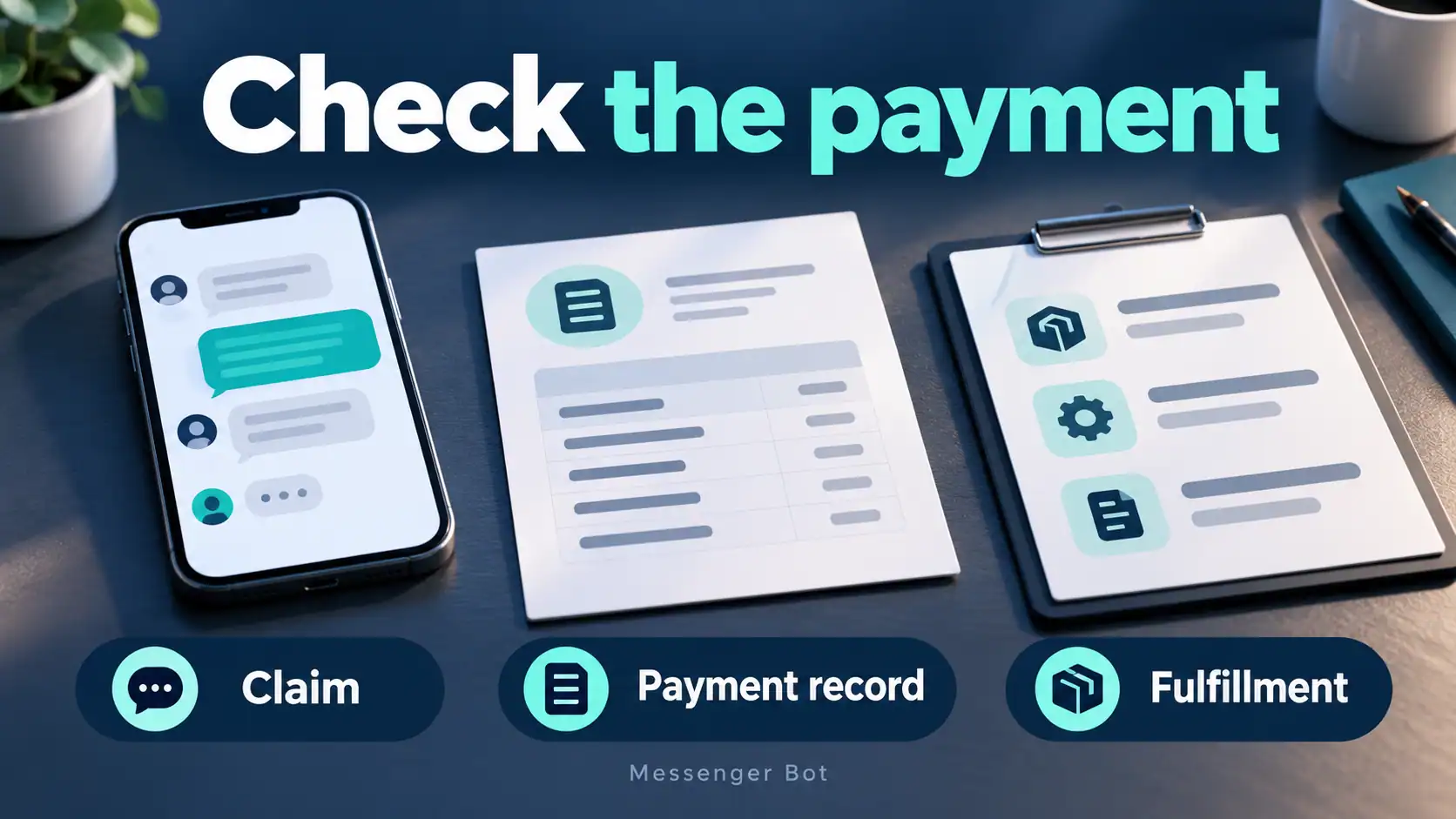
A chat message, an earning-app balance and a payment in your wallet answer different questions. Before relying on a Messenger earning offer, identify who is supposed to pay you and what that payment is for. A task reward, a customer order, an affiliate referral and a client project need different records. GCash being mentioned in the offer does not establish that the operator pays, that a withdrawal is available or that the work will produce income.
This comparison helps you examine an existing offer or business transaction. No third-party earning bot is certified here, and there is no verified daily payout range. For general registration, legitimacy and business-setup questions, use the separate earning-bot verification and business-planning guide. Here, the focus is narrower: connect a payment claim to the terms, transaction and work it actually refers to.
Four Messenger Earning Models and the Payment Evidence to Compare
Use four separate questions when reading an offer. What is being claimed? What payment condition was agreed? What does your own payment account show? What goods or work have been delivered? You may have an answer to one question and still lack the others. A payment record does not establish the quality of delivered work, and an accepted deliverable does not by itself establish that money arrived.
| Model being considered | Who would pay? | Question about the agreed condition | Records to compare privately | What remains to resolve? |
|---|---|---|---|---|
| Third-party task offer | The operator named in the offer | What does the operator actually promise, and does it demand money to release a job or earnings? | The dated offer, its terms and your own transaction history | A displayed balance or first payment does not establish continued payment or trustworthiness |
| Selling goods or services in chat | The buyer identified in the order | What item, price, payment and delivery arrangement did both parties discuss? | The order agreement, payment record and delivery or service record | Receipt of money, fulfillment and any refund are separate statuses |
| Disclosed affiliate arrangement | The payer identified in the actual program terms | Which action qualifies, and which approval, reversal or payment conditions apply? | The relevant terms, referral record, approval information and payment record | A tracked action may not satisfy the program’s payment conditions |
| Client automation services | The client identified in the agreement | What work, review and payment conditions did the parties agree? | The agreed scope, deliverable review, invoice and payment record | A submitted draft, accepted work and paid invoice are not interchangeable |
The table is a comparison method, not a ranking of profitability or safety. Actual arrangements differ. If the payer, condition or supporting record is missing, write “not established” in your notes rather than supplying an assumed fee, deadline or result. That gap tells you which question to ask next; it does not automatically prove fraud or a legal entitlement.
Task Offers: Separate a Displayed Balance from a Payment
Start with the narrow claim you can actually observe. If an offer says a balance is available, record where the claim appears and which dated terms describe it. Then separately check your own payment account. A screenshot sent by the operator and a transaction you open independently are different sources of evidence. Neither should be used to fill in an unstated withdrawal rule.
The FTC’s task-scam guidance describes schemes that display fabricated earnings and sometimes make a small initial payment to build trust before asking for a deposit. Do not pay to unlock a promised job or earnings. A first payout is not a reason to increase your exposure or test another withdrawal with your own money.
Keep the Claim and the Transaction Separate
Imagine an offer that shows an available reward but gives no clear explanation of who pays it. This is an illustrative situation, not a report about a particular bot. Your notes might say that the screen displays a balance, the payer is not established, and no matching transaction has been found in your own wallet. Do not rewrite those three observations as “payment verified.”
If a transaction does appear, record only what that observation supports. Compare the relevant date, amount and reference privately.
Ask About Missing Terms Without Funding a Test
Useful questions include who operates the offer, what work it describes, which payment condition it states and where its current terms can be checked independently. Save the version you reviewed. If a later message changes the condition, keep both versions instead of replacing the earlier record. You can then describe the change accurately without guessing when it happened or why.
This comparison is not a recommendation to install a third-party app or share an access code. General operator and registration checks belong in the linked companion guide; the payment question here remains whether the evidence supports the exact claim being made.
Selling in Chat: Connect Payment to One Order
For a business already selling goods or services, examine the transaction at order level. A conversation about several items may contain several possible prices and delivery options. Identify the version the buyer actually agreed to before comparing it with a payment. Do not let a later message silently replace the item, quantity, delivery arrangement or refund discussion attached to that order.
An Illustrative Order Record from Offer to Fulfillment
Suppose a buyer asks for a custom item, the seller replies with an offer, and the buyer chooses one option. This is a hypothetical record-comparison example, not a customer case or a universal sales process. The seller could keep a concise order summary showing the agreed item, total and delivery arrangement, then compare that summary with the relevant payment and fulfillment records.
- Offer: Keep the description and version discussed, including any conditions the parties actually stated.
- Agreement: Identify the buyer’s response accepting or changing that offer; do not treat an unanswered quotation as an accepted order.
- Payment observation: Compare the relevant transaction in your own account with the order. A chat attachment alone is not independent confirmation.
- Fulfillment observation: Note what was dispatched or delivered and which record supports that observation.
- Later change: Keep a cancellation, refund request or replacement discussion attached to the same order rather than losing its context.
These records help you ask a precise question. “Which order does this payment refer to?” is different from “Was the item delivered?” An order may involve more than one payment, or a payment may relate to more than one item. Explain the relationship in your notes instead of assuming a one-to-one match. Use the actual agreement rather than a standard timeline invented for this article.
Distinguish a Requested Refund from a Recorded Refund
A request, an acknowledgment and a transaction record are different observations. If a buyer asks for a refund, retain that request. If the seller agrees, retain the response and the conditions discussed. If a refund is recorded, connect that record to the original order. Do not mark money as returned solely because a message says that a refund will be arranged.
If the records disagree, write down the disagreement without adding a diagnosis. For example, the order discussion may identify one amount while the payment record shows another. Ask the counterparty to clarify what each amount covers. Do not assume that a mismatch proves dishonesty, or that a particular screenshot explains a financial-service processing problem.
Keep Evidence Useful Without Collecting Everything
Use the order reference and only the relevant supporting information. Do not turn this exercise into a request for unnecessary identity documents, access codes or complete wallet history. Keep customer and transaction details private and share only what the appropriate official support process asks for. Publicly posting an unredacted receipt is not a useful substitute for resolving the specific order question.
The same approach works for a service delivered through chat: identify the agreed task, what was supplied and the relevant payment. A written acknowledgment may help describe what happened, but this guide does not determine its legal effect. If a dispute involves contractual rights, obtain appropriate advice rather than treating a checklist as a judgment.
Affiliate Offers: Read the Actual Conditions Behind a Referral
For an affiliate arrangement, identify the payer and the action the current terms describe as eligible. Do not assume that a link click, a trial or an order produces the same result in every program. Compare the specific referral record with those terms. If the conditions are unavailable, the commission amount, approval timing and payment schedule are not established by this guide.
Use Status Labels as Questions, Not Universal Rules
The following labels are an illustrative way to organize your review. A real program may use different labels, combine them or define them differently. Translate the actual program’s wording before drawing a conclusion.
- Tracked: What action does the record show, and does the agreement say that action qualifies for compensation?
- Pending: Which condition is still unresolved? Do not assume a particular holding period.
- Approved: What has been approved, by whom, and are any separate payment conditions still outstanding?
- Reversed: What explanation or term is recorded for the change? Do not invent a refund, cancellation or rule violation.
- Received: Which payment record supports receipt, and which referral or group of referrals does it cover?
For a hypothetical comparison, a referral report might show an eligible action while no payment record has yet been identified. Keep those observations separate. Read the actual payment conditions and ask the named payer about the unresolved point. Do not substitute a supposed industry-standard threshold or waiting period; none is verified here.
Compare the Version of the Terms with the Version of the Record
Keep the relevant dated terms alongside the referral observation. Ask whether the program describes which actions qualify, how attribution is assessed, what can change an approval and who handles payment questions. These are questions to verify, not promises that every program provides the same protections or process. A recognizable brand or a professional-looking report does not answer them for you.
If the wording changes, identify the change before treating it as an explanation for an older referral. A newer document may not tell you which terms applied to the earlier action. Ask the program to clarify the relevant version. Do not infer that a reversal was justified or unjustified solely because a status changed on the screen.
Be clear about your commercial interest when recommending an affiliate offer, and check the requirements that apply to your audience and agreement. This article does not supply legally sufficient disclosure wording or certify a program. Its purpose is to help you connect a reported referral with the conditions and payment records actually available.
Client Automation Work: Compare the Deliverable, Agreement and Invoice
If a business hires you to help with customer conversations, start with what the parties agreed you would deliver. A draft workflow, a completed review and a paid invoice answer different questions. Keep the agreement visible when discussing progress instead of assuming that submitting work automatically means it has been accepted or paid.
A Hypothetical Client Review with Separate Payment Questions
Imagine a client asking for help organizing common enquiries. The parties discuss a particular set of replies and a review process. Later, the client asks for an additional workflow. This is an illustrative example, not a claim about a Messenger Bot feature, a real client or the usual cause of nonpayment. The useful task is to distinguish the original work from the proposed addition.
Compare the current request with the agreed scope. Record what has been supplied, which feedback relates to that work and whether the parties agreed to a change. Keep a new request separate until its effect on the work, review and payment conditions has been discussed. Do not assume it creates an extra fee, removes a payment obligation or changes a deadline.
- Identify the agreed deliverable and its relevant version.
- Keep the record of what was supplied and when it was presented for review.
- Record the client’s actual response, including any unresolved point.
- Compare the invoice with the payment condition the parties actually agreed.
- Check the relevant payment record separately from the invoice or acknowledgment.
This method does not prescribe a deposit, signature requirement, warranty or maintenance fee. Those arrangements need to be discussed in the actual agreement. An acknowledgment can help establish the sequence of events without resolving every contractual issue. Do not present a checklist as proof that a client has lost the right to raise a concern.
Make a Missing-Payment Question Specific
Instead of saying that “the project is unpaid,” identify the particular uncertainty. Is a deliverable still under review? Does the invoice match the agreed work? Has the client reported sending a payment? Does your own account show a relevant transaction? Each answer points to a different next conversation. No explanation should be filled in merely because another project had a similar problem.
A client who has not agreed to an invoice and a financial service handling a recorded transfer are not the same counterparty. Explain which question you are asking and provide the relevant record through an appropriate private channel. This guide does not decide a contract dispute or recommend a legal remedy. Ask for qualified advice when the question concerns rights rather than missing factual information.
For a business evaluating conversation software, Check Current Pricing and compare the offer with the workflow you can actually verify. Software costs are separate from your client’s payment conditions. A task-offer reader checking a promised withdrawal does not need to buy automation software to resolve that question.
Choose Official Help for the Specific GCash Payment Problem
Start by describing the event accurately: a promised transfer not yet identified, an online merchant payment deducted but not reflected, a merchant refund not received, or suspected deception. Do not classify every disagreement as an unauthorized transaction. Open the relevant official help independently and follow the instructions for the problem you actually encountered.
For its covered online-payment and merchant-refund issues, the GCash payment-reflection guide says to check the payment details and Transactions record. Its current support path is the affected transaction, “Get Help,” then “My payment did not reflect.” Do not assume that this online-payment article supplies the procedure for every transfer type.
For suspected deception involving a GCash transaction, the official scam-reporting page gives the affected-transaction route and “Get Help” / “Report as scam” option, alongside reporting to authorities. GCash states that return of scammed funds is not guaranteed. Report the facts truthfully; do not promise recovery or submit a complaint against someone merely because an invoice is unresolved.
The BSP Consumer Assistance Mechanism concerns BSP-supervised financial institutions. Its guidance starts with clarifying the concern and lodging a formal complaint with the financial-service provider. Do not assume that this mechanism certifies an earning bot or resolves an ordinary client-deliverable disagreement. Its stated scope is different from a promise to collect a private invoice.
Keep the relevant records privately and separate observations from interpretations. “This is the transaction I see” and “this is the order or payment I expected” are useful starting points. An official support response may identify a further step; it does not justify an income guarantee or a blanket judgment about an unrelated operator.
Frequently Asked Questions About Earning Models and Payment Evidence
Does an earning dashboard balance prove money arrived in my GCash wallet?
No. The displayed balance and your independently opened wallet record are different evidence. Check the relevant transaction separately. A recorded payment on one occasion does not verify an operator’s future payouts or establish that the offer is trustworthy.
What should I check when an online payment or merchant refund has not reflected?
Check the details and affected Transactions record against the current GCash online-payment guidance. For its covered issue, use the transaction’s “Get Help” and “My payment did not reflect” option. Do not apply that article to every transfer type or assume a refund timeline.
Does a first small payout prove a task offer will keep paying?
No. The FTC describes task scams that use an initial payment to build trust before demanding a deposit. Do not pay to unlock a promised job or earnings, and do not use another deposit to test an offer.
Is reporting a scam the same as disputing an unreceived merchant payment?
No. GCash publishes separate guidance for scam reporting and online-payment reflection. Describe the facts and use the applicable official route. A missing or disputed payment does not automatically prove deception, and return of scammed funds is not guaranteed.
Can BSP settle an unpaid chatbot-client invoice or certify an earning bot?
Do not assume that role. BSP describes its assistance mechanism for concerns involving supervised financial institutions, starting with the financial-service provider. That guidance is not certification of an earning bot or a determination of a private client’s contractual obligations.
 English
 Tagalog
 简体中文
 العربية
 हिन्दी
 Português do Brasil
 Español de México
 Français
 বাংলা
 香港中文
 繁體中文
 Nederlands
 Deutsch
 Bahasa Indonesia
 日本語
 한국어
 Polski
 Русский
 Español
 Tiếng Việt