
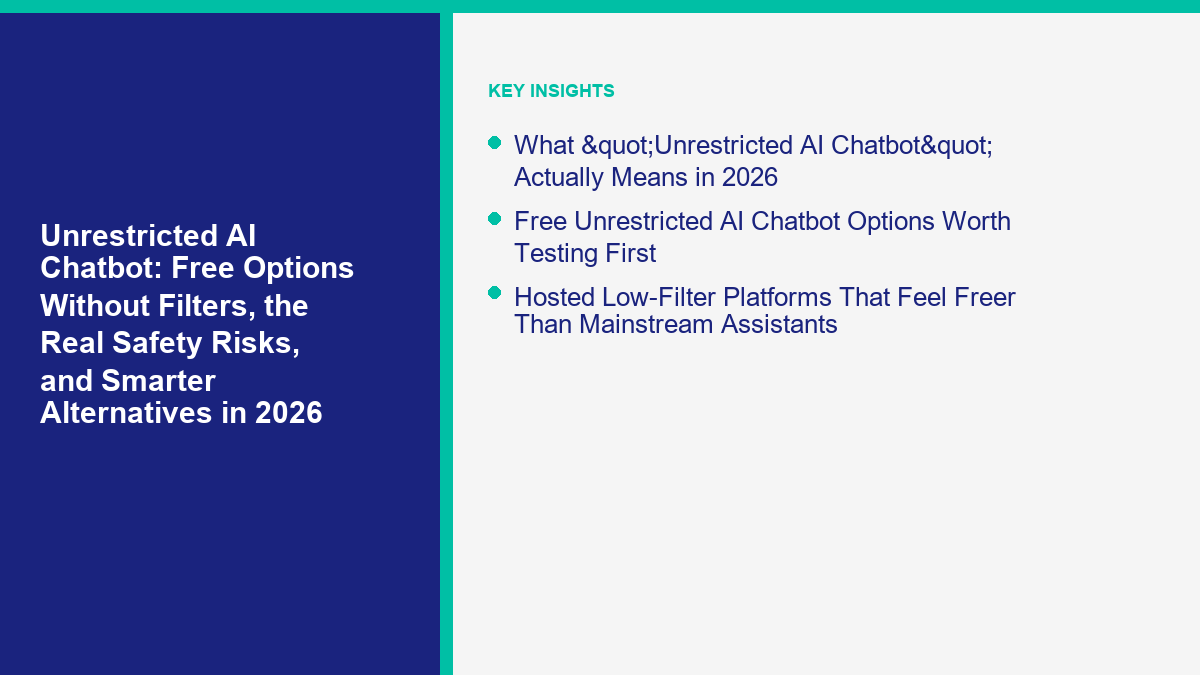
大多數針對的頁面 無限制的 AI 聊天機器人 仍然在銷售一種幻想:一個免費的機器人,沒有規則,沒有帳戶摩擦,沒有使用上限,沒有隱私權的妥協,沒有缺點。這並不是市場的實際情況 2026 年 4 月 12 日. 實際上存在的是一個光譜。一些工具比主流助手過濾得少。一些工具在不登錄的情況下更容易打開。一些工具是為角色聊天而非事實工作而構建的。而有些則將整個堆棧移到您自己的機器上,讓您自己控制更多的行為。.
這種區別很重要,因為尋找 未過濾的 AI 聊天機器人 的人通常並不是在問同樣的問題。一個用戶希望對於虛構、諷刺、對抗性頭腦風暴或角色扮演的拒絕更少。另一個用戶希望有一個 沒有限制的免費 AI 聊天機器人 ,因為他們不想再創建另一個帳戶。還有一個用戶希望有一個感覺像是 無限制的 AI 聊天 而不是一個在十次提示後就限制他們的產品。還有另一個人真的在嘗試將 AI 放在網站、Facebook Messenger 或 Instagram 上,而不會造成品牌安全災難。.
在撰寫這篇文章之前,我查看了 OpenAI、DuckDuckGo、Venice、Character.AI、LM Studio、Ollama、ManyChat、Tidio、FTC 和美國版權局的當前定價頁面、幫助中心、安全文件和政策頁面。簡短的版本非常直白。. 在 2026 年,沒有主要的公共聊天機器人是真正不受限制的。. 如果一家公司托管模型、擁有帳戶層並且可以暫停或重塑訪問,那麼無論登陸頁面是否說明為私人、未經審查、不受限制或無過濾,該產品都受到管理。.
這並不意味著這個類別毫無用處。這只是意味著你應該停止尋求魔法漏洞,開始選擇適合工作的正確工具。Duck.ai 是最好的免費私人測試之一。Venice 是最清晰的托管低過濾選項之一。Character.AI 在角色方面比在真實性上更強。像 LM Studio 和 Ollama 這樣的本地工具最接近一個真正的 ai 聊天機器人沒有限制 設置,但你也承擔了責任。如果你的真正目標是在 Messenger、Instagram 或你的網站上進行面向客戶的自動化,請比較 查看 MessengerBot 價格 在將消費者聊天選項連接到一個從未建立過的公共工作流程之前。.
這篇文章保持實用性。您將看到哪些免費選項是真實的,哪些「無過濾」的主張對普通用戶有效,隱私在哪裡改善或變差,如何安全地測試低過濾工具,以及當您想要靈活性而不將您的公開對話交給責任生成器時,更智能的替代方案是什麼樣的。.
2026年「無限制AI聊天機器人」的真正含義
這個短語聽起來簡單,但它通常隱藏著四個不同的目標。.
| 搜尋者想要什麼 | 這在實踐中通常意味著什麼 | 最佳適合 | 主要注意事項 |
|---|---|---|---|
| 更少的拒絕 | 一個可以討論邊緣但合法提示的託管聊天機器人,而不會有不斷的政策中斷 | 威尼斯、Duck.ai,一些開放模型前端 | 您仍然會遇到提供者的審核、計劃上限或產品變更 |
| 無註冊障礙 | 一個可以快速打開的免費標籤,無需將會話綁定到主帳戶 | Duck.ai、來賓模式、公共演示 | 無需註冊並不等於無需管理 |
| 角色深度 | 角色扮演、陪伴或強烈的人格,而不是通用助手的聲音 | Character.AI、Replika風格的工具 | 娛樂並不等於準確性、隱私或穩定性 |
| 真正的控制 | 本地運行模型,讓你選擇提示、存儲和行為 | LM Studio、Ollama | 設置、硬體、評估和安全成為你的問題 |
這就是為什麼許多「最佳無限制AI聊天機器人」的總結感覺不可靠。他們將四個不同的類別進行比較,好像它們是可以互換的。一個沒有帳戶的聊天包裝與一個低過濾的託管產品並不是同一回事。一個角色應用與一個通用助手也不是同一回事。一個本地運行時與一個公共網路聊天機器人也不是同一回事。如果你不將這些類別區分開來,每次比較都會變成市場噪音。.
最有用的心理模型是相對自由,而不是絕對自由。如果一家公司託管系統並發布規則,那麼它就有明確的界限。這些界限可能比ChatGPT的更寬鬆。它們對於諷刺、情感強烈的小說或角色扮演來說,可能感覺更成熟。但它們仍然是界限。一旦你接受這一點,這個類別就變得更容易理解。.
這種框架也解釋了為什麼這個關鍵字不斷增長。許多用戶並不是在尋求詐騙、惡意軟體或危險內容。他們是在對過度修正做出反應。他們想要一個能處理更黑暗的小說、尖銳的政治辯論、禁忌的哲學、諷刺、成熟幽默或角色扮演的機器人,而不是陷入千篇一律的拒絕。他們希望對話感覺不那麼受到監督,而不是魯莽。.
更聰明的問題不是「哪個聊天機器人沒有規則?」而是「我能容忍多少監管,我需要多少隱私,以及我願意做多少設置工作?」你的答案決定了你應該打開 Duck.ai、支付 Venice、選擇主流助手,還是本地運行模型。.
值得先測試的免費無限制 AI 聊天機器人選項
如果你想要一個起始的短名單,而不是理論,這就是它。下面的表格專注於截至 2026 年 4 月的真正免費路徑的產品,而不是在三個提示後就消失的虛假「免費」優惠,或在你能做任何有用的事情之前強迫你提供信用卡。.
| 平台 | 免費訪問 | 當前公共付費價格 | 感覺有多過濾 | 最佳適用於 | 真正的陷阱 |
|---|---|---|---|---|---|
| Duck.ai | 是的,免費但有每日限制且不需要帳戶 | DuckDuckGo 訂閱在美國為 $9.99/月. | Medium | 私密、低摩擦的測試和隨意聊天 | Provider moderation still applies, and free usage is capped daily |
| 威尼斯 | Yes, 10 text prompts and 15 image prompts per day | Pro at $18/month | Low for a hosted product | Hosted low-filter text and image generation | Still a hosted service, and the mature filter toggle is paid-only |
| Character.AI | 是 | c.ai+ at $9.99/month | Medium | Personas, roleplay, and voice-heavy conversations | Not built for truth, and moderation varies by age experience and policy rules |
| ChatGPT 免費版 | 是 | Plus at $20/month | Medium to high | Best all-around assistant quality on a free tier | Strong guardrails and usage limits make it a poor “no restrictions” pick |
| LM Studio | Software is free | No platform fee for the app itself | As low as you choose | Private local chat with downloaded models | Hardware, model quality, and safety checks are entirely on you |
| Ollama | Software is free | No platform fee for the runtime itself | As low as you choose | Local APIs, terminal workflows, and self-hosted experimentation | Best experience still depends on your machine and model choices |
The surprise winner for most people is still Duck.ai. DuckDuckGo’s current help pages say the free version supports Anthropic’s Claude 4.5 Haiku, Meta’s Llama 4 Scout, Mistral Small 3 24B, OpenAI’s GPT-4o mini, GPT-5 mini, and gpt-oss-120b. DuckDuckGo also says it does not filter or modify model responses itself, removes IP-linked metadata before sending prompts to providers, and does not use chats to train AI models. That is a better privacy and friction profile than the average free consumer chat tab.
威尼斯 is the clearest answer if your search literally means “show me something marketed as uncensored.” Its current features and pricing pages say the free plan includes 10 text prompts and 15 image prompts per day, while Pro costs $18 per month and includes unlimited text with Free and Pro models in-app. Venice’s help docs also say disabling the Mature Filter is a Pro-only setting. In other words, Venice is not pretending to be the same kind of product as ChatGPT. It is openly courting the crowd that wants fewer filter interruptions.
Character.AI is useful if your goal is personality, not clean factual output. Its current subscribe page lists c.ai+ at $9.99 per month, with better memory, ad-free chats, access to newer models, no slow mode, unlimited voice calls, and more chat customization. That makes it a strong entertainment and roleplay destination, but not a replacement for a serious research or customer-service stack.
ChatGPT 免費版 still belongs in the table because a lot of searchers think “unrestricted” when what they really want is a good free chatbot that does not feel broken. OpenAI’s pricing page still shows a real $0 plan with limited access to GPT-5, search, file uploads, voice, image tools, custom GPTs, and projects, while the Plus plan remains $20 per month. The problem is obvious: if your top priority is fewer guardrails, ChatGPT is not the right product to force into that job.
LM Studio 和 Ollama are the only entries here that can get close to true control. They are free software, they run locally, and they shift storage, model selection, and prompt behavior toward you instead of a hosted provider. That is the closest thing to a real 沒有限制的免費 AI 聊天機器人 path, but it is not one click and it is not foolproof.
Sources checked: Duck.ai overview, Duck.ai chat models, Duck.ai usage limits, DuckDuckGo subscription pricing, Venice features, Venice pricing, Venice mature filter help, Character.AI subscribe, 查看 MessengerBot 價格, ChatGPT Plus 幫助, LM Studio system requirements, Ollama quickstart.
Hosted Low-Filter Platforms That Feel Freer Than Mainstream Assistants
Duck.ai Is the Best Place to Start If You Want Private Free Chat First
Duck.ai does not win because it is the smartest model stack on the web. It wins because it removes a lot of the friction that makes “free unrestricted chatbot” pages so annoying in practice. You do not need a standard account to try it. The free tier is real. DuckDuckGo says chats are anonymized, IP-linked metadata is stripped before prompts go to model providers, and conversations are not used to train AI models. The company also says it does not filter or modify responses itself, though Anthropic, Meta, Mistral, and OpenAI still apply their own moderation policies.
That makes Duck.ai a very good answer for readers who want a lighter-touch experience without turning privacy into an afterthought. It is not truly unfiltered, and it is not positioned that way. What it does offer is a low-drama environment for trying ideas, asking awkward questions, drafting edgy-but-legal content, or testing how different models behave without handing your session to a high-friction social login.
Venice Is the Clearest Hosted Answer to the "No Filters" Search Intent
Venice deserves separate treatment because it is one of the few products in this category whose marketing, pricing, and help docs all line up. The product pages use “private,” “uncensored,” and “unrestricted” language directly. The current free tier is usable instead of symbolic. The paid tier is priced clearly at $18 per month. And the mature-filter controls live behind the Pro plan, which is exactly the kind of detail generic listicles usually fail to mention.
If your definition of unrestricted means “stop lecturing me every time a fictional scene gets intense,” Venice is one of the better hosted fits in April 2026. The catch is the same one that applies to every hosted low-filter service: the company can still change limits, policies, filters, or pricing later. Hosted freedom is always provisional freedom.
Character.AI Is Better for Personality Than for Truth
Character.AI still dominates a very specific lane: persistent personas, character libraries, voice-heavy chat, and public roleplay. If that is your goal, mainstream assistants usually feel flat by comparison. Character.AI’s current c.ai+ plan adds better memory, newer models, no slow mode, unlimited voice calls, and customization. That matters because people searching for an ai 聊天機器人沒有限制 sometimes do not really want fewer rules. They want a bot with a stronger personality.
The safety center is the important reality check. Character.AI says it now creates distinct experiences for teens and adults, uses additional classifiers for under-18 users, and blocks content that violates its terms or community guidelines. So yes, the platform can feel freer than a mainstream work assistant for character play. No, it is not a lawless environment.
The practical rule is simple. If you want a workhorse assistant, use a mainstream assistant. If you want freer private chat, try Duck.ai first. If you want a hosted low-filter product, test Venice. If you want characters, Character.AI is still the obvious stop. Treat those as different lanes and the whole market stops looking contradictory.
Sources checked: Duck.ai 隱私, Duck.ai model list and moderation note, Venice features, Venice pricing, Venice mature filter settings, Character.AI pricing, Character.AI Safety Center, Character.AI voice FAQ.
Local AI Setups That Get Closest to a Free AI Chatbot With No Restrictions
If your search really means “I want actual control,” local is the serious answer. Not flashy. Not the easiest. But serious. That is because once the model runs on your own machine, you can choose the model family, the prompt template, the memory behavior, the logging rules, the front end, and whether the session ever leaves your device at all.
LM Studio Is the Easiest GUI Path for Private Local Chat
LM Studio describes itself as local AI on your computer and says you can run models privately and for free on your machine. For many non-developers, that matters more than benchmark scores. You get a visual app, local chat, downloadable models, and an OpenAI-compatible workflow without having to start from a terminal-first mindset. If you want the closest thing to a “private unrestricted chatbot” without renting infrastructure, LM Studio is a very approachable starting point.
Ollama Is Better if You Want APIs, Scripts, and Repeatable Local Workflows
Ollama’s quickstart says it is available on macOS, Windows, and Linux, and the docs make the local pattern obvious: install the runtime, run a model, and call it through a local API. That makes Ollama especially strong for people who want a local chatbot that can eventually power scripts, tools, or developer workflows instead of just a single desktop chat window.
There is a tradeoff that a lot of “unlimited ai chat” threads skip. Local software can be free while the real cost moves into hardware, storage, evaluation time, and patience. Ollama’s hardware docs spell out broad GPU support across newer Nvidia generations, but the bigger practical point is this: the cheaper your hardware, the more you will feel context limits, slower responses, or smaller-model quality tradeoffs.
A Safe Way to Start Local Without Creating a Mess
- Start with one small local model and one narrow use case. Do not begin by trying to replace every cloud chatbot you use.
- Keep a separate test folder or prompt notebook. Local freedom gets sloppy fast if you mix experiments, work prompts, and sensitive data.
- Turn off any syncing you do not understand. “Local” is only local if your front end is not silently backing things up elsewhere.
- Test for hallucination before you test for edginess. A model that feels freer but is wildly wrong is not progress.
- Document your model and prompt choices. If a setup works, you want to reproduce it instead of rebuilding from memory next week.
That is the honest local pitch in 2026. If you want truly fewer restrictions, you can get closer by moving the stack onto your own hardware. You also lose the safety rails, trust layer, and convenience that hosted tools provide. For some readers that is the whole point. For others it is a sign they never wanted a local setup in the first place.
Sources checked: LM Studio system requirements, Ollama quickstart, Ollama hardware support.
The Real Safety Risks Most "No Filter" Lists Skip
The biggest problem with the unrestricted-chat niche is not that the tools exist. It is that too many roundups treat fewer filters as a universal upgrade. It is not. The moment you remove friction, you are changing what kinds of mistakes the system makes and how expensive those mistakes can become.
Hallucinations Get More Dangerous When the Tone Feels More Confident
Low-filter systems often feel more candid, which users mistake for honesty. That is a risky mix. If a bot stops refusing and starts sounding bolder at the same time, it can give bad medical, legal, financial, or reputational advice with extra confidence. That does not require obviously illegal prompts. It only requires the user to overtrust the tone.
Voice Features Raise the Stakes Fast
Voice is where this category stops feeling like harmless experimentation. DuckDuckGo’s voice-chat privacy page is unusually candid: it says voice chats are private, anonymized, not used to train models, and not stored after the session ends, but it also warns that your voice is unique and can function as biometric data. That is the kind of tradeoff more products should explain as clearly.
The FTC has been treating AI voice misuse as a real consumer-protection problem for a while now. Its 2024 voice cloning challenge announcement explicitly framed AI-enabled voice cloning as a fraud risk, not just a novelty feature. If your favorite “unfiltered” app lets users create voices, roleplay real people, or simulate authority, you should think about impersonation risk immediately, not after something gets abused.
Scam Patterns Scale When Bots Feel Casual and Human
The FTC’s April 2025 text-scam release reported $470 million in losses from text scams in 2024, with fake delivery notices, bogus job offers, fraud alerts, unpaid toll messages, and wrong-number threads leading the list. That matters here because the winning scam pattern is rarely “look at this obvious robot.” It is a conversation that feels ordinary enough to keep you talking. An unrestricted chatbot used carelessly in public channels can make that problem worse by sounding convincing without applying strong boundaries.
Digital Replica Problems Are Not Theoretical Anymore
The U.S. Copyright Office’s AI initiative now breaks out digital replicas as its own major issue, and its July 31, 2024 Part 1 report recommended a federal digital replica law. That is a concrete signal that voice and likeness misuse is no longer a fringe technical concern. If a tool encourages celebrity imitation, synthetic voice reuse, or realistic impersonation, it is moving into a legal environment that is tightening, not loosening.
Public-Facing Use Multiplies Every Risk
A risky personal experiment is one thing. Putting the same model in front of customers is different. The moment the bot speaks for your brand, every hallucination becomes a support problem, every weird refusal becomes a user-experience problem, and every low-filter answer becomes a compliance or reputation problem. That is why “no filters” is a fun consumer feature for some use cases and a terrible default architecture for most business use cases.
Sources checked: Duck.ai voice privacy, FTC voice cloning challenge announcement, FTC text scam losses release, U.S. Copyright Office AI initiative.
Why Privacy Usually Gets Murkier Before It Gets Better
A lot of people treat “uncensored” and “private” as synonyms. They are not. Sometimes the low-filter tool is more private. Sometimes it is much less private. You need to read the storage and provider rules, not just the homepage adjectives.
Duck.ai is currently one of the cleaner privacy stories in this space because DuckDuckGo says prompts are not stored on its servers by default, recent chats are saved locally unless you opt out, IP-linked metadata is removed before prompts go to providers, and chats are not used to train models. Even there, you still need to read the fine print. DuckDuckGo’s newer privacy terms now say you can also choose encrypted Sync & Backup for longer-term server storage if you want it. That is still private by mainstream standards, but it is no longer a purely local-history story for every user.
威尼斯 uses strong privacy language, but it is still a hosted service with accounts, payments, and feature controls. That does not make it bad. It just means you should not mentally file it beside LM Studio or Ollama. Hosted products can be privacy-forward without being equivalent to local execution.
Local tools feel safer because data stays near you, but they create their own mistakes. Users forget about browser caches, synced folders, screenshots, export files, local logs, and copied prompts sitting in a notes app. “It runs on my laptop” is not the same thing as “I handled the data responsibly.”
The right privacy question is not “Is this uncensored?” It is “Who can see the data, who can retain it, and who can connect it back to me?” Those are different questions, and the answers vary wildly across the tools people keep lumping together.
If you care about privacy more than raw power, test Duck.ai first. If you care about control more than convenience, go local. If you care about public customer conversations more than private experimentation, use a business platform that makes retention, handoff, and approved knowledge manageable instead of guessing. That is where 瀏覽我們的教程 becomes more useful than another Reddit thread about which roleplay bot is least annoying this week.
Sources checked: Duck.ai privacy details, Duck.ai privacy terms, Venice pricing, LM Studio, Ollama.
How to Vet an AI Chatbot Unfiltered Claim in Under 10 Minutes
You do not need a 40-tab research session before trying a new tool. You do need a better process than “the landing page looked cool.” This checklist catches most of the problems fast.
- Read the pricing page before the homepage. This is where fake free tiers collapse. If the service is really free, the limits will still be useful. If the service is pretending, you will see microscopic caps or immediate upsell pressure. Venice is a good example of pricing that is honest enough to evaluate in minutes.
- Search the help center for moderation language. Duck.ai says it does not filter or modify responses itself, but provider moderation still applies. Character.AI openly describes separate teen and adult experiences. Those details matter more than influencer hype.
- Check the storage rules. Look for whether chats are saved locally, on servers, in synced backups, or by model providers. If you cannot find the storage story quickly, assume it is not a privacy-first product.
- Run three harmless but revealing prompts. Try one piece of dark fiction, one emotionally intense conversation, and one adversarial but legal debate prompt. You are not testing extremity. You are testing whether the bot becomes unusably rigid or remains workable.
- Test deletion and export immediately. If you would not be comfortable with the conversation existing later, you should know how to remove it before you say anything interesting.
- Check whether voice or likeness features exist. Voice upload, voice cloning, or public voice sharing changes the risk profile a lot, even if you never planned to use them.
- Decide whether this is private play or production infrastructure. A bot that is fun in a private tab can still be the wrong tool for customer support, lead capture, or sales messaging.
The last point is the one most people skip. They test a consumer chatbot, like the tone, and then start imagining it as a website agent, a Messenger bot, or an Instagram auto-responder. That is usually the wrong jump. Consumer AI chat and production conversation design are different jobs.
Use this checklist and you will save yourself from two common mistakes: trusting a “free ai chatbot with no restrictions” claim that falls apart after five minutes, and confusing a fun private chat experience with something stable enough to hand to customers.
Where Unrestricted Chat Helps and Where It Turns Into a Liability
Low-filter chat is not automatically irresponsible. It becomes useful when the task benefits from fewer false positives and more expressive range.
| Good fit for lower-filter chat | Bad fit for lower-filter chat |
|---|---|
| Fiction, roleplay, satire, worldbuilding, and character dialogue | Customer support, billing answers, return policies, and regulated business messaging |
| Internal brainstorming that needs sharper debate or more candid tone | Medical, legal, or financial advice where confidence errors are expensive |
| Prompt research, jailbreak analysis, and adversarial testing in a private environment | Anything involving minors, real-person impersonation, or likeness-sensitive content |
| Disposable private sessions where you want less sign-up friction | Brand voice, public community moderation, or unattended live website chat |
The easiest way to think about it is audience. If the audience is just you, the main risk is whether the tool wastes your time, leaks data, or nudges you toward bad judgment. If the audience is a customer, lead, patient, client, or member of the public, the risk jumps from personal convenience to operational liability.
That is why the best consumer “unrestricted” option and the best business chatbot are rarely the same product. One is optimizing for freedom. The other is optimizing for reliability, routing, approved knowledge, and escalation. You can respect both jobs without pretending one tool should do both.
Why an Unrestricted Bot Is the Wrong Default for Websites, Messenger, and Instagram
This is the section most no-filter articles avoid because it breaks the fantasy. A consumer chatbot that feels freer in a private tab is usually a bad default for public channels. Not because public chat has to be stiff, but because the operational requirements are different.
On a website or in Facebook Messenger, the user is not testing your personality. They are usually trying to solve a job. They want pricing, product fit, order status, appointment details, support, a human handoff, or a next step. If the bot answers those questions with style but without control, you have not created a better experience. You have created a faster way to confuse people.
The problem gets worse on Instagram and Messenger because users arrive with even less patience. They are often replying to a Story, asking from a phone, or coming straight from an ad. A loose, conversational assistant sounds attractive until it invents the wrong refund rule, misses a handoff cue, or answers a public-facing question in a tone that made sense in a private no-filter session but looks absurd on a branded account.
This is also where pricing logic changes. Public conversation tools are not just about model access. They are about channels, contacts, automations, seats, escalation, widgets, forms, and reporting. That is why comparing Venice or Character.AI to a Messenger automation stack is the wrong purchase comparison. If your actual problem is customer messaging, start with a system designed for customer messaging.
MessengerBot’s current public pricing page, for example, shows 每30天NT$19.99的高級方案, 每30天NT$49.99的專業方案, 以及 Agency at $299.99 per 30 days, alongside Messenger-first features such as website chat, a visual flow builder, forms, tags, Google Sheets integration, comment automation, team tools, and Instagram chatbot support. That is a completely different buying story from a roleplay or low-filter personal chatbot.
So if your goal is “give customers a flexible but safe experience,” the move is not to bolt an unrestricted chatbot onto a public channel. The move is to use controlled automation, approved content, and a clean human handoff. If you need more advanced routing, channel handling, and workflow control after the first build, compare Upgrade to MessengerBot Pro instead of treating a consumer no-filter tool like production infrastructure.
Sources checked: 查看 MessengerBot 價格.
Smarter Alternatives That Keep Conversations Flexible Without Removing Every Guardrail
If you like the appeal of freer AI chat but hate the operational risk, there are better patterns than “just deploy the no-filter bot.” These are the setups that actually hold up.
Use a Private Sandbox for Creativity and a Controlled Bot for Customers
This is the cleanest pattern for most businesses. Let your team use a freer tool privately for brainstorming, scenario testing, rough drafts, and creative exploration. Then push only approved outputs, FAQs, flows, and escalation logic into the customer-facing bot. That gives you expressive range internally without making every live conversation a moderation experiment.
Keep Retrieval and Rules in Front of the Model
A smart public bot should answer from approved knowledge first, not raw model vibes first. That means the chatbot pulls from known content, route logic, tags, forms, and handoff triggers instead of improvising policy answers. The bot can still sound conversational. It just stops pretending that every answer deserves full creative freedom.
Separate Discovery, Qualification, and Support
Most public chat failures come from using one bot for every job. Discovery chat should be short and helpful. Qualification should capture intent cleanly. Support should be grounded in policy and able to escalate fast. Once you split those jobs, the craving for one “unrestricted” super-bot usually disappears because you finally see the real operational needs.
Use Human Handoff as a Feature, Not a Failure
Lower-filter AI is most dangerous when the system is forced to answer everything. The fix is not more censorship. It is better routing. A good public bot should know when to stop guessing and hand off with transcript context intact. That feels more trustworthy than an “anything goes” agent that answers every question confidently whether it should or not.
This is where tutorial content matters more than model tribalism. If you want the implementation path for Messenger, Instagram, comment automation, forms, and website chat, 瀏覽我們的教程 before you spend days trying to force a consumer chat product into a customer-service role. And if you build client automation stacks yourself, 加入我們的聯盟計劃 instead of treating each setup as a one-and-done service fee. That is the better business model for a lot of agencies and consultants in this space.
Business-Safe Chatbot Platforms Compared by Real 2026 Pricing
Once you move from private experimentation to real customer conversations, the buying criteria change fast. Price still matters, but the bigger questions are channel fit, automation depth, handoff quality, and how predictable the billing model stays once you start getting actual traffic.
| 平台 | Current public starting price | 最佳適合 | Why it is smarter than an unrestricted consumer chatbot |
|---|---|---|---|
| MessengerBot | 高級 $19.99 每 30 天 | Messenger-first businesses that also want Instagram and website chat options | Built around flows, widgets, tags, forms, broadcasts, integrations, and supportable public messaging |
| ManyChat | Essential $17/month, Pro $39/month for new-account pricing | Social automation across Instagram, Messenger, TikTok, WhatsApp, SMS, and email | Structured funnels and inbox controls beat freestyle consumer chat when money is on the line |
| Tidio | Starter $24.17/month, Growth from $49.17/month, Lyro AI from $32.50/month | Website support, live chat, and help-desk style workflows | Designed for service operations and AI support quotas, not raw conversational freedom |
MessengerBot makes the most sense when Facebook Messenger is the actual job to be done. The flat public plan structure is easier to understand than a lot of contact-metered pricing, and the feature set is already pointed at the follow-up work businesses care about after the first conversation: forms, widgets, broadcasts, tagging, ecommerce, integrations, and multi-channel messaging. If that is your lane, 查看 MessengerBot 價格 before you overengineer a workaround.
ManyChat is still strong if your world is broader social automation, especially for new accounts on the March 2, 2026 pricing model. Essential starts at $17 per month, Pro at $39, Business at $99, and Advanced at $199, with contact allowances and overages layered on top. That is a very different billing shape from a flat-price Messenger-first platform, and it matters more once your campaigns actually work.
Tidio becomes the cleaner answer the moment your main problem lives on your website instead of inside social DMs. Its pricing page is unusually transparent about the split between customer-service plans and Lyro AI quotas. That is useful because it forces buyers to think about support volume, not just chatbot novelty.
All three of these are more operationally honest for public conversations than a low-filter consumer chatbot. That is the whole point. Once real customers are involved, the safest “smarter alternative” is not a more unrestricted assistant. It is a more controlled system.
Sources checked: 查看 MessengerBot 價格, ManyChat Essential plan, ManyChat Pro plan, ManyChat Business plan, ManyChat Advanced plan, 查看 MessengerBot 價格.
Which Option Fits Your Goal, Budget, and Risk Tolerance
If you only want a quick answer, use this decision rule.
- Pick Duck.ai if you want a real free option, low friction, privacy-minded defaults, and a lighter-touch experience without pretending moderation vanished.
- Pick Venice if your priority is a hosted low-filter product that openly targets the unrestricted-search crowd and clearly explains its free and paid limits.
- Pick Character.AI if your main goal is roleplay, voice, and persona depth rather than work, research, or business accuracy.
- Pick LM Studio or Ollama if you want actual control and are willing to handle setup, hardware, and safety yourself.
- Pick a business chatbot platform if the conversation will be public, tied to revenue, or expected to follow policy every time.
The honest bottom line is this. “Unrestricted AI chatbot” is mostly a search shorthand, not a stable product class. The closest thing to true freedom is still local. The best free private test is Duck.ai. The clearest hosted low-filter option is Venice. The most entertaining persona platform is still Character.AI. And the smartest alternative for Messenger, Instagram, and website conversations is usually not a looser chatbot at all. It is a controlled automation stack with better routing, better grounding, and better handoff.
If your next step is customer-facing deployment rather than more experimentation, compare 查看 MessengerBot 價格, review Upgrade to MessengerBot Pro, and use 瀏覽我們的教程 to build a system that sounds useful without turning every live chat into a moderation gamble.
常見問題
在2026年,真的有一個沒有過濾器的免費無限制AI聊天機器人嗎?
並不是大多數人所指的絕對方式。有一些免費工具感覺不那麼受限,特別是 Duck.ai 和 Venice 的免費層,但主要的公共聊天機器人仍然在產品規則、提供者的審核或使用上限下運作。如果你想要最接近真正無限制聊天的東西,本地工具如 LM Studio 和 Ollama 是更可靠的選擇。.
哪一款不受限制的 AI 聊天機器人最適合私人使用?
Duck.ai 是私人休閒使用的最強起點之一,因為 DuckDuckGo 表示聊天是匿名的,不會用於訓練 AI 模型,並且在提示到達提供者之前會移除與 IP 相關的元數據。這仍然不是僅限本地的 AI,但在免費托管選項中,它是隱私故事較好的選擇之一。.
我可以在我的商業網站上使用未過濾的 AI 聊天機器人嗎?
您可以這樣做,但這通常不是一個好的默認選擇。面向公眾的聊天需要經過批准的答案、路由、升級以及準確的計費或政策。在私人使用中,較低過濾的消費者助手可能感覺更好,但一旦開始與客戶對話,就可能會造成品牌、合規性和支持問題。受控的商業聊天機器人平台通常是更安全的架構。.
什麼是最接近無限制的 AI 聊天而不受嚴格過濾的東西?
本地 AI 是實踐中最接近這一點的,因為軟體本身不會像託管的免費增值服務那樣限制你的提示。託管產品有時會在付費計劃中宣傳無限制或接近無限制的使用,但這些承諾仍然受到公司規則、變更政策和基於帳戶的訪問的限制。.
像 LM Studio 和 Ollama 這樣的本地工具算不算不受限制?
它們被視為最接近真正控制的主流選擇,而不是完美自由或完美安全的保證。本地工具讓您自己選擇模型、提示、存儲和 API。它們還去除了本來會為您管理安全性、評估和便利性的託管服務層。這是權力,但伴隨著責任。.


 繁體中文
繁體中文  English
  Tagalog
  简体中文
简体中文  العربية
  हिन्दी
  Português do Brasil
  Español de México
  Français
  বাংলা
বাংলা  香港中文
香港中文  Nederlands
  Deutsch
  Bahasa Indonesia
  日本語
日本語  한국어
한국어  Polski
  Русский
  Español
  Tiếng Việt