
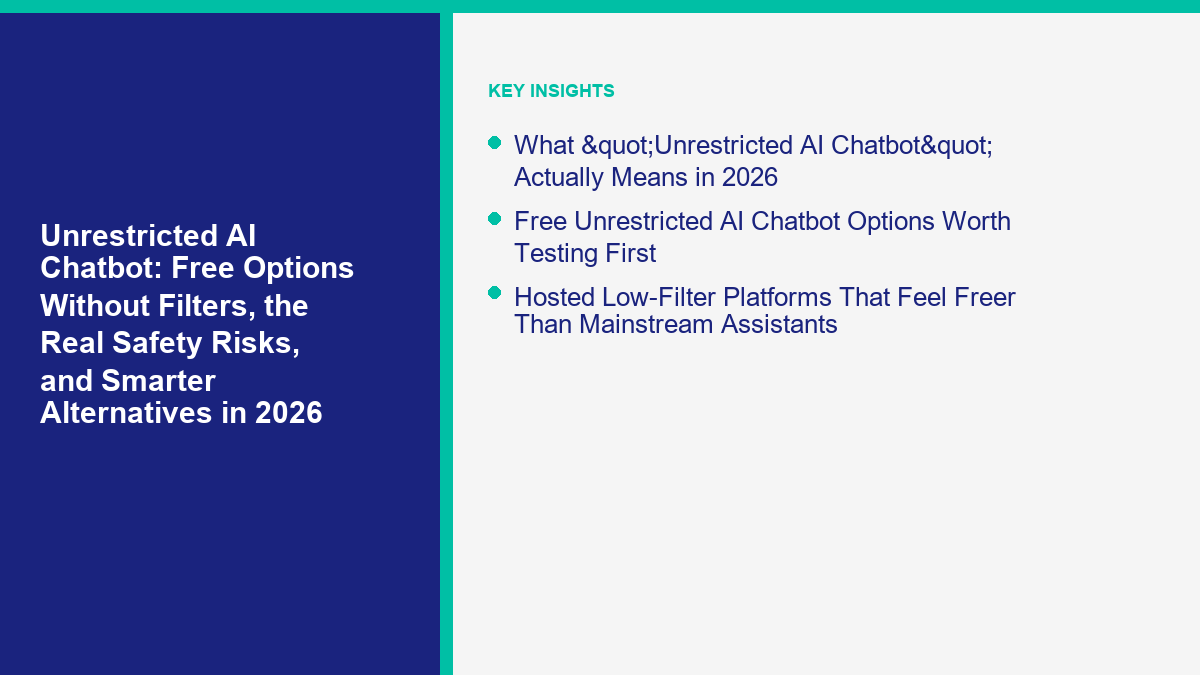
La plupart des pages ciblant un chatbot IA sans restrictions vendent encore un fantasme : un bot gratuit, sans règles, sans friction de compte, sans limites d'utilisation, sans compromis sur la vie privée, et sans inconvénient. Ce n'est pas ce à quoi ressemble le marché sur le 12 avril 2026. Ce qui existe réellement est un spectre. Certains outils sont moins filtrés que les assistants grand public. Certains sont plus faciles à ouvrir sans se connecter. Certains sont conçus pour des discussions de personnages plutôt que pour un travail factuel. Et certains déplacent l'ensemble de la pile sur votre propre machine afin que vous contrôliez beaucoup plus de comportements vous-même.
Cette distinction est importante car les personnes recherchant un chatbot IA non filtré ne posent généralement pas la même question. Un utilisateur veut moins de refus pour la fiction, la satire, le brainstorming antagoniste ou le jeu de rôle. Un autre veut un chatbot IA gratuit sans restrictions car il ne veut pas créer un autre compte. Un autre veut quelque chose qui ressemble à un chat IA illimité au lieu d'un produit qui les limite après dix demandes. Et une autre personne essaie vraiment de mettre l'IA sur un site web, Facebook Messenger ou Instagram sans créer un désastre en matière de sécurité de marque.
J'ai vérifié les pages de tarification actuelles, les centres d'aide, les documents de sécurité et les pages de politique d'OpenAI, DuckDuckGo, Venice, Character.AI, LM Studio, Ollama, ManyChat, Tidio, la FTC et le Bureau américain des droits d'auteur avant d'écrire cela. La version courte est directe. Aucun chatbot public hébergé majeur n'est vraiment sans restrictions en 2026. Si une entreprise héberge le modèle, possède la couche de compte et peut suspendre ou remodeler l'accès, le produit est régulé que la page d'accueil indique privé, non censuré, sans restriction ou sans filtre.
Cela ne rend pas la catégorie inutile. Cela signifie simplement que vous devriez cesser de demander une échappatoire magique et commencer à choisir le bon outil pour le travail. Duck.ai est l'un des meilleurs tests privés gratuits. Venice est l'une des options hébergées à faible filtre les plus claires. Character.AI est plus fort pour les personas que pour la vérité. Des outils locaux tels que LM Studio et Ollama se rapprochent le plus d'un vrai chatbot IA sans restrictions configuration, mais vous héritez également de la responsabilité. Et si votre véritable objectif est l'automatisation orientée client sur Messenger, Instagram ou votre site, comparez Voir les tarifs de MessengerBot avant de connecter un onglet de chat consommateur à un flux de travail public pour lequel il n'a jamais été conçu.
Cet article reste pratique. Vous verrez quelles options gratuites sont réelles, quelles revendications “ sans filtres ” tiennent pour les utilisateurs ordinaires, où la confidentialité s'améliore ou s'aggrave, comment tester un outil à faible filtrage en toute sécurité, et à quoi ressemblent des alternatives plus intelligentes lorsque vous souhaitez de la flexibilité sans confier vos conversations publiques à un générateur de responsabilités.
Ce que signifie réellement "Chatbot IA sans restrictions" en 2026
L'expression semble simple, mais elle cache généralement quatre objectifs différents.
| Ce que recherche le chercheur | Ce que cela signifie généralement en pratique | Meilleur ajustement | Principale difficulté |
|---|---|---|---|
| Moins de refus | Un chatbot hébergé qui discutera de sujets audacieux mais légaux sans interruptions constantes de la politique | Venise, Duck.ai, certains fronts de modèles ouverts | Vous êtes toujours soumis à la modération du fournisseur, aux limites de plan ou aux changements de produit |
| Aucune friction d'inscription | Un onglet gratuit que vous pouvez ouvrir rapidement sans lier la session à un compte principal | Duck.ai, modes invités, démos publiques | Pas d'inscription n'est pas la même chose que pas de modération |
| Profondeur des personnages | Jeu de rôle, compagnonnage ou fortes personnalités au lieu d'une voix d'assistant générique | Character.AI, outils de style Replika | Le divertissement n'est pas la même chose que la précision, la confidentialité ou la stabilité |
| Véritable contrôle | Exécution de modèles localement pour que vous choisissiez les invites, le stockage et le comportement | LM Studio, Ollama | Setup, hardware, evaluation, and safety become your problem |
That is why a lot of “best unrestricted AI chatbot” roundups feel slippery. They compare four different categories as if they are interchangeable. A no-account chat wrapper is not the same thing as a low-filter hosted product. A character app is not the same thing as a general assistant. A local runtime is not the same thing as a public web chatbot. If you do not separate those buckets, every comparison turns into marketing noise.
The most useful mental model is relative freedom, not absolute freedom. If a company hosts the system and publishes rules, it has hard boundaries. Those boundaries may be looser than ChatGPT’s. They may also feel much more adult, especially for satire, emotionally intense fiction, or roleplay. But they are still boundaries. Once you accept that, the category becomes much easier to read.
That framing also explains why the keyword keeps growing. Many users are not asking for fraud, malware, or dangerous content. They are reacting to overcorrection. They want a bot that can handle darker fiction, sharp political debate, taboo philosophy, sarcasm, mature humor, or character play without collapsing into canned refusals. They want the conversation to feel less supervised, not reckless.
La question plus intelligente n'est pas “ Quel chatbot n'a aucune règle ? ” La question plus intelligente est “ Quelle modération puis-je tolérer, de quelle vie privée ai-je besoin et combien de travail de configuration suis-je prêt à faire ? ” Votre réponse détermine si vous devez ouvrir Duck.ai, payer pour Venice, rester avec un assistant grand public ou exécuter un modèle localement.
Options de chatbot IA gratuites et sans restriction à tester en premier
Si vous voulez une liste de départ au lieu de théorie, la voici. Le tableau ci-dessous se concentre sur des produits avec un véritable chemin gratuit à partir d'avril 2026, et non sur de fausses offres “ gratuites ” qui meurent après trois invites ou qui obligent à utiliser une carte de crédit avant de pouvoir faire quoi que ce soit d'utile.
| Plateforme | Accès gratuit | Prix public payé actuel | À quel point cela semble filtré | Meilleur pour | Véritable piège |
|---|---|---|---|---|---|
| Duck.ai | Oui, gratuit avec des limites quotidiennes et sans exigence de compte | Abonnement DuckDuckGo à partir de $9.99/mois aux États-Unis. | Medium | Tests privés, à faible friction et discussion informelle | Provider moderation still applies, and free usage is capped daily |
| Venise | Yes, 10 text prompts and 15 image prompts per day | Pro at $18/month | Low for a hosted product | Hosted low-filter text and image generation | Toujours un service hébergé, et le basculement du filtre mature est uniquement payant |
| Character.AI | Oui | c.ai+ à $9,99€/mois | Medium | Personas, jeux de rôle et conversations axées sur la voix | Pas conçu pour la vérité, et la modération varie selon l'âge, l'expérience et les règles de politique |
| ChatGPT Gratuit | Oui | Plus à $20€/mois | Moyen à élevé | Meilleure qualité d'assistant tout-en-un sur un niveau gratuit | Des garde-fous solides et des limites d'utilisation en font un mauvais choix “sans restrictions” |
| LM Studio | Le logiciel est gratuit | No platform fee for the app itself | As low as you choose | Private local chat with downloaded models | Hardware, model quality, and safety checks are entirely on you |
| Ollama | Le logiciel est gratuit | No platform fee for the runtime itself | As low as you choose | Local APIs, terminal workflows, and self-hosted experimentation | Best experience still depends on your machine and model choices |
The surprise winner for most people is still Duck.ai. DuckDuckGo’s current help pages say the free version supports Anthropic’s Claude 4.5 Haiku, Meta’s Llama 4 Scout, Mistral Small 3 24B, OpenAI’s GPT-4o mini, GPT-5 mini, and gpt-oss-120b. DuckDuckGo also says it does not filter or modify model responses itself, removes IP-linked metadata before sending prompts to providers, and does not use chats to train AI models. That is a better privacy and friction profile than the average free consumer chat tab.
Venise is the clearest answer if your search literally means “show me something marketed as uncensored.” Its current features and pricing pages say the free plan includes 10 text prompts and 15 image prompts per day, while Pro costs $18 per month and includes unlimited text with Free and Pro models in-app. Venice’s help docs also say disabling the Mature Filter is a Pro-only setting. In other words, Venice is not pretending to be the same kind of product as ChatGPT. It is openly courting the crowd that wants fewer filter interruptions.
Character.AI is useful if your goal is personality, not clean factual output. Its current subscribe page lists c.ai+ at $9.99 per month, with better memory, ad-free chats, access to newer models, no slow mode, unlimited voice calls, and more chat customization. That makes it a strong entertainment and roleplay destination, but not a replacement for a serious research or customer-service stack.
ChatGPT Gratuit still belongs in the table because a lot of searchers think “unrestricted” when what they really want is a good free chatbot that does not feel broken. OpenAI’s pricing page still shows a real $0 plan with limited access to GPT-5, search, file uploads, voice, image tools, custom GPTs, and projects, while the Plus plan remains $20 per month. The problem is obvious: if your top priority is fewer guardrails, ChatGPT is not the right product to force into that job.
LM Studio et Ollama are the only entries here that can get close to true control. They are free software, they run locally, and they shift storage, model selection, and prompt behavior toward you instead of a hosted provider. That is the closest thing to a real chatbot IA gratuit sans restrictions path, but it is not one click and it is not foolproof.
Sources checked: Duck.ai overview, Duck.ai chat models, Duck.ai usage limits, DuckDuckGo subscription pricing, Venice features, Venice pricing, Venice mature filter help, Character.AI subscribe, Voir les tarifs de MessengerBot, ChatGPT Plus help, LM Studio system requirements, Ollama quickstart.
Hosted Low-Filter Platforms That Feel Freer Than Mainstream Assistants
Duck.ai Is the Best Place to Start If You Want Private Free Chat First
Duck.ai does not win because it is the smartest model stack on the web. It wins because it removes a lot of the friction that makes “free unrestricted chatbot” pages so annoying in practice. You do not need a standard account to try it. The free tier is real. DuckDuckGo says chats are anonymized, IP-linked metadata is stripped before prompts go to model providers, and conversations are not used to train AI models. The company also says it does not filter or modify responses itself, though Anthropic, Meta, Mistral, and OpenAI still apply their own moderation policies.
That makes Duck.ai a very good answer for readers who want a lighter-touch experience without turning privacy into an afterthought. It is not truly unfiltered, and it is not positioned that way. What it does offer is a low-drama environment for trying ideas, asking awkward questions, drafting edgy-but-legal content, or testing how different models behave without handing your session to a high-friction social login.
Venice Is the Clearest Hosted Answer to the "No Filters" Search Intent
Venice deserves separate treatment because it is one of the few products in this category whose marketing, pricing, and help docs all line up. The product pages use “private,” “uncensored,” and “unrestricted” language directly. The current free tier is usable instead of symbolic. The paid tier is priced clearly at $18 per month. And the mature-filter controls live behind the Pro plan, which is exactly the kind of detail generic listicles usually fail to mention.
If your definition of unrestricted means “stop lecturing me every time a fictional scene gets intense,” Venice is one of the better hosted fits in April 2026. The catch is the same one that applies to every hosted low-filter service: the company can still change limits, policies, filters, or pricing later. Hosted freedom is always provisional freedom.
Character.AI Is Better for Personality Than for Truth
Character.AI still dominates a very specific lane: persistent personas, character libraries, voice-heavy chat, and public roleplay. If that is your goal, mainstream assistants usually feel flat by comparison. Character.AI’s current c.ai+ plan adds better memory, newer models, no slow mode, unlimited voice calls, and customization. That matters because people searching for an chatbot IA sans restrictions sometimes do not really want fewer rules. They want a bot with a stronger personality.
The safety center is the important reality check. Character.AI says it now creates distinct experiences for teens and adults, uses additional classifiers for under-18 users, and blocks content that violates its terms or community guidelines. So yes, the platform can feel freer than a mainstream work assistant for character play. No, it is not a lawless environment.
The practical rule is simple. If you want a workhorse assistant, use a mainstream assistant. If you want freer private chat, try Duck.ai first. If you want a hosted low-filter product, test Venice. If you want characters, Character.AI is still the obvious stop. Treat those as different lanes and the whole market stops looking contradictory.
Sources checked: Confidentialité de Duck.ai, Duck.ai model list and moderation note, Venice features, Venice pricing, Venice mature filter settings, Character.AI pricing, Character.AI Safety Center, Character.AI voice FAQ.
Local AI Setups That Get Closest to a Free AI Chatbot With No Restrictions
If your search really means “I want actual control,” local is the serious answer. Not flashy. Not the easiest. But serious. That is because once the model runs on your own machine, you can choose the model family, the prompt template, the memory behavior, the logging rules, the front end, and whether the session ever leaves your device at all.
LM Studio Is the Easiest GUI Path for Private Local Chat
LM Studio describes itself as local AI on your computer and says you can run models privately and for free on your machine. For many non-developers, that matters more than benchmark scores. You get a visual app, local chat, downloadable models, and an OpenAI-compatible workflow without having to start from a terminal-first mindset. If you want the closest thing to a “private unrestricted chatbot” without renting infrastructure, LM Studio is a very approachable starting point.
Ollama Is Better if You Want APIs, Scripts, and Repeatable Local Workflows
Ollama’s quickstart says it is available on macOS, Windows, and Linux, and the docs make the local pattern obvious: install the runtime, run a model, and call it through a local API. That makes Ollama especially strong for people who want a local chatbot that can eventually power scripts, tools, or developer workflows instead of just a single desktop chat window.
There is a tradeoff that a lot of “unlimited ai chat” threads skip. Local software can be free while the real cost moves into hardware, storage, evaluation time, and patience. Ollama’s hardware docs spell out broad GPU support across newer Nvidia generations, but the bigger practical point is this: the cheaper your hardware, the more you will feel context limits, slower responses, or smaller-model quality tradeoffs.
A Safe Way to Start Local Without Creating a Mess
- Start with one small local model and one narrow use case. Do not begin by trying to replace every cloud chatbot you use.
- Keep a separate test folder or prompt notebook. Local freedom gets sloppy fast if you mix experiments, work prompts, and sensitive data.
- Turn off any syncing you do not understand. “Local” is only local if your front end is not silently backing things up elsewhere.
- Test for hallucination before you test for edginess. A model that feels freer but is wildly wrong is not progress.
- Document your model and prompt choices. If a setup works, you want to reproduce it instead of rebuilding from memory next week.
That is the honest local pitch in 2026. If you want truly fewer restrictions, you can get closer by moving the stack onto your own hardware. You also lose the safety rails, trust layer, and convenience that hosted tools provide. For some readers that is the whole point. For others it is a sign they never wanted a local setup in the first place.
Sources checked: LM Studio system requirements, Ollama quickstart, Ollama hardware support.
The Real Safety Risks Most "No Filter" Lists Skip
The biggest problem with the unrestricted-chat niche is not that the tools exist. It is that too many roundups treat fewer filters as a universal upgrade. It is not. The moment you remove friction, you are changing what kinds of mistakes the system makes and how expensive those mistakes can become.
Hallucinations Get More Dangerous When the Tone Feels More Confident
Low-filter systems often feel more candid, which users mistake for honesty. That is a risky mix. If a bot stops refusing and starts sounding bolder at the same time, it can give bad medical, legal, financial, or reputational advice with extra confidence. That does not require obviously illegal prompts. It only requires the user to overtrust the tone.
Voice Features Raise the Stakes Fast
Voice is where this category stops feeling like harmless experimentation. DuckDuckGo’s voice-chat privacy page is unusually candid: it says voice chats are private, anonymized, not used to train models, and not stored after the session ends, but it also warns that your voice is unique and can function as biometric data. That is the kind of tradeoff more products should explain as clearly.
The FTC has been treating AI voice misuse as a real consumer-protection problem for a while now. Its 2024 voice cloning challenge announcement explicitly framed AI-enabled voice cloning as a fraud risk, not just a novelty feature. If your favorite “unfiltered” app lets users create voices, roleplay real people, or simulate authority, you should think about impersonation risk immediately, not after something gets abused.
Scam Patterns Scale When Bots Feel Casual and Human
The FTC’s April 2025 text-scam release reported $470 million in losses from text scams in 2024, with fake delivery notices, bogus job offers, fraud alerts, unpaid toll messages, and wrong-number threads leading the list. That matters here because the winning scam pattern is rarely “look at this obvious robot.” It is a conversation that feels ordinary enough to keep you talking. An unrestricted chatbot used carelessly in public channels can make that problem worse by sounding convincing without applying strong boundaries.
Digital Replica Problems Are Not Theoretical Anymore
The U.S. Copyright Office’s AI initiative now breaks out digital replicas as its own major issue, and its July 31, 2024 Part 1 report recommended a federal digital replica law. That is a concrete signal that voice and likeness misuse is no longer a fringe technical concern. If a tool encourages celebrity imitation, synthetic voice reuse, or realistic impersonation, it is moving into a legal environment that is tightening, not loosening.
Public-Facing Use Multiplies Every Risk
A risky personal experiment is one thing. Putting the same model in front of customers is different. The moment the bot speaks for your brand, every hallucination becomes a support problem, every weird refusal becomes a user-experience problem, and every low-filter answer becomes a compliance or reputation problem. That is why “no filters” is a fun consumer feature for some use cases and a terrible default architecture for most business use cases.
Sources checked: Duck.ai voice privacy, FTC voice cloning challenge announcement, FTC text scam losses release, U.S. Copyright Office AI initiative.
Why Privacy Usually Gets Murkier Before It Gets Better
A lot of people treat “uncensored” and “private” as synonyms. They are not. Sometimes the low-filter tool is more private. Sometimes it is much less private. You need to read the storage and provider rules, not just the homepage adjectives.
Duck.ai is currently one of the cleaner privacy stories in this space because DuckDuckGo says prompts are not stored on its servers by default, recent chats are saved locally unless you opt out, IP-linked metadata is removed before prompts go to providers, and chats are not used to train models. Even there, you still need to read the fine print. DuckDuckGo’s newer privacy terms now say you can also choose encrypted Sync & Backup for longer-term server storage if you want it. That is still private by mainstream standards, but it is no longer a purely local-history story for every user.
Venise uses strong privacy language, but it is still a hosted service with accounts, payments, and feature controls. That does not make it bad. It just means you should not mentally file it beside LM Studio or Ollama. Hosted products can be privacy-forward without being equivalent to local execution.
Local tools feel safer because data stays near you, but they create their own mistakes. Users forget about browser caches, synced folders, screenshots, export files, local logs, and copied prompts sitting in a notes app. “It runs on my laptop” is not the same thing as “I handled the data responsibly.”
The right privacy question is not “Is this uncensored?” It is “Who can see the data, who can retain it, and who can connect it back to me?” Those are different questions, and the answers vary wildly across the tools people keep lumping together.
If you care about privacy more than raw power, test Duck.ai first. If you care about control more than convenience, go local. If you care about public customer conversations more than private experimentation, use a business platform that makes retention, handoff, and approved knowledge manageable instead of guessing. That is where Parcourez nos tutoriels becomes more useful than another Reddit thread about which roleplay bot is least annoying this week.
Sources checked: Duck.ai privacy details, Duck.ai privacy terms, Venice pricing, LM Studio, Ollama.
How to Vet an AI Chatbot Unfiltered Claim in Under 10 Minutes
You do not need a 40-tab research session before trying a new tool. You do need a better process than “the landing page looked cool.” This checklist catches most of the problems fast.
- Read the pricing page before the homepage. This is where fake free tiers collapse. If the service is really free, the limits will still be useful. If the service is pretending, you will see microscopic caps or immediate upsell pressure. Venice is a good example of pricing that is honest enough to evaluate in minutes.
- Search the help center for moderation language. Duck.ai says it does not filter or modify responses itself, but provider moderation still applies. Character.AI openly describes separate teen and adult experiences. Those details matter more than influencer hype.
- Check the storage rules. Look for whether chats are saved locally, on servers, in synced backups, or by model providers. If you cannot find the storage story quickly, assume it is not a privacy-first product.
- Run three harmless but revealing prompts. Try one piece of dark fiction, one emotionally intense conversation, and one adversarial but legal debate prompt. You are not testing extremity. You are testing whether the bot becomes unusably rigid or remains workable.
- Test deletion and export immediately. If you would not be comfortable with the conversation existing later, you should know how to remove it before you say anything interesting.
- Check whether voice or likeness features exist. Voice upload, voice cloning, or public voice sharing changes the risk profile a lot, even if you never planned to use them.
- Decide whether this is private play or production infrastructure. A bot that is fun in a private tab can still be the wrong tool for customer support, lead capture, or sales messaging.
The last point is the one most people skip. They test a consumer chatbot, like the tone, and then start imagining it as a website agent, a Messenger bot, or an Instagram auto-responder. That is usually the wrong jump. Consumer AI chat and production conversation design are different jobs.
Use this checklist and you will save yourself from two common mistakes: trusting a “free ai chatbot with no restrictions” claim that falls apart after five minutes, and confusing a fun private chat experience with something stable enough to hand to customers.
Where Unrestricted Chat Helps and Where It Turns Into a Liability
Low-filter chat is not automatically irresponsible. It becomes useful when the task benefits from fewer false positives and more expressive range.
| Good fit for lower-filter chat | Bad fit for lower-filter chat |
|---|---|
| Fiction, roleplay, satire, worldbuilding, and character dialogue | Customer support, billing answers, return policies, and regulated business messaging |
| Internal brainstorming that needs sharper debate or more candid tone | Medical, legal, or financial advice where confidence errors are expensive |
| Prompt research, jailbreak analysis, and adversarial testing in a private environment | Anything involving minors, real-person impersonation, or likeness-sensitive content |
| Disposable private sessions where you want less sign-up friction | Brand voice, public community moderation, or unattended live website chat |
The easiest way to think about it is audience. If the audience is just you, the main risk is whether the tool wastes your time, leaks data, or nudges you toward bad judgment. If the audience is a customer, lead, patient, client, or member of the public, the risk jumps from personal convenience to operational liability.
That is why the best consumer “unrestricted” option and the best business chatbot are rarely the same product. One is optimizing for freedom. The other is optimizing for reliability, routing, approved knowledge, and escalation. You can respect both jobs without pretending one tool should do both.
Why an Unrestricted Bot Is the Wrong Default for Websites, Messenger, and Instagram
This is the section most no-filter articles avoid because it breaks the fantasy. A consumer chatbot that feels freer in a private tab is usually a bad default for public channels. Not because public chat has to be stiff, but because the operational requirements are different.
On a website or in Facebook Messenger, the user is not testing your personality. They are usually trying to solve a job. They want pricing, product fit, order status, appointment details, support, a human handoff, or a next step. If the bot answers those questions with style but without control, you have not created a better experience. You have created a faster way to confuse people.
The problem gets worse on Instagram and Messenger because users arrive with even less patience. They are often replying to a Story, asking from a phone, or coming straight from an ad. A loose, conversational assistant sounds attractive until it invents the wrong refund rule, misses a handoff cue, or answers a public-facing question in a tone that made sense in a private no-filter session but looks absurd on a branded account.
This is also where pricing logic changes. Public conversation tools are not just about model access. They are about channels, contacts, automations, seats, escalation, widgets, forms, and reporting. That is why comparing Venice or Character.AI to a Messenger automation stack is the wrong purchase comparison. If your actual problem is customer messaging, start with a system designed for customer messaging.
MessengerBot’s current public pricing page, for example, shows Premium à $19,99 par 30 jours, Pro at $49.99 per 30 days, et Agency at $299.99 per 30 days, alongside Messenger-first features such as website chat, a visual flow builder, forms, tags, Google Sheets integration, comment automation, team tools, and Instagram chatbot support. That is a completely different buying story from a roleplay or low-filter personal chatbot.
So if your goal is “give customers a flexible but safe experience,” the move is not to bolt an unrestricted chatbot onto a public channel. The move is to use controlled automation, approved content, and a clean human handoff. If you need more advanced routing, channel handling, and workflow control after the first build, compare Upgrade to MessengerBot Pro instead of treating a consumer no-filter tool like production infrastructure.
Sources checked: Voir les tarifs de MessengerBot.
Smarter Alternatives That Keep Conversations Flexible Without Removing Every Guardrail
If you like the appeal of freer AI chat but hate the operational risk, there are better patterns than “just deploy the no-filter bot.” These are the setups that actually hold up.
Use a Private Sandbox for Creativity and a Controlled Bot for Customers
This is the cleanest pattern for most businesses. Let your team use a freer tool privately for brainstorming, scenario testing, rough drafts, and creative exploration. Then push only approved outputs, FAQs, flows, and escalation logic into the customer-facing bot. That gives you expressive range internally without making every live conversation a moderation experiment.
Keep Retrieval and Rules in Front of the Model
A smart public bot should answer from approved knowledge first, not raw model vibes first. That means the chatbot pulls from known content, route logic, tags, forms, and handoff triggers instead of improvising policy answers. The bot can still sound conversational. It just stops pretending that every answer deserves full creative freedom.
Separate Discovery, Qualification, and Support
Most public chat failures come from using one bot for every job. Discovery chat should be short and helpful. Qualification should capture intent cleanly. Support should be grounded in policy and able to escalate fast. Once you split those jobs, the craving for one “unrestricted” super-bot usually disappears because you finally see the real operational needs.
Use Human Handoff as a Feature, Not a Failure
Lower-filter AI is most dangerous when the system is forced to answer everything. The fix is not more censorship. It is better routing. A good public bot should know when to stop guessing and hand off with transcript context intact. That feels more trustworthy than an “anything goes” agent that answers every question confidently whether it should or not.
This is where tutorial content matters more than model tribalism. If you want the implementation path for Messenger, Instagram, comment automation, forms, and website chat, Parcourez nos tutoriels before you spend days trying to force a consumer chat product into a customer-service role. And if you build client automation stacks yourself, Rejoignez notre programme d'affiliation instead of treating each setup as a one-and-done service fee. That is the better business model for a lot of agencies and consultants in this space.
Business-Safe Chatbot Platforms Compared by Real 2026 Pricing
Once you move from private experimentation to real customer conversations, the buying criteria change fast. Price still matters, but the bigger questions are channel fit, automation depth, handoff quality, and how predictable the billing model stays once you start getting actual traffic.
| Plateforme | Current public starting price | Meilleur ajustement | Why it is smarter than an unrestricted consumer chatbot |
|---|---|---|---|
| MessengerBot | Premium $19,99 par 30 jours | Messenger-first businesses that also want Instagram and website chat options | Built around flows, widgets, tags, forms, broadcasts, integrations, and supportable public messaging |
| ManyChat | Essential $17/month, Pro $39/month for new-account pricing | Social automation across Instagram, Messenger, TikTok, WhatsApp, SMS, and email | Structured funnels and inbox controls beat freestyle consumer chat when money is on the line |
| Tidio | Starter $24.17/month, Growth from $49.17/month, Lyro AI from $32.50/month | Website support, live chat, and help-desk style workflows | Designed for service operations and AI support quotas, not raw conversational freedom |
MessengerBot makes the most sense when Facebook Messenger is the actual job to be done. The flat public plan structure is easier to understand than a lot of contact-metered pricing, and the feature set is already pointed at the follow-up work businesses care about after the first conversation: forms, widgets, broadcasts, tagging, ecommerce, integrations, and multi-channel messaging. If that is your lane, Voir les tarifs de MessengerBot before you overengineer a workaround.
ManyChat is still strong if your world is broader social automation, especially for new accounts on the March 2, 2026 pricing model. Essential starts at $17 per month, Pro at $39, Business at $99, and Advanced at $199, with contact allowances and overages layered on top. That is a very different billing shape from a flat-price Messenger-first platform, and it matters more once your campaigns actually work.
Tidio becomes the cleaner answer the moment your main problem lives on your website instead of inside social DMs. Its pricing page is unusually transparent about the split between customer-service plans and Lyro AI quotas. That is useful because it forces buyers to think about support volume, not just chatbot novelty.
All three of these are more operationally honest for public conversations than a low-filter consumer chatbot. That is the whole point. Once real customers are involved, the safest “smarter alternative” is not a more unrestricted assistant. It is a more controlled system.
Sources checked: Voir les tarifs de MessengerBot, ManyChat Essential plan, ManyChat Pro plan, ManyChat Business plan, ManyChat Advanced plan, Voir les tarifs de MessengerBot.
Which Option Fits Your Goal, Budget, and Risk Tolerance
If you only want a quick answer, use this decision rule.
- Pick Duck.ai if you want a real free option, low friction, privacy-minded defaults, and a lighter-touch experience without pretending moderation vanished.
- Pick Venice if your priority is a hosted low-filter product that openly targets the unrestricted-search crowd and clearly explains its free and paid limits.
- Pick Character.AI if your main goal is roleplay, voice, and persona depth rather than work, research, or business accuracy.
- Pick LM Studio or Ollama if you want actual control and are willing to handle setup, hardware, and safety yourself.
- Pick a business chatbot platform if the conversation will be public, tied to revenue, or expected to follow policy every time.
The honest bottom line is this. “Unrestricted AI chatbot” is mostly a search shorthand, not a stable product class. The closest thing to true freedom is still local. The best free private test is Duck.ai. The clearest hosted low-filter option is Venice. The most entertaining persona platform is still Character.AI. And the smartest alternative for Messenger, Instagram, and website conversations is usually not a looser chatbot at all. It is a controlled automation stack with better routing, better grounding, and better handoff.
If your next step is customer-facing deployment rather than more experimentation, compare Voir les tarifs de MessengerBot, review Upgrade to MessengerBot Pro, and use Parcourez nos tutoriels to build a system that sounds useful without turning every live chat into a moderation gamble.
Questions fréquemment posées
Y a-t-il vraiment un chatbot IA gratuit et sans restrictions en 2026 ?
Pas dans le sens absolu que la plupart des gens lui donnent. Il existe des outils gratuits qui semblent moins filtrés, notamment Duck.ai et le niveau gratuit de Venice, mais les principaux chatbots publics hébergés fonctionnent toujours selon des règles de produit, une modération par le fournisseur ou des limites d'utilisation. Si vous voulez la chose la plus proche d'un chat sans restrictions réelles, des outils locaux tels que LM Studio et Ollama sont la voie sérieuse.
Quel chatbot IA sans restriction est le plus sûr pour un usage privé ?
Duck.ai est l'un des meilleurs points de départ pour un usage privé et décontracté, car DuckDuckGo affirme que les discussions sont anonymisées, qu'elles ne sont pas utilisées pour entraîner des modèles d'IA, et que les métadonnées liées à l'IP sont supprimées avant que les requêtes n'atteignent les fournisseurs. Ce n'est toujours pas la même chose qu'une IA uniquement locale, mais c'est l'une des meilleures histoires de confidentialité parmi les options gratuites hébergées.
Puis-je utiliser un chatbot IA non filtré sur le site web de mon entreprise ?
Vous pouvez, mais c'est généralement un mauvais choix par défaut. Un chat destiné au public nécessite des réponses approuvées, un routage, une escalade et une précision en matière de facturation ou de politique. Un assistant consommateur à filtre inférieur peut sembler mieux pour un usage privé, mais peut créer des problèmes de marque, de conformité et de support une fois qu'il commence à s'adresser aux clients. Une plateforme de chatbot d'entreprise contrôlée est généralement l'architecture la plus sûre.
Quelle est la chose la plus proche d'un chat IA illimité sans filtres stricts ?
L'IA locale est la chose la plus proche de cela en pratique, car le logiciel lui-même ne limite pas vos requêtes comme le fait un service freemium hébergé. Les produits hébergés annoncent parfois une utilisation illimitée ou presque illimitée sur des plans payants, mais ces promesses restent soumises aux règles de l'entreprise, aux politiques changeantes et à l'accès basé sur les comptes.
Les outils locaux comme LM Studio et Ollama comptent-ils comme non restreints ?
Ils comptent comme l'option grand public la plus proche d'un véritable contrôle, et non comme une garantie de liberté parfaite ou de sécurité parfaite. Les outils locaux vous permettent de choisir vous-même les modèles, les invites, le stockage et les API. Ils suppriment également la couche de service hébergé qui gérerait autrement la sécurité, l'évaluation et la commodité pour vous. C'est du pouvoir, mais cela s'accompagne de responsabilités.


 Français
  English
  Tagalog
  简体中文
简体中文  العربية
  हिन्दी
  Português do Brasil
  Español de México
  বাংলা
বাংলা  香港中文
香港中文  繁體中文
繁體中文  Nederlands
  Deutsch
  Bahasa Indonesia
  日本語
日本語  한국어
한국어  Polski
  Русский
  Español
  Tiếng Việt