2026年的聊天機器人定價混亂不堪,原因只有一個:供應商不再收取相同的費用。一個平台按活躍聯絡人收費。另一個按解決的對話收費。還有一個看起來便宜,直到你增加座位、AI 點數、WhatsApp 或上線培訓。然後你會發現一些固定費用的工具在紙面上看起來簡單,但一旦你的業務開始增長,就會限制最重要的渠道或使用量。.
我在2026年4月10日檢查了12個聊天機器人平台的公開定價和幫助文檔,並將它們並排放置:MessengerBot.app、ManyChat、Chatfuel、Tidio、Freshchat、Intercom、Zendesk、HubSpot、Botpress、Crisp、Kommunicate和Landbot。這個日期很重要。ManyChat在2026年3月2日為較新的帳戶推出了一個新的定價模型,而HubSpot已經宣布將於2026年4月14日生效的Breeze客戶代理定價變更。如果你正在比較舊博客文章的截圖,你幾乎肯定是在比較過時的數字。.
在表格之前,先做一個快速的現實檢查:如果你想要一個認真的商業聊天機器人,基本上沒有這樣的東西是 無需註冊. 您可能會找到免費計劃、免費試用或無需信用卡的試用。但真正的聊天機器人軟體需要一個帳戶、保存的對話歷史、頻道權限,以及存儲自動化的地方。這是正常的。值得問的問題不是您是否可以避免註冊,而是當您的對話數量翻倍時,計費模型是否仍然合理。.
| 平台 | 免費層或試用 | 公開起始價格 | 主要定價模型 | 什麼會迅速變得昂貴 |
|---|---|---|---|---|
| MessengerBot.app | 免費試用 | 高級 $19.99 每 30 天 | 固定月費計劃 | 大多數可預測;只有在您需要專業或代理商容量時,成本才會跳升 |
| ManyChat | 2026年3月模型的免費計劃,包含25個活躍聯絡人 | 基本 $每月17 | 活躍聯絡人加上超出部分 | 聯絡人增長和額外的收件箱席位 |
| Chatfuel | 免費試用 | 每月 $23.99 的商業方案 | 每次對話 | 額外對話每次 $0.02,並且有特定頻道的定價變更 |
| Tidio | 免費計劃 | 入門方案每月 $24.17 | 計劃費用加上 AI 對話配額 | Lyro AI 使用和大型團隊計劃 |
| Freshchat | 最多 10 名代理免費 | 增長方案每位代理每月 $19,按年計費 | 每個座位加上 AI 會議 | Freddy AI 會議包和座位增長 |
| Intercom | 14天免費試用 | 每個座位每月基本費用 $29,按年計費 | 每個座位加上每個 Fin 結果 $0.99 | 大規模解決結果計費 |
| Zendesk | 免費試用 | 支持費用從每位代理每月 $19 開始 | 每個座位加上 AI 附加功能或捆綁包 | Copilot、高級 AI 代理和更高級的套件捆綁包 |
| HubSpot | 免費工具 | 目前在美國定價卡中,入門版每個座位每月 $15 | 每個座位加上 AI/結果收費 | 升級到專業版或企業版及付費 AI 解決方案 |
| Botpress | 按需付費,每個 $0 享有免費 AI 信用 | 每月加收 $89 | 工作區費用加上 AI 支出 | 提供者使用量、額外消息和管理服務 |
| Crisp | 免費計劃 | 每個工作區 $45 | 固定工作區費用,按計劃捆綁 AI 信用 | 從基礎版升級到 Plus 以適應團隊規模和 AI 使用量 |
| Kommunicate | 免費試用 | 每月 $83.33,按年計費 | 對話配額加上隊友限制 | 升級到進階版並超過對話配額 |
| Landbot | 沙盒免費計劃 | 每月 $45 美元,詳情請見美元定價頁面 | 聊天配額、席位和頻道層級 | 商業層級、WhatsApp 和額外席位 |
該表格已經顯示了主要模式:聊天機器人的定價不再只是每月的標價。這是一種計費理念。固定費用的工具最容易預算。基於使用的工具更容易啟動,但更難預測。基於結果的 AI 定價看起來公平,直到機器人變得優秀並開始解決大量對話。如果你在為一個精簡的團隊做出購買決策, 適合小型企業的最佳聊天機器人 問題實際上是關於可預測的投資回報,而不僅僅是功能。.
聊天機器人定價模型解釋,沒有供應商的偏見
在將這些定價頁面並排比較後,我會將聊天機器人的定價分為四種真實模型。供應商的措辭不同,但資金仍然通過相同的管道流動。.
| 定價模型 | 運作方式 | 使用此平台的 | 買家喜歡它的原因 | 可能會讓你受傷的地方 |
|---|---|---|---|---|
| 每個聯絡人 | 您根據在計費期間內有多少聯絡人或活躍聯絡人進行支付 | ManyChat | 當您的名單較小時感覺便宜 | 即使消息量保持可控,病毒式活動或活躍月份也可能導致超支 |
| 每條消息或對話 | 您支付聊天量、對話或會話包的費用 | Chatfuel、Tidio、Freshchat、Kommunicate、Landbot | 使用與成本之間的更緊密聯繫 | 支援高峰、產品發布和季節性流量可能會迅速超出您的配額 |
| 每個解決的結果 | 當 AI 機器人完全解決一個對話時,您需要支付費用 | Intercom Fin,HubSpot Breeze 從 2026 年 4 月 14 日開始 | 對於財務團隊來說,這是一個簡單的故事,因為成本與交付的價值相符 | 您的機器人表現越好,帳單就越大 |
| 固定費用或基於席位的 | 您支付固定的訂閱費用,通常按工作區或代理席位計算 | MessengerBot.app、Crisp、Zendesk 基本計劃、HubSpot 基本計劃 | 預算編制非常簡單 | 您可能仍需為席位、AI 層、SMS、WhatsApp、入門培訓或高級支持支付額外費用 |
最佳模型取決於您的業務產生的負載類型。當地服務業每月回答 150 條 Messenger 問題,通常在固定計劃上表現最佳。擁有大量支持請求但自助內容緊湊的支持團隊,如果解決率高且節省勞動成本明顯,可以接受結果定價。社交互動不穩定的創作者業務在主動聯絡計費上需要特別小心,因為一個贈品貼文可能會將便宜的計劃變成意外的發票。.
按聯絡人計費通常是最容易低估的模型。ManyChat 2026 年 3 月的幫助文檔比舊版本清晰得多:免費版包括 25 個活躍聯絡人,基本版包括 250,專業版 2,500,商業版 7,500,高級版 25,000,並且超過的部分會額外收費。這是誠實的。這也意味著您需要考慮活躍聯絡人,而不是追隨者。如果 2,000 人在本月回覆了一個故事序列,帳單將根據活動而不是觀眾規模而產生。.
每次對話的定價聽起來更安全,但它在不同的名稱下有相同的陷阱。Chatfuel 的公開定價從 $23.99 開始,然後對每個額外的對話收取 $0.02。Freshchat 包含前 500 次 Freddy AI Agent 會話,然後每 100 次會話收取 $49。Tidio 提供您前 50 次 Lyro AI 對話免費,然後將您推入付費 AI 配額。在緩慢的月份,這看起來還不錯。在產品發布、假期支持高峰或結帳流程故障時,這些超出費用突然變得重要。.
Chatfuel 需要額外的警告,因為其公開定價頁面和較新的幫助文檔在 2026 年的閱讀方式並不完全相同。在您批准支出之前,請截圖您所購買版本內的計費畫面。這只需 30 秒,並可以防止以後出現許多可避免的混淆。.
免費聊天機器人計劃:您在付款之前實際獲得什麼
免費聊天機器人計劃是有用的,但並不是大多數人所想的原因。它們不擅長承擔真正的支持操作。它們非常適合證明渠道適合性、測試第一個流程以及回答一個簡單的問題:客戶是否真的會使用這個機器人?

| 平台 | 免費優惠 | 需要注意的真正限制 | 良好的使用案例 | 升級信號 |
|---|---|---|---|---|
| ManyChat | 在新模型上有 25 個活躍聯繫人時免費 | 如果您的 DM 活躍,聯繫人上限會很快到來 | Testing Instagram or Messenger automations | You need more than one real campaign running at once |
| Tidio | Free live chat plan plus 50 Lyro conversations free | AI quota is tiny for a busy website | Trying live chat and a few AI answers on a small site | Bot handles real traffic and you want reporting or more automation |
| Freshchat | 最多 10 名代理免費 | Messaging channels and AI depth live in paid tiers | Basic web chat and inbox setup | You need WhatsApp, Messenger, or AI handling |
| HubSpot | 免費工具 | Good core inbox, weak advanced automation | CRM-first teams validating support workflows | You want routing, richer automation, or AI resolution |
| Botpress | PAYG at $0 with free monthly AI credit | Usage still matters; free is for lightweight testing | Builders prototyping an agent | You need branded production deployment or team collaboration |
| Crisp | Free plan with 2 seats | No AI credits included | Solo founders or tiny teams needing website chat | You need omnichannel inbox or chatbot automation |
| Landbot | 沙盒免費計劃 | Built for testing, not serious production volume | Prototype web lead flows | You want live traffic and more than toy chat volumes |
The useful way to think about free plans is as a sandbox. Can you connect the channel, build a greeting, answer three repeat questions, capture a lead field, and hand off to a human? If yes, the free plan has done its job. Once you need reporting, branding removal, more seats, more AI volume, or multiple production automations, free stops being a business plan and becomes a limitation.
ManyChat and Tidio are the strongest free-to-paid funnels in this group. ManyChat lets you feel the product quickly, and Tidio gives you a real website support footprint before the AI meter starts running. Crisp’s free plan is honest but deliberately narrow. Freshchat’s free tier looks generous because of the agent count, but the channel and AI story becomes much more useful once you move into Growth. Botpress is a different kind of free: not business-ready out of the box, but excellent if you want to prototype with control.
If you are a small business owner, the mistake is staying free after the bot has already proven itself. Once the bot is capturing leads or deflecting support volume, the free plan is no longer saving you money. It is usually slowing you down.
Entry-Level Chatbot Plans Between $15 and $50 a Month
This is the most crowded band in the market, and it is where most SMB buyers should start. The trap is assuming these plans are interchangeable. They are not. A $19.99 Messenger bot for a Facebook-driven business can outperform a $45 website bot if the traffic is happening in Page messages, not on your site.
| 計劃 | Public price | Pricing logic | 最佳適合 | Main caution |
|---|---|---|---|---|
| MessengerBot.app Premium | $19.99 每 30 天 | Flat plan | Facebook Messenger-first businesses | You may outgrow Premium if you need more pages, websites, or channel breadth |
| Freshchat Growth | $19 per agent per month billed annually | Per seat | Budget omnichannel support with social channels | AI is not really free once the 500 Freddy sessions are gone |
| ManyChat Essential | $17 per month | 250 active contacts included, then overages | Creators and social-first brands starting to monetize DMs | Active-contact overages at $0.10 each on monthly billing |
| Chatfuel Business | From $23.99 per month | Conversation-based | Social messaging flows with no-code setup | Extra conversations cost more the moment your campaign performs |
| Tidio Starter | $24.17 | Base plan plus AI quota if needed | Website chat and basic help-desk setup | Starter alone is not the full AI cost story |
| HubSpot Starter | Currently $15 per seat per month on the pricing card | Per seat | CRM-first teams wanting live chat and basic service workflows | Serious AI service work starts higher in the HubSpot stack |
| Crisp Mini | $45 per workspace | Flat workspace price | Early-stage teams wanting email plus website chat | Omnichannel bot features live higher in the stack |
| Landbot Starter | 每月 $45 | Chat quota and seats | Conversational forms and lightweight web lead capture | Upsell pressure starts when volume and channels grow |
| MessengerBot.app Pro | $49.99 每 30 天 | Flat plan | Businesses that need more pages, chat widgets, and scale without contact math | Not built for enterprise help-desk governance |
If I had to split this bracket into buyers instead of prices, I would do it like this. MessengerBot.app, ManyChat, and Chatfuel are best when social messaging is the center of the business. Tidio, Freshchat, Crisp, and Landbot are stronger when the website matters as much as the social inbox. HubSpot Starter is the most CRM-shaped option in this range, which is useful if you already want the broader customer platform around the bot.
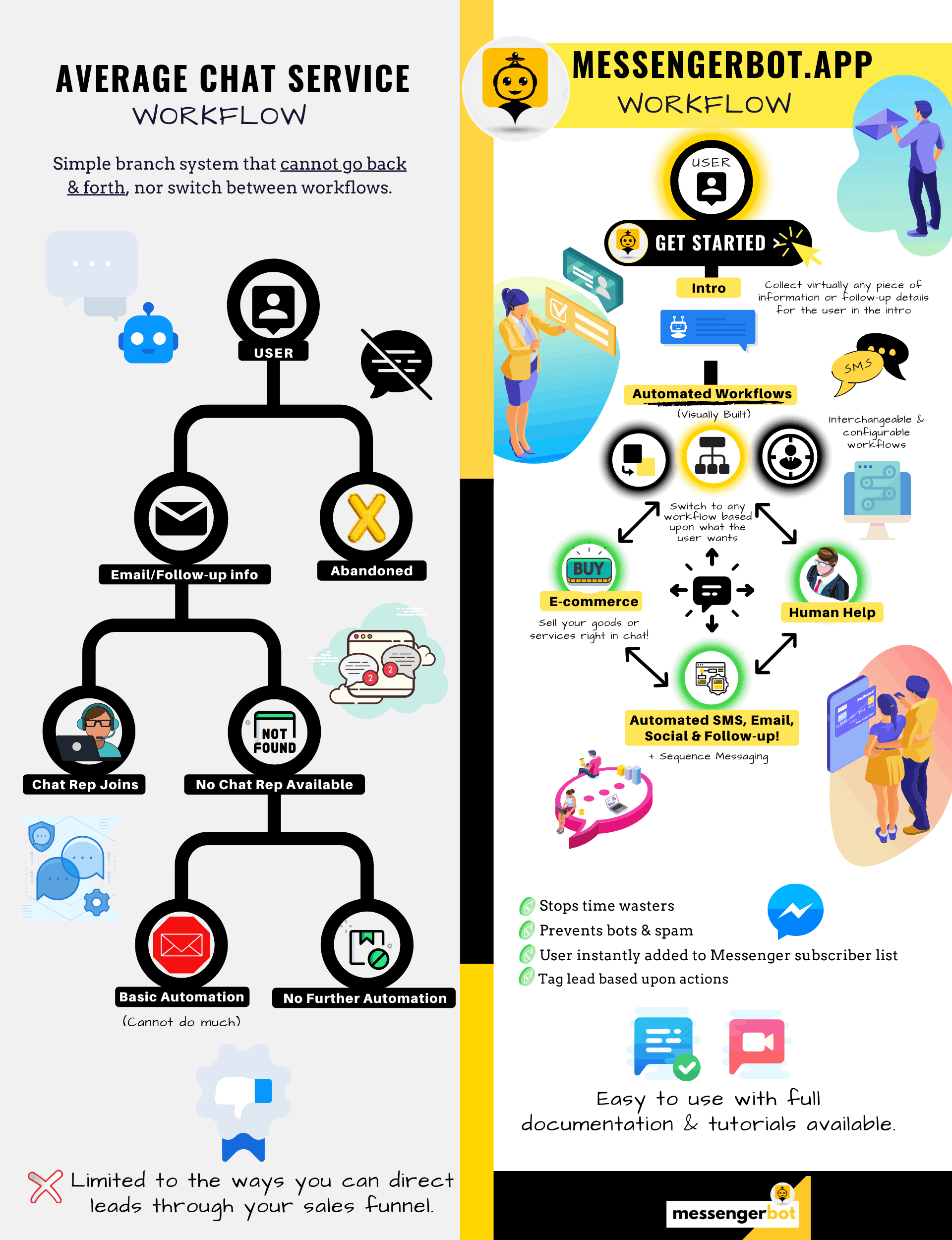
MessengerBot.app is the cleanest pricing story in this group. Premium at $19.99 per 30 days and Pro at $49.99 per 30 days are easy to explain to a real business owner. No active-contact math, no outcome billing, no wait-until-renewal surprises if usage spikes. If your leads live on Facebook and you want automations, forms, sequences, website chat, and Google Sheets or Zapier connectivity, a flat price has real value.
ManyChat is still one of the easiest products to recommend for social DMs, but the bill follows engagement more than older list-based buyers expect. The new March 2026 model is clearer than the legacy version, which is an improvement. It is also a reminder that cheap and predictable are not the same thing. A creator with modest activity can sit happily on Essential. A brand running multiple campaigns can hit Pro or Business faster than expected.
Tidio and Freshchat are the two plans I would watch closest if your goal is support deflection. They can be excellent value. They can also be misread. The base plan is not the whole story if your team actually wants the AI agent to do real work.
Mid-Tier Business Chatbot Plans That Usually Land Between $50 and $200
This is where chatbot buying stops being casual. Once you reach this band, you are usually trying to solve a business process, not just test a channel. You need better routing, richer reporting, more team seats, or an AI layer that is expected to carry real conversation volume.

| 計劃 | Public price | Why teams move here | What to check before buying |
|---|---|---|---|
| Crisp Essentials | $95 per workspace | Omnichannel inbox, workflow builder, AI chatbot, knowledge base | Whether 10 seats and included AI credits are enough |
| ManyChat Business | 每月 $99 | 7,500 active contacts, 5 users, 3 Inbox seats, unlimited channels | How fast you are approaching overage pricing |
| HubSpot Professional | $100 per seat per month | Automation, knowledge base, CRM-connected service workflows | Seat count and whether Pro is enough for your AI plans |
| Botpress Plus | $89 per month plus AI spend | Production-ready agent building with more messages and collaboration | Provider spend and extra message charges |
| Intercom Advanced | $85 per seat per month billed annually plus $0.99 per Fin outcome | Growing support teams wanting automation and AI in one help desk | Projected monthly Fin outcomes |
| Zendesk Copilot add-on | $50 per agent per month billed annually | AI assistance for human agents inside a Zendesk stack | You still need the underlying Zendesk plan cost underneath it |
| Zendesk Suite + Copilot Professional | $155 per agent per month billed annually | Serious service teams wanting unlimited Copilot in the bundle | How many agents actually need that full bundle |
| Kommunicate Advanced | $166.66 per month billed annually | Higher conversation allowance, more teammates, voice, and integrations | How close you are to enterprise usage and custom support needs |
| ManyChat Advanced | $199 per month | 25,000 active contacts, API access, larger team support | Whether the annual plan or custom enterprise negotiation is better |
The important shift here is that your chatbot is now part of operations. HubSpot Professional is not just a more expensive bot. It is a CRM-linked service workflow. Intercom Advanced is not just chat plus AI. It is a help desk with AI outcomes billed on top. Botpress Plus is not just a nicer visual builder. It is a control-heavy platform where the base plan is only part of the monthly number because LLM usage is passed through separately.
This is also the range where buyers often compare the wrong tools. Someone looking at Intercom, HubSpot, and Zendesk is really buying service operations software. Someone comparing ManyChat Advanced with Botpress Plus is deciding between social automation scale and agent-building flexibility. Those are different jobs. If you are still torn between general AI assistants and business automation platforms, read our chatbot comparison after this, because the categories blur fast once vendors start saying AI agent on every page.
Enterprise Chatbot Pricing Starts at $500 Faster Than Most Buyers Expect
Enterprise chatbot pricing rarely appears as one neat line item. It usually shows up as a stack: seats, AI outcomes, onboarding, compliance, premium support, higher rate limits, and sometimes minimum commitments. That is why a tool that looked affordable in a demo becomes a four-figure monthly commitment by procurement time.
| Example enterprise setup | Monthly math | What pushes it over $500 |
|---|---|---|
| Intercom Essential with 5 full seats and 500 Fin outcomes | $145 in seats plus $495 in Fin outcomes = $640 per month | Outcome billing scales with success, not failure |
| Zendesk Suite + Copilot Professional for 5 agents | 5 x $155 = $775 per month | Seat-based enterprise bundles add up immediately |
| HubSpot Enterprise for 5 service seats | 5 x $150 = $750 per month, plus onboarding fee in the product catalog | Seat minimums and onboarding make the first year much higher |
| Tidio Plus | Starts at $749 per month | Custom quota and bigger-team support push you out of SMB pricing |
| Botpress Team | $495 per month plus AI spend | Even modest provider usage pushes the real total above $500 |
| Botpress Managed | $1,245 per month plus AI spend | Managed implementation and optimization |
| Landbot Business | Starts at $450 per month before extra seats and channel costs | Extra seats or WhatsApp-heavy usage can take it past $500 quickly |
Intercom is the clearest example of transparent enterprise pricing done right. The company openly prices Fin at $0.99 per outcome. That is excellent from a budgeting standpoint because you can model the bill before signing. It also makes one thing brutally obvious: a good bot can become expensive fast. If Fin resolves 1,500 conversations in a month, that is $1,485 in AI outcomes before seat cost.
HubSpot is a different kind of enterprise story. The published service pricing cards make the seat math easy enough, but the real jump happens when you move from we want a chatbot to we want service automation connected to CRM, routing, analytics, and AI. The legal product catalog also lists a one-time onboarding fee for Enterprise, which is the kind of line item people forget when they compare only monthly price cards.
Zendesk lives in a similar zone. The entry point exists, but the serious AI service purchase is usually not the cheapest public starting plan. It is the bundle or add-on combination that actually matches your support workflow. That is why enterprise chatbot pricing is more negotiation than shopping cart.
The Hidden Chatbot Costs Nobody Tells You About
The most expensive part of chatbot software is often not the advertised plan. It is the quiet multiplication around the edges.
- Extra seats: Freshchat, HubSpot, Intercom, and Zendesk all look fine until a second, third, or fifth teammate needs access.
- AI overages: Freshchat bills beyond the first 500 Freddy sessions, Intercom bills per Fin outcome, Botpress bills AI usage at provider cost, and Tidio gates larger Lyro volumes behind bigger quotas.
- Active-contact creep: ManyChat’s pricing makes more sense than it used to, but you still need to watch how many people actually engage in a billing month.
- Conversation spikes: Chatfuel, Kommunicate, Tidio, and Landbot all punish volume surprises more than flat-fee tools do.
- Annual billing optics: A vendor showing the annual equivalent can make a plan feel cheaper than the month-to-month commitment really is.
- Onboarding and implementation: HubSpot explicitly lists onboarding on higher tiers, and managed platforms often package setup into the first-year cost even when the headline price looks monthly.
- Channel fees: WhatsApp, SMS, phone, and some outbound messaging channels often create their own usage layer outside the chatbot plan itself.
- Currency and tax friction: UK buyers should check VAT treatment and local invoicing. Some pricing pages also mix currencies or regional pages in ways that make screenshot comparisons dangerous.
The practical fix is simple: never ask a vendor only for the plan price. Ask for the all-in monthly number at your expected volume. That means seats, AI usage, channel usage, onboarding amortized over the first year, and any rate-limit or support upgrade you are likely to need. If they cannot model that clearly, your budgeting problem starts before the contract does.
How to Calculate Chatbot ROI Before You Spend a Dollar
A chatbot is worth paying for when it saves more labor and recovers more revenue than it costs to run. The formula is simple:
Monthly chatbot ROI = ((labor saved + gross profit recovered + churn avoided) – software cost – maintenance cost) / total monthly chatbot cost
The key phrase there is gross profit, not revenue. If your bot recovers a $100 order and your margin is 35%, the value is $35, not $100. A lot of ROI claims fall apart because they count top-line revenue like it is pure gain.
- Count the repetitive conversations you handle in a normal month.
- Estimate how many minutes each one consumes when a human answers it.
- Multiply that by your loaded hourly staff cost, not just wage rate.
- Add the gross profit from leads, appointments, or orders the bot is likely to save after hours.
- Subtract the real monthly software number, including AI usage and maintenance time.
| Business type | Monthly chatbot workload | Estimated labor or revenue gain | Illustrative chatbot cost | Net monthly upside |
|---|---|---|---|---|
| Local service company | 120 repetitive Messenger chats, 5 minutes each | 10 hours saved at $25 per hour = $250, plus one recovered job at $300 gross profit | MessengerBot.app Premium at $19.99 | About $530 before setup time |
| Small ecommerce store | 400 support chats, 4 minutes each | 26.7 hours saved at $22 per hour = about $587, plus $240 gross profit from recovered carts | Crisp Essentials at $95 | About $732 before maintenance |
| Growing SaaS support team | 700 support conversations, 3 minutes each, plus 250 Fin outcomes | 35 hours saved at $35 per hour = $1,225 | Intercom Advanced for 2 seats is $170 plus $247.50 for 250 outcomes | About $807.50 before admin time |
This is why a flat $20 to $50 chatbot can be a no-brainer for a small business, while a $700 enterprise bot can still be underpriced if it replaces enough manual work. ROI is not about paying the least. It is about paying less than the problem currently costs you.
When a Free Chatbot Stops Being Cheap and Starts Costing You Sales
The right time to upgrade is not when the vendor says so. It is when the limits of the free tier are now more expensive than the paid plan.
- Upgrade when customers are hitting caps or dead ends. If contacts exceed limits or AI responses shut off mid-month, free is already too small.
- Upgrade when the bot is visibly generating leads or deflecting support. At that point you are protecting proven value, not experimenting anymore.
- Upgrade when more than one teammate needs to work inside the inbox without chaos.
- Upgrade when branding, reporting, routing, or knowledge-base integration starts affecting conversion or support speed.
- Upgrade when you need paid channels like WhatsApp, email, SMS, or advanced CRM integrations.
The easiest upgrade decision in this group is usually from a free social or web chat test into a predictable paid plan. That is why flat-fee pricing still matters. If a bot has already proven it can book jobs, answer FAQs, or stop repetitive support tickets from landing on your team, the monthly cost should not require a spreadsheet every single billing cycle.
How to Negotiate Enterprise Chatbot Pricing Without Overpaying
Once you cross into enterprise, published pricing becomes a starting point, not the final number. The buyers who get the best deals usually do three things well: they model their own volume clearly, they ask for caps, and they negotiate around implementation instead of just pushing for a generic discount.
- Ask for a 60- to 90-day pilot with success metrics tied to deflection, lead capture, or CSAT.
- Request a cap on outcome, conversation, or contact overage charges for the first contract term.
- Push for onboarding credits, waived setup, or extra seats instead of only asking for a lower sticker price.
- Get the exact billing definitions in writing: what counts as an active contact, a conversation, a session, or a resolution.
- Ask for a rate card for year two before signing year one. Many discounted enterprise deals snap back hard at renewal.
- Negotiate an exit or downgrade path if the bot misses the agreed ROI target.
Vendors respond better when you bring concrete numbers. Eight thousand support conversations a month, 20 agents, 1,500 likely AI resolutions, and one WhatsApp channel is a real procurement conversation. We want your best price is how you end up paying list.
Flat Pricing Still Wins When You Want Budget Certainty
If your business runs heavily through Facebook Messenger, flat pricing is often easier to justify than contact math or outcome billing. 查看 MessengerBot 價格 to compare the current Premium, Pro, and Agency tiers before you lock yourself into a billing model that gets harder to forecast as engagement grows.
常見問題
聊天機器人的每月費用是多少?
對於小型企業來說,實際的起始範圍大約是每月 $15 到 $50,如果您使用的是基本的付費聊天機器人計劃。中階商業計劃通常在每月 $50 到 $200 之間。企業聊天機器人設置通常在您添加座位、AI 使用或實施後,每月超過 $500。真正的答案與供應商標誌關係不大,而是取決於定價是基於聯繫人、對話、座位還是結果。.
對於大多數企業來說,一個免費的聊天機器人足夠嗎?
免費的聊天機器人足以測試需求、建立第一個常見問題流程,並證明客戶會使用自動化。當機器人開始處理實際的潛在客戶量、支持量或多個團隊成員時,這通常是不夠的。免費計劃最好被視為驗證工具,而不是長期基礎設施。.
最昂貴的聊天機器人平台是什麼?
在企業規模下,最昂貴的平台通常是擁有最多座位、AI 使用和實施的組合。Intercom、Zendesk、HubSpot、Botpress Managed 和 Tidio Plus 都可能根據團隊規模和使用量變得昂貴。Intercom 特別值得注意,因為其定價透明:每個 Fin 結果的 $0.99 當 AI 代理表現良好時,成本會迅速增加。.
我該如何計算聊天機器人的投資回報率?
計算機器人節省的每月工時,乘以加載的每小時員工成本,然後加上從回收的潛在客戶或銷售中獲得的毛利,然後減去軟體成本和維護時間。使用毛利,而不是收入,並在簽署合約之前模擬您的正常月份。如果節省的勞動力和回收的利潤超過實際的每月聊天機器人成本,那麼升級就很容易證明是合理的。.
我什麼時候應該從免費聊天機器人升級?
當免費計劃已經證明其價值且限制開始影響性能時,應該升級。最明顯的跡象包括聯絡人上限、缺少渠道、報告不佳、座位過少、品牌問題或 AI 配額在月中耗盡。一旦機器人開始節省時間或產生收入,繼續使用免費計劃往往是更昂貴的選擇。.