
Wenn Sie gesucht haben falscher Messenger nachdem Sie ein blaues Chat-Symbol gesehen haben, das fast richtig aussah, vertrauen Sie diesem Instinkt. Im Jahr 2026 kann der Begriff eine gefälschte Messenger-App, ein geklontes Messenger-Profil, einen gefälschten Verdienbot innerhalb von Messenger oder eine Phishing-Seite bedeuten, die Ihre Meta-Anmeldedaten möchte. Das sind verschiedene Probleme, aber sie funktionieren alle gleich: zuerst Vertrauen kopieren, dann nach Daten oder Geld fragen.
Ich habe die aktuellen offiziellen Store-Listings, die Sicherheitsrichtlinien von Google Play, die Überprüfungsregeln von Apple, die Anti-Betrugs-Posts von Meta und aktuelle Betrugsdaten überprüft Stand: 11. April 2026 bevor ich dies schrieb. Das ist wichtig, weil sich diese Nische schnell bewegt. Ein Messenger-Klon-Betrug der vor sechs Monaten harmlos aussah, könnte jetzt APK-Installationen, gefälschte Auszahlung-Dashboards oder falsche Kontowiederherstellungslinks fördern.
Wenn Ihr Hauptanliegen die Verdienbot-Seite dieses Chaos ist, beginnen Sie mit diesen legitimen Messenger-Verdienbots zuerst. Dieser Leitfaden ist breiter. Er ist für die Person, die die praktischste Frage in der gesamten Nische stellt: ist dieser Messenger echt, oder bin ich dabei, mein Telefon, Facebook-Login oder GCash-Daten an einen Klon zu übergeben?
Was “Fake Messenger” 2026 bedeutet und warum das Suchvolumen explodiert ist
“Fake Messenger” bedeutete früher Screenshots von Scherz-Chats und neuartige Klon-Apps. Im Jahr 2026 ist es hauptsächlich eine Sicherheitsanfrage. Die Leute suchen danach, nachdem eines von vier Dingen passiert: sie sehen eine verdächtige App im Google Play oder im App Store, sie erhalten eine Messenger-Loginaufforderung von einer seltsamen Domain, sie bekommen eine kalte Nachricht von einem Profil, das vorgibt, jemand zu sein, den sie kennen, oder sie werden in einen gefälschten Verdienstbot rekrutiert, der behauptet, “innerhalb von Messenger” zu arbeiten.”
Die Suchnachfrage ist nicht zufällig. Messenger hat immer noch eine enorme Reichweite in der realen Welt auf den Philippinen. Der Digital 2026 Bericht von DataReportal sagt, dass Anzeigen auf Messenger 65,8 Millionen Nutzer auf den Philippinen Ende 2025 erreichten, was 83,31 % der Erwachsenen ab 18 Jahren entspricht, während Facebook selbst 95,8 Millionen Nutzer erreichte im Land (DataReportal). Wenn eine Plattform so verbreitet ist, wird Markenimitierung profitabel.
Der globale Betrugsrahmen wird ebenfalls schlimmer. Meta sagte im März 2026, dass es über 159 Millionen Betrugsanzeigen im Jahr 2025 entfernt hat, 10,9 Millionen Konten die mit kriminellen Betrugszentren verbunden sind, und die fortschrittliche Betrugserkennung auf Messenger auf weitere Länder ausgeweitet hat (Meta Newsroom). Auf der US-Seite sagt die FTC, dass Verbraucher $12,5 Milliarden an Betrugsverlusten im Jahr 2024 gemeldet haben, mit $2,95 Milliarden die allein mit Betrugsmaschen verbunden sind (FTC).
Es gibt auch einen lokalen SEO-Grund, warum das Thema jetzt wichtig ist. Die Keyword-Recherche von MessengerBot.app aus April 2026 zeigt falscher Messenger bei ungefähr 1.000 monatlichen Suchanfragen auf den Philippinen, was hoch ist für einen engen Begriff zur Betrugsaufklärung. Das sagt dir dasselbe, was Support-Foren und Facebook-Kommentare bereits tun: Genug Menschen werden hereingelegt, sodass die Warnanfrage jetzt ein echtes Volumen hat.
Die drei Arten von gefälschten Messengern, auf die du stoßen wirst: Apps, Konten, Bots
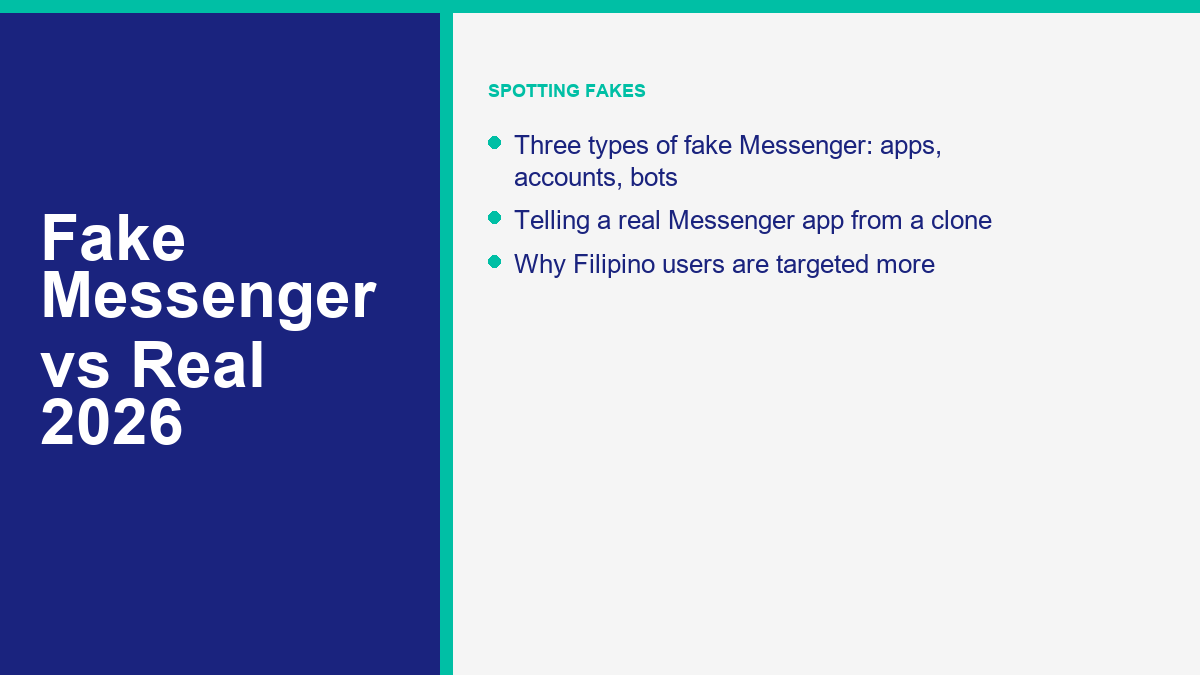
Der Fehler, den die meisten Menschen machen, ist, jedes gefälschte Messenger-Problem wie ein App-Problem zu behandeln. Manchmal ist die App echt und das Konto gefälscht. Manchmal ist das Profil echt genug, aber der Zahlungsbot dahinter ist es nicht. Diese schnelle Tabelle ist der klarste Weg, sie zu unterscheiden.
| Art des gefälschten Messengers | Wie es normalerweise aussieht | What the scammer wants | Your first check |
|---|---|---|---|
| Fake app | A store listing or APK with Meta-style colors, a similar icon, and a chat-style UI | Device permissions, logins, ads, installs, or payment details | Check the developer, package ID, store history, and permissions |
| Fake account | A cloned profile using a real person’s name, photos, and friend list patterns | Money transfers, OTP codes, romance bait, or account recovery access | Check mutuals, country mismatch, message style, and video-call willingness |
| Fake bot | An earning, support, or verification bot that starts in Messenger and moves you to a dashboard or fee page | Referral growth, registration fees, wallet details, or identity data | Check live payout proof, domain age, and whether a fee appears before a real withdrawal |
That last category is where many Filipino users get burned. The scam is not always a direct APK install. Sometimes the hook is an “earning assistant,” “answering job,” or “free registration” chat that eventually leads you to a login mirror or payment request. If you need a market-wide map before touching any of those offers, the best baseline is still the legit-bot directory linked above.
How to Tell If a Messenger App Is Real Before You Install It
This is the part where a little discipline saves a lot of cleanup. A real Messenger listing leaves a clear official paper trail. A fake Messenger app usually relies on speed, visual confusion, and the fact that most people never open the developer details.
The package, publisher, and ratings details below are current Stand: 11. April 2026. The official Google Play listing for Messenger is published by Meta Platforms, Inc., uses the package ID com.facebook.orca, shows 5B+ downloads and roughly 109M reviews, and describes Messenger as a free messaging app with in-app purchases (Google Play listing). The official US App Store listing also shows the developer as Meta Platforms, Inc. and about 12M Bewertungen (Apple App Store listing).
If the app in front of you does not line up with that publisher identity, stop there. Do not rationalize it away because the icon looks close enough. Meta’s brand is one of the most copied visuals on the mobile internet. Close is not good enough.
The 30-Second Check I Run Before Installing Any “Messenger” App
- Open the developer name. It should clearly point to Meta Platforms, not a random studio, reseller, or “tools” publisher.
- Open the full store URL. On Android, the real Messenger listing uses
id=com.facebook.orca. - Check scale. A product with 5B+ downloads does not suddenly appear with 50K installs and a near-identical icon.
- Read the bad reviews first. Clone victims usually mention ads, login theft, or surprise subscriptions fast.
- Refuse off-store installs. If someone sends you a Telegram file, Drive link, ZIP, or APK and says “this is the updated Messenger,” treat it as hostile.
Google gives you some built-in help here. Google Play Protect is kostenloser, on by default, and can scan apps from both Google Play and outside sources. Google’s help page says Play Protect may deactivate or remove harmful apps, warn you about apps that hide or misrepresent important information, and even prevent installation of unverified apps that request sensitive permissions commonly abused in financial fraud (Google Play Protect help).
For a second opinion, VirusTotal is also free for non-commercial use and can scan URLs or files across a large set of security engines (VirusTotal docs). If somebody insists on sending you a Messenger APK outside the store, upload the file hash or URL there before you touch it. That will not make the app safe, but it can expose known detections fast.
| Safety tool | Preis | Best use before install |
|---|---|---|
| Google Play Protect | Kostenlos | Scan installed or sideloaded Android apps and catch suspicious permission abuse |
| Google Play Data safety section | Kostenlos | Check what the developer claims to collect, share, and protect |
| VirusTotal | Free for non-commercial use | Scan suspicious APK files, URLs, and download links before opening them |
| Apple App Store listing review | Kostenlos | Verify the developer, ratings history, privacy label, and official app identity |
The short version is simple: a real Messenger app should come from the official store, from the official developer, with the official package or app ID, and with scale numbers that make sense for a global app. If any one of those breaks, assume the app is fake until proven otherwise.
Red Flags in a Messenger Profile That Signal a Fake Account
Sometimes the app is real, but the person messaging you is not. That is why users keep asking “is this Messenger real” when the real problem is a cloned profile inside real Messenger.
Meta is leaning into this problem. In March 2026, Meta said Facebook is testing suspicious friend-request alerts for profiles with warning signals such as a different country location or very few mutual friends, and Messenger is expanding advanced scam detection for patterns like suspicious job offers (Meta Newsroom). In other words, the platform itself now assumes impersonation and cold outreach are common enough to deserve product warnings.
These are the profile signs I take seriously:
- The account appears out of nowhere with your friend’s photos but no shared chat history. A real friend does not usually lose your entire thread.
- The country or language suddenly shifts. Meta specifically calls out country mismatch as a suspicious signal.
- The message jumps straight to urgency. “I need money now,” “vote for me,” “help me recover my account,” and “send the code fast” are classics.
- The profile refuses a quick voice or video verification. Cloners hate real-time verification.
- The account pushes you off-platform. Fake profiles love to move you to shady login pages, crypto sites, or install links.
Meta’s Messenger Help Center says impersonation reports can be filed from the conversation itself. On desktop web, the route is conversation, then Privacy & support, dann Melden, dann Pretending to be someone (Messenger-Hilfecenter). Use that before you warn friends publicly, because cloned accounts often keep hitting the same contact list for hours.
If the fake profile is tied to money or earning claims, do not stop at blocking it. Save the chat, the profile link, and the payment request. Those screenshots are what you need if you later report the case to Meta, Google, Apple, the FTC, or local law enforcement.
Why Filipino Users Are Targeted More Than Any Other Market
This is not because Filipino users are gullible. It is because the Philippines is almost a perfect environment for Messenger impersonation and fake-app abuse. In this niche, scale beats sophistication. Scammers go where Messenger use is normal, mobile-first behavior is strong, and social proof spreads quickly through group chats and referrals.
The hard numbers explain a lot. DataReportal’s 2026 Philippines report says the country had 137 million mobile connections, 98.0 million internet users, 95.8 million social media user identities, and 65.8 million Messenger users by ad reach in late 2025 (DataReportal). Statcounter’s January 2026 mobile OS data for the Philippines shows Android at 91.95% und iOS at 7.92% (Statcounter).
That combination matters. Android-heavy markets are easier to target with clone listings, sideload prompts, APK mirrors, and fake update files. Messenger-heavy markets are easier to target with cloned accounts, fake recovery chats, and “business opportunity” bots. Put those together and the Philippines becomes unusually attractive for anything pretending to be official Messenger.
There is also a cultural layer: Messenger is not treated like a niche app in the Philippines. It is part of everyday communication, school coordination, family updates, small-business selling, and bot-style earning schemes. That is why a fake support message or fake payout screenshot can move faster there than in a market where messaging is split more evenly across iMessage, SMS, WhatsApp, Signal, and email.
Meta itself has linked the Philippines to the wider regional scam-center problem. In May 2025, the company said it had detected and disrupted over seven million accounts associated with scam centers across Myanmar, Laos, Cambodia, the UAE, and the Philippines since the start of 2024 (Meta Newsroom). That does not mean every scam is run locally, but it does show the Philippines sits inside a real operational corridor for digital fraud.
Fake Messenger Earning Bots: The Scam Pattern That Keeps Resurfacing
This is where the fake Messenger problem overlaps with the bot-earning niche that MessengerBot.app already covers. The flow keeps repeating because it works on the same emotions every time: small daily cash, low entry friction, social proof in comments, then a sudden push to register, pay, or recruit.
The FTC says reported losses in business and job opportunity scams reached $750.6 million in 2024, while job and employment agency scam losses rose from $90 million in 2020 to $501 million in 2024 (FTC). Different market, same structure: fake work, fake onboarding, fake urgency, real money lost.
The Messenger version usually looks like this:
- A recruiter or cloned account contacts you. The pitch is answering tasks, data entry, referrals, or “simple clicks.”
- You are moved into Messenger or a Messenger-linked dashboard. This is where the fake authority gets built.
- You see payout screenshots or a fake balance. The dashboard number is the bait, not proof of cash.
- The hidden condition appears. Activation fee, verification fee, referral quota, or a wallet link.
- The domain rotates or the support thread goes cold. That is the point where most victims realize the bot never mattered. The funnel did.
If you are comparing the better-known names, our Messenger MathBot legitimacy review is the fastest place to see what a higher-visibility bot looks like under scrutiny. For another common PH name, read the full breakdown on KKCB Messenger Bot legitimacy. Both show the same broader truth: even when a bot looks semi-functional, that does not make the support path, login mirror, or referral chain safe.
The easiest tell of a fake Messenger earning bot is still the fee wall. Real apps can be risky. Fake bots almost always need your money before they need your work.
How Meta Actually Lets Fake Messenger Apps Into the Store
The headline sounds like Meta personally approves every fake Messenger app. That is not how the pipeline works. On Android, Google Play is the gatekeeper. On iPhone, Apple is the gatekeeper. Meta controls the Messenger brand and its own platforms, but not the final store review for third-party apps.
That said, clones still get through because store review is a scale problem, not a magic shield. Google said it prevented 2.36 million policy-violating apps from being published in 2024, then over 1.75 million more in 2025. It also says Play Protect now scans over 350 billion Android apps daily (Google). Apple’s review guidelines explicitly ban copycats, apps that impersonate other services, and use of another developer’s icon or brand without approval (Apple App Review Guidelines).
So why do clones still surface? Usually for one of five reasons:
- The app enters as generic software. It may look like a harmless chat skin, prank app, or browser wrapper during review.
- The scam happens after install. The real damage may come from ads, remote content, update prompts, or off-store links.
- The branding is similar, not identical. That is enough to fool users before it is enough to trigger fast removal.
- The bad behavior is region-specific. Some apps show one face to reviewers and another to users in a specific country or language market.
- Stores react after reports, not before every edge case. Review systems are strong, but they are still massively scaled moderation systems.
Google’s own policy language is blunt here. Play says metadata must precisely reflect the app’s functionality, apps cannot mimic other apps or OS warnings, and apps cannot mimic other apps to trick users into disclosing personal information (Google Play Deceptive Behavior policy). Apple is equally direct under guideline 4.1: do not copy a popular app, do not impersonate other apps or services, and do not use another developer’s icon, brand, or product name without approval (Apple).
The practical takeaway is not “stores are unsafe.” It is this: store approval lowers risk, but it does not replace your own check. A fake Messenger app only needs a short window and a convincing icon.
What to Do If You Already Installed a Fake Messenger Clone
If you already installed a fake Messenger app, speed matters more than embarrassment. Do not keep opening it to “see what happens.” Assume anything you typed into it may be exposed.
- Disconnect first. Put the phone on airplane mode or disable mobile data and Wi-Fi before you reopen anything.
- Remove the app. Uninstall it immediately. On Android, then run a Play Protect scan. On iPhone, delete the app and check whether it installed any configuration profile or subscription.
- Change your Meta password from a clean device. Do not use the same phone until you finish the first scan.
- Turn on two-factor authentication. If you already had 2FA, rotate backup codes and review trusted devices.
- Review logged-in sessions. Log out of unknown sessions on Facebook, Messenger, and Instagram.
- Check linked payment apps. Watch GCash, PayPal, Apple Pay, Google Wallet, and your bank app for strange prompts or transfers.
- Preserve evidence. Save the store URL, screenshots, app name, icon, version, chat logs, referral messages, and any payment request.
If the app arrived through a fake earning or login flow, review the same habits we call out in the ECNL login safety guide: go back to the original known thread, distrust forwarded mirrors, and never assume a new login page is safe just because it was sent inside Messenger.
If you still have the file or suspicious download link, upload it to VirusTotal from a safe machine. Again, VirusTotal is free for non-commercial use and can tell you whether other engines already flag the sample (VirusTotal). On Android, Google says Play Protect can also warn, disable, or automatically remove harmful apps once detected (Google Play Protect).
The one thing I would not do is factory-reset first and ask questions later. Resetting can destroy useful evidence and does not help if the real damage was credential theft. Secure the accounts, save proof, then decide whether a deeper device cleanup is necessary.
How to Report a Fake Messenger App, Account, or Bot
Reporting is not just civic cleanup. It is how you shrink the lifespan of these clones for the next person. Use the channel that matches the type of fake.
How to Report a Fake Messenger App on Google Play
Google Play’s official help page says you can open the app detail page, tap Mehr, choose Flag as inappropriate, pick a reason, and submit. Google also provides separate routes to report policy-violating apps and illegal content (Google Play Help).
How to Report a Fake Messenger App on the App Store
Apple’s App Store user guide says to go to reportaproblem.apple.com, sign in with your Apple Account, choose the issue from the “I’d like to” menu, and follow the prompts (Apple Support).
How to Report a Fake Messenger Account or Conversation to Meta
Inside Messenger, use the conversation itself. Meta’s Help Center route for impersonation is the clean one: open the chat, go to Privacy & support, tap Melden, and choose Pretending to be someone (Messenger-Hilfecenter).
Where US and PH Users Should Escalate Financial Losses
US users should also file a complaint at ReportFraud.ftc.gov, especially if money, identity data, or employment bait is involved. The FTC uses those reports for fraud trend analysis and enforcement starting points (FTC). Philippine users should preserve the same evidence set and escalate payment or identity-loss cases to the NBI Cybercrime Division or the PNP Anti-Cybercrime Group, especially when the scam involved GCash, cloned social profiles, or fake job recruitment.
Whatever market you are in, send the useful evidence, not just “this is fake.” Include the store URL, profile link, payment wallet, screenshots, timestamps, and any alternate domains the scammer used.
Staying Safe: The Five Checks to Run Before Trusting Any Messenger App
If you only remember one section from this article, make it this one. Every fake Messenger case I have seen in the last year breaks at least one of these checks, and most break three.
- Check the publisher. Official Messenger listings point to Meta Platforms, not a random developer brand.
- Check the route. Real Messenger comes from the official store or official web routes like
messenger.com, not from APK mirrors, ZIP files, or “updated” links in comments. - Check the ask. A messaging app does not need your GCash seed phrase, a registration fee, or an urgent OTP from another service.
- Check the reputation. Search the exact domain, package ID, or profile name before you act. Use Play Protect and VirusTotal when needed.
- Check the pressure. Real platforms can wait five minutes while you verify. Scams always need you to move now.
That is the entire safety model in plain English. If the app is real, verification will confirm it fast. If it is fake, verification usually annoys the scammer or exposes the clone immediately.
If You Need Real Messenger Automation, Use an Official Platform
A lot of people land on fake Messenger apps because they are really looking for automation, auto-replies, or lead capture and end up in the wrong corner of the internet. If your goal is business messaging, not random APKs or mystery bots, MessengerBot-Preise anzeigen and work from an official platform instead of a clone economy.
Häufig gestellte Fragen
Wie kann ich erkennen, ob eine Messenger-App gefälscht ist?
Check the developer, store URL, package ID, ratings scale, and permissions before installing. The real Android listing uses com.facebook.orca and the official publisher is Meta Platforms, Inc. Anything asking for an APK install, unusual permissions, or urgent login verification deserves suspicion.
Ist jeder Messenger-Klon ein Betrug?
Nein. Einige Klone sind Demos, Chat-Simulatoren oder harmlose UI-Kopien. Das Problem beginnt, wenn ein Klon Meta imitiert, Anmeldungen erfasst, gefälschte Zahlungen anstößt, Abonnements durch Verwirrung verkauft oder Sie auf Phishing-Seiten weiterleitet.
Was soll ich tun, wenn ich eine gefälschte Messenger-App installiert habe?
Trennen Sie das Gerät, deinstallieren Sie die App, führen Sie Play Protect aus, wenn Sie Android verwenden, ändern Sie Ihr Meta-Passwort von einem sauberen Gerät, überprüfen Sie die angemeldeten Sitzungen, aktivieren oder rotieren Sie die 2FA und speichern Sie Screenshots und URLs, bevor Sie die App melden.
Warum gibt es im Jahr 2026 so viele gefälschte Messenger-Verdienstbots?
Weil das Modell billig zu kopieren ist und auf Vertrauen basiert. Betrüger können das Messenger-Branding ausleihen, gefälschte Auszahlungsscreenshots zeigen, Domains rotieren und Empfehlungs- oder Aktivierungsgebühren schneller vorantreiben, als die meisten Nutzer die Quelle überprüfen.
Wie melde ich ein gefälschtes Messenger-Konto bei Meta?
Open the conversation, go to Privacy & support, tap Report, and choose the impersonation option. If money or identity theft is involved, also report the case to the app store and your local fraud or cybercrime authority.
 Deutsch
  English
  Tagalog
  简体中文
简体中文  العربية
  हिन्दी
  Português do Brasil
  Español de México
  Français
  বাংলা
বাংলা  香港中文
香港中文  繁體中文
繁體中文  Nederlands
  Bahasa Indonesia
  日本語
日本語  한국어
한국어  Polski
  Русский
  Español
  Tiếng Việt