
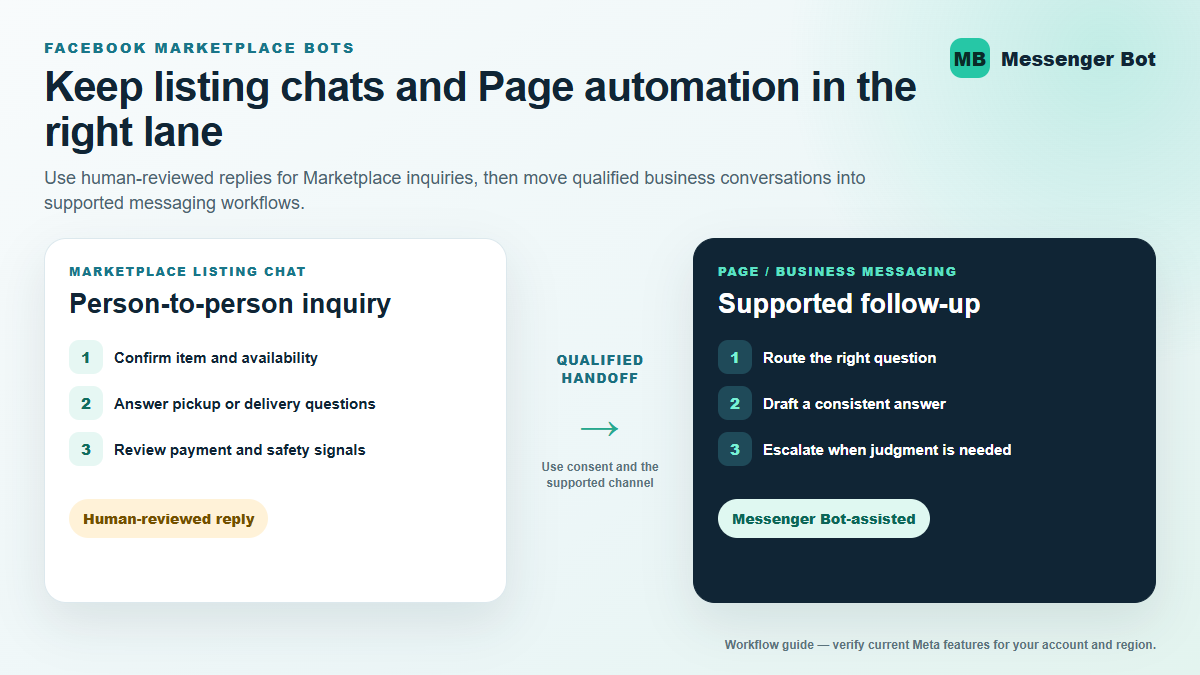
Facebook Marketplace can create a flood of short, repetitive questions: “Is this available?”, “Where are you located?”, “Will you take less?”, and “Can I pick it up today?” It is natural to look for a Facebook Marketplace bot that can answer every message. The important distinction is that a Marketplace listing conversation is not the same workflow as a message sent to a Facebook Page or another business inbox. Treating those surfaces as interchangeable can create a confusing buyer experience and encourage unsafe promises about what an automation tool can control.
The practical goal is not to remove people from Marketplace conversations. It is to make the repeatable parts faster while keeping a person responsible for identity, payment, pickup, condition, disputes, and unusual requests. A useful workflow starts with a clear listing, saved response building blocks, inbox organization, and a documented handoff. When a buyer chooses to continue through a supported business messaging channel, Messenger Bot can help the team organize and review that follow-up without pretending it controls the original listing thread.
This guide explains the distinction, shows what you can standardize today, and gives you a repeatable path from Marketplace inquiry to supported business follow-up. Features can differ by account, region, device, and Meta product updates, so confirm the controls visible in your own account before relying on them.
What “Facebook Marketplace Bots” Usually Means
People use the phrase bots de Facebook Marketplace for several different jobs. One seller may mean a saved answer for the default availability question. Another may mean a Page instant reply. A retailer may mean a system that routes business messages, while a buyer may be talking about spam or suspicious accounts that contact listings. Those are not one product category, and they do not share the same permissions.
It helps to separate the request into four layers:
- Listing-chat efficiency: reusable wording, fast access to item details, and a human-reviewed response to an individual buyer.
- Marketplace inbox organization: viewing buying and selling conversations, filtering by listing or transaction status, and keeping the next action visible.
- Page and business messaging: instant replies, keyword-based routing, labels, assignment, and other features available to supported business accounts.
- Monitoring and safety: identifying unusual message patterns, risky payment requests, duplicated questions, or conversations that need a person.
Meta’s help material describes Marketplace messages as buyer-and-seller conversations that can be viewed in the Marketplace inbox and Messenger. It separately documents instant replies for Facebook Pages and other automations for business inboxes. That separation matters. A good plan should say which layer it handles instead of marketing every messaging feature as direct Marketplace automation.
If your actual problem is slow replies, start by measuring where the delay occurs. If the team cannot find the correct listing information, the answer is a better item record. If buyers receive inconsistent pickup directions, the answer is an approved reply block. If qualified prospects later message the business Page, then supported Page messaging tools may be appropriate. Choosing the layer first prevents unnecessary software and keeps the buyer’s context intact.
Marketplace Listing Chats and Page Messages Are Different Lanes
A Marketplace conversation begins around a specific listing and a specific buyer or seller. Meta’s current help documentation shows that sellers can view Marketplace messages in the Selling section, group conversations by listing, and use transaction-related filters where those features are available. The buyer’s message is connected to the item, condition, location, price, and transaction stage. A useful response therefore needs the listing context, not just a generic greeting.
Page messages belong to a business identity. Meta documents instant replies as a Page feature and describes Meta Business Suite Inbox as a place to manage supported business communications. Those tools may include greetings, away messages, keyword automations, labels, assignments, and searches. They are valuable, but their existence does not prove that the same automation controls a personal Marketplace listing chat.
For that reason, the safest operating assumption is simple: respond to the Marketplace inquiry in the Marketplace or Messenger experience where it appears. If the buyer later chooses an approved business channel for broader service, scheduling, support, or future updates, continue there with the proper consent and account permissions. Keep the handoff explicit so the buyer knows who they are speaking with and why the channel changed.
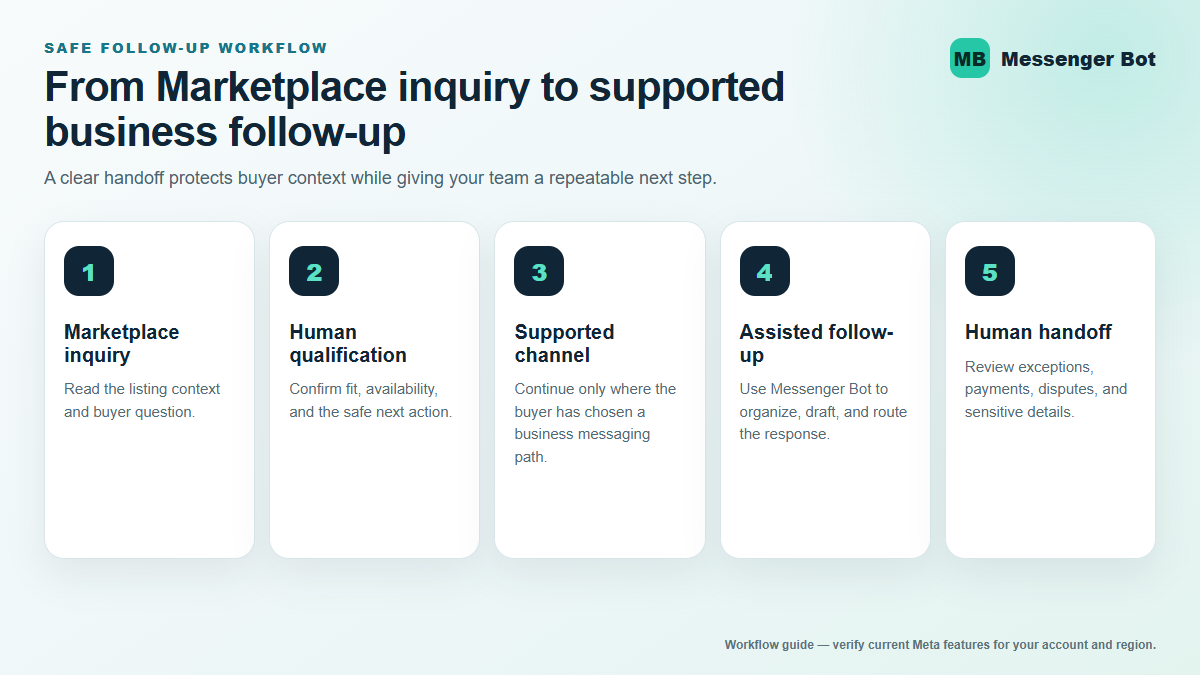
This distinction also improves reporting. Marketplace response time, completed transactions, and buyer questions belong to the listing workflow. Page conversation routing, reply reviews, and lead follow-up belong to the business workflow. Combining the two in one metric can hide whether the team is actually helping buyers faster.
For a closer look at the business side of the inbox, see the Facebook Messenger Business Inbox guide. Use it after you have identified a supported Page or business messaging use case; it is not a shortcut around Marketplace permissions.
What You Can Standardize Safely
The most reliable efficiency gains come from standardizing information, not automating judgment. Build a small reply library around facts that are stable and easy to verify. Each reply should still be checked against the listing before it is sent.
Availability and condition
Prepare a short answer that confirms whether the item is available, repeats the exact item name, and points out the most important condition detail. Avoid a blanket “yes” response if inventory changes quickly or several similar items are listed. The person replying should confirm the listing status first. When the item is pending or sold, update the listing so new buyers receive accurate context.
Pickup, delivery, and timing
Write separate blocks for pickup area, available time windows, delivery boundaries, and shipping where applicable. Keep the first message general enough to protect private information. Share a precise address only when the transaction is ready and the meeting plan is appropriate. If a buyer changes the location or timing unexpectedly, pause and review instead of forcing the conversation through a preset sequence.
Price and negotiation
Define the listed price, whether reasonable offers are considered, and who can approve a discount. A response can explain the policy, but it should not invent urgency or claim another buyer exists unless that is true. If the price depends on quantity, condition, delivery, or a bundle, make the dependency clear before agreeing to a final amount.
Common product questions
Store measurements, compatibility notes, included accessories, known defects, and care instructions in the listing record. A saved response should pull from those verified facts. Do not let a generic answer overrule the actual item. For electronics, vehicles, collectibles, or regulated categories, route technical, ownership, or compliance questions to someone who can verify them.
A useful reply block contains three parts: the direct answer, one relevant detail, and one clear next action. For example: “Yes, the oak desk is available. It is 48 inches wide and has the scratch shown in photo four. Would you like the pickup windows for Saturday?” The buyer gets an answer without being pushed into a long scripted funnel.
Keep Personal Listing Replies Separate From Business Page Messaging
Facebook Marketplace listing conversations and business Page conversations are different product surfaces. A feature documented for a Page should not be assumed to work for a personal profile or Marketplace listing. Meta documents Page features such as respuestas instantáneas, but availability, eligibility, and settings can change. Confirm the current documentation for the exact account and conversation surface before configuring anything.
Be cautious with extensions or scripts that promise to auto-reply, renew listings, negotiate prices, scrape buyer details, or simulate clicks through a personal account. Review the Meta Platform Terms and the tool’s requested permissions. Avoid any product that asks for a personal password, bypasses documented access, or cannot explain how it handles customer information. “Automation” is not a single permission that applies everywhere.
For Marketplace itself, use human-reviewed listing replies and native controls. If a business also operates an eligible connected Page, supported Page conversations may use Page messaging features within current platform rules and with a person responsible for review. Messenger Bot supports that business/Page conversation lane. It does not make personal Marketplace automation safe, supported, or available, and it should not be presented as a way around Marketplace restrictions.
This boundary protects both ranking intent and customer expectations: readers searching for Facebook Marketplace bots receive a clear explanation of what can be standardized manually, what requires current Meta documentation, and where business Page messaging begins.
A Safe Marketplace-to-Business Follow-Up Workflow
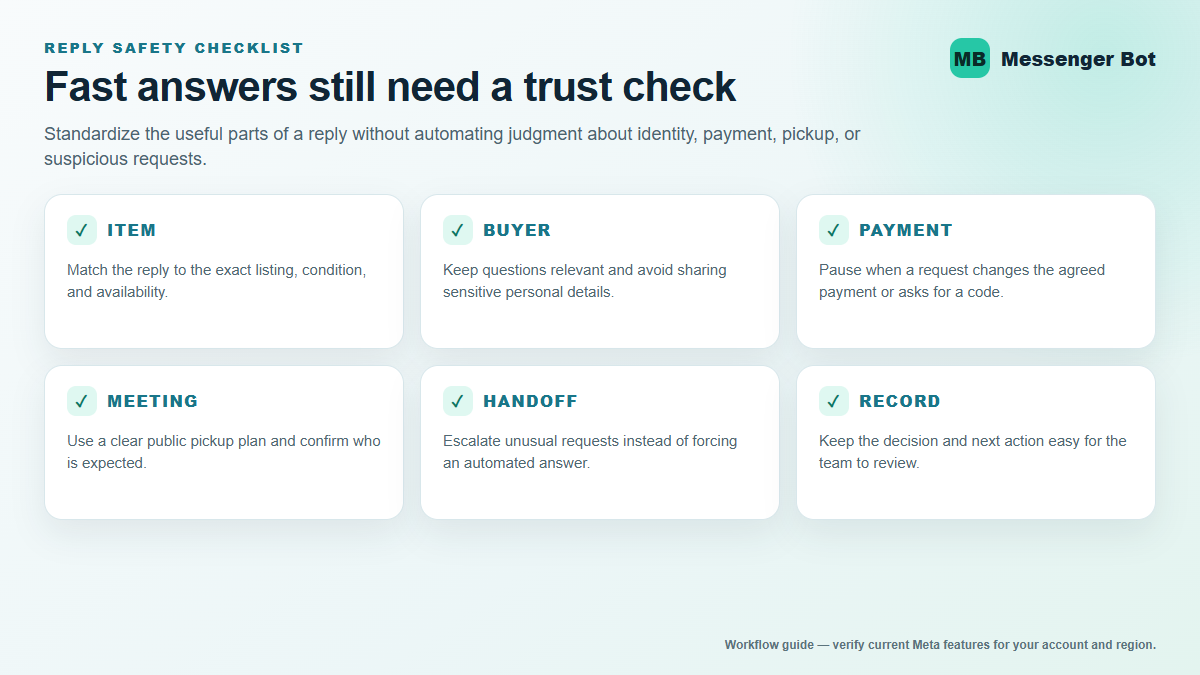
A strong workflow protects the original context and creates an explicit handoff. Use these five stages as an operating checklist.
- Read the listing and question. Confirm which item the buyer selected, what they asked, and whether the listing is still current.
- Qualify the next action. Decide whether the answer is a simple fact, a negotiation, a safety-sensitive request, or a question that belongs with another team member.
- Reply in the listing conversation. Give the buyer the useful answer where the inquiry began. Do not make them change channels just to learn whether an item is available.
- Offer a supported business path only when it helps. A business channel can be useful for ongoing service, an appointment, a broader product question, or future support. Explain the benefit and let the buyer choose it.
- Use reviewed follow-up and human handoff. On supported Page or business messaging channels, Messenger Bot can help organize intent, draft consistent answers, and route exceptions. A person should remain responsible for sensitive details and final decisions.
The handoff message should be plain and optional. For example: “I can answer the listing question here. If you want help choosing between several models, our business Page team can continue with the comparison.” This tells the buyer what changes and why. It does not imply that their Marketplace data will automatically follow them into a different system.
Document the supported channel, the trigger for the handoff, the information the buyer has already provided, and the point where a person must review. This prevents repeated questions and gives the team a rollback path if a workflow produces the wrong result.
Reply Templates That Stay Useful
Templates should shorten the path to a correct answer, not make every conversation sound identical. Use the examples below as starting points and replace brackets with verified listing details.
Availability reply
Yes, the [exact item name] is currently available. The main condition note is [verified detail]. Would you like the pickup windows or another photo?
Pending item reply
The [item name] is pending until [time or date]. I can let you know here if it becomes available again. I do not need payment or a code to hold your place in the conversation.
Pickup-area reply
Pickup is in the [general area] during [verified windows]. Once we agree on a time, I will confirm the appropriate meeting details here.
Offer reply
Thanks for the offer. The listed price is [price], and I can consider [approved range or condition]. If that works, the next step is to confirm the pickup or delivery option.
Business handoff reply
I can answer questions about this listing here. If you want help with [broader business need], you can choose to continue with our Page team at [supported destination]. They will know you are asking about [item or need].
Review templates whenever the listing format, pickup policy, supported channel, or Meta feature changes. Remove any promise that cannot be verified. A reply library should have an owner and a last-reviewed date so old wording does not quietly become policy.
Handle Suspicious Marketplace Messages Without Adding Another Bot
A seller may receive a generic message soon after publishing a listing. Requests to move immediately to text or email, share a verification code, accept an unusual payment method, or click an unfamiliar link deserve extra scrutiny. Use Meta’s current Marketplace scam guidance to compare warning signs and reporting steps. Keep the listing conversation together long enough to review what the buyer asked and what was promised.
If a message appears suspicious, do not share personal, account, or payment details. Use the current report and block controls where appropriate, and preserve the relevant conversation. An unapproved browser script is not a safer way to argue with, screen, or answer suspicious accounts. It can add another party with access to messages and can create account risk without proving that the buyer is genuine.
For ordinary listing questions, a short human-reviewed reply can confirm availability, condition, location boundaries, and the next safe step. The standard Marketplace messaging help is the correct starting point for current product behavior. A buyer’s willingness to stay in the normal interface is useful context, but it is not proof that a transaction or payment is safe. Evaluate the buyer, payment method, and handoff separately.
Safety Signals That Should Stop Automation
Marketplace conversations can involve real-world payments, meetings, shipping, and personal details. These are precisely the moments when a person should slow down. Meta publishes guidance about Marketplace scams, and it provides reporting tools for suspicious Marketplace activity. Your process should make those safeguards easier to use.
Route a conversation to manual review when a buyer or seller:
- asks for a verification code, password, or account login;
- moves the conversation away from the normal channel before basic details are confirmed;
- changes the payment method or amount unexpectedly;
- requests an overpayment, refund, or third-party transfer;
- sends a link that does not match the expected service;
- pressures the other person to skip reasonable checks;
- changes the meeting person, location, or item at the last moment; or
- makes a claim that conflicts with the listing or previous messages.
A standard safety response can say that the team needs to verify the request before continuing. It should not accuse the buyer of wrongdoing. Respectful language protects legitimate customers while giving the team time to inspect the situation. If the conversation is clearly unsafe or violates Marketplace rules, use the reporting and blocking controls provided by Meta.
Do not store more personal information than the transaction requires. Keep access limited to people who need it, and do not paste payment details, identification, or private addresses into a broad team note. If your business has formal privacy, refund, or dispute procedures, link the Marketplace workflow to those policies.
How to Measure Whether the Workflow Is Working
The best Marketplace workflow is not the one that sends the most automated messages. It is the one that helps the right buyer get a correct next step with fewer delays and fewer preventable handoffs.
Track a small set of operational measures:
- Time to first useful reply: measure when the buyer receives an answer to the actual question, not merely a greeting.
- Accuracy corrections: count replies that had to be fixed because availability, condition, price, or logistics were wrong.
- Unresolved conversations: identify messages that remain open without a clear owner or next action.
- Manual-review rate: watch how often safety, payment, negotiation, or exception rules require a person.
- Supported handoff completion: count buyers who knowingly choose a Page or business channel and receive the promised help.
- Outcome by listing: compare inquiries, qualified conversations, pending items, completed transactions, and common objections.
Review a sample of conversations, not just totals. A fast first reply can still be unhelpful. A low manual-review rate can mean the system is failing to flag risky requests. The qualitative review should ask whether the response matched the listing, whether the buyer understood the next step, and whether the channel handoff was transparent.
Use the findings to improve the listing first. If ten buyers ask for dimensions, add them to the description and photos. If pickup questions dominate, clarify the general area and available windows. Better listing information reduces repetitive messages before any automation is involved.
Choosing Tools Without Overbuying
Evaluate a tool against the exact layer it is supposed to improve. A Marketplace monitoring service, a Page messaging platform, and a saved-reply library solve different problems. Do not compare them as though they all have the same access.
Before choosing a tool, ask:
- Which account and message surface does it officially support?
- Can it show the listing context a person needs to answer correctly?
- What actions require review before anything is sent?
- Can a person take over immediately?
- Does it keep an understandable record of the decision and next action?
- What happens when a permission, Page connection, or Meta feature changes?
- Can you export or remove the workflow without losing the original Marketplace conversation?
Avoid purchasing based on a broad promise to “automate Marketplace.” Ask the provider to name the exact supported surface and show the current official permission. If the demonstration jumps from a personal listing chat to a Page inbox without explaining the difference, treat that as an unresolved capability gap.
For a supported business messaging use case, Messenger Bot is designed to help teams create clearer reply and handoff workflows while keeping human review visible. Start with one narrow conversation type, test the response and escalation rules, and expand only after the team can explain the result. Explora nuestros tutoriales for setup guidance, or Verificar precios actuales when you are ready to compare plans.
Set Up a Reviewed Business Follow-Up in Messenger Bot
Begin after you have confirmed that the conversation belongs on a supported Page or business messaging channel. The Marketplace listing reply should remain a separate step.
- Name one audience and outcome. For example, “People who chose Page messaging after asking for help comparing several products.”
- Define the entry condition. Record the buyer action or business-channel message that begins the workflow. Do not silently import an unrelated Marketplace conversation.
- Write the direct answer first. Give the person the result they asked for before collecting extra information.
- Add one qualification question at a time. Ask only for information needed to recommend the next step.
- Create human-review rules. Escalate pricing exceptions, payments, disputes, private data, uncertainty, and any answer the team cannot verify.
- Test with labeled examples. Use a normal question, a missing-detail question, and a safety-sensitive request. Confirm that each reaches the expected response or handoff.
- Review the live experience. Check the message wording, mobile readability, links, assignments, and the path back to a person.
The setup is successful when the team can state what the workflow handles, what it does not handle, and how a person takes over. That clarity is more valuable than a large number of branches. If you need a separate walkthrough for a basic Page response, use the Messenger auto reply tutorial and verify the current controls in your own account.
Preguntas Frecuentes
Can a Facebook Marketplace bot reply to every listing message?
Do not assume that a Page or business messaging tool can control personal Marketplace listing threads. Meta documents Marketplace buyer-and-seller messages separately from Page instant replies and business inbox automations. Use human-reviewed listing replies, then use supported business messaging features only where your account and the buyer’s chosen channel allow them.
Can I use saved replies for “Is this available?”
Yes, a saved reply can speed up the answer, but a person should confirm the exact listing and current availability before sending it. Include one useful detail and a clear next action so the response is more helpful than a generic acknowledgment.
Where can sellers find Marketplace conversations?
Meta’s help documentation says sellers can view conversations in the Marketplace inbox under Selling and can also see Marketplace messages in Messenger. Available filters and transaction stages may vary by location and account.
What can Meta Business Suite Inbox automate?
For supported business accounts, Meta documents features such as Page instant replies, greetings, away messages, keyword automations, labels, assignments, search, and consolidated business communications. Confirm what appears for your Page and region before building a workflow around it.
When should a Marketplace message go to a person?
Use manual review for identity questions, payment changes, verification codes, disputes, unusual links, private details, pickup changes, pricing exceptions, and any request that conflicts with the listing. Automation should not make trust decisions on the team’s behalf.
How does Messenger Bot fit into the process?
Messenger Bot supports reviewed Page and business messaging workflows after the conversation is in a supported channel. It can help organize intent, prepare consistent replies, and route exceptions. It should not be presented as controlling a personal Marketplace listing chat when that capability has not been verified.


 Español
  English
  Tagalog
  简体中文
简体中文  العربية
  हिन्दी
  Português do Brasil
  Español de México
  Français
  বাংলা
বাংলা  香港中文
香港中文  繁體中文
繁體中文  Nederlands
  Deutsch
  Bahasa Indonesia
  日本語
日本語  한국어
한국어  Polski
  Русский
  Tiếng Việt