
Two years ago, this was an easier argument. Chatbots were cheap, stiff, and mostly useful for FAQ triage. Live chat felt more human, more flexible, and more expensive. In 2026, that clean split is gone. A good chatbot can now answer policy questions, qualify leads, collect order details, route a refund request, and hand the full transcript to a human. Live chat still wins when nuance, reassurance, or closing skill matters. So the real question is no longer “which tool is better?” It is “which layer should meet the customer first?”
Here is the practical answer most businesses need: if your inbox is repetitive and after-hours messages matter, chatbot automation usually pays for itself faster than owners expect. If your sales process is consultative, regulated, or high-ticket, live chat still earns its keep. But for most small and mid-sized businesses, the strongest setup is hybrid. Let the bot handle the fast, repeatable, low-friction part of the conversation. Let a human step in when the buyer is valuable, the issue is messy, or the customer clearly wants a person.
Pricing and benchmark references in this article were checked against public product pages, vendor benchmark reports, and official research on April 10, 2026. Where I use conversion numbers, I call out whether the figure comes from a broad benchmark or a vendor case study, because those are not the same thing.
Why Chatbot vs Live Chat Is Still a Real Business Decision in 2026
De nombreux articles comparatifs agissent comme si ce débat était déjà terminé et que l'IA avait gagné par défaut. Ce n'est pas ce que dit les données. Gartner a rapporté en août 2025 que le service autonome et le chat en direct sont en passe de surpasser les canaux traditionnels en tant que technologies de service client les plus précieuses d'ici 2027. C'est un signal utile car il montre où les responsables du support placent réellement leurs paris : non pas sur une couche magique d'IA, mais sur un mélange de service autonome rapide et de chat assisté par un humain.
Le côté des attentes des clients s'est également affûté. Le rapport CX Trends 2026 de Zendesk indique que 74% des consommateurs s'attendent désormais à un service 24/7 parce que l'IA existe, et 86% disent que la réactivité et la résolution précise influencent fortement leur décision d'achat. Cela crée la tension centrale. Les clients veulent des réponses instantanées, mais ils ne veulent pas de cul-de-sac. Un chatbot est excellent pour l'instantané. Une personne est meilleure pour l'ambiguïté. Choisissez la mauvaise première couche et vous dépensez soit trop de temps humain, soit vous frustrez les clients au moment où leur intention est la plus forte.
| Approche | Où ça gagne | Où ça casse | Meilleur ajustement |
|---|---|---|---|
| Chatbot en premier | Réponses instantanées, couverture 24/7, faible coût marginal, forte performance des FAQ et de la capture de leads | Faible sur les cas particuliers, les plaintes émotionnelles, la négociation et les questions hors script | Support répétitif à fort volume, capture de leads après les heures d'ouverture, statut de commande, réservation, qualification |
| Chat en direct en premier | Human judgment, trust-building, complex troubleshooting, sales conversations with real nuance | Expensive to staff, hard to cover 24/7, queues form fast when volume spikes | High-ticket sales, regulated industries, consultative buying, low-volume premium support |
| Hybrid | Fast first response, lower labor cost, better routing, better after-hours coverage, cleaner escalations | Takes more setup discipline because flows and handoffs have to be designed well | Most SMBs, ecommerce brands, SaaS teams, local services, and Messenger-first businesses |
One quick reality check before we go deeper: serious support software is not a “no sign up required” category. If a vendor markets business chat that way, you are probably looking at a demo, not an operating system. Real support workflows need saved context, channel permissions, routing rules, reporting, and an obvious handoff path.
If the issue you are trying to solve is support cost rather than just channel selection, read notre guide de service client IA after this. It goes deeper on bot deflection, knowledge-base quality, and the support ROI model behind these numbers.
How Modern Chatbots Actually Work When They Are Set Up Properly
The biggest mistake I see in this debate is treating “chatbot” like one thing. In practice, most business chatbots in 2026 are a stack of three different systems working together: a conversational layer, a knowledge layer, and an escalation layer. When one of those layers is weak, the whole bot feels bad.
Rule-Based Menus Still Matter More Than Most People Admit
Even with better AI, the fastest bots still use structure. They greet the user, offer 3 to 5 clear starting paths, and reduce confusion before the free-text part even begins. That sounds old-fashioned, but it works. If someone wants order help, store hours, refund policy, booking, or a human agent, do not make them prove it to a large language model from a blank screen. Give them a clean front door.
This matters for conversion too. A buyer who lands on a product page at 10:30 p.m. and clicks “shipping” or “book a demo” is showing intent right now. A structured bot can keep that intent warm immediately. That is not hype. That is just removing friction.
AI Retrieval Is What Makes a Bot Feel Useful Instead of Scripted
The newer part of the stack is retrieval. A good support bot now pulls answers from approved sources such as FAQ pages, help docs, PDFs, product pages, shipping policy, appointment rules, or internal support notes. That is why some bots feel surprisingly competent and others feel vague. The model is only half the story. The knowledge base is the other half.
For a small business, this is the practical dividing line between a useful chatbot and an embarrassing one. If your help content is thin, inconsistent, or outdated, the bot will sound generic. If your source material is clean, specific, and current, the bot can answer with real precision. Most bad chatbot experiences are not caused by “AI being dumb.” They are caused by businesses feeding the bot weak content.
Escalation Rules Decide Whether the Bot Saves Money or Creates Churn
The third layer is where the serious money gets made or lost. A bot has to know when to stop. Refund demands, billing disputes, repeated failed answers, account access issues, and emotionally charged complaints should not be trapped in automation. They should move to a human fast, with context attached.
That is why the strongest chatbot setups in 2026 are not “replace the team” systems. They are first-response and first-resolution systems. The bot handles what is repetitive, obvious, or time-sensitive. The person handles what is risky, valuable, or emotionally loaded.
HubSpot says its Customer Agent currently resolves 65% of conversations and cuts resolution time by 39% across more than 8,000 activated customers. Intercom says Fin resolves an average of 67% of customer queries across more than 7,000 paying teams. Those are strong numbers, but notice what they imply: even good AI systems still leave a meaningful share of work for humans. That is normal. It is also why hybrid is usually the right design, not a compromise.
What Live Chat Really Looks Like Behind the Widget
Live chat looks simple from the outside. A chat bubble appears, a person replies, the customer gets help. The cost comes from everything behind that bubble: staffing, shift coverage, queue management, QA, coaching, after-chat notes, routing, coverage during lunch or weekends, and the reality that people ask harder questions than your FAQ page can answer.
LiveChat’s latest customer service benchmark gives a useful picture of how real-time chat actually behaves in production. Across the businesses in its report, the average first response time was 35 seconds, the average chat lasted 8 minutes and 25 seconds, and businesses were available for 17 hours and 58 minutes per day on average. Queue waiting time averaged 4 minutes and 18 seconds, and the queue dropout rate was 27.4%.
That last number matters more than people think. More than one in four customers left the queue before reaching an agent. So when a live-chat advocate says human chat converts better, that may be true once the customer reaches a real person. But the queue is part of the experience too. If your team cannot answer quickly, live chat turns into a visible delay machine.
Live Chat Software Is Usually Cheap. Labor Is What Hurts
The software bill is not the main problem. Dedicated live chat tools still start at fairly approachable prices. LiveChat starts at $19 per month on Starter and $49 per seat per month on Team, billed annually. Freshchat has a free tier and Growth starts at $19 per agent per month billed annually. The expensive part is the person sitting behind the tool.
The U.S. Bureau of Labor Statistics puts the median pay for customer service representatives at $20.59 per hour. For planning math, I would not stop there. Add a conservative 30% for payroll tax, software, scheduling overhead, management time, and the basic cost of keeping a support function running, and you are at about $26.77 per hour in loaded labor cost. That is still a modest estimate for many US and UK teams.
Now combine that loaded labor rate with actual chat time. A live chat conversation that lasts 8 minutes and 25 seconds is not really an 8-minute cost. It includes pre-chat context, concurrent chat juggling, after-chat notes, routing, and follow-up. That is why live chat feels inexpensive in vendor pricing tables but expensive in payroll.
There is one more hidden cost most small businesses miss: live chat creates a promise. The moment you show the widget, customers assume a person might answer now. If you only staff it lightly, or only during certain hours, the gap between expectation and reality can damage trust faster than a slower but honest asynchronous channel.
Chatbot vs Live Chat Cost Over 12 Months With Real Numbers
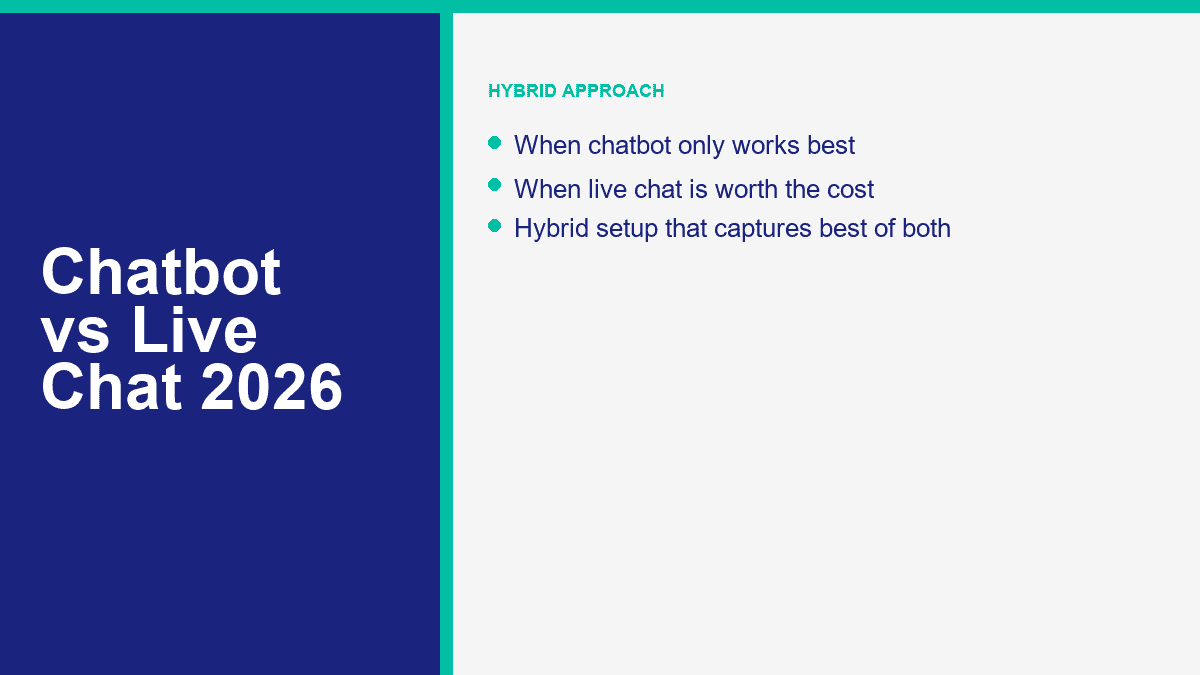
Let us put real planning math on the table. The model below is not a fantasy “AI replaces the whole team” spreadsheet. It is a grounded SMB example using current public pricing and operating benchmarks.
Assumptions for the 12-month model:
- The business handles 1,200 inbound chat conversations per month.
- The average live chat conversation lasts 8 minutes and 25 seconds, based on LiveChat’s benchmark report.
- Loaded human support cost is $26.77 per hour, using the BLS median CSR wage of $20.59 plus 30% overhead. That overhead is my planning assumption.
- Live chat software reference is LiveChat Team at $49 per seat per month billed annually, with two seats.
- Chatbot software reference is MessengerBot Pro at $499.99 per year on current public pricing.
- Hybrid resolution assumes the bot fully handles 65% of conversations before human handoff. That is based on current HubSpot and Intercom public performance data, used here as a planning benchmark rather than a guarantee.
- Live agent time includes a 20% buffer for after-chat work, routing, and operational drag.
| Model | Annual software cost | Annual labor cost | Estimated 12-month total | What the number assumes |
|---|---|---|---|---|
| Chatbot only | $499.99 | $2,569.92 | $3,069.91 | MessengerBot Pro plus about 8 hours per month of bot tuning, review, and exception handling |
| Live chat only | $1,176.00 | $64,878.48 | $66,054.48 | 1,200 chats per month, 8 minutes 25 seconds per chat, 20% ops buffer, and two Team seats |
| Hybrid chatbot plus live chat | $1,675.99 | $22,707.47 | $24,383.46 | Bot resolves 65% of conversations, humans handle the remaining 35%, with the same labor assumptions |
The headline is obvious. The software costs barely matter compared with labor. Live chat only is more than 21 times the cost of the chatbot-only model in this scenario. The hybrid model costs far more than bot-only, but it is still about 63% cheaper than running live chat alone. That is why the wrong debate is “bot or human?” The right debate is “how much of the queue should still require a human in real time?”
Also notice what the table does not claim. It does not say bot-only is the best experience. It says bot-only is the cheapest operating model. Those are different things. If your team sells bespoke services, high-ticket products, or anything that depends on trust-building, a pure cost answer can easily be the wrong answer.
If you run a UK team, swap in your loaded hourly rate and rerun the math. The exact totals will change, but the ranking usually will not. Labor remains the dominant cost driver. Software stays the smaller line item.
Response Speed, Coverage, and the New 24/7 Expectation
Speed is where chatbots have the cleanest advantage. A bot answers instantly at 2 p.m., 2 a.m., weekends, holidays, and lunch breaks. Live chat only answers quickly when someone is staffed, available, and not already handling other conversations. That does not make live chat bad. It just means human speed is conditional and bot speed is not.
Zendesk’s 2026 report found that 74% of consumers now expect 24/7 service because AI exists. That is not saying customers expect a human at every hour. It is saying they now assume a business should offer some useful response at every hour. This is the standard AI raised for everyone, including companies that still prefer human-first service.
LiveChat’s benchmark is useful here too. Businesses were available for an average of 17 hours and 58 minutes per day. That is pretty good, but it is still not round-the-clock coverage. Even on a channel built for real-time support, most teams are leaving meaningful time uncovered.
Where live chat wins is the quality of the second minute, not the first second. Once a real agent is in the thread, they can interpret tone, combine multiple facts, reassure an anxious buyer, or adapt on the fly in a way most bots still cannot. So if the question is strictly “Who answers fastest?” the bot wins. If the question is “Who handles a weird, emotional, high-value case better after minute one?” the human still wins.
The operational goal is to combine those strengths. Let the bot own the first second. Let the human own the difficult minute.
Do Customers Prefer Chatbots or Human Agents?
This is where the answer gets more nuanced than either side likes to admit.
On one hand, LiveChat’s benchmark report shows chatbot satisfaction at 64.7%, slightly above the 64.2% average CSAT for human-handled chats. That tells you something useful: when a bot is deployed on the right kind of issue, customers do not automatically hate it. For straightforward questions, speed and clarity can matter more than whether a person typed the answer.
On the other hand, Pega’s February 2026 consumer research across North America and the UK found that 66% prefer human-led support, 77% say they often or always achieve better outcomes with humans, and only 2% want to interact exclusively with generative AI chatbots. Gladly’s 2026 consumer report sharpens the point: 88% say AI got their issue resolved, but only 22% preferred the company afterward. In a separate Gladly analysis, 59% said they prefer AI as a first stop for support, but 57% expect a clear path to a human within five AI exchanges and 54% will walk away after 10 minutes of getting nowhere.
Put those numbers together and the pattern is pretty clear. Customers are not anti-bot. They are anti-trap. They will happily start with automation if it is fast, accurate, and obviously reversible. They get angry when the bot wastes time, repeats itself, or blocks access to a human.
So which one do customers actually prefer? For simple, transactional, time-sensitive issues, they often prefer the speed of a bot. For complex, emotional, or expensive decisions, they prefer a person. If you force them to choose one mode for every scenario, satisfaction drops. If you match the mode to the job, satisfaction usually holds.
Why the Hybrid Chatbot Plus Live Chat Model Usually Wins
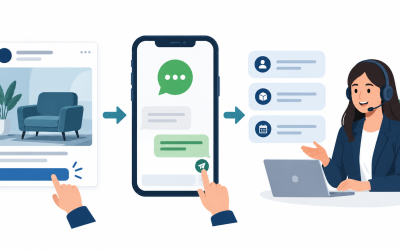
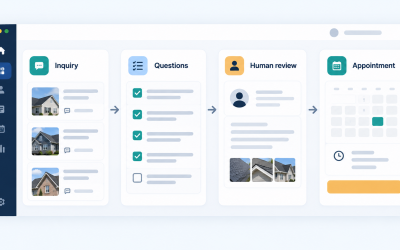
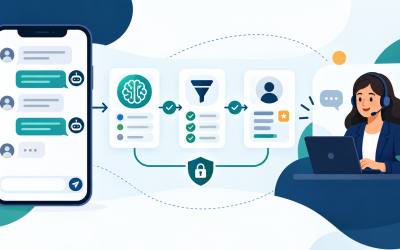
Hybrid works because it separates the conversation into two jobs. The first job is speed: greet, route, answer basics, collect details, and qualify intent. The second job is judgment: reassure, troubleshoot, negotiate, make exceptions, or close. Bots are excellent at the first job. Humans are still better at the second.
The strongest hybrid setups I have seen are not complicated. They usually follow a simple pattern:
- The visitor lands on the site or opens Messenger and gets an instant bot greeting with a few high-intent options.
- The bot answers common questions, captures order numbers or contact details, and tags the conversation by intent.
- If the issue stays inside the approved lane, the bot finishes it.
- If the issue is valuable, complex, or clearly emotional, the conversation moves to live chat with context attached.
- The human sees the history, avoids asking the same questions again, and picks up at the useful part of the conversation.
This is also where a lot of the real conversion lift shows up. The best revenue outcomes usually come from instant qualification plus timely human follow-up, not from a bot or an agent working in isolation.
| Source | Reported result | What it suggests |
|---|---|---|
| LiveChat / Auto Accessories Garage case study | 485% conversion boost for chat users, plus nearly 400% higher per-session value | Real-time human help can dramatically lift conversions on high-consideration ecommerce pages |
| Tidio / Pearl Lemon case study | 30% increase in website-to-lead conversions and 70+ additional monthly leads | Bot-led qualification can recover demand that would otherwise leave silently |
| Tidio / Pastreez case study | 70% conversion rate on customer inquiries through chat | Fast chat responses can turn high-intent product questions into orders |
Those are vendor case studies, not universal averages, so do not treat them like guaranteed lift. But they do make one thing hard to deny: chat works best when speed and human follow-through meet at the same moment. A bot captures and routes. A person closes or calms. That is the model most businesses should actually build.
When Chatbot-Only or Live-Chat-Only Is the Right Call
There are still situations where a pure approach makes sense. You do not need to force hybrid if your business model clearly leans one direction.
Use Chatbot Only When the Work Is Mostly Repetitive and Transactional
- More than half your inbound questions are the same 10 to 20 questions every week.
- Your customers mainly want hours, pricing ranges, order status, booking links, shipping rules, or simple qualification.
- After-hours coverage matters more than real-time human reassurance.
- You can handle exceptions through callbacks, email follow-up, or next-business-day review.
- Your margin does not support keeping live agents on chat all day.
This is common in local services, booking-driven businesses, lean ecommerce teams, and Messenger-heavy businesses that mostly need fast routing plus one clean human backup path.
Use Live Chat Only When Trust and Nuance Are the Product
- Your average sale is high enough that even a few extra conversions justify staffing.
- Most conversations require clarification, diagnosis, or consultative advice.
- You work in a regulated or trust-sensitive category such as legal, financial, healthcare-adjacent, or complex B2B service.
- Your monthly volume is still low enough that staffing chat is cheaper than designing and maintaining automation.
- Your brand position depends on white-glove service more than speed at scale.
If you read both lists and feel like your business belongs in both, that is your answer. You probably need the hybrid model.
If you are still shopping broadly rather than deciding between channels, this roundup of the meilleur chatbot pour les petites entreprises is the right next read. It is useful when you need to compare software categories, not just pick the service model.
Best Chatbot and Live Chat Platforms Worth Shortlisting
There is no universal winner here because the front door matters. A Messenger-first business should not shop the same stack as a website-first SaaS company. Still, these are the tools I would put on a practical shortlist based on current public pricing and fit.
| Approche | Plateforme | Public starting price checked April 10, 2026 | Meilleur ajustement | Main watch-out |
|---|---|---|---|---|
| Chatbot en premier | MessengerBot.app | Premium $19.99 per 30 days; Pro $49.99 per 30 days | Facebook Messenger-first businesses that also want flows, forms, broadcasts, website chat, and clean handoff logic | Less ideal if your main buying journey happens on website live chat rather than inside Meta channels |
| Chatbot en premier | Tidio | Free plan; Starter $24.17 per month; Growth from $49.17 per month | Website-first teams that want live chat, ticketing, and AI in one place | Useful AI capability often means stacking plan cost with AI quota cost |
| Chat en direct en premier | LiveChat | Starter from $19 per month; Team from $49 per seat per month; ChatBot add-on from $52 per month | Teams that need dedicated real-time website chat and proactive sales conversations | Software is affordable, but labor becomes the real bill very quickly |
| Chat en direct en premier | Freshchat | Free for up to 10 agents; Growth $19 per agent per month billed annually | Budget-conscious omnichannel teams that want to start free and add live support depth later | AI and advanced routing economics need to be modeled separately as volume grows |
| Hybrid | HubSpot Customer Agent | Free live chat tools; Customer Agent outcome pricing moving to $0.50 per resolved conversation from April 14, 2026 | CRM-centered teams that want bot, handoff, and customer history in one system | Best value shows up when you already operate inside HubSpot, not when you buy it only for chat |
| Hybrid / enterprise | Intercom | Essential from $29 per seat per month; Fin AI Agent at $0.99 per resolved outcome | Mature support teams that want strong AI resolution plus agent workflow depth | Outcome pricing is transparent, but it gets expensive fast at scale |
The honest recommendation depends on the channel that already matters to you. If Facebook Messenger is one of your real sales or support surfaces, MessengerBot is the easiest place to start because the workflow is already aligned to how Messenger businesses actually operate. If your website is the main front door, Tidio, LiveChat, or HubSpot usually make more sense. If you need a true support-ops platform with AI deeply embedded, Intercom is stronger than most SMB tools, but it is priced like it knows that.
Also pay attention to which products are genuinely free and which are only free to test. HubSpot and Freshchat both give you real free starting points. Tidio has a free plan too. None of the serious business-grade options here are “no sign up required,” and that is fine. You want configuration, saved context, and reporting in production.
If Messenger Is One of Your Core Channels, Start With a Hybrid Build
For most businesses on Messenger, the smartest first build is not a giant AI project. It is one welcome flow, one FAQ layer, one lead or support form, and one clear human handoff path. That is enough to test whether automation is reducing response time, improving lead capture, and lowering repetitive work without boxing customers into a bad experience. If you want to compare the current MessengerBot tiers before you map that out, Voir les tarifs de MessengerBot. Start with the smallest setup that gives you bot coverage plus a human escape hatch. That is usually where the ROI becomes obvious.
Questions fréquemment posées
Un chatbot est-il meilleur qu'un chat en direct pour les petites entreprises ?
En général, pour le coût et la couverture, oui. Un chatbot est préférable lorsque la plupart de vos messages entrants sont répétitifs, que les messages en dehors des heures de travail comptent et que vous avez besoin d'une réponse instantanée sans avoir à constituer une équipe toute la journée. Le chat en direct est meilleur lorsque vos conversations de vente ou de support sont suffisamment nuancées pour qu'un humain apporte une valeur évidente. Pour la plupart des petites entreprises, la meilleure réponse est hybride : bot en premier, humain si nécessaire.
Les clients préfèrent-ils les chatbots ou les agents humains ?
Les clients préfèrent généralement les chatbots pour des tâches rapides et simples et les agents humains pour des problèmes complexes ou émotionnels. Des recherches récentes sur les consommateurs menées par Pega montrent une préférence humaine claire dans l'ensemble, mais les références de support montrent également que des bots bien implémentés peuvent égaler ou légèrement surpasser le CSAT humain lors de conversations routinières. Les clients ne détestent pas les bots. Ils détestent être piégés à l'intérieur.
Un chatbot peut-il remplacer une équipe de chat en direct ?
Un chatbot peut remplacer une part significative du travail répétitif de chat en direct, mais pas toute l'équipe dans la plupart des entreprises. Il peut gérer très bien les questions fréquentes, le statut des commandes, les réservations, la capture de prospects et le routage de base. Il ne devrait pas être la seule couche pour les plaintes, les litiges de facturation, le dépannage compliqué ou les ventes consultatives à forte valeur.
Quelle est la différence de coût entre un chatbot et un chat en direct ?
L'écart logiciel est petit. L'écart de main-d'œuvre est énorme. Dans le modèle de 12 mois de cet article, une configuration axée sur le chatbot a atteint environ $3,070, une configuration hybride environ $24,383, et un modèle uniquement de chat en direct environ $66,054. Les totaux exacts dépendent de votre volume et de vos salaires, mais la main-d'œuvre est presque toujours le coût dominant dans le chat en direct.
Devrais-je utiliser à la fois un chatbot et un chat en direct sur mon site web ?
Oui, si vous avez suffisamment de volume pour le justifier et suffisamment de complexité pour qu'un bot ne gère pas chaque conversation. La configuration la plus efficace est généralement un chatbot associé à un chat en direct : le bot répond instantanément, qualifie le problème, collecte le contexte et transmet les cas difficiles ou précieux à un humain. Cette combinaison vous offre une meilleure rapidité, une meilleure couverture et un meilleur contrôle des coûts que l'utilisation de l'un ou l'autre outil seul.
 Français
  English
  Tagalog
  简体中文
简体中文  العربية
  हिन्दी
  Português do Brasil
  Español de México
  বাংলা
বাংলা  香港中文
香港中文  繁體中文
繁體中文  Nederlands
  Deutsch
  Bahasa Indonesia
  日本語
日本語  한국어
한국어  Polski
  Русский
  Español
  Tiếng Việt